


This article addresses the skills gap in supply chain management (SCM) education, particularly in emerging markets, where traditional curricula lack the technical expertise required for blockchain technology. The study identifies key challenges hindering blockchain adoption in SCM curricula and proposes an empirically grounded, interdisciplinary, modular training framework suitable for non-technical learners.
A qualitative exploratory design within an interpretivist paradigm was adopted. Data included a review of South African SCM curriculum documents, consultations with external stakeholders and learning artefacts from lecturers and students involved in blockchain-integrated teaching. Data were thematically coded in ATLAS.ti and triangulated across sources. The framework was developed iteratively and examined through comparative cross-case analysis and a South African classroom pilot.
The study identified interrelated constraints: limited curricular coverage of blockchain concepts and laboratory exposure; uneven faculty readiness and institutional resource limitations; and learner heterogeneity that increases cognitive load for non-technical cohorts. These findings informed a three-tier modular framework comprising foundational literacy; applied simulations and platform familiarisation; and industry-linked capstone projects. Cross-case comparison and classroom pilot evidence indicate that staged, use-case-driven learning supports progression from conceptual understanding to applied competence within resource-constrained contexts.
This study is exploratory in nature and based on a single institutional case. Further empirical testing and comparative studies across institutions and geographies are recommended to validate the framework’s generalisability and long-term impact.
The framework provides a roadmap for integrating blockchain into non-technical programmes, enabling universities, government and industry to co-develop scalable skills development interventions. It supports employability, innovation and national digital transformation agendas.
This study contributes to social inclusion by proposing an accessible, non-technical pathway for integrating blockchain education into SCM programmes. By lowering technical entry barriers, the framework supports skills development for diverse learner groups, including students from non-IT backgrounds and working professionals engaged in upskilling and reskilling. In the South African and broader African context, this approach has the potential to enhance graduate employability, reduce digital skills inequalities and support youth participation in digitally enabled supply chains. The framework also aligns higher education curricula with inclusive Fourth Industrial Revolution agendas and workforce transformation goals.
The article contributes a stakeholder-centred, practice-informed approach to curriculum innovation in SCM education. It integrates Technology–Organisation–Environment, stakeholder theory and learning theory to explain adoption feasibility and pedagogical progression and offers a scalable framework and implementation roadmap for resource-constrained institutions seeking to align SCM education with digital transformation and employability demands.
1. Introduction
1.1 Background: the digital shift in supply chain management
Supply chain management (SCM) is rapidly undergoing a digital transformation, moving from an administrative activity to a complex task that requires integrating logistics activities within and across companies. Since the late 1990s, SCM has been integrated with the development of information systems. Through these systems, information technologies and information have simultaneously been shared with all supply-chain members, making SCM activities more transparent and reliable (Özkanlısoy and Akkartal, 2021). Emerging technologies, such as blockchain, are now key enablers of transparency, security and operational efficiency across logistics and SCM processes and practices (Rauniyar et al., 2023; Alazab et al., 2021). According to Abney et al. (2020), industries are strategically adopting blockchain to optimise business processes and increase competitive advantage, making it a sought-after technology in the job market.
Despite the growing potential of this technology, the SCM education system lacks structured blockchain education, especially in sub-Saharan Africa, where curriculum development often lags technological advancement. This suggests that, as the blockchain job market in SCM industries grows, graduates in this region are likely to be left behind. At the same time, the widespread adoption of blockchain in SCM faces a critical skills shortage owing to its limited inclusion in educational institutions. This is because, despite growing industry demand for blockchain-literate graduates, educational institutions have been slow to provide relevant training (Hidayanto and Prabowo, 2019).
1.2 Aim and structure of the paper
This study presents a structured response to the blockchain skills gap in SCM education. It aims first to identify the key structural, pedagogical and institutional barriers to integrating blockchain into logistics and SCM curricula. The second aim is to provide an interdisciplinary, modular training framework tailored to non-technical SCM students. Third, it aims to examine how blockchain education has been implemented in practice by drawing analytical insights from selected case studies in emerging economies. Finally, it aims to present a practical implementation roadmap for higher education institutions that seek to align supply-chain education with evolving digital and industry demands.
The remainder of the article is structured as follows. This section provides the rationale for the study by identifying gaps in current SCM education and a case for interdisciplinary blockchain education. Section 2 reviews current SCM education’s knowledge gaps regarding blockchain and examines barriers to its adoption through relevant theoretical lenses. Section 3 outlines the methodology underpinning the study. Section 4 presents a proposed three-tier modular blockchain training framework. Section 5 analyses selected international case studies using a comparative approach. Section 6 discusses implementation considerations and institutional implications. Section 7 concludes the article by summarising key contributions and identifying directions for future research.
1.3 Gaps in current supply-chain education and the case for interdisciplinary blockchain training
SCM education has increasingly been investigated for its ability to meet evolving industry demands (Fawcett and Rutner, 2014). SCM programmes in emerging economies remain focused on traditional operations, with limited integration of digital technologies such as blockchain (Okangba et al., 2022). At the same time, scholars note a misalignment between curricular focus and industry expectations. While some programmes overemphasise technical or operational competencies (Luke and Heyns, 2019), employers increasingly prioritise strategic, analytical and change-management capabilities (Jordan and Bak, 2016; Mapanga, 2024). This dual gap – insufficient digital literacy alongside underdeveloped higher-order skills – suggests that existing curricula are inadequately preparing graduates for technologically enabled and strategically complex supply-chain environments.
This misalignment is further compounded by structural limitations within higher education. SCM programmes are often located within social science faculties, where curricular emphasis is placed on managerial and qualitative competencies rather than technological proficiency. Consequently, critical blockchain-related competencies – such as distributed ledger systems, smart contracts and decentralised applications – are either absent or introduced only at a conceptual level, limiting students’ ability to engage with real-world applications.
Addressing these gaps requires a shift towards interdisciplinary and practice-oriented approaches to SCM education. Interdisciplinary blockchain training offers a pathway to integrate technological literacy with domain-specific knowledge without requiring advanced programming expertise. Such approaches enable students to engage with blockchain through applied-use cases, simulations and problem-based learning, in this way reducing cognitive barriers for non-technical learners while increasing practical competence (Zhao et al., 2023).
From a theoretical perspective, the Technology–Organisation–Environment (TOE) framework provides a useful lens for understanding the feasibility of integrating blockchain into SCM curricula, as adoption is shaped not only by technological capabilities but also by institutional readiness and external industry pressures. In parallel, learning theory supports a staged approach to knowledge development, where students progress from foundational understanding to applied problem-solving through experiential learning (Kolb, 1984).
Accordingly, this study proposes an interdisciplinary, modular blockchain training framework that responds directly to the identified curricular and skills gaps. By embedding blockchain within SCM education through structured, non-technical pathways, the framework aims to align academic programmes with digital-transformation imperatives and increase graduate readiness for emerging supply-chain environments.
2. The need for interdisciplinary blockchain training
2.1 Supply-chain education gaps in blockchain knowledge
Traditional SCM education prioritises managerial, logistical and operational competencies, with limited integration of the technological foundations required in the Fourth Industrial Revolution (4IR) (Jabbar et al., 2021; Paliwal et al., 2020). In many emerging economies, SCM programmes are situated within social science faculties, which emphasise qualitative and managerial capabilities over digital and technical literacy (Okangba et al., 2022). As a result, graduates often lack exposure to key blockchain concepts necessary for participation in digitally enabled supply-chain ecosystems.
Core blockchain competencies, including distributed ledger technology, cryptographic security, smart contracts and decentralised applications, are either absent or introduced only at a conceptual level within existing curricula (Zhao et al., 2023; Casino et al., 2019). This limits students’ ability to evaluate, design or implement blockchain-based solutions in real-world supply-chain contexts. Furthermore, where blockchain is included, it is often taught in isolation or as a theoretical add-on, rather than being integrated into SCM-specific applications such as traceability, transaction verification and supply-network coordination (Pandey and Sen, 2022).
The absence of interdisciplinary integration further constrains learning. SCM students are rarely exposed to the intersection of blockchain, data analytics, enterprise systems and supply-chain optimisation, which reduces their ability to apply technological solutions within their domain (Benson et al., 2020). Consequently, graduates remain underprepared for blockchain-enabled environments, reinforcing the broader skills gap between academic training and industry requirements (Treiblmaier, 2018).
Addressing this gap requires a shift from conceptual exposure to applied, interdisciplinary learning approaches that embed blockchain within SCM contexts. These approaches include introducing scaffolded learning pathways, practical simulations and use-case-driven instruction that enable non-technical learners to engage meaningfully with blockchain technologies without requiring advanced programming expertise (Zhao et al., 2023).
2.2 Barriers to blockchain adoption in supply chain management
Despite blockchain’s recognised potential for increasing transparency, traceability and efficiency in SCM, its adoption within higher education remains limited (Saberi et al., 2019; Sauer et al., 2024). This slow uptake is driven by a combination of structural, institutional and environmental barriers that constrain the integration of blockchain into SCM curricula. A key challenge is the lack of interdisciplinary integration across business, logistics and technology domains. In many institutions, blockchain is treated as a specialised topic within computer science or finance, limiting its accessibility to SCM students and reducing opportunities for applied, discipline-specific learning (Okangba et al., 2022; Benson et al., 2020). This fragmentation restricts students’ ability to engage with blockchain in meaningful supply-chain contexts.
Institutional capacity constraints further hinder adoption. Many SCM educators lack the technical expertise required to teach blockchain applications beyond a conceptual level, resulting in superficial coverage that does not translate into practical competence (Jabbar et al., 2021). In addition, the implementation of blockchain laboratories and training environments is often associated with high costs and resource requirements, making it difficult for universities, particularly in emerging economies, to invest in the necessary infrastructure (Treiblmaier, 2018; Mangla, 2024).
External factors also play an important role. In some industries, scepticism regarding scalability, regulatory uncertainty and unclear return on investment limits demand for blockchain-trained graduates, which in turn reduces institutional incentives to integrate blockchain into curricula (Saberi et al., 2019; Pandey and Sen, 2022). These environmental constraints highlight the importance of aligning educational innovation with industry readiness and policy support.
Collectively, these barriers suggest the need for structured, interdisciplinary and resource-sensitive approaches to blockchain education. Addressing these challenges requires scalable models that integrate technological feasibility, institutional readiness and stakeholder alignment, as conceptualised in the TOE framework.
2.3 Theoretical foundations underpinning the conceptual framework
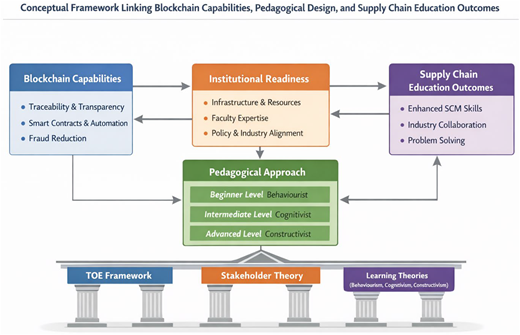
The conceptual framework used as the basis for this study, presented in Figure 1, is grounded in established theories of technology adoption and learning. Specifically, the framework integrates the TOE framework, stakeholder theory and learning theory perspectives (behaviourist, cognitivist and constructivist) to explain how blockchain capabilities can be embedded within SCM education for non-technical learners.
From a technology-adoption perspective, the TOE framework provides a useful lens for understanding how blockchain integration into supply-chain curricula is shaped by technological characteristics (e.g. traceability, immutability, smart contracts); organisational conditions (e.g. faculty expertise, curriculum structure, institutional readiness) and environmental factors (e.g. industry demand, regulatory context, policy alignment). Within this framework, blockchain capabilities are theorised to influence supply-chain learning outcomes by enabling greater transparency, reducing fraud and automating processes – outcomes that mirror those observed in blockchain-enabled supply-chain practice.
Stakeholder theory further underpins the framework by recognising that curriculum innovation in higher education is not driven solely by institutions but emerges from the interactions between multiple stakeholders, including industry partners, policymakers, educators and learners. This suggests that the relationships depicted in the framework reflect the need for alignment among stakeholder expectations, curriculum design and graduate skill requirements to ensure the sustainable adoption of blockchain education within supply-chain programmes.
At the pedagogical level, learning theory provides the rationale for the framework’s tiered structure. Behaviourist principles inform the introductory stage of the framework by supporting concept familiarisation through structured reinforcement and guided exposure. Cognitivist theory explains the intermediate stage, where learners progressively develop mental models of blockchain systems through scaffolded problem-solving and applied exercises. Constructivist theory underpins the advanced stage, in which learners actively construct knowledge through industry-based projects, simulations and experiential learning. Together, these learning theories explain how non-technical students can transition from conceptual understanding to applied competence within a blockchain-enabled supply-chain context.
In Figure 1, the arrows within the framework represent theoretically grounded relationships rather than assumed associations. Blockchain capabilities are expected to influence supply-chain learning outcomes through their interactions with institutional readiness, stakeholder engagement and pedagogical design, as explained by the integrated theoretical lenses.
Figure 1 illustrates the theoretically informed relationships between blockchain technological capabilities (e.g. traceability, smart contracts, fraud reduction), SCM contexts and educational outcomes. The framework, grounded in the TOE framework, stakeholder theory and learning theory, highlights how institutional readiness, pedagogical approach and stakeholder alignment mediate the integration of blockchain into non-technical supply-chain curricula.
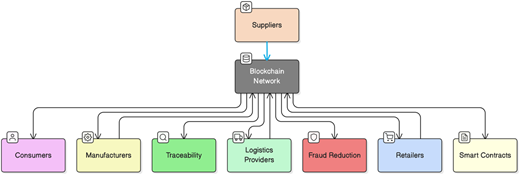
Integrating blockchain into SCM requires aligning core supply-chain elements with key blockchain functionalities. Figure 1 shows consumers, manufacturers, logistics providers and retailers as the elements of SCM within the supplier’s network. It also shows traceability, fraud reduction and smart contracts as elements associated with blockchain within the supplier’s network. The figure demonstrates the importance of the supply network in relation to SCM and blockchain technology. When students are given cases similar to those shown in Figure 1, they can easily integrate blockchain knowledge into SCM studies, to understand both fields and, most importantly, develop innovative solutions for them.
3. Methodology
The study adopted a qualitative, exploratory approach grounded in an interpretivist paradigm to examine the integration of blockchain into SCM education.
Data were collected from three sources: a review of 32 curriculum documents from logistics and supply-chain programmes across public and private universities in South Africa; stakeholder input from 11 academic and industry experts engaged during student showcase events; and learning artefacts from 7 lecturers and 123 students involved in blockchain-integrated teaching.
Data were thematically analysed using ATLAS.ti, with findings triangulated across curriculum documents, stakeholder input and student artefacts to increase analytical robustness.
4. A modular framework for blockchain training in supply-chain education
To integrate blockchain effectively into supply-chain programmes, we propose a three-tiered learning framework, as set out in Figure 2 below.
Three-tiered modular framework for integrating blockchain into non-technical supply-chain curricula. Source: Authors’ own work
Three-tiered modular framework for integrating blockchain into non-technical supply-chain curricula. Source: Authors’ own work
Figure 2 presents a three-tier modular learning pathway designed for non-technical SCM learners that progresses from conceptual literacy to applied competence and finally to solution development. The sequencing is informed by learning theory and by the logic of technology adoption. At the beginner level, behaviourist perspectives support structured introduction of blockchain concepts through guided reinforcement, foundational terminology and low-risk learning activities that reduce cognitive overload for novice learners (Ulum and Fauzi, 2023). The intermediate level is informed by cognitivist learning, where students progressively develop understanding through engagement with use cases, simulations and platform exposure, allowing them to connect blockchain concepts to real SCM problems and decision contexts (Bada and Olusegun, 2015; Kolb, 1984). The advanced level is grounded in constructivist learning, emphasising experiential and problem-based learning through capstone projects, enabling students to integrate SCM knowledge with blockchain tools to develop implementable solutions and demonstrate competence in authentic contexts (Kolb, 1984).
In parallel, the framework aligns with the TOE model by acknowledging that successful curriculum adoption depends not only on technological feasibility (availability of tools such as Ethereum and Hyperledger), but also on institutional readiness (faculty capacity, resources, curriculum flexibility) and environmental pressures (industry demand, regulatory conditions, employability expectations), Although these dimensions are not explicitly labelled in Figure 2, they are conceptually embedded in the design of the framework as discussed by Tornatzky and Fleischer (1990).
Stakeholder theory further supports the progression towards industry-linked capstone projects by positioning industry, policymakers and universities as co-producers of relevant skills and curriculum legitimacy, strengthening the likelihood of uptake and sustained implementation in SCM programmes (Erjavec, 2021).
4.1 Beginner level: introduction to blockchain (no coding required)
The beginner level focuses on developing foundational blockchain literacy within SCM contexts without requiring programming skills. Rather than treating blockchain as a standalone subject, core concepts are embedded across existing SCM modules such as procurement, logistics and distribution. This approach enables students to understand blockchain in relation to their disciplinary context (Okangba et al., 2022).
At this level, students are introduced to key concepts, including decentralisation, consensus mechanisms and the distinction between public and private blockchains, using platforms such as Ethereum and Hyperledger Fabric. Learning is supported through lectures, guided tutorials and introductory simulations, with assessments focused on conceptual understanding through quizzes and case-based analysis.
The design of this level is informed by foundational learning principles that support structured knowledge acquisition and reduce cognitive overload for non-technical learners (Ulum and Fauzi, 2023). By grounding blockchain concepts in familiar SCM applications, such as traceability and transaction verification, students develop the conceptual foundation necessary to engage with more advanced, practice-oriented learning in subsequent stages.
4.2 Intermediate level: smart contracts and blockchain use cases (hands-on learning)
The intermediate level shifts from conceptual understanding to applied learning, enabling students to engage with blockchain through practical SCM use cases. At this stage, students are introduced to smart contracts and their role in automating supply-chain processes such as transaction verification, inventory tracking and supplier coordination (Sangari and Mashatan, 2022).
Learning is structured around hands-on activities, including guided simulations and platform-based exercises using environments such as Ethereum and Hyperledger Fabric. These activities allow students to interact with blockchain systems in controlled settings, strengthening their ability to connect theoretical concepts with real-world supply-chain applications (Betti et al., 2020).
Case-based learning is used to illustrate how blockchain is applied in global supply chains, including use cases related to traceability, transparency and process automation. This experiential approach supports knowledge construction and application, enabling non-technical learners to develop practical competence without requiring advanced programming expertise (Bada and Olusegun, 2015). By emphasising applied learning and contextual relevance, this level serves as a critical bridge between foundational knowledge and the development of advanced-stage industry-oriented blockchain solutions.
4.3 Advanced level: industry projects and blockchain-enabled supply chain management solutions
The advanced level focuses on the application of blockchain within real-world supply-chain contexts and requires students to synthesise disciplinary knowledge with technological capabilities to develop solution-oriented outcomes. At this stage, learning is driven by problem-based and experiential approaches, where students identify operational challenges and design blockchain-enabled solutions aligned with industry needs (Kolb, 1984; Queiroz et al., 2020).
A key feature of this level is the integration of industry-linked projects and capstone activities. Students engage in collaborative assignments, hackathons and applied case studies that simulate real supply-chain environments, enabling them to develop practical and contextually relevant solutions. These activities support higher-order thinking, innovation and the development of entrepreneurial competencies within SCM.
The Big Five student startup, described in 4.5, provides an illustrative example of this approach. In this case, students developed a blockchain-based solution to address inefficiencies in the automotive spare-parts supply chain by increasing transparency, coordination and accessibility. Importantly, this was achieved without prior technical expertise, demonstrating the effectiveness of staged, interdisciplinary learning in enabling non-technical learners to produce viable digital solutions.
By integrating experiential learning with industry engagement, this level supports the transition from applied competence to innovation, preparing graduates to operate effectively within digitally transformed supply-chain environments.
4.4 Policy alignment and local relevance
The proposed learning-theory-informed framework, which progresses through behaviourist, cognitivist and constructivist principles, offers a structured approach to embedding emerging technologies such as blockchain. However, challenges persist, including resource constraints, digital divides and the need for comprehensive pedagogical transformation (Lubinga et al., 2023). Integrating 4IR technologies into higher education in South Africa is crucial for addressing industry demands and improving graduate employability (Olaitan et al., 2024). The proposed framework aligns with South Africa’s national drive towards 4IR-focused education and social impact, as emphasised by the Department of Higher Education and Training and the University of Johannesburg (UJ), whose strategic pillars include technology for the future, innovation and global excellence. Universities such as UJ are incorporating 4IR modules, which include artificial intelligence (AI) and blockchain, into their curricula to prepare students for future work (Adelowotan et al., 2025). The framework also supports BRICS’ education priorities focused on digital upskilling and collaborative innovation.
A framework that focuses on graduate digital-skills preparedness has been developed by Civilcharran and Maharaj (2018) to align higher education with industry requirements. This framework helps non-technical students in logistics and supply-chain programmes to learn about blockchain, which addresses industry needs, youth unemployment and the strong demand for graduates skilled in digital technology who can promote economic growth across the continent.
4.5 South African implementation: The Big Five startup case
In South Africa, UJ has already piloted this interdisciplinary blockchain training model with logistics students through the Big Five startup summarised above. This student-led initiative, founded by third-year students, developed a blockchain-based application that connects automotive spare-part retailers, mechanics and customers in real time. The application uses blockchain to ensure transparency in service offerings, pricing and location-based accessibility, which solves a critical supply-chain issue in underserved areas. Importantly, these students had no prior technical background, yet they successfully used smart contracts and blockchain tracking systems after completing the beginner and intermediate phases of the modular framework. Their success story illustrates the framework’s practical impact, scalability and potential for replication across BRICS + universities.
5. Case studies: blockchain education in emerging economies
To contextualise the proposed framework, cases from emerging economies have been selected to illustrate different approaches to integrating blockchain into education and their relevance to SCM programmes.
In India, blockchain adoption in education is driven by strong policy support and institutional implementation, particularly in credentialling and certification systems (Bhatia and Bhasin, 2023). These initiatives demonstrate how national strategy and regulatory alignment can facilitate large-scale integration of blockchain technologies within higher education.
Nigeria presents a policy-driven approach focused on digital economy inclusion and talent development. Although national frameworks support blockchain adoption, implementation is constrained by infrastructure limitations, digital literacy gaps and regulatory uncertainty (FMCDE, 2023; Lawal et al., 2023). This highlights the importance of aligning educational innovation with institutional capacity and socio-economic context.
In contrast, Brazil illustrates an industry-led model of blockchain education, where training programmes emphasise practical skills development through simulations and gamified learning approaches (Palma et al., 2019; Soliani et al., 2024). These approaches demonstrate the effectiveness of experiential learning in enabling non-technical students to engage with blockchain concepts in applied contexts.
The South African case, represented by the Big Five student startup, provides evidence of how interdisciplinary blockchain training can be implemented within SCM programmes. Through a staged learning approach, students progressed from conceptual understanding to applied problem-solving, ultimately developing a blockchain-enabled solution without prior technical expertise. This case demonstrates the feasibility and scalability of integrating blockchain into non-technical supply-chain curricula.
A comparative summary of these blockchain education approaches across emerging economies is presented in Table 1.
Cross-case comparison of blockchain education approaches in emerging economies
| Dimension | India | Nigeria | Brazil | Lessons for South Africa/SCM programmes |
|---|---|---|---|---|
| Policy support | Strong national strategy and institutional adoption | National policy exists, but implementation barriers persist | Industry-led training and certification models | Policy accelerates adoption, but institutional readiness determines implementation |
| Main education focus | Credentialling and institutional automation | Digital economy inclusion and talent development | Skills training through gamification and industry alignment | SCM programmes should combine skills development with applied projects |
| Delivery model | Government-supported formal programmes | Policy-driven but uneven capacity | Industry-led academy and gamified learning | Modular delivery supports scalability across unequal contexts |
| Practical learning design | Usefulness and adoption-oriented design | Limited by infrastructure and digital divide | Simulations (e.g. Beer Game) | Simulation reduces cognitive load for non-technical learners |
| Industry involvement | Moderate to strong | Emerging policy encourages collaboration | Strong industry pull | Industry partnerships strengthen employability and sustainability |
| Key barriers | Governance, privacy and scale | Infrastructure, low digital literacy and regulatory uncertainty | Scaling and institutional integration | Capacity building and affordable laboratories are essential |
| Implications for the framework | Supports TOE readiness logic | Confirms equity and environmental constraints | Supports constructivist hands-on learning | Confirms staged progression with context-sensitive implementation |
As shown in Table 1, the effectiveness of blockchain education initiatives depends on the alignment between policy support, institutional readiness and practical learning design.
5.1 Cross-case findings and lessons learnt
The cross-case comparison indicates that blockchain education initiatives become effective when three enabling conditions align. First, policy support and institutional commitment strengthen the legitimacy and scalability of adoption, as demonstrated by India’s structured certification and credentialling initiatives. Second, where infrastructure constraints and uneven digital literacy persist, as in Nigeria, implementation remains inconsistent despite strong policy intent, underscoring the importance of organisational readiness and inclusive design. Third, Brazil illustrates that industry-led and gamified approaches can translate blockchain concepts into accessible, practice-oriented learning for non-technical cohorts. Collectively, these cases support the proposed modular framework by confirming that conceptual foundations must be followed by applied simulations and discipline-specific use-case engagement, while advanced outcomes require stakeholder partnerships and contextual feasibility. For South African SCM programmes, the key lesson is that blockchain curriculum integration should be phased, practice-based and co-designed with stakeholders to ensure relevance, scalability and impact on employability.
5.2 Cross-case findings: evidence-based testing of the modular framework
The comparative case analysis provides evidence that supports the logic and sequencing of the proposed three-tier modular framework (Figure 2). Across the cases, foundational exposure to blockchain concepts is necessary before meaningful applied learning can occur, confirming the relevance of the beginner level as an entry point for non-technical learners. In particular, the cases indicate that early-stage learning is most effective when it reduces cognitive load through structured scaffolding and clear conceptual framing, rather than premature emphasis on technical depth. This supports the framework’s progression from conceptual understanding to applied engagement.
The intermediate level is supported by evidence that practical simulations, platform engagement and real-world use cases strengthen learner comprehension and relevance. Brazil’s skills-oriented and gamified approaches demonstrate that non-technical learners can develop confidence and competence when blockchain is taught through experiential activities that mirror supply-chain dynamics. This confirms that applied learning tools serve as a bridge between theoretical literacy and implementation readiness.
At the advanced level, the cases show that sustainable impact depends on stakeholder alignment and enabling institutional conditions. India’s institutional and policy-supported initiatives illustrate that scaling blockchain education requires organisational readiness, governance mechanisms and integration into formal systems. Nigeria’s experience demonstrates that even when policy intent exists, implementation may remain uneven when infrastructure constraints, digital divides and regulatory uncertainty persist. These findings reinforce the TOE logic embedded in the framework and demonstrate that advanced capstone outcomes require more than pedagogy; they require institutional capacity and multi-stakeholder collaboration. Overall, the results validate the framework’s staged approach while highlighting that contextual feasibility and institutional readiness determine whether programmes progress beyond awareness towards applied capability and innovation outcomes.
6. Implementation roadmap for universities
The implementation of the proposed interdisciplinary blockchain framework requires a phased and collaborative approach. First, institutions should conduct a needs assessment and engage key stakeholders, including industry partners, policymakers and technology providers, to align curriculum development with emerging supply-chain requirements.
Second, curriculum integration should focus on embedding modular blockchain content within existing SCM programmes or introducing it through short learning programmes. This process must be supported by targeted faculty development to improve interdisciplinary teaching capacity and ensure effective delivery.
Finally, institutions should prioritise industry engagement through applied-learning initiatives such as internships, hackathons and capstone projects. These activities provide students with practical exposure to blockchain applications while strengthening employability and innovation outcomes.
7. Conclusion
This study addressed the misalignment between SCM education and the digital competencies required in contemporary supply-chain environments. By identifying key structural, institutional and pedagogical barriers, the study developed an interdisciplinary, modular framework to integrate blockchain training into SCM curricula for non-technical learners.
The findings demonstrate that a staged, practice-oriented approach enables students to progress from conceptual understanding to applied competence, even in resource-constrained contexts. The proposed framework contributes both theoretically, through the integration of TOE, stakeholder and learning theories, and practically, through a scalable model aligned with industry needs.
Future research could examine the long-term impact of such frameworks on graduate employability and explore integration with complementary technologies such as AI and the Internet of things.
Ethics statement
We did not conduct any formal data-collection process that required clearance. The student reflections used were secondary data, meaning they were not created specifically for this study but were part of the students’ class assessments.

