Although organizational resilience is widely acknowledged as a critical determinant of firm performance, limited research has examined its antecedents in hotels operating under institutional pressures and adopting advanced technological capabilities. Grounded in institutional theory and the dynamic capabilities view (DCV), this study proposes an integrated framework that explores how AI capabilities, cognitive analytic capabilities, and dynamic capabilities enhance organizational resilience and subsequent performance and how institutional pressures moderate these relationships.
Using survey data from 400 hotel managers in the United Arab Emirates, analyzed through partial least squares structural equation modeling, the findings reveal that these capabilities significantly strengthen hotel resilience and performance, with institutional pressures amplifying these effect.
The study contributes to hospitality scholarship by empirically demonstrating how technological and strategic capabilities interact under institutional pressure.
This study underscores the managerial importance of aligning digital transformation with cognitive readiness to foster strategic agility and long-term competitiveness.
1. Introduction
Organizational resilience has emerged as a critical capability enabling firms to absorb shocks, adapt to disruptions, and maintain operational continuity, particularly in high-risk, service-intensive sectors such as hospitality (Ghazi et al., 2024). In the hotel industry, it is multidimensional, encompassing technological integration, human capital development, organizational agility, strategic planning, and environmental responsiveness, which collectively allow hotels to sustain operations and service quality amidst uncertainty and turbulence (Prayag et al., 2024).
Few studies have examined how hotels' strategic and technological capabilities—artificial intelligence (AI) capabilities, cognitive analytic capabilities, and dynamic capabilities shape resilience and performance outcomes (Demitr et al., 2025). Due to a limited understanding of their interrelationships and interactions with institutional pressures, they are typically studied in isolation across separate research streams. This study addresses this gap by examining their role in shaping organizational resilience in a hospitality market. AI capabilities enable automation, data-driven decision-making, and predictive insight, helping firms anticipate and respond to market uncertainty (Li et al., 2024). Cognitive analytic capabilities enhance managerial sensemaking and strategic judgment, translating insights into actions that mitigate risks and optimize resources (Majhi et al., 2023; Rialti et al., 2019). Dynamic capabilities support the integration, building, and reconfiguration of resources, strengthening organizational adaptability, learning, and competitiveness in volatile environments (Liu and Yang, 2021; Zollo and Winter, 2002).
Hotels operate within institutional environments that influence strategic behavior and capability deployment (Dang-Van et al., 2024). Institutional pressures—coercive, normative, and mimetic forces—affect the development and use of resilience capabilities through compliance, legitimacy, and alignment with industry norms (DiMaggio and Powell, 1983). These pressures may enable or constrain technological and dynamic capabilities, influencing how hotels adapt to turbulence (Liu and Yang, 2021). This interplay between internal capabilities and external forces raises questions regarding how resilience is built and sustained in hospitality. Accordingly, this study addresses the following research questions:
To what extent do hotels' AI capabilities, cognitive analytic capabilities, and dynamic capabilities affect organizational resilience?
How do institutional pressures moderate the relationship between organizational resilience and performance in hotels?
To address these questions, this study proposes an integrated framework grounded in the Dynamic Capabilities View (DCV) (Teece et al., 1997) and institutional theory (DiMaggio and Powell, 1983). The framework posits that AI capabilities, cognitive analytic capabilities, and dynamic capabilities enhance hotel resilience and performance, while institutional pressures strengthen the relationship between resilience and performance. The model is empirically tested using Partial Least Squares Structural Equation Modeling (PLS-SEM) on survey data from 400 managerial-level employees in United Arab Emirates (UAE) hotels.
The hotel industry provides a relevant context for examining how organizational resilience influences performance under institutional pressures due to intense customer interaction and exposure to demand fluctuations. The UAE is selected for four key reasons: it is a leading global tourism and aviation hub with a developed hospitality sector and strong regulatory environment; tourism is a major driver of economic growth and GDP; the UAE hotel industry contributes nearly 13% to GDP (AED 267.5 billion), with international visitor spending projected to reach AED 228.5 billion in 2025, 37% above 2019 levels (World Travel and Tourism Council, 2025); its governance ensures stability during crises; and the UAE is a global leader in AI adoption supported by national tourism and hospitality strategies.
This study contributes to research on organizational resilience, dynamic capabilities, and digital transformation in hospitality. Grounded in institutional theory and DCV, it proposes and validates an integrated framework demonstrating how AI capabilities, cognitive analytic capabilities, and dynamic capabilities enhance organizational resilience and performance. By integrating these dimensions, the study explains how hotels utilize internal competencies to sense, seize, and reconfigure resources, strengthening adaptive capacity and recovery potential.
The findings underscore the moderating role of institutional pressures, highlighting how internal capabilities interact with external forces to support continuity, adaptation, and competitiveness. This demonstrates that institutional pressures not only constrain behavior but also facilitate capability deployment, strengthening hotels' response to disruptions while maintaining legitimacy. Additionally, the study establishes the interdependence among cognitive-analytic capabilities, dynamic capabilities, and AI adoption in fostering resilience. Collectively, these contributions advance hospitality research by illustrating how organizational capabilities, within institutional contexts, shape resilience in uncertain environments. The rest of the paper is organized as follows. The next section outlines the theoretical grounding, followed by the research model and hypotheses. The subsequent section presents the methodology, followed by a discussion of the results. Finally, conclusions and theoretical and managerial implications are presented, followed by a discussion of limitations and suggestions for future research.
2. Theoretical grounding
2.1 Dynamic capability view (DCV)
The DCV, introduced by Teece et al. (1997), explains how organizations sustain competitiveness by integrating, reconfiguring, and renewing resources. It extends the resource-based view (RBV) (Wernerfelt, 1984; Barney, 1991), which emphasizes valuable, rare, inimitable, and non-substitutable (VRIN) resources but overlooks how they are developed and adapted over time. The DCV addresses this gap by explaining how firms adjust resources in rapidly changing environments. Teece (2007) suggested that dynamic capability comprises three interrelated capabilities: sensing, seizing, and reconfiguring. Sensing identifies threats and opportunities, seizing mobilizes resources to exploit opportunities, and reconfiguring realigns assets and structures to maintain strategic fit in evolving environments (Teece, 2021).
In the hotel sector, dynamic capability refers to a hotel's ability to adapt and reconfigure operational capabilities to respond to changing market conditions and external uncertainty (Tajeddini et al., 2024, 2026). Liu and Yang (2021) emphasized that dynamic capabilities enable resource allocation and the reconfiguration of resources, facilitating organizational resilience in turbulent environments. More recently, Hossain et al. (2025) showed that dynamic capability enables hotels to adapt their practices in response to disruptions, thereby improving resilience. These capabilities empower hotels to develop employee competencies and leverage advanced technologies, strengthening their capacity to withstand and recover from disruptions (Teece, 2021).
2.2 Institutional theory
Institutional pressure is a central concept within the sociological stream of institutional theory proposed by DiMaggio and Powell (1983), comprising coercive, normative, and mimetic forces that influence organizational behaviour and conformity. Coercive pressures stem from regulatory and governmental requirements (Soares et al., 2020), including laws, compliance standards, and inspections that require hotels to comply (Scott, 2008). These pressures reflect state authority and regulatory control over organizational behavior (Hamzah et al., 2024; Scott, 2008).
Normative pressures are social expectations that promote conformity to professional norms, values, and standards. They arise through professional associations and inter-organizational interaction (DiMaggio and Powell, 1983), reflecting the normative pillar of values (what is appropriate) and norms (accepted practices) (Scott, 2008). Mimetic pressures describe organizations' tendency to emulate successful competitors under uncertainty to reduce risk, avoid first-mover disadvantages, and gain legitimacy (DiMaggio and Powell, 1983). In hotels, institutional pressures shape decision-making, resource allocation, and adaptation (Hamzah et al., 2024). Accordingly, hotels integrate capabilities, processes, and technologies to comply with regulations, adhere to norms, and emulate effective practices, thereby strengthening legitimacy and resilience (Soares et al., 2020). Recognizing these forces enables the alignment of organizational capabilities with institutional requirements, enhancing organizational resilience and performance.
2.3 Artificial intelligence (AI) in hotels
Technological turbulence, driven by rapid AI advancement under Industry 4.0, has transformed strategic processes in the hotel sector. AI adoption enables hotels to automate tasks, improve efficiency, personalize guest experiences, and support evidence-based decision-making using tools such as self-service kiosks, robotic agents, AI-powered forecasting, and smart guest interaction platforms (Nam et al., 2021; Yi et al., 2025). From a strategic management perspective, these applications build AI capability through organizational learning and knowledge integration, supporting competitive advantage, strategic renewal, and long-term value creation (Tan et al., 2025). However, resilience does not automatically translate into performance, as outcomes depend on complementary capabilities, organizational readiness, alignment, expertise, and processes (Kim et al., 2025). In the hotel industry, embedding AI into decision-making and aligning it with strategy is complex due to high costs, data quality and governance issues, workforce resistance, legacy system integration challenges, and skill requirements (Tan et al., 2025). These limitations show that AI improves performance only when aligned with organizational capabilities and integrated into broader strategic systems.
Within the DCV framework, AI enables dynamic and cognitive analytic capabilities, enhancing hotels' ability to sense market changes, seize emerging opportunities, and reconfigure resources effectively (Hossain et al., 2025). However, hospitality research has largely focused on AI's operational performance and customer-facing applications, with limited attention to its role in developing organizational capabilities and resilience (Almheiri et al., 2024). This highlights the need to examine how AI, together with dynamic and cognitive analytic capabilities, strengthens hotel resilience, providing both theoretical insights and managerial guidance to sustain long-term competitiveness.
3. Research model and hypotheses development
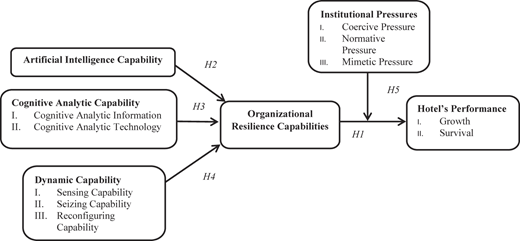
Drawing on the theoretical foundations of the DCV and institutional theory, this paper posits that a hotel's AI capabilities, cognitive analytic capabilities, and dynamic capabilities positively influence its resilience, which enhances hotel performance. Furthermore, it proposes that institutional pressures moderate this relationship. Pressures from regulatory bodies, industry associations, and stakeholder expectations can stimulate the development and deployment of resilience capabilities, amplifying their impact on performance. Under heightened institutional pressure, hotels are more likely to leverage resilience-oriented capabilities to respond to disruptions, maintain operational continuity, and enhance adaptive capacity. The conceptual framework presented in Figure 1 illustrates these relationships, further operationalized through empirically testable hypotheses in the following subsection.
3.1 Organizational resilience capabilities and performance of hotels
Organizational resilience capabilities enable hotels to anticipate, absorb, and adapt to disruptions in dynamic and uncertain environments (Li et al., 2024). Drawing on the DCV, these capabilities enhance sensing, seizing, and reconfiguring processes to respond to environmental and market changes (Teece, 2007). Integrating these capabilities into organizational processes fosters a proactive orientation, mitigates disruptions, and identifies strategic opportunities (Tajeddini et al., 2026).
As an integrated system, organizational resilience capabilities enhance agility, innovation, and recovery, enabling hotels to transform challenges into performance opportunities. This improves operational continuity, adaptability, competitiveness, and long-term sustainability. Based on these theoretical foundations, this study proposes the following hypothesis:
Organizational resilience capabilities positively influence the performance of hotels.
3.2 AI capabilities and organizational resilience capabilities
AI capabilities in the hotel sector function as strategic enablers of organizational transformation and resilience beyond their technological role (Yi et al., 2025). From a DCV perspective, AI capabilities strengthen the micro-foundations of organizations—such as individual skills, organizational routines, learning mechanisms, and cognitive processes—enhancing the ability to sense, seize, and reconfigure resources in response to environmental changes (Teece, 2007, 2021). Through these mechanisms, AI fosters dynamic learning, decision-making, and strategic agility, which underpin organizational resilience.
In practice, AI enables automation and optimization of hotel operations, from front-office services and housekeeping coordination to guest communication, thereby improving operational reliability, efficiency, and service consistency (Yi et al., 2025). Beyond automation, AI facilitates continuous organizational learning by leveraging machine learning algorithms to refine decision-making based on accumulated data, enhancing demand forecasting, personalized guest experiences, and resource allocation (Nam et al., 2021). Moreover, AI augments managerial cognition by processing large volumes of structured and unstructured data, enabling managers to interpret complex market signals, anticipate risks, and make timely, evidence-based strategic decisions (Yi et al., 2025). Collectively, these capabilities strengthen hotels' sensing, seizing, and reconfiguring capacities, which are critical for resilience (Nam et al., 2021).
In increasingly turbulent business environments characterized by pandemics, geopolitical instability, environmental crises, and shifting consumer expectations, AI capabilities are particularly salient in fostering resilience (Li et al., 2024). By supporting adaptive learning, cognitive agility, and resource reconfiguration, AI empowers hotels to anticipate disruptions, maintain operational continuity, and emerge stronger post-crisis (Nguyen et al., 2024). Accordingly, this study hypothesizes that:
AI capabilities positively influence organizational resilience capabilities.
3.3 Cognitive analytic capabilities and organizational resilience capabilities
Cognitive analytic capabilities refer to an organization's ability to collect, interpret, and act on complex data through analytical reasoning, evidence-based decision-making, and computational technologies such as AI and data analytics platforms (Majhi et al., 2023). These capabilities reflect not only a firm's technological infrastructure but also its managerial cognitive orientation toward strategic sensemaking, organizational learning, and knowledge integration (Majhi et al., 2023). Firms with strong cognitive analytic capabilities are better equipped to leverage their dynamic capabilities, enabling more accurate, timely, and strategic decision-making (Rialti et al., 2019). They can distinguish meaningful signals from environmental noise, identify potential pathways for resource reconfiguration, and deploy resources effectively—all of which contribute to enhanced organizational resilience (Magistretti et al., 2019). In contrast, firms lacking these capabilities may underutilize their dynamic capabilities, leading to delayed, fragmented, or ineffective responses to disruptions (Rialti et al., 2019).
The relevance of cognitive analytic capabilities is particularly pronounced in the hotel industry, which operates under intense competition, fluctuating demand, and rapidly evolving customer expectations (Tajeddini et al., 2024). In such dynamic environments, dynamic capabilities alone may not suffice to ensure adaptability and long-term survival; they must be complemented by robust cognitive analytic capabilities (Helfat and Peteraf, 2015). These capabilities enhance managerial judgment, enable timely and informed decision-making, support innovative strategy development, and foster organizational learning and shared understanding among stakeholders (Carneiro et al., 2018). By transforming vast volumes of data into actionable insights, cognitive analytic capabilities improve operational efficiency, responsiveness, and adaptive resource utilization, key antecedents of organizational resilience (van Rijmenam et al., 2019).
Moreover, cognitive analytic capabilities are pivotal in resource reconfiguration, a core dimension of organizational resilience (Teece, 2007). Advanced data-driven analysis allows hotels to identify inefficiencies, explore new market opportunities, and orchestrate resources toward innovation and value creation (Teece, 2007). The descriptive and prescriptive aspects of cognitive analytics guide investment priorities, enhance process flexibility, and facilitate creative problem-solving, enabling hotels to balance legacy systems with emerging technologies and align reconfiguration processes with evolving market conditions (Magistretti et al., 2019).
Collectively, cognitive analytic capabilities strengthen a hotel's capacity to sense environmental shifts, seize emerging opportunities, and reconfigure resources effectively, thereby fostering resilience in the face of uncertainty and disruption. Therefore, this study hypothesizes that:
Cognitive analytic capabilities positively influence organizational resilience capabilities.
3.4 Dynamic capabilities and organizational resilience capabilities
Dynamic capabilities are critical for hotels operating in volatile, uncertain environments, enabling organizations to anticipate, adapt to, and recover from market disruptions (Tajeddini et al., 2024). The hotel industry is exposed to turbulence from human-made and natural crises, including pandemics, geopolitical instability, and economic fluctuations, which threaten operational continuity and performance. In such high-risk contexts, the ability to respond swiftly and strategically is essential. Defined as the ability to integrate, build, and reconfigure internal and external resources in changing environments (Teece et al., 1997), dynamic capabilities enable hotels to sense threats and opportunities, seize them through timely decision-making, and reconfigure resources to sustain continuity and competitiveness. Beyond resource possession, resilience requires continuous learning, renewal, and strategic flexibility. This entails developing dynamic capabilities that facilitate the generation, modification, and reconfiguration of operational routines, strategic processes, and organizational practices in alignment with evolving market demands (Zollo and Winter, 2002). By enabling proactive adaptation, agility, and innovation, dynamic capabilities allow hotels to anticipate potential shocks, absorb their impact, and recover efficiently without compromising service quality or customer satisfaction. In this way, dynamic capabilities form the foundation of resilience-building processes, underpinning a hotel's ability to maintain stability during disruptions while positioning it to exploit post-crisis opportunities. Grounded in the DCV, this study therefore posits that:
Dynamic capabilities positively influence organizational resilience capabilities.
3.5 Moderating effect of institutional pressure
Institutional pressures from regulatory bodies, industry associations, local communities, and non-governmental organizations require hotels to align operations with external expectations (Jain et al., 2023). These pressures intensify during periods of environmental turbulence, such as pandemics, crises, and sustainability demands, when compliance, adaptability, and legitimacy are essential for survival. During the COVID-19 pandemic, hotels faced coercive pressures from government mandates aimed at safeguarding public health and reducing virus transmission (Shah et al., 2025). Normative pressures from employees and customers, guided by organizations such as the World Health Organization, reinforced expectations for rigorous hygiene and operational standards. Mimetic pressures from competitors' best practices prompted hotels to scan, benchmark, and adopt effective operational practices. These pressures shape capability development by driving the adoption of adaptive routines to secure legitimacy (DiMaggio and Powell, 1983). They also accelerate digital transformation and strengthen dynamic and analytical capabilities, reducing uncertainty and maintaining legitimacy (Tajeddini et al., 2024). In the DCV framework, institutional pressures act as external triggers that activate sensing, seizing, and reconfiguring, thereby enhancing the deployment of resilience capabilities.
Confronted with these pressures, hotels must respond adaptively to ensure continuity and legitimacy. The effectiveness of these responses depends on organizational resilience capabilities, including AI capabilities, cognitive analytic capabilities, and dynamic capabilities. AI capabilities enable automation, demand prediction, and personalized guest experiences, enhancing responsiveness to shocks. Cognitive analytic capabilities support the processing of complex data and evidence-based decisions. Dynamic capabilities—the ability to sense, seize, and reconfigure resources (Teece et al., 1997)—enable the integration and deployment of technological and analytical resources to sustain resilience. Together, these capabilities enhance flexibility and agility, enabling hotels to navigate institutional pressures and sustain performance. The UAE hotel sector operates within a regulated institutional environment that requires compliance with government standards to ensure legitimacy. These pressures shape resource allocation and stimulate the deployment of dynamic capabilities through sensing, seizing, and reconfiguration. AI and cognitive analytics support alignment with external demands. From an institutional perspective, these pressures increase legitimacy requirements, whereas the DCV perspective suggests they enhance capability effectiveness amid turbulence, thereby improving performance.
Drawing on institutional theory and the DCV, institutional pressures act as external stimuli that activate and enhance resilience capabilities. These pressures encourage hotels to leverage AI, employ cognitive analytics for environmental scanning, and strengthen dynamic capabilities for resource reconfiguration and innovation. Thus, institutional pressures not only shape behavior but also amplify the effect of resilience capabilities on performance. Hotels experiencing higher institutional pressure are more likely to deploy resilience capabilities effectively, ensuring compliance, maintaining continuity, and enhancing performance outcomes. Consequently, it is posited that:
Institutional pressure positively moderates the relationship between organizational resilience capabilities and hotel performance, such that the relationship is stronger under higher levels of institutional pressure.
4. Method
4.1 Measures, sample context, and data collection
The theoretical framework and hypotheses (Figure 1) were empirically tested. The model was developed based on organizational capability theory, institutional theory, and prior literature to explain organizational performance. A pilot test conducted in May 2022 with three academics and four industry experts confirmed clarity and face validity, with no issues reported.
The study targeted national and international hotels in the UAE hospitality sector. The UAE receives over 14 million international visitors annually and has more than 1,100 hotels and accommodations. With a 75% occupancy rate, the sector significantly contributes to GDP and reinforces its position as a tourism and business hub (Khassawneh and Mohammad, 2025). The UAE Travel and Tourism portal identified 1,593 hotels. Data were collected via emailed and hand-delivered questionnaires to hotel management, with screening ensuring that respondents were hotel employees.
To enhance generalizability and reduce bias, a random sampling approach was used, contacting 750 hotels in January 2023. Managers from lower, middle, and senior levels were included as key informants due to their involvement in strategic decision-making and expertise in organizational capabilities and resilience. Non-response bias was assessed by comparing early and late respondents using independent-samples t-tests for key constructs. No significant differences were found (p > 0.05), indicating minimal non-response bias. To reduce selection bias, hotels were randomly contacted, and only experienced managers with over 10 years of professional experience were included. Of the 485 participating hotels, data were collected through prearranged, management-approved face-to-face meetings. Participants provided informed consent, and confidentiality was ensured in line with university ethics. After screening, 85 responses were excluded for inconsistencies, missing data, failed attention checks, or low engagement, leaving 400 valid responses by April 2023.
Sample adequacy was assessed using the calculator developed by Soper (2017), based on Westland (2022). With 11 constructs, 52 items, a medium effect size, 0.80 power, and a 0.05 significance level, the minimum required sample was 91. The final sample of 400 exceeded this requirement. Harman's single-factor test showed that the first factor explained 32.8% of the variance, below the 50% threshold, indicating that common method bias was not a serious concern. Data was collected through a structured questionnaire with two sections: demographic information and measurement items adapted from validated studies. All constructs were modeled as reflective and measured using established scales, as the indicators represent manifestations of the underlying latent variables and are expected to covary (Hair et al., 2019).
Established scales were used. Dynamic capability was measured using Kump et al. (2019), covering sensing, seizing, and reconfiguring. AI capability was measured using Arias-Pérez and Vélez-Jaramillo (2022) and Akter et al. (2021). Institutional pressure was measured using the Kauppi and Luzzini (2022) scale. Organizational resilience was assessed using Chatzoudes et al. (2022), Naidoo (2010), Kellermanns and Eddleston (2007), and Zacca and Dayan (2018). All items used a five-point Likert scale (1 = strongly disagree, 5 = strongly agree). Growth was measured relative to competitors over the past three years using the same scale (1 = much worse, 5 = much better).
Subjective managerial assessments were used because financial data in hotels is often confidential and not uniformly available. Prior research supports the use of subjective measures as valid proxies for performance (Dess and Robinson, 1984; Wall et al., 2004). For the analysis, SmartPLS was used due to its suitability for non-normal data (Hair et al., 2014). Hypotheses were tested using bootstrapping to assess direct, indirect, moderating, and mediating effects (Hair et al., 2021). PLS-SEM was selected for its predictive orientation (Hair et al., 2019). The first section captured demographic and organizational information (Table 1). The second included 11 constructs covering institutional pressure, AI capability, dynamic capability, cognitive analytic capability, and organizational resilience.
5. Findings
5.1 The model evaluation and construct validity tests
We evaluated the measurement model's construct validity to determine whether a given scale measured its construct correctly and the extent to which the construct reflected its constituent measures in the survey (Flake et al., 2022). Table 2 demonstrate that the majority of indicator variables had factor loadings exceeding the 0.6 threshold, consistent with Adedia et al.'s (2020) recommendations for retaining constructs in SEM. To evaluate potential multicollinearity, variance inflation factor (VIF) values were computed, with all values remaining below the established cutoff of 10 (O'Brien, 2007), thereby indicating the absence of significant multicollinearity concerns. These results lend empirical support to the theoretical robustness and discriminant validity of the model's constructs, as further elaborated in Table 2.
Table 3 demonstrates convergent validity, which evaluates the interrelationships among measures of specific variables by computing the average variance extracted (AVE) for each construct (Schuberth, 2021). An AVE value greater than 0.5 indicates that the items are sufficiently related to measure the same construct (Lee, 2019). Another validity test, composite reliability, measures the internal consistency of the construct's variables. A composite reliability of 0.7 or above affirms the internal consistency of a given construct's measures (Dash and Paul, 2021). As Thorndike (1995) recommended, the minimum acceptable Cronbach's alpha coefficient for all variables was 0.7.
Table 4 presents the evaluation of discriminant and convergent validity. Discriminant validity confirms that theoretically distinct constructs exhibit low intercorrelations, whereas convergent validity verifies that indicators hypothesized to measure the same latent variable demonstrate strong internal consistency (Roemer et al., 2021). To empirically assess these properties, the heterotrait–monotrait (HTMT) ratio of correlations was utilized. An HTMT value below the conservative threshold of 1.00 provides evidence of adequate discriminant validity, indicating that the constructs are empirically separable and not unduly correlated (Roemer et al., 2021).
5.2 Structural model (Inner model) and hypothesis testing results
To test the hypothesized relationships, the SEM approach was employed using SmartPLS Version 4. This software was selected for its effectiveness in handling complex causal models, its strength in PLS regression, and its suitability for theory development and prediction-oriented research. The adoption of this analytical tool aligns with the study's objective of rigorously evaluating the structural and measurement models underpinning the theoretical framework. This study revealed the direct effect of organizational resilience capabilities on performance, as well as the moderating effect of institutional pressures on the relationship between organizational resilience capabilities and performance. Two hypotheses served as the basis for the analysis presented in this section. As shown in Table 5, artificial intelligence capability, cognitive analytic capability, and dynamic capability significantly influenced hotel performance (0.000, p < 0.05). Table 5 also shows that organizational resilience capabilities significantly influenced hotel performance (0.000, p < 0.05). Table 5 also indicates that institutional pressures moderate the relationship between organizational resilience capabilities and hotel performance (0.000, p < 0.05). Although H5 is supported, the results indicate that institutional pressures have a significant moderating effect on the relationship between organizational resilience capabilities and hotel performance (β = −0.116, t = 4.994, p < 0.001). The negative interaction coefficient indicates that as institutional pressures increase, the positive effect of organizational resilience capabilities on hotel performance becomes weaker.
6. Discussion and implications
The acceptance of H1 confirms the significant impact of organizational resilience capabilities on hotel performance, underscoring the strategic importance of cultivating resilience within the hospitality sector. Specifically, H2's acceptance indicates that AI capabilities enhance operational efficiency, facilitate data-driven decision-making, and enable proactive responses to environmental disruptions. Notably, the influence of AI on resilience is maximized when integrated into a broader organizational capability framework, emphasizing the necessity of strategic embedding rather than isolated technological adoption.
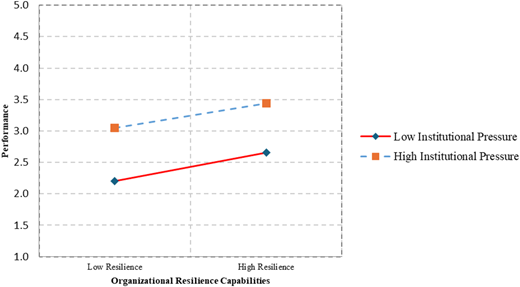
Similarly, the findings supporting H3 highlight the pivotal role of cognitive analytic capabilities in translating dynamic capabilities into informed strategic actions. By enhancing managerial sensemaking and enabling the interpretation of complex environmental signals, cognitive analytic capabilities strengthen a hotel's capacity to navigate uncertainty and reinforce resilience. This underscores the critical contribution of cognitive infrastructures in complementing technological and operational competencies. The acceptance of H4 further establishes that dynamic capabilities, encompassing sensing, seizing, and reconfiguring resources, directly enhance a hotel's ability to adapt to turbulence and recover from disruptions. These capabilities constitute the primary mechanisms through which hotels sustain operational continuity and maintain long-term competitiveness in volatile environments. Finally, the results also support H5, indicating that institutional pressures significantly moderate the relationship between organizational resilience capabilities and hotel performance. These findings indicate that increasing institutional pressures weaken the positive effect of organizational resilience capabilities on hotel performance. To illustrate the nature of the interaction effect, we plotted the relationship between organizational resilience capabilities and hotel performance at high and low levels of institutional pressure (Figure 2), accompanied by a simple slope analysis for each (Aiken and West, 1991). Figure 2 further illustrates this interaction, showing that the positive relationship between organizational resilience capabilities and hotel performance is stronger under low levels of institutional pressure (simple slope = 0.46, t = 3.24, p < 0.005) than under high levels of institutional pressure (simple slope = 0.39, t = 3.60, p < 0.005).
6.1 Theoretical implications
This study offers several key theoretical contributions by developing and empirically validating an integrated framework rooted in the DCV to investigate organizational resilience within the hotel sector (Teece, 2021). First, the results substantiate that AI capabilities, cognitive analytic capabilities, and dynamic capabilities exert a significant positive influence on organizational resilience, thereby corroborating and extending prior scholarly work (e.g. Garrido-Moreno et al., 2024; Teece, 2021). Specifically, AI capabilities enhance operational efficiency, facilitate data-driven decision-making, and enable proactive responses to environmental disruptions, thereby strengthening resilience. Cognitive analytic capabilities improve managerial sensemaking, support strategic judgment, and enable the effective interpretation of complex environmental signals, translating dynamic capabilities into actionable strategies that reinforce adaptability. Dynamic capabilities, encompassing the ability to sense, seize, and reconfigure resources, directly empower hotels to respond to turbulence and recover efficiently from disruptions (Teece, 2021). Collectively, these results highlight that resilience emerges from the integrated deployment of technological, cognitive, and dynamic infrastructures, illustrating their synergistic role in sustaining adaptive capacity and long-term competitiveness in volatile environments. Second, institutional pressures are shown to play a critical theoretical role in shaping the effectiveness of organizational resilience capabilities in enhancing hotel performance (Suder et al., 2026). This perspective extends the DCV by emphasizing that resilience is co-constructed through the interaction between internal competencies and external expectations (Alzubi et al., 2025). Adaptation and recovery are strengthened when hotels align their capabilities with institutional norms, regulatory requirements, and industry best practices, demonstrating the moderating effect of institutional environments on organizational outcomes (Qalati et al., 2025).
Third, the study underscores the synergistic interdependence among AI, cognitive analytic, and dynamic capabilities in fostering resilience, offering a nuanced understanding of how multiple capabilities interact to enable hotels to navigate uncertainty effectively (Tajeddini et al., 2026). By integrating the DCV and institutional theory, this research advances hospitality literature by establishing that organizational resilience is jointly shaped by internal capabilities and external institutional forces (Demitr et al., 2025). These insights provide a robust theoretical foundation for future investigations into adaptive and sustainable organizational practices in complex service environments.
6.2 Managerial implications
The findings show that hotel resilience in the UAE is strengthened not by isolated capabilities, but by the joint development of AI, cognitive analytic, and dynamic capabilities. Their impact increases under higher institutional pressure; the UAE's regulated tourism environment acts as both a constraint and a catalyst for capability deployment, performance, and resilience. These capabilities require coordinated investment in technology and human capital. UAE hotels should deploy AI-driven demand forecasting systems to support automation, resource optimization, and predictive analytics. These systems enable real-time adjustments in pricing, staffing, and service delivery based on demand and customer behavior. Cognitive analytic capabilities should be embedded in daily decision-making by training managers to interpret data, detect market shifts, and translate insights into action. This can be achieved through simulations, cross-functional workshops, and continuous learning aligned with regulatory updates, customer preferences, and competitor practices.
Second, institutional pressures shape the effectiveness of these capabilities. UAE hotels should monitor coercive, normative, and mimetic pressures through engagement with tourism authorities and industry bodies. This enables managers to anticipate regulatory changes and integrate them into planning. Hotels should also align KPIs with national tourism standards and use compliance and audit data to improve service quality, efficiency, and decision-making. Third, the findings highlight the interdependence of AI, cognitive analytic, and dynamic capabilities, requiring an integrated rather than an isolated system. This can be operationalized through cross-functional coordination between IT, operations, and revenue management, supported by shared data platforms and integrated decision routines. This integration enables faster responses to environmental changes and improves operational continuity. Finally, resilience should be embedded in daily operations through practical tools and routines. UAE hotels should implement cross-functional response teams, real-time dashboards, and scenario-based simulations. These practices support demand forecasting, customer feedback analysis, pricing adjustments, and workforce planning, enabling rapid and coordinated responses to disruptions. Given the UAE's competitive and regulated environment, these practices should be tailored to hotel size, category, and resources.
7. Conclusion
Organizational capabilities are drivers of resilience; however, research in the hotel sector under institutional pressure, in conjunction with AI adoption, remains limited. Addressing this gap, the study integrates institutional theory and the DCV to develop a comprehensive framework examining how AI capabilities, cognitive analytic capabilities, and dynamic capabilities enhance organizational resilience and hotel performance, and how institutional pressures moderate these relationships.
Using PLS-SEM on survey data from 400 managerial-level employees across hotels in the UAE, the study demonstrates that AI capabilities, cognitive analytic capabilities, and dynamic capabilities significantly strengthen organizational resilience. Moreover, institutional pressures further amplify the translation of resilience capabilities into improved performance outcomes. Theoretically, these findings advance understanding of how technological adoption, cognitive readiness, and institutional contexts collectively shape dynamic capabilities and foster resilience in turbulent environments. From a managerial perspective, the study underscores the importance of integrating technological tools with cognitive and dynamic resources, enabling hotel managers to sense opportunities, adapt strategically, and orchestrate resources effectively to sustain operational continuity, drive innovation, and maintain long-term competitiveness in the hospitality landscape.
Key limitations include the use of cross-sectional data from UAE hotels, where socio-cultural and institutional factors may uniquely shape technology adoption and organizational responses, limiting generalizability. This design also restricts understanding of how capabilities and resilience evolve; longitudinal studies are better suited to trace how hotels adapt their resources and strategic orientations in response to technological, institutional, and market shifts.
Future research should adopt multi-source data from different organizational stakeholders and combine objective with self-reported measures to reduce common method bias, improve validity, and provide a better understanding of how organizational resilience capabilities and institutional pressures shape hotel performance outcomes. It may also extend the analysis to broader outcomes, such as operational agility, profitability, innovation performance, and customer experience.