This study aims to examine how environmental, social and governance (ESG) performance and ESG controversies influence dividend payout decisions among European listed firms, with particular emphasis on the effect of the Corporate Sustainability Reporting Directive (CSRD).
Using a balanced panel of 550 European non-financial listed firms and 6,050 firm-year observations covering the period 2014–2024, the study employs fixed-effects, mixed-effects and instrumental-variables (2SLS) estimation methods. Dividend policy is proxied by the dividend payout ratio, while ESG performance is measured using aggregate ESG scores and individual environmental, social and governance pillars. ESG controversies score and a CSRD regulatory dummy are incorporated to capture reputational shocks and regulatory pressure.
The study indicates that ESG performance is positively correlated with dividend payout ratios, primarily driven by environmental and social factors. ESG controversies do not directly and statistically significantly affect dividend payouts, even after controlling firm-specific heterogeneity and financial fundamentals. Importantly, CSRD plays a significant moderating role: while dividend payouts are higher during CSRD-related years, the positive association between ESG performance and dividends weakens under CSRD pressure, suggesting a reallocation of resources toward compliance, disclosure and sustainability investments during the regulatory transition period.
This study advances the ESG-dividend literature by integrating ESG performance, ESG controversies and mandatory sustainability reporting within a unified empirical framework. It provides early evidence on how the CSRD reshapes the ESG-dividend nexus, highlighting regulatory pressure as a key boundary condition in the sustainability-payout relationship.
1. Introduction
As environmental, social, and governance (ESG) factors embed into strategic decision-making, their implications for dividend distribution remain unclear (Jain and Malhotra, 2025). ESG performance influences firms by lowering equity costs and enhancing earnings potential, with the latter potentially driving higher payouts (Cheung et al., 2018; Gillan et al., 2021; Treepongkaruna et al., 2024a). ESG-oriented strategies reduce risk levels and equity risk premiums (Simone, 2026), while stakeholder engagement improves operational performance and limits downside risk, simultaneously decreasing capital costs and supporting profitability (La Rosa and Bernini, 2022; Tron et al., 2025).
Dividend policy reflects strategic trade-offs between shareholder distributions, investment retention, and long-term value creation (Brav et al., 2005; Miller and Modigliani, 1961; Jensen, 1986). While traditional theories emphasize profitability, leverage, and agency costs (Lintner, 1956; Jensen and Meckling, 1976), ESG considerations have fundamentally altered this decision-making context (Ferrell et al., 2016; Ananzeh et al., 2025).
Literature highlights how sustainability advantages foster stable financial outcomes, shaping payout capacity through enhanced cash-flow predictability and stakeholder trust (Barnett and Salomon, 2012; Jha and Rangarajan, 2020; Garzón-Jiménez and Zorio-Grima, 2022; Matos et al., 2020; Dua and Sharma, 2024). ESG engagement yields sustainable dividends by balancing payouts with long-term investments (Saidi et al., 2025). Agency and signaling theories further suggest that ESG performance reduces information asymmetry, making dividends credible signals of stability (Cheung et al., 2018; Tsang et al., 2025; Bhattacharya, 1979; Jain and Malhotra, 2025). However, associations remain mixed under financial constraints or weak institutions (Ellili, 2022; Lakhal et al., 2023; Oh and Park, 2021; Matuszewska-Pierzynka et al., 2023; Kumar and Ghalke, 2025). Furthermore, ESG controversies act as negative shocks that impair trust and raise financing costs (Dahiya et al., 2023; Elamer and Boulhaga, 2024). Per legitimacy theory, firms may divert resources toward reputation repair over dividends (Suchman, 1995; Cheung et al., 2018), though evidence on dividend cuts versus resilience remains inconclusive (Kumar and Ghalke, 2025; Matuszewska-Pierzynka et al., 2023).
The European Union's Corporate Sustainability Reporting Directive (CSRD) shifts governance by mandating standardized disclosures to enhance transparency and external monitoring (Li et al., 2025; Talha, 2026; Sharma, 2025). Mandatory reporting may influence real corporate behavior, reshaping resource allocation and financial policies (Cheung et al., 2018; Mahmood et al., 2026).
Despite this research expansion, three gaps remain. First, studies often overlook how ESG controversies offset the benefits of strong ESG performance (Elamer and Boulhaga, 2024). Second, empirical evidence is lacking on how mandatory regimes like CSRD determine the ESG-dividend nexus, as existing literature focuses on voluntary or pre-CSRD settings (Ellili, 2022). Third, findings remain fragmented regarding how regulatory pressure alters trade-offs between payouts and sustainability investments.
This study analyzes a balanced panel of 6,050 firm-year observations from European non-financial listed firms (2014–2024) using fixed-effects, mixed-effects, and 2SLS estimates, finding a positive ESG performance–dividend payout relationship (strongest for environmental and social aspects), no significant direct effect from ESG controversies (even after controls), and CSRD as a key moderator: higher payouts during CSRD years but weakened ESG–dividend link due to resource reallocation toward compliance, disclosure, and sustainability investments. It contributes novelly by integrating ESG performance, controversies, and CSRD regulation in a unified framework, unlike prior works on cross-country ESG–dividends (Bilyay-Erdogan et al., 2023), dividend stability in large firms (Matos et al., 2020; Benlemlih, 2019), or static analyses, adopting a dual-channel view of responsible/irresponsible signals and showing CSRD's first-time impact in reducing ESG dividend advantages while amplifying controversy effects via resource redirection to compliance and sustainability. Overall, it provides policy-relevant insights on how sustainability regulation reshapes payout decisions, extending ESG, corporate finance, and sustainable governance literature in European markets.
The rest of the paper is structured as follows. In Section 2, the literature pertaining to the issue is reviewed and the theoretical framework and hypothesis are constructed. Section 3 outlines research design, data sources, variable definitions, and econometric methodology. Section 4 presents empirical results. Section 5 discusses the findings in relation to existing theory and empirical evidence. Section 6 concludes by outlining implications for managers, investors, and policymakers, and suggesting directions for future research.
2. Literature review
2.1 Theoretical framework
2.1.1 Stakeholder theory
Stakeholder Theory posits that managing relationships with investors, employees, customers, and communities creates long-term value beyond shareholder-only prioritization (Freeman, 1984). Sustainability performance reflects a commitment to meeting expectations and mitigating risks, translating into stable cash flows and greater earnings confidence (Khan et al., 2016). These conditions support dividends as a commitment mechanism that sustains stakeholder legitimacy. Empirically, stronger ESG profiles correlate with dividend stability and favorable payout ratios, where engagement signals reduced risk and enhanced payout capacity (Matos et al., 2020; Dua and Sharma, 2024; Almulhim et al., 2024). The theory also explains how ESG controversies weaken this relationship; reputational damage and financing frictions force firms to balance distributions with remediation and risk mitigation (Elamer and Boulhaga, 2024; Kumar and Ghalke, 2025). Finally, by enhancing transparency and comparability (Li et al., 2025), the CSRD strengthens stakeholder monitoring, moderating how ESG performance and controversies translate into dividend outcomes.
2.1.2 Legitimacy theory
Legitimacy Theory posits that organizations operate under a “social contract,” where survival depends on aligning behavior with societal norms (Suchman, 1995). ESG controversies disrupt this legitimacy, heightening scrutiny and increasing regulatory or litigation costs while impairing access to capital. These factors raise the opportunity cost of dividends, incentivizing cash retention. Consequently, exposure to controversies is associated with conservative payout policies due to reputational risk and uncertainty (Dahiya et al., 2023; Elamer and Boulhaga, 2024).
The theory also explains the joint impact of ESG factors; a single controversy can reframe a firm's narrative and diminish the dividend-supporting benefits of overall sustainability performance. Such negative “events” compel firms to prioritize legitimacy repair—via compliance or remediation investments—over value distribution, reducing payout capacity despite historical ESG engagement (Cheung et al., 2018). The CSRD reinforces these mechanisms by mandating structured reporting that limits managerial discretion and exposes gaps between reported performance and controversial outcomes. By increasing accountability, the CSRD strengthens the controversy-dividend linkage while allowing genuinely high-performing firms to distinguish themselves from symbolic adopters.
2.1.3 Agency theory and signaling under information asymmetry
Agency Theory highlights manager-shareholder conflicts and predicts that governance mechanisms and dividends reduce agency costs by limiting free cash flow for discretionary use (Jensen and Meckling, 1976; Jensen, 1986), signaling discipline and future earnings confidence (Bhattacharya, 1979). ESG performance mitigates agency costs by improving monitoring, governance, and stakeholder alignment, thereby enhancing dividend capacity, especially when governance and investor protection are strong (Dua and Sharma, 2024; Kumar and Ghalke, 2025; Oh and Park, 2021). Signaling theory complements this as under information asymmetry, ESG performance and credible disclosures (e.g. under CSRD) signal lower risk and stable cash flows, supporting payouts (Bhattacharya, 1979; Fathi et al., 2025), as CSRD reduces asymmetry, boosts ESG credibility, and enables better pricing of sustainability risks (Li et al., 2025). Conversely, CSRD heightens scrutiny on controversies, prompting cash retention for corrections, moderating ESG's ability to offset controversies in payout decisions (Dua and Sharma, 2024; Kumar and Ghalke, 2025; De Villiers et al., 2024).
2.2 Hypotheses development
2.2.1 ESG and dividend payout ratio
The relationship between ESG performance, commonly proxied by Environmental, Social, and Governance (ESG) scores and dividend payout ratios, has attracted substantial attention in corporate finance, reflecting growing investor expectations for transparency, ethical conduct, and long-term value creation. A substantial body of empirical evidence supports a positive association between higher ESG performance and more favorable dividend policies (Khan et al., 2016; Almulhim et al., 2024; Saidi et al., 2025), consistent with the view that ESG factors are financially material and influence corporate outcomes and investment decisions (Nguyen, 2025).
Previous studies show that firms with stronger ESG profiles exhibit more stable and generous dividend payouts (Matos et al., 2020; Dua and Sharma, 2024; Almulhim et al., 2024), as higher ESG performance links to dividend stability, payout ratios, and sustained distributions, signaling commitment to shareholders and stakeholders, particularly among less financially constrained firms (Malik and Kashiramka, 2025). However, not all evidence is consistent. For instance, Chen et al. (2024) find that mandatory ESG reporting may reduce dividend payouts, potentially reflect increased compliance costs or shift in resource allocation. Such mixed findings may be attributed to heterogeneous ESG practices (Ellili, 2022) and differences in institutional contexts (Liu and Lee, 2025), indicating that the relationship is not uniform across settings.
Literature also identifies key moderators of the ESG-dividend nexus, such as investor protection, legal frameworks, and corporate governance quality, which strengthen the positive impact of sustainability on payouts by enhancing managerial accountability (Kumar and Ghalke, 2025; Yilmaz et al., 2024). Overall, the relationship is nuanced but compelling (Bilyay-Erdogan et al., 2023); while a positive association usually prevails through effective stakeholder engagement, mixed findings underscore the influence of institutional contexts. Understanding this conditional relationship is critical as sustainability increasingly shapes financial strategy. Based on this discussion, we formulate the following hypotheses:
ESG performance is significantly associated with the dividend payout ratio.
To further examine the individual dimensions of ESG performance, the following sub-hypotheses are proposed:
Environmental performance is significantly associated with the dividend payout ratio.
Social performance is significantly associated with the dividend payout ratio.
Governance performance is significantly associated with the dividend payout ratio.
2.2.2 ESG controversies and dividend payout ratio
The link between ESG controversies and dividend payouts is increasingly vital due to heightened scrutiny of ethical conduct (Al-Dhamari et al., 2025; Kumar and Ghalke, 2025). Controversies signaling sustainability weaknesses alter risk perceptions, capital access, and managerial priorities (Zhou and Ge, 2025; Chasiotis et al., 2024), supporting the hypothesis that such events significantly associate with payout decisions.
Despite its relevance, empirical evidence on the ESG controversy–dividend relationship remains limited and inconclusive. While Casey et al. (2020) suggest that firms with higher exposure to controversies are more likely to adopt less stable dividend policies, they find no strong association between controversy scores and dividend payouts in the IT sector. It is consistent with evidence that ESG controversies impose reputational and financial costs that adversely affect firm outcomes (Qawasmeh et al., 2026), increasing firm risk and constraining financial decisions (Del Sarto, 2025). In fact, some studies provide robust support for a negative relationship between controversial practices and dividend distribution, finding that involvement in controversial activities significantly reduces dividend payments (Benlemlih, 2019) or higher overall ESG controversy scores are systematically linked to lower dividend levels, (Bilyay-Erdogan et al., 2023).
Syntheses and event-based studies corroborate this negative relationship. Meta-analytical evidence shows ESG risks are generally associated with lower payouts (Jain and Malhotra, 2025), while rating downgrades often trigger dividend reductions or slower growth as a prompt response to shocks (Tsang et al., 2025). Overall, evidence suggests controversies negatively impact dividends, contingent on governance, legal enforcement, and financial constraints. These mixed findings indicate that the relationship remains insufficiently explored across different institutional contexts. Consequently, this study hypothesizes:
ESG controversies are significantly associated with the dividend payout ratio.
2.2.3 The moderating role of the corporate sustainability reporting directive (CSRD)
The Corporate Sustainability Reporting Directive (CSRD) represents a major regulatory advancement in sustainability governance by requiring harmonized, verifiable, and decision-relevant ESG disclosures (Oskarsdottir et al., 2025; Talha, 2026). By enhancing the transparency, reliability, and comparability of sustainability information, the CSRD reshapes how investors assess firms' ESG performance and exposure to sustainability-related risks. This has direct implications for dividend policy, given that dividends serve as signals of financial stability and risk management. However, no recent research has begun to examine yet whether CSRD (Oskarsdottir et al., 2025) strengthens or alters the ESG–dividend relationship and the effect of ESG controversies on payout decisions.
Enhanced sustainability disclosure under CSRD strengthens the informational environment, reducing asymmetry and perceived risk through standardized reporting (Li et al., 2025). Signaling and agency perspectives suggest that stringent disclosure regimes enable firms to sustain dividends by boosting investor confidence (Cheung et al., 2018). Furthermore, as a mechanism of coercive isomorphism, CSRD compels firms to align governance and reporting with regulatory mandates (DiMaggio and Powell, 1983). By constraining managerial discretion and providing auditable data, the mandate enhances the signaling value of ESG performance, allowing investors to distinguish genuine sustainability from symbolic disclosure. This justifies modeling CSRD as a moderator of the ESG-dividend relationship rather than as an independent determinant.
Conversely, ESG controversies function as negative shocks that typically drive conservative payout policies to preserve financial flexibility (Bilyay-Erdogan et al., 2023; Kumar and Ghalke, 2025). However, CSRD requirements to report incidents and corrective actions may mitigate these adverse effects for firms signaling credible remediation (Zadeh, 2020; Cheung et al., 2018). While CSRD enhances accountability and constrains opportunistic behavior (Malik and Kashiramka, 2025), it may not fully shield firms from the financial strain of serious controversies. Remediation costs and reputational damage often force managers to prioritize risk management over distributions, as environmental disputes remain linked to conservative payouts even under strengthened disclosure (Al-Dhamari et al., 2025). Thus, CSRD likely improves information quality without entirely offsetting the financial consequences of sustainability shocks. Taken together, the literature seems to suggest that CSRD could play a conditional role, strengthening ESG signaling while only partially mitigating the adverse effects of controversies. Building on these insights, this study examines the moderating role of CSRD in the ESG–dividend relationship. Accordingly, this study proposes the following hypotheses:
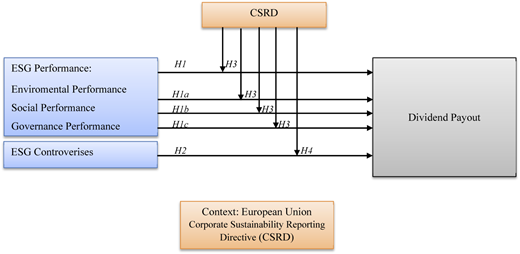
CSRD moderates the relationship between ESG performance, and its environmental (E), social (S), and governance (G) dimensions, and the dividend payout ratio.
CSRD moderates the relationship between ESG controversies and the dividend payout ratio.
Figure 1 presents the conceptual framework of the study, illustrating the direct relationships between ESG performance, ESG controversies, and dividend payout ratio, as well as the moderating role of CSRD.
3. Methodology
3.1 Sample selection and variable definition
The initial sample includes all non-financial firms listed on major European stock exchanges and covered by the LSEG Workspace database (Bilyay-Erdogan et al., 2023; Salvi et al., 2024). Financial institutions are excluded because their regulatory frameworks, capital structures, and dividend policies differ substantially from those of non-financial firms, potentially biasing the empirical results. In line with the European Commission's definition of large enterprises, the sample is further restricted to firms employing more than 250 employees. Firms with missing data for key variables, including financial indicators, dividend measures, ESG performance scores, and ESG controversy indicators, are also removed. After applying these filters, the final sample consists of 550 firms, yielding 6,050 firm-year observations (balanced panel) as shown in Table 1.
Table 2 presents the definitions and measurements of all variables used in this study. The variables include dividend payouts as the dependent variable, ESG performance and ESG controversies as the main explanatory variables, the CSRD indicator as a moderating variable, and a set of firm-level control variables. All measures are constructed using standard definitions from ESG and corporate finance literature.
3.2 Model specification
To test the baseline hypotheses, we use the following model to understand the relation between ESG and dividend payout:
Where ESG is proxied by the overall ESG score (ESGS) and by each individual pillar score (EPS, SPS, and GPS). ESGC is the ESG controversies score. captures unobserved firm-specific effects, and denotes year fixed effects. Furthermore, denotes firms, and denotes time periods.
To examine the moderating role of CSRD, interaction terms are introduced:
Separate specifications are estimated using aggregate ESG scores and individual E, S, and G pillar scores, as well as joint ESG-controversy models.
We implement a multi-layered estimation strategy for robustness. First, we run firm fixed effects regressions (clustered SE) as baseline, we also estimate mixed-effects models as an additional robustness check.
To address potential endogeneity—specifically reverse causality and omitted variable bias (e.g. managerial quality)—we employ a two-stage least squares (2SLS) instrumental-variable approach using lagged ESG variables (Wintoki et al., 2012). Lagged ESG measures satisfy the relevance condition due to high correlation with current levels, while supporting the exogeneity assumption as they are unlikely to affect current dividends except through current ESG performance. In the first stage, ESG performance is regressed on its lagged values and controls; the resulting predicted values are then used in the second stage to estimate their impact on dividend payout ratios. This strategy enhances the credibility of the empirical results by mitigating endogenous bias.
4. Results
Table 3 presents descriptive statistics for the sample of 550 firms over 2014–2024. The dividend payout ratio (DPD) distribution is strongly right-skewed, typical of financial variables where most firms pay modest dividends while few distribute high amounts, highlighting payout heterogeneity.
Turning to ESG performance, ESG indicate moderate engagement among European firms, with stronger performance in social and environmental dimensions relative to governance, consistent with prior evidence (Dkhili, 2025). ESG controversies are generally low, although a subset of firms experiences negative ESG events, highlighting the relevance of analyzing controversies as a distinct dimension (Bilyay-Erdogan et al., 2023; Kumar and Ghalke, 2025). Reported variance inflation factors (VIFs) remain below conventional thresholds and correlations remain below 0.65 (Table 4), suggesting multicollinearity is not a concern.
As shown in Table 4, dividend payout (DPD) is positively associated with profitability and negatively related to leverage and firm size, in line with conventional dividend theory. In contrast, unconditional correlations between dividends and ESG performance are not significant, suggesting that the ESG–dividend relationship operates through conditional or interaction effects rather than simple linear associations. ESG performance is strongly correlated with its individual pillars, reflecting its composite nature. ESG controversies are positively associated with ESG performance and firm size, indicating that more visible firms both engage more in ESG and face greater scrutiny, while their negative correlation with profitability and dividends suggests adverse financial implications. The CSRD variable exhibits low correlations with firm-level characteristics, supporting its interpretation as an exogenous regulatory factor.
4.1 Empirical tests
Regarding Hypothesis 1 (H1), which posits a positive association between ESG performance and dividend payouts, the evidence is strongly supportive (Table 5). Specifically, the aggregate ESG score (ESGP) is positive and highly significant (β ≈ 0.022–0.023, p < 0.01), indicating that firms with stronger ESG engagement tend to distribute higher dividends. When ESG is disaggregated into pillars, both environmental (EPS) and social (SPS) scores remain positive and significant, whereas governance (GPS) is not significant. This pattern suggests that dividend incentives are primarily driven by environmental and social performance, which aligns with prior research demonstrating that strong ESG practices enhance stakeholder trust and signal financial stability (Kumar and Ghalke, 2025; Matos et al., 2020; Liu and Lee, 2025).
In contrast, Hypothesis 2 (H2) was not supported as it proposed that ESG controversies would negatively affect dividend payouts. The direct fixed-effects models indicate that ESG controversies (ESGC) are not statistically significant, leading to the rejection of H2 in this within-firm context. This result implies that exposure to controversy alone does not systematically reduce dividends, consistent with studies suggesting that the effect of controversies is conditional and often moderated by regulatory or governance factors (Kumar and Ghalke, 2025; Bilyay-Erdogan et al., 2023).
Turning to Hypothesis 3 (H3), which considers the moderating effect of the CSRD, the results show a more complex pattern. The CSRD indicator itself enters positively, indicating slightly higher dividend payouts during the CSRD period. More importantly, the interaction terms reveal a negative moderation effect for ESG performance, both for ESGP and EPS and SPS pillars, are negative and significant (≈−0.016 to −0.017, p < 0.05). This suggests that while ESG performance generally promotes higher dividends, its effect diminishes under CSRD-related regulatory pressure, likely because firms reallocate cash toward compliance, reporting, or sustainability investments (Mahmood et al., 2026; Ellili, 2022).
Finally, the control variables behave as expected, reinforcing classical dividend theory. Profitability (ROA) is strongly positive and highly significant across all models, highlighting that earnings capacity is a primary driver of dividends. Conversely, firm size (Fsize) and leverage (LEV) are negative and significant, consistent with evidence that larger and more leveraged firms face financial constraints that limit dividend distributions (Duque-Grisales and Aguilera-Caracuel, 2021). The models show a stable fit (R2 ≈ 0.34–0.36) and high overall significance (p < 0.001), supporting the reliability of these findings.
4.2 Robustness and endogeneity tests
Supplementary Table S1 re-estimates the models using mixed-effects panel regressions (Xtmixed, Stata 18), allowing random firm intercepts while retaining the same covariates and specifications (aggregate ESG vs. pillars; controversies; CSRD interactions). Results closely mirror fixed-effects estimates: ESGP, EPS, and SPS remain positive and significant in direct models, controversies and GPS effects are insignificant, and CSRD moderation holds with negative, significant effects on ESGP, EPS, and SPS. This consistency across estimators confirms the robustness of the moderation effect to alternative variance assumptions.
Supplementary Table S2 presents 2SLS instrumental-variable estimates using lagged ESG variables to address endogeneity. These results are directionally consistent with the FE and mixed-effects models from Tables 4 and 5
5. Discussion
The results demonstrate robustness across specifications, allowing for a comprehensive understanding of the ESG–dividend relationship under evolving regulatory conditions. Consistent with H1, the results indicate a positive association between aggregate ESG performance (ESGP) and dividend payouts. Notably, the environmental (EPS) and social (SPS) dimensions exhibit strong positive effects, whereas governance (GPS) does not significantly influence dividends. This suggests that firms prioritize environmental and social initiatives when signaling financial strength and reliability to shareholders. Consistent with agency theory, high ESG performance reduces perceived agency risk and enhances investor confidence; firms with stable operations and strong stakeholder relationships can afford higher dividends (Bhattacharya, 1979; Jensen, 1986). Furthermore, these results echo prior European and meta-analytic evidence showing that firms with robust ESG practices maintain higher and more stable dividend policies (Matos et al., 2020; Liu and Lee, 2025; Kumar and Ghalke, 2025; Jain and Malhotra, 2025; Salvi et al., 2024). Therefore, ESG performance emerges as a significant dividend driver, particularly in environmental and social dimensions, by signaling long-term operational resilience.
Turning to ESG controversies, contrary to expectations, they are not significant, suggesting that European firms may absorb ESG shocks without immediately adjusting dividends. This finding aligns with the perspective that firms often address controversies through operational or reputational remediation rather than dividend reductions (Treepongkaruna et al., 2024b; Dahiya et al., 2023). However, some studies document negative consequences of ESG controversies, including litigation costs, reputational damage, and financing constraints, which can pressure payout policies (Benlemlih, 2019; Bilyay-Erdogan et al., 2023; Casey et al., 2020; Al-Dhamari et al., 2025). Taken together, these insights imply that the impact of ESG controversies on dividends is context-dependent and moderated by institutional and regulatory frameworks that may shield firms from immediate dividend adjustments.
Next, the CSRD's role as a regulatory intervention was examined through interaction terms with ESG performance. Interestingly, while ESG performance alone positively affects dividends, interactions with CSRD are negative and significant, except for GPS, indicating that the ESG-dividend effect weakens during CSRD implementation. Governance again shows no significant interaction effect. This pattern suggests that although ESG initiatives generally promote higher dividends, the introduction of mandatory reporting creates resource allocation trade-offs, as firms must devote capital and managerial attention to compliance and disclosure (Cheung et al., 2018; Ellili, 2022; Li et al., 2025). In essence, the CSRD appears to partially crowd out the dividend-signaling function of ESG performance, highlighting the conditional nature of ESG effects under regulatory scrutiny. This finding is consistent with prior evidence showing that regulatory mandates can temporarily dampen ESG's influence on shareholder returns, even though it will bring long-term benefits (Mahmood et al., 2026; Dua and Sharma, 2024).
For H4, the interaction term ESGC × CSRD is not significant, indicating that CSRD does not materially alter the effect of ESG controversies on dividend decisions. This finding suggests that, despite increased transparency requirements, firms tend to respond to controversies through mechanisms other than dividend changes, such as reputational management or operational adjustments (Xue et al., 2023; Dahiya et al., 2023). At the same time, this aligns with prior studies arguing that firms may maintain dividends strategically to restore legitimacy after controversial events (Zadeh, 2020). Thus, ESG controversies appear to exert conditional effects on dividends, largely independent of regulatory disclosure mandates.
Finally, the role of financial fundamentals such as profitability, leverage, and firm size is strongly supported. Return on assets (ROA) is consistently positive and significant, while leverage (LEV) and firm size (Fsize) exhibit negative effects, echoing classic dividend theories (Lintner, 1956; Duque-Grisales and Aguilera-Caracuel, 2021; Alslaibi et al., 2025). These results indicate that ESG effects operate in conjunction with, rather than independently of, traditional financial determinants, highlighting the complementary nature of ESG signals in shaping payout policies. Moreover, financial constraints may moderate the ESG–dividend link, as prior studies show that firms with limited financial flexibility may prioritize compliance and investment over dividends (Malik and Kashiramka, 2025).
The results reveal a nuanced interplay between ESG performance, controversies, regulatory intervention, and financial fundamentals. First, ESG performance, particularly in environmental and social areas, consistently enhances dividend payouts, supporting the notion that sustainability serves as a signaling mechanism for shareholder confidence. Second, the CSRD negatively moderates this effect, reflecting short-term trade-offs between compliance and dividend signaling. Third, ESG controversies have a limited direct effect on dividends, and CSRD does not substantially alter this dynamic. Finally, financial fundamentals remain critical, underscoring the importance of profitability and leverage in determining payout policy. These findings contribute to the literature by integrating ESG performance, regulatory transparency, and dividend policy, demonstrating that ESG acts as a positive signal for dividends, but its impact is conditional on regulatory and financial contexts. This highlights the complex and context-dependent nature of ESG in corporate finance, providing insights for managers, investors, and policymakers seeking to align sustainability with shareholder returns (Freeman, 1984; Jensen and Meckling, 1976; Suchman, 1995).
These findings have important practical implications for corporate financial policy, investor decision-making, and sustainability reporting under the CSRD framework. First, for corporate managers, the results indicate that ESG performance—particularly environmental and social dimensions—can be strategically leveraged to support dividend stability and enhance investor confidence. However, under CSRD, firms should anticipate short-term trade-offs, as increased regulatory compliance and reporting requirements may temporarily reduce the marginal impact of ESG on dividend payouts. This suggests that dividend policy and sustainability investments should be jointly managed as part of an integrated corporate strategy with financial implications, rather than treated as independent decisions.
6. Conclusion
This study examines how ESG performance and ESG controversies influence dividend payout decisions in European listed firms, with particular attention to the moderating role of the Corporate Sustainability Reporting Directive (CSRD). Using a comprehensive panel dataset and multiple estimation techniques, the findings show that ESG performance is positively associated with dividend payouts, primarily through environmental and social dimensions. In contrast, ESG controversies do not exert a statistically significant direct effect on dividend policy, even after controlling firm-specific heterogeneity and financial fundamentals. Importantly, CSRD emerges as a meaningful regulatory moderator: while dividend payouts are, on average, higher during CSRD-related years, the positive ESG-dividend relationship weakens under CSRD pressure, indicating a reallocation of corporate resources toward compliance, disclosure, and sustainability investments during the regulatory transition period.
This study contributes to the ESG-finance literature by integrating insights from stakeholder theory, legitimacy theory, and agency-signaling perspectives into a unified empirical framework. The positive association between ESG performance and dividends supports stakeholder-based arguments that sustainability engagement enhances dividend cash-flow stability, reduces risk, and strengthens firms' capacity to distribute value to shareholders. At the same time, the attenuating effect of CSRD on the ESG-dividend relationship highlights an important boundary condition: under heightened regulatory scrutiny, firms appear to prioritize reinvestment and compliance over short-term payout signaling. This finding extends prior work by demonstrating that ESG-dividend dynamics are not static but are shaped by evolving institutional and regulatory environments. Moreover, the absence of a robust controversy effect suggests that legitimacy disruptions do not automatically translate into payout reductions, reinforcing the view that ESG risks influence financial policies in conditional and context-dependent ways.
For corporate managers, the results underline the importance of viewing dividend policy and sustainability strategy as interdependent rather than competing objectives. While strong ESG performance can support stable dividend payouts under normal conditions, firms subject to the CSRD should anticipate short-term trade-offs between shareholder distributions and investments in reporting systems, governance processes, and sustainability initiatives. Investors, in turn, should interpret dividend adjustments during the CSRD transition with caution, recognizing that lower marginal payouts among high-ESG firms may reflect strategic reinvestment rather than financial weakness. For boards and financial executives, the findings highlight the need for transparent communication regarding how regulatory compliance and sustainability investments affect payout decisions. From a broader societal perspective, the results suggest that the CSRD is achieving one of its intended objectives: encouraging firms to internalize sustainability considerations and allocate resources toward long-term value creation rather than short-term financial distribution. By reshaping the ESG-dividend relationship, CSRD may indirectly promote more resilient and socially responsible corporate behavior, even if this comes at the cost of reduced dividend sensitivity to ESG performance in the short run. For policymakers, the findings imply that enhanced disclosure regulation can influence corporate financial behavior beyond transparency alone, reinforcing sustainability investment while maintaining overall payout stability. However, the lack of a moderating effect on ESG controversies also suggests that disclosure regulation alone may be insufficient to discipline firms following severe ESG incidents, highlighting the potential role of complementary enforcement and governance mechanisms.
Despite its contributions, this study has several limitations that provide avenues for future research. First, the CSRD variable captures an early transition period as the directive has only recently been implemented across European jurisdictions and initially applies to a subset of large firms (“wave one” adopters). Accordingly, the observed moderating effects may reflect short-term adjustment dynamics rather than fully stabilized corporate behavior. Future research should examine longer post-implementation periods to assess whether the ESG–dividend relationship evolves as firms adapt to CSRD requirements.
Second, the analysis relies on aggregate and pillar-level ESG scores, which may obscure heterogeneity across specific ESG components, such as carbon emissions, labor practices, or governance mechanisms. In addition, ESG ratings may be subject to measurement inconsistencies across providers. Future research could employ disaggregated ESG indicators or alternative data sources to capture more granular sustainability dimensions and improve measurement accuracy.
Third, given that this study focuses on European listed firms, the generalizability of the findings is limited to institutional environments characterized by relatively strong regulatory frameworks and enforcement mechanisms. Future studies could extend the analysis to emerging markets or conduct cross-country comparisons to examine how institutional quality, legal enforcement, and investor protection influence the ESG–dividend relationship.
Fourth, although this study addresses endogeneity concerns using an instrumental-variable approach, potential limitations related to instrument validity and dynamic endogeneity may remain. Future research could explore alternative identification strategies, such as natural experiments, difference-in-differences designs, or regulatory discontinuities, to further strengthen causal inference.
Fifth, the analysis focuses exclusively on dividend payouts as the primary form of shareholder distribution. However, firms may also use alternative payout mechanisms, such as share repurchases, which may respond differently to ESG performance and regulatory pressures. Future research could incorporate multiple payout channels to provide a more comprehensive understanding of corporate distribution policies.
Finally, future research could explore sector-specific ESG materiality, as the relevance of environmental, social, and governance factors may vary significantly across industries. Integrating industry-level analysis would provide deeper insights into how ESG priorities shape financial decision-making in different economic contexts.
ChatGPT 5.5 was used solely to assist with language editing. No AI tool was used for data analysis, interpretation, theoretical development or scientific content generation. The authors take full responsibility for the final manuscript.
The supplementary material for this article can be found online.