Can youth sports build character? Research suggests that the answer to this question leads to 2 further questions: (1) can youth sport coaches be effectively prepared to become character educators, and (2) can character education take place in today’s competitive youth sport environment? (Bredemeier & Shields, 2006; Power, 2015; Power & Sheehan, 2014). In this study, coaches from 10 boys and girls basketball teams were randomly selected to participate in a 3-hour clinic focused on character education and lead weekly discussions with their players on moral decision making. Coaches and players in both control and experimental conditions were administered pre- and posttests assessing the moral environment of their team, the coach’s moral attitudes and behavior, and the athlete’s personal moral reasoning and behavior. In all, 19 coaches and 341 players were assessed. Results indicated that trained coaches established a more positive moral environment than coaches in the control condition, who had a limited impact on player moral development outcomes.
The primary justification for organized youth sports in the United States has been—and remains to this day—the development of children’s character (Power & Sheehan, 2014). In the latter half of the 19th century, proponents of organized youth sports argued that adult-supervised sports could save children from the dangers of the streets and teach children the virtues of discipline and teamwork, which are vital to success in the workplace (Chudacoff, 2007). This belief in the character building potential of organized sports persists today, largely on the basis of testimony from former athletes. Yet alongside that belief is the ever-growing awareness that organized youth sports have become less about developing virtues than about winning, self-promotion, and profits. Bad to outrageous coach, fan, and player behavior has become commonplace. Lipsyte’s (1995) often quoted epitaph that “Sports are over because they no longer have any moral resonance,” may be as true about youth sports today as it was about professional sports at the close of the 20th century.
Character and Moral Development
Youth sports may be losing their moral resonance, but judging from the thriving youth sport industry (Koba, 2014); they are hardly over. Should we be concerned about the perception that youth sports have become more focused on winning than on fostering character development? Why should we expect youth sports to do more than teach children how to compete while developing their athletic skills? Contemporary scholars in the fields of moral and character education generally look to schools’ curricula not to sports programs to provide moral, character, and civic education (Altof & Berkowitz, 2006). Well-run sports programs, however, have the potential to provide young people with experiences of group attachment and social responsibility with significant character-building potential (Power, 2015; Power & Sheehan, 2014). At a time of rising inequality and declining social mobility and social solidarity (Putnam, 2015), the need for such sports programs that can serve both poor and affluent children has never been greater.
To date, there has been little research that substantiates the notion that playing organized youth sports build character, at least insofar as character is understood to have a moral dimension (e.g., Bredemeier & Shields, 2006; Power & Sheehan, 2014; Shields, Bredemeier, & Power, 2002; Stoll & Beller, 2000). By a moral dimension, we mean what Lickona and Davidson (2005) have called “moral character,” that is character marked by other-oriented virtues, such as justice and respect for the rights and welfare of others. Although there is a widespread interest in promoting character development through youth sports (e.g., Character Counts’ Gold Medal Standards Campaign, CHARACTER COUNTS!, 2006) and the Positive Youth Development movement (e.g., Weiss, 2008), the view of character advanced in these approaches does not differentiate moral from performance character (Power, 2015). Following in the tradition of Kant (Kant, Schneewind, Baron, & Kagan, 2002) and Kohlberg (1981), we argue that achievement-related virtues, such as self-discipline, courage, and perseverance, are not virtues in the full sense unless they are at the service of the moral virtues, which are rooted in principles of justice and benevolence (see also Berkowitz, 1997; Power, 2015; Shields, 2011).
Piaget (1932/1965), Kohlberg (1984), and Damon (1990) have shown that morality develops throughout the lifespan as a function of social experience. They describe the process of moral development as a constructive activity that occurs through interactions within different macro and microcultures. Although most moral development research has focused on reasoning and judgment, moral functioning encompasses a wide range of competencies. Rest (1983) provides a helpful model, which identifies four major components of moral functioning leading to moral behavior: (1) moral sensitivity; (2) reasoning and judgment; (3) motivation, which includes responsibility and identity (Blasi, 1993); and (4) the execution of the action itself. These four components constitute what we mean by character.
Coaching and Character Education
Coaches play a critical role in the way in which young athletes participate in sports. Coaches have a special relationship with their players, not only because of the time they spend together, but because of the intensity of the experiences they share. This special relationship with their athletes gives coaches the opportunity to exercise significant influence insofar as they can provide direction and guidance for their athletes. Most coaches believe that they are character educators at least in the sense that they see themselves as teaching life lessons by demanding that their players accept the discipline required to achieve athletic success. Although they tend to emphasize the virtues related to “performance character,” they also recognize the importance of other-oriented virtues, like teamwork, fairness, and respect.
How much of a commitment coaches give to cultivating moral virtues may depend to a large extent on the kind of sports organization in which they coach. As Coakley (2015) notes, community-based youth sport organizations with a service orientation such as parks and recreation leagues, the YMCA, and police athletic leagues focus on sports as a means of serving all children, particularly those in need, by promoting their health and character development. Private youth sport organizations with a compete-to-win orientation, such as Pop Warner Football, Little League Baseball, and elite sports clubs focus on developing the skills of the most talented athletes through elite competition. Public school sports, although publically funded, often straddle the two orientations. Whereas character development is important to their mission, the pervasive play-to-win culture can lead coaches to lose sight of their educational role. For example, although they, like youth sport coaches (Power & Sheehan, 2012a), typically see value in all their players some playing time, they also feel they must play their “best” athletes to win. If coaches are to become character educators, they must make hard choices about their priorities. Fraser-Thomas, Cote, and Deakin (2005) cite research suggesting that coaches who place a priority on winning rather than on athletes’ development are perceived as exploiting their players. In our view, becoming a character educator requires both commitment and sacrifice.
We chose to study public middle school (seventh and eighth grade) varsity basketball teams in an urban area because of the challenge presented by the highly competitive sports environment. Of course, we also believed that it was important to assess how organized sports could serve children in poor neighborhoods, who are losing opportunities to play organized sports (Coakley, 2015).
Preparing coaches to be character educators involves more than simply instructing them to emphasize values, maintain discipline, or control players’ behavior. When coaches address moral issues, they often engage in exhortation, which is meant to motivate athletes to act on what they already know to be right. Yet exhortation alone does not influence athletes’ sensitivity to moral issues nor address their moral reasoning and judgment. Research clearly demonstrates that the most effective approach to character education is one that sensitizes young people to the needs of others and engages them in focused reflection and deliberation on how to promote the common good (e.g., Berkowitz & Bier, 2005; Lemming, 2008; Power, Higgins, & Kohlberg, 1989; Power & Power, 2012). Applying this to the athletic context means that coaches must look for opportunities to call their players’ attention to moral issues and to devote time specifically to leading team meetings that address moral concerns. Most coaches are, however, not well prepared for such a task. They are often not that reflective about the morality of their own coaching behaviors and lack expertise and experience in leading moral discussions. Directing team meetings and leading moral discussions require special training over and above that provided even in standard teacher education programs (Lemming, 2008).
Popular approaches to character education in youth sports, such as Character Counts Sports (“Pursuing Victory with Honor,” n.d.) focus on addressing the lack of civility and honor in sports by making virtues more salient to coaches, fans, and players without providing evidence-based strategies for becoming more attentive and thoughtful about the ways in which players and coaches treat each other, their opponents, and officials. Educating for moral development entails applying the Socratic approach of posing problems, asking questions, and promoting a discussion of moral values and principles (Power & Power, 2012; Snarey & Samuelson, 2008). Moreover, education for moral development should have a strong civic dimension in which players learn how to deliberate as members of a democratic society. This is best achieved by establishing and enforcing rules through a participative democratic process as outlined in the just community approach (Power et al., 1989).
Integrating Moral Education into Sports
Leading effective moral discussions and democratic meetings requires considerable expertise, which proponents of character and moral education in the schools, as well as the sports context, tend to overlook (Power & Power, 2012). The fact is that in spite of a consensus supporting character education in schools and sports, there has been little discussion about what character education ought to entail and how teachers and coaches are to acquire the background knowledge and skills that they need to be effective moral educators. Schwartz (2008) notes that most teacher education programs nationally fail to provide even the most basic preparation in moral education, and those who do give some attention to this area typically provide the bare minimum. Coaching education lags well behind teacher education. Most coach education at the youth and high school level is delivered through workshops and online courses that focus on meeting multiple certification standards covering a broad gamut of topics from teaching sports skills and strategies to physical conditioning (see National Association for Sport and Physical Education, 2006).
Leading researchers in sports and moral development believe that only deliberate moral educational programs embedded within the context of the typical youth sports experience can lead to measurable outcomes (Shields et al., 2002; Weiss et al., 2008). Romance, Weiss, and Bockovan (1986) used a physical education context to investigate the effectiveness of interventions rooted in structural developmental theory. They found that an 8-week intervention program with fifth-grade children significantly improved their moral reasoning. Over the past 20 years, Hellison (Hellison & Martinek, 2009) has been working to develop and field test a physical education model for teaching self-responsibility to delinquency-prone youth. Hellison and his colleagues (DeBusk & Hellison, 1989; Hellison & Martinek, 2009) report the successful use of physical education instruction with at-risk youth in promoting self-control, respect for the rights of others, and prosocial behavior. Hellison’s field work has yielded insights with important implications for youth sports, but further empirical research is needed to discern the applicability of his methods to the competitive youth sports environment.
Research to date suggests that physical education classes led by professional educators provide the optimal conditions for fostering moral development within athletics. One challenge for those of us who are trying to bring moral education to organized sports is to approximate those conditions outside of a controlled classroom setting. Our goal is to develop a replicable, morally focused character education model for middle school sports. In this study, we explore the effectiveness of preparing coaches to be character educators within the practical constraints of a relatively short (3 hours) clinic and a single sports season. Becoming a moral educator requires far more preparation than a single clinic, and character development takes time (Power & Power, 2012). Yet we have to start somewhere if we hope to reach more than a small number of coaches and children. Our study takes a first step in building a foundation for further program development and research focused specifically on character education.
Much of the groundbreaking coach education research has been undertaken by Smoll, Smith, and their colleagues (Barnett, Smoll, & Smith, 1992; Coatsworth & Conroy, 2006; Conroy & Coatsworth, 2006; Smith, Smoll, & Barnett, 1995; Smith, Smoll, & Curtis, 1979; Smoll, Smith, Barnett, & Everett, 1993; Smoll, Smith, & Cumming, 2007). They use the Coach Effectiveness Training approach and a revision of Coach Effectiveness Training, the Mastery Approach to Coaching, which draws on motivational climate-building techniques (Duda & Balaguer, 2007). These coach education studies show that coach training can be used effectively to increase the amount of encouragement and verbal rewards that coaches give their players. They also show that players perceived trained coaches as engaging in more positive verbal behaviors, in less negative verbal behaviors (e.g., failing to reinforce and punishment), and in more mastery behaviors than untrained coaches. In addition, youth playing for the trained coaches liked their coaches more, perceived their coaches as liking them more, reported improved self-esteem, were less anxious, had lower dropout rates, and showed gains in task oriented motivation.
Research on athlete outcomes has broadened from a focus on achievement to positive youth development, which includes a character component (e.g., Becker, 2013; Conway & Coatesworth, 2006; Cote, & Hay, 2002; Gould, 2013). There remains, nevertheless, a dearth of empirical research that focuses specifically on the development of moral character and the conditions that promote it (e.g., Evans, McGuckin, Gainforth, Bruner, & Cote, 2015; McCullick et al., 2009; Power, 2015; Power & Sheehan, 2014).
Those of us working with the Play Like a Champion Today (PLC) coach education program have been grappling with the issue of moral development in youth sports over the past decade. The PLC approach draws heavily on achievement goal and self-determination concepts (Deci & Ryan, 1985; Duda, 2013; Hagger & Chatzisarantis, 2007; Ryan & Deci, 2007), as well as developmental moral education theory (Power et al., 1989; Power & Power, 2012). PLC focuses on developing athletes’ intrinsic motivation, commitment to justice and care, and autonomy and responsibility. The PLC youth sports clinic educates coaches by leading them to examine: (1) their role as a character educator; (2) the stages of the moral development of children; (3) the necessity of treating players respectfully, particularly when correcting their mistakes; (4) the fairness of distributing playing time equally at youth level; (5) the importance of respecting officials; 6) the basics of facilitating moral discussions (Power & Sheehan, 2012a); and (7) the importance of establishing a norm of mutual care among teammates. Because the PLC clinic challenges coaches to “go against the grain” of the prevailing youth sport culture, and in many cases to change their previous approach to coaching, the clinics devote significant time to reflective group discussion. Both youth and high school coaches report that the interactive PLC clinics have led them to become more committed to teaching moral values, holding moral discussions, and giving athletes opportunities to make decisions (Power & Sheehan, 2012b).
Preparing Coaches to be Moral Educators: Questions for Exploration
What makes moral education in sports different from and more challenging than moral education in the classroom is that moral education in sports must address how coaches function in the context of competition. It is one thing to teach coaches how to lead moral discussions in off-court team meetings and another thing to teach coaches in today’s professionalized youth sport culture how to behave as a moral educator while interacting with their players, referees, opponents, and screaming parents or fans. The educational model that we employed in this study is similar to the one proposed by Conroy and Coatesworth (2006). In their view, coach education should have “a direct effect on coach behaviors, which in turn should alter youth perceptions of coach behavior” (p. 134) and of the environment itself. These youth perceptions should then lead to changes in the youth’s psychological processes. Conroy and Coatesworth (2006) explain the effects of coach training in terms of the athletes’ internalization of the “behaviors, values, and beliefs … modeled by their coaches” (p. 134). We, on the other hand, explain the process of moral education leading to moral development within Piaget (1932/1965) and Kohlberg’s (1984) social interactionist approach, which regards both coach and athlete learning as a constructive activity. From either explanatory framework, the sequential chain of influences is the same.
We designed the research for this study to assess each link in the developmental chain beginning with the coaching clinic and culminating with the athletes’ moral functioning as conceptualized according to Rest’s four-component model (Narvaez & Rest, 1995; Rest, 1983). First, we assess the effectiveness of the clinic from the perspective of the coaches’ desire to embrace their role as moral educators. Second, we explore how the student athletes perceived their coaches’ behavior and attitudes. Third, we examine the extent to which players’ moral functioning changed. Finally, we examined whether the PLC coach training affected spectator behavior during games.
Method
Participants
We recruited 10 middle schools in a Midwestern public school system, and randomly selected five of them to serve as the treatment condition. The schools not selected served as controls. Both boys and girls basketball teams were used in the study; basketball was an extracurricular activity at the public schools, and not part of the students’ physical education curriculum; coaches were (with one exception) teachers who taught content courses during the school day. The median percentage of students on free and reduced lunch in the schools across the sample was 76%. The schools in the treatment condition had a higher percentage of students on free and reduced lunch (range from 79% to 91%) than those in the control group (range from 45% to 76%).
The total number of male participants was 197; 82 were seventh graders and 115 were eighth graders.1 Their mean age was 14.2 years (SD = .69); range was 12.8 years to 16.3 years. Most of the male participants had played basketball in their school the previous year (66.3%). Others had experience playing some sport in a community recreational league. The ethnic makeup of our sample was diverse, and the percentage of African American participants was far higher than that of the city as a whole: 65.3% of our male participants were Black whereas 26.6% of all of residents in this city are African American.2 Other male participants included 15.3% Caucasians, 5.9% Hispanic or Latino; .5% Asian American, 1% Native American, and 7.4% other (usually of mixed ethnic origin).
We had 144 female participants; 70 were in seventh grade and 73 in eighth grade. Their mean age was 14.01 years (SD = .62); range was 12.7 to 15.6 years. Most of our female participants had previously played basketball (55.9%), although not as many as the boys. The ethnic makeup of the girls was similar to that of the boys; 53.1% of female participants were African American, 22.8% were Caucasian, and 7.6% were Hispanic or Latina; one participant (.7%) identified herself as Native American, and 15.2% said they were other (usually of mixed ethnic backgrounds).
The head coaches and most of their assistants (if they had them) of the girls and boys basketball teams participated in a Play Like a Champion coaching clinic. All of the head coaches were teachers in the schools where they coached. The few assistant coaches were generally not teachers. All of the head coaches had coached before and most had participated in other coach education clinics. We paid the head coaches in the experimental and control groups a modest stipend for their participation; and we paid each team a modest stipend for the students’ completion of the research survey.
Training Procedures and the Basketball Season
All of the coaches in the treatment group participated in a 3-hour PLC Coaching for Character clinic, which was modified to accommodate instruction on how to lead a moral discussion with the help of a manual and structured lesson plans.3 In designing the intervention for the PLC coach clinic used in our study, we dropped the concluding section on working with parents and replaced it with a section on leading moral discussions in team meetings. We introduced coaches to the basic discussion strategies of presenting moral dilemmas, such as asking open-ended questions, focusing on prescriptive moral reasoning and probing student athletes’ reasons for their opinions. In an attempt to compensate for the lack of time we could give to teaching coaches how to facilitate moral discussions, we provided the coaches with a manual describing the discussion approach in more detail and highly structured lesson plans including probe questions (Power & Sheehan, 2012a).
The clinic began with a focus on the coach’s role as a character educator, moved to discussion of sports as play and the fairness of guaranteeing equal playing time, and then finished with what it means to “play like an ethical champion” and how coaches can communicate and foster social and moral development with their athletes. Coaches were given an instructional manual with lesson plans for leading moral discussions and were asked to lead at least one moral discussion a week.
While collecting pre- and posttest data at the beginning and end of the basketball season, we observed how taxed the head coaches were in managing teams averaging 20 boys and fourteen girls of wide-ranging skills. Some of these coaches had volunteer assistants but many did not. Had we chosen a suburban school system, we would have had better conditions for such research. On the other hand, we believe that as character educators ourselves, we have a responsibility to prioritize serving financially distressed populations. In addition, the basketball season had been scheduled to last ten weeks, but was shortened by two weeks because of weather related delays of the football season.
Measures
Coaches and athletes were asked to complete pre- and posttest questionnaires. Before we administered the interviews, we explained the purpose of the study and assured the coaches and players that their participation was voluntary. On the pretest, athletes were asked to rate their experience on the previous year’s basketball team. If they were not on a basketball team, they reported their experience from the last team that they played on. Coaches were asked to describe how they understood their role as moral educators and how committed they were to the role of moral educator. Generally the athletes and coaches were able to complete the measures within a half an hour, although some took as long as 45 minutes. The length of time to complete the measures was acceptable to the coaches, and any student fatigue was offset by a bathroom or water break.
We used a mixed methods approach in selection of instruments (Johnson, Onwuegbuzie, & Turner, 2007). Our surveys included Likert scale items and open-ended questions. We adapted existing measures that previous research on the moral atmosphere of schools had indicated were critical to the development of one or more components of moral development (Power & Higgins-D’Allesandro, 2008). Some measures had previously been used by the Play Like a Champion program to assess the effects of the coaching clinic on coaches’ dispositions and actions (Power & Sheehan, 2012b). Measures of athletes’ moral reasoning and ideal self-descriptions were adapted from previous research on middle school students (Power & Power, 2013). We also included items from Kavussanu and Boardley’s (2009) Prosocial and Antisocial Behavior in Sport scale (PABSS). They developed their scale in response to a call for more instruments to assess moral functioning in sports (Bredemeier & Shields, 1998). PABSS asks athletes to respond to 20 statements by indicating on a 5-point Likert scale (1 = never, 5 = very often) how often they had engaged in certain prosocial behavior (“congratulated an opponent”) or antisocial behavior (“physically intimidated an opponent”) during the previous season or recently concluded season.
Coach Evaluation Form. This 46-item measure included 26 Likert-type items on how well the coaches perceived their communication with athletes and parents, their relationship with athletes, their coaching behavior relevant to their fair and respectful treatment of athletes (which included how they distributed playing time, their emphasis on the values of fairness and sportsmanship, and their commitment to fostering a strong sense of team), and their perceptions of fan behavior. These items demonstrate good internal consistency (.88 for coaching style; .98 for communication; .96 for relationship with athletes; .83 to .94 for coaching behavior; and .81 to .86 for fan behavior). Demographic data was also collected with this form.
The measure also included 20 items adapted from PABSS (Kavussanu & Boardley, 2009) to be relevant to coaching. For example, the athlete item “how often did you help an injured player” was adapted for the coaching scale to read “how often did you encourage your players to help an injured player?” Internal consistency was lower for the coaches’ PABSS than the players’ (Cronbach’s α = .63 for prosocial behavior and .58 for antisocial behavior), which suggests that labeling coach behavior as simply prosocial or antisocial is inadequate.
As a part of the posttest, coaches were asked to report the number of moral discussions they held, the average length of each discussion, and the average number of student athletes who participated.
Athlete Evaluation Form. This 59-item measure included athletes’ assessments of the following: (1) overall team experience, (2) perceptions of coaching, (3) and their own prosocial and antisocial behavior (PABSS). The overall team experience scale is composed of 13 items in which the student athletes assessed their experience with their coaches, including how their coaches distributed playing time and the extent to which they developed as morally engaged and responsible teammates throughout the season. This total score demonstrated strong internal consistency (Cronbach’s α = .82 at posttest). All 13 items collected at posttest were also subjected to a Principal Components Factor Analysis with Varimax rotation. This yielded three factors: coach support, playing time, and athlete moral engagement (see Table 1).4 All three subscales demonstrated good internal consistency (.88 for coach support; .79 for playing time; and .75 for moral engagement). Sample items in the coach support subscale included:
I liked my head coach.
I felt supported by my head coach.
I learned a lot from my head coach.
I felt listened to by my head coach.
Two items concerning playing time included:
I received about the same amount of playing time as the other players.
I felt happy about the amount of playing time I received.
Four items concerning the development of moral engagement were presented at the posttest (therefore no pre- to posttest construct analyses are possible). The moral engagement subscale measures the first (moral sensitivity), third (responsibility), and fourth (action) component of Rest’s (1983) moral functioning model.
The moral engagement items were:
I thought more about what is fair.
I tried to show more sportsmanship.
I tried extra hard to be a good teammate even to players who were not my friends.
I learned more about being responsible for others.
The Perceptions of Coaching scale includes 18 items used in previous PLC research to assess athletes’ perceptions and assessment of their coaches. Both positive and negative items demonstrated good internal consistency (Cronbach’s α = .89 for positive items, and .71 for negative items). Some of the positive items were:
My head coach communicated well with me.
My head coach helped me to think about the relationship between sports and my character.
My head coach taught me the importance of fairness and sportsmanship at all times.
My head coach handled losing well.
Sample items on the negative coaching behavior subscale included:
This season, how often did your head coach yell at a player?
This season, how often did your head coach encourage rough play?
This season, how often did your head coach use inappropriate language?
This season, how often did your head coach yell at a ref?
This season, how often did your head coach act like a “bad sport?”
The remainder of the questionnaire includes 20 items from PABSS (Kavussanu & Boardley, 2009). Kavussanu and Boardley (2009) reported that items on PABSS demonstrated good factor loadings (.57 to .89) and internal consistency (.74 for prosocial teammate and opponent behavior; .83 for antisocial teammate behavior; .86 for antisocial opponent behavior; pp. 104-105).
Sample items on the PABSS antisocial behavior scale included:
This season, how often did you intentionally distract an opponent?
This season, how often did you swear at a teammate?
This season, how often did you try to injure an opponent?
This season, how often did you retaliate after a bad foul?
This season, how often did you physically intimidate an opponent?
Sample items on the PABS prosocial behavior scale included:
This season, how often did you encourage a teammate?
This season, how often did you help an injured opponent?
This season, how often did you congratulate a teammate for good play?
This season, how often did you ask to stop play when an opponent was injured?
This season, how often did you give positive feedback to a teammate?
PLC Moral Scenarios. Designed for this study, this qualitative measure consisted of four moral dilemmas with four to six accompanying questions. Athletes’ sports related moral reasoning was assessed by presenting athletes with two dilemmas and requesting that participants justify their answers. The first dilemma involved game behavior (i.e., should a basketball player lie that he or she was fouled in order to put the team’s best foul shooter on the free throw line); the second involved behavior off the court (i.e., should a teammate help an unpopular teammate prepare for a math test). Responses were coded for their moral stage according to a coding manual adapted from the moral judgment stage coding procedures described in Colby et al. (1987, 1988). Scores ranged between Stages 1 and 4 and included the transitional stages 1/2, 2/3, and 3/4. The coders were trained on a subsample of 20 construction cases. Interrater agreement was calculated for each story on 20 interviews. There was 85% agreement within a half stage on the first dilemma, and 90% on the second.
Players were also asked whether being a member of their team helped them to act in more prosocial ways by being friendly to everyone, encouraging others to play hard, refraining from criticizing a teammate after a bad play, and not complaining to a referee. Finally, they were asked to describe their future, ideal self, and the teammate they would like to become. These responses were coded for the extent to which self-descriptions incorporate references to moral virtues (see Power & Khmelkov, 1997). No psychometric properties exist on this measure, although Colby, Kohlberg et al. (1987) report an alpha of .92 for their standard moral judgment interview.
Results
Coaches’ Surveys
All of the coaches in the treatment (PLC) group found that the PLC clinic helped them to teach respect, fairness, and sportsmanship to their players, and to foster a strong sense of team. Because the coach sample size was so low (10 male and 9 female coaches for both conditions), we conducted item analyses on the coach measure. Even then, some items did not have enough participants to enable us to draw reliable conclusions from the data. What we report here are posttest comparisons and pre- to posttest trends.
On the posttest assessment, two thirds (6 of 9) of the PLC coaches strongly agreed that they acted as character educators and taught moral values and team building; less than half (42%) of the control group coaches endorsed this item. Almost all of the PLC coaches (7 of 9) strongly agreed that they gave constructive feedback throughout the season compared to half (3 of 6) of those in the control group.
Among the PLC boys’ coaches, we saw several trends in the expected directions. PLC coaches reported that they handled losing better at the end of the season then they had the previous season. They noted that they were more likely to encourage their players to help an injured opponent and to give a player positive or constructive feedback. They also reported that they were less likely to criticize a player and act like a “bad sport.”
In general, boys’ coaches in the control condition reported liking their student athletes less and giving less constructive feedback at the end of the season than they reported from the previous season. They reported giving less encouragement to players, congratulating players less for good plays, and were generally less likely to foster a strong sense of team (this item did approach statistical significance: t = 2.45; p = .07). Although they reported that they expressed more frustration and yelled at players more frequently at the end of the recent season, they also reported that they were less likely encourage a player to foul an opponent. They were more likely to yell at referees, but were also more likely to encourage their players to help an injured player from the opposing team at the end of the season than at the beginning.
All of the PLC boys’ coaches reported that they led some of the discussions prescribed in the curriculum. The number of actual discussions held varied from only three to “regularly” (at least once each week). The average time spent in discussion was 15 minutes per session. Only one reported doing most of the talking (the same coach who held only three discussions); all of the other coaches reported that they involved some, if not all, of the athletes in the discussions. The boys’ PLC coaches unanimously felt that the PLC discussions were “mostly” or “very helpful” in (a) building a sense of team; (b) teaching sportsmanship; (c) helping players to show respect for the referees; (d) helping players to show respect for their opponents; and (e) helping players to care for each other.
Results for the PLC girls’ coaches were mixed. On the one hand, they showed gains from the previous year in being better able to lose well and doing more to help their players develop their skills; but they also reported giving their players less equitable playing time and less constructive feedback than they did the previous season. PLC girls’ coaches saw little improvement in player behavior as a result of their training. Instead, they reported that their players did not congratulate other teammates for good plays very often, and they believed their players were more likely to show frustration at a teammate’s poor play. Girls’ coaches in the control condition reported declines in their ability to communicate well with parents. They also said that they argued with players more and were more likely to use inappropriate language at the end of the season than at the beginning.
Overall, girls’ PLC coaches lead more discussions during team practices than the boys’ coaches (from 5 to “countless”). Not surprisingly, the coaches who used the PLC protocol more often were also more likely to endorse it as “very helpful.” Girls’ coaches also spent 15-20 minutes on each discussion. About half of the girls’ coaches said they did “most of the talking,” while the other half reported significant player participation.
The PLC girls’ coaches were more varied than the boys’ coaches in their evaluation of the PLC clinic. One thought the clinic was very helpful in every area and that players showed “a great deal of improvement” as a result of their involvement with PLC. A second coach also thought PLC discussions were “mostly” or “very helpful” and that students showed “significant” or “a great deal of improvement” in the following areas: (a) building a strong team; (b) making sure no one on the team felt bullied or neglected; (c) respecting the referees; and (d) respecting opponents. The other girls’ PLC coaches thought the program was “somewhat” helpful.
Athlete Surveys
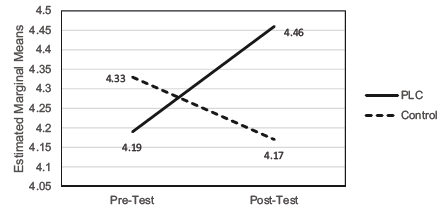
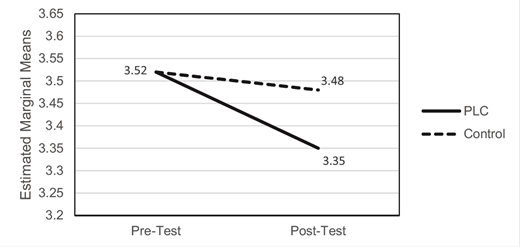
Overall Team Experience. Players on all of the PLC teams reported a significantly more positive sport experience overall than did players in the control schools (INTX F(1,239) = 11.58, p = .001) (see Table 2). This relationship was statistically significant for boys (INTX F(1,132) = 12.10; p = .001) but not for girls (INTX F(1,105) = .95; p = .33), although the result was in the expected direction. Figure 1 depicts this finding for the boys. At the posttest, players in the PLC schools felt more supported by their coaches (t = -2.63, p = .009). PLC players also received more equal playing time and were more pleased with the amount of playing time they received (t = -2.46, p = .02).
Moral Engagement. A key question for this study was whether the PLC players’ team experience had an effect on their character. The players on the PLC teams reported that they were more morally engaged throughout the season (t = -1.93, p = .06) than players on the control teams.
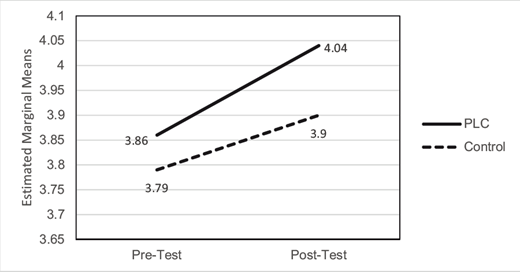
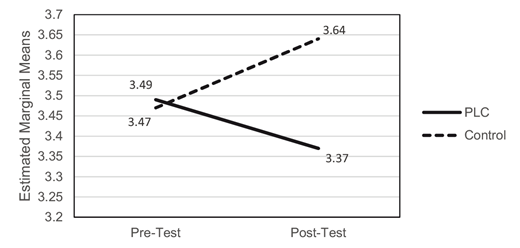
Perceptions of Coaches. Players on the PLC teams reported having more positive experiences with their coaches than did players on the control teams (INTX F(1, 244) = 8.31; p = .004). This finding was especially true for boys (INTX F(1, 132) = 10.02; p = .002). Girls on both PLC and control teams reported a significant increase in positive experiences with their coaches, although on the posttest those on the PLC teams rated their coaches significantly higher than those players on the control teams (ME F(1, 110) = 4.96; p = .03). The graph in Figure 2 is a visual depiction of this finding for girls.
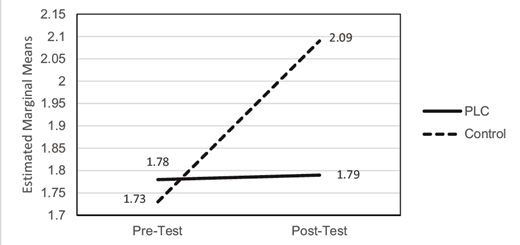
There was a significant main effect for an increased negative coaching behavior for all players (ME F(1, 243 = 7.15; p = .008); that is, the players perceived more negative coaching behavior at the end of their current season than they had the from their season the year before. Boys on the PLC teams, however, reported no changes in negative coaching behaviors from the previous season, while boys on the control teams saw a significant increase in negative coaching behavior (INTX F(1, 132) = 9.25; p = .003). The graph in Figure 3 illustrates this finding for the boys.
Although there were no statistically significant differences, the girls on PLC teams perceived their coaches as somewhat less negative than those in the control condition. The range of ratings for reported negative coaching behavior for the PLC teams was lower (i.e., never to almost never) than the range for the control schools (i.e., almost never to sometimes). Part of the perceived increase in the negative behaviors from the pre- to the posttest across the sample appears due to the fact that the posttest was administered immediately after the season, whereas the pretest addressed the season that had ended almost a year earlier. Another part seems to be an artifact of the sample. We were informed by the coaches and athletic directors that basketball at seventh- and eighth-grade level is far more competitive than that at the fifth- and sixth-grade level. On the pretest, the seventh-grade student athletes were reporting on their sixth-grade experience. Focusing simply on the posttest, girls’ on the PLC teams perceived their coaches as yelling less at the referees (M = 1.36, SD .63, p = .06) than those on the control teams (M = 1.61, SD = .79). We found a similar pattern among the eighth-grade boys (M = 1.96, SD = 1.12, p = .009; Control: M = 2.47, SD = 1.20).
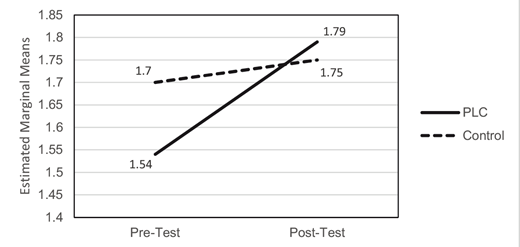
The analysis of the PABSS scales indicated that both boys and girls were significantly more likely to report that they engaged in more negative behavior during the completed season than the previous season [ME F(1,132) = 7.03, p = .009 for boys]. Girls in the PLC teams were also significantly more likely to report more frequent negative behavior than girls in the control condition [INTX F(1, 109) = 5.06, p = .03; see Figure 4], although the groups were not significantly different at posttest (t = .45, p = .65).
Boys on both the PLC and control teams reported significant declines in positive behavior [ME F(1, 132) = 3.56, p = .06], and boys in the PLC condition reported fewer positive court behavior than boys in the control condition at the end of the season, although this trend was not statistically significant (see Figure 5). Girls on the PLC teams, however, were significantly more likely to report increases in positive court behavior [INTX F(1, 109) = 4.32, p = .04] as is illustrated in Figure 6. Female players in the PLC groups consistently reported they engaged in positive behaviors “a lot of the time.”
Moral Reasoning and Responsibility. We did not find evidence of development in moral reasoning in either the PLC or control groups. We did find, however, that there was development on some teams but not on others. Among the boys’ teams, two of the control group teams showed significant development. Two of the PLC teams also showed strong gains, but they were not significant because of the small sample size. We did not find any significant differences between the PLC and control groups on questions that addressed athletes’ sense of responsibility for telling the truth or helping others.
Within the girls’ teams, the only significant development from pre- to posttest occurred in one of the PLC teams, although a second PLC team showed considerable development that was nonsignificant because of the small sample size. There was no clear relationship between the number of discussions that the girls’ coaches led and players’ reports of self, coach, or team improvement. There were two exceptions: the team whose coach demonstrated the least commitment to the PLC approach and the least cooperation in arranging for the data collection showed significant increases in negative fan behavior (t = 2.0, p = .07), negative coaching behavior (t = 3.64, p = .0004), and self-reports of negative player behavior (t = 3.17, p = .009). In contrast, the team most supportive of the PLC approach showed very significant changes in player reports of positive coaching behavior (t = 3.03, p = .008).
Perceptions of Team’s Influence on Prosocial Behavior. We found no significant differences between the PLC and control groups on questions related to their team’s influence on prosocial behavior with one exception: the athletes on the boys’ PLC teams reported that they encouraged everyone on the team to play hard (t = 2.1, p = .04).
Ideal Self. All players showed significant positive change from pre to posttest on their descriptions of their ideal future selves (t = 3.5, p <.001). We did not find significant differences between the PLC and control groups.
Discussion
This study showed that the PLC clinic helped coaches to provide their athletes with a sports experience conducive to their character development. The results indicated that the PLC coaches accepted their role as moral educators and made an effort to foster their players’ character development. The players on the PLC teams were significantly more likely than those on the control group teams to perceive their coaches as character educators who emphasized moral values throughout the season and helped them to develop a concern for fairness and to respect and care for each other.
One way coaches at the youth level demonstrate their concern for their players is to try to give them all equal playing time. By and large, the players on the PLC teams perceived their coaches as doing this. We appreciate the sacrifice the coaches made in putting the welfare of each athlete before winning. Sports are by their nature competitive play. Yet the purpose of sports at the youth level, particularly in a school setting, ought to be on the development of each athlete. Giving equal playing time is a simple matter of fairness. If coaches are to be credible teachers of fairness, they must practice it.
The analyses of the PABSS scales indicated that athletes on the PLC teams generally rated their coaches as practicing more positive coaching behaviors than their coaches had in the previous year. Their positive behavior ratings were also generally higher than those given by athletes on the control teams. The positive behaviors included those related to athletic development as well as to character.
The analyses of the athletes’ perceptions of negative coaching behavior indicated that the players perceived the coaches in both the treatment and control conditions as having behaved more poorly during the recently completed season than the year before. The perceived increase in negative behaviors reported by players in both the PLC and control groups may be explained—at least in part—by the fact that at the pretest the seventh-grade players were reporting on the experiences at the less competitive sixth-grade level. In addition, the pretest focused on their experience almost a year earlier, whereas the posttest focused on their recently completed season.
When we focused simply on posttest results, we found that the PLC coaches were significantly less critical of referees and used less inappropriate language than those in the control condition. The PLC clinic focused explicitly on how coaches should treat referees and to a lesser extent on the language coaches should use in speaking to players. The fact that the PLC coaches did not differ significantly from control coaches in other negative behaviors suggests that future clinics should address directly other negative behaviors.
An important goal of this study was to assess the extent to which coaches held moral discussions in team meetings. Unfortunately, most of the preseason practices had to be eliminated because of unanticipated late end of the football season. This meant that the PLC coaches had fewer opportunities to hold discussions. Reviews of the effectiveness of the moral discussion approach point to the importance of leading frequent moral discussions over at least several months (Higgins, 1980; Schlaefli, Rest, & Thoma, 1985). The fact that there was so little time for discussions in this study lessened the possibility of finding moral reasoning development.
In spite of the shortened season, all of the PLC coaches led at least some discussions, although the number, length, and extent of player participation varied. We found evidence for moral development only on the five teams in which the coach held discussions that lasted 20 minutes or longer and involved most of the players. This finding is consistent with other studies on leading moral discussions, including the classic Stone study of social studies teachers by Colby et al. (1983). They reported that the effectiveness of the discussions depended upon how faithfully the teachers applied the approach.
The Stone Study and other moral discussion research suggests that although it is convenient for teachers to integrate moral discussions into their curricula (particularly in areas such as social studies, literature, and physical education), they often lack the motivation to lead moral discussions, which may appear tangential to their curricula (Higgins, 1980; Power et al., 1989). On the other hand, although it is far less convenient for coaches to hold team meetings, this study suggests that coaches may be more motivated than teachers to lead discussions, which promise to build team unity as well as promote moral developments. Some of the dilemmas in the lesson plans directly addressed issues related to team building. One dilemma that coaches found particularly relevant focused on the need for trust in playing “help defense.” We believe that future attempts to integrate moral discussions into team meetings at the seventh- and eighth-grade levels should give greater emphasis to team building and relational dilemmas addressing such issues as promoting solidarity among different cliques, discouraging teasing and bullying, and helping unpopular students.
Given the differences that we found among the teams within both the PLC and control groups, we recommend that ongoing research studies focus on teams as a unit of analysis. We also recommend that such research explore how differences in coaching style (Chelladurai & Riemer, 1998) relate to coaches’ development as effective discussion leaders. Our results indicate that coaches with an autocratic leadership style may be less inclined to use the discussion approach than those with a democratic style.
On the whole, the results indicate that the PLC clinic helped the coaches to establish an environment that was fair to their players and that was perceived as supportive of their character development. The question remains, however, as to what extent the environment influenced the players’ moral functioning. The only difference between the PLC and control teams was on the moral engagement scale. The moral engagement scale assessed athletes’ attentiveness to the moral dimension of their sport experience, which means they make an effort to think about what is fair and to take responsibility for teammates. In our view, moral engagement is a “gateway” to developing the other dimensions of moral functioning. If athletes are going to develop their moral reasoning, their sense of moral responsibility and their moral self-understanding (i.e., their ideal self), they must first concern themselves with the moral challenges presented in their environment (Narvaez & Rest, 1995).
We did not find any significant changes on the PABSS behavioral measures of the student athlete. This was disappointing, of course, but not surprising given the brief duration of the basketball season and the difficulty most moral education programs have in influencing behavioral change (Power & Power, 2012). As Blasi (1983) has shown in his classic review of moral development research, moral reasoning does not necessarily lead to moral action. Moral education research indicates that the best way to influence moral behavior is through the just community approach of embedding moral discussions within a democratic decision-making governance structure focused on developing shared norms and values (Power et al., 1989). We hope to explore the applicability of the just community approach in youth sports in future intervention studies in which coaches can work with athletes over a longer season.
As much as we value the PABSS scales as a behavioral measure in sports, they present some limitations for middle school basketball players. For example, some PABSS items focus on specific sportsmanship behaviors, which many athletes may not regard as morally wrong (e.g., “How often did you try to distract an opponent?). We find it curious that the boys and girls on the PLC teams had different patterns of self-reported behavior. The self-reported positive behaviors of the boys on the PLC teams declined from the previous year although at posttest they were no different from the behavior of the boys on the control teams. On the other hand, the girls on the PLC teams reported significantly higher positive athletic behaviors than those in the control teams, even though they did not report significantly lower negative athletic behaviors. Further research is needed to determine whether male and female athletes in this age range have different perceptions of their positive and negative court behavior and how character education programs may influence athletes’ perceptions of prosocial and antisocial behaviors.
Our study shows that athletes on both the PLC and control teams developed a more moral sense of their ideal selves through the basketball season. We cannot determine whether their sports experiences actually contributed to that development. Further research comparing student athletes with those who have no sport experience would be helpful, especially given evidence for the beneficial effects of sports (Fredricks & Eccles, 2008).
Conclusion
This exploratory study indicates that a carefully designed clinic can help youth sport coaches provide meaningful character education, even within a single sport season. We found that the PLC clinic helped coaches to provide an environment that their players perceived as making their sports experience fair, enjoyable, and oriented to their character development. We agree with Power et al. (1989) that cultivating a group’s moral atmosphere is itself a worthy end of moral education. Establishing a moral environment is also necessary for fostering character development. In this study, we found that student athletes’ sense of moral engagement improved. At the end of the season, the players on the PLC teams reported that they were more focused on matters of morality and had made a greater effort to show more sportsmanship and care for their teammates.
Future research is necessary to determine whether providing coaches with further preparation in character education and establishing a coordinated, character education-oriented athletic program across all school sports over multiple seasons would lead to more extensive character development. The results of this study do, however, indicate that an investment in coach education can pay rich dividends for student athletes, especially from financially distressed school systems. We hope that at a time when schools sports are being cut back or even dropped altogether, this study will encourage character educators to support quality sports programs for the most vulnerable of our children.
Notes
Subtotals and percentages may not reflect total number of participants due to missing data.
U.S. Census Bureau (2010). http://quickfacts.census.gov/qfd/states/18/1871000.html.
Coaches in the control condition were given the opportunity to receive PLC training after the completion of the study.
Interestingly, no items assessing “fun” or “skill development” on the team loaded onto any single factor and were fairly equitably distributed across all three.