This paper responds to Berkowitz, Bier, and McCauley’s description of effective features and practices that support character development by pushing on the question of how child and youth environments might “build character.” Acknowledging the challenges of drawing on program evaluations and extant studies of character development to identify promising practices, the author suggests a more thorough leveraging of both theoretical work and empirical studies in other disciplines (e.g., neuroscience, cognitive science, social psychology, developmental psychology, sociology, philosophy) to theorize about potential mechanisms whereby school practices develop character in children and adolescents. Utilizing a recent developmental framework, the Foundations for Young Adult Success (Nagaoka, Farrington, Ehrlich, & Heath, 2015), the author proposes that 10 particular “developmental experiences”—specific opportunities provided for young people to act and reflect—are key mechanisms whereby settings influence the development of character and equip children and youth to build toward agency, an integrated identity, and a set of competencies that support success in young adulthood.1 These developmental experiences are briefly summarized and some potential alignments with Berkowitz and colleagues’ PRIMED framework are noted.
Berkowitz, Bier, and MacAuley (this issue) remind us that the ultimate goal of character education “is for children and adolescents to become good people, to develop into and act as agents for good in the world. [It] is about being people of character even more than it is about acting good” (p. 43). Over the past decade, Berkowitz and colleagues have periodically reviewed empirical studies to better understand how schools can help to develop young people of character. By examining the effects of specific strategies on character development, they have identified common strategies across effective programs (Berkowitz, 2011; Berkowitz & Bier, 2005, 2007, 2014). In this special issue they extend that work to include results from a recent review of reviews.
Taken together, this body of work represents a significant contribution to research and practice in character education. However, in reviewing the empirical literature, Berkowitz et al. are limited by the research methodologies utilized in the studies they reviewed and the quality and scope of the data those methods
produced. They have done a laudable job of elevating key strategies associated with effective practice in character education, but more work needs to be done to illuminate the mechanisms whereby good practice develops the character of children and adolescents in K-12 schools and to further build robust theory about character development.
Berkowitz and colleagues (2017) pursued three approaches to identifying evidencebased practices for developing character from the available empirical literature. Where studies identified specific practices with evidence of effects, they were able to link practices to the character outcomes those practices produced. Where studies evaluated programs whole cloth, they attempted to deconstruct the programs to identify specific practices or strategies within them as well as the kinds of impacts associated with the programs. Finally, in some cases they worked backward from specific outcomes to see what research or theory said about potential causal factors. The central challenge across these three approaches, as they noted, was that very few studies identified both specific practices and specific outcomes that could be causally linked by the available evidence.
The methodological challenges of research to determine “effectiveness” of character education are enormous. Human development is a complex, multidimensional, nonlinear process that occurs across a variety of settings over a long period of time; as such, it does not lend itself well to random assignment or controlled trials. Collecting compelling and unambiguous outcome data is particularly challenging. Consider Berkowitz et al.’s (2017) broad definition of character as “the set of psychological characteristics that motivate and enable one to function as a moral agent, to perform optimally, to effectively pursue knowledge and intellectual flourishing, and to be an effective member of society.” By this definition, there are at least four discrete outcomes of character development (moral, performance, intellectual, and civic); being able to tie particular strategies to varied and specific character outcomes is seldom possible with the still-too-crude tools available to social scientists. Further, few studies follow students for a long enough time period to really understand long-term developmental outcomes. Researchers must often rely on discrete behaviors or other short-term outcomes as proxies for “being a person of good character” or of developing toward becoming one. But getting students to turn in homework at higher rates or to learn helpful steps for calming down when angry is no guarantee that they are in fact developing good character that will endure.
The input side of the research equation is equally challenging. As Berkowitz and colleagues noted, most of the existing research evaluates holistic programs, with few studies identifying specific practices or strategies, let alone testing their effects. Even where specific program components are described, it is impossible to isolate the impact of one component versus another.
Complicating this even further is the fact that development is dependent not only on what the inputs are, but on what individual children make of those inputs, how they interpret them, and how they make meaning of them. Character development, as all aspects of human development, is as much a phenomenological process as a neurological or behavioral one. Adults employ various practices, strategies, rules, and guidelines in raising and educating children, hoping that they grow up to be good and learned people, but one can never be certain in the moment that these methods will bear fruit. Researchers could study such processes exhaustively, and still not hope to isolate exactly which variables at what dosages and durations and in what order will ensure goodness and kindness and steadfastness in adulthood. And yet, study we do, from a wide variety of disciplinary lenses. Perhaps it is by taking a broad, multidisciplinary view that we can best decipher the big picture of character development emerging from the research.
Based on the current state of the field, Berkowitz, Bier, and MacAuley make two recommendations for future work. One is a call for coordinated investment in targeted studies of specific strategies and practices aimed at developing young people’s character and socioemotional competencies. The second is a field-building tool in the form of an interactive data repository as researchers collectively accumulate more evidence of effective practices. While these both seem like worthy and important efforts, I would suggest an additional approach. A major shortcoming of reviewing program evaluations and studies of extant strategies is that this approach results in a listing of prevalent practices that is largely atheoretical. While the reviews and resulting PRIMED framework developed by Berkowitz and colleagues have contributed significantly to illustrating examples of effective practice in character education, they have done less to advance broader theory or to illuminate the specific mechanisms that make these practices “effective.” How does prioritizing character education or empowering stakeholders turn into young people with good character?
In addition to the work that Berkowitz, Bier, and MacAuley have undertaken and the recommendations they make for future study, I advocate for drawing on the extensive theoretical and empirical literature on learning and development to build theory about why specific school practices might lead to positive character outcomes. For example, what do neurological studies or psychological interventions with young people suggest about strategies that build neural pathways associated with emotional competence, that support moral reasoning, or that reinforce positive behavioral habits? Leveraging the broader literature on learning and development seems like a fruitful avenue for building robust theory of effective character education and illuminating the mechanisms of character development in young people.
Unfortunately, expanding theory and knowledge about developmental mechanisms doesn’t solve the many challenges associated with studying outcomes of youth development. Theorized mechanisms can be investigated empirically using observation tools for detecting their presence in schools and other youth settings, and utilizing available science to measure specific short-run student-level outcomes believed to be fostered by these mechanisms (e.g., empathy, social problem-solving skills, sense of belonging, civic participation, school attendance), checking for hypothesized associations. Ultimately, the effects of identified mechanisms can be rigorously tested through randomized controlled trials where such mechanisms are added into existing youth programs or educational settings and compared with previous practice. Still, by drawing from evidence across disciplines, we can contribute to the field of youth development research and practice by hypothesizing mechanisms whereby development happens.
The Foundations for Young Adult Success: A Developmental Framework
As applied education researchers who study youth development with a particular eye toward practice, my colleagues and I at the University of Chicago Consortium on School Research have taken up the question of how young people both learn and become, across the myriad settings in which they act and grow (Farrington et al., 2012; Nagaoka et al., 2015). Our most recent work has led us to identify a set of ten “developmental experiences” that the research suggests are associated with both neurological (building neural pathways) and phenomenological (making meaning of one’s experience) aspects of character development. This work contributes to the field of character education by hypothesizing specific mechanisms of development, pushing researchers and practitioners to think about not only the types of adult practices associated with student character outcomes, but also the kinds of character-building experiences and opportunities that young people are afforded across school, home, and community. Ultimately, it is what children and youth do and experience—and the meaning they make of those experiences— that lead to young people’s development.
In 2013, my colleagues and I were commissioned by the Wallace Foundation to (1) identify key factors contributing to young adult success, (2) study how those factors developed over time, and (3) note the implications for practice in school, home, and community settings. Our methods included in-depth review of the empirical literature and expert interviews with researchers, practitioners, and policymakers. We worked across disciplines in education, child/youth development, social psychology, sociology, neuroscience, economics, cognitive sciences, and philosophy (Nagaoka et al., 2015).
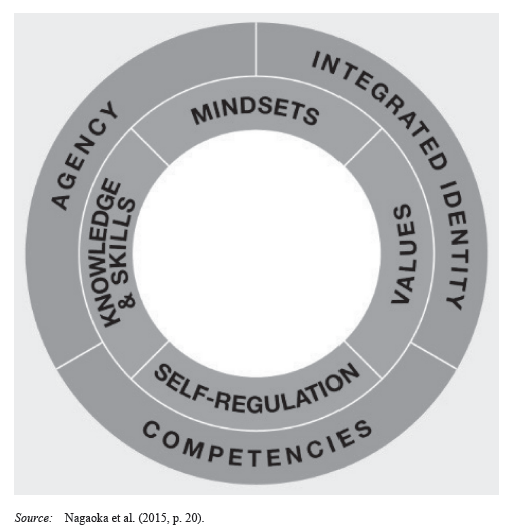
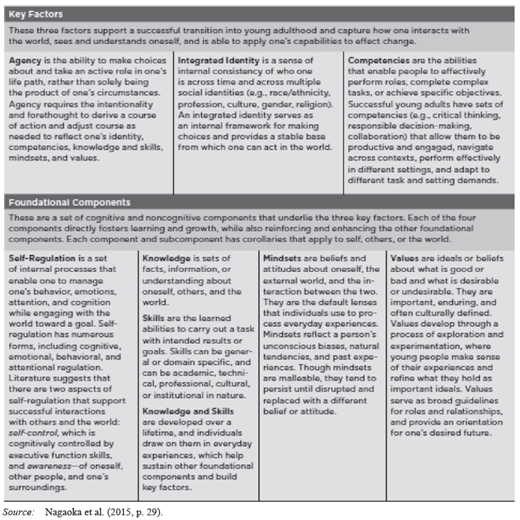
From our investigation, we created a framework of the Foundations for Young Adult Success (FYAS), depicted by a double-ringed graphic illustration (see Figure 1) of the essential ingredients for success in young adulthood across a variety of domains (education, work, relationships, civic engagement) (Nagaoka et al., 2015). The outer ring of the Foundations for Young Adult Success framework consists of three key factors:agency, integrated identity, and competencies. We conceptualize these key factors as what parents, teachers, and other youth developers might hold as a North Star in the raising, teaching, and mentoring of children and adolescents: young adults who are able to navigate constraints, make choices about, and act on behalf of themselves and their communities (agency); who are self-aware and able to integrate their various strengths and social identities in a way that provides them with a solid and expansive foundation (integrated identity); and who have a set of socially valued interpersonal, academic, and technical competencies that allow them to be productive and contributing members of their families, communities, workplaces, and civic institutions (competencies).
The inner ring of the Foundations for Young Adult Success framework shows four foundational components, mutually reinforcing elements that underlie and enable the three key factors (Nagaoka et al., 2015). Self-regulation encompasses executive function skills and the general awareness of and ability to direct one’s behaviors, thoughts, and emotions (Bandura, 1991; Baumeister, Heatherton, & Tice, 1994). Knowledge and skills denotes what one knows and can do across a variety of domains (academic, interpersonal, technical, cultural, institutional). These become the constituent parts from which broader competencies are built2Mindsets are attitudes and beliefs about oneself and the world; mindsets of openness, self-efficacy, belongingness, and the malleability of intelligence (growth mindset) have been shown to support positive action and improved performance in a variety of settings (Bandura, 1993; Dweck, 2006; Farrington et al., 2012; McCrae & Sutin, 2009; Walton, & Cohen, 2011). Values are the fourth foundational component, lasting beliefs about what is good, bad, and important in life that act as a moral code of conduct to guide behavior, enduring preferences, and one’s larger sense of purpose (Rokeach, 1973; Schwartz, 1992). These four foundational components work together to shape and inform human choice and behavior and ultimately enable the key factors of agency, integrated identity, and competencies in adulthood. Table 1, taken from our original report, further defines each of these factors and components in the Foundations for Young Adult Success framework. In Nagaoka et al. (2015), we show the developmental progression of each of these foundational components across five developmental stages from early childhood through young adulthood.
A central question in our study focused on how the key factors and foundational components identified in the Foundations for Young Adult Success framework develop over time. As Berkowitz and colleagues point out, schools often focus on strategies to shape students’ behavior, but they “are not equally effective in nurturing the development of people” (Berkowitz, Bier, & MacAuley, this issue, p. 43). To influence children’s long-term development, it is insufficient to focus solely on inputs, conditions, and strategies. To best leverage settings and adult practices to maximize youth learning and development, we have to understand something about the underlying mechanisms whereby these inputs, conditions, and strategies result in “character.”
Developmental Experiences
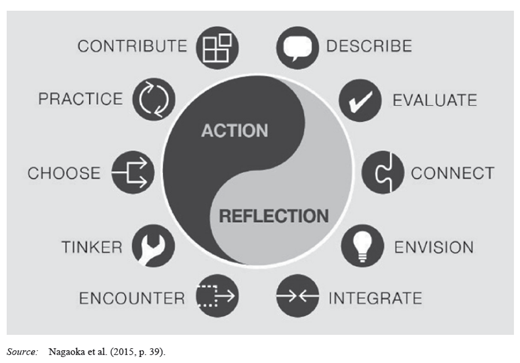
Emerging from our review of evidence, a set of 10 “developmental experiences” was identified—five action experiences and five reflection experiences—that appear in the literature as critical mechanisms for transforming children’s daily experience into learning and becoming—and for developing a set of navigational tools grounded in both knowledge and wisdom, an adaptive orientation toward life, and the habitual good behaviors associated with “character.” Developmental experiences are defined here as activities that provide children and youth with the necessary conditions and stimuli to advance their development as appropriate to their age. I build upon Larson, Hansen, & Moneta’s (2006) concept of developmental experiences to identify opportunities for specific types of action and reflection that the literature suggests are the means through which young people build specific capacities and competencies. The developmental experiences model presented here draws from theoretical and empirical evidence that cuts across different disciplinary perspectives and theories of learning. Across this wide base of research, particular kinds of action and reflection experiences were repeatedly implicated as critical components of how learning happens. These developmental experiences are largely consistent, and in some cases overlapping, with the guiding principles in Berkowitz et al.’s PRIMED framework (Berkowitz, 2009; Berkowitz & Bier, 2014; Berkowitz & Bustamante, 2013; Burkowitz et al., 2017), but they shift the focus from contextual inputs or adult practices to what young people do and how they make meaning within those inputs and practices.
I argue here, in short, that youth become “good people” through developmental experiences that build their capacity to regulate their behavior, develop their understanding of the world, cultivate attitudes and beliefs that support their growth, and develop a set of values and a moral vision that can guide their decisions and actions. In this way, the concept of developmental experiences builds upon earlier theories of positive youth development that emphasized “developmental assets” as building blocks to healthy growth and development (Benson, Scales, Hamilton, & Sesma, 2006). Importantly, as is called out by Berkowitz and other youth development scholars, these developmental experiences are most powerful in the context of strong, supportive, and sustained developmental relationships with caring adults (Berkowitz et al., 2017; Li & Julian, 2012; Scales, Benson, & Roehlkepartain, 2011).
I focus here on broad lines of work that depict learning as experiential and social, as well as work that examines the underlying neurological components of learning. Though there is still perhaps far more we don’t understand about learning and development than we do, together these bodies of research suggest compelling courses of action for adults working with children and youth. This work is very briefly summarized here. For a fuller description of the evidence behind each developmental experience, see Nagaoka et al. (2015).
A long tradition of work in philosophy, psychology, and education emphasizes the critical role of experience in learning (Dewey, 1938/1969; Freire, 1970/1993; James, 1912; Kolb, 1984; Mezirow, 1985, 2000). Educational theorist David Kolb defined learning as “the process whereby knowledge is created through the transformation of experience” (1984, p. 41). This kind of direct experience—“the concrete, tangible, felt qualities of the world, relying on our senses, and immersing ourselves in concrete reality”—is one of the primary ways children perceive new information (Kolb, p. 41). But certain types of experiences provide richer
opportunities for development than others. Rich developmental experiences include those that put children in interaction with others (peers and adults); build strong and supportive relationships; and provide opportunities to play and explore, try on new roles and perspectives, publicly demonstrate new skills and competencies, and contribute to endeavors that are personally and socially meaningful.
Drawing from extensive research on how children learn and how habits are developed (e.g., Bransford, Brown, & Cocking, 2000; Ericsson & Charness, 1994; Lally, Van Jaarsveld, Potts, & Wardle, 2010), the developmental experiences model includes both active and reflective components. The active component of developmental experiences provides opportunities for children and youth to encounter, tinker, practice, choose, and contribute. Encountering involves exposure to a variety of people, perspectives, roles, and places. This includes opportunities to watch others and have access to models or exemplars. Encountering new ways of thinking and being and models of advanced practice are some of the primary ways youth take in information about the world and expand their sense of possibility (Halpern, Heckman, & Larson, 2013; Kolb, 1984; Vygotsky, 1978). The literature in this area suggests why the principle of modeling in the PRIMED framework may be important to character development, as well as to the critical role of mentors and role models noted in the principle of Relationships.
Tinkering involves extended and uninterrupted periods of time for children to explore their environments. Developing an understanding of how the world works requires opportunities to play around, take things apart, or try various solutions in a low-risk, low-stakes setting. Tinkering includes imaginative play in early childhood and experimenting with new personas in adolescence, both essential preparation for successfully taking on adult roles (Hughes, 1999; Schwartz, Cote, Arnett, 2005; Singer, Golinkoff, & Hirsh-Pasek, 2006; Weisberg & Gopnik, 2013). The research supporting tinkering as a developmental experience aligns with implementation strategies in the PRIMED framework, including the importance of a “safe environment” (Prioritization principle, subcategory of climate) and of “Opportunities for revising one’s work/efforts” (Intrinsic Motivation principle, subcategory of self-growth).
Practicing extends upon encountering and tinkering by providing the opportunity to build skills and competencies over time. There is strong empirical support for practice as a major factor in developing expertise (Bengtsson et al., 2005; Ericsson & Charness, 1994; Ericsson, Krampe, & Tesch-Romer, 1993; Winstein, 2014) as well as motivation for continued learning. Ultimately, practice prepares children and youth to be successful in future performance. The research literature on practicing lends support for Berkowitz and colleagues’ inclusion of “Practice” as a subcategory in the PRIMED framework and “role playing/practice” as an effective strategy under the Developmental Pedagogy principle.
Choosing fulfills children’s and youth’s basic psychological needs for autonomy (Deci & Ryan, 1985; Ryan & Deci, 2000), supports young people to feel in control of their own destinies, and fosters cognitive, moral, and social development (Assor, 2012; Erikson, 1950/1963; Stefanou, Perencevich, DiCintio, & Turner, 2004). Providing meaningful choices motivates further participation, setting up a positive developmental cycle (Zuckerman, Porac, Lathin, Smith, & Deci, 1978). The research on choosing provides further support for the principle of “Empowerment” in the PRIMED framework, as the practices of “shared leadership” and “democratic classrooms” provide opportunities for students to make meaningful choices.
Finally, contributing provides young people with opportunities to solve problems or bring into the world works of value to the self and others. Contributing is called out in several youth development models (Pittman, Irby, & Ferber, 2010; Zeldin, 1995), and cited as the “Sixth C” of positive youth development (Lerner, 2004).3 Contributing is important not only because of its altruistic aspects and its value to a community; making meaningful contributions that are valued by others also builds young people’s self-confidence and sense of competence (Hattie & Yates, 2014). For adolescents, opportunities to contribute help to integrate the moral and civic (and perhaps spiritual) components of identity and instill an ethic of giving back (Damon, 2008; King & Benson, 2006). This aligns with and helps to explain the developmental importance of the practices of “Opportunities for moral action” and “Community service/service learning” (subcategory of Service) in the PRIMED framework (Intrinsic Motivation principle).
It is through experience that youth develop the foundational components for success. But if experience is to have lasting benefit, it must be infused with meaning and integrated into one’s emerging sense of identity. Learning is accelerated and more readily transferred to other situations when one reflects on what happened, what worked, and what needs improving (Palincsar & Brown, 1984; Scardamalia, Bereiter, & Steinbach, 1984; Schoenfeld, 1983, 1985, 1991). The reflective component of developmental experiences provides opportunities for young people to make sense and meaning of their active participation by describing and evaluating their experiences and observations, connecting experiences to other things they care about, envisioning how an experience might inform or contribute to a desirable future, and, over time, integrating one’s developmental experiences into one’s self-concept and the “story” of oneself.
Describing and evaluating events and activities help children to “own” an experience and define it for themselves. Children build knowledge and vocabulary by talking about the world—and the more knowledge and vocabulary they build, the more able they are to participate in discussions about how things work (Huttenlocher, Waterfall, Vasilyeva, Vevea, & Hedges, 2010). For older youth, dialogue fosters close social relationships, helps youth figure out their values and perspectives, and creates the conditions for making substantive change as they “name the world” for themselves (Freire, 1970/1993, p. 88). Throughout the PRIMED framework are opportunities for describing and evaluating, including the emphasis in Prioritization on using “common language” and “providing opportunities for [self-]assessment and feedback for character/ SEL.”
Connecting is a fundamental cognitive process; the human brain thinks in terms of relationships, guiding the storage and retrieval of information and ideas into and from long-term memory (Bransford et al., 2000; Hattie & Yates, 2014). Creating connections not only helps to build cognitive understanding, but it also allows youth to direct and maintain their attention. Tasks that are connected to something a student values increases their interest, persistence, and performance of the task (Damon, 2008; Wigfield & Eccles, 1992). The importance in the literature of connecting as a developmental mechanism suggests why fostering “empathy” and using a “challenging/ meaningful/relevant curriculum” (Intrinsic Motivation principle) might be effective character education practices.
Envisioning is the act of imaging oneself in the future. Young people need opportunities to envision and construct concrete, positive futures for themselves that embrace their important social identities (Oyserman & James, 2011). This is particularly important where social stereotypes place limitations on the future expectations for marginalized subgroups (Espinoza-Herold, 2003; Oyserman & Fryberg, 2006). The literature on envisioning parallels the PRIMED framework’s inclusion of “goal setting/imagining possible selves” in their list of effective practices.
Integrating refers to the act of incorporating insights, nascent skills, and other “life lessons” into one’s larger sense of self in a way that expands a young person’s competencies and agency in the world (Erikson, 1950/1963; Moshman, 2005). Adolescents especially need opportunities to author their own life narratives (McAdams & Adler, 2010), particularly if their social identity is one for whom the dominant narrative is limiting or negative (Perry, Steele, & Hilliard, 2003). Integration moves a young person from a stance of “I did that” to embrace a larger implication for one’s identity: “I’m the kind of person who can....” Berkowitz and colleagues’ inclusion of the “use of reflection (especially moral)” as an effective practice in the PRIMED framework (Intrinsic Motivation principle) is aligned with the evidence on integrating as a developmental mechanism.
In summary, developmental experiences are those which expose young people to new ideas, people, and perspectives, demonstrations of expert performance, and models of high quality work to emulate (encounter); provide opportunities to engage in hands-on learning (tinker); offer extended time to rehearse, role play, and develop competencies (practice); make consequential decisions about one’s time, activities, and modes of expression (choice); and make meaningful contributions to causes beyond the self (contribute). In addition to these five action experiences, the literature points to five important reflection experiences. These include opportunities to “name the world” and assert one’s perspective (describe and evaluate); draw parallels between new ideas and experiences and other things one cares about (connections); and imagine one’s future life and self (envision). Finally, developmental experiences provide opportunities for young people to weave together their many social identities into a larger sense of themselves that can propel them forward (integrate). Developmental experiences thus set the stage for acting with agency in the world. Indeed, “when a concrete experience is enriched by reflection, given meaning by thinking, and transformed by action, the new experience created becomes richer, broader, and deeper” (Kolb & Kolb, 2009, p. 309).
Empirical evidence and rich theory suggest that these developmental experiences are important mechanisms by which character is developed. By augmenting studies of the effects of specific practices in character education with an equal attention to empirical and theoretical work about the mechanisms of character development, researchers can move the field substantially farther and make richer contributions to practice in schools, communities, and families.
Notes
Invited paper for the National Academies of Sciences, Engineering, and Medicine Workshop on Defining and Measuring Character and Character Education, July 26-27, 2016. The developmental experiences theory highlighted in this paper was developed by the author through a project generously supported by The Wallace Foundation, originally published in Foundations for Young Adult Success: A Developmental Framework (Nagaoka et al., 2015), a report by the University of Chicago Consortium on School Research.
For example, being a competent voter draws on knowledge of the political process, knowledge about issues and candidates on the ballot, communication skills to engage in dialogue with others to come to a deeper understanding of these issues, critical thinking about the pros and cons of particular positions, knowledge about when and where to register and to vote, and self-management to ensure that one gets oneself to the polls.
The Five C’s of positive youth development are competence, confidence, connection, character, and caring (Lerner, Fisher, & Weinberg, 2000).