Given the ubiquity of youth sport, it has the potential to impact character development among millions of American youth. However, findings about the youth sport-character development relation have been mixed. Character education may be necessary to optimize the sport environment to promote character attributes. There is much knowledge of what works in character education within schools, but less is known about character education in interscholastic sports. In this study, we examined athletics directors’ (ADs) perspectives of a sport-based character education program from Positive Coaching Alliance (PCA) implemented through their high school athletics departments. ADs discussed factors that mattered for implementing PCA programming, as well as perceived effects of PCA programming among their high school coaches and athletes. Our discussion integrates findings from this study with previous knowledge about effective character education programs in schools. With the goal of using ADs as informants who have expertise in interscholastic sport, findings from this study generated new hypotheses to be tested in future studies to further understanding of character education in sport.
About 70% of American youth participated in school- or community-based sports in recent years (Holt, 2016; Sabo & Veliz, 2008; Vandell, Larson, Mahoney, & Watts, 2015). Sport is discussed as a setting to promote positive youth development (Holt, 2016). However, whether sport promotes character is controversial, such that some findings suggest that sport participation promotes character attributes, whereas others suggest the contrary (Bredemeier & Shields, 2006; Rudd, 2005). Mixed findings about the sport-character development relation may be largely due to the wide variation in the quality of sport programs.
Previous research overwhelmingly supports that high quality youth development programs promote the most positive youth outcomes (e.g., Yohalem, Wilson-Ahlstrom, Fischer, & Shinn, 2007). Universal features of high quality youth development programs include having a safe physical environment, as well as the presence of supportive relationships and positive social norms, to name a few (e.g., Eccles & Gootman, 2002). However, intentional efforts are necessary to ensure youth development programs are high quality. Thus, explicit curricula may be necessary to promote high quality sport programs, such as by promoting positive coaching behaviors, addressing conceptions of competition, and providing opportunities for character development (Bredemeier & Shields, 1986, 2006). In this study, we examine athletics directors’ (ADs) perspectives on the effectiveness of a sport-based character education program from Positive Coaching Alliance (PCA).
There is much knowledge of “what works” in character education in schools (Berkowitz, Bier, & McCauley, 2017), but less is known about character education in sport. In high school interscholastic sports, ADs have a significant influence on the goals, vision, and mission of the athletics programs. Thus, we conducted a focus group with ADs after they had engaged in PCA’s character education program implemented through their high school athletics departments. Accordingly, in this hypothesis-searching study (Cattell, 1966), the ADs served as a panel of informants who have been judged by school administrators to have sufficient expertise in interscholastic sport to be hired into positions of leadership of these programs. Our goal was to integrate the views of ADs who experienced PCA programming with what is known about effective character education in schools to present hypotheses about effective sport-based character education.
Character Development in Achievement Contexts: The Case for Sport
Given the plethora of knowledge of what works in character education in schools (Berkowitz & Bier, 2014), classroom settings might serve as a starting point for understanding character education through interscholastic sport. Sport is similar to classrooms because they are both achievement settings that provide opportunities for youth to develop competence (Duda & Nicholls, 1992). What distinguishes sport from the classroom is that participation is voluntary and occurs outside of the traditional school curriculum. Sport also differs from school because of the central focus on competition (Bredemeier & Shields, 1986). Sport by definition involves participating in a game in which there are winners and losers (Shields & Bredemeier, 2011).
The game component of sport matters considerably for youth character development. According to game reasoning theory (Bredemeier & Shields, 1986), some youth compromise moral principles and prioritize performance goals (e.g., winning) over mastery goals (e.g., personal improvement) because the game is not “real life.” In other words, some youth athletes engage in behaviors during sport that they know are not moral (e.g. intentionally injuring an opponent), but not in settings outside of sport. Thus, sport has the potential to promote or inhibit athletes’ character. We wish to elucidate ideas pertinent to the process through which the potential to promote character is instantiated by engaging with sport-based character education.
Character Education in Sport: What Works?
Positive youth development involves mutually beneficial exchanges between individuals and their environments, termed individual ⇔ context relations (Lerner, Lerner, Bowers, & Geldhof, 2015). Character development involves individuals positively engaging with their social world (Nucci, 2001, 2017). Thus, extending the positive youth development perspective, character development involves mutually beneficial individual ⇔ relations but, more specifically, positive individual ⇔ individual relations (Lerner & Callina, 2014). There are a variety of curricula to promote youth character development and many of them are situated within schools (Berkowitz & Bier, 2014). The most effective character education strategies are summarized in Berkowitz and colleagues’ PRIMED model (Berkowitz et al., 2017). According to the PRIMED model, character education must be Prioritized in the (educational) setting; Relationships should be proactively and strategically nurtured; Intrinsic motivation should be the primary motivational aim; Models of character should be readily available to students; stakeholders should be Empowered and supported; and the curriculum should be Developmentally appropriate. Together, the strategies in the PRIMED model represent optimal character education implementation (Berkowitz et al., 2017).
A widely used sport-based character education curriculum was developed by PCA, a national nonprofit focused on promoting character through youth sport (Thompson, 2010). Specifically, PCA’s mission is to “transform the youth sports culture into a development zone where all youth and high school athletes have a positive, character-building experience that results in Better Athletes, Better People” (www.positivecoach.org). PCA uses a partnership model to form relationships with athletics programs and jointly implement the curriculum with coaches and youth athletes. The PCA theory of change states that if (1) coaches and athletes engage with PCA programming; then (2) coaches will become double-goal coaches who focus on winning and life lessons, and athletes will become triple impact competitors who focus on contributing to a better self, better teammates, and a better game; and in turn, (3) athletes will contribute positively to society. PCA programming involves coaches and athletes participating in separate 60- to 90-minute workshops, which highlight principles to promote athletes’ character development, reading a book about PCA principles of character, and coaches and athletes engaging in weekly talking points about specific character-focused scenarios in sport. The purpose of this study was to use PCA as an example case to generate expertise-informed (AD-informed) hypotheses for future studies (Cattell, 1966) that could enhance our understanding of the processes involved in successful sport-based character education.
In theory, PCA’s mission and curriculum align with the PRIMED model of character education. First, PCA’s mission of developing double-goal coaches is to encourage coaches to Prioritize the development of character attributes (i.e., life lessons) alongside the goal of winning. Second, nurturing relationships is crucial for PCA, such that the coach-athlete relationship is central to fostering character development in young people through the sport context. Moreover, PCA provides tools (e.g., talking points) to support coach facilitation of positive communication about character virtues with athletes. Third, PCA’s approach is to allow extrinsic motivations, such as an emphasis on performance goals (e.g., winning), but to simultaneously elevate Intrinsic motivations (e.g., personal improvements) to be of equal emphasis within the sport arena. Fourth, to achieve their mission and goals, PCA trains administrators, coaches, and parents to be positive and approachable models of character. Fifth, PCA seeks to empower stakeholders by giving ADs, parents, and coaches a voice in determining the focus of curriculum content. Finally, PCA provides developmentally appropriate curricula by tailoring their curriculum content and delivery approaches depending on the particular set of youth athletes who participate in particular sports. In this study, we examine the alignment between ADs’ perspectives of how PCA was delivered in practice and the elements of the PRIMED model.
Summary and Study Goals
To our knowledge, there are few, theory-guided studies of sport-based character education. We used qualitative methods to explore ADs’ perspectives after engaging with PCA programming in their high school athletics programs. Understanding ADs’ perspectives of PCA programming provides a starting point for generating hypotheses about processes involved in sport-based character education. Our hope was that this “hypothesis seeking” study (Cattell, 1966) will generate new hypotheses about the process of sport-based character education to be tested in future studies.
Method
This study was part of a larger evaluation of PCA (Ettekal, Konowitz, Agans, Syer, & Lerner, 2017). The larger evaluation, which took place from the fall of 2014 until the spring of 2017, involved a longitudinal examination of youth athletes’ character attributes. Prior to fall 2014, the ADs at four Boston area high schools were approached by a staff member from PCA and offered free PCA programming in return for participating in a research study. The ADs had no prior experience with character education programs. Utilizing a waitlist control design (Maholmes & Lomonaco, 2010), two schools received PCA programming during the first year, whereas the other two schools waited to receive PCA programming until the second year; all four schools received PCA programming during the third and final year. The ADs were not originally enrolled as participants in the study, but helped the researchers coordinate recruitment and enrollment of athletes and coaches from their high schools. ADs also helped PCA implement the curriculum (e.g., scheduling PCA workshops). At the time of the focus group, the results of the larger evaluation study (i.e., whether PCA promoted athletes’ character development) were not yet revealed.
Participants
We briefly describe the demographics of the ADs and schools, but some details are excluded to maintain anonymity. There were four ADs (both genders represented), each with at least five years of experience as an AD. We refer to the ADs using the following pseudonyms: Devon, Alex, Jordan, and Avery. All four ADs had graduate degrees in either educational or athletics administration. The four ADs were about the same age (mid-30s to mid-40s). The four high schools each served ninth through twelfth grade and were in the Boston-area suburbs. Two of the schools had mostly White students (i.e., >75%), whereas two of the schools had students who were ethnically diverse (i.e., 60% Black and 40% Hispanic youth). The four high schools varied in size with 697–1,686 students enrolled. We purposefully do not identify which ADs belonged to which schools to maintain anonymity.
Procedures
In the fall of 2016, the ADs were invited to participate in a focus group about their experiences with PCA programming. The focus group took place at a public restaurant during the day and was audio-recorded for later transcription and analysis. There were two researchers present to moderate the focus group using a semistructured interview guide. The two researchers had been involved in the larger evaluation study from the outset and maintained positive relationships with the ADs throughout the study. The researchers were understood by the ADs and student-athletes to be separate entities from PCA (i.e., not representatives or employees of PCA) by verbally declaring their representation as their university affiliation and by wearing university-affiliated attire during their interactions. The interview format was divided into four sections: (1). What do you think about character development through sport?; (2) Do you value PCA’s mission?; (3) How did you implement
PCA in your school?; and (4) Did you perceive any changes among your coaches and athletes as a result of participating in PCA programming? The focus group lasted approximately two hours and each AD received a gift card for his/her participation.
Analysis Plan
The research team used a combination of deductive and inductive approaches (Thomas, 2006). The team conducted a qualitative content analysis (Hsieh & Shannon, 2005) with primary and secondary data coding (Ryan & Bernard, 2003). The analysis was led primarily by the first and second authors of this paper, but all authors were involved in interpretation and resolving discrepancies. Data coding proceeded in several steps. First, three of the authors read the entire transcript and took notes on major themes. The themes identified during note-taking loosely corresponded with the four primary sections of the interview. The first and second author each coded the entire transcript for the primary themes in Microsoft Word using the comment function in track changes. The authors revised the primary coding until they were in 100% agreement. Second, the first and second authors read each of the primary themes and wrote memos for emergent secondary themes (Emerson, Fretz, & Shaw, 1995). After deciding on secondary themes, the first author coded all excerpts and a reliability check was conducted on 20% of the excerpts by the second author. Team members wrote integrative memos of their reflections on codes and relations among the codes during the entire coding process (Emerson et al., 1995). Finally, the researchers created data displays in Microsoft Excel to examine patterns of topics that emerged (Miles & Huberman, 1994).
Results
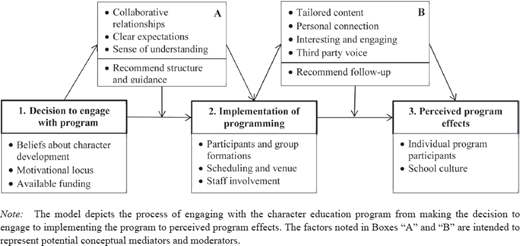
As shown in Figure 1, the focus group unveiled six primary themes. Three of the themes were deductive, including the decision to engage in PCA programming (Box 1 in Figure 1), how PCA programming was implemented (Box 2 in Figure 1), and whether there were any perceived effects of PCA programming (Box 3 in Figure 1). Two themes were inductive, including factors that mattered for how well the program was implemented (Box A in Figure 1), and factors that might promote or inhibit the effectiveness of PCA programming (Box B in Figure 1). The Boxes labeled “A” and “B” are shown in the figure as potential conceptual mediators or moderators that could be tested analytically in future studies.
Deciding to Engage With Character Education
As shown in Figure 1 (Box 1), the first step was deciding to use PCA programming. Three factors mattered for the decision to use PCA programming, including ADs’ beliefs about character, ADs’ motivational locus, and funding availability. First, all ADs expressed positive beliefs about character suggesting that character development “is important” or that character is “a part of sport.” The attributes used to encapsulate character in sport included “respect,” “pride,” “citizenship,” and “gratitude.”
Next, ADs were largely externally motivated to engage with PCA, namely for “professional development” purposes. The ADs discussed how there were high standards for professional development because they were athletics programs within educational settings. For example, Jordan said, “They were hammering down on the coach education piece at the MIAA [Massachusetts Interscholastic Athletic Association]. So when I received the call I thought this is a great opportunity for professional development.” Similarly, Avery said, “It sounded like it could be a supplemental program to help me give my coaches professional development.” Alex agreed, “It looked good for your program to be a part of it, to be affiliated with successful schools, to align ourselves with quality programs.” In short, the primary motivation to partner with PCA was to fulfill a professional development requirement, but also because it “looked good” to utilize character education.
Finally, ADs did not have funds available to purchase a character education curriculum. Avery said, “I wouldn’t take away anything right now that I currently do to bring this in. We’re shoestring enough and we just need basic essentials (e.g., equipment, transportation to/from competitions).” Alex said he would if he “could get funding to do it.” Thus, ADs at public schools must also conduct a cost-benefit analysis when making decisions about the feasibility of engaging with character education programs through interscholastic sport.
Implementation
As shown in Figure 1, the ADs discussed their experiences implementing PCA programming. We have organized this section to first discuss logistical considerations for implementing PCA programming and then we highlight factors that may matter to facilitate successful implementation. Finally, we present ADs’ recommendations for implementation.
Logistics of Implementation. The ADs discussed three factors related to implementing the PCA program (Box 2 in Figure 1), including staff involvement, scheduling issues, and identifying target participants. First, the ADs noted that they had little or no administrative support suggesting “I didn’t really have any help,” or “I did it myself.” Devon said, “I used my secretary to be present in some of the sessions. As far as communicating, I would just send the email to whatever team it might be to attend their session.” Although one AD had some administrative support, the ADs agreed that implementing a curriculum through athletics was particularly difficult because they did not have enough personnel support, and there were many “layers of control” that need to be penetrated to reach athletes directly (e.g., coaches).
Second, high school athletics function on a strict calendar set by the state athletics association which stipulates when teams can be selected, when first practices can occur, and when games will occur throughout the season. Thus, adding a curriculum to the already complex calendar of high school athletics was “problematic schedulewise” or “a great idea on paper that was more difficult to execute.” All ADs agreed that scheduling the PCA workshops needed to be more flexible and more amendable to high school athletics calendars.
Third, the ADs discussed how PCA’s design allowed them to choose which individuals and groupings would receive the curriculum. Overall, the ADs agreed that the curriculum content was more suitable for younger athletes. For instance, ADs said PCA programming was “really geared for youth” or “geared a little too much toward youth sport.” Avery suggested “if we can start at the youth level, they’ll be familiar with it when they get to the high school program.” Then, when athletes get to high school, Alex said, “Why not do it with the freshmen? What happens is the freshmen see how the JV [junior varsity] act and react. Then they move to JV and they watch the varsity.”
A developmental progression may be necessary for athletes, but ADs agreed that the curriculum was most important for coaches and administrators. Alex said:
The system comes from the leadership of an AD to show its coaches, student athletes, families, and school community we want to have things done in a positive manner. If our coaches listen and implement it, then I think we have a much better success rate in teaching our student athletes.
Indeed, ADs agreed that coaches were essential targets for character education. Jordan said, “I think where PCA would find the most influence is if they really dug their heels in with the coaching staff.” Similarly, Alex said “I look at [character] more so with my coaching staff than I do the kids because I expect a lot more out of the coaches than I do out of the kids because they are adults.” Together, these findings suggest that flexibility in implementation is necessary to deliver PCA programming effectively with high school athletes, coaches, and administrators.
Factors to Optimize Implementation. The ADs discussed three factors that would assist them in implementing PCA programming effectively and efficiently in their athletics programs, namely their expectations for PCA, their partnership with PCA, and feeling understood by PCA (Box A in Figure 1). First, the ADs did not have clear expectations about the curriculum. The ADs suggested that “nobody knew what to expect” or “had a ton of expectations going into it.” Avery said, “For us, it was trying to delineate or affiliate what PCA was really trying to get accomplished. Okay, we’re doing these workshops, but what does this really mean?” Similarly, Jordan said, “I’m not really sure what their overarching goal was.” For some ADs, they did not understand what it would look like to implement the program in their school. Avery said, “I had no knowledge of PCA at all and I didn’t quite know, even after talking to them, what this was gonna look like. I still don’t know.” The ADs thought that one way to clarify the expectations and to ease the transition into a partnership with PCA would be to have a local athletics director, who was both familiar with the PCA program and the responsibilities of an AD, serve as a mentor or local sponsor for the school.
Next, how the AD viewed his/her relationship with PCA mattered for implementation. The ADs viewed PCA as a “resource or facilitation,” rather than a collaboration or partnership. The ADs felt as though PCA was not invested in the school and was “more of a guest.” Avery wanted PCA to be more present in the partnership saying, “I just felt like we were kind of in a pocket over here, let’s see what we can do with this group and then that’s it.” ADs did not view the relationship as collaborative, but viewed PCA as a resource to call upon when needed. When juxtaposed with the ADs’ expectations, it is possible that viewing PCA as a resource could have led to their lack of use of programming.
Finally, the ADs thought PCA needed a better understanding of the high school context and how it differs from recreational youth sport. Jordan said, “It’s not like an AAU [Amateur Athletic Union] program, it’s not like a travel program, it’s not like a club program. It’s high school athletics, educational athletics.” Alex discussed the hectic lives of high school athletes saying, “These kids nowadays are going out working five hour shifts after they go to practice until 10 o’clock at night. Then they’re up until 2 in the morning doing homework. Their schedules are really busy.” Jordan agreed that, “Besides coaching, whether they’re a teacher or working insurance, they have a lot of demands. They may only have a short window of time. Leading into a season, every minute counts in trying to be with their team.” The ADs thought PCA staff should have a clear understanding of high school athletics and be considerate of the context when planning program implementation.
Recommendations. To ease implementation, the ADs thought it would be helpful to have a “menu of options” from PCA to know the possibilities for the curriculum. Alex also thought more guidance with planning was needed:
It may be best if PCA put out a syllabus that said “you’re gonna have your workshop on this day … then you should do a talking point … then you should follow it up with this.” It just gives you a schedule to look at and you can cater it to your own specific needs.
Thus, along with a clearer description of the possible options for PCA programming, the ADs thought it would be helpful to have a “syllabus” to help guide them through program implementation.
Program Effectiveness
The ADs discussed several factors related to program effectiveness. First, the ADs discussed any perceived effects they saw from participating in PCA programming. Next, there were several factors identified that may inhibit or promote program effectiveness. Finally, the ADs offered recommendations related to enhancing program effectiveness.
Program Effects. The ADs discussed two areas of program effects, namely effects related to participants directly receiving the program and to the culture of the school (Box 3 in Figure 1). First, the ADs thought PCA programming was mostly effective to reinforce existing beliefs. Devon said, “I think it was helpful in a sense that it gave coaches a reassurance that they were doing some correct things.” Moreover, PCA programming provided a shared language to speak about character. Coaches and athletes were able to “associate character with acronyms and terms.” Perceived behavior change was larger among coaches than athletes. For example, Alex noted an increase in “the collegiality of the coaches,” suggesting that, “I mean there’s discussion that never took place. It’s not only male to male coaches, it’s male to female coaches.” The ADs did not see large changes among athletes, but thought that it “instilled in them to be confident about what’s going on, speak up when there might be an issue, and take care of one another. The emotional support the peers were providing for peers was actually pretty cool.” In sum, the ADs believed that PCA programming was largely effective in reinforcing existing beliefs about character and providing terminology to discuss character in sport.
Although the ADs noted some small individual effects, they did not see a change to the culture of their schools or athletics programs. ADs had unique goals to create specific cultures for their schools and did not want to bring in PCA to create a new culture. Rather, ADs preferred to integrate the “PCA Way” into their own school cultures. For example, Jordan thought “There were definitely some things that could be pulled, but I wouldn’t say our identity was a PCA school. I wouldn’t really say that that’s where we were at.” Devon agreed saying, “I really didn’t create an overall culture to say okay this is the philosophy we’re gonna be following.” Although these ADs thought that PCA could contribute positively to their school cultures, they did not think that PCA defined their school cultures.
Factors to Optimize Program Effects. There were multiple factors that mattered for program effectiveness, including tailored content, personal connections, interesting and engaging format, and third party voice (Box B in Figure 1). First, ADs thought that tailored content would be more effective for their athletes than universal content. ADs disliked a “one-size-fits-all” approach. Many of the ADs had particular areas (e.g., social media, hazing) they wanted to target with PCA programming because “every year you have a different group of kids with different challenges.” Devon thought PCA needed “a little bit more prior knowledge about what the school needs.” There were instances in which the ADs communicated with PCA about their particular programming needs, such as Devon who said, “I gave three bullet points of things that I was interested in and they covered it. It was awesome.” The ADs wanted to tailor the program to their schools, but also to specific teams. For example, Alex said, “I would break it down team by team. When you have those discussions, kids can be frank with each other because they’re gonna be side by side on the field or on the court.” ADs’ perspectives suggest that universal programming may not be as effective for their schools as tailored programming.
Next, the ADs thought it was important for PCA to make personal connections with the athletes in their schools. For example, Avery said, “They got a lot of powerful people on their boards, but how do we connect to that?” He went on to say, “I think they have national outreach, but if they could find a way to make it more local so that we all can get our connection, it would be better.” Alex agreed that “there’s gotta be some thought process as to how we can intertwine who the spokespeople are for PCA and the message that they’re trying to get out to the high schools.” Making this intentional connection with high school athletes was exemplified by Avery when he said: “We had a female [from PCA] who’s African American, who was an athlete. Our girls saw her and heard her story, which was more powerful than anything I could have ever put together.” The ADs underscored the importance of connecting with high school athletes.
Third, PCA’s message needed to be delivered in an interesting, engaging, and interactive format. ADs thought the workshops were “repetitive” and “too long to keep the athletes’ attention.” For example, Alex said, “To be honest, I was pretty burnt out on this. I didn’t really feel like the workshops were changing our kids or coaches a whole lot. It came across as very repetitive at times.” Jordan agreed saying “If it’s hearing the same exact message multiple times, it almost becomes counterproductive at some point. It feels more like a waste of time.” ADs thought that more discussion in the athlete workshops would be beneficial, such as Alex who said, “The kids are more talked to in the workshops, whereas the coaches are more discussion oriented. I think the kids need discussion.” The workshops also needed to be short, which was stated succinctly by Avery who said, “I asked him not to be too long winded because they’re gonna tune out after a while. So I asked him to hit on each point real quickly. And he did that. It worked.” Thus, discussion-oriented workshops which are less repetitive and shorter may contribute to a more interesting, engaging, and interactive workshop format.
Finally, ADs thought one of the most valuable parts of PCA was having a third party voice convey the message. Devon said, “it’s a different voice than my own. I’ve been saying [character is important] for the last 3 years, but it’s better than hearing me speak over and over again.” Alex agreed saying, “there’s times when you bring someone else in to reinforce that fact that it’s a different face, it’s a different view, it’s a different voice. I think it’s that addition to the curriculum that worked.” Having a third party deliver a message about character development helped reinforce the messages the ADs were already sending.
Recommendations. To optimize the potential for program effects, ADs wanted more follow-up from PCA, particularly with the coaches. ADs thought PCA was not engaged with the school deeply enough and, as Jordan said, there was “definitely a lack of support or follow up with the coaches about these kids.” Avery described how the lack of follow up from PCA “left them hanging:”
The other thing was the follow up for the coaches. After it was over, some of my coaches questioned what they got. We had the meeting in the beginning, but thought there would be some follow up with the coaches at the end of the season and that wasn’t there.
Continued follow-up from PCA would help the ADs assess how well the program worked and make decisions about moving forward with the program.
Discussion
Sport is a setting known to promote positive youth development (Holt, 2016). However, findings about whether sport promotes character are mixed (Bredemeier & Shields, 2006; Rudd, 2005), likely due to the wide variation in the quality of sport programs. Thus, character education may be necessary to ensure high quality sport environments that promote character attributes. Although there is much knowledge of effective character education in schools (Berkowitz et al., 2017), little is known about character education in interscholastic sport settings. The purpose of this study was to examine ADs’ perspectives of PCA’s programming and to generate hypotheses (Cattell, 1966) about the process involved in sport-based character education. Our hope is that this hypothesis-generation process can lead to ideas that will be tested in various, specific ways in different sport-based character education programs.
Character Education: Considerations for Interscholastic Sport
This study was grounded in the current state of character education in schools, in particular, the PRIMED model of prioritizing character education, building positive Relationships, fostering Intrinsic motivation, being positive role Models, Empowering all stakeholders, and providing developmentally appropriate pedagogy (Berkowitz et al., 2017). We discuss our findings in the context of the PRIMED model in order to extend what is known about character education in schools to character education in interscholastic sport settings.
Prioritizing Character Education. For character education to be effective, character must be authentically prioritized (Berkowitz et al., 2017). The ADs in this study believed character was important, but did not seem to prioritize character in their athletics programs. Practically, the lack of character prioritization may have been because ADs did not have a clear understanding of PCA programming and were not trained well enough to maintain the programming after PCA personnel left the school. Thus, a primary focus among ADs might be how to prioritize character rather than whether to prioritize character. Prioritizing character in sport may involve reconceptualizing the definition of competition. Competition may be viewed through a metaphor of war (e.g., a battle to be won) or through a metaphor of partnership (e.g., an interdependent activity to support shared goals; Shields & Bredemeier, 2011; Shields, Funk, & Bredemeier, 2016a). We hypothesize that reconceptualizing the definition of competition to focus on partnership will lead to greater prioritization of character in sport.
There is evidence that athletes’ orientation to competition matters for character attributes, such that partnership orientations predicted increased sportpersonship (Shields, Funk, & Bredemeier, 2016b), decreased moral disengagement (Shields, Funk, & Bredemeier, 2015), as well as increased grit (Shields, Funk & Bredemeier, 2018). Developing a partnership orientation to competition involves appreciating the role of the opponent, which PCA approaches by using the Latin root of the word competition, that is “to strive with,” as opposed to the common understanding of competition meaning “to strive against” (Thompson, 2010). However, athletes need to learn the partnership concept and, as well, practice the partnership approach in context. As the concept of orientations to competition is relatively new to the literature (e.g., Shields & Bredemeier, 2011), learning how to develop partnership orientations may be a promising line for future research.
Building Positive Relationships. Effective character education involves building and nurturing positive relationships (Berkowitz et al., 2017). PCA’s model of character education is largely focused on developing positive relationships between coaches and athletes. However, findings from this study suggest that the relationship between PCA and their partner organization (i.e., ADs in the current study) is also essential to authentically engage with PCA programming. Our findings suggest that ADs did not view their relationships with PCA as a partnership or collaboration, but rather as a resource. Moreover, ADs did not have clear expectations of the partnership from the outset and wanted more follow-up and presence from PCA in their schools. We hypothesize that collaboration, clear expectations, and follow-through will predict strong and positive relationships among the organizations offering character education and the administrators involved in implementing the curriculum in their schools.
An approach to relationship-building in sport was presented by Blom and colleagues (2015) in the RESPOND model. RESPOND involves codeveloping relevant, empowering, sustainable partnerships that promote local opportunities, networks, and development (Blom et al., 2015). Our findings suggest that sport-based character education should be relevant to athletes and coaches, be empowering for the coaches and athletes to engage with the curriculum, be sustainable through follow-up visits and continued consultation, and provide additional opportunities for growth in the school and athletics program. Specific strategies to enhance partnerships include (1) emphasizing shared leadership with regard to content, context, expertise, and resources; (2) encouraging reciprocity, validation and trust; and (3) establishing clear expectations and roles at the outset (Blom et al., 2015). Future research should test how and which relationships foster successful integration of character education in sport.
Fostering Intrinsic Motivation. Character education should use strategies that promote internalization of specific character attributes the initiative targets (Berkowitz et al., 2017). In this study, ADs’ intrinsic motivation to engage with PCA was lacking and there were no clear strategies for improvement. That is, ADs engaged with PCA largely for free professional development and a positive image. Moreover, ADs’ demanding responsibilities and limited resources constrained their time and ability to authentically devote their athletics programs to character education. We hypothesize that intrinsic motivation to engage with character education is especially important when the external constraints on administrators to implement the curriculum are high. Explicit strategies are needed to foster intrinsic motivation among ADs.
A strong predictor of intrinsic motivation is an individual’s goal orientation, such that a mastery orientation (e.g., focus on personal improvement) is associated with higher intrinsic motivation than a performance orientation (e.g., focus on winning or looking good; e.g., Ferrer-Caja & Weiss, 2000). Thus, a promising approach to increase ADs’ intrinsic motivation and subsequently, coaches’ and athletes’ intrinsic motivation, may be to shift the focus away from the positive image a character education curriculum provides for a school and toward the positive effects individuals experience from character education. However, more research is needed on the positive effects of character education in sport. Moreover, as sport is a dual-goal setting focused on winning and life skills (e.g., Gould & Carson, 2008), future research should also disentangle the relation between the development of character attributes and performance outcomes (e.g., winning records).
Positive Role Models. Adults should model their expectations of youth for character education to be effective (Berkowitz et al., 2017). The ADs in this study suggested that coaches are the most important role models for athletes and, thus, should be a primary focus of PCA. Indeed, just as teachers are important for character development in schools (Berkowitz et al., 2017), coaches are highly influential role models for youth athletes’ character (Ferris, Ettekal, Agans, & Burkhard, 2015). A challenge may be that coaching behaviors are difficult to change, perhaps because of the prevalent focus on winning in sport. For example, positive coaching behaviors diminished among coaches who were evaluated based on their athletes’ scoreboard performance (Iachini, 2013). Thus, athletics administrators will also have to shift their standards away from strictly performance outcomes in order to promote positive role modeling among coaches. Nevertheless, coaches should resist the pressure of using ineffective practices, such as focusing on winning and scoreboard results, and prioritize character in their coach practices. We hypothesize that defining success in athletics programs based on character outcomes, as well as winning, will lead to more positive role modeling in interscholastic sport.
A strategy for positive role modeling may be found in the power of a common language. For example, ADs in this study thought PCA’s terminology was “sticky” and useful for coaches and athletes to identify and practice different character attributes. However, this finding was also coupled with some ADs’ perceptions that the programming and some of its terminology was more geared toward younger athletes. Thus, a shared language can provide a way of promoting positive role modeling, but coaches and athletes should be empowered to develop their own language that is most relevant to their teams and athletes. A shared language that is developed, celebrated, and practiced by coaches and athletes may promote positive role modeling within the sport environment, as well as carry over to other settings, such as athletes’ classrooms.
Empowering Stakeholders. Effective character education programs share power with stakeholders (Berkowitz et al., 2017). In this study, ADs did not perceive stakeholders, such as themselves, coaches, or athletes as having a voice in the programming. ADs largely experienced a universal program implemented in a “one-size-fits-all” format. Previous research suggests that youth programming that is tailored to an individual’s or group’s specific needs is more effective in promoting empowerment than universal programming (Simpkins & Riggs, 2014). ADs in this study suggested that PCA made few personal connections with their athletes, but when personal connections were made, they were very powerful. Therefore, we may hypothesize that involving stakeholders in determining what type of programming is needed, how to deliver the program, and to whom to deliver the program will lead to more effective character education in sport.
Culturally responsive organized activity systems provide an excellent framework to provide programming which empowers the stakeholders and gives the individuals involved in the program a voice (Simpkins, Riggs, Okamoto, Ettekal, & Ngo, 2016). Our findings suggest that ADs did not want to impose a new PCA culture on their school, but rather wanted to integrate PCA into their own cultures. Integrating an existing curriculum into a school’s culture involves listening to the specific youth about their needs and preferences, and using methods of delivery that are important and useful to those specific youth. Stakeholders (e.g., community members, teachers, coaches, parents, and youth) have important knowledge about the specific character needs, of the specific youth athletes served, in the specific types of sport, and in specific historical times. We hypothesize that tailoring character education to this “specificity” in sport (cf. Bornstein, 2017) will promote stakeholder empowerment.
Developmentally Appropriate Programming. Pedagogy should be developmentally appropriate in effective character education (Berkowitz & Bier, 2014: Berkowitz et al., 2017). Many of the ADs in the current study thought PCA’s programming and terminology was geared toward younger youth. Moreover, the ADs thought PCA workshops needed to be more interesting, engaging, and interactive for high school athletes. As the ADs noted, one size does not fit all and they preferred programming that matched the developmental phase of their high school athletes. A primary psychological need of adolescence is to feel a sense of belonging and mattering (Deci & Ryan, 2011). One way to promote athletes’ belonging and mattering is to give them a voice in the programming they experience. In this study, athletes had little or no voice in the curriculum content they experienced (e.g., what character attributes they focused on), where the curriculum was delivered (e.g., in a classroom versus on the field), or how the content was delivered (e.g., lecture versus discussion-based approaches). The ADs felt that PCA did not fully understand their high schools or the demands of high school athletes. We hypothesize that top-down approaches to character education, such as by implementing programming in which only adults have voice, will lead to decreased effectiveness.
The ADs also wanted programming to be provided in a developmental progression (e.g., new compared to returning athletes). Developmental needs should be considered, but also the specific needs of an athlete along a specific trajectory in their sport involvement. There are multiple pathways of sport involvement marked by if and when an athlete specializes in sport (Côté, Baker, & Abernathy, 2007). According to the developmental model of sport participation, sampling multiple sports early and continuing recreational play promotes increased performance, enjoyment, and personal development, whereas early specialization promotes increased performance, but at the cost of athlete enjoyment and burnout (Côté, et al., 2007). We suggest that successful character education programming may necessarily depend on the developmental phase of sport engagement. For example, specialized athletes and highly competitive coaches may be more resistant to changing their orientation to competition than recreational athletes and coaches. A clear hypothesis, then, is that character education in sport should align with youth developmental phase, as well as their pathway of sport involvement.
Conclusions
Derived from knowledge about effective character education in schools (e.g., Berkowitz & Bier, 2014), the current study sought to examine ADs’ perspectives of PCA’s sport-based character education program and to generate hypotheses (Cattell, 1966) about the process involved in sport-based character education. As we have noted, future tests of the hypotheses we have generated will require testing through use of specific operationalizations and associated measures linked to the general constructs identified in the hypotheses. Nevertheless, a contribution of the present study is to point future researchers to several key constructs and hypothesized associations between constructs that require further refinement in diverse sport-based character education programs. Importantly, such future tests should also involve tests of causality. The data involved in the current article reflected retrospective accounts of ADs’ engagement with a character education curriculum in their high school athletics programs. Thus, we did not test causal effects of character education in sport on athletes’ character. Next steps involve integrating the hypotheses generated in the present research into a model of the process of engaging with sport-based character education. Evidence derived from such theory-guided research may promote successful implementation and effective character education in sport.
Character development through sport is not certain and may require intentional efforts to shift away from a focus on performance goals (e.g., winning) and, thus, to prioritize character (Bredemeier & Shields, 2006). The hypotheses generated from the ADs’ views point to several facets of a process that may need to be instantiated for character education in sport to be effective. Key findings include the need for positive and collaborative relationships between athletics administrators and organizations offering sport-based character education, tailored programming that incorporates stakeholders’ (e.g., coaches, parents, athletes) input, and positive change and modeling of character at the “top” (i.e., administration) in order to promote change on the “bottom” (i.e., coaches and athletes). Moreover, reconceptualizing athletics administrators’, coaches’, and athletes’ orientations to competition was a common theme, such that a partnership orientation to sport may help promote engagement with character education and increase its effectiveness. Learning more about the view of ADs, and other key informants, is important to create effective character education programs in sport settings. Future research should test the hypotheses presented in the current study and, as well, pursue additional questions concerning the effectiveness of sport-based character education.