With millions of youth involved in sport in North America and across the world, the potential positive impact for good that sport coaches can play in the development of moral character in their players and teams is significant. Yet, there is limited empirical data on the effectiveness of the design and integration of youth sport coach character development programs (Ettekal et al., 2017, 2018; Ferris et al., 2015; Holtzclaw et al., 2019). Despite the long-accepted notion that sport builds positive moral character, there is a trend of socio-negative/ anti-social behaviors in young athletes involved in sport (Anderson, 2010; Shields & Bredemeier, 2011; Shields et al., 2015a, 2015b; Vella, 2019) which may justify the need for empirically driven coaching for character education programs. We have created an innovative evidence-based coach training program that we are excited to share in this article called PRIMED for Coaching for Character (PCC).
In depicting where the youth sport landscape stands in regards to character and character development, the following statement from two of the research thought leaders in the field of character education in sport provides framing and relevance: “The roots of sport in the fertile soil of play may dry up when exposed to the heat of competition, and our vision of the human and humane potential of sport may blur when our eyes are on the prize more than the process” (Shields & Bredemeier, 1995, p. 2).
The research on character development in youth and amateur sport over the past four decades has produced mixed and controversial findings (Anderson-Butcher et al., 2021; Bates & Anderson-Butcher, in press; Bredemeier & Shields, 2006; Ettekal et al., 2018) that oppose the long-accepted notion that sport participation inherently leads to positive character development [prosocial behavior] (Anderson, 2010; Boardley & Kavussanu, 2010; Bredemeier & Shields, 1986 & 2006; Holt, 2016; Shields & Bredemeier, 2011; Shields et al., 2015a; Vandell et al., 2015). The findings on negative effects can be evidenced through a trend of youth “quitting” sport prematurely in the United States (Beatty & Fawyer, 2013; Cote & Fraser-Thomas, 2008; Farrey, 2008), higher reported instances of burnout and overuse injuries-both physical and psychological (Burgess & Naughton, 2010; Cote et al., 2007; Cote Gilbert, 2009; Horton, 2013), or a quick internet search of the latest news headlines related to youth sports, as one will find countless stories that chronicle the lack of character from coaches, parents, administrators, and young athletes who mimic this behavior (McLaughlin & Lett, 2015; Rosenberg, 2016; Whiteside, 2014).
However, as a former professional athlete and youth coach of more than 25 years, and the Head of Leadership and Character Development at IMG Academy (the largest and most prestigious multi-sport youth academy in the world), I know that sport coaches can be highly effective character educators. With millions of youth involved in sport in North America and across the world, the potential positive impact that sport coaches can have in the development of character is significant. The relevant literature in coaching for character training programs over the past 40 years presents small but incremental progress in the effectiveness of sport coaching training programs geared specifically around the intentional focus on the moral domain of character development (Bates & Anderson-Butcher, in press; Falcao et al., 2012; Naylor et al., 2013). However, there is limited empirical data on the effectiveness of the design and integration of sport coach character development programs for youth (Ettekal et al., 2017, 2018; Ferris et al., 2015; Holtzclaw et al., 2019), and there are little to no accountability measures in place and touch points with many of the character interventions past the initial training sessions to keep coaches committed and thereby to avoid the “fade-out effect” (Bornstein, 2017; Ettekal et al., 2017; Ferris et al., 2015; Holtzclaw et al., 2019; Simpkins et al., 2017). The fade-out effect is a common occurrence with professional development trainings where the content received quickly wanes after the session. It is critical that coaches are provided effective, evidence-based training programs from which to influence their coaching behaviors and practices for character development, and the challenge for such trainings is how to make it stick.
With the goal of providing an effective, evidence-based coaching for character training program for coaches, one promising model to bridge the gap between coach practice and evidence-based character education is the PRIMED for Character Education framework (Berkowitz, 2021). PRIMED is grounded in decades of research around “What Works in Character Education” (Berkowitz & Bier, 2014). We have created an innovative coach training program that we are excited to share called PRIMED for Coaching for Character (PCC).
PRIMED for Character Education Framework
The PRIMED framework is the product of the accumulation of 40 years of dedicated service by Dr. Marvin Berkowitz and colleagues (and The Center for Character and Citizenship at the University of Missouri-St. Louis) to the field of character education in K-12 schools, and “nurturing the flourishing of goodness in kids” (Berkowitz, 2021, p. 3). In working with top character educators, practitioners, and behavioral scientists across the world, Berkowitz’s summative work throughout his career shaped the framework with the six interrelated design principles of PRIMED.
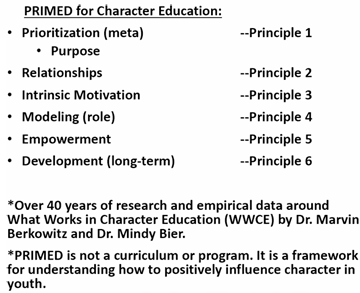
The PRIMED framework (Berkowitz, 2021) has “Six Design Principles for Effective Character Education” in schools (p. 30). For all six of the design principles, our PCC coaching program seeks to apply them to the sport landscape. The principles are defined as follows:
Prioritization: “Making educating for character development an authentic and salient priority in the mission, vision, policy, and practice of the school” (Berkowitz, 2021, p. 30). In applying prioritization of character to sport, this means it is more important than wins and losses when it comes to what our number one priority is as a coach of character. Are we as coaches concerned most with hoisting the championship trophy in the air at the end of the season, or raising up stronger character in our youth? Are we concerned most with the “bling” or this long-term development thing? A key strategy from PCC asks us to consider how we are going to proactively prioritize character building prior to practice or competition, as well as to reflect on how well we did so after each day. It is one thing for the head coach and the coaching staff to prioritize character development, but if the athletics director, the school, and the parents do not align with this priority, it will be an uphill battle. It is critical that all stakeholders are supportive towards the ultimate end goal of character building and the “R” in PRIMED emphasizes the importance of building those partnerships with all stakeholders.
Relationships: “Intentionally and strategically nurturing healthy relationships within and across all stakeholder groups” (Berkowitz, 2021, p. 30). In this case with sports, athletes (including those on opposing teams), coaches, administrators, parents, officials, fans, family, etc., should all be valued. Oftentimes, coaches tend to build strong relationships of trust with the star players and captains. However, it is important to cultivate such relationships with all players on the team, and others. When we talk about stakeholders, there are many individuals who go unnoticed and unappreciated. We have found that the most frequently left out group are parents and opposing players and fans. Do not shy away from reaching “across the field” so to speak to build healthy, collaborative rapport and trust with these constituencies. Having given hundreds of talks on character building through sports with coaches over the years, a common coach response that I get when I bring up partnering with parents is, “Well, I just don’t deal with parents.” This idea of “dealing” with parents is not the correct approach. If we (as coaches) work to partner with parents, rather than deal with them, we have found it to be a healthier and more effective support for the kids, as “it takes a village.” One strategy from PRIMED is what Berkowitz (2021) refers to as the “Champion of Character” initiative, where the entire school staff collaborates to create a relationship mapping grid to ensure that all students have at least one adult in the building who knows them well to be a champion and mentor for them. This Champion of Character concept can be replicated through sports teams. Every player should have at least one person who is a champion for them.
Intrinsic Motivation: “Nurturing the internalization of character and the intrinsic motivation to be a person of character and avoiding extrinsic motivators” (Berkowitz, 2021, p. 30). With PCC, this can serve as a shift away from the instant gratification “trophy” generation in youth sport (Paciorek, 2017, pp. 25-31). Cultivating intrinsic motivators for competing in sport can feel counterintuitive to what coaches have learned over their sports careers from their adolescence on up through the highest levels of sport. For instance, we all know the old unifying cliche that, “There is no ‘I’ in team” yet we continue to highlight and give out of balance praise and recognition to the stars on the team. High school coaches constantly emphasize D1 college scholarships, and even hold such hopes and dreams over their players’ heads as a motivational carrot, which creates unrealistic expectations that often lead to disappointment and the feeling of failure (as such a small percentage of high school student-athletes receive athletic-based scholarships).
Modeling: “All adults and other role models embody and exemplify the character that they want to develop in students” (Berkowitz, 2021, p. 30). In our case with PCC, coaches need to accept this responsibility to act as models of character, as do team captains/leaders. Young student-athletes have an uncanny knack for picking up on inauthenticity and hypocrisy between what their coaches say and do. Thus, our words and deeds need to be in alignment, but more importantly, our “being” needs to reflect strong moral character. The “doing” of character in what we say and do is being watched and listened to by our athletes, but our “being,” or how we show up on a daily basis, is the greatest testament to the sincerity and commitment to modeling the way.
Empowerment: “Creating a culture and governance structure that empowers all
stakeholders, by inviting their voices, listening to those voices, and seriously considering what they have to say, so that each one has the possibility of making a significant difference” (Berkowitz, 2021, p. 30). This is an area that many sport coaches struggle with, as they are often used to maintaining authoritarian, dictator-like control, rather than empowering athletes as leaders. For me, as a sport coach of 25 years who always desired to be a coach of character, I admit that in my early years of coaching this empowerment piece was not a common practice. There are ample opportunities daily for sport coaches committed to character development through PCC to empower their athletes. Aside from the more obvious ways (e.g., involving the players in team culture and goal setting and norms), one strategy that PCC posits is for coaches to empower returning members of the team to explain and demonstrate any array of drills and team strategies pertaining to X’s and O’s as well as team rules and expectations. This simple strategy not only gives voice to the players, but it also builds trust and cultivates the next generation of coaches and leaders.
Developmental Pedagogy: This design principle “takes a developmental perspective in its educational philosophy and practice by educating in ways that support the long-term learning and character development of students” (Berkowitz, 2021, p. 30). This is a shift away from the transactional, win-at-all-costs/zero-sum game narrative that prevails throughout the youth and amateur sport landscape (see Paciorek, 2017, pp. 27-31). As stated, sport coaches can be some of the most impactful mentors and influencers in the lives of youth passionate about sports. However, the original intent for “why” most coaches enter the profession of coaching (e.g., to positively impact the young lives that they work with) can be easily blurred in pursuit of championship rings, personal promotion, and ego. This final design principle “D” in PCC provides a daily reminder for coaches to remain aligned with their noble purpose to positively impact the character of all of the players.
PRIMED is not a rigid curriculum or program. It is a framework for understanding how to influence character. The PRIMED framework was designed for classroom educators and school administrators, and I saw immediate utility to my life’s work as a youth sport coach committed to character development with my players and teams. I began applying the six design principles to my own coaching practices, sharing it with others, including my assistant coaches, team parents, family, and friends in the sport coaching profession. My hunch was that if coaches and parents were anything like me, they, too, would find the PRIMED framework to be relevant to the development of character through sports.
More than 1,000 coaches across the country and world have received a brief orientation on PCC. The bulk of these workshop training sessions have been for the University of Florida’s Institute for Coaching Excellence (https://coaching.hhp.ufl.edu/) and more recently in collaboration with Character Plus (https://www.characterplus.org/aace). The informal feedback on the effectiveness of PCC suggested that it could provide a way to combat the gaps in the literature on character development training for coaches and compelled us to further look into its utility.
Youth sport coaches are busy; coaching, for the overwhelming majority of them, is not their primary job. Oftentimes coaches are rushing to practices and competitions from their jobs that pay the bills, and their time is precious. Thus, they would be better suited by a brief intervention that is easy to recall, as well as daily reminders to keep the prioritization of character development front and center, which would address the two major gaps in the research around character education training programs for coaches: 1. Need for a short intervention that is rooted in evidence-based best practices to keep them committed to being coaches of character and, 2. A way to combat the fade-out-effect where information is learned but not retained and applied long-term. Therefore, we created PRIMED for Coaching for Character (PCC) to provide an innovative solution to both gaps in the coaching for character literature. PCC relies on the 40 years of research and complex empirical data from PRIMED (Berkowitz, 2021) and its easy-to-recall mnemonic device for the six design principles. The basic elements of PCC are the delivery of a short, eight-slide PowerPoint presentation orientation (20-25 minutes), followed by a six-week intervention period where in-season coaches make a conscientious effort to apply PRIMED directly to their coaching. During this six-week period, the coaches are sent two short text prompts (Mondays and Wednesdays) prior to practice as a reminder and refresher on the six design principles. Additionally, coaches were granted access to additional materials around PCC to learn more, if they so desire: The PRIMED for Character Education guidebook (Berkowitz, 2021), the eight-slide PowerPoint slide deck, and the PCC Electronic Playbook (none of these additional resources are required components to take part in the PCC training).
PCC Innovative Features
The PRIMED for Coaching for Character (PCC) program is unique for four reasons: 1. It is power-packed with empirical data from 40 years of research as stated above. 2. The initial coach orientation is only 20-25 minutes in time and is synchronously delivered virtually. During this short period of time, we believe that the eight-slide PowerPoint presentation provides coaches with all the relevant information that they need to know about PCC to begin to effectively and immediately apply it to their coaching. 3. Along the same lines as the short orientation overview of PCC, we also believe that a short intervention period of as little as six weeks is all that is needed for coaches to learn, apply, and retain the PCC framework for long-term usage and retention. 4. Lastly, the use of weekly text prompts to the coaches during the six-week intervention period can mitigate the fade-out-effect of most coach training programs. We believe and are finding PCC’s brevity to be one of its greatest assets, while still proving a depth of understanding for participants. A recent meta-analysis on character education interventions aligns with PCC regarding the findings on the effectiveness of shorter interventions in professional development programs (Brown et al., 2023).
Harvard professors Rogers and Milkman (2016) emphasize that “Forming an intention is easy; following through is hard” (p. 973). In an effort to increase commitment to one’s intention, they stress the importance of keeping one’s intention(s) front and center. Rogers and Milkman (2016) posit an approach to enhancing follow through via “reminders through association.”
Throughout the six-week intervention period, we are finding that semi-weekly text prompts can be a potential innovative means to combat the “fade-out” effect noted by researchers as a major challenge to coach professional development training programs (Ettekal et al., 2017; Ferris et al., 2015). Throughout my coaching career, I have taken part in a handful of well-intentioned professional development trainings, and I can attest to what the literature says on the waning of impact from such programs due to lack of recall of information gained, as well as the “busyness” of coaches, as the bulk of information gained quickly fades away.
These text reminders are neither lengthy nor complex, but rather strategically placed key components (e.g., design principles, short videos) from the PCC framework to keep it in the forefront of the coaches’ thoughts. The coaches do not have to respond or even acknowledge that they received these text messages. These semi-weekly text prompts are non-intrusive for the coach, as they take less than a few minutes to review. An example of the most commonly sent text is provided below, which simply reminds the coaches of what each letter of PRIMED represents. I chose to highlight this simple slide because of the early informal feedback that coaches gave indicating that they printed it from the provided slide deck and referred to it when building out their daily practice plan with intentional character development in mind. This is the beauty of PRIMED in that it is rooted deeply in data, but simple to recall and reflect upon.
Initial Implementation on PCC
In our initial implementation of this professional development training program, we worked with 11 in season high school sport coaches (demographic information: 4 females: 7 males, from six states in the U.S., both male and female athletes from 6 different sports). Rather than rely on informal feedback like we did with the University of Florida’s Institute for Coaching Excellence, we intentionally collected coach feedback through surveys and Zoom interviews (for more details see Paciorek, 2023). We were interested in whether the coaches would find the PCC intervention directly applicable and relevant to their coaching during the six-week period. After the short orientation on PRIMED (Berkowitz, 2021), the coaches were to seek to apply PCC to their coaching at practices and games.
Coach Feedback
Upon the conclusion of the six-week period, we conducted 20-30-minute Zoom interviews with each coach, individually, to gain their feedback on how PCC resonated with them over the course of the intervention, as well as surveys. The main findings from this six-week initial implementation with the 11 high school sport coaches support the previously suggested evidence that the PCC framework could be applicable and relevant to sport coaching to train coaches around evidence-based practices in character education. While there were many themes that seemed to emerge out of these coach interviews and surveys, the most compelling was that all 11 coaches clearly stated that they were committed to, and would continue to utilize, PCC with their future coaching.
It was unanimous that all 11 coaches would be using the PRIMED for Coaching for Character framework moving forward. One coach summed up the sentiment of the other coaches stating, “I think that it has found its way into what I do, and how I operate. So, I’d say, moving forward, PRIMED is going to be something that I will be implementing” (Paciorek, 2023, p. 109). Another coach went a step further in his commitment to using PRIMED long-term comparing his six-week crash course on the PCC framework to his coaching Bible. He stated:
Having this kind of a framework is equally as important as having just pure technical baseball knowledge in the sport…I could see where this could really become my Bible, my guideline and my book to go to when I need some reinforcement in how to be a better coach. I've been quite taken by the whole experience [of using PCC] (Paciorek, 2023, p. 110).
Next Steps With PCC
This initial implementation, to my knowledge, was the first time that the PRIMED model (Berkowitz, 2021) was applied solely to sport coaches during a pilot study that involved an orientation, application, and reflection over multiple weeks of time. From this initial implementation with 11 in-season high school sport coaches, there are ample opportunities for future research to build off the specific findings and themes that emerged. There are millions of coaches who are untrained in coaching for character at all levels of youth sport participation, thus, examining if the PCC framework can be applied to a variety of participant levels would be worthwhile avenues of future research to consider, from the “Pee Wee” levels of sport participation all the way up through the collegiate level, as athletes can be highly impressionable at all levels, especially by influential coaches.
To date, close to 1,000 coaches have been introduced to the PCC framework worldwide, both in person and virtually. PCC seems to be well-received for its relevance and application to sport coaching. The coaches who have been trained in PCC are using it pre- and post-practice and competitions as a way to show up to “do” and “be” their best as coaches of character for their players and teams. Aristotle was focused on “transforming habits (doing)” during the formidable years of adolescence for the cultivation of “virtues (being)” (Berkowitz, 2021, p. 4). PRIMED for Coaching for Character (PCC) could be an effective framework for cultivating stronger character and the flourishing of youth that can support the millions of children participating annually in sport.
I want to acknowledge my esteemed dissertation committee, Dr. Marvin Berkowitz, Dr. Melinda Bier, Dr. Thomas Hoerr, Dr. David Shields, and Dr. James Shuls. Thank you for imparting your knowledge and expertise, and for your unfeigned support throughout my doctoral journey. A special thanks to my dissertation chair, Dr. Marvin Berkowitz, who has become a great mentor in my life. As one of the world's leaders in character education, I feel blessed and honored to have learned from you. As your understudy, I have been “PRIMED” by the best.