This article seeks to contribute to the theory and practice of peace education at the university level through the lens of spiritual moral purpose. It outlines a concept of peace from a Bahá’í perspective and identifies three key elements that shape an approach to peacelearning initiatives in higher education: (1) sense of moral purpose, (2) core concepts of human nobility and the unity or oneness of humanity, and (3) expression of purpose through personal development and social action, each of which is described in relation to theory and research. It then presents an application of this conceptual framework in a unity-centered pedagogy for peace that emphasizes cultivating personal moral qualities and dispositions, as well as identifying, understanding, and removing barriers to unity, in the form of injustice and prejudice, which obstruct the path to peace. This evolving pedagogy is explored in terms of educational purpose and context, moral considerations, curriculum content and learning activities, and the learning environment, and illustrated with examples from a case study of an undergraduate peace education course. The article concludes with a discussion of how unity-centered pedagogy may serve as a resource for university peace educators.
Introduction
Peace education is concerned with the development of knowledge, skills, and attitudes conducive to the creation of peaceful environments (e.g. Clarke-Habibi, 2021; Gross, 2017; Harris, 2002, 2019; Kester, 2010). It is a tool for the long-term transformation of individuals, groups, and eventually societies. Peace education can—and needs to- take many forms, from community group initiatives to more structured programs in educational settings, from local to global, from children to adults, across the spectrum of conflict and violence at the interpersonal and intergroup level (Finley, 2018; Harris, 2002, 2009). Alongside particular concepts of peace, specific historical, social, and cultural factors often shape the parameters of the knowledge, skills and attitudes covered by peace education programs (Bar-Tal, 2002; Komatsu, 2017). Nonetheless, a shared underlying aim of peace educators is to foster capacities conducive to the sought-after condition of peace, which, however defined, is a desirable condition for individuals, communities, nations, and the world.
At the heart of peace education, then, is a moral assertion about what constitutes a good life for a human being and for human society, that there is a set of “universal values and types of behavior on which a culture of peace is predicated” (UNESCO, 1995). Developing such a culture involves ethical response to particular immediate conditions as well as a slower kind of moral proactivity that generates deep understanding and commitment to lasting peace. Reardon (2019) calls this process “peacelearning” and describes it as “the sum of reflections on all learning experiences—intellectual, social and political, ethical, aesthetic, emotional even physical” leading “us toward human wholeness” and drawing “us into efforts to restore wholeness to the world” (p. 254). What does it mean to educate for human wholeness and to restore wholeness to the world? In keeping with Reardon’s description, we believe that education for wholeness incorporates all aspects of human experience, sense of self, and belonging in the world at large. It includes the refinement of human character in modes of thought and conduct with a vision of human capacity that embraces individual wellbeing, the welfare of humanity, and the health of the planet as facets of one integrated experience of being human. In contrast to fragmented or siloed conceptions of knowledge, development, and progress, working towards wholeness requires conscious effort to integrate across aspects of our lives with the conviction that wholeness is necessary for peace and human flourishing. To educate with a view to wholeness thus calls for a conceptual framework that addresses the development of moral character as well as the principles of meaningful social change.
Because such a framework entails an articulation of beliefs and values grounded in a conception of human nature and identity that goes beyond material conditions and physical characteristics, there is an obvious bridge from moral development to spirituality in peace education (Harris, 2002; Timpson, 2010), as aligned with the perceptions of university students, who describe spirituality as a deeply human abstract reality that gives meaning and direction, related to but not synonymous with religion or belief systems (Fuertes & Dugan, 2021). Spiritual and religious philosophies serve as important sources of universal values connecting peace education with a metaphysical hermeneutic (Gentry, 2016), “an explicit or implicit desire to base all actions on a higher purpose transcending rationality” that “can serve as inspiration for doing the right thing together” (Bauer, 2019, p. 317), supersede other sources of identity and group affiliations (Heller & Mahmoudi, 1992; McFarland et al., 2012) and shape an ethical framework. Given the overwhelming percentage of the global population identifying as religious (88.7% and rising, according to Johnson & Crossing, 2020) or reporting an increasing sense of non-religious spirituality in the case of the United States (Masci & Lipka, 2016), a revisioning of peace education pedagogies on this basis is timely, especially in higher education in the United States, where opportunities for moral (not to mention spiritual) education are often absent, “leaving university students without sufficient support to negotiate a crucial time in their moral development” (Lamb et al., 2021, p. 81) and ill-equipped to navigate humanity’s grand challenges in their adult lives.
At the same time, we find it striking that this set of foundational principles concerning purpose, moral conduct and orientation to others dovetails with research and popular culture interest in positive psychology and the idea of human flourishing—a notion that is closely allied to wholeness and holistic conceptions of peace. There is a now significant literature on human flourishing, its association with prosocial values and behaviors (e.g., Nelson et al., 2016), including the impact of a sense of mission or other-oriented sense of purpose on wellbeing (e.g., Baumsteiger et al., 2022; Chen et al., 2019), and the importance of coherence across cognitive, affective, and motivational domains, that is, “the intellectual perception that one’s life, values, and relation to the world express an intelligible pattern and are part of a context or narrative that makes sense of one’s existence or existence in general” (Hanson & VanderWeele, 2021, p. 348). Much of this work echoes and amplifies Maria Montessori’s principles and practice of pedagogy which she describes in terms of the development of moral and spiritual life to organize humanity for peace (Montessori, 1949/2015). This growing body of research serves to direct our attention to the role of meaning and purpose in peace education and calls us to consider our own theory and practice in this light.
If peace education at the university level is to contribute to an integrated global society, we believe there is a need for an integrative approach that not only critically examines historical bias, causes of division and exclusion, market forces and economic drivers of disparity, but also explores unifying conceptions of identity, humanity, moral purpose, and shared progress that admit the dimension of the human spirit; peace education must re-examine basic assumptions about the nature of the human being, humanity as a global construct and the purpose of education at this stage of humanity’s development. As we reflect on the need to educate for wholeness at the level of both self and society to create cultures of peace, as urged by Reardon (2019), we turn to the perspectives and experiences to which we have access. The Bahá’í Chair for World Peace at the University of Maryland was established in 1993 to explore, discuss and apply the principles articulated in the Bahá’í Faith to scholarship about peace and generate knowledge that promotes the interests and wellbeing of humanity.
In this article, we therefore look to Bahá’í concepts that directly address the connections between spiritual motivations, moral character development and global peace as a resource for an integrative approach to peace education (Betts Razavi & Mahmoudi, 2022), bringing together multiple areas of inquiry across disciplines. More specifically, we ask how Bahá’í principles, sense of purpose, moral character education and undergraduate peace education come together to enrich and inform understanding within our learning community. Drawing on our research and teaching experiences, we seek to contribute to the theory and practice of peace education by articulating a framework based on moral purpose, using Bahá’í concepts as a guide, which we hope will be helpful to others engaged in the pursuit of peace through higher education. For the benefit of those who may not be familiar with it, we begin with a brief description of the Bahá’í Faith. We follow this overview by describing a concept of peace from a Bahá’í perspective, and then identify three key elements that shape an approach to peacelearning initiatives in higher education: (1) sense of moral purpose, (2) core concepts of human nobility and the unity or oneness of humanity, and (3) expression of purpose through personal development and social action, each of which is described in relation to theory and research. We present an application of this conceptual framework in a unity-centered pedagogy for peace that emphasizes cultivating personal moral qualities and dispositions, as well as identifying, understanding, and removing barriers to unity, in the form of injustice and prejudice, which obstruct the path to peace. We describe this pedagogy in terms of educational purpose, moral considerations, curriculum content and learning activities, and the learning environment, then highlight student experiences of a unity-centered class using examples from a case study of an undergraduate peace education course (see (Betts Razavi & Mahmoudi, 2022). Finally, we discuss how unity-centered pedagogy may serve as a resource for university educators seeking to nurture the development of moral dispositions and social action for the common good on the path to peace.
A Brief Introduction to the Bahá’í Faith1
The Bahá’í Faith is an independent monotheistic world religion founded in mid-nineteenth century Iran by the Báb and Bahá’u’lláh, who Bahá’ís regard as universal spiritual (divine) educators equal to the founders of other religions. Religion is viewed as a process of progressive revelation, meaning that while all religions share a common spiritual core, religious laws and practices necessarily change in accordance with the characteristics and needs of the time. As humanity evolves collectively, social principles guide individuals, communities, and institutions “to carry forward an ever-advancing civilization” (Bahá’u’lláh, 2014, CIX).
Bahá’í teachings include guidance for personal spiritual life focused on integrity and upright conduct through the development of qualities such as kindness, fairness, honesty, courage, and patience. This development is reinforced by practices that remind the individual of the spiritual aspect of human nature, including daily prayer and reading from the Bahá’í writings as well as reflection on one’s decisions and actions. There is no clergy in the Bahá’í Faith, and Bahá’í texts stress the importance of the responsibility of individuals to investigate matters of belief and faith and reach a conclusion independently, as well as to bring themselves to account privately in an effort to improve personal conduct.
Bahá’í writings also place great emphasis on the betterment of the world and the happiness and welfare of all peoples and nations. A central and distinctive tenet of the Bahá’í Faith’s is the recognition of the oneness of humanity and its diversity as the foundation of a peaceful future global society. Many of the Bahá’í teachings therefore take the form of principles to guide community and society-building, such as the abolition of all forms of prejudice, the equality of women and men, universal education, the eradication of extremes of wealth and poverty, and the harmony of science and religion in the advance of knowledge and technology. Bahá’ís endeavor to build open, service-oriented communities on the basis of these principles, guided by administrative bodies that use a consultative process to plan and direct collective efforts.
A Bahá’í Approach to Moral Purpose and Peace2
At the core of a Bahá’í approach to peace are two defining features of individual and collective identity—human nobility and the unity, or oneness, of humanity. As in many religious philosophies, a Bahá’í understanding of human nature reflects a duality; that is, in addition to the physical form of the body (the lower nature), the human being possesses a non-material reality, or soul (the higher nature). Bahá’í texts describe this higher nature as “lofty and noble”—the gifts of “mind, perception, memory, abstraction and the powers of the senses” allow the human being to become “the manifestation of divine virtues, a radiant light in the world of creation, a source of life and the agency of constructiveness” (Abdu’l-Bahá, 1912b, No. 110). The concept of human nobility thus refers to human beings’ inherent higher nature and our capacity for “goodness” through the expression of virtuous qualities. All human beings share this essence, which defines the understanding of both self and others:
Know ye not why We created you all from the same dust? That no one should exalt himself over the other. Ponder at all times in your hearts how ye were created. Since We have created you all from one same substance it is incumbent on you to be even as one soul… (Bahá’u’lláh, 1858, Arabic No. 68).
For Bahá’ís, moral purpose is twofold—“to develop [our] inherent potentialities and to contribute to the transformation of society” (Universal House of Justice,32010, paragraph 19). There is thus a clear link between moral purpose, character development and peace:
Today the benefits of universal peace are recognized amongst the people, and likewise the harmful effects of war are clear and manifest to all. But in this matter, knowledge alone is far from sufficient: A power of implementation is needed to establish it throughout the world…The power of conscience is therefore needed, and spiritual sentiments are required, that souls may feel compelled to evince a goodly character (‘Abdu’l-Bahá, 1920, paragraph 8).
The acquisition of “heavenly qualities” and “divine attributes” (‘Abdu’l-Bahá, 1912c, No. 133, paragraph 10) occurs in a social context, through the expression of spiritual qualities such as justice, compassion, forgiveness and kindness toward all fellow human beings and positive social change depends on the conduct of individuals striving to translate those qualities into action through behaviors conducive to the common good. Such striving is therefore a necessary condition of peace as “in essence, peace stems from an inner state supported by a spiritual or moral attitude, and it is chiefly in evoking this attitude that the possibility of enduring solutions can be found” (Universal House of Justice, 1985/1986, part II, paragraph 12).
From a Bahá’í perspective, the moral imperative to raise the standard of individual human goodness and to contribute to collective wellbeing must be complemented by an orientation to unity-building as the basis of global peace. This orientation is predicated on a conception of humanity as one cooperative unit, a complex system comprised of diverse individuals, groups and nations collaborating for the shared benefit of all:
The body politic may be likened to the human organism. As long as the various members and parts of that organism are coordinated and cooperating in harmony, we have as a result the expression of life in its fullest degree. When these members lack coordination and harmony, we have the reverse, which in the human organism is disease, dissolution, death. Similarly, in the body politic of humanity dissension, discord and warfare are always destructive and inevitably fatal. All created beings are dependent upon peace and coordination, for every contingent and phenomenal being is a composition of distinct elements. As long as there is affinity and cohesion among these constituent elements, strength and life are manifest; but when dissension and repulsion arise among them, disintegration follows (‘Abdu’l-Bahá, 1912a, No. 41).
This emphasis on the oneness of humanity is a distinctive feature of a Bahá’í conception of peace and gives rise to an ethic of unity that speaks directly to the aspiration of wholeness: peace is a state of wellbeing, cohesion, harmony, reciprocity, and coordination according to a set of universally valued social principles. These principles operate to challenge injustice and to break down barriers to unity, as a prerequisite to peace, and call for moral commitment and collective engagement. As noted earlier, they include the independent investigation of truth, universal education, the equal participation of women and men in all aspects of the life of society, the elimination of extremes of wealth and poverty, and the “abandonment of prejudice—prejudice of every kind—race, class, color, creed, nation, sex, degree of material civilization, everything which enables people to consider themselves superior to others” (Universal House of Justice, 1985/1986, part III, paragraph 2). These principles thus serve as reference points for navigating ethical questions both individually and collectively.
Pursuance of the twofold moral purpose also requires recognition that humanity’s history of prejudice, war and conflict is not seen as an indictment of the capacity for goodness, rather an “expression of immature stages in a vast historical process” (Universal House of Justice 1985/1986, preamble, paragraph 10). Indeed, such an acknowledgement is a necessary component of peacebuilding, too, providing hope and assurance of the eventual achievement of global peace. To frame the difficult and complicated social, political, economic, and cultural obstacles to peace that face global society today in terms of concepts of oneness and nobility is not to deny the complexity of the many drivers of conflict that afflict humanity, but rather to trace them to root causes and understand them at the level of principle. This understanding is an important part of a conscious process of personal and, by extension, social transformation, for a “heart that has embraced love for the whole of humanity will certainly be pained when confronted by the suffering that so many endure because of disunity” and is compelled to greater “commitment to constructive action” (Universal House of Justice, 2019, paragraph 9).
But such a reaction to suffering and disunity is not a given. From a Bahá’í perspective, nobility—though an inherent human potential—must be nurtured. Character education is therefore critical to the vision of peace. Bahá’u’lláh describes the human being as “a mine rich in gems of inestimable value” and states that “education can, alone, cause it to reveal its treasures, and enable mankind to benefit therefrom” (Bahá’u’lláh,2014, CXXII).4 It is the role of the educator to foster the qualities of the higher nature in the human being, and this training of souls “to rehabilitate the fortunes of mankind, to ensure spiritual progress, to promote universal peace” is regarded as the “primary accomplishment of humankind” (‘Abdu’l-Bahá, 2014b, p. 193). Bahá’í communities worldwide are especially focused on education as a critical component of the transformation of society on the path to unity and peace, and are actively engaged in local level small group programs of participatory learning addressing moral, spiritual and religious education for children, adolescents, youth, and adults to develop capacities for service to humanity.
Though it is not the focus of this article, it is important to note that a Bahá’í approach to peace includes principles that apply not only to individuals but to communities and institutions; the concepts of human nobility, the oneness of humanity and moral purpose are also at the heart of Bahá’í perspectives on building cultures of peace and forms of governance for peace. These same core ideas are used to examine the ideologies that have shaped societies and find form in social, economic, and political structures and systems, and are reflected in Bahá’í participation in public discourses and programs of social action around the world.5
We find in this cluster of ideas—the twofold moral purpose to develop personal qualities and contribute to the betterment of society, concepts of human nobility and the oneness of humanity, and the active expression of purpose through personal development and service to others—a framework for the pursuit of peace and the elevation of the human condition. As described in the sections below, this set of concepts has shaped our approach to peace education and helped us to develop, analyze and evolve a pedagogy, which we have found to lead to positive outcomes among undergraduate students.
Exploring the Elements of a Framework for Moral Education for Peace
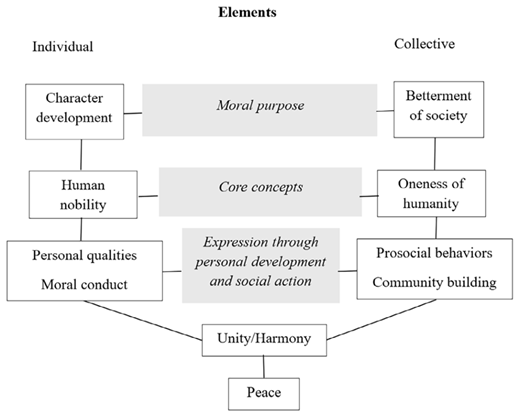
What are the pedagogical implications of the concepts described above? For us, the first implication is that a chief concern of peace education is to cultivate a sense of moral purpose that includes a dimension of personal development as well as contribution to the betterment of society. Second, we need to find ways to channel consciousness of this sense of purpose into the development of moral character by raising capacities that demonstrate and uphold human nobility and reinforce the oneness of humanity. Third, we need to foster knowledge, skills, attitudes, and commitments that are conducive to the betterment of the world and create conditions for dispositions to be expressed in action, which may range from interpersonal conduct to broader action for social change. We propose that these three ideas constitute the basic elements of a framework for moral education for peace: (1) sense of moral purpose, (2) core concepts of human nobility and the oneness of humanity, and (3) expression through personal development and social action (see Figure 1).
We have already described these elements as concepts drawn from Bahá’í sources. We now look to theory and research across a range of disciplines to further enhance our understanding of these elements, including motivational, educational, and behavioral dimensions. We briefly explore each element, both to situate the framework in the context of the literature and to illustrate the integrative nature and function of the framework, which we believe is critical to peace education, particularly because the literature itself is fractured; for example, we find that psychological research on sense of purpose is largely disaggregated from enquiry about moral imperatives and from peace, but is tied to human flourishing, while the relationship between peace and flourishing is scarcely examined although these constructs coalesce in notions of inner peace, positive peace and holistic peace.
Element 1: Moral Purpose
When we look at moral purpose, we are surprisingly hard-pressed to find empirical research explicitly interrogating its relationship to peace and peace education, despite significant theoretical work that draws these ideas together. For example, Montessori (1949/2015) writes of the need for humanity to take control and give direction to its own progress, to develop individual spiritual life and organize humanity for peace; in her seminal text on peace education, Noddings (2012) considers the moral worth of concerns that give meaning to human lives and argues that when we seek meaning, intellect and affect should be bonded, and elsewhere she further discusses the moral instinct for peacemaking (Noddings, 2010). If we widen our consideration of peace in the literature to include the wellbeing of humanity—akin to notions of holistic peace (Bauer, 2019)—Nussbaum’s (2011) discussion of relationships between human dignity, agency, and self-realization in connection with human flourishing are also pertinent. Using this wider definition, we find a growing number of empirical studies supporting the relationship between having a sense of purpose and experiencing enhanced personal wellbeing across generational cohorts (e.g., Baumsteiger et al., 2022; Damon et al., 2003; Hill et al., 2010, 2014), especially at life stage inflection points (e.g. Malin et al., 2019; Tirri & Quinn, 2010), though studies of sense of purpose and measures of collective wellbeing are lacking.
Interestingly, many studies of sense of purpose identify and explore the role of orientation to concepts of self and others. Hill et al. (2010), for instance, consider four types of sense of purpose orientation (creative, prosocial, financial, and personal recognition) and report long-term benefits only for the prosocial orientation. Quinn (2012) establishes that other-oriented sense of purpose and prosocial behavior relates to beliefs about the possibility for change and growth in the world. In the context of an extensive review of the literature, Damon et al. (2003) assert that “purpose plays a positive role in self-development as well as a generative one for the person’s contributions to society” and posit that “acquiring noble purposes discourages the acquisition of ignoble ones” (p. 126).
Element 2: Core Concepts of Human Nobility and the Oneness of Humanity
In relation to the core concepts of human nobility and oneness we also generally find resonant theoretical development and supportive but limited empirical evidence. Though different terms are used to label them, ideas very similar to nobility and oneness are found in various relevant discussions in psychology, philosophy, and development. A notable example can be found in theories of identification, such as Maslow’s (1954) description of self-actualizing individual connections with the entire human race, and Adler’s (1927/1954) notion of social interest expressed in its most mature form as oneness with humanity. Reinforcing this theoretical stance, empirical research indicates the presence of a positive quality of identification with all humanity involving valuing the lives of in-group and out-group members equally (McFarland et al., 2012), and the literature on moral exemplars demonstrates the capacity for integration of agency or self-enhancement with communion or universalism (Frimer et al., 2011). Discussions of the central role of the development of moral capabilities in realizing the aspiration of the good life also capture aspects of the core concepts of human nobility and the oneness of humanity. For example, Nussbaum identifies the imperative to consider both the self and others (Nussbaum, 2007) and highlights human dignity, agency, and self-realization in connection with human flourishing (Nussbaum, 2011).
These themes are also identified as important in discussions of the goal of peace education. For example, Gerson (2021) argues that human dignity is the foundational moral value of peace and peace education for common good. Reardon (1988) describes the transformation at the center of peace education as “a change in the human consciousness and in human society” reflecting “an authentic planetary consciousness” (p. x). Snauwaert (2021) argues that education for peace is education for a just society and requires the development of individual moral capabilities. Moreover, the idea that the state of harmony and unity at every level, from the personal to the global, is a necessary feature of peace is generally articulated in descriptions of holistic peace (e.g. Bauer, 2019; Hansen, 2016). There is also evidence that embracing the notion of wholeness is a key to human flourishing (Pargament et al., 2022), and that integrative approaches to peace education that promote unity are effective among school-aged children (Danesh, 2008).
Element 3: Expression Through Personal Development and Social Action
We find in the literature some follow-through from concepts of self-development and oneness with humanity to expression of moral virtues in interpersonal conduct and broader prosocial behaviors. Perhaps the clearest parallel is found in descriptions of inner peace as a personal state of being and outer peace as a set of processes in the social and natural environment (Harris, 2004), a multifaceted view that is deeply embedded in the idea of positive peace, that is, that peace is more than a state of non-aggression (Standish et al., 2021). In elaborating this basic orientation in the notion and practice of everyday peace, Mac Ginty (2021) describes the importance of individual qualities and attitudes, including forgiveness, mercy and compassion, in interpersonal interactions, and their extension into prosocial grassroots action that disrupts conflict and builds peace in small groups below the level of civil society organizations. Chowdhury (2014) similarly refers to focusing on what binds us together as human beings and empowering each individual to express fundamental principles in both individual and societal level actions as the basis of sustainable peace.
In terms of research relating to ways individuals express internalized concepts about human nature and humanity, there is evidence linking identification with all humanity with political action for the benefit of others (Lantos et al., 2022), as well as with support for human rights, and efforts to reduce global inequalities (McFarland et al., 2019). The extent to which these forms of social action may be motivated by a sense of moral purpose as suggested by the framework proposed here is not clear, though interestingly, McFarland et al. (2012) find that identification with all humanity is a construct layered over moral reasoning and general morality, suggesting that in some individuals moral purpose is channeled into behavior through a belief in the oneness of humanity.
This mosaic of theoretical perspectives and initial scanning of research evidence suggests that the elements of our proposed approach to moral education for peace resonate with other conceptions and findings. We also find that bringing together the elements in this way points to new relationships that would benefit from further research to develop understanding of educating for peace and wholeness, particularly in the context of young adults poised for increased participation in civic life; there is much to be done to delve into and integrate the diverse literatures relevant to these questions.
Evolving a Unity Centered Pedagogy for Peace in an Undergraduate Class
We describe our approach to moral education for peace as unity-centered pedagogy because it focuses attention on the construct of the oneness of humanity as a prerequisite for peace while also acknowledging the quality of human nobility that unites all human beings in a common identity. From our perspective, it is the most critical factor shaping character development, social action, and peace education in this framework, as it describes both the conviction we have in the capacity of every student and the condition toward which we aspire through our educational efforts. As such, the term “unity-centered” captures our response to the two questions at the core of pedagogy—the why and the how of our approach to educating, which we explore further in this section by describing educational purpose and context, moral considerations, curriculum content and learning activities, and the learning environment.
Educational Purpose and Context
In sharing this evolving pedagogy, we believe it is helpful to restate our understanding about the purpose of the peace education teaching/learning experiences in which we are engaged in the context of the Bahá’í Chair for World Peace. Based on our orientation to the whole human being and the importance of building unity, our fundamental educational purpose is to nurture students’ latent capacities of thought, feeling and behavior, and help to channel these capacities into constructive action for peace and the common good. The Bahá’í Chair for World Peace defines peace as “an all-embracing, holistic, and inclusive planetary process” and focuses on five central themes: structural racism and the root causes of prejudice; the empowerment of women and peace; the frontiers of global governance and leadership; global environmental challenges; and human nature” (see Bahá’í Chair for World Peace, 2021). The articulated educational purpose of the program is “to encourage students to cultivate critical thinking skills, which lead to understandings about the complex nature of social change in the creation of a more peaceful world” and “to develop a set of values—including the importance of service to others—that are the basis of lifelong engagement in framing public policy in areas such as the social and behavioral sciences, science and technology, and the arts and humanities” and a guide “in their international and civic life” (Bahá’í Chair for World Peace, 2021).
Moral Education Considerations
As a form of moral education for peace, unity-centered pedagogy encompasses the three predominant parallel perspectives that definitions of morality strive to reconcile—moral reasoning, moral emotion, and moral virtue (Haste & Abrahams, 2008). It builds on ethics of “autonomy, community and divinity” (Shweder et al., 1997, p. 119), by emphasizing basic spiritual responsibility and moral choice, and the fundamental relationship between moral identity, prejudice, justice, oneness, and peace to shape an ethic of unity. The classroom is a microcosm of the struggle to apply these principles; the experience therefore urges participants (students and teachers) become protagonists of change as they begin to embody new understanding, qualities and dispositions and develop a sense of personal responsibility and agency. These include character virtues and moral disciplines specific to a culture of unity and peace, such as compassion, empathy and emotional connection, and the ability and desire to address suffering (Shapiro, 2002), openness, honesty, and discernment (Roberts, 2016). They also include related cognitive capacities, such as integrative complexity (e.g., Tadmor & Tetlock, 2007), creating narratives to frame mutual understanding and spaces for future dialogue (Haste & Abrahams, 2008) and forging a positive vision of the future (Jenkins, 2020). In addition, the experience must provide scope for moral action, that is, opportunities to both inside the classroom and outside in the wider community, as an exercise of moral responsibility.
Curriculum Content and Learning Activities
Curriculum content can of course vary when adopting a unity-centered pedagogy at the undergraduate level, and we believe that sensitivity to social and cultural context is important. That said, the concept of peace inherent in the framework points us clearly in the direction of content that identifies and addresses barriers to unity to anchor strategies of character development and social action in the context of a unity-based worldview, as illustrated in our case study of the undergraduate class on “The Problem of Prejudice” (Betts Razavi & Mahmoudi, 2022). This course is designed to examine the root causes of prejudice, discrimination, and inequality as barriers to peace, and the implications for personal and collective action. It is therefore organized around content areas of bias, racism, sexism, antisemitism, economic inequalities, ethnic cleansing, nationalism and religion.
Through attention to these identified obstacles to wholeness, the course addresses how prejudice affects the human condition, how prejudice is embedded in social systems and structures, the role of bias in our own lives, and ways to address the problem through social action projects. Specific materials (books, articles, films, lectures, discussion prompts) are reviewed every year and the collection of resources used in the course adapted in light of experience, the changing conditions of the world, collective consciousness of issues and advancing scholarship in relation to these issues.
Learning activities are varied across a range of sources and media. Students are asked to read and listen to first-person accounts, to consider fictional narrative as well as research reports and sociological analysis and to develop and articulate in class discussion and journal reflections their own views about the prejudices examined in the course, in relation to justice, unity and peace. Each class participates in a unique set of public events involving academic speakers from diverse backgrounds who share focused research on specific issues—some local and some international—which serve as a basis for in-depth class discussions. Topics of past events include: Confederate street names and racial differentials in the labor market; anti-Asian violence in context; reintegration after genocide in Rwanda; happiness as realization of human potential; and sex, brain, gender, and socialization. Students are also required to work on a group project to develop a cultural, social, economic, political, or other form of intervention to interrupt different manifestations of prejudice. Such interventions include a video, a curriculum, a website, an art installation, and an event, among other options.
Learning Environment
At the level of the learning environment, then, a unity-centered pedagogy involves strategies for character development, including self-reflection, engagement with moral exemplars, dialogue that increases moral character literacy, and mutual accountability, which are often absent at the university level (Lamb et al., 2021). These form part of the integrative, unity-based worldview and translate to an inclusive approach (Danesh, 2006, 2008) in which classroom practices generate and strengthen the knowledge, skills, attitudes, qualities and dispositions implicated in peacebuilding capacities. Opportunities are created for the learning community to “recognize, challenge and change” worldviews (Opotow et al., 2005, p. 205), experiences, structures, and systems that contradict the principle of the oneness of humanity and deny human nobility, both in the immediate setting and in the world at large.
Explicitly articulated discursive values oriented to nobility and unity-building are also central to the peacelearning environment and to a unity-centered approach to challenging and changing bias and prejudice. Beyond “the mere voicing of personal views”, the goal is to express thoughts “as a contribution to the consensus of opinion”, with “serenity, calmness and composure” (‘Abdu’l-Bahá, 1912, No. 31, paragraph 2), “dignity, courtesy, care and moderation” and “absolute freedom” (‘Abdu’l-Bahá, 2014a, pp. 93-94). This kind of collaborative search for truth is conducive to moral development as participants must self-reflect and grapple with ethical issues and moral qualities such as fairness, responsibility, and the value of human life (Russell, 2002). There is an explicit emphasis on building unity and a sense of common purpose as a critical strength, in contrast to the limitations imposed by national, cultural, and racial boundaries, when considering pragmatic solutions to humanity’s most pressing problems. At the same time, there is a conscious endeavor to move beyond a “safe” environment that tends to be homogenous to creating an environment in which students appreciate the diversity of the members of the class and take ownership of their own learning processes and the learning space, with a focus on being able to help others. Beyond equal opportunity, we strive to create an “equal benefit” learning environment in which all participants feel responsible for making the learning experience meaningful for the group and all its members in their own way (see Betts Razavi & Mahmoudi, 2023).
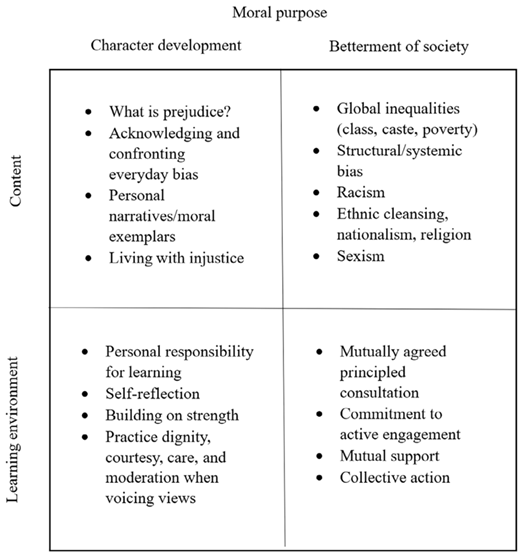
As we make conscious decisions about how to cultivate moral character and capacity to contribute to the betterment of humanity, to foster individual and collective wholeness, we find it helpful to conceive of the unity-centered approach to peace education in the form of a matrix that makes explicit how the two aspects of moral purpose are reflected in the learning environment and the content of the curriculum (see Figure 2).
Looking at peace education through the lens of moral purpose compels us to face the challenge of combining the individual and the systems level, which we believe is critical to addressing barriers to peace and to building sustainable peaceful communities and nations. Without acknowledging and exploring the complexity of peace and the deep interconnection between the parts and the whole, we cannot hope to understand either the problems we wish to solve or the path to the future we wish to create. We have responded to this challenge in each of the aspects of pedagogy described in this section, from the range of voices and knowledge sources represented in the materials selected for the course to the participatory approach in the classroom and the varied forms of coursework. While we recognize that understanding the systems level is vital, we also accept that for knowledge to lead to action, volition is required, and believe that unity-centered pedagogy can help to spark that volition among students. It is a constructive pedagogy of possibility that prompts us to search for what and who is missing, overlooked, or forgotten in order to see or build wholeness as individuals, communities, and societies.
Student Voices
While the unity-centered approach to pedagogy described here emerges from a set of concepts about peace, it has also evolved as result of a process of experience and reflection. In addition to regular university-required student evaluations, in 2021 we systematically studied students’ perceptions of changes in their own capacities in relation to key components of peace education—knowledge, skills, attitudes, commitment, and behaviors—through anonymous written responses to open-ended questions (Betts Razavi & Mahmoudi, 2022). We share some of these self-reports here to illustrate the student experience of unity-centered pedagogy. We should note that in the year that these reflections were collected, the students did not meet in person and were not able to carry out the group project under the conditions of previous years (due to the pandemic). Moreover, the case study survey prompted students to self-reflect rather than describe social action. We therefore also include in this section some group project reports from previous years.
In the written responses collected in 2021, we found positive developments in all categories, indicating the effectiveness of the unity-centered approach at least in the short-term, aptly summed up in this student evaluation:
[This class] has completely changed how I think about the world.…I recommend this course to everyone because it teaches us about humanity and peace in a way that could help our world be so much greater.
Stemming from this comment, for the purpose of this article, we focus on two categories of student perceptions that map on to the purpose element of our framework—the realization of personal potential and the orientation to contribute to the betterment of the world.
In relation to personal development, the most notable theme in student responses was the increased capacity for self-reflection. For example, one noted:
I think this class has made me more hyperaware of my actions—especially after reading Everyday Bias.6 I try to make a conscious effort to avoid being biased against others, but I have noticed how engrained certain biases are in my thinking. Often times, I am ‘scolding’ myself in my head about the way I’ve been thinking in certain situations.
Similarly, another student wrote:
As we’ve spent time studying and exploring various prejudices, I’ve grown to further reflect on my own forms of subconscious biases, and I hope to continue to work to diminish my own prejudices as well as share exposure of prejudice to others.
In some cases, students linked their personal development with increased capacity to address the problem of prejudice. For example, one student wrote:
I [also] perceived a change in skill namely with regards to my ability to reflect on my own experiences in a more brutally honest way. Nobody likes to acknowledge the ways in which they contribute to the existence of prejudice, but I was able to develop this skill in class regardless.
In terms of contributing to the transformation of society, we found a clear theme of increased empathy and appreciation for the experience and perspectives of others, and greater sense of community, as illustrated in this response:
My attitudes towards people, cultures, and our differences have become more open-minded and understanding. It was interesting to hear from so many different types of people, listening to their perspectives and experiences. These moments of connections made me realize the strength in identity, but also community, which makes it important to improve the attitudes we have towards others.
Another student reflected:
I think the discussions we had every class made everyone become more empathetic. We were able to hear our classmates’ experience with x prejudice that the individual may not have experienced. Hearing first-hand accounts of prejudice that we may not have thought much about because it didn’t affect us makes us more empathetic.
The same student’s comments then bridged to contributing to the betterment of society:
I also think that we all understand unconscious biases better which will help us become more conscious of the attitudes we’ve socialized to combat them. Hopefully everyone feels the same way as I do and will be allies in the fight against prejudice.
The moral imperative to work for the betterment of humanity is also found in the form of reflections on commitment to justice and peace, such as having “more of a commitment to social issues and finding their solutions than before”, “fighting prejudice and biases”, and “advocating for equality and speaking up.”
Group project reports from previous cohorts taking this course also suggest signs of growing capacity to participate in social discourse and take social action. For example, one student, from a group that created a video tackling racism for young people, reflected on the need for outreach activities to be “relatable” to the intended audience. This group thought about how to present the most relevant content in a short amount of time, and what setting and language would be familiar. The student described how interviews with young people were included to capture “some of the discomfort that comes from the discussion of racism” and that the group identified a need to fill in gaps in young people’s historical knowledge of racism by creating “a timeline that was full of information while also not being too long.” Finally, the student reported, “we wanted to talk about how anyone in our country can make a difference.” Another student, whose group addressed aspects of the problem of racism by creating a website, noted:
Our first step can be to engage in conversation about anything; either it be social media or the world or our everyday lives, we just need to start talking. The initial conversation will not alleviate all of our problems but it can start a trend. I know racism is a big problem, but small solutions by a big population could be the answer to what we are looking for.
The last voice we share here, from our 2021 class, encouragingly captures the potential impact of the learning experience in relation to both self and others:
The knowledge which I gained, skills I developed, attitudes which were changed, and commitment levels which were increased all cumulatively assisted a change in behavior and an increase in activism within me. Now, anytime I see a family member or friend act under the influence of a prejudiced opinion, I step in to inform them about how the way they approached the subject is not correct. I believe that everything which I learned within this class will benefit me for the rest of my life.
Discussion: Unity Centered Pedagogy as a Resource
Though we have derived our framework for moral education for peace from an orientation to spiritual principles, our experience with unity-centered pedagogy is at a secular public university in the United States. While there is no assumption of religious or spiritual belief in this context, the university defines itself in the moral terminology of goodness, committed to “do good” and to “transforming idealism into impact”(The University of Maryland, 2018) and this approach to peace education has been well-received and even commended. Yet there remains debate about the place of moral education at the university level (Kiss & Euben, 2010). As Lamb et al. (2021) note, most character education is implemented at K–12 level, “leaving university students without sufficient support to negotiate a crucial time in their moral development” (p. 81) and ill-equipped to navigate humanity’s grand challenges in their adult lives.
Given our experience in a secular context, we suggest that the unity-centered pedagogy described here may serve as a resource for integrating moral education into the university by providing a framework within which peace education is woven into intellectual investigation conducted with a moral conscience and a vision of social action. This approach offers a clear set of elements upon which an effective academic peace education curriculum can be built. It promotes moral inclusivity (Opotow, 1990) and sets up ethical reference points for students to evaluate the condition of the world and the goal of peace as well as their own moral purpose in “an ontological loop that mediates thought, feeling and practice” (Gervais, 2004). Unity-centered pedagogy builds consciousness of treating experiences in a way that underscores oneness rather than division and reinforces hope based on constructive collaboration, rather than cynicism derived from a negative view of human nature or history.
As educators, this framework primes us to educate for wholeness in our students and in the world—in the sensitivity with which we articulate questions and remove barriers in order to create learning spaces that build on strength and support all participants in pursuing moral purpose. This approach echoes many elements of critical pedagogy (Freire, 1970); it views both students and teachers as active agents in the learning process (Giroux, 2020), it advances pedagogy itself as a force for the generation of knowledge (Lankshear & McLaren, 1994), the creation of culture and society based on human values (Giroux, 2020), and it supports the importance of fostering community (hooks, 2003). At the same time, this framework adds emphasis to individual participation in peacelearning as an exercise of moral responsibility. It values standpoint epistemology (Nielsen, 2020) and epistemic humility, and positions personal and local perspectives as part of a global vision. The elements of the framework combine to prompt a pedagogical imperative to increase the capacity not only of the individual student but of the learning community to carry forward the moral requirement of peacebuilding.
We believe that there is much to be gained from university-level moral education for peace, and that unity-centered approaches, geared to addressing the barriers to peace in diverse contexts, are critical to future peacebuilding efforts. Certainly, we acknowledge that more research is needed, but this acknowledgement need not prevent university educators from developing courses that better equip their students to rise to the moral imperatives of peace and contribute to our learning about the efficacy of peacelearning in higher education. For our part, through the framework and reflections shared here, we hope to have contributed to the theoretical and practical resources available to others seeking to educate for peace and wholeness.
Notes
This section provides a short description of the essential features of the Bahá’í Faith. More detailed information and discussion is available at the official website of the worldwide Bahá’í community: https://www.bahai.org/
This section is a brief overview of concepts elaborated in Bahá’í texts based on our own understanding. We draw on works authored by Bahá’u’lláh, ‘Abdu’l-Bahá (son of Bahá’u’lláh) and the Universal House of Justice, which are authoritative Bahá’í texts.
The Universal House of Justice is the world governing body of the Bahá’í Faith.
Translated from the Persian, in which the noun and pronouns are ungendered.
For example, the moral orientation to upholding the nobility of every individual and group is a key message in Bahá’í input to discourses on development, sustainability, environmental justice, and climate equality; Bahá’í contributions on this theme challenge ideologies that focus on self-interest, and preference satisfaction in relation to economic growth. Rather, such contributions focus on moral capabilities for the common good (e.g., Bahá’í International Community, 2022). Social action initiatives similarly emphasize the importance of the development of human potential for the betterment of some aspect of the life of the community, such as health, sanitation, or education, and challenge the view of social change as something that comes about by one group of people doing something for the benefit of another group. Instead, this approach to social action involves local populations actively tending to their own progress (Bahá’í International Community, 2023).
Required reading: Ross, H. J. (2016). Everyday bias: Identifying and navigating unconscious judgments in our daily lives. Rowman & Littlefield.