

Aulas en Paz is a multicomponent peace education program based on the promotion of socio-emotional and citizenship competencies. Evaluations have shown positive results in urban contexts with high levels of violence, although implementation is challenging given the amount of training and support it requires. Kernels are flexible, low-cost strategies targeted specifically at crucial active ingredients of programs which can greatly facilitate their implementation. Two types of kernels were developed for 4- to 10-year-olds, and piloted successfully for the Aulas en Paz program: Aulas en Paz Cards and Aulas en Paz Audio Clips. This paper describes these kernels and presents qualitative results of the pilot implementation. Results are very promising for the scalable and sustainable impact of Aulas en Paz.
Introduction
Children who grow up exposed to high levels of violence are more likely to develop aggressive behaviors, and to participate in violence later in their lives, contributing to a cycle of violence (Dodge et al., 1989). The promotion early in life of socio-emotional competencies such as anger regulation, empathy, and assertiveness has been proposed as a way to help break that cycle of violence (Chaux, 2012). This has been an inspiration to programs such as Aulas en Paz (Classrooms in Peace), an evidence-based multicomponent program for the prevention of aggression and the promotion of peaceful relationships in schools. It was developed in Colombia in 2005 and it includes a classroom curriculum, workshops for parents, home visits and an extracurricular component implemented with heterogeneous groups. It is based on the development of 8 socio-emotional competencies: emotional management, empathy, perspective taking, active listening, assertiveness, consideration of consequences, creative generation of options and critical thinking. Its evaluations have shown, in general, positive results such as reduction of aggression and increase in prosocial behavior (Chaux, 2012; Chaux et al., 2017).
Although Aulas en Paz has been applied widely (more than 500 schools reaching more than 300,000 students in Colombia as well as some schools in Chile and Mexico), its greatest challenge continues to be its implementation, especially on a large scale. Clearly, large scales imply important costs, although the cost of Aulas en Paz is very low (25 US dollars per student per year; Chaux et al., 2017) in comparison to other multicomponent programs (e.g., 5800 US dollars per child per year in the Fast Track program; Foster, 2010). The main challenge is not usually costs, but the fi and quality with which the program is implemented.
Each of the components of Aulas en Paz was designed to be implemented sequentially. For instance, the curricular component included 40–50 minutes lessons which are usually applied weekly. In practice, very few schools apply all the expected activities. More worrisome, in many cases, the implementation differs greatly from the original designs. Although the majority of teachers are greatly committed to the program, we have found that many would only skim through the teacher manuals and would be improvising during class, affecting the fidelity of implementation. Also, in many cases, socio-emotional development only occurred during the specific lessons of the program. On a typical week, nothing related to socio-emotional development happened the rest of the week, and therefore it was difficult for students to incorporate what they were learning into their everyday interactions. Aulas en Paz clearly needed more flexible and easy to implement strategies.
Furthermore, Aulas en Paz was initially developed for elementary grades (2nd to 5th grades). In order to promote earlier socio-emotional development, we created Aulitas en Paz for preschool years. Working with preschool children brings new opportunities and challenges such as the need for more interactive and short pedagogical strategies given their low attention span, but also the possibility of repetition, given the joy most children find in repeating many times fun stories and activities. Both, the challenges of large-scale implementations and the opportunities of working with preschool children, lead us to develop two new types of kernels: Socio-Emotional Cards and Socio-Emotional Audio Clips.
Kernels have been defined as “low-cost, targeted strategies which (…) represent the essential “active ingredients” in the more comprehensive programs we know to be effective” (Jones et al., 2017; p. 2). Furthermore, Jones et al. (2017) state that “kernels target a specific behavior (one that occurs many times or few per day) Recent evaluations are showing promising results. For instance, Colagrossi et al. (2023) conducted a study with preschool children in Brazil in which teachers were instructed to use the Kernels cards twice a day for 5 to 15 minutes and were encouraged to make positive comments when they observed their students using the skills at other times during the day. Compared to control classrooms, receiving the SEL Kernels intervention was associated with significant improvements in teacher-reported child behavioral and emotional outcomes and teacher growth mindset (Colagrossi et al., 2023). Thus, kernels represent a great opportunity to increase flexibility, fidelity, and impact in Aulas en Paz, especially when implemented at a large scale.
Three criteria have been useful when designing kernels for Aulas en Paz: practicity, flexibility, and costs. By practicity, we mean that the activity represented in the kernels should be short and easy to apply. Flexibility means that the kernels should be self-contained so that they can be applied repeatedly, in no particular order, and in either specific planned moments, or spontaneously. Finally, low costs are important since most schools do not have the resources to acquire additional materials, and financial support for educational programs is limited. These three criteria were crucial when designing Socio-Emotional Cards and Socio-Emotional Audio Clips.
Aulas en Paz Cards
The Aulas en Paz Socio-Emotional Cards were created as short activities that provide opportunities for the development of socio-emotional competencies in everyday interactions in the classroom. These cards had a design process that included several phases: conceptual definition, visual design, piloting, and adaptation. Each of these phases was intended to connect the conceptual, pedagogical, and design elements that are central to kernel development. As a result of this process, 3 types of cards were developed:
Cards for the development of socio-emotional competencies in everyday classroom interactions.
Cards for promoting a positive classroom climate.
Cards for managing difficult situations in the classroom.
The main characters from the classroom component in the Aulas en Paz and Aulitas en Paz programs, along with the competencies each one represents, were taken as the basis for the design of the initial cards. Subsequently, key activities from the programs were identified and incorporated into the cards. The cards for classroom climate and to manage difficult situations were inspired by the pedagogical principles on which Aulas en Paz is based (e.g., cooperative learning; Chaux, 2012; Saldarriaga, 2004), by mindfulness-based programs such as Respira (respira.co), and by our own observation of innovative teachers (e.g., Claudia Bernal, from Cali, used the book “The Silent Creatures” by Tortosa (2020) to help focus students’ attention).
As part of the visual design, it was defined that the instructions would provide a ‘step-by-step’ description of the activity with up to 4 bullet points that used approximately 100 words in total. Additionally, a color palette and visual elements aligned with the Aulas en Paz program image were used. Finally, an easy-to-remember name was created for each card, the competencies it developed were defined, and the objectives and suggested ages for its use were established.
Teachers can use Aulas en Paz cards according to their classroom and students’ needs. For instance, they can use them randomly based on their categories, ages, or the competencies they want to develop. Also, since these cards can be applied for specific situations, they can use them when they identify a conflict among students, when they notice a disrupted classroom climate, or when they believe that students need to practice a certain skill. Finally, due to their low cost, these cards allow teachers to have a complete package of 40 cards that provides them with a wide range of options to work with their students.
Examples of Aulas en Paz Cards:
Aulas en Paz Audio Clips
- Cards designed to develop socio-emotional competencies in everyday classroom interactions.
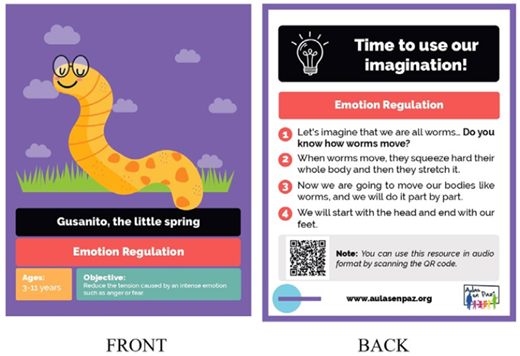
- Cards for promoting positive classroom climates.
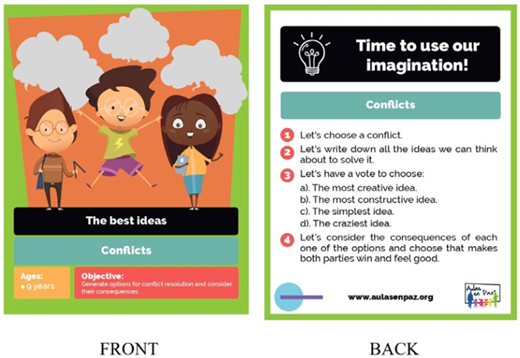
- Cards for managing difficult situations in the classroom.
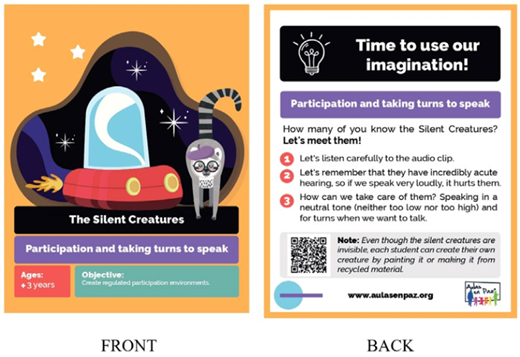
You can see these examples of the Aulas en Paz cards in Spanish and English in the following
Also using the main characters from Aulas en Paz, several audio clips were created. These stories used narratives about the characters’ origins, physical appearance, and life experiences to promote the learning and development of socio-emotional and citizenship competencies. The audio clips use engaging storytelling with sound effects aimed at capturing students’ attention and guiding the practice to reinforce skill learning. These stories, which last between 4 and 7 minutes, feature a main character as the narrator, with occasional additional characters that participate in the story to make it more engaging for students.
One of the most engaging audio clips is ‘Gigi the Empathetic Giraffe.’ This clip1 begins with drum and afrobeat sounds in the background, emulating a scene in the African savannah. Then Chango (another character from Aulas en Paz) starts telling the story of Gigi, describing her as a long-necked giraffe that has a collection of glasses, a big heart, and an elegant walk. Gigi interacts with the children, explaining that she is looking for sunglasses in her bag, and describing how she uses them and what they are for. Gigi’s sunglasses, along with her enormous heart, are associated with the two socio-emotional competencies she represents: perspective-taking and empathy. As a secret, Gigi also tells the children that her glasses allow her to see better and recognize how others might feel in the midst of a conflict. She also reveals that her heart helps her feel something similar to what the person involved in the conflict could be feeling.
Aulas en Paz features 7 audio clips, each one linked with a QR code on the card making it easy for teachers to use them during certain class activities or transitions. Also, the audios can be played both online, by following the link, or offline by downloading them to a digital device beforehand.
Piloting the Kernels
During the first semester 2022, we conducted a pilot test of the Socio-Emotional Cards. In a public school in Bogotá, two kindergarten teachers implemented the cards with their students (about 20 per group; 4 to 5 year olds). Before the pilot, both teachers participated in a 45-minutes training session conducted by two of authors. The pilot showed positive and interesting results. The two teachers mentioned that it was easy for them to understand the activities described by the cards. They did not need additional explanation of what they needed to do, and it was also easy to use them with their students. Additionally, they mentioned that the design and colors of the cards were very engaging to them and to their students.
The two teachers reported that they used more frequently the cards with socio-emotional activities, and that the ones they used the least were those about managing challenging situations. For instance, they considered that the one about mediation of conflicts was designed for older children and was long and difficult to implement in kindergarten. Finally, teachers mentioned that the implementation did not imply any additional work. On the contrary, the cards were well articulated with their classes and improved their classroom climate by helping them solve quickly situations that usually required longer times.
One of their suggestions was that cards should have additional materials, and that they should be located in accessible places in the classroom where children could reach for them, interact with them, and use them in relevant situations. They even suggested developing hand puppets, images, or videos, to accompany the implementation of the cards to improve children’s attention even more. This inspired us to develop hand puppets for each of the characters associated with socio-emotional competencies in Aulitas en Paz, as well as the Socio-Emotional Audio Clips described above.
During the pilot, we told teachers that the cards were flexible and that they could used them in the moments they considered more appropriate. We found that the Socio-Emotional Cards were not used during specific situations of aggression or conflict. Instead, teachers implemented them in moments such as at the beginning of the day or right after recess. Initially, the teachers promoted the use of the activities, but then children started using the strategies by themselves and teaching them to new students. For instance, in one case, when a teacher asked her students how they were feeling returning from recess, one student mentioned “today I feel angry because they did not let me be the one to catch them [in a hide-and-seek game]”. Then, his classmates helped him use one of the cards’ activities about a worm (Gusanito, the little Spring) who contracts and relaxes its muscles.
By the time the pilot was conducted, only one Socio-Emotional Audioclip had been developed. Teachers were initially worried that it would be too long (more than 5 minutes) for kindergarten children. However, they quickly realized that children had no problem maintaining their concentration when listening to the story. They also highlighted that this audioclip help them promote empathy and caring, and contributed to managing their classroom since the story is about some creatures (called “the Silent Creatures”; based on Claudia Bernal’s practice with the book by Tortosa, 2020) who are very sensitive to loud noises. Reminding students about these Silent Creatures promoted an emotional and caring connection to these imaginary characters at the same time that it was an opportunity to help calm down the class. Students even started regulating themselves the noise in the classroom by reminding their classmates to speak softly in order not to hurt the Silent Creatures.
Finally, during the pilot, the learnings from the socio-emotional kernels reached their parents since children spontaneously suggested the use of the strategies during emotionally charged situations at home. All of this confirmed to us the relevance that children seem to give to the Socio-Emotional Cards and Socio-Emotional Audio Clips, and the enormous potential they have.
Next Steps
The recent developments of “Aulas en Paz” have opened new possibilities to strengthen innovative approaches to addressing our challenges. Both, difficulties related to implementing a structured and sequenced curriculum, and those of working with early childhood and the differences in pedagogical approaches at these ages. These innovations have shown the importance of developing more flexible and adaptable materials that do not necessarily follow a rigid sequence and that can be quickly and easily applicable, without losing pedagogical depth and preserving our competencies development approach.
To continue with these developments and consolidate these learnings, we aim to conduct broader pilots in different contexts, as well as research to explore their outcomes and relevance. So far, we have conducted small-scale pilots that have shown promising results. However, we are still uncertain about how these developments will function in different contexts, such as public education in vulnerable settings, small cities, or rural contexts.
On the other hand, we believe that it is possible to apply some of the learnings we are having in preschool and early childhood education to address other age groups. This way, we can complement the existing curriculum and tools of “Aulas en Paz” for primary education, with new, more flexible, and replicable developments. This will allow us to strengthen the application of these learnings in spaces beyond the specific “Aulas en Paz” classes, including short activities at different times during the school day and across various subjects. It might even inspire new developments for young people and adolescents.
Finally, we believe these tools can extend beyond the school and be used by parents and caregivers at home. This opens new possibilities to test their functionality with families in different contexts, exploring their relevance and usefulness. This implies new ways of working that can expand our impact on society.
Note
You can listen to the audio clip of Gigi, the Giraffe at the following link: https://bit.ly/3Pjqxbu


