This paper describes a community-engaged project during the first year of the COVID-19 pandemic to develop an online peace education toolkit that was preliminarily tested in one middle school. The goal was to provide accessible tools and strategies for teachers at the school to help students cope, adapt, and thrive while simultaneously bolstering their social emotional skills, a foundational element of character education (Lerner et al., 2017). We present the project as an example from peace education to demonstrate a whole school process to support young people’s social and moral development. This approach builds on scholars who have advocated for whole school approaches to thinking about character education (e.g., Elias, 2014). The case exemplifies being attuned to context, engaging diverse stakeholders, and creating opportunities for student leadership and growth.
Across the United States (U.S.), schools scaffold young people’s social and moral development through explicit curriculum and critical mental health supports (Eccles & Roeser, 2010; Schaeffer, 2022). This work takes place daily in classrooms and schools, and often relies on educators’ direct, frequent contact with students as they observe behaviors, coping responses, and emotions resulting from trauma (Cohen & Mannarino, 2011; Gelkopf & Berger, 2009). Even when schools have psychologists and counselors, teachers play primary roles in identifying children’s responses to trauma, facilitating recovery, and promoting productive coping responses (Berkowitz et al., 2017; Chafouleas et al., 2016; Eccles & Roeser, 2010). While previous research demonstrates the valuable and central role teachers play in supporting students’ social and moral development, COVID-19 heightened the need to support educators in this work and to provide remote programming and tools that they can employ. In the context of COVID-19, highly visible movements for social and racial justice, and their intersectional impacts on students and their communities, educators became even more critical frontline workers. Yet, at the same time, established school programs, curricula, and activities to bolster social and moral development were interrupted.
The project presented in this manuscript offers one example of how a university-school partnership was used to build on the strengths of both in addressing the resulting challenges that emerged from this disruption. Below, we first present the project’s peace education programming through a framing of peace and character education as related to social-emotional development. Next, we detail the context: the pandemic’s impacts on schools and young people in Milwaukee, where the university and middle school partner are located. Finally, we describe the project and lessons learned from the process of collaborating on developing this toolkit.
Peace Education Curriculum
Peace education takes varied forms because of the complexity and contextual dynamics involved in preventing and addressing violence in its various forms while building cultures of peace. In Galtung’s framework (1990), peace can be understood both as the negation of violence (negative peace) and the dynamics, attitudes, and systems that form peaceful societies (positive peace). Peace education with youth must thus be structured to address the contextual and systemic dynamics within a given setting (Bajaj & Brantmeier, 2011). The goals and form of peace education may be structured to tap into psychological processes that foster young people’s development as peacebuilders (this includes key character traits like fairness, justice, and self-regulation). To avoid reifying cultural and structural violence, the content and delivery of peace education must be tailored to young people’s lives and everyday concerns (Galtung, 2008).
More broadly, the goals of peace education align well with those of character education, particularly as they intersect with socio-emotional development. Social-emotional skills involve psychological processes, attitudes, and behaviors that are at the core of both young people’s developing character and the ways they contribute to localized cultures of peace. As the Collaborative for Academic, Social, and Emotional Learning (CASEL) defines it, social-emotional learning is:
the processes through which children and adults acquire and effectively apply the knowledge, attitudes, and skills necessary to understand and manage emotions, set and achieve positive goals, feel and show empathy for others, establish and maintain positive relationships, and make responsible decisions. (CASEL, 2013, p. 4).
In line with the goals of character education, these attitudes, skills, and actions are the foundation for building healthy democratic societies where the rights of all people are respected (Elias, 2014). Similarly, they are the groundwork for citizens who engage with each other and with social and political systems that align with what it takes to build cultures of peace (Hymel & Darwich, 2018; Moghaddam, 2016).
In summary, an intersection of peace and character education involves fostering social emotional development. Focusing on how young people relate to each other and are engaged in their communities lays a clear path for theorizing and implementing an effective peace education program. It must be attentive to the social context it is embedded in. In schools, it can also focus on an array of skills beyond academic learning that is integral to prosocial development and aligned with the goals of character education.
Project Model and Curriculum
The project builds on a peace education and violence prevention program that increases young people’s capacity to identify and resolve conflicts nonviolently. It utilizes a distinct model of change, foundational practices, and program components developed over multiple decades of working with Milwaukee and Chicago-area public, Catholic, and alternative schools. The program is rooted in an academic center whose mission is to support research, learning, and action for the promotion of peace, human dignity, and justice.
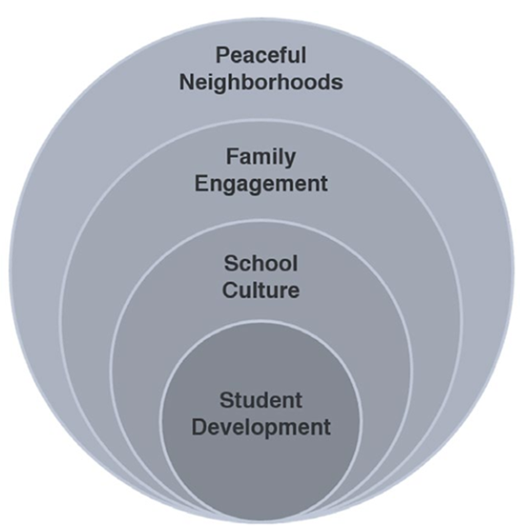
The theoretical framework of this peace education program is a model of progressive transformation based on the Centers for Disease Control and Prevention’s Social-Ecological Model for Violence Prevention (see Figure 1). Learning peacemaking and conflict resolution skills can positively impact students’ experiences of, and contributions to, school culture, family engagement, and peaceful neighborhoods. These skills are best learned through relationships and reinforced through school, family, and community interactions. Scholars in both peace and character education have proposed an ecological framework to understand the ways that multiple spheres of social influence beyond simply curriculum content inform young people’s moral and social development (Callina & Lerner, 2017; Snyder, 2014).
Drawing on this model of change, the program’s curriculum is research-informed and grounded in three core practices: (1) social-emotional learning, (2) restorative practices, and (3) peer mediation. These practices play out through three components. The first is student instruction in which students develop skills through instructor-led sessions. Instruction is delivered in either a classroom or small group setting. The curriculum can be implemented as a stand-alone course or integrated into an existing course (such as civics, health, or homeroom). This flexibility allows for cross-curricular connections (rather than as part of an isolated material) that are more effective in promoting students’ holistic development. The second component is professional development. Faculty and administrators receive training to reinforce and model program practices in their classrooms and school. Teacher-provided classroom interventions can be valuable ways to promote social and moral development, but these practices require careful structure and support (Kupersmidt et al., 2022). The third component is integrated programming. There are varied structured opportunities for students to apply social skills, including peer mediation programs and student-family activities. Actively testing out skills and learning from real-world contexts is a fundamental part of developing self-efficacy in both peace and character education (Bajaj & Brantmeier, 2011; Elias, 2014; Lerner et al., 2017).
Drawing from literature on social-emotional development and peace education, this curriculum focuses on self-regulation, interpersonal skills, and self-efficacy. The topics covered include, but are not limited to, gratitude, self-esteem, managing anxiety, building relationships, social responsibility, and peaceful living. This content is taught through an array of activities that center on reflection, action, and movement while challenging students to apply the content to their relationships with peers, families, and others in the community.
Milwaukee and the Pandemic
The project setting for this collaboration between a university and middle school was Milwaukee, Wisconsin, a deeply segregated city with vastly different experiences for communities of color that includes educational inequities (Luthern, 2019). Even before the COVID-19 pandemic, many young people in Milwaukee faced enormous challenges tied to historic and systemic injustices: poverty, racism, unequal access to resources, and high rates of community violence. Young people and their communities have demonstrated much resilience and strength, but systemic factors are still risks for negative outcomes that must be addressed inside and outside of schools (Jain et al., 2012; Spencer et al., 2006).
Across the country, the pandemic has laid bare and deepened challenges in relation to education and equity. In Milwaukee, this was especially true as resource divides (i.e., access to technology) and the disproportionate impacts of the pandemic on communities of Black, Indigenous, and people of color (BIPOC) communities presented greater academic, social, and neighborhood challenges. From a purely statistical viewpoint, the impacts are stark and cross-cutting: greater learning losses, increasing behavioral concerns, and growing mental health challenges (Falk, 2021; Koran, 2021; Peek, 2023). Similar to other contexts across the country, quarantines and remote schooling meant that many youth were disconnected from social and mental health supports, while teachers were overburdened with adapting and handling a myriad of challenges driving high rates of burnout (e.g., Hirshberg et al., 2023). However, a sole focus on these numbers takes a deficit lens on the city and its population. One of the city’s strengths is the richness and historical depth of efforts both inside and outside of school to engage young people in violence prevention and peace education programming (DeLong, 2015; Gassin et al., 2005; Harris, 1998; Velez et al., 2021).
Later, we describe the specific context of the middle school that served as the development and preliminary testing ground for the online toolkit. In the above section, we have aimed to first more broadly contextualize this project within broader social and historical dynamics that inspired the need for it.
Building an Online Toolkit
The pandemic heightened existing issues and inequities, but also created the opportunity to develop innovative ways for responding to and supporting young people. In this section, we describe this collaborative project in 2020–2021 between a university center and a middle school to turn a peace education program that had demonstrated efficacy as an intensive in-person curriculum into a flexible online toolkit. With a focus on assisting schools, the aim of this project was to develop an online toolkit based on the Peace Works (PW) curriculum to utilize digital learning while providing a resource for teachers to help students and families cope with and manage the mental health challenges during the pandemic and beyond. Building on the established PW program, the toolkit’s purpose was to equip teachers with the materials needed to foster students’ resilience and social-emotional capacities in confronting challenges created by COVID-19.
Previous indications of the PW curriculum’s impact included qualitative work with instructors (Velez et al., 2021), as well as unpublished quantitative reports for school partners. The latter was based on pre/post tests using the 7-item Beliefs About the Aggression and Nonviolent Alternatives (a Center for Disease Control—CDC—recommended resource; Dahlberg et al., 2005) and an organization created school climate survey. The effort during the pandemic was a partnership between a university center, academic faculty, and stakeholders in a middle school community. Overall, the project demonstrated the potential for a community-based, integrative approach to developing peace education curriculum, which can lead to valuable resources for fostering character development and promoting the growth and development of student leaders engaged in the process.
Responding to the Pandemic and Toolkit Development
To respond to conditions created by COVID-19, the center running the program sought to provide increased accessibility to the peace education curriculum through the development of an online toolkit. The aim was to continue to provide supports for promoting peaceful social skills, while addressing challenges to well-being for students, educators, and families during this time.
To ensure the toolkit resonated with and support educators and school communities, the center partnered with a predominantly Hispanic Milwaukee-area middle school that had implemented the program for the previous six years. The school partner’s teachers, students, and parents actively participated in the development of the toolkit, alongside a team of advisors consisting of university researchers, practitioners in the mental health field, and education experts. A Leadership Council was developed to oversee the project and worked closely with two other subgroups on the project: a Content Development and an Evaluation and Measurement team. The Content Development team included a peace education specialist, school counselor, therapist, and local students, teachers, and family representatives. The Content Development team reviewed, edited, and enhanced toolkit resources. The Evaluation and Measurement team consisted of faculty in nursing and education, as well as graduate student researchers, undergraduate nonviolence educators, and local students, teachers, and family representatives. They reviewed materials and provided feedback while also gathering and disseminating research.
Over the course of eight months, these teams met regularly and advanced in their specific areas of focus, while sharing work with each other in various ways. The Leadership Council and two teams met at least monthly, with the coordinators of both Content Development and Evaluation and Measurement participating in Leadership Council meetings. The Leadership team facilitated the project moving forward as a cohesive whole. At the end of the eight-months, the team explored various lessons from the PW curriculum to develop 12 lessons specific to school needs based on teacher, student, and parent feedback and tested these lessons across three 6th grade classrooms. These lessons included gratitude, self-motivation, self-care, self-esteem, positive communication, decision-making, perspective, thought-feeling-behavior cycle, reacting to our thoughts, managing anger, conflict resolution, and forgiveness. As mentioned, input from community stakeholders informed the process through the representatives on the various teams, as well as through three focus groups with teachers about implementing the curriculum, three student surveys, six student focus groups, and two rounds of parent surveys. Based on the input, activities that were developed included short active opening exercises, reflections attached to related YouTube videos and TED Talks, and online games to demonstrate learning. Each module included a suggested lesson plan with connected learning objectives, but, following the goal of adaptability, also allowed educators to choose specific activities to incorporate into their classes.
Evidence of Value and Lessons Learned
The Measurement and Evaluation Team met bi-monthly to discuss evaluation strategies and to gather various stakeholder input. This group consisted of academic researchers from various disciplines (including nursing and education), teachers, students, and parents. It was subdivided into three working groups focused on collecting data from students, teachers, and parents, which was both used for both toolkit development and evaluation. Each of these working groups was comprised of at least one university member (e.g., faculty, center staff, student support), one student, and one parent. They met multiple times each month and then reported on progress, shared activities, and collectively debriefed at the broader team meetings. Additionally, the preliminary findings from each group informed others. For example, the student working group ran focus groups in December, and their focus on stress and challenge during the pandemic led to the addition of a question in the next teacher interviews about how they students employing coping strategies from the content in the classroom. Across the various data collected, exploratory analyses seem to indicate the toolkit was received positively and as a support by student and teacher participants.
Student Data
Multiple forms of data and input were collected from students at various times during the project. A school climate survey was adapted from a previous instrument to measure how the students and teachers got along with each other and supported each other. The survey included 10 statements about school environment, which participants could rate on a five- point scale from strongly disagree to strongly agree. This scale was not meant to be a robust measurement of impact (given limitations noted below), but rather provide a general sense of school climate.
All 6th graders participated (N= 68, 67% female) and completed the school climate survey in October of 2020. It was repeated in the spring (late March 2021), when they also reported feedback on each of the lessons. In the first round, findings indicated robust senses of connection and belonging. Students had a mean score of 40.4 (SD=5.80) out of a possible 50, which indicated that most students felt that the school environment was mostly positive. There were no significant differences between boys and girls (Boys M=39.86, SD=4.22, Girls M=40.76, SD=6.09, p=.54). While there was a slight increase in the overall mean in the spring survey (M=38.83, SD=7.66) this was not statistically significant (p=0.17). The high mean and lack of change may speak to the strength of the school community at this site, which supports using an integrated, collaborative approach to building the toolkit.
In the spring survey, students also evaluated individual lessons and 15 to 20 percent consistently reported telling someone outside of school about each lesson. While we did not ask explicitly about whether these were positive or negative descriptions, our student representatives felt that these would have been positive based on discussions with classmates and how they and their peers understood the survey. Lessons on anger management, perspective taking, self-care, and decision making stood out most in terms of value and applicability to students. Just under half noted that they used a strategy learned in class to manage anger, while about a quarter used a strategy to manage their anger at home with their families. Examples included using a strategy to avoid fighting with siblings and feeling able to cope when other family members were fighting. Several participants combined perspective taking and anger management and wrote how taking the perspective of others helped them to control anger and not fight. Students also demonstrated how these lessons intersected. For example, the decision-making lesson helped students learn how to make decisions, think before they act, and consider others’ perspectives because, as one student notes, “now we think when do something or not. For example, when you see someone getting bullied and you take the decision to help him.”
A randomly chosen subset of 6th graders also participated in three focus groups across the year. The student working group presented the opportunity to these students, who could then opt into participating (2 did not and were then replaced by other students). Each focus group had 5 or 6 participants, and while most participants were the same, there were 1 to 2 who were different each time due to logistical challenges (e.g., a participant being sick the day of data collection). Focus group data allowed the evaluation team to identify key challenges and propose solutions in relation to online learning, the pandemic, and social-emotional health. These findings were presented to the entire school community and informed their decision making about supporting their students. In the conversations, participants noted struggling with sitting still in front of screen all day, being isolated from family and friends, and technology issues. Students worried about getting in trouble if they had connection problems and missing content when they lost connection to the classroom. In terms of solutions, they described the importance of getting to interact with friends, support each other through talking, and getting to move and go outside. This information broadly supported the school community as it was conveyed to administrators, educators, and parents on the leadership team. It also informed the toolkit development as the Content Development team added online games, activities in which young people interact with friends, and ones that required them to move and go outside.
Teacher Data
Three focus groups were conducted with the three teachers in the school who were implementing the toolkit lessons in their classrooms (in October, January, and May). Each conversation gathered feedback on individual lessons, overall challenges, and general responses to the utility of the toolkit. In terms of the lessons, teachers highlighted the utility of self-care activities. They found that these activities sparked conversation, connected with other topics (previous social-emotional curriculum), and created space for talking about struggles with well-being during the pandemic and how to attend to oneself and others in the school community. Other positives included that students were engaged in the activities, especially as the semester went on and lessons incorporated more games and physical activities. Teachers also noted personal benefits during a time of high stress: the toolkit saved planning time and helped fill a gap in the curriculum. At the time, social-emotional skills were only addressed at unstructured intervals when a counselor was available, so the toolkit offered a teachers a way to more directly incorporate these topics into the classes. Conversations with teachers created a space for teachers to ask questions about the curriculum including the impetus for its creation. The teachers’ perspectives informed how to frame and present the toolkit to teachers throughout this school. They noted that the topics emphasized intrapersonal more than interpersonal areas, but added that they thought this was appropriate for the current remote learning context. This feedback led to a conversation about the program’s theory of change. To this end, teachers described not having great sense about the underlying motivation or mission of the curriculum, which led to conversations about training modules and how the toolkit was presented and framed.
Parent Data
A small group of parents was surveyed to understand better the impact of COVID-19 on their child’s schooling and if students were discussing the toolkit or using the skills at home. In the fall survey (November, 2020), thirty-two parents responded to an online, open-ended survey that was sent to all middle school guardians. Many reported feeling overwhelmed by online learning and its effects in their household. They noted challenges with balancing multiple children at home with different classes and schedules, maintaining their own job schedule (whether remote or in person), and feeling a lack of social connectivity. Some expressed that their children were able to do better academically because of the lack of social distractions.
In March 2021 follow up surveys were sent to all guardians again, but the response rate was low (N=11). Questions similarly asked about experiences with online learning and feedback on the toolkit topics and their resonance at home. The small group of parents who responded generally expressed feeling more comfortable managing online learning. They also discussed being grateful for the topics in the toolkit and noted their students at home talking about gratitude, self-care, and the peace education experience more broadly. As a note, though these samples were limited, the points raised resonated with the experiences shared by parent representatives on the Leadership Council and two teams.
Overall
On the whole, these exploratory and formative data helped shape the development of the toolkit and lessons, while also seeming to indicate that it provided some support. Student responses to the spring survey and in focus groups indicated that the toolkit provided socio-emotional developmental support. Teacher and parent/guardian input (albeit that the latter were limited) showed that students were particularly engaged with the self-care checklist and goal setting. This finding was further supported by student evaluations at the end of the year and can be framed in terms of challenges related to COVID. Self-care may have helped students in coping with the stress, anxiety, and uncertainty of the pandemic, and goal setting helped students maintain focus and motivation. Teacher participants identified significant benefits from the online toolkit. Before the toolkit, teachers did not feel knowledgeable in locating resources about these topics; the online curriculum provided specific plans with multiple options for teaching socioemotional-focused lessons to their students.
Extensions
In this paper, our goal was to describe the development of an online peace education toolkit in close collaboration with community partners to demonstrate the potential of such an approach for developing peace education materials. Importantly, our process did not simply engage with the content and format—that is, the lessons and material presented—but also the context. Taking a holistic and collaborative approach engaging the voices of various stakeholders was helpful for understanding challenges to their learning. It also meant that the project served the school partner by providing feedback to support it in creating a rich environment for social emotional and character growth.
Broadly, this approach demonstrates communal engagement and a horizontal and inclusive structure to developing curriculum. On the one hand, the peace education program this toolkit was based on has been implemented for decades, and the school partner has demonstrated that it creates an effective learning environment through various measures (e.g., student and family satisfaction, test scores, graduation rates). On the other hand, the COVID-19 pandemic presented new challenges for both the center and school partner. Generally, the move to remote instruction and reverberations of the pandemic demonstrated the value of having flexible tools for educators to support their students’ well-being and social skills, foundational elements of character education (Elias, 2014; Golden et al., 2023; Snyder, 2014).
Students, parents, and educators were deeply involved in the development of this toolkit. For students, this engagement in their education has the potential to build self-efficacy and provide a formative opportunity for leadership development and reflection on what helps them, and their classmates engage in creating peaceful, democratic communities (e.g., Bajaj, 2018). Students collected data—e.g., running focus groups—with their peers, providing suggestions and feedback on lesson material, and generally being important sources of information as part of teams comprised of adult members of their community and academic “experts.” The perspectives of students who did not directly participate in the project were still an integral part of the development of the online toolkit through surveys and focus groups. These opportunities are in line with a focus in character education on agency and engagement; that is, that young people’s moral and social development can best be facilitated when effective spaces are created for them to be active participants and demonstrate efficacy (Lerner et al., 2017; Nucci, 2017). Importantly, this stands in contrast to much peace education programming, wherein adults make curriculum decisions and evaluate. The result often is disconnection with young people’s lived experience and thus their disengagement (e.g., Lopes Cardozo et al., 2015).
Furthermore, the collaborative nature of this project demonstrated the potential to help peace and character education engage with contextual challenges. As we have noted, the COVID-19 pandemic deeply affected young people and the socio-ecological systems around them. While the content of this online toolkit was more generally focused on socio-emotional skills tied to peacebuilding and violence prevention, the process incorporated space for engaging with related pandemic challenges. Students talked about difficulties with remote learning and social disconnection, and educators described feeling overburdened and desiring easily applicable resources. The teachers also noted how specific lessons facilitated conversations in the classroom about different challenges to wellbeing due to the pandemic. As a broader takeaway, this finding demonstrates the value of a process-oriented approach based in collaboration to developing peace and character education materials.
At the same time, several challenges are also important to consider. First, while students and educators were incorporated in multiple ways into the project, it was more difficult to generate family engagement. Some parents participated on the various teams, but collecting data to capture their perspective was ultimately unsuccessful. This is particularly noteworthy given the important role parents play in character and social-emotional development (Lerner et al., 2017; Nucci, 2017). Additionally, a second consideration is that the approach taken here was deeply connected to the specific context of one school and its community. Teachers, for example, raised the concern that some lessons or materials might not resonate in other school settings due to cultural differences, age, or even social dynamics within the school and in the community. This concern highlights educators’ need for ways to support character and social-emotional development that are flexible and adaptable (Elias, 2014).
Conclusion
Peace education, socioemotional learning, and character education are three closely related fields. Each has its own history, important definitional differences, and distinct foci, but all three also center on key goals related to fostering students’ empathy, harmonious and just interpersonal relations, and conflict resolution skills. Across all three areas, a primary challenge is that the movement from theoretical frameworks to implementation can take varied forms and can often be de-contextualized (e.g., Bajaj & Brantmeier, 2011; Callina & Lerner, 2017; CASEL, 2013; Elias, 2014; Galtung, 2008). In other words, in applied school settings, peace education, socioemotional learning, and character education may look very different or follow models and content that are uniform but are disconnected from the lives and psychological development of the school stakeholders. Along these lines, others have advocated for whole-school approaches to character education (e.g., Elias, 2014). Beyond implementing such a program across a school, this project demonstrates the potential of explicitly developing the curriculum and tools through a whole-school approach. Ultimately, and in line with a relational developmental systems approach to character, the context and maturation of a child’s social and moral psychological processes influence and shape each other (Nucci, 2017). Therefore, a process for developing programming to support this development can benefit from both the perspectives and engagement of varied school stakeholders. Such a process itself promotes young people’s growth through their active participation. The project described in this paper may not be an applicable model for every situation for peace and character education through school programming, but it demonstrates the potential and provides an example of such a process.