To present and analyze the conceptual framework for Values-Based Education (VBE) implemented in Kazakhstan’s high-performing Bilim Innovation Lyceums (BIL), positioning it as a culturally responsive model for character education in a post-Soviet context.
This conceptual paper undertakes a documentary analysis of the BIL VBE framework, contextualizing it within global character education literature and Kazakhstan's unique socio-political landscape. It contrasts the framework's localized approach with prominent Western models, such as that of the Jubilee Centre, to highlight its distinctive features.
The BIL framework is a syncretic model that integrates indigenous Kazakh philosophies (Abai Kunanbayev's Tolyk Adam) with globally recognized psychological theories (e.g. CASEL's SEL). It functions as a holistic, whole-school ecosystem to foster responsible citizenship (Adal Azamat). While the framework underpins the network's renowned success, its implementation within an elite school system creates a “policy paradox”, raising critical questions about equity and social stratification.
As a conceptual paper, it relies on framework documents and existing literature. It calls for future empirical research to validate the causal links between the framework's components and the observed success of BIL students.
The framework offers a transferable model for educators and policymakers in Kazakhstan and other nations seeking to develop culturally authentic and effective character education systems.
The paper highlights how localized character education can be a distinct tool for national identity formation and the cultivation of civic virtues in a globalized world.
This paper provides the first in-depth, critical analysis of the BIL VBE framework in English-language literature. It contributes a nuanced case study of a non-Western character education model, examining the tensions between its pedagogical ideals and its role in a stratified society.
1. Introduction
The global resurgence of character education marks a significant shift in educational priorities worldwide. After decades where the explicit cultivation of character was often sidelined in favor of purely academic metrics, a renewed consensus has emerged among policymakers, educators and the public that the moral and civic development of students is fundamental to sustaining healthy democracies and flourishing societies (Jubilee Centre for Character & Virtues, 2017). This revival is not merely a nostalgic return to past practices but is often better grounded in academic theory, drawing from the renaissance of virtue ethics in philosophy and insights from positive psychology.
However, this global trend presents a critical challenge for non-Western nations: the risk of uncritically importing models that may not align with local cultural, historical and social contexts. This is particularly salient in post-Soviet nations like Kazakhstan, which are actively engaged in a process of national identity formation while navigating the pressures of globalization. The nation faces the dual task of counteracting the perceived negative influences of materialism and hedonism while cultivating a new generation of citizens rooted in their own cultural heritage (de Ruyter & Steutel, 2013).
It is within this context that the network of Bilim Innovation Lyceums (BIL) in Kazakhstan presents a compelling case study. Comprising over 30 schools, the BIL network is renowned for its outstanding academic achievements, consistently producing winners of international science olympiads and graduates who matriculate to the world's top universities. Yet, this academic success is not pursued in isolation. A core tenet of the BIL philosophy is an equal, if not greater, emphasis on tarbiye a comprehensive Kazakh term that encapsulates upbringing, moral formation and holistic character development. This dual focus on intellect and character has been instrumental to their success.
This paper presents and analyzes the conceptual framework for Values-Based Education (VBE) that underpins the BIL school system. It argues that the BIL VBE framework is a significant contribution to the field, offering a sophisticated, culturally responsive and practically effective model for character education. By examining its philosophical foundations, psychological architecture and holistic implementation strategy, this paper aims to demonstrate how a localized framework can integrate indigenous wisdom with global best practices to cultivate both academically proficient students and virtuous citizens.
2. Literature review: the global landscape of character education
The contemporary character education movement is diverse, yet certain influential models provide a useful benchmark for analysis. Its modern resurgence can be traced to a confluence of factors, including a reaction against the perceived moral relativism of the mid-20th century and growing anxieties about social fragmentation and a decline in civic engagement. Early approaches in the latter half of the century often fell into two camps: the “values clarification” movement, which encouraged students to discover their own values without prescriptive guidance, and more direct, behaviorist models that sought to instill specific virtues through reinforcement. Both, however, faced criticism the former for its reluctance to endorse universal moral principles, and the latter for potentially promoting unreflective compliance over genuine moral reasoning (Lickona, 1991).
This set the stage for the emergence of more philosophically and psychologically robust frameworks. Among the most prominent in the Western academic tradition is the Neo-Aristotelian model developed by the Jubilee Centre for Character & Virtues at the University of Birmingham. This model is explicitly grounded in Aristotelian virtue ethics, with the ultimate aim of promoting eudaimonia, or human flourishing. Flourishing is achieved through the cultivation of a wide range of virtues categorized as intellectual, moral, civic and performance which are integrated by the meta-virtue of phronesis, or practical wisdom. This approach represents a significant evolution, moving beyond mere behavior to focus on the internal state of the individual their intentions, emotions and moral reasoning. The framework's pedagogy is famously encapsulated in the triad of character being “caught” through the school ethos, “taught” through explicit instruction in virtue literacy and ultimately “sought” by students who become intrinsically motivated to pursue their own moral development.
Concurrently, the field of Social and Emotional Learning (SEL) has gained enormous traction, particularly in North America. Pioneered by the Collaborative for Academic, Social and Emotional Learning (CASEL), SEL focuses on developing five core competencies: self-awareness, self-management, social awareness, relationship skills and responsible decision-making. While distinct from virtue ethics-based character education, with its primary roots in psychology rather than philosophy, the goals of SEL are highly complementary. Its widespread adoption has been significantly bolstered by a robust body of empirical evidence demonstrating a clear link between well-implemented SEL programs and improved academic outcomes, reduced behavioral problems and enhanced student well-being (Durlak, Weissberg, Dymnicki, Taylor, & Schellinger, 2011). This evidence base has made SEL an attractive proposition for schools and policymakers focused on measurable results.
However, while such philosophically and empirically grounded models offer a universal language of virtue and competence, their direct application in different cultural contexts can be problematic. Scholars have increasingly highlighted the limitations of “one-size-fits-all” approaches, arguing that effective character education must be sensitive to the specific values, traditions and social realities of the community it serves (Berkowitz & Bustamante, 2013). Simply importing a framework, no matter how well-designed, risks being perceived as a form of cultural colonialism and may fail to resonate with students, parents and teachers, thus limiting its efficacy. This critique extends to the very definitions of the virtues themselves. Concepts like “autonomy”, “leadership” or “civic duty” can carry different nuances and priorities in collectivist versus individualistic cultures (Hofstede, 2001). For instance, a Western emphasis on individual rights and self-expression might clash with a greater East Asian emphasis on communal harmony and respect for elders. This underscores the critical need for locally developed or adapted frameworks that are authentic, relevant and meaningful within their specific context, capable of navigating the complex interplay between universal human values and their unique cultural expressions.
This critique of “one-size-fits-all” models has spurred the a universal grammar for 21st-century education, which national systems can then use to articulate their own unique philosophical and cultural priorities. development of more adaptable global frameworks. Recent influential initiatives include the OECD's Future of Education and Skills 2030 project and the Center for Curriculum Redesign's (CCR) 4D Framework. The OECD's Learning Compass 2030 emphasizes the development of “student agency” and competencies needed for individual and collective well-being, providing an aspirational vision designed for local contextualization (OECD, 2015). The CCR framework offers a more granular model, arguing that a complete education must integrate four key dimensions: Knowledge, Skills (e.g. creativity, critical thinking), Character (e.g. ethics, resilience) and Meta-Learning (e.g. a growth mindset) (Center for Curriculum Redesign, 2024). These frameworks represent a shift towards providing a universal grammar for 21st-century education, which national systems can then use to articulate their own unique philosophical and cultural priorities.
3. The Kazakhstani educational context: a post-Soviet imperative for character
3.1 The post-Soviet educational landscape
Since gaining independence in 1991, Kazakhstan has undergone significant transformations in its education system, shaped by both the legacy of the Soviet Union and the demands of a new national identity. The collapse of the Soviet Union created a profound “ideological void or vacuum”. For 70 years, the entire educational apparatus had been geared towards producing the “New Soviet Man” an archetype grounded in collectivism, atheism and unwavering loyalty to the state, explicitly designed to supplant local ethnic and cultural identities with a supranational Soviet one (Soboleva, 2017).
This ideological rigidity had a direct impact on the development of educational and psychological theories. The work of Lev Vygotsky, a pioneering Soviet psychologist, exemplifies this complex relationship. In the 1920s, his sociocultural theories, which argued that human consciousness is shaped by social interaction and culture, were initially embraced as they aligned with Marxist principles. However, under Stalin's rule, the state favored more mechanistic theories like Pavlov's classical conditioning. Vygotsky's nuanced ideas about consciousness were deemed too abstract, and in 1936, his entire field of “pedology” (the holistic study of child development) was banned by state decree (Vygotsky, 1978). His books were removed from libraries, and his work was suppressed for nearly two decades, driving his direct influence underground, only for his ideas to be rediscovered and become foundational to the very post-Soviet educational reforms later adopted in Kazakhstan and across the region.
While the Soviet system had provided notable achievements such as free and universal access to education, high literacy rates and strong gender equality in enrolment, it was also criticized for its rigid structure, emphasis on memorization and ideological orientation that stifled figures like Vygotsky (Silova & Eklof, 2013; Fimyar & Kurakbayev, 2016). Soviet policies of Russification further entrenched Russian as the dominant language of instruction, leaving the Kazakh language marginalized for decades (Mehisto and Genesee, 2015). Moreover, Kazakhstan’s unique demographic composition characterized by the presence of more than 100 ethnic groups due to collectivization, famine and forced deportations posed additional challenges in balancing identity, language and education policy (Asanova, 2007).
In the early years of independence, education reforms were often fragmented, reflecting efforts to strengthen sovereignty through national identity formation and Western-oriented reforms (Yakavets, 2016). Over time, education came to be recognized as central to human capital development, culminating in the Kazakhstan 2050 Strategy, which linked educational modernization with the country’s aspiration to rank among the top 30 most developed nations (Keene, 2013). The Ministry of Education and Science (MoES) has played a centralized role in overseeing this transition. The contemporary education structure includes preschool, primary, basic and general secondary education, with compulsory and free schooling for children aged 6–16. While reforms are ongoing, the system still bears the imprint of its Soviet past, particularly through centralized governance and a curriculum that can limit creativity (OECD, 2015).
3.2 The national response: reviving an indigenous philosophy of education
In response to this historical context, the call for a robust character education framework has become a state-level priority. It is driven by a clear socio-political imperative to shape a modern national identity and cultivate the Adal Azamat an “Honest Citizen” or “Just Person” as envisioned by President Kassym-Jomart Tokayev. This vision is formalized in the “Біртұтас тәрбие бағдарламасы” (Unified Upbringing Program), a national initiative that provides the overarching structure for values education. The “Adal Azamat” program is a comprehensive national framework by Kazakhstan's Ministry of Education designed to address societal issues by integrating core national values into all educational levels. It is implemented through curriculum integration, hands-on social projects and a structured rollout plan involving teachers, parents and the community to foster a “holistic personality” in students.
This state-led initiative is deeply rooted in the nation's rich philosophical and pedagogical heritage, deliberately drawing upon the wisdom of foundational Kazakh thinkers. The central ideal is Tolyk Adam (“The Integral Person”), a concept from the 19th-century philosopher Abai Kunanbayev, which serves as the philosophical cornerstone. This holistic vision is centered on the harmonious integration of three core faculties:
Mind (Aqyl): Representing reason, scientific knowledge and strategic thinking. Abai was a fervent advocate for enlightenment and rationality as the primary path to individual and societal progress (Fetalieva, 2018).
Heart (Juˊrek): Embodying the moral and spiritual core the source of empathy, compassion and ethical decision-making. This aligns with the Kazakh educator Ybyrai Altynsarin’s assertion that “education without morality is humanity's worst enemy” (Fetalieva, 2018).
Will (Qaırat): The faculty of action, resilience and perseverance. It is the force that translates the knowledge of the Mind and the values of the Heart into concrete deeds and meaningful contributions to the community (Fetalieva, 2018).
This commitment to moral formation is further reinforced by invoking the medieval philosopher Al-Farabi's dictum that “education without upbringing is the worst enemy of mankind”. The need for a nationally-focused approach is underscored by the work of pedagogue Magzhan Zhumabayev, who argued that “Every child of a nation... is obliged to be educated with the upbringing of that nation.” This ideal is traditionally transmitted through tərbïe a comprehensive concept of moral upbringing, often using Kazakh literature and national epics as primary pedagogical tools for instilling virtues (Aipova, Apaeva, Temirgalinova, Shabambaeva, & Karabulatova, 2021).
3.3 The Bilim-Innovation Lyceums as a case study
It is within this context of forging a new national and educational identity that the Bilim-Innovation Lyceums (BIL) presents a compelling case study. First established in 1992 with three schools in Turkistan, Kokshetau and Almaty, the network has since grown to nearly 30 schools across Kazakhstan (Yakavets, 2014). Most are single-sex, and admission is highly competitive, involving examinations in core subjects alongside IQ assessments. For example, in 2015/16, the BIL in Oral City accepted just 45 students from 585 applicants (7.7%) (Zhussipbek, 2019). In 2017/18, the BIL in Shymkent admitted only 70 students from 1,709 applicants (4.1%), equating to approximately 24 candidates per place. Student attrition is uncommon and generally related to family circumstances (Zhussipbek, 2019).
This selectivity translates into remarkable academic performance, which is widely recognized as a key indicator of educational success in Kazakhstan (Zhussipbek, 2019). This is most evident in national Olympiad competitions, where schools are ranked annually. Out of more than 7,800 schools nationwide, in the 2025 results, 12 BILs were ranked among the top 20, securing the highest positions, including first, second and third place.
However, the significance of the BIL network, and the importance of understanding its educational framework, extends beyond these impressive academic achievements (Zhussipbek, 2019). In Kazakhstani society, BIL students are widely known for having good character and strong tərbïe. They are often seen as reliable patriots who think about the nation and act with integrity. Therefore, the BIL framework provides a solid, real-world model of how to successfully integrate the national goal of cultivating the Tolyk Adam with the pursuit of elite academic excellence, directly addressing Kazakhstan's core post-Soviet educational challenge.
4. A conceptual framework for values-based education in Bilim Innovation Lyceums
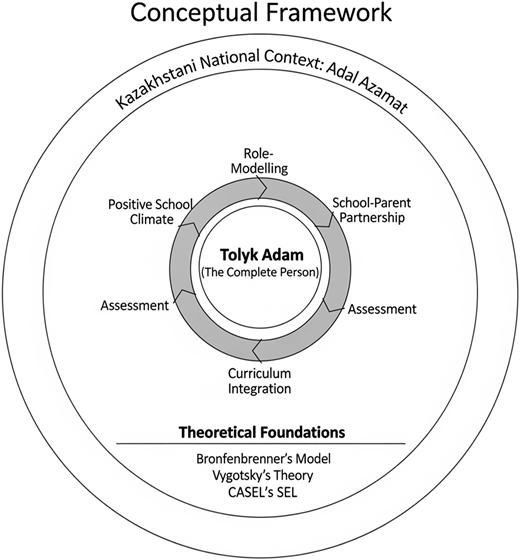
The VBE framework used in the BIL is a comprehensive and multi-layered system designed to translate these philosophical ideals into practice (See Figure 1). It is best understood as a holistic ecosystem that operates on the principles of cultural synthesis and pragmatic integration. The framework's intellectual strength lies in its syncretic nature, as it does not rely solely on Kazakh wisdom but pragmatically integrates it with globally recognized, evidence-based psychological theories. This approach uses Lev Vygotsky’s Sociocultural Theory to provide a theoretical basis for its emphasis on national and cultural context, arguing that cognitive and moral development are inseparable from the social environment in which they occur (Vygotsky, 1978). This is complemented by Urie Bronfenbrenner’s Bioecological Model, which underpins the framework's holistic, ecosystem-based approach by highlighting that a child's development is shaped by continuous, reciprocal interactions with their entire environment family, school, community and culture (Bronfenbrenner, 2005). As a key practical tool, the framework explicitly adopts the five core competencies of CASEL's SEL framework: Self-awareness, Self-management, Social awareness, Relationship skills and Responsible decision-making (CASEL, 2023). This integration provides teachers with a familiar language and access to a wealth of practical resources, significantly enhancing the framework's implementability and leveraging its demonstrated link to improved academic outcomes (Durlak et al., 2011).
The BIL framework is visually and conceptually organized as a holistic ecosystem with the student at its center. This ecosystem comprises five interconnected and mutually reinforcing components that work in concert to foster character. The first component, a positive School Climate, is considered the bedrock of the entire system, emphasizing the creation of a safe, supportive and inspirational learning atmosphere that extends even to the physical design of the classroom (Barret et al., 2015; National School Climate Center, 2022). The second component is Role-Modelling, which places immense importance on the character of adults. Principals are seen as moral leaders and “drivers of change,” while teachers are “agents of change” who serve as living exemplars of the values being taught, echoing Akhmet Baitursynov's sentiment that “A teacher is the soul of the school” (Berkowitz, 2021). Third, a strong School-Parent Partnership is mandated, moving beyond informal engagement by formally adopting Joyce Epstein’s “Six Types of Parental Involvement” to create a structured, evidence-based approach to reinforcing school values at home (Epstein, 2001). The fourth component is Curriculum Integration, which employs a “targeted” strategy to infuse national and moral values into key subjects like Kazakh Language, History and Music, which are seen as primary carriers of cultural identity (Dossanova, Kunekova, Zhumasheva, & Dossanova, 2018; Altynsarin Akademiasy, 2023). Finally, the fifth component is Assessment, which utilizes a formal, mixed-methods approach combining formative and summative tools like surveys, moral dilemmas and observation reports to provide evidence of impact to stakeholders and drive continuous improvement (Harrison, Arthur, & Burn, 2016).
4.1 The framework in practice: a living ecosystem
The conceptual power of the BIL VBE framework is fully realized in its execution. The five components of the ecosystem do not operate in isolation; rather, they are woven into the fabric of the school's daily life, creating a deeply integrated and mutually reinforcing system. This transformation from a paper-based framework into a living culture is achieved through a set of core practices that ensure the principles of tarbiye are not just taught, but consistently experienced, practiced and reflected upon by the entire school community. At the heart of this practical application are the weekly “Tәрбие сағаттары” (Tarbiye Hours or Character Development Hours), which serve as the central, dedicated time for explicit values education.
These sessions are the antithesis of passive indoctrination. They are highly structured, interactive forums guided by homeroom teachers (сынып жетекшісі - synyp zhetekshisi) who receive specialized training in facilitation. The pedagogy employed is dynamic, incorporating Socratic dialogue, the analysis of moral dilemmas drawn from literature and real-life events, project-based learning and reflective journaling (e.g. Berkowitz, 2021). For example, a month dedicated to the value of “responsibility” might begin with a tarbiye hour where students analyze a short story about a character who fails to meet their obligations. This is followed by a group discussion where students connect the theme to their own lives their duties to their families, their academic responsibilities and their role in the school community. This explicit instruction in the “taught” dimension of character (Jubilee Centre for Character & Virtues, 2017) provides the cognitive and linguistic tools for students to understand and articulate virtues.
However, the framework’s strength lies in ensuring these lessons extend beyond the classroom walls. The theme of responsibility is concurrently integrated across the school ecosystem. In subject lessons (Curriculum Integration), a history teacher might highlight the civic responsibility of historical figures, while a science teacher discusses the ethical responsibilities of researchers. The school climate reinforces this through visible posters and by entrusting students with meaningful roles, such as managing a classroom library or leading a clean-up initiative. This is where role-modelling becomes paramount; students witness teachers and administrators demonstrating responsibility through their punctuality, preparedness and care for the school environment.
Furthermore, the framework activates a wide array of co-curricular and extracurricular activities as practical laboratories for character development. The traditional Kazakh concept of asar a form of collective, voluntary work for the community is institutionalized through mandatory community service projects that connect directly to forming a modern national identity (Dossanova et al., 2018). Whether it involves assisting at a local nursing home or organizing an environmental campaign, these projects provide students with direct experience in applying values like compassion, teamwork and civic duty. Similarly, the school's renowned focus on academic olympiads and competitive sports becomes a vehicle for cultivating performance virtues such as perseverance, discipline and resilience (Jubilee Centre for Character & Virtues, 2017). In these high-stakes environments, coaches and mentors explicitly frame challenges and setbacks as opportunities for character growth, not just as wins or losses.
The loop is closed through a dynamic approach to assessment and partnership. Following the unit on responsibility, students might complete a self-assessment rubric on their own progress, which is then discussed in a one-on-one meeting with their homeroom teacher. This use of varied tools aligns with modern approaches to character evaluation (Harrison et al., 2016). Simultaneously, the school communicates the monthly value to parents, providing conversation starters and suggesting related activities to do at home, thus strengthening the School-Parent Partnership (Epstein, 2001). Feedback from parents about changes they observe in their children’s behavior is considered a vital piece of informal assessment data. This continuous, 360-degree cycle of teaching, practicing, modeling and reflecting ensures that values are not a peripheral concern but are the central, organizing principle of the entire educational experience at BIL. It is this deeply integrated, multi-faceted application that transforms the framework from a mere document into a thriving, effective ecosystem for cultivating the Tolyk Adam.
5. Discussion of the BIL VBE framework
The VBE framework of the BIL presents a compelling case study for the global character education movement. In an era where the Westphalian assumption of the nation-state as the sole arbiter of policy is challenged by supranational organizations and global discourses (Niemann & Martens, 2021) the BIL model is a sophisticated example of educational “glocalization.” This analysis argues that the framework functions as a site of reception and translation, where global education policies are selectively adapted to serve local needs and values (Steiner-Khamsi, 2012). This chapter will examine the framework's principal strengths as a syncretic model, address its significant weaknesses in the context of post-Soviet elite formation and systemic challenges and assert its value as a vital non-Western contribution to a field often defined by uncritical policy borrowing.
5.1 A syncretic model of educational glocalization
This framework exemplifies a nuanced approach to policy borrowing. Education policy, at its core, is the “authoritative allocation of values” for a society (Easton, 1953, p. 129), and the BIL framework is an authoritative decision to allocate values rooted in the indigenous Kazakh concept of tarbiye. This term connotes a holistic process of nurturing a person toward the ideal of Tolyk Adam (“The Integral Person”), providing a philosophical depth that anchors the framework in the local cultural context. The primary strength of the BIL VBE framework lies in its sophisticated theoretical architecture, which grounds its structure in established educational research, thereby avoiding the common pitfall of being a simple list of aspirational values. The entire model is conceptualized as a whole-school ecosystem, a direct application of Urie Bronfenbrenner’s (2005) bioecological model. This choice is in itself a significant analytical statement, asserting that character is not merely taught but is formed through a complex web of reciprocal interactions between the student and their environment a perspective that directly informs the framework's multi-faceted approach targeting students, school leadership, teachers, parents and the physical setting (Barrett, Davies, Zhang, & Barrett, 2015).
The philosophical and pedagogical heart of this ecosystem is tarbiye, a concept of holistic upbringing central to its cultural authenticity. This focus on an indigenous ideal is a powerful act of indigenization, standing in contrast to the often-superficial borrowing of Western “best practices” (Silova, 2009). This philosophy is operationalized through dedicated “Тәрбие сағаттары”, which are not didactic lectures but forums for facilitated self-reflection. In these sessions, teachers guide students through discussions on ethical dilemmas and cultural narratives to foster the practical wisdom, or phronesis, essential for autonomous moral agency rather than unreflective compliance (de Ruyter & Steutel, 2013). This cultural legitimacy is further reinforced by a strategy of integrating national values directly into the core curriculum through subjects identified as primary carriers of cultural identity, such as Kazakh language, literature and history (Dossanova et al., 2018).
This culturally authentic foundation is skillfully supported by a high degree of pragmatism, demonstrating a sophisticated process of policy translation. The framework bridges the gap between the high-level philosophy of Tolyk Adam and daily classroom practice by integrating concrete, evidence-based tools. Chief among these are the five core competencies of the CASEL framework for Social and Emotional Learning (CASEL, 2023) and Joyce Epstein’s (2001) six types of parental involvement. The integration of an internationally recognized toolkit like SEL, which is backed by substantial empirical evidence linking it to improved academic and well-being outcomes (Durlak et al., 2011), provides teachers with a shared, practical pedagogical grammar. This synthesis is powerfully demonstrated in the schools' distinct curricular approach, which strategically navigates the core post-Soviet tension between nation-building and the pressures of globalization (Yakavets, 2014). While Kazakhstan’s national curriculum devotes a significant proportion approximately 18% to the study of the national language as a vehicle for strengthening identity, the BIL schools diverge. English is the primary medium of instruction for STEM disciplines, a pragmatic choice that grants students access to the global language of science. However, subjects central to national identity such as History, Geography and Law are taught in Kazakh, which also remains the primary language for daily communication and school events. This creates a model of bicultural fluency, preparing students for international engagement without sacrificing their cultural heritage.
The most compelling evidence for the framework's value is the synergistic success of the BIL schools, which offers a tangible counter-narrative to major global education debates. In an era where neoliberal pressures often reduce the purpose of education to human capital formation, the BIL network’s consistent, elite performance suggests that its dual focus on rigorous academics and intentional character formation is not only compatible but mutually reinforcing. This provides a powerful “proof of concept” that the stable, supportive and values-driven environment created by the framework is the very foundation upon which academic excellence is built, reaffirming that a holistic educational ecosystem is a direct pathway to, not a diversion from, academic achievement.
5.2 Critical considerations and areas for development
Despite its considerable strengths, the framework operates with an idealized view of the school and overlooks the challenging realities of the broader educational system. Its most significant weakness is its silence on the issue of equity and social stratification. The framework analyzes the school as a self-contained entity, failing to acknowledge that the institutions best positioned to implement such a comprehensive model are often elite, selective schools. This raises critical questions about whether a values framework focused on individual character inadvertently legitimizes a stratified system and how its resource-intensive principles can be realistically applied in mainstream public schools without widening the existing equity gap. For the framework to have systemic value, it requires a critical discussion of its application across diverse socioeconomic contexts.
A further critical consideration raised by this analysis is the tension between the framework's implementation in elite schools and the democratic ideals of a post-Soviet society. The focus on the selective BIL network may appear to promote an elitist aim for education. However, this paper argues that the BIL schools function as a case study for a national, civic ideal the formation of the Tolyk Adam rather than promoting elitism as an end goal. The values it cultivates, such as justice and responsibility, are fundamentally democratic in nature and intended for all citizens.
Similarly, the framework’s climate could be misconstrued as promoting an authoritarian model that contradicts democratization. It is crucial here to distinguish between an authoritarian approach, which demands unreflective compliance, and an authoritative one, where teachers act as legitimate moral exemplars and guides. The BIL framework unequivocally embraces the latter. The use of Vygotsky’s theories, for instance, supports the framework’s socio-cultural methodology, not a command structure. Furthermore, the authority inherent in the Tolyk Adam ideal is not one of external coercion but of internal moral authority the self-mastery that comes from harmonizing reason, compassion and will. The teacher’s authoritative role, therefore, is to guide students toward this state of autonomous moral agency, which is the very foundation of a self-governing and democratic citizen, making the framework a potential asset, rather than a hindrance, to Kazakhstan’s ongoing democratization.
Furthermore, the framework leans toward idealism in its assumptions about implementation, presuming the existence of highly supportive principals, intrinsically motivated teachers and deeply engaged parents. The reality in many schools, particularly those grappling with the legacy of Soviet-era pedagogy, is often quite different, with school administration sometimes being a significant barrier to reform (Qanay, Courtney, & Nam, 2024). A more robust version of this framework would need to address these implementation challenges by offering strategies for gaining teacher buy-in and adapting the model for schools where resources and administrative support are limited. Finally, the framework is underdeveloped in its approach to assessment and impact measurement. While it advocates for a holistic approach, it offers little detail on how the development of character or a positive school climate can be reliably evaluated. For the model to be compelling to policymakers and funders, it must be accompanied by a clear, mixed-methods evaluation protocol that moves beyond academic scores to include validated instruments such as school climate surveys, qualitative interviews and observational rubrics (Berkowitz, 2021).
5.3 Significance and contribution to the field
These weaknesses notwithstanding, the BIL VBE framework is a highly significant contribution to the field of comparative education. It serves as an exemplary case study of how a non-Western nation can move beyond the normative approach to policy borrowing which often uncritically seeks to transfer “best practices” to a more analytical and culturally grounded model of adaptation. The framework adds a crucial non-Western voice to a global discourse on character education that remains heavily dominated by Anglo-American perspectives, offering a potential model for other post-Soviet nations seeking to build educational systems authentic to their own cultural narratives. By so effectively bridging the theory-practice divide, the BIL framework is of immense value to both researchers, who can analyze it as a rich sociological phenomenon of policy translation, and practitioners, who can see it as a guide for transformative, culturally responsive school reform.
6. Conclusion and implications
The VBE framework of the BIL is a significant and sophisticated model of educational glocalization. Its conceptual contribution lies not in a simple list of components, but in its successful synthesis of indigenous Kazakh philosophy with globally recognized pedagogical and psychological theories. This fusion is more than a pragmatic act of policy borrowing; it is a deliberate cultural statement that offers a powerful counter-narrative to the dominant neoliberal discourse that often reduces education's purpose to human capital development. By authoritatively allocating values rooted in the holistic ideal of Tolyk Adam (“The Integral Person”), the framework champions a vision of education aimed at cultivating flourishing individuals who embody virtues central to Kazakhstan's national identity, such as responsibility, justice and industriousness.
However, this pedagogical success is situated within a complex and contradictory socio-political context. The framework's implementation within an elite, selective school network creates a profound “policy paradox.” While the state promotes the inclusive ideal of Tolyk Adam for all, its investment in exclusive institutions risks contributing to a system where elites consolidate their status, creating globally competitive citizens from a narrow segment of society. This raises the critical question of whether the framework, despite its noble aims, has the unintended consequence of exacerbating the very social stratification it seeks to overcome.
This central tension necessitates a forward-looking research agenda. Future inquiry must move beyond validating the framework’s internal efficacy to critically examine its external impact on the broader educational ecosystem and national social cohesion. Rigorous empirical studies are needed to formally validate the links between the framework's five core components and student outcomes, including character development, academic achievement and long-term well-being. Furthermore, valuable insights could be gained by studying the mainstream schools that are now beginning to implement the BIL VBE model to understand their perceptions, the implementation challenges they face and the resulting student outcomes in a non-elite context.
For policymakers and educators in Kazakhstan and other nations with similar post-Soviet contexts, the BIL framework provides a powerful and transferable model. It demonstrates that it is possible to move beyond the simple importation of Western models and instead build a system that is grounded in national heritage while leveraging internationally recognized, evidence-based practices.
Ultimately, despite the systemic challenges it highlights, the VBE framework makes a vital contribution by demonstrating what is possible when education is aimed at its highest purpose. Its core vision remains an inspiring one: to successfully navigate the complex terrain between preserving a unique national identity and preparing students for a globalized future, thereby fulfilling the ultimate aim of forming citizens who are both intellectually proficient and morally good.