This article describes 1 school’s model for improvement using the character education framework as a set of instructional practices and professional development activities that fostered a learning community for both adults and children. The 11 Principles of Effective Character Education inspired and guided the school to emphasize the new ABCs of learning (autonomy, belonging, and competency) and transform itself into a full-service school model.
Introduction
The Thomas Edison School, located in the Village of Port Chester, serves approximately 430 students from kindergarten through fifth grade. It is a Title I school with a population that is predominantly Hispanic (88%), largely minority (94%) and overwhelmingly poor with 80% of its students receiving free or reduced lunch. Although the village is located in Westchester County, New York, an area typically associated with suburban affluence, the school’s demographic characteristics more closely resemble those of large urban cities.
In 1997, Edison School began a gradual process of reflection and transformation beginning with the appointment of a new principal, a dramatic shift toward higher learning standards for students and the rigorous testing requirements instituted under No Child Left Behind Act. Edison was faced with many challenges including the need for students to meet the revised testing requirements under the new state standards, and to address the issue of their “readiness” to learn as they walked through the schoolhouse door given that 46% of the student population was considered limited English proficient, that the school had experienced low levels of parental involvement, and that many of Edison families were Hispanic immigrants of undocumented status and therefore, facing a variety of difficulties typically associated with acculturation. Dabbah (2006) explains how many Hispanic parents, who are recent arrivals, allow their own school experiences to shape their views and expectations of public schools in the United States. These views inhibit parents from making their presence felt in schools and from taking an active role in their children’s education. As a result, their children’s readiness to learn is hindered by such underlying parental beliefs that school personnel know what is best for their children and that undocumented and non-English speaking parents can not participate in an educational system that often appears intimidating to them. It is not surprising then that in 1999, before the implementation of Edison’s full-service community school model and character education initiative, only 19% of Edison’s fourth graders passed the New York State’s English language arts assessment and greater parental involvement was identified as a critical concern.
Planning for School Improvement and Achieving Transformative Change
As part of Edison’s initial planning for school improvement in 1996, an ongoing dialogue was established with parents and members of community-based organizations. As part of this dialogue, in which the multilevels of stress faced by many Edison families was recognized, educational practitioners and social service providers from within the community sought to identify more comprehensive and integrated service delivery models for meeting the social service, physical, and mental health needs of students and their families. A parallel effort was also underway for identifying strategies in which to make the school and classroom environment more inviting and focused on improving the quality of teaching and learning. CEP’s (Character Education Partnership, 1996) “Eleven Principles of Effective Character Education” were used as guidelines for planning a comprehensive school improvement initiative with character education as a central theme. These principles became the vehicle by which to transform Edison into a caring and inclusive learning community able to respond to the needs of a diverse student population.
The result was an exciting, new vision of education focused on the goal of developing the whole child rather than simply concentrating on the improvement of test scores. The framework of the Child Development Project (CDP), a scientifically validated model of effective character education (Berkowitz & Bier, 2005) conceptualized by the Developmental Studies Center, served to inspire and inform the school’s newly formed emphasis on the new ABCs of learning. These new ABCs of learning represented CDP’s approach to education by supporting the child’s overall developmental needs for gaining “autonomy,” experiencing a sense of “belonging” and achieving intellectual, ethical, and social-emotional “competency” (Child Development Project, 1995). Classroom instruction and school programs and activities were redesigned to build a strong sense of community in classrooms and throughout the school for students, staff and families.
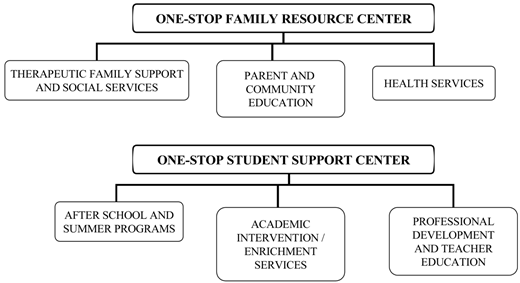
The school’s goals of creating an inclusive school community and meeting the overall developmental needs of children fit comfortably within the context of implementing a full-service community school. This unique approach to schooling, which has its historical roots in the Settlement House Movement of the late 1800s (Blank, Melaville, & Shah, 2003), gathers the resources of the community to provide programs and services for students and their families colocated at the school site. These programs and services were instituted at Edison as part of a “One Stop Center” that included after school and summer enrichment programming for students, on-site courses for future teachers, parent education classes, therapeutic counseling for families, case management services for students in need, and dental and medical services for Edison children. Figure 1 depicts the two levels of services provided to students and their families as part of Edison’s “One Stop Center.”
Developing a comprehensive plan for school improvement resulted in the school’s transformation in ways that included a rethinking of its mission statement, as follows:
At the Thomas Edison Community School, children’s intellectual, social-emotional, ethical, and physical development are central to all school initiatives. At Edison we believe that improving the quality of life within the general community and strengthening community connections has a positive impact on children’s growth and learning. Our full-service school provides direct services to students in a comprehensive and integrated manner. It seeks to strengthen the network of relationships between the child’s home, school and community; thereby, enabling students to come to school ready to learn and to experience academic success.
Edison’s revised mission statement has been supported by research in neuropsychology (Caine & Caine, 1994; Shonkoff & Phillips, 2000, Sylester, 2000) that has linked child development to academic achievement vis-à-vis positive relationships and meaningful engagement within the school. Edison’s approach to the implementation of character education has thus been an application of this field of knowledge.
Implementing Quality And Effective Character Education
Although each of the “Eleven Principles of Effective Character Education” (Character Education Partnership, 1996) listed below was thoughtfully incorporated into Edison’s Three Year School Improvement Plan document and helpful in shaping Edison’s organizational identify, several were most critical to systemic change.
Promoting core ethical values;
Understanding character development;
Developing intentional, proactive, and comprehensive approaches;
Creating a caring school community within the school;
Providing opportunities for moral action;
Making meaningful connections to the academic curriculum;
Encouraging intrinsic, self-motivation;
Engaging the participation of the entire school community;
Fostering shared leadership;
Including all stakeholders; and
Evaluating the school’s progress along the way.
Character Education Partnership’s principles: 1, 3, 4, 6, 10, and 11 were particularly useful in integrating academic initiatives with meaningful character education and in promoting the cross fertilization of ideas between community school research and research on child development. Principle 1, “promoting core ethical values as part of a school’s culture and organizational identity” established a focus for faculty meetings, professional development days, staff retreats and stakeholder meetings over the course of several years. This process enabled Edison to define and adopt the values of “respect, responsibility, kindness and tolerance” and to build a common language for communicating and interacting with every member of the school community. CEP principles 3 “developing intentional, proactive and comprehensive approaches” and 4 “creating a caring school community within the school” were applied to the design of these adult meetings which paralleled the class meeting structures introduced to children as part of the Child Development Project. For both adults and children, these meeting formats served to build trust and collaboration, establish procedures and expectations to guide their social interactions, and to promote ongoing discussions involving problem solving at both school and classroom levels. As a result, disciplinary referrals to the principal decreased from 30% during the 1996 school year, prior to the implementation of character education, to 11% in 2007. Furthermore, 86% of the staff surveyed in 2006 indicated that, as a result of the implementation of character education, they felt Edison students were more independent as learners, experienced a greater senses of belonging within the school, and that they were much more competent individuals socially, ethically, and intellectually than in the past; thereby, helping move toward achieving the ABCs of learning previously described.
Reaching out to all families and including all stakeholders was a critical aspect of building a caring school community as described in CEP principles four and ten. Parent programs and activities, conducted bilingually both during the school day and after school hours, were carefully developed in response to the needs and interests expressed by parents and members of the school community. Efforts to engage families were coordinated and offered by school staff and community partners, and included such activities as grade level take home assignments intended to make parents a viable part of the curriculum (Developmental Studies Center, 1995), theme-based exhibitions of student work, curriculum evenings designed around family fun and learning, community health and housing fairs, topical workshops, and adult continuing education courses. Regardless of their educational backgrounds and native language, all parents were encouraged to feel that they were partners in their child’s academic learning. In addition, a course titled, “Common Sense Parenting,” was also initiated to introduce parents to developmentally appropriate approaches to discipline, and to enable them to better understand the role that character development plays in effective childrearing. For the first time, parents were given the opportunity to be part of the school’s agenda for change, given strategies on how to partner with the school in support of their children’s learning, and to ask questions and express their views regarding schooling in the United States. During many of the aforementioned activities, parents verbally reported experiencing a sense of empowerment and respect within the school. Attendance documentation over the past 5 years has shown that an average of 75% of Edison parents and adult caregivers attended major schoolwide events, a statistic particularly significant given that Edison parents had previously been disconnected from the school as reported by veteran staff.
CEP principle six underscores the importance of linking character education to a meaningful and challenging academic curriculum and Edison applied this principal to introducing components of the Child Development Project. Two of these program components, buddy class and class meetings (Developmental Studies Center), were particularly useful in establishing more child-centered instructional practices. Buddy class activities involved the pairing of students from upper and lower grade classes at least twice monthly for a variety of learning experiences centered on reading, writing, drawing, speaking and listening to one another. These program components complimented research on child development that has demonstrated that positive relational engagement with both adults and peers within environments for learning is linked to healthy growth and development, to better classroom engagement, and to improving the student’s ability to be academically successful (Shonkoff & Phillips, 2000). The Developmental Studies Center indicates that cross age partnerships promote a sense of responsibility and caring between older and younger children while giving them an opportunity to practice important language, thinking and social skills (Developmental Studies Center, 1996). These outcomes were particularly evident at Edison during read aloud activities and the sharing of student authored books and journals.
Class meetings, also relevant to CEP principal six, served as important vehicles for turning everyday school and classroom experiences into meaningful opportunities for growth and learning. Class meetings played an important role in fostering tolerance, one of Edison’s four core values, and in developing the students’ listening and language skills within the context of authentic social interactions. These meetings in which students are typically seated in a circle with a group facilitator include the following formats: planning meetings, decision-making meetings, problem-solving meetings, and reflection meetings (Dalton & Watson, 1997).
Ideas from the Child Development Project were eventually integrated into other curricular areas as teachers came to value and incorporate student partnerships and to more comfortably implement individual, small and large group instructional methods. In addition, curriculum content was enhanced by the integration of character related themes involving ethics, civic responsibility, moral action, decision making, and problem solving. Studies of the Holocaust, which gave fifth grade students recognition from community leaders and county legislators, along with the efforts of first graders to beautify the school grounds by growing a community garden, represent just a few of the grade level projects that have taken place over the years demonstrating the ease with which challenging academic content could be integrated with instructional activities designed to also teach and generate commitment to a set of core human values, and to then reinforce these values through student performance. Collectively, Edison’s focus on building community, fostering caring relationships, and achieving the new ABCs of learning resulted in dramatic and sustained improvements in English language arts and mathematics over a 7-year period as reflected in Table 1.
Evaluating School Progress
The collection of data to monitor and assess the effectiveness of goals and objectives included in Edison’s Three Year School Improvement Plan, with its focus on community school programs and character education, reflected CEP principle 11 and its emphasis on systematic evaluation of progress along the way. Given the constraints of time on school staff and the language barriers and limited literacy levels of a significant number of Edison family members, the collection of data was limited to more informal methods. These qualitative methods were used to gather information and included questionnaires, surveys, the examination of school related documents, meeting minutes, and notes taken during interview and focus group discussions. For example, data was collected on parent attendance at schoolwide events and on disciplinary referrals to the principal’s office. Verbal reports from teachers and support staff were also considered, and reflected their views that the levels of independence exhibited by students in completing class assignments and in demonstrating prosocial attitudes and behaviors in working with their peers had increased significantly with the implementation of character education. Feedback from both students and teachers shared the perception that both groups felt supported within the school and enjoyed being part of the school community. Finally, student achievement gains indicated by test scores in English language arts and mathematics also reflected the total impact of school improvement initiatives. Although the data collected by the school’s staff and leadership did not reflect the rigor of a scientific investigation, it did provide valuable information to guide ongoing reflections and planning each year. However, the data did serve as important indicators of the positive impact of character education and community school restructuring on those areas of most concern ten years earlier.
Conclusions
Edison has successfully woven character education into all of its school programs and partnerships, thereby increasing family engagement, instilling its core values schoolwide, developing a more meaningful and engaging academic curriculum, and truly creating a caring school community. In moving forward, Edison has made deliberate efforts to extend its community school philosophy and practices, based upon the conceptual frameworks of the Child Development Project and the Eleven Principles of Effective Character provided by CEP, to its work in training future teachers. Through its collaboration with Man- hattanville College, Edison has evolved into a professional development school where preservice teachers now benefit from working and learning their craft in a community school environment in which character education is embedded. In doing so, experienced teachers at Edison have begun to reshape the profession enabling future teachers to assume a more broadly defined role as educators of the whole child, and thereby as educators of character.
Ten years later the Thomas Edison School has emerged as a beacon of light for many immigrant families in Port Chester and model of best practices in a full service community school both locally and at the national level. With over 90% of its students passing the fourth grade assessments in English language arts in fourth grade and mathematics in 2005-2006, the school was recognized in 2005 by the New York State Education Department as a high performing school that has successfully closed the achievement gap. In 2003, Edison was honored to receive recognition as a National School of Character by the Character Education Partnership, a further testimony to the value of engaging children, parents, staff members and community stakeholders in the process of school renewal and in demonstrating the positive impact of character education in the pursuit of academic excellence.