Peer victimization has received much attention from researchers and educators over the last decade, since it is a problem that affects children and adolescents. As more time-extensive programs do not seem to be used in schools, in this article the EQUIP program for Educators is proposed as an instrument for the prevention of peer bullying and social exclusion. Its three components, anger management and thinking error correction, social skills and social decision making might be useful to work on various aspects involved in victimization situations between peers. The training was carried out in two groups of students in Spanish Secondary education between the ages of 14 and 17 years. Results of the study in relation to thinking error correction, peer bullying and social exclusion incidence, classmates’ behavior in victimization situations and classroom climate are presented and discussed.
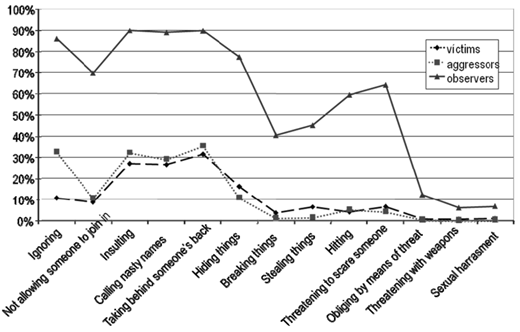
Peer victimization has been identified as a problem that affects a proportion of children and adolescents in both primary and secondary schools. It can be defined as a “perverse type of interpersonal relation that is characterized by repeated behaviors of intimidation and neglecting towards a student who is in a disadvantaged position” (Del Barrio, Martín, Almeida, & Barrios, 2003). It implies an inequality of power: a student who is in a more powerful situation, usually supported by a number of classmates, addresses aggressive actions to a powerless peer. These actions can be direct (e.g., insulting) or indirect (e.g., talking behind someone’s back), physical, verbal or by other means. When victimization implies interactions, we refer to it as bullying, but when it is aimed at depriving someone from interaction we call it exclusion. This maltreatment between peers has a negative effect on the victim’s wellbeing and affects the climate of the group in which these students find themselves in a negative way (Rigby, 1996; Van der Meulen, 2005). Prototypically it is repeated behavior, although it can occur that one interaction, or lack of interaction, is enough to perceive it or experience it as victimization (Olweus, 1999). Recent data on the incidence of peer victimization in Spanish secondary education (Defensor del Pueblo-UNICEF, 2007) show that the numbers of students being victimized by other students, those actively participating and those observing the maltreatment depend on the type of aggression involved. With respect to victims, for example, percentages range between 0,5% (threatened with weapons) and 27,1% (insulted). Incidence related to these three viewpoints, obtained in this national-wide survey is shown in Figure 1.
School bullying and social exclusion has been a major concern for educators and politicians in many countries for the last fifteen years, and many have contributed to the knowledge available at this moment, as this phenomenon is a hot item among researchers in psychology and education. Initially, the main focus was on the victim and the bully or bullies, reducing possible causal explanations and interventions to these two parts of the relation, and many times only referring to their personal characteristics, more or less stable. Later on, this relation has started to be seen as embedded in a group context (del Barrio et al., 2003; Pellegrini, 2002; Salmivalli & Voeten, 2004). Therefore, specific group aspects as popularity or friendship structures in the group have to be taken into account. Also, various roles in a bullying or social exclusion situation have been distinguished. Apart from the victim and the bully or bullies, other students support these latter, for example by laughing or telling them to continue. Only some help the victim, defend him/her, or talk to the person afterwards. Many students are mere observers; they know about the victimization but do nothing to stop it (Salmivalli, Lagerspetz, Björkqvist, Österman, & Kaukiainen, 1996).
In summary, school peer victimization should be perceived as a group phenomenon, rather than exclusively provoked and affected by individual factors, which explains why it is difficult for a victimized student to get out of the situation by him/herself. Various effective intervention methods that take into account the ways of group functioning in schools have been designed by researchers and teachers. Some of these have shown to be useful in primary school (e.g., Circle of friends; see Sullivan, 2000), others in secondary education (e.g. the Pikas Method of Shared Concern (Pikas, 1989). These interventions are not only aimed at improving the relation between bully/bullies and victim but try to go beyond that, heading for changes in the whole group and in the classroom climate. Fewer programs are to be found of a preventive nature however. Experienced teachers and writers refer to possibilities such as theater or activities including role-playing in the class, curriculum work, which includes information on understanding and defining bullying (Sullivan, Cleary, & Sullivan, 2004), or training teachers to create positive relationships in the classroom (Galloway & Roland, 2004). These activities have in occasion been elements of larger intervention programs, implemented in a considerable number of schools, as for example the pioneering Olweus Bullying Intervention Program in Norway (e.g., Olweus, 1993; later adapted by several others to introduce it in their own country), or the Sheffield Project in the United Kingdom (e.g., Smith, Sharp, Eslea, & Thompson, 2004). These larger projects consist of various components (e.g., drama, video, quality circles, peer counseling, playground supervisor training) to be implemented in each school. Some of these are done with several, or even all classrooms over a few sessions, others with a selection of the school’s total student population, and others only with the teachers. However, more extensive programs to work with all the students of a classroom over a longer period of time do not seem to be used in schools.
We believe that the EQUIP program for Educators (DiBiase, Gibbs, Potter, & Spring, 2005) is an interesting method that might be useful in creating a positive classroom climate, and thus preventing the appearance of antisocial behavior as peer victimization. This program is an adapted version of the original EQUIP, which aims at educating young people at-risk or with behavioral problems in thinking and acting responsibly using a peer-helping approach (Gibbs, Potter, & Goldstein, 1995). EQUIP for Educators can be used in mainstream secondary schools and it involves three components: (1) anger management and thinking error correction, (2) social skills and (3) social decision making (see DiBiase in this volume for background information on this program). An important aspect of the first component is the reduction of students’ self-serving cognitive distortions. Gibbs (e.g., 2003) distinguishes four types of these distortions, the so-called thinking errors. Self-centered is the primary self-serving cognitive distortion: only one’s own views, needs, rights, feelings etc. are what count, those of others are not or scarcely considered (Gibbs, Potter, Barriga, & Liau, 1996). For a person, the fact of continuing his/her self-centered attitude typically results in protective rationalizations, that Gibbs (e.g., 2003) calls secondary cognitive distortions. When hurting other people, the offender might use these to protect him/herself against psychological stress that could be generated by his/her actions. Blaming others, Assuming the worst and Minimizing/Mislabeling are all secondary cognitive distortions. Blaming others can be understood as misattributing blame for one’s own actions to outside sources (Gibbs, Potter, & Goldstein, 1995). When somebody attributes hostile intentions to other persons, he or she considers a social situation as inevitable or assumes that there are no possibilities to improve his/her behavior, s/he is Assuming the worst (Gibbs et al., 1996). A person is Minimizing or Mislabeling when s/he uses belittling or dehumanizing labels in relation to others, or depicts antisocial behavior as being acceptable, even admirable, or not really harming others (Gibbs et al., 1995).
In earlier research that we conducted with SCAN-Bullying, a narrative instrument created to study children’s and adolescents’ understanding of peer victimization (Del Barrio, Almeida, van der Meulen, Barrios, & Gutiérrez, 2003), causal explanations of bullying and social exclusion were found that could be labeled as thinking errors. Ramón1 (11), for example, is minimizing when he explains the behavior of a bully: “I think he does it just in order to pretend being funny. Not to hurt anybody, but to let the others know how funny he is, so it will make him more popular.” Some young adolescents blame others, as do Sergio (13): “Because of the parents, they don’t care for their children and let them to do what they want”; Nuria (13): “They are influenced by their friends,” and Paula (11): “Perhaps because of how she [victim] looks like.” Finally, Juan (11) refers to others’ Self-Centered viewpoint as the starting point for victimization: “Some people believe they are the best, they are better than the rest for being taller, stronger or more intelligent. Some people think they are superior and that’s why things that shouldn’t occur, start to happen.” Gibbs (2003) also refers to Self-centeredness in relation to victimization, when he describes a bullying situation in a summer camp. Several campers pulled on a prank on Edward, a mildly retarded adult who was a maintenance staffer. While he was asleep, they would sink one of his hands into a pail of water so he would wet his pans in bed. Awaken, he would sweat and run after the laughing campers. According to Gibbs, these campers did not take into account Edward’s situation—his limited ability—when they bullied him, so they remained Self-centered.
It seems then that working on reducing thinking errors might be useful to change students’ perception on bullying and social exclusion, which as a result could reduce its incidence in schools as children and adolescents start to see it as hurtful behavior towards others once they really start taking them into account. But also the other components of the program, learning social skills and improving social decision making, are important aspects to work on with students in order to prevent victimization or to enable them to intervene more appropriately in abusive situations. Students can learn how to show other than just negative or aggressive behaviors, listen more carefully to their classmates’ problems, and make better decisions on what to do in a real or might-be conflict situation in the group.
We think that EQUIP might be useful to change hurtful group processes such as peer victimization, since the dynamics of the group are made clear during the program session. When analyzing real and hypothetical conflict situations in the classroom, behavior of the whole group is being clarified (which role has everyone, is pressure felt to act in a certain way, etc.) and analyzed by the students themselves. Also, possible new ways of dealing with conflicts in the group are discussed, as offered by some of the students to their classmates, which is a key-element of the peer-helping approach. Brugman et al. (2003) found that when students have a more adequate perception of the moral atmosphere in the school, this reduces norm transgressive behavior. In the same line, the understanding of the group processes involved in peer maltreatment could reduce its presence in the classroom.
We translated EQUIP for Educators into Spanish and called it EQUIPAR (DiBiase, Gibbs, Potter, van der Muelen, Granizo, & del Barro, 2010). Part of its contents, mostly concerning examples (e.g., social problem situations), were adapted to the Spanish secondary school context. We also introduced some specific sessions on peer bullying and social exclusion in school. Nevertheless, the main structure of the program was not altered. In the present study we piloted the EQUIP program in a Spanish mainstream school setting. Our hypothesis was that the training would reduce antisocial behavior in the form of peer victimization, as it makes the students more aware of the negative consequences this type of aggression has for those who suffer it. We were also interested in the effects that more adequate moral reasoning of the individuals in the group would have on the atmosphere in the class, understanding this atmosphere or climate as students’ sense of wellbeing and security in the class, group members’ sense of unity and teachers’ attitudes towards students. We predicted that, when adolescents reduce their cognitive distortions classroom climate would be perceived as more positive after the intervention. This means that students would indicate a higher sense of wellbeing and feelings of security after the training and the group would show an increased cohesion. Naturally, a positive classroom atmosphere would also enable the decreasing of aggressive behavior. In a positive climate peer victimization will be perceived by the students as inadequate behavior. One way or another, our prediction was that a successful intervention in terms of a reduction of cognitive distortions in the group would be related to a more positive classroom climate and a reduction of peer victimization.
Method
Participants
Two groups of students of two state-funded secondary schools from the province of Madrid (Spain) participated in this study. The first group, a regular second year class consisted of 24 students—11 boys and 13 girls—, with a mean age of 14.2 years. In the second school, a 3rd third year class that received extra teaching hours focusing on students’ learning difficulties participated. Students in this group —3 boys and 12 girls—, had a mean age of 16.2 years. Two control groups also participated: in the first school another second year class, 18 boys and 7 girls (mean age 14.0 years); in the second school another ordinary third year group, 20 boys and 5 girls (mean age 14.4 years).
Instruments
The EQUIP program for Educators consists of three components: (1) Anger management/Thinking error correction, (2) Social skills and (3) Social decision making. The material of the program was translated into Spanish, and students’ manuals were prepared. The three components appeared as in the original English version; however, the illustrative elements were altered where this was considered necessary. In the first place, almost half of the original examples of the social skills units were either changed or replaced, in part because of cultural incongruence (e.g., shoveling a driveway because of snow; in Spain most students live in apartments and little snow falls in the city of Madrid; baseball is not a commonly played sport in Spain, etc.), but also because many examples were about experiences outside school, while we aimed at using more examples of situations inside school. In the second place, also examples of the Anger management/Thinking error correction component were changed where needed (e.g., stealing a cell phone instead of a car). Third, from the original social decision-making sessions five problem situations were taken out as they were not considered appropriate for the Spanish school context: two situations on stealing, one on drug-dealing, one on an escape from an institution for boys, another keeping a gun in school and one on a father’s drinking problem. We considered these situations very different from adolescent’s daily life experiences in Spain (e.g., possession of weapons is very rare in Spain; teenagers under 18 are unable to have a driver’s license) and decided therefore to exclude them. We introduced three new problem situations, which were all related to the school setting, since we were interested in improvements of the relations between peers in the classroom. Two of them were situations of peer victimization in the class and the third situation implied a student-teacher problem. Our Spanish version of the Equip program for Educators contains therefore a total of 29 units.
Three questionnaires were used to evaluate the effects of the program. First, a Spanish translation of the How I Think questionnaire (Barriga, Gibbs, Potter, & Liau, 2001) was used to perceive possible changes in the amount of thinking errors made by the students. To assure reliability, the Spanish version was backtranslated into English by a translator not involved in this study, and minor corrections were made. The total How I Think questionnaire consists of 54 items and measures the four categories of self-serving cognitive distortions: Self-Centered (9 items), Blaming Others (10 items), Minimizing/Mislabeling (9 items) and Assuming the Worst (11 items). A reliability analysis was performed on the four subscales: Cronbach’s coefficient alpha varied between .74 and .84; Cronbach’s coefficient alpha of the total scale was found to be .93. These coefficients correspond with those found in the instruments’ validation study done by the authors of the questionnaire (Barriga et al., 2001). In four different samples, alphas of the whole scale were found between .92 and .96; alphas of the four subscales ranged between .71 and .89. The HIT also contains an Anomalous Responding Scale of 8 items and seven Positive Fillers, which serve to counterbalance the negative content of the distortion items. Responses to the items on this questionnaire are given on a 6-point Likert scale varying from totally disagree to totally agree.
Second, two questions of the School bullying and social exclusion questionnaire (Defensor del Pueblo [Spanish Ombudsman], 2000) that was originally used in a Spanish national wide survey were employed. These questions were used to measure peer victimization incidence in the classroom on the one hand, and to obtain information on students’ perceptions of their peers’ interventions in bullying/social exclusion situations on the other. The first question, Have you observed other peers in your class being victimized over the last 3 months?, was split up in questions on thirteen types of aggression (insulting, ignoring etc.). Cronbach’s coefficient alpha was found to be .83 in the reliability analysis. To answer the second question, How do your classmates react to victimization situations in your class?, respondents had to indicate how many students (choosing between None, Some or Many students) they believed responded to victimization situations with respect to nine alternatives, as for example “They join the bully/bullies” (Cronbach’s alpha = .64).
A third questionnaire, the Classroom Climate Scale, which was created by the authors of this article, involves 19 items on a Likert scale from 1 to 6. Out of the four subscales that the original scale contains, we used two for the purpose of this study. Wellbeing/Security (e.g., “I can trust my classmates”) encloses six items of which three are negative statements that are reverse-scored. In a reliability analysis, Cronbach’s coefficient alpha was found to be .61. Group Cohesion (e.g., “In this class there are groups that do not mix”) has seven items (Cronbach’s alpha = .59). Of this subscale, four items are positively stated and three negatively; the latter ones are reverse-scored. Reliability of the two subscales together was .70 (Cronbach’s alpha).
The individual interview included two questions that referred to the evaluation of their participation in the EQUIP program for use in the present study: “Did you learn anything from the program?”, “Which part did you find most useful and which part least?”
Procedure
One of the female researchers, who had previously received a training in EQUIP from an expert, taught the program in both schools; the first author also participated in training the students in the second school. Both groups worked on the program for six months. The 29 units of which the program is composed, were carried out during 36 classes of 50 minutes. The three components were taught in sequence. The first module of Anger management and Thinking error correction was implemented in 16 classes; the second module of Social skills in 10 sessions and the third component, Social decision making, was carried out in 8 sessions. On the first day of the training, students in the experimental groups completed the questionnaires used for evaluation purposes; so they did on the last day of the training. The control groups completed the questionnaire during the same week, before and after the training, as when the experimental groups filled in theirs. Students of the two experimental groups in both schools were also interviewed after finishing the program to obtain their perceptions on the effectiveness of the program. These interviews were performed by the three researchers, who have a large experience in interviewing children and adolescents. The program in the schools was supported by a teacher in the first school and by the school counselor in the second. Both of them assisted to most of the sessions of the program.
Results
EQUIP for Educators Training
The implementation of the EQUIP training in the experimental group in the second school was completed without problems. Students’ participation was considered satisfactory by the adults carrying out the program. Among them was the school counselor, who helped to introduce the program in the school, and obtained support for it from senior managers and teachers directly involved with the group. She also maintained positive relations with these students and motivated them to do their best during the training, reminding them how useful the program could turn out for them. However, completion of the program in the first school was considered difficult. The teacher was not successful in motivating the group and did not receive any help or (explicit) approval from other educators. During the school year, some serious conflicts occurred between the students but also between the group and several teachers, which as a consequence provoked very little interest in activities that were proposed by these educators. As a consequence, participation in the program was unsatisfactory in many sessions.
Thinking Errors
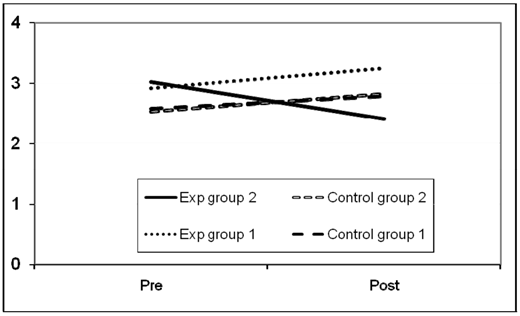
Means of thinking errors, obtained with the How I Think questionnaire (HIT; Barriga et al., 2001), were calculated for each of the participating groups, experimental and control, before and after the intervention (see Table 1 and Figure 2). Anomalous Responding (AR) scores were also calculated before and after the training. After the intervention, 12% of the respondents obtained a score of 4.25 or more. Before the intervention, even 27,4% scored above 4.25. About the same high percentage of high AR scoring subjects were reported by Van der Velden, Brugman, Boom, and Koops (2010) in their large scale study on secondary school students in the Netherlands. This high percentage contrasts with the low percentage (5%) that Barriga et al. report in their study on the reliability and validity of the HIT. Still, we removed these subjects scoring high on social desirability from the samples to perform our analyses, as Barriga et al. suggest to do in the HIT manual. In all participating groups, the proportion of subjects removed was similar.
From the ANOVA test a significant HIT × School × Group interaction emerged (F(1,46) = 6.11, p < .05, eta = .117). To examine this interaction, two different ANOVAs were conducted, one for each school. No predictions were made about differences between the two schools, so no further analysis was performed in that direction. In the second school, the interaction HIT × Group was found significant (F(1,22) = 11.44, p < .01) but did not come up as significant in the first school. Follow-up univariate ANOVAs to investigate simple effects of the interaction in the second school were conducted and showed significant differences between preand posttest of the HIT in both the experimental and the control groups. However, these differences were found in different directions. The class who received the EQUIP training in the second school showed significantly less thinking errors after the intervention (F(1,8) = 9.78, p < .05). On the contrary, the control class seemed to demonstrate an increased number of thinking errors at this second measuring moment, although the difference is not statistically significant (F(1, 14) = 2.98, p = .10).
In the experimental group of the second school, a decrease between 15–27% with respect to the initial number of each of the four thinking errors was found. The reduction of Blaming others (F(1,8) = 8.60, p < .05) and Minimizing/Mislabeling (F(1,8) = 11.58, p < .01) emerged as statistically significant. The number of thinking errors that were labeled as Self-centered also diminished, though not significantly (F(1,8) = 4.00, p = .08). This was also the case of Assuming the worst (F(1,8) = 3.23, p = .11), possibly because of the low number of subjects in the sample involved in the analyses.
Peer Victimization in the Class
The original data with respect to the observation of peer victimization situations in the class over the last three months in terms of frequency—never, sometimes and always—, were transformed into two categories: occurring or not occurring, for each type of bullying or exclusion. In Table 2 incidence of these 12 types of victimization are shown for experimental and control groups in both schools. We did not run statistical tests on the data because of the low number of participants in this group, which made the testing unreliable. However, we did try to make comparisons between groups and measuring times, which then of course should be interpreted with caution.
As can be observed in Table 2, in the experimental group of School 2, six types of victimization were observed by fewer students after the intervention (the numbers are painted in grey), while four other types were observed by more students. Proportions of observation of one type did not differ between preand posttest, and two types had never been seen by the students, neither before nor after the training. In the control group of School 2, three types of bullying were observed by fewer students at the second measuring moment, five aggressive behaviors were observed by a higher amount, and five by the same amount of students. It seems then, that overall, a slight decrease in the observation of victimization situations has occurred in the experimental group. On the other hand, perception of bullying and social exclusion situations in the control group might show a small increase. Additionally, it is worth to observe that the percentages of the experimental group are overall lower than those of the control group, already before the intervention, but even more pronounced after the training: nine aggression types had been observed by less than 37% of the experimental group versus four by less than 37% of the control group. One type had been seen by 69% of the experimental group versus five types between 67% and 86% of the control group.
The results for the groups in School 1 seem to be quite different. In the experimental group, 12 out of the 13 types of bullying and social exclusion were observed by more students after the intervention. No reduction of any victimization type appeared. In the control group, an increase was found in eight occasions, while percentages remained similar for four victimization situations and one reduction was found. Hence, in School 1 a general increase of bullying and social exclusion situations can be observed in both control and experimental groups. In addition, percentages are higher in comparison with the experimental, but also control group of School 2. Nine types of peer maltreatment had been perceived by 71%-100% of the students of the participating groups in School 1.
Finally, it is worth to note that Sexual harassment (including gestures, verbal comments), which had not been observed by any of the students at start, showed its appearance at the second measuring moments in all groups.
Classmates’ behavior in victimization situations in the classroom is presented in Table 3. Also in relation to this aspect we transformed the answers given on the questionnaire into two categories: whether the behavior is observed or not. Neither in this case did we perform statistical tests for the same reason as described before. When focusing first on the experimental group in School 2, some changes (only implying variations of 10% or more) can be observed in students’ perceptions of their peers’ behavior after the intervention in comparison to their observations before the training. It seems that fewer people saw their classmates rejecting the bully/bullies as a consequence of their behavior, and more students observed their peers cheering the bully/bullies on. On the other hand, apparently more students talked to their classmates about doing something to stop the victimization or spoke to the victim. So in this group, more support for the bullies is identified by these adolescents, as well as more support for the victim, either talking to him/her or with their classmates. In the control group of School 2, fewer students saw others not caring about the victimization. At the same time however, fewer students saw their classmates talking to others in order to do something about the situation. In the experimental class of School 1, more students seemed to observe a direct support to the bullies, either joining them or cheering them on. However, the proportion of students who saw others rejecting the bully/bullies, intervening directly in the situation, or telling a teacher also increased. Results of the control class of School 1 also show more students observing classmates who cheer the bully/bullies on, just as in the two experimental groups. On the other hand, a reduced number of these adolescents observed peers talking to the teacher about the victimization. In summary, more changes were found in the experimental than in the control groups. When examining these variations a paradox comes up, as both an increased support for the victim as for the bully or bullies was observed by the students.
Classroom Climate
Means were calculated corresponding to the two components Wellbeing/Security and Group Cohesion of the Classroom Climate Scale for all control and experimental groups. From the two ANOVA tests that were performed, a significant interaction Group Cohesion × School × Group interaction emerged (F(1,65) = 4.35, p < .05). To examine this interaction, two different ANOVAs were conducted, one for each school. A significant interaction of Group Cohesion × School was found in the second school (F(1,32) = 6.26, p < .05) but not in the first school. Follow-up univariate ANOVAs to investigate simple effects of this interaction were conducted and showed only significant differences in relation to Group Cohesion between preand posttest in the experimental group (F(1,12) = 4.78, p < .05). In Table 4 means of the control and the experimental groups for both components of Wellbeing/Security and Group Cohesion are presented. Hence, students in the experimental group in School 2 indicated no changes in their sense of wellbeing and feelings of security in the classroom after the training. However, their view of group cohesion did alter: the class was perceived as less united than before the intervention. The other groups did not show any changes in their perception of classroom wellbeing or safety and group cohesion.
Qualitative Evaluation of the Program by the Students
From the interviews we obtained anecdotal information on students’ perceptions of the effectiveness of the program, which we present here. A structural analysis on the answers was not performed. Instead, we were interested in the nature of that perception of effectiveness: how does it affect them and in which context?
Some of the students explained how they used what they had learned in their family environment:
Maria (15; 3): “When I have an argument with my parents, I think a lot about the thinking errors and how I can control myself and so on. In which way do you think about thinking errors? When I do something I say ‘let’s see what happened, perhaps it was also my fault.”
Others spoke in general terms (without referring to a particular context):
Sergio (16; 3): “We’ve been taught to think … to face problems … now I feel more secure about my decisions. What do you mean by ‘more secure’? For example, before I would have said something, and I would have regretted it, but now I don’t regret anymore … ‘cause you’ve helped me to think, and now I think about how to answer in advance.”
Others talk about the effects in the class itself:
Tamara (16; 7): [Which parts did you find useful?] “The dilemma in which a classmate was bullied, because we had a person like that in our classroom, so you think about it, you realize (…) To respect your classmates, I also respected them before, you know, but you didn’t put yourself in the other one’s shoes, rather you would move away, and now that you are aware you think the next time it happens you should protect him.”
Angela (15; 5): “The thinking errors have been useful for all of us because we all have realized, for instance, when suddenly we lose control, then we say “I’ve had a thinking error”, we’ve done that so very often. Raquel uses it quite a lot. When someone says something or whatever, Raquel says ‘ah! you’re minimizing the problem’, or ‘you’re self-centered’, so you can be aware of how you are. I think it’s been quite useful to us.”
These last comments seem to show positive effects on the whole group and its climate. In this group, Angela and Raquel are able and feel free to talk about and label classmates’ mistakes. Tamara’s comments might suggest that working on a specific peer victimization dilemma using earlier taught skills of the EQUIP program could show students how to handle such a negative situation inside the peer group.
Discussion
For the present study we made EQUIP for Educators program usable (DiBiase et al., 2005; DiBiase et al., 2010) for the Spanish school context and piloted it in two groups of adolescents in two schools of mainstream secondary education. Our goal was to reduce cognitive distortions in these young people and to study its effects on peer victimization incidence and classroom climate in terms of students’ wellbeing, security and group’s cohesion. Though interpretation of the results of this study should be done with caution because of the relatively small sample size, we found EQUIP to be successful in one of the two collaborating schools as far as cognitive distortions are concerned. In the other school, the group of students that participated in the EQUIP training did not improve their abilities of thinking error correction.
A possible explanation might be found in the particular settings in which the training was carried out. Related to the classroom, two observations can be made. First, the person involved in the training of both groups perceived it as more difficult to carry out the activities proposed by the EQUIP program with the group of 25 students than with the group of 15. Consequently, group size might affect the running of the program and its results. A second classroom issue to bear in mind is the nature of the relationship between the students and the teacher or school counselor present during the EQUIP sessions. In the group where the training did not function well, several conflicts occurring throughout the school year deteriorated the relationship between the teacher and the students. This teacher did not receive much help from other educators to improve that relationship. Both aspects could result in differences linked to students’ motivation, much more evident in the relatively smaller group where the students-teacher relationship was a positive one.
A third reason more linked to whole school factors could be added, concerning the support for the program from the whole school. In the school where the EQUIP training worked out well, the trainers and the school counselor, who was directly involved with the implementation, received support from teachers and school staff, while the other school might be perceived as not supportive, as they did not show any interest in the program, or enable to extend it to other people, spaces and time moments in the school. This school has not offered the EQUIP program to other classes afterwards, while the second school still continues with its application, having other teachers and students involved in it.This finding points at the need to know more about other characteristics of the school related to the social climate and the relevance of this kind of programs within the educational plan of the school. These school culture elements can influence the attitudes towards intervention programs addressed to improve interpersonal relations and moral reasoning, and consequently the results of such interventions (Martín, Fernández, Andrés, del Barrio, & Echeita, 2003; Smith, Pepler, & Rigby, 2004).
On the other hand, it can be said that no improvement was observed in the two control groups; it even seems that students of one of these groups increased their cognitive distortions. Therefore, no spontaneous progress could be perceived over a 7-month period in students between the ages of 14 and 16.
Although the data on the incidence of peer bullying and social exclusion should be interpreted with caution, a first analysis does not indicate an overall reduction of the observation of victimization situations in the classroom. However, in the group who showed better thinking error correction after the intervention, a reduction was found of the observation of six bullying and social exclusion types. This kind of reduction was not found in the other three groups. In addition, it can be said that those types that were observed by a larger proportion of students after the intervention: hiding things, breaking things, not allowing someone to join in and sexual harassment refer to types that might be more difficult to recognize as victimization, as they are not done in a direct (as for example insulting or hitting) but indirect way to the or person or carried out in more subtle ways (e.g., verbal sexual harassment). An increased consciousness of the variety of victimization situations might account for this finding, that is, certain events are now identified as bullying.
Taking into consideration the complete sample of participants, it might be concluded that in general an increase of the proportion of students observing peer maltreatment has been found. This does not refer directly to a higher incidence of peer victimization in the schools but to the increase of students who observe victimization situations. Hence, it might be interpreted as an increased awareness of students in relation to bullying and social exclusion events. In comparing the 1999 and 2006 Spanish national-wide surveys on peer maltreatment incidence in secondary schools (Defensor del Pueblo-UNICEF, 2007; Del Barrio, Martín, Montero et al., 2008), an increase was also found in the observation of various victimization situations, while incidence of several types reported by both victims and aggressors had decreased after seven years. This might be explained by the fact that there has been a lot of interest in the phenomenon during the last decade. More information can be found in the news, internet but also in the schools themselves. Intervention programs and methods have found their way into schools. Other researchers confirm the shift to an improved perception of behavior that students have of themselves, their classmates and teachers, when actions against victimization are undertaken in schools (Del Barrio, Martín, Montero et al., 2008; Smith, Pepler, & Rigby, 2004).
In addition, the decrease of observations that was found of the behaviors insulting and ignoring in both the experimental and control group in the second school, and also of threatening to scare someone in the group that received the EQUIP training match with findings of the Spanish national-wide study. Over the 7 years that passed between the two surveys, observers, victims and bullies reported less insulting, while victims and bullies also indicated less ignoring and threatening.
Results on the nature of bystanders’ reactions to peer victimization seem to show a paradox. Apparently, from the group of the students who improved their ability to correct erroneous reasoning a higher proportion observed their classmates supporting the bullies in their antisocial behavior, or did not reject them afterwards. On the other side, more students also observed their peers talking to the victim or other classmates in order to support that person. Also in the other experimental group contradictive changes appeared. However, again it could be hypothesized that it shows students’ increased awareness of what really happens in these situations. For example, these adolescents might have become aware that they are actually being supportive to that classmate who is showing victimizing behavior, for example, when they laugh about it. They might also think that after a bullying event, they do not really reject the bully, since s/he’s still their classmate. They might want to say something about it, but not fully reject him/her. Talking to other classmates and to the victim about what is happening does also imply an increased sensitiveness.
After the training, students did not report to feel better and more secure in the classroom. Naturally, various factors can influence the level of wellbeing of individual students in the class. Friendship structures, daily conflicts and the solution of these conflicts are just some of these factors. The improvement of the abilities to correct cognitive distortions of the group on a whole neither seems to be accompanied by more group cohesion. On the contrary, level of group cohesion diminished over the course of the intervention. It could be interpreted that group cohesion is not related to increased abilities for the correction of cognitive distortions and moral behavior in a linear way. A higher sense of union does not directly produce more pro-social behavior or impede antisocial actions. These results could point at students’ higher level of individuation caused by the awareness of the differences between one and another, and the lack of a true cohesion evidenced by the fact that they often do not help others when experiencing peer victimization. This improved ability of diagnosis of what is going on can be related to changes in the group’s dynamics, i.e. a higher awareness of differences between them can help the students to individuation processes necessary for their development (Blasi & Glodis, 1995). Adolescents who do not agree with what is going on in the classroom (e.g., victimization, which might be caused by their improved moral reasoning), feel the need to separate from the others. Students can have become conscious of being different from their classmates in many aspects, including their attitudes to relationships and in particular victimization. This increased individuation affects the group’s sense of union negatively. This probably explains why the students do not increase their level of feeling of wellbeing and security among their classmates, even after a whole school year of reasoning about mutual understanding.
In this study we proposed EQUIP for Educators as a potential program for tackling peer bullying and social exclusion in secondary school. Although some support might be found for the idea of increased awareness in the students, no results came up that really confirm changes in victimization behavior. Only a reduction of the observation of some types of peer maltreatment in the group of students who improved their ability of cognitive distortion correction seems to point in that direction. Therefore, new studies are needed, with different methodologies as observation or measures as self-report on the frequency of being bullied or socially excluded, and including larger samples. Also more qualitative data obtained with interviews, and an effective analysis of these data could shed more light on students’ perceptions of the dynamics in their group before, during and after the program and of changes of their own and their classmates’ behavior. In that way we would be better able to find out if EQUIP for Educators can really be useful for the prevention of such a serious problem as peer victimization that affects children and adolescents in their daily school life.
Note
Names that are used in this document are not students’ real names.
We thank the schools and students for their participation. This study was funded by the Universidad Autónoma de Madrid and the Comunidad de Madrid in Spain (CCG06-UAM/HUM-0410). Special thanks to Maria José de Dios, Marisa Alonso and Carmen Pinilla. We also thank the reviewers for their useful comments.