


Institutional Review Boards (IRBs) have become a central feature in current research in Character Education. The author reviews ways in which character education research has increasingly come under the auspices of federal regulation and IRB approval. After explaining the basis of Use of Human Subjects regulation (the Belmont Report; the Common Rule, and the Protection of Pupil Rights Amendment) the issue of active versus passive consent is addressed. Difficulties with active consent involving cost, response rates, and sampling bias are illustrated. Lastly, the paper reviews the questions IRBs ask in determining whether you need to get active consent, and ways in which researchers can tailor their research design to avoid problems.
Institutional Review Boards (IRBs) have become a central feature in the professional and intellectual life of educational researchers. These Boards are committees of professionals including scientists, ethicists, community members, researchers, and other practitioners who review applications for research involving “human subjects,” that is, involving people. An IRB’s main charge is to safeguard human participants in the research by representing their interests and holding research proposals accountable to federal regulations safeguarding research subjects. It is this ultimate importance placed on the well-being of human subjects that justifies IRBs having oversight of research proposals. A detailed set of federal regulations guide IRBs in making determinations of what safeguards are required for ethically sound research, though questions of what ethics requires and what is “safe enough” still exist. IRBs have existed since the mid-nineteen sixties in the fields of biomedical and behavioral research.
Character educators, program implementers, and evaluators have generally not had to deal with these committees or the government regulations relevant to their oversight. Their work was seen as educational practice, or as “soft” research if as research at all, typically reported at the school or district level, and therefore not considered to entail risk to individual students. However, as the purview of IRBs has continued to expand; as federal funding in Character Education continues to expand; and as the federal regulations governing research ethics themselves continue to evolve, character educators increasingly need to be familiar with the guidelines for ethical research (Pritchard, 2002; Silverman, 2000).
The reader might wonder what ethical problems could arise in character education research? Isn’t it benign? As will be described, some character education research will not need to make any great accommodations to federal regulations, though most will need to deal with an IRB. On the other hand, some will need to deal with more complex issues involving federal regulation: getting informed consent; giving confidentiality guarantees; and asking about sensitive subjects such as religious beliefs, risky behavior, or illegal activities.
This article will lay out the history of regulations safeguarding research participants and the mission of the IRB; discuss who needs to obtain IRB approval; and outline what information you’ll need to provide to the IRB; the questions they will ask; and the requirements the IRB will likely find applicable to your situation. In describing the likely impact of these regulations on character education research, attention will be focused on the question of active versus passive consent for research with minors in schools as this has become the biggest logistical problem in federally funded character education research.
Is This Practice or Research?
One confusion regarding whose proposed activities need to be evaluated by an IRB comes from disagreement as to who is doing research, as opposed to some form of practice. Practitioners in the diverse fields and service areas falling under the large umbrella of educational practice have generally been exempt from research regulation because they qualified as implementers rather than researchers (Belmont Report, 1979). Indeed, research on the effects of character education programs makes up only a small portion of the field and much of the early work in this field was not well researched (Berkowitz, Scheaffer, & Bier, 2001; Leming, 1997). However, the line that previously might have been drawn cleanly between practitioners and researchers has blurred as they have formed collaborations allowing them to implement, evaluate, and research simultaneously in keeping with federal funding requirements, most notably those connected to the No Child Left Behind Act (2001). This change in how we think about what people are doing is occurring in the confluence of three forces:
a greater demand for accountability;
direct funding of character education programs by federal agencies with accompanying federal regulation; and
a more inclusive regulatory definition of what qualifies as research—with its attendant research ethics.
Each will be addressed in turn.
Accountability
There are several layers of accountability in research with children in schools. Researchers are accountable to the standards of good research (to justify even doing the research); the schools you go into hold you accountable not to harm their students or the school community; parents hold the school personnel accountable to uphold the best interests of their children. IRBs hold researchers accountable to their interpretation of the federal regulations that guide them. And increasingly publicly funded educational interventions, such as the current funding in character education, are being held accountable to show more clearly what they are accomplishing. This type of accountability directly impacts both research and practice.
For example, the No Child Left Behind Act (2001) requires that programs supported with Department of Education monies “implement scientifically based” practices.
Now, the nation’s principal legislative policy tool for federal support of K-12 education, NCLB, includes more than 100 references to “scientifically based research” and connects funding for a variety of programs—from reading to professional development—to scientifically based evidence of effectiveness. (Laisch, 2003, p.1)
Similarly, programs and activities developed under the auspices of Department of Education funding through the Safe and Drug-Free Schools and Communities Act must meet the “principles of effectiveness” laid out in section 4115 of that act. It specifies that programs must, among other things, “be based on scientifically based research that provides evidence that the program to be used will reduce violence and illegal drug use” (Sec 4115a1(C)). In the Partnerships in Character Education Program it clearly states that when you apply for funding your application must contain information that: “(A) demonstrates that the program for which the grant is sought has clear objectives that are based on scientifically based research” (Sec 5431(e)2(A). Additionally, once funded, programs are required to undergo periodic evaluations to assess their progress. The regulations specifically allow, and thereby encourage, research into the faithfulness of implementation in the project and evaluation of the effectiveness of instructional models for all students (Sec 5431(h)2A). Funds may also be used to develop materials and curricula and for professional development of teachers (Sec 5431(h)2A), both of which could be researched for effectiveness.
The greater emphasis on scientifically based, empirically tested methods and procedures has led to greater scrutiny of components going into programs, and favored those that can in some way tie the logic and activity of their program component to empirical research that already exists. Additionally, this emphasis on research results and accountability has meant that more funding for implementing Character Education, and most other things, are now being required to show research results, in turn leading to the expansion of the research element of character education projects that previously only dealt with implementation. Research and interventions of all kinds, have come under closer scrutiny and more stringent regulation regarding ethical treatment of human subjects over the last two decades (The Belmont Report, 1979; Federal Common Rule, 1991; No Child Left Behind, 2001).
The tightening of regulations on researchers was, unfortunately, the result not of hypothetical or potential problems with the system, but very real ones (Silverman, 2000). Federal regulations have evolved in response to notable lapses in protecting the welfare of participants (Kelman, 1982; McCord, 2003). Perhaps the most egregious on U.S. soil was the “Tuskegee Study of Untreated Syphilis in the Negro Male” in which public health officials running the study failed to provide the participants (all of whom had syphilis) with the cure (penicillin) when it became available in 1947 (Pence, 1995). Their disease was purposefully left untreated for years until the study came to public attention. A second well known example is Milgram’s studies of obedience (Milgram, 1974) in which in an experimental setting he got otherwise good people to intentionally inflict pain on another person, much to the upset of the participants themselves. Other, less dramatic, lapses have also occurred sufficient to show that regulation was necessary to supplement the professionalism and good intent of researchers (see Silverman, 2000; Warwick, 1982). Though character educators may justifiably feel their intervention is entirely positive and healthful, as will be illustrated, there are still several things that need to be considered to be sure you are adhering to the standards of ethical research.
Government Funding
Character Education has a long and diverse history in the United States, but never before have character education programs been publicly funded on the current scale. Nor have they generally been so in the public’s eye, nor have we collectively expected so much from these programs for rectifying social ills. All of these factors combine to bring character educators, evaluators, and researchers to a place where they must go about their business on a national stage, with more eyes watching, friendly and critical, than ever before.
Forty-seven states and the District of Columbia have received character education funding through the U.S. Department of Education Partnerships in Character Education Pilot Project. Between 1995 and 2001, awards of $37 million were made to help communities organize a character education response to their own most compelling issues. The money supported the development of character education materials and their integration into the broader curriculum, provided professional training for teachers, and facilitated the involvement of the community and parents in the effort. These implementation grants were intended to get character education projects up and running. Beginning in fiscal year 2002, Partnerships in Character Education grants took on a new emphasis—research. For the first time, research evaluation of the faithfulness of the implementation, and evidence of effectiveness of the program were required. Five state grants were awarded as were 34 grants to local education agencies (LEAs), totaling $16.5 million. These grants are under the new program reauthorized by the No Child Left Behind Act of 2001 (NCLB), and all State Educational Agencies (SEAs) and Local Educational Agencies (LEAs) were eligible to apply. In addition to the federal funding for character education, 14 states have their own legislation mandating character education (Character Education Partnership, 2002).
The emphasis on research is really an emphasis on quantitative research. The NCLB legislation is written in such a way as to emphasize “scientifically based” and “evidence based” research, by which they mean statistical models of quantitative data, collected in randomized experimental studies. This results in an anti-qualitative bias, seemingly reverting to the days when “meaningful” and “statistical” were thought to be synonymous. Grover Whitehurst, the Director of the Institute of Education Sciences at the U.S. Department of Education gave a keynote address to the Office of Safe and Drug-Free Schools Conference in October 2003. In that address he emphasized “evidence-based” programs with “scientifically-based” research with reliable and systematically collected performance data. He argued for standardizing educational research into the medical research model of “randomized efficacy trials” and meta-analysis.
Some educators and educational researchers have criticized this approach. The Association for Supervision and Curriculum Development (ASCD), for example, issued a statement concluding that “the NCLB definition thus favors a quantitative methodology, thereby excluding almost all qualitative research. Additionally, labeling one type of research as “scientifically based” creates a false dichotomy, implying that all other research is not based in science” (Laitsch, 2003, p. 3). The American Education Research Association has also expressed “dismay that the Department of Education through its public statements and programs of funding is devoting singular attention to this one tool of science [randomized trials] jeopardizing a broader range of problems best addressed through other scientific methods” (Laitsch, 2003, p.3).
Research Ethics: Who and What is Included?
Part of the current confusion as to who needs to seek oversight approval from an IRB is that the term research is used differently by different members of the research community, and if it is research the project is directed by one set of guidelines, and if it is not research the project is directed by other guidelines (Pritchard, 2002). IRBs tend to have the most exacting definition of research, spelled out in federal regulations.
Research means a systematic investigation, including research development, testing and evaluation, designed to develop or contribute to generalizable knowledge. (34 CFR Part 97; Subpart A; 97.102 (d))
Research ethicists define research more expansively as any deliberate pursuit of knowledge or understanding, pointing out that research doesn’t always have a practical application in mind; and that practice may also result in new understandings. In contrast, educators use the word research more colloquially, sometimes defining what they do as reflective practitioners investigating their own teaching as research (such as action research). Other times, educators see themselves as simply being good teachers being reflective, and don’t think of it as research at all (Zeni, 2001).
Two kinds of research are generally being done currently in character education programs, and there are increasing calls for a third kind of research. The first type of research involves research of the children and classrooms—generally gathering data in a survey format accompanied by observations in the school. While these data are gathered to assess things like school climate and the character-related behavioral and attitudinal stance of the student body, surveys and observations may generate information that might embarrass or incriminate students, their parents, teachers, and staff. This is an unintended ethics-related side effect of this kind of research. A second focus of research is the evaluation of how the Character Education program is being implemented. Though the focus here is on the school personnel and any outside trainers rather than the students, both types of research involve at least passively observing students, and potentially witnessing or hearing about information that could be damaging to them (their own misbehavior, truancy, gang activity, drug use, or sexual harassment for instance). Both kinds of school research projects might want to gather information on student attendance, disciplinary records, and possibly grades and standardized test scores, which fall under FERPA, another Department of Education regulation discussed below. The third kind of research, increasingly being discussed, is experimental evaluation of the effectiveness of character education programs as measured by individual student outcomes, for example on academic measures such as state standardized tests. This kind of research is potentially problematic because the character education data need to remain identified with each student so that comparisons with each child’s test scores are possible. This raises a number of confidentiality issues in satisfying research ethics.
Before summarizing the steps researchers need to go through to acquire IRB approval, federal regulations pertinent to the use of human subjects will be reviewed, especially as they pertain to research with children in schools.
The Belmont Report
In 1974 the newly created National Commission for the Protection of Human Subjects of Biomedical and Behavioral Research set out to identify the basic ethical principles involved in human subject research. Five years later the Commission issued The Belmont Report: Ethical Principles and Guidelines for the Protection of Human Subjects of Research, still referenced and readily available from the federal government.1 This report illuminates three areas of importance to our discussion: first, the boundaries between practice and research, that is, to whom research ethics apply. Second, the report lays out the relevant ethical principles. Third, the report suggests applications of these ethical principles in research design.
The Belmont Report makes clear that practitioners need not undergo review for the protection of human subjects. They clarify what they mean by this:
The term “practice” refers to interventions that are designed solely to enhance the well-being of an individual patient or client and that have a reasonable expectation of success … By contrast, the term“research” designates an activity designed to test an hypothesis, permit conclusions to be drawn, and thereby to develop or contribute to generalizable knowledge. (Belmont, p. 4)
While The Belmont Report does not formally apply to educators and implementers, it is well worth being familiar with its ethical principles as it lays out a nationally recognized “relational ethic,” that provides all who work with children and other dependent persons a language and set of principles that ensure the safety and dignity of the persons in your charge.
There are three basic principles that together are said to form a comprehensive ethical critique for the evaluation of any set of research practices. These principles can be described in the following questions. First, does the research design show respect for persons? That is, are participants treated respectfully as autonomous agents? In instances where that autonomy is diminished (such as children, pregnant women, some elderly, and persons with disabilities) are the human subjects protected from possible risk and harm by the researcher? Respect for autonomous persons requires not simply providing information and acquiring a signature on a consent form, it requires achieving understanding on the part of the participant. The regulations stipulate that informed consent explanations must be conveyed at a level appropriate to participants’ education and in their native language, though it is a questionable assumption that parents and guardians are literate in any language. Additionally, when doubt exists as to whether someone understands the implications of what they are about to agree to, or if it seems they may not be capable of understanding, then further steps to secure their safety are advised. Special consideration is given to persons who are incarcerated or in some way dependent on the state such that we guard against their feeling coerced to participate.
Second, does the research design show beneficence? This means, are researchers looking out for the participants’ best interests as they work to secure the benefits of the research for society broadly.
Two general rules have been formulated as complementary expressions of beneficent actions in this sense: (1) do not harm and (2) maximize possible benefits and minimize possible harms The obligations of
beneficence affect both the individual investigators and society at large, because they extend both to particular research projects and to the entire enterprise of research. (Belmont Report, p. 5)
While the potential risk of harm discussed here pertains most directly to participants of the study, the possible benefits extend well beyond the participants and, in fact, may not actually benefit them personally at all.
Beneficence in the research context governs both the design and conduct of research, including not only immediate risks and benefits to subjects, but consideration of whether the research is “worth doing” in light of long-term expected results and their societal implications. (King, et al., 1999, p.9)
Third, is justice a characteristic of the division of benefits and burdens of the research? Is there a fair distribution of the risks and also of the rewards? In research, this is most pertinent in sample selection.
For example, the selection of research subjects needs to be scrutinized in order to determine whether some classes (e.g., welfare patients, particular racial and ethnic minorities, or persons confined to institutions) are being systematically selected simply because of their easy availability, their compromised position, or their manipulability, rather than for reasons directly related to the problem being studied. (Belmont Report, Part B,3. Justice)
The Belmont report makes clear that the benefits to children in general can justify research on children who may not themselves stand to benefit from involvement. For example, in a medical field that is not yet at the point of testing potential cures, research may still need to be done that offers no hope to the particular people involved in the research. Character education research would be harder to justify on these grounds.
The Report outlines applications of these principles with regard to research. The practice of requiring that participants be allowed to make an informed decision and give consent is an application of respect for persons. Specific guidance is given as to what kinds of information should be conveyed to participants and how. Questions of comprehension are addressed, as is the question of the actual voluntariness of participants’ actions. There are varying threats to ensuring that participants want to be doing what they are doing and that they feel free to express what they really believe or to withdraw from the research. Three shades of coercion or unethical “influence” are described:
Coercion occurs when an overt threat of harm is intentionally presented by one person to another to obtain compliance. Undue influence, by contrast, occurs through an offer of an excessive, unwarranted, inappropriate or improper reward or other overture in order to obtain compliance. Also, inducements that would ordinarily be acceptable may become undue influences if the subject is especially vulnerable. (Belmont Report, p. 9)
The Report discusses how to execute a Risk and Benefit Assessment of the research, estimating the probability of any harm coming to participants, and weighing that against the likely benefits. These principles and standards were articulated to safe-guard research participants from at least the common and anticipated threats.
Common Threats to Participants
The Belmont Report’s ethical principles— justice, beneficence, and respect for persons— can all be said to be ensuring a social pact where all involved have their interests considered and protected. Social science research ethicists have articulated a number of ways in which participants are meant to be protected: from injury (physical, psychological, material); from stress and indignity, including discomfort, embarrassment, and feelings of inadequacy; from diffuse harm, including inequality, manipulation, and arbitrariness; from damage to interpersonal relationships; and from legal jeopardy (Belmont Report, 1979; Kelman, 1982; King, Henderson, & Stein, 1999; Warwick, 1982).
There has been a growing concern with privacy as we have entered the information age (Mann & Stewart, 2000). The ready availability of vast amounts of information through electronic means, including the electronic compilation of vast databases of the purchasing habits and financial dealings of Americans has left many people feeling that privacy is slipping away. Computer hacking has made vulnerable seemingly confidential computer files such as police records, insurance and medical records, credit card transactions, and the phone numbers of calls placed from your home or place of work. Information from insurance records, bank transactions, and medical files, all generally assumed to be private, have been sold to third parties or shared between one branch of an organization and another, further eroding our sense of privacy. Because all of this information is gathered electronically, and data storage constraints are constantly being revised, we have reason to fear that many kinds of records having to do with your life will persist into the indefinite future and will become available for purchase or perusal as part of large databases. In the face of these challenges there is a greater concern with privacy as an issue of national concern and further safeguards have been incorporated into federal policy through the No Child Left Behind Act (2001) and the Family Educational Rights and Privacy Act (FERPA).
The Federal Common Rule
Additional policy regarding “use of human subjects” was laid out in Federal Policy for the Protection of Human Subjects (1991)2. This document is often referred to as the Federal Common Rule, because seventeen U.S. government departments and agencies hold these standards in common.3 This document spells out in detail what activities come under regulation; how terms such as research, human subject, and minimal risk are defined; how research proposals should be scrutinized by IRBs; how IRBs are to be constituted; the criteria for approval of research; and general requirements for informed consent. The ethical ideals to which it refers are spelled out in the earlier Belmont Report (1979). In addition, the Common Rule articulates guidelines for who should be in the position to judge relative harm and benefits, that is, who should sit on the IRB committee. It mandates the constitution of IRBs as fair, informed, and impartial mediators of the well-being of research subjects.
Each IRB shall have at least five members, with varying backgrounds to promote complete and adequate review of research activities commonly conducted by the institution. The IRB shall be sufficiently qualified through the experience and expertise of its members, and the diversity of the members, including consideration of race, gender, and cultural backgrounds and sensitivity to such issues as community attitudes, to promote respect for its advice and counsel in safeguarding the rights and welfare of human subjects. (regulation 34 CFR; Part 97; Subpart A; 97.107a)
In addition, the Common Rule attempts to be especially sensitive to vulnerable populations, mandating that if an IRB regularly reviews research that involves a “vulnerable category of subjects, such as children, prisoners, pregnant women, or handicapped or mentally disabled persons,” then the IRB must include people specifically knowledgeable about this population (regulation 97.107a).
In addition to protection of human participants, IRBs assure researchers a fair hearing, and help the research community to pursue important research in ways that most effectively balance the concerns of all involved. The discussion generated by the greater attention to research ethics also contributes to a more informed community discourse regarding research and the public good.
In keeping with the Belmont Report, The Common Rule left most educators and implementers generally free from IRB oversight. While the default position of the regulations is that you need to get parent/guardian permission for any activity involving minors, the Common Rule does make exceptions. Researchers can argue that their research is exempt because they meet the conditions of any of four exemptions. Exemptions 1,2,& 4 are most important here, but these exemptions only apply if no part of the study procedure includes non-exempt activities. “Research activities in which the only involvement of human subjects will be one or more of the following categories are exempt from this policy,” that is, exempt from full IRB review and from the requirement to acquire active consent.
Research conducted in established or commonly accepted educational settings, involving normal educational practices, such as (i) research on regular and special educational instructional strategies, or (ii) research on the effectiveness of or the comparison among instructional techniques, curricula, or classroom management methods.…
Research involving the use of educational tests (cognitive, diagnostic, aptitude, achievement), survey procedures, interview procedures or observation of public behavior, unless
Information obtained is recorded in such a manner that human subjects can be identified. … ; and
Any disclosure of the subjects’ responses outside the research could reasonably place the subjects at risk…
Research involving the collection or study of existing data, documents, records … if these sources are publicly available or if the information is recorded by the investigator in such a manner that subjects cannot be identified, directly or through identifiers linked to the subjects. (97.101b)
It should be noted that the term “existing data” means existing before the study begins. On-going data collection of the same kind of material may make FERPA a consideration.
While these exemptions cover standard educational practice, they may not cover character education interventions, and decidedly do not exempt things done in the prevention end of the field, such as inquiring about sexual activity, or delinquency, drug use, or other illegal or anti-social activities.
Beyond exempting types of research from full IRB review, the Common Rule (97.116d) also spells out criteria by which an IRB can waive the requirements to obtain informed consent. They may do so provided the IRB has documentation that:
The research involves no more than minimal risk to the subjects;
The waiver or alteration will not adversely affect the rights and welfare of the subjects;
The research could not practicably be carried out without the waiver or alteration; and
Whenever appropriate, the subjects will be provided with additional pertinent information after participation;
While the previous type of research exemptions are relatively clear, these four criteria are far more open to interpretation and disagreement. Researchers and the IRB may take different perspectives on criteria one above— what is an acceptable minimal risk to participants. Criteria number two raises a difficult and even more complex issue. The rights and welfare of participants in clearly defined contexts is complex enough, but potential adverse affects are myriad and hypothetical, leaving open even more room for disagreement. For example, your IRB may disagree with you about what kind of risk to one’s reputation or one’s self esteem may be entailed in participation in your study.
The Common Rule helpfully outlines the criteria IRBs should use to approve a research proposal. This is the checklist they will apply to your proposal:
risks to subjects are minimal …
risks to subjects are reasonable in relation to anticipated benefits …
selection of subjects is equitable …
informed consent will be sought … to the extent required …
informed consent will be appropriately documented …
adequate provision has been proposed for monitoring the data collected …
adequate provisions have been proposed to protect the privacy of subjects and confidentiality of data.
The Family Educational Rights and Privacy Act (FERPA)
FERPA is a federal law that applies to educational agencies and institutions that receive federal funds under any program administered by the U.S. Department of Education. FERPA is generally concerned with the privacy of educational records and prohibits funded agencies from having a policy or practice of disclosing student’s “educational records” without consent of the parent or eligible student. FERPA defines “educational records” as information directly related to students in attendance at educational agencies or institutions. Information such as grades, attendance, and disciplinary action are common parts of one’s educational record.
Of interest to researchers, university disciplinary records were deemed by a federal court to be “educational records” under FERPA. As such, the disclosure of those records without students’ consent constitutes a violation of FERPA. While there is no comparable court finding for disciplinary records of students in elementary and secondary schools where most character education is done, researchers would do well to assume such a finding and act accordingly. These records are considered problematic precisely because student names are attached and therefore their privacy is compromised. Anonymous aggregated disciplinary records would not constitute the same threat to privacy, and the court specifically recognized the importance and legitimacy of parents and students having access to statistical information about the type and amount of crimes on a particular campus. FERPA currently allows schools to disclose certain items of information as “directory information” without students consent. This would include such things as names, addresses, and phone numbers.
While FERPA does not generally apply to State Educational Agencies (SEA), the Individuals with Disabilities Education Act does apply FERPA’s confidentiality provisions to education records maintained by State Educational Agencies. FERPA provides parents with the right to inspect and review educational records maintained by SEA.
The Protection of Pupil Rights Amendment (PPRA)
The Department of Education has additional regulation for programs receiving funding under their auspices, the Congressionally enacted statute called the Protection of Pupil Rights Amendment (PPRA). The PPRA outlines a number of topics considered sensitive that it defines as “protected information.” Inquiry into these topics is considered a potential threat to a child’s privacy and psychological well-being and therefore research involving any of these topics requires parental/ guardian consent. Areas of “protected information” include:
Political affiliations
Mental and psychological problems potentially embarrassing to the student and his/her family;
Sex behavior and attitudes;
Illegal, anti-social, self-incriminating and demeaning behavior;
Critical appraisals of other individuals with whom the respondents have close family relationships;
Legally recognized privileged or analogous relationships, such as those of lawyers, physicians, and ministers; or
Income (other then that required by law to determine eligibility for participation in a program or for receiving financial assistance under such program).
Religious beliefs and practices.4
Beyond the introduction of the eight sensitive topics (hereafter referred to as PPRA part 1) the PPRA introduced a regulation that extends far beyond Department of Education funded research. The PPRA, as amended by the No Child Left Behind Act (2001) requires that research done in any school receiving Department of Education monies meet the following condition (hereafter referred to as PPRA part 2). If research is done in the school that either (a) inquires into one or more of the eight sensitive topics; or (b) has a non-emergency physically invasive component; then parents have a right to be informed about the research, review the research materials, and opt their child out of the research. This requirement applies to all research done in schools receiving federal education money of any kind; meaning most public schools and some private ones.
It is not altogether clear, however, what it would mean to “opt out” of the research portion of a Character Education program. Certainly you could avoid a particular survey or activity that you found too personal or in some other way offensive. Many Character Education programs though are whole-school initiatives extending across the school year and real opting out would require school reassignment. PPRA part 2 seems to assume a research approach constituted by discrete data collection methods that can be easily and cleanly avoided.
It should be remembered that these several sources for how to think about research ethics and federal regulation constitute something of a quilt—they are attached and stand in meaningful relation to one another, but they are not of the same cloth. The Belmont Report is an influential report by a government commission that laid groundwork for other legislation but was not itself binding in any way; the Common Rule is Federal Policy, amended or supplemented to suit various departmental needs; and the PPRA and FERPA are congressionally enacted laws. Additionally, it should be remembered that many states and school districts have research regulation or laws that exceed the requirements of federal regulation.
Federal character education grantees have reported that the greatest confusion their cohort has faced concerns under what conditions one is allowed to get passive consent and under which conditions active consent is required. Since this is both a substantive question in research ethics and a substantial methodological concern it will be addressed at length.
Active versus Passive Consent
It was mentioned earlier that “informed consent” is an expression of “respect for persons.” In the case of school children, who are minors, this means the consent of the parents/ guardians. There are two general approaches to guardian consent, known as active consent and passive consent. With active consent researchers proactively seek written permission and the parent actively gives that consent before researchers engage any child in research. Contrary-wise, passive consent requires only that researchers let parents know what they will be doing in the school so that if parents/guardians disapprove and wish to remove their child from the activity they can do so. Approval is assumed if a parent/guardian does nothing, hence the term passive consent.
Dent, Sussman, and Stacy (1997) argue that besides the question of whether active consent is ethically necessary we need to consider the research ramifications of demanding it.
Thoughtful observers on both sides of the parental consent reform legislation have valid concerns, but a central issue to evaluators is the potential for such a policy to undermine the interpretability of their research findings due to the sample restriction leading to selection bias. Research data on important social issues affecting children, such as substance abuse, violence, and adolescent pregnancy, are obviously affected by the proposed consent policy revision. (Dent, et.al., 1997, p.2)
These likely ramifications will now be explored.
Problems With Requiring Active Consent
If seeking active consent is the more respectful approach, the ethically safer choice, and the method giving us the most explicit permission, then we might ask, why doesn’t everybody just get active consent? There are five main reasons:
As mentioned earlier, educators traditionally did not see what they were doing as research and therefore did not believe that research ethics as such applied to what they were doing;
active consent requirements typically secure far fewer participants for your study;
the “fewer” returns are not randomly distributed, introducing a sampling bias;
alternative methods for gaining active consent are resource intensive for researchers; and,
the process of repeated announcements made to students, and the paperwork sent home and collected again in the classroom eats up valuable teacher time and energy.
The first of these reasons was addressed above, the other four are explicated here.
Response Rates
Passive consent strategies yield high participation rates, typically between 90%-100%. Most students excluded from studies using passive consent are not due to parents and guardians objecting to their participation but rather to the students themselves missing school that day.
In contrast, when active consent procedures depend on students carrying a sheet of paper home to be read, filled out, and signed by their guardian, and then brought back and given to the teacher it is difficult to get a high rate of return (Ellickson & Hawes, 1989; Iverson & Cook, 1994). Researchers suggest you can expect 40% 60% to fail to return the form at all, neither giving nor denying permission, though by the logic of active consent a missing permission slip must be treated as a denial of permission (Dent, Sussman, & Stacy, 1997; Severson & Biglan, 1989). Kearney, Hopkins, Mauss, & Weisheit (1983) had a return rate of 66%, but only ended up with an obtained consent rate of 51% of the eligible population, a figure they suggest is comparable to earlier studies (Lueptow, Mueller, Hammes, & Master, 1977; Josephson & Rosen, 1978). An example comparing response rates between active and passive consent is Schuster, Bell, Berry, & Kanouse (1998). They studied a school condom availability program using a passive consent procedure and had a participation rate of 98%. When the authors switched to an active consent procedure the following year their participation rate dropped to 59%.
Response rates also appear to be affected by the dynamics within individual schools. Esbenson, Deschenes, Vogel, & West (1996) report that with one particularly organized school a response rate of 70% was returned at the end of the first week. In contrast, at a second, particularly disorganized school the response rate was 13% at the end of the first week. Pokorny, Jason, Schoeny, Townsend, & Curie (2001) report that when they switched from passive to active consent 9 of 13 schools dropped on average from 91% (passive consent) to 82% (aggressive active consent); but that 4 schools dropped on average from 86% to 55% with the active procedure. Apparently, results will vary. (See Singer (1993) for an overview)
If fewer students participate in a school study, the study will have a less complete and less accurate picture of what is going on in the school. Statistics, the mathematical measures by which quantitative researchers establish that what they have found is meaningful—that is, statistically significant—has a stringent and articulated requirement as to how complete a picture of the student body is necessary to say anything meaningful about it. If the sample size is limited, even if there isn’t an evident bias, the limited sample reduces the ability of the study to detect actual effects and increases risk of sampling variation. So, even if non-respondance is distributed randomly, reduced participation can have serious impacts on study reliability and validity. Sampling bias introduced as a result of using active consent measures is now taken up.
Sampling Bias
In addition to lowered response rates, active consent procedures have been found to create non-representative samples of participants, thereby limiting the validity and generalizability of the study finding (Pokorny et al., 2001).
Of the variables investigated, ethnic group surfaced as the most important determinant of parental response. Specifically, Asian parents were found to respond less frequently and to deny consent twice as frequently as White parents. Black parents were less likely to deny consent than White parents but were more likely not to respond. As a result, the final sample of students participating in the study was significantly over represented by White children and underrepresented by Black and Asian children. (Hollman & McNamara, 1999, p.143)
Significant differences have been found between the group of children who typically get parental/guardian consent and those who do not in terms of demographics, academic achievement, and social and personality variables (Hollmann & McNamara, 1999; Pokorny et al., 2001). Anderman, Cheadle, Curry, Diehr, Shultz, & Wagner (1995) found that in a sample of 9th and 12th graders “participants with active consent were more likely to be White, to live in two-parent households, to have a grade point average of B or above, and to be involved in extracurricular activities” (p. 569). Minority students, students with lower standardized test scores and school achievement indicators, and students from single-parent households have been shown to be underrepresented in samples requiring active consent (Dent, et al., 1997). Beck, Collins, Overholser, & Terry (1984) found that those who did not receive parental consent to participate in the study were significantly more likely to be perceived by teachers as having problematic peer relationships. Others have found “no consent students” to be seen by peers as less popular, less attractive, and more aggressive and/or withdrawn than their consent bearing peers (Frame & Strauss, 1987). Socially rejected children and neglected children largely fall into the children without consent category. Severson and Ary (1983) reported other differences of special interest to those concerned with prevention research. The no consent students were more likely to smoke cigarettes and marijuana than their peers. The authors concluded: “the requirement to obtain parental consent resulted in the loss of nearly 60% of the school’s smokers, creating a biased sample that limited generalizability of the study results” (p. 4). Pokorny et al. (2001) found in one school in which they administered both active and passive consent (the latter when active consent procedures yielded only a 55% rate of participation) that students with consent were less likely to have used any tobacco products. Additionally, children without consent self-report to be greater risk-takers and more negatively orientated toward school (Dent, Galif, Sussman, Stacy, Burton, & Flay 1993). Consent and no consent children have been found to differ on other variables as well. Kearney et al. (1983) found differences on reading and vocabulary scores. Frame and
Strauss (1987) conclude that there is a general relationship between poor social relationships and lack of parental consent to participate in research, concluding, “the most important statistically independent predictors of not receiving consent were found to be social withdrawal and poor academic performance” (p. 235).
These results provide a description of the population of children that would likely be included in a passive consent study who will be disproportionately left out of an active consent study. Esbensen et al.(1996) argue that requiring parental consent for school-based research greatly endangers accurate information about programs. They point out that if a sample is biased, all estimates of prevalence and relationships are similarly biased. Kearney et al. (1983) conclude that “research concerning variables which differ greatly among the various racial/ethnic groups is likely to yield biased results if the explicit consent procedure must be used” (p. 101).
This selection bias will have two major implications for research in character education. First, the selection bias will lead our studies to misrepresent the student body because many of those exhibiting behavior character educators are concerned about will not be studied. This will result in a rosy picture as compared to the life concerns of those students left out. Second, if we study a limited set of the student population, then by extension we are studying the effectiveness of our programs on a limited set of the student population. This research may still be important, but it needs to be recognized as potentially, if not necessarily misleading.
Aggressive Consent Seeking
For those needing to acquire active consent, there are several things that can be done to substantially increase response rates. Dent et.al. (1997) describe their aggressive approach to getting active consent. Three weeks prior to the giving of the survey all students carried home a consent form, and the researchers got response rates ranging from about 40% in one high school to about 60% in another. Two weeks prior to giving the survey all non-responding parents were called, with an average of 1.2 calls to each home before either reaching someone or giving up trying. This increased response rates to 78% and 90% respectively. Lastly, one week prior to the survey a second letter was sent home reminding parents to sign and return if they want their child to participate; and telling parents that their child would be offered to take a revised copy of the survey which they would fill out anonymously at the same time as their class if the parent doesn’t return the form with “refuse” marked. This second version of the survey deletes any questions of a sensitive nature, and has no details about the identity of the person who filled it out.
This method needed to be approved by an IRB, of course, and this team of researchers got two useful concessions from their IRB that supported getting these high rates of response. First, the team petitioned the IRB for the right to get verbal approval during the follow-up phone calls, accompanied by a letter of agreement sent home. This let the researchers proceed without the parent having to take an active step in signing and returning a consent form, or the researchers having to deal with the lag time of consent forms dribbling in right up to the day of giving the survey. Additionally, the IRB approved an alternative form of the survey, without protected information or identifiable marks, and a passive consent procedure for any students who did not have consent to take the regular survey. This mix of written and verbal consent, the two options of survey, and an aggressive campaign to call all non-responders allowed for relatively high rates of participation, resulting in a sample of over 1600 students. Rates of parents declining to participate were in the 5% range.
Ellickson and Hawes (1989) achieved a 100% response rate for a sample of 200 students by utilizing a particularly complex strategy. A consent package was mailed directly to parents in their home, containing a letter describing the prevention program and research procedures, a fact sheet for parents, and the consent form. A week later postcard reminders were sent to non-respondents. One week after the reminder, only 40% of parents had returned the consent form, a figure the authors note comparable to other researchers using active consent measures. The first of two telephone calls home increased response by 14% (to a total of 54%) while a second consent package, this time sent home with the student netted another 21% (totaling 75%). Retrieving the remaining 25% of consent forms was achieved by a second round of phone calls home and teachers’ daily reminders to students to return their forms. At the end of four weeks of intense efforts, the researchers had attained a response rate of 100%, and a consent rate of 86%.
Esbenson et. al. (1996) sent home two written consent forms followed up if necessary by two phone calls. Using this method they got a 90% response-rate overall; with a 72% participation rate. At a second site in a different city they got an 83% response rate with 76% giving consent. Marshall and Caldwell (2003) designed an active consent procedure utilizing a letter home, followed by a consent form sent home with the child. Those not returning forms within one week are then to be called by the classroom teacher. Those not reached over the phone are to be visited at home by project coaches who otherwise operate as trainers and support staff for the school personnel implementing the character education program. This procedure has not yet been implemented.
Pokorny et al. (2001) report success with combining the consent procedure with something the school is already doing, such as a report card that requires a parent’s or guardian’s signature returned to the school. This piggy-backing technique resulted in an 85% response rate, down just 4% from the researcher’s previous passive consent research. Some schools offer incentives to boast return rates: for example, those returning slips may go to lunch early or have a double recess; some teachers even give extra credit or candy for compliance (Esbenson et. al., 1996).
It must be remembered that active consent procedures introduce another problem of a different kind for researchers. They cannot begin gathering most kinds of baseline data during the first six or eight weeks it typically takes to acquire consent, and so neither can the character education program get underway. Researchers typically plan to measure students before the intervention has begun, as a pretest score. The intervention must be pushed back from the beginning of the semester, requiring more accommodation on the part of classroom teachers and may work against the creation of a caring school community. If the character education program is begun before the researchers are prepared to begin (lacking consent) then the study will lose the ability to say the students were at “this level” before the intervention and at “this level” after the intervention (as opposed to a control group) which is a basic source of establishing effectiveness.
At What Cost?
Ellickson and Hawes (1989) question whether most researchers would have the resources to replicate their extensive effort.
Our two stages of telephone follow-up alone cost approximately $25 per case. In a large study, that expense would be prohibitive. For example, calling parents for a sample of 7,500 students with an initial parental nonresponse rate of 60% would cost $ 112,500 (4,500 parents X $ 25). Conducting those calls would take about 234 interviewer days (25 minutes per case for all calls to complete), requiring a minimum period of three to four weeks for a telephone center with 20 interviewer stations. (p.49)
Johnson, Bryant, Rockwell, Moore, Waters-Straub, Cummings, & Wilson (1999) estimated costs for acquiring active consent to range from $ 2.81 for those who responded to the initial letter home; to $ 31.50 for those who did not respond immediately and required repeated calls home; with an average of $ 8.28.
If researchers are going to make phone calls home as part of their research method they should petition their IRB to accept verbal consent from parents over the phone. This will decrease selection bias as well as boast participation numbers overall, thereby increasing validity (Singer, 1993). It must also be remembered that response rates are not determined solely by the methods used to acquire consent. The characteristics of the study context: such as parental involvement; the school ‘s reputation and working relationship with the community; the Socio-Economic Status (SES) of the community; all influence response rates for the better or worse.
In addition to researchers’ expenses in time and money, school personnel are also impacted by research requirements.
Although some school administrators will welcome active consent procedures, others will see it as a burden because more time and energy needs to be devoted to gaining consent. At the very least, active consent procedures require time from school staff members to follow up with students or parents regarding missing consent forms, to identify students who have and do not have parental consent, and to generate and distribute a list for teachers regarding student consent status. (Pokorny et al., 2001,p. 578)
For these reasons, permission to proceed with passive consent is often preferred. We are now in a position to describe what determines the requirement of gathering active consent which will be done by reviewing the questions your IRB will ask of your Department of Education funded Character Education proposal.
Who Must Acquire Active Consent?
As the previous discussion has shown, needing to get active consent can significantly impact the cost of your study, the timetable of your project, the validity of your findings, and even the feasibility of the project as a whole. The question of how regulation is applied regarding active consent and what questions an IRB or federal agency will bring to your proposal to make that determination will now be addressed.
It is difficult to say with any certainty that a project is completely in the clear regarding the need to get active consent -even if it seems to meet the criteria to be exempt. This is because, as described earlier, some of the criteria to be considered are open to interpretation. Additionally, the evaluation as to which requirements apply to a particular research project is a complex one because there are not only various federal regulations pertaining but also several layers of institutional authority, including school district, state and local educational agencies, an IRB, possibly a university through whose auspices the research will be conducted and analyzed, and the project’s granting agency (see Pritchard, 2001). Each of these authorities has their own interpretation of what kinds of research are legitimate, what kinds of risk likely, and acceptable, and what kinds of safeguards sufficient. School districts may consciously play it safe, requiring active consent even when a strong argument can be made that it is not required by federal regulation in this particular instance. IRBs are free to impose strict interpretations with little or no exemption from meeting the full requirement of the law if in the eyes of IRB members your study poses any potential risk, psychological or social, to the children. Only when you have IRB approval in hand will you know for sure what you need to do to meet the requirements of research ethics and the spirit of human subjects regulation, though the process by which IRBs make those determinations can, to a large extent, be predicted.
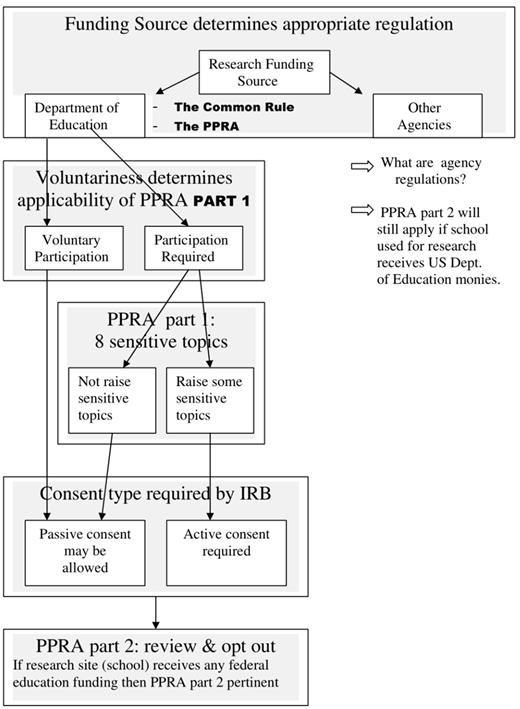
Research requirements can be anticipated by knowing what questions an IRB is going to be asking about your project. Their decision regarding whether or not you need to get active consent rests on an evaluation of four major factors. They are:
the funding source for the research;
whether research participation is truly voluntary;
whether the research touches on any of the eight sensitive topics; and
Based on this evaluation the IRB will decide whether you need active consent before engaging in the research or whether passive consent will do; and whether you need to also get participants’ own assent.5 A fifth criterion— whether the research is being done in a school receiving federal education money—determines if the PPRA (part 2) policy regarding parental review and opt-out is relevant and needs to be applied.
The funding source for the research is pertinent in determining what regulations apply. Research funded through the U.S. Department of Education, such as the Partnerships in Character Education Program, needs to meet the standard of the Common Rule and the Protection of Pupil Rights Amendment (PPRA).6 Funding from other government agencies may require abiding by the Common Rule or the agency may have alternate or additional regulations. Private funding brings with it the least regulation and oversight, and while IRBs or institutional policies may enforce comparable regulation, non-governmental funding does not typically need to comply with federal regulation. Ethicists have pointed out, however, that participants in privately funded research are just as deserving of high standards of protection as are those participating in government funded research. In addition to the source of research funding being a measure of the regulation that applies, it must be remembered that the later provision of the revised PPRA (part 2—the review and opt-out policy) is applicable in any schools receiving any department of education money for any purpose. Compliance with this provision may, however, be accommodated using passive consent. So, while this part of the regulations is broadly applicable to research in schools, it does not necessarily increase the need for active consent. The Family Policy Compliance Office, the division of the U.S. Department of Education that handles issues of compliance with the PPRA, offers examples of such opt-out documents.7
The eight sensitive topics were discussed above when describing the Protection of Pupil Rights Amendment (PPRA). It is not a simple clear decision as to whether your survey or interview questions touch on these sensitive topics or not—it is very much an interpretive question. For example, you can’t ask directly about how much money the participants’ parents make; but can you ask about what kind of consumer goods they have at home? Isn’t this just another way to find out about their economic situation and an area of “protected information” from which they are to be protected by law? If the IRB or federal agency reviewing your research proposal interprets your questions as inquiring into an area of protected information, then it would behoove them to require active consent so that participants and their guardians make a clear and conscious choice whether to share this information.
In another example of inadvertently touching on a sensitive topic: researchers are precluded from research “that reveals information concerning … critical appraisals of other individuals with whom respondents have close family relations.” It would be difficult to ask any questions at all about how students’ home life has been going without setting yourself up for possibly hearing something critical of their mother or father. If character educators ask about whether mom or dad helps with homework or comes to parent-teacher conferences, might not those questions elicit critical comments about someone with whom the child has a close family relationship? While character educators are not setting out to gather incriminating evidence against a child or their family, the exposure and sharing of such information is not difficult to imagine.
Voluntariness is another interpretable criterion, which the PPRA makes central to its regulation. The PPRA declares that “it seeks to ensure that schools and contractors obtain written consent before minor students are requiredto participate” (emphasis added). The Family Policy Compliance Office8 (FPCO) emphasizes that “any determination about whether a survey is required shall be made by examining a totality of the circumstances surrounding the administration of the survey” (emphasis added, FPCO document9) In a published assessment of a complaint of violation of the PPRA, in which students complained of being forced to take a survey, the Family Policy Compliance Office examined several factors in making their determinations of the voluntariness of the research as it was implemented.10 First, they ask, what did the school officials tell the students when they administered the survey? Were students told they did not have to answer all the questions? Were they told that they could decline to participate in the survey without any detrimental effects? What were the physical conditions during the survey? Did students feel free to leave the testing area? As you can see, voluntariness is at least in part an interpretation of one’s freedom, that is, one’s sense of freedom to choose, and not simply an assessment of the intention of the researcher. When it is clear to school staff that having as large a sample as possible is a good thing, they may, even inadvertently, attempt to influence students to participate. It is not enough to call the procedure voluntary and assume everyone will know what to do. This cannot be left to each teacher or administrator to make up as they go along. To convince an IRB that your study is voluntary you need to submit copies of the correspondence that will be sent to the schools; what the administrators of the test are to say to the students—the exact instructions to be given. What you say to research participants is on the order of a contract—you are specifying for them the nature of their participation and in that regard clarity and precision are virtues. You need to be especially clear about the voluntariness of participation—it cannot be assumed in a school setting, which is generally not voluntary.
Identifiability, the ways in which participants might be identified later by information in your data, directly influences promises of anonymity and confidentiality. Whether you have adequately safeguarded participants’ identities is another criterion open to interpretation, and without guarantees of confidentiality active consent will be necessary. Anonymity of research subjects is commonly assumed in order to protect them from as yet unknown consequences of participation. Character educators who wish to compare character education implementation with individual academic improvements or do longitudinal research will need to keep identifying information on the data as it is collected and stored in order to be able to match the children’s character education information with their test scores. More complex procedures for assuring anonymity and confidentiality will be expected. Interpretation comes in when deciding what is safe enough, and what risks are posed by what situations.
Now, having clarified some of the interpretive elements of this evaluation, the conditions under which researchers are likely to be required to get active consent will be explicated. Using the criteria explained above: source of funding; voluntariness; sensitive topics; and identifiability; a simple set of rules follow:
If Department of Education funding supports any part of the research, and the research inquires into any of the eight sensitive subjects, and participation is required for all students, then you will unquestionably need to get active parent/guardian consent.
If Department of Education funding supports any part of the research, and the research inquires into any of the eight sensitive subjects, but participation is voluntary, then the PPRA (part 1) does not apply and active consent is not required unless otherwise indicated by other layers of authority (IRB, district, university). Passive consent, student assent, and steps to insure confidentiality are still necessary.
If you have other federal funding, the particular agencies’ regulations may follow the Common Rule, or they may have additional or alternate requirements, but the PPRA standard regarding protected information (PPRA part 1) does not apply. Even if you are touching on the eight sensitive topics and requiring participation, passive consent may be allowed. Of course, IRBs are free to follow the standard of the PPRA, recognizing that asking children about sensitive subjects can be risky. If you made your research participation voluntary you would be in compliance with the spirit of the PPRA and not simply outside its legal domain.
If your research is funded privately you have only such regulation as your funders or institutional affiliates and local and state regulations require, with the following exception:
For all of these conditions, regardless of funding source, if the research is done in a school receiving department of education monies, and your research touches on sensitive subjects, then the school district will need a parental review and opt-out policy to comply with PPRA (part 2).
There is, as yet, little research on how many students would likely decline to participate if research were made voluntary and researchers could proceed with passive consent by parents and voluntary assent by students. Studies asking parents’ for consent find a denial rate of about fifteen percent (Josephson & Rosen, 1978; Kearney et al.,1983; Lueptow, et al., 1977) though it is likely that there would be wide variation reflecting various factors. It my well be that a researcher would lose less participants by making the study voluntary, thereby skirting the PPRA and being allowed to use passive consent, than they will by needing to seek active consent because it is involuntary, even if they go about it in an aggressive manner. As character education programs emphasize school community, social inclusion of all children, and student participation in school affairs they will be sowing the seeds for full voluntary participation in any character education research that can be justified to the students as making their community stronger and better able to live out the character ideals they share.
Discussion
There is a tension, perhaps even an irony, in the present situation. The children most likely to be without parents’ consent to participate in research are often the ones that researchers are most concerned about and most desiring to hear from. Prevention studies involving tobacco, drug use, sex, and other risky behaviors, are themselves at risk for missing the students most involved in the behavior being researched. Emphasizing the rights of the parent/guardian in demanding active versus passive consent, in this situation, undermines those attempting to help students at risk for these potentially life-threatening behaviors. Dropping them out of a study acts to conceal some of the real difficulties of their lives, and potentially keeps them from being identified as in need of appropriate intervention. We cannot expect to know what kinds of behavior children and adolescents are engaging in if we are kept from asking about it, or at least, kept from asking those most likely to be engaging in the behavior.
This difficulty, however, is not a conflict or choice between applying ethical principles too stringently versus letting researchers have free-reign; but rather it is a tension between two of the principles outlined in the Belmont Report (Pritchard, 2002). Justice, as a moral standard, argues for including the vulnerable populations who might best be helped by the resulting intervention. Respect for persons, on the other hand, argues for respecting the guardian’s authority and giving them the opportunity to make an informed decision and give their consent. This is based on recognizing that minors by definition have “diminished autonomy” and therefore are entitled to protection. Parents and guardians are traditionally the providers of that protection. But if we are to have any hope of crafting a realistic response to the difficulties children and adolescents face then we must find ways, where relevant, to do the research that includes the most troubled children.
For research that will be required to seek active consent, schools need to be more invested in seeking that parent participation, as the job of getting large numbers of them to give permission becomes over-whelming for researchers. Schools and district administrations need to be committed to research as something that will improve their effectiveness by providing critical insight. The concerted efforts necessary for aggressive active consent procedures must be justified in the life of the school. Additionally, funding sources will need to build into their grant expectations more program costs for simply acquiring a research subject pool. Much is expected of researcher’s as well. The Belmont Report and the Common Rule demand from the researcher a sound research design, noting that if the knowledge produced by the study will not be reliable or valid, than no risk or inconvenience will be warranted at all.
While there is still room to debate when and whether active consent is really necessary to safeguard students’ well-being; or whether aggressive active-consent procedures will return response rates sufficiently high to combat the research bias that inevitably creeps in with diminished numbers of student participants; there is no question that we must take both seriously. When children’s needs to be protected collide with researchers’ needs to get a view that is as unbiased as possible, we need to collectively pay attention because both of these values are important and solutions that satisfy both must be found for the good of the research, and for the good of the children.
The author would like to acknowledge the assistance of Marvin Berkowitz, Melinda Bier, Jon Marshall, Ivor Pritchard, Jeffrey Rodamar, Patricia Somers, and three anonymous reviewers at the JRCE in reading drafts of this paper. Responsibility for any remaining confusion or inconsistency remains with the author.
Notes
(http://ohsr.od.nih.gov/mpa/Belmont.php3).
Federal Policy for Protection of Human Subjects (1991) (also known as The Common Rule) (34 CFR Part 97; Subpart A) http://ohsr.od.nih.gov/ mpa/belmont.php3
Including the Department of Health and Human Services; the Department of Education; the Centers for Disease Control; and the National Institutes of Health. See Pritchard (2001) for a helpful discussion of variation in applicability of federal regulations across departments and agencies.
This eighth category was added in 2001 with the No Child Left Behind Act.
This discussion assumes the research will be conducted in schools with students who are legal minors.
Other federal regulation could also apply. The Family Educational Rights and Privacy Act (FERPA) is Department of Education regulation covering privacy of educational records; and (HIPAA) is Department of Health and Human Services regulation concerning privacy of health and medical records.
The Family Policy Compliance Office makes available a Model Notice and Consent/ Opt-out for Specific Activities, as well as a Model Notification of Rights Under the Protection of Pupil Rights Amendment (PPRA) on their web page: www.ed.gov/offices/OM/fpco/ppra/index.html
U.S. Department of Education; www.ed.gov/offices/OM/fpco
www.geocities.com/ridgewoodschools/doepdf.html p. 12 of 15.
For an example of how an allegedly voluntary survey turned out to not be, see the finding of the Family Policy Compliance Office at www.geocities.com/ridgewoodschools/doepdf.html. This example also highlights the importance of faithful implementation, that is, of actually doing what you told the IRB you would do.

