


This paper reviews the evidence on staff practices and quality programs that foster character development through social and emotional learning. The paper describes the state of the OST workforce, and barriers and opportunities to adding social and emotional learning to their job description. Specifically, the paper provides an overview of the literature on the characteristics of staff practices that yield positive youth outcomes and the readiness of the OST workforce to implement intentional opportunities for social and emotional learning. We explore current and potential future efforts in the field to prepare staff to incorporate practices that support social and emotional learning. The paper concludes with future directions for the field and recommendations for a research agenda to explore and understand the supports for staff that ultimately foster character development through social and emotional learning. Keywords: character development, social and emotional learning, out-of-school time, afterschool, workforce, relationships.
There is a newfound interest in children’s positive social and emotional development as a part of their enrichment and educational experience in both traditional PK-12 educational and out-of-school time (OST) settings. It is a newfound interest as opposed to a wholly new endeavor because the very philosophical foundation of our public education system honored the development of the whole child as a key part of the education experience (Dewey, 1916). In addition, youth development programs in OST settings have aimed to support positive development for more than 2 decades (Catalano, Berglund, Ryan, Lonczak, & Hawkins, 2002). More recently, there has been a flood of efforts that delineate how adults in educational and OST settings can support children’s social and emotional development (Devaney, 2015b). These efforts are likely due to a combination of factors, including the following: response to good research and practice to date on children’s social and emotional development and the links between positive development and academic and workforce outcomes; the backlash against accountability and standards in core content areas; and, most recently, the new language in the Every Student Succeeds Act, which honors the education of the whole child (Moroney & McGarrah, 2016).
The aforementioned “flood” of efforts to support children’s social and emotional development has come in many forms and with many names: (positive) youth development, character and moral development, social and emotional learning (SEL), 21st century skills, and Foundations for Young Adult Success—among other constructs and terms to denote traits; attitudes; and skill sets such as grit, growth mindset, and noncognitive factors (Devaney, 2015b). This paper does not attempt to detangle these different but related frameworks. Instead, we discuss three framings that are especially pertinent to the OST workforce today—character, SEL, and youth development—and attempt to tease out where they overlap, service one another, or are different.
We begin with character education. Traditional character education programs were described as promoting core values and providing opportunities to practice morality in caring environments that involve families, the school, and the community (Lickona, 1996). A more modern view of character development maintains that character, among other aspects of development, is situationally driven and not fixed (i.e., it depends on the situation and the competencies the individual brings to the situation) (Nucci, 2001). Character education is defined by Character.org as the intentional practice to “support the social, emotional, and ethical development of students” (Berkowitz & Bier, 2005). Character.org further suggests that character education programs support the development of young people’s sense of fairness, responsibility, and grit, among other attitudes and skills. In order to develop these skills, character education recognizes that programs need to do more than just provide information about being socially and ethically competent—they also have to help children with how (i.e., skills) to use that knowledge to change their behavior (Elias, Parker, Kash, Weissberg, & O’Brien, 2008).
SEL is the second major framework we explore in this paper. SEL is the process by which individuals develop the attitudes, knowledge, and beliefs to succeed in school and in life. The Collaborative for Academic, Social, and Emotional Learning (CASEL) defines five core social and emotional competencies that are critical to success in school and in life: self-management, self-awareness, social awareness, relationship skills, and responsible decision making (CASEL, 2016). In school settings, SEL programs create the positive conditions (e.g., safe and supportive places, high expectations, support from adults, structured and cooperative learning environments) that ultimately contribute to children’s engagement, prosocial behavior (and reduction in antisocial behavior), and academic success (Durlak, Weissberg, Dymnicki, Taylor, & Schellinger, 2011).
Finally, youth development, sometimes called positive youth development, is both the natural process of human development and also the strengths-based approach to youth-work practice (Hamilton, Hamilton, & Pittman, 2004). Youth development programs champion a strengths-based approach as opposed to a prevention mentality; they intentionally bring in family, school, and community partners to ensure programs are contextually relevant and celebrate and showcase the community’s assets (Anderson-Butcher, Stetler, & Midle, 2006; Benson, 2003; Hamilton et al., 2004). Ideally, youth development programs are designed to be developmentally aligned and to provide opportunities for skill building that is embedded into the content of the program (Deschenes, McDonald, & McLaughlin, 2004; Walker, Marczak, Blyth, & Borden, 2005).
The key purpose of defining these three frameworks is to highlight that although they are not the same, all stem from common disciplines of psychology and human development. At certain points in the evolution of the implementation of each framework they reflected different educational philosophies (i.e., constructivist, behaviorist), but more recently there appears to be more common implementation practices and outcomes across frameworks, than not. That is, in some ways, SEL can be considered the process that helps young people to enact the knowledge imparted as part of character education (Elias et al., 2008). Likewise, youth development can be considered an approach to creating positive environments that ultimately support social and emotional skill building and character development. The remainder of the paper focuses on the readiness of the OST workforce to implement SEL practices that ultimately support participants’ social and emotional skill building, including the skills needed to implement or enact key values such as respect, responsibility, and honesty that are the foundation of character development. This paper is guided by the framing question: What are the capacity and readiness for the OST workforce to support participants’ positive development, including character, through SEL?
The first section of the paper describes youth development (also sometimes called positive youth development to distinguish it from the natural process of human development) as a grounding framework in OST (Hamilton et al., 2004). The paper then builds on the interrelated structures between youth development, SEL, and character, and staff members’ role in these process frameworks. The paper concludes with recommendations for future practice and research to support the OST workforce in supporting participants’ positive development.
Quality Youth Development Programs in OST Settings
In order to frame the conversation around workforce preparedness to implement SEL, it is first important to understand the history of OST. OST programming has deep roots in a tradition of youth development. Importantly, the field has invested heavily in defining and measuring quality in youth development programs. Not surprisingly, researchers have found that participants benefit from youth development programs in OST settings when they attend regularly and the programs are implemented with quality (Durlak, Mahoney, Bohnert, & Parente, 2010; Durlak & Weissberg, 2007; Vandell, Reisner, Brown, et al., 2007; Vandell, Reisner, & Pierce, 2007). High-quality youth development programs in OST settings include some agreed-upon core components: a safe and supportive environment with contextually relevant offerings via local partnerships, in which participants have a sense of belonging, positive relationships and shared norms, and opportunities for skills building and efficacy (Kauh, 2011; Lerner et al., 2005; Phelps et al., 2007; Smith, Peck, Denault, Blazevski, & Akiva, 2010; Vandell, Reisner, Brown, et al., 2007). High-quality youth development programs allow youth participants opportunities to explore their interests, engage in learning and reflection, and build skills and knowledge (Lerner, Brittian, & Fay, 2007).
So how does youth development and its emphasis on quality instructional practices connect to the topic at hand—the development of character through SEL? Youth development is a foundational practice that encourages adults to see participants with a strengths-based lens, celebrates and includes the community, and intentionally fosters positive development through structured activities. In reviews of youth development programs, researchers have found that high-quality programs both create the conditions for and promote what are often called the five C’s of youth development: confidence, competence, connection, caring, and character (Roth, Malone, & Brooks-Gunn, 2010; Lerner et al., 2005). As such, character development may be one of many possible outcomes of a high-quality youth development program. Indeed, character development has been a part of historical youth development practice and is in fact central to many youth development organizations’ mission statements (e.g., YMCA, scouting, and 4-H programs). Historically, however, these organizations have not used the language of SEL to describe how they achieve this goal. That is, many programs can define what characteristics they hope their participants will have as a result of participation in their programs (e.g., be honest, respectful, have a sense of right and wrong, be empathetic, help others, etc.), but may not have had the language to articulate how youth participants have developed those characteristics. Now that the SEL framing has gained more national attention and is more accessible to nonschool programs such as those that take place in OST settings, positive youth development programs have a language and a process for how they can more intentionally support skill building and character development (i.e., through SEL practices).
OST programs are quickly adopting or claiming ownership of the language and spirit of SEL and being clear about how that work builds on other current and past efforts and frameworks. The following section further details the relationship among youth development, SEL, character development, and how that relationship is dependent on intentional and high-quality practice.
Intentional SEL Practice
In 2007, amidst a flurry of activity in the field of OST to define and measure quality of structured youth development programs and to tell our OST story with sometimes misaligned academic outcome metrics, Durlak, Weissberg, and colleagues conducted a meta-analysis, which would later become multiple CASEL reports and peer-reviewed articles in Child Development and the American Journal of Community Psychology (Durlak et al., 2007; Durlak et al., 2011; Durlak & Weissberg, 2007; Durlak, Weissberg, & Pachan, 2010). The first report, The Impact of After-School Programs that Promote Personal and Social Skills, outlined the findings suggesting that high-quality OST programs (1) promoted participants’ development of social skills, including self-confidence, self-esteem, and bonding to school, and (2) reduced risky behaviors, which may imply sound decision making (Durlak & Weissberg, 2007). The authors specified that these outcomes were present only in high-quality programs defined as being logically and developmentally sequenced, active and hands on, focused on skill building, and explicit in the intention of skill building— or SAFE. This singular brief triggered not only fieldwide interest in SEL but also a sense of validation that “Yes, this is what we do in OST.” Since 2007, SAFE has been twisted this way and that to fit youth development and other OST programs’ definitions of quality and their implementation strategies. Most relevant has been the ongoing dialogue over whether youth development and SEL are the same, and if so, can we check the box on whether we know how to implement high-quality practices that support SEL, or not. The answer is: yes and no.
Yes, in that high-quality youth development practice and intentional SEL practices share many of the same characteristics, and both support young people’s social and emotional development, including character.
However (this is the “no”), saying we already know how to do it does not do justice to our real understanding of high-quality SEL, or actually recognize what we may not yet know about high-quality SEL practice and character development in OST. Youth development programs in OST provide youth opportunities to build relationships in safe and supportive environments and to create self-determined opportunities based upon their own strengths and interests. No doubt social and emotional skill building and character development may be a consequence of this work, and for OST programs that endeavor to implement and support general positive youth development, there is no need to go further.
But for those programs in which character development and SEL are primary goals, program leaders need to identify and be intentional about how they prepare staff who are already familiar with youth development practice to extend those practices and more intentionally and concretely focus on SEL implementation.
If OST programs with a foundation of youth development are laying claim to implementing SEL and/or character development but are not intentionally implementing SEL and character development practices, then they may not be going far enough. For example, they likely aren’t implementing practices with consistency, hiring prepared staff, or training existing staff to understand and implement SEL practices. Program leaders and staff need to intentionally implement SEL and character development programs, practices, or strategies if that is the goal.
Multiple studies have pointed to staff experience, preparation, characteristics, and their role in fostering positive relationships as the catalysts in implementing high-quality programs that promote positive youth outcomes (Durlak & Weissberg, 2007; Smith et al., 2010; Vandell, 2013; Vandell & Lao, 2016). Figure 1 shows the interrelated factors that theoretically influence intentional practice in supporting SEL. Vandell (2013) suggests that the role for staff in implementing high-quality programs includes developing positive relationships, providing developmentally appropriate activities, and intentionally providing opportunities for skill building and engagement through choice and autonomous experiences. Smith and colleagues (2010) describe this relationship between setting level program quality and positive youth experience as the point of service: “Point of service focuses on the coexistence and correspondence between staff practices and youth experience that is likely to produce positive developmental change” (p. 359). As we train staff to intentionally support social and emotional skill building, researchers, practice leaders, and staff need to recognize that defining quality implementation for SEL and character development may be an area we need to explore more fully. The following section details the characteristics of the OST workforce and its support of young people’s positive development to date.
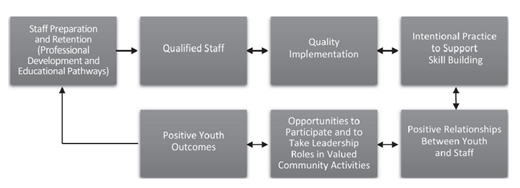
Interrated Factors That Influence Intentional SEL Practice
Interrated Factors That Influence Intentional SEL Practice
The OST Workforce
First, who is the workforce? The OST workforce comprises almost one million individuals from a variety of preparations and backgrounds from college students to parent volunteers, teachers, specialists, and youth-work professionals (Miller & Gannett, 2006; Vandell & Lao, 2016). Broadly defined, a youth worker is “an individual who works with and on behalf of children and youth to facilitate their personal, social, and educational development and enable them to gain a voice, influence, and place in society as they make the transition from dependence to independence” (Garza & Yohalem, 2013). Recent scans suggest that the OST workforce is primarily composed of young professionals (ages 18-25) and those who are retired or late career and newly entering the OST space (Vandell & Lao, 2016; Yohalem, Pittman, & Edwards, 2010). The OST workforce experiences high turnover, receives relatively low compensation for demanding work, and is staffed significantly by part-time staff (Vandell & Lao, 2016; Yohalem et al., 2010). This creates a great challenge in efforts to consistently prepare and expect staff to implement high-quality practice. It also poses a significant barrier to youth and staff forming meaningful and long-term relationships, which is critical to both high quality programming and associated social and emotional development (Vandell & Lao, 2016).
Nearly half of staff in OST programs have a 2- or 4-year degree in a variety of disciplines related to youth work, including education, child development, and social work (Vandell & Lao, 2016; Yohalem et al., 2010). A movement toward professionalizing the OST workforce currently is led by associations such as the National AfterSchool Association, the National Institute on Out-of-School Time, the National Summer Learning Association, 4-H Extension, Every Hour Counts, the Weikart Center for Youth Program Quality, and local entities such as the Partnership for Children & Youth in California and the Partnership for Afterschool Education in New York City. In addition, there is an emergence of degrees specifically focused on youth development practice at the University of Illinois at Chicago and the University of Minnesota among others, as well as state-driven credentialing systems for child care settings. There is promise for more explicit preparation and career pathways for youth workers in the near future.
It should come as no surprise that the qualifications and motivations of the staff working in afterschool programs matter, and that high-quality programs employ staff who are “especially qualified,” intrinsically motivated, and develop positive relationships with youth and families (Huang, Cho, Mostafavi, & Nam, 2008). High-quality programs have hiring practices that are structured, use formal and informal recruitment strategies, and align desired staff qualifications with needed skills (Huang et al., 2010).
Staff Preparation and Youth Engagement
Some research has found that higher levels of staff education and more structured and organized programming lead to higher levels of staff engagement, which leads to higher levels of youth engagement (Miller, 2005; Vandell, Larson, Mahoney, & Watts, 2015). For example, researchers involved in the Massachusetts After-School Research Study found a positive relationship between staff members’ educational attainment and program quality indicators (e.g., youth and staff engagement), and also between staff educational attainment and participant outcomes (i.e., homework completion) (Miller, 2005). The conundrum is that the OST workforce does not have one direct educational trajectory. Few degree programs exist in youth development, SEL, character development, or related disciplines, and OST jobs do not adequately compensate individuals to pay back student loans (thus, they may not always attract an educated workforce). Traditional education pathways are one route to creating a prepared workforce, but there are other pathways. There is some evidence that staff educational level has little impact on program quality but that staff members’ participation in a quality-improvement process does, suggesting that in-program professional development and reflection are paramount to supporting quality (and thus, youth outcomes, theoretically) (Smith et al., 2010). Because staff come from a variety of backgrounds and preparations, staff professional development is another feasible pathway to ensure that staff have the tools to implement high-quality opportunities for SEL. In fact, Vandell, Simzar, O’Cadiz, and Hall (2016) found a relationship between staff participation in professional development and youth participants’ development of social competencies. Few studies have endeavored to make this meaningful connection between the relative value of formal postsecondary preparation, professional learning, and program quality in OST. While we do the work to influence and potentially transform postsecondary programs in the next decade to improve traditional education and OST opportunities for positive development for all young people, we can more immediately support professional learning systems and create alternate credentials that are meaningful and engaging for the adults who have such a significant impact on youth in OST programs.
For example, we may learn from the early childhood and emerging child care fields how to create multiple preparation pathways for youth work professionals. Although the OST field differs from early childhood in important ways (i.e., it is less regulated, the age range is broader, children’s needs are different, the goals of OST programs are more varied), there still may be important lessons to glean from the early childhood field’s decade-long focus on workforce development, quality programming, and positive child outcomes. Many states have a quality rating and improvement system for early childhood programs, which has created an infrastructure for support, both to the program quality and the workforce. Several states are currently working to integrate licensed school-age OST programs into the early childhood quality rating and improvement system in their state. In fact, the most recent Child Care Development (Block) Grant legislation includes language that suggests an increased allocation for both professional pathways and learning and quality improvement for child care settings. In some states, there are grants to support quality improvement in licensed child care settings that are part of the quality rating and improvement system, so those OST programs that serve as school-age programs and are licensed (often Boys and Girls Clubs and YMCAs, for example) may have access to professional development funds for staff.
This is an opportunity, or a moment in time, to take what we know from more than 2 decades of research and practice in early childhood and the research on the unique aspects of OST youth development, SEL, and character development to make informed decisions about how to support a workforce in implementing high-quality OST and to create meaningful and relevant career pathways for adults who make youth work a career. For example, the early childhood field has created mechanisms to foster professional learning and preparation through the Council for Professional Recognition (2016), which houses a degree registry, listings of professional learning opportunities, an online learning community, among other resources for early childhood staff; the T.E.A.C.H. Early Childhood National Center (2016) provides equitable access through funding for educational opportunities for early childhood professionals. The OST field is different from ECE, to be sure, but OST may benefit from exploring and learning from the early childhood field’s structure to support ongoing professional learning and to supplement formal postsecondary opportunities to professionalize and advance the OST workforce.
The Relationship between Youth Workers and Participants’ Social and Emotional Development
So why is the adult role in delivering high-quality programming and as an actor in positive relationships so primary to young people’s social and emotional development? Why is preparation of the OST workforce to deliver SEL so essential to developing character? Despite the lack of consistent support, preparation, or remuneration for the OST workforce, we have ample evidence that staff are a key to program quality, young people’s positive experience in programs, and their positive outcomes, including their social and emotional development. Staff play a critical role in the recruitment, retention, and engagement of youth in programs that ultimately support their social and emotional development. The foundations of SEL and character education, going back to social learning theory and the importance of modeling and environment in learning behavior, point to the important role adults play in supporting skill development among children (Elias et al., 2008). The following sections feature the literature on relationships among youth and staff participation in programs, staff engagement and youth engagement, and characteristics of positive relationships between youth and staff. All of these are related to participants’ positive social and emotional development. Additionally, Table 1 shows results of a literature scan that includes studies of multiple OST types (structured OST and extracurricular activities) that describe, aim to change, or show effects of OST programming on participants’ social and emotional development and related outcomes.
Program staff have a positive influence from the get-go on a young person’s program experience. Youth are more likely to enroll in programs which there are known staff members, and are more likely to stay in programs in which staff also are returning. Furthermore, participants are more likely to enroll in and come back to programs in which they feel safe, have a sense of belonging, have choices of programming, and are engaged in activities (Vandell et al., 2015). All of the practices described here are components of OST program quality that staff members are critical players in implementing. Not surprisingly, the more youth attend programs, the more they experience the benefits of programs and, specifically the developmental outcomes of interest (e.g., improved social skills, positive behaviors, engagement, and decrease in risky behaviors (Fredricks & Eccles, 2006; Vandell, 2013; Vandell et al., 2015). So, the more consistent staff are and the higher the quality of the programs they offer, the more youth attend and the more likely they are to experience the benefits of programming.
The Characteristics of a Positive Relationship Between Youth and Staff
So where does this leave us? We know that staff who are known entities attract youth to enroll in programming, staff who stay and offer high-quality program activities retain youth in programming, and youth participation is likely to afford opportunities for positive social and emotional development. We also are aware that there are parallel structures and systems that support the workforce in early childhood. Let’s focus on one aspect of quality that is especially pertinent here: the relationships between staff and youth in programs. First, we must acknowledge that adults (staff, in this case) also benefit from positive, reciprocal relationships (Lerner et al., 2006) and that when both youth and adults, or both parties in a relationship, are experiencing all of the real and perceived benefits of a relationship, they are likely to be more satisfied in their circumstance (Lerner et al., 2006). A handful of OST studies deeply explored the interactions between youth and youth workers and found that intentional, facilitated relationships between youth and youth workers were central to program quality (which we know is key in promoting youth outcomes) (Chaskin, 2009; Larson & Walker, 2010; Sullivan & Larson, 2010). In addition, Pierce, Bolt, and Vandell (2010) found that positive staff-child relationships in an OST program were associated with positive academic outcomes and increased social skills for those participants.
Literature Scan of All OST Types
| Reference | Study/Report Type | Program Type | Age/Grade | Staff Contribution | Youth Outcome(s) |
|---|---|---|---|---|---|
| Lerner et al. (2005) | Longitudinal Sequential Design | 4-H programs, youth development organizations | Primarily Grade 5/early adolescent |
|
|
| Larson & Walker (2010) | Longitudinal Design | Youth development programs; community and school-based arts & leadership programs | High school-aged youth |
|
|
| Vandell & Lao (2016) | Research Synthesis | Afterschool programs | NA |
|
|
| Vandell et al. (2015) | Research Synthesis | Afterschool programs, OST settings, including extracurricular activities, camps, museum & library programs | NA |
|
|
| Vandell (2016) | Quasi-experimental Design | Afterschool programs, focused on STEM | Primarily elementary |
|
|
| Hall, Yohalem, Tolman, & Wilson (2003) | Qualitative Design | Afterschool programs | Varied |
|
|
| Vandell (2013) | Research Synthesis | Afterschool programs | NA |
|
|
| Vandell, Reisner, Brown, et al. (2007) | Multicity Quasi-experimental Design | Afterschool programs | Elementary and middle school youth |
|
|
| Morrissey & Werner-Wilson (2005) | Quasi-experimental Design | School-based extracurricular activities, religious activities, community-based clubs, sports, service groups | Ages 10–18 |
|
|
| Fredricks & Eccles (2006) | Longitudinal Sample Quasi-experimental Design | Various school-based extracurricular activities | Grades 7-12 |
|
|
| Riggs, Jahromi, Razza, Dillworth, & Mueller (2006) | Research Synthesis | School-based afterschool academic achievement & social skills program | Grades 1-6 |
|
|
| Mahoney, Cairns, & Farmer (2003) | Longitudinal Sample Quasi-experimental Design | Various school-based extracurricular activities | Grades 4-7 |
|
|
| Ettekal, Callina, & Lerner (2015) | Research Synthesis | Organized activities | Grade 7 |
|
|
| Jagers (2001) | Research Synthesis | School-based social & emotional competency building programs, extra hour of afterschool time | NA |
|
|
What do these positive relationships look like? They are characterized by shared norms, high expectations, stability and continuity, and connectedness to each other’s lives (e.g., school, community, family) (Hall et al., 2003; Vandell, Reisner, Brown et al., 2007). The positive outcomes associated with positive adult/youth relationships has been well studied in traditional education settings, and specifically when adults have high expectations of the youth with whom they work. A longitudinal study of middle school students found that youth who reported that their teachers had a positive perception of them had increased academic success, increased self-esteem, and decreased anger (Roeser & Eccles, 1998). In addition to high expectations, staff are successful in creating positive relationships with participants when they are respectful; provide youth with guidance; show a genuine interest in youth; and are responsive, attentive, and nonjudgmental (Ettekal et al., 2015; Hall et al., 2003). In OST settings, organizational development and staff practices should be grounded in a core philosophy of youth development to foster positive and respectful relationships (Deschenes et al., 2004; Hall et al., 2003).
We have learned that staff need to be educated in a related degree or prepared and continually provided opportunities for professional development and engaged and that they need to stay in low-paying, high-demand jobs. They need to implement high-quality programs that reflect youth interests and to be in partnerships with the family and community. All the while, they need to do so with the utmost care and responsiveness to ensure that all participants feel safe and have a strong sense of belonging, have opportunities to form positive relationships and practice skill and knowledge building in any number of content areas, and have opportunities for efficacy and leadership. Now, we are saying they should be ensuring that participants have explicit opportunities for SEL in order to support their positive development and character. This is a tall order. Let’s consider whether the OST workforce is ready to implement SEL.
Readiness to Implement
As a field, are we ready to support the OST workforce as it develops this next layer of expertise? Are members of the OST workforce ready and prepared to implement programs that support participants’ social and emotional development, including character? In 2015, the National AfterSchool Association conducted a scan of its members, asking them to respond to questions focused on their value, interest, ability, expertise, and needs in implementing OST opportunities that supported SEL. Not surprisingly, the findings suggested that OST programs place a high value on SEL and report implementing opportunities for SEL, but responses were mixed on whether staff felt equipped to implement SEL. The majority of respondents indicated that they wanted more resources and professional development on SEL (National AfterSchool Association & American Institutes for Research, 2016). Across the country, PK-12 education systems, schools, and OST programs are endeavoring not only to implement opportunities for SEL and character development but also to assess social and emotional competencies. It is critical that we take stock of where we are in OST organizational practices that support staff and their implementation of SEL, program implementation, and the readiness and comfort level of staff in implementing SEL.
The National AfterSchool Association, along with the National Institute on Out-of-School Time, has developed core knowledge and competencies for afterschool and youth development professionals (National AfterSchool Association, 2011). Intermediary organizations have recently designed tools to support staff member implementation of SEL, reflect on SEL practice, and determine their readiness to assess social and emotional development (Devaney, 2015a; Moroney & McGarrah, 2016; Smith, McGovern, Larson, Hillaker, & Peck, 2016). These resources only scratch the surface if they are not accompanied by organizational buy-in, ongoing and aligned professional development, and staff inclusion and readiness for this new endeavor. We know from research that adoption of new practices at scale’or “diffusion of innovation” in research speak—is most effective when the problem is visible or tangible, when the solution is doable (e.g., requires small effort on the part of the individual or is relatively simple), and when the innovation or new practice has been tested and is supported by peers (Gawande, 2013; Rogers, Singhal, & Quinlan, 2009). Coburn (2003) suggests that bringing an education initiative to scale requires more than just putting it in lots of classrooms—it requires a depth and spread of implementation that gets to the core of the ideas by changing norms and beliefs, not just activities, by getting people on the ground involved in solving the problem. Something similar needs to happen with the OST field. SEL and related practices need to be made relevant to the workforce; the language and practices need to be made accessible; and the OST workforce needs to be meaningfully engaged in defining high-quality SEL in OST settings in order for successful and widespread adoption of SEL practice and character development. Efforts are underway to this effect. American Institutes for Research has released a variety of tools and briefs designed to help practitioners with how to implement and assess their own SEL practice. Likewise, the Susan Crown Exchange and the Weikart Center for Youth Program Quality, through their SEL Challenge, have developed a guide for programs serving older youth on how to incorporate SEL practices into OST programming. But much more is needed to help the OST workforce truly understand SEL practice and how it plays a role in improving social, emotional, and character development.
Future Directions for OST Practice: A New Job Description
At this juncture, we may consider how we can support staff in implementing SEL, while at the same time avoiding the youth work pivot. Over the years, we have asked youth workers to be instant specialists in prevention programming; arts; environmental education; literacy; academic enrichment and Supplemental Education Services; Science, Technology, Engineering, and Mathematics; and life skills, to name a few. Staff who are primarily part time and with low pay have had to pivot from one important initiative to another, often with little preparation or background, and, as such have experienced trend fatigue with each new and important initiative. Throughout this time, our pervasive mission has been to support children and youth in their positive development. As we explore, identify, and implement practices to support staff in their preparation to implement high-quality SEL and character development, we need to acknowledge: (1) this effort builds on the OST field’s fundamental mission of supporting youth development, and (2) if the goal of a program is to support content development (e.g., arts exploration), then it may not be necessary for the entire program to make a shift to SEL. An entire content-varied and rich field does not all have to simultaneously pivot to a new mission and content—only one that makes sense for an organization in its history, context, and future direction.
Perhaps we don’t need to redefine the role of every youth worker in a way that makes SEL yet one more thing they need to learn and be able to “do.” Perhaps instead, we need to think about SEL practice as we might any other important skills we seek in employees. Take, for example, communication. Just about every job description talks about the importance of communication skills for success. Usually, to do your job well, you need to be able to communicate with other staff, clients, or key stakeholders. But for some, communication is more a key component of the job than others—a marketing director at a company must have greater communication skills than, say, the computer programmer. Both may need it, but the one as part of their overall effectiveness as an employee and the other as a core component of the work of their job. What if we did the same for youth workers? Everyone needs to understand and support SEL as an overall part of their job, but we can make a new job description for youth workers who specialize in SEL. This role would be similar to academic liaisons who connect the OST program with in-school learning and ensure that activities are aligned and working in conjunction with the school. A youth worker focused on SEL would ensure that programming is infused with both embedded and explicit SEL practices. This approach presents not only the opportunity for programs to have SEL-focused staff members but also another career trajectory for youth workers.
The following recommendations for next steps represent the collective thinking of field leaders on future directions in research and practice. Building on the core question presented in the introduction of this paper, we asked field leaders: What is the next step in the field to prepare the OST workforce to support participants’ character development through SEL? The following themes emerged from their responses.
Organizational Support Toward Sustainability
Youth-serving organizations, schools, and other agencies that house OST programs should support the value of SEL from the outset of programming. There needs to be organizational buy-in, including supportive adults, to foster settings that promote positive development and to invest resources in the supports that staff need (e.g., professional development) to learn or bolster SEL strategies. Before making a shift to SEL, organizations must consider sustainability of organizational support for SEL in consideration of the issues of staff turnover previously mentioned in this paper. Organizations also may consider how they will evaluate the effectiveness of staff practice in implementing SEL. There exists great controversy around using youth-level measures of social and emotional competence to gauge staff practice. At the same time, we know that continuous-quality-improvement practices that include staff reflection on their own implementation lead to improved quality programming and staff engagement.
Adoption of Frameworks and Knowing What That Means
There are two lines of thinking on adopting a common framework and language to describe the process of SEL and associated outcomes of social and emotional competencies, with the framing of workforce preparation for implementing high-quality SEL. First, there are some who assert that we need to agree on a common framework and shared understanding of language. Second, others are comfortable with “locally” adopted frameworks. At the very least, there must be consensus within a program, or system of programs, in which staff may have job mobility, that there be a common framework and clarity of language. This very article points to the complexity of language. SEL and character education are two frameworks with some common goals and strategies, but staff who are asked to contribute to, understand, and practice both may be confused. There are efforts underway in both in-school and OST SEL to move toward consensus building for a variety of reasons, but most primarily to detangle and clarify strategies for staff and buy-in from stakeholders.
Culture and Context
We need to explicitly explore and critically address issues of cultural bias. SEL and character are culturally defined and may function differently in different contexts. Character, in particular, is laden with contextual implications because many consider character within a religious framing or a context of “right” and “wrong.” These terms can be understood differently in different contexts, and we need to do more than just acknowledge this challenge. We need to start having the critical conversations about the appropriateness, relevance, and application of SEL and character in a variety of OST programs serving a wide variety of people. We not only need to pay credence and attention to this space, but we also need to start having conversations that include youth, family members, staff, and community members on the strategies and competencies that are relevant and valued by a community. Moreover, we need to pay attention to how different contexts (e.g., a small program, a rural program) influence opportunities for staff to implement high-quality SEL and how high-quality SEL is defined in those contexts. The Asia Society and Policy Studies Associates are leading a coideation process around 21st century competencies with systems builders across the globe (Stewart, 2015). This may be one method to ensure the relevance of efforts to support SEL and aligned staff supports as we move forward in creating a more responsive and culturally reflective approach to SEL and character development across contexts.
Adult Social and Emotional Competence
The OST workforce has a wide and varied job description. Not unlike other fields today, we know we have to add social and emotional competencies to the job qualifications list. Studies show that employers want these skills, above almost all others, and that we cannot teach young people to change their behavior if we are not able to model how to do it ourselves (American Management Association, 2012; Elias et al., 2008). We want OST staff to know themselves and to be able to work well with others by being good communicators and collaborators. These are all core competencies of a good employee, team player, and someone who can form ongoing and positive relationships that are critical to young people’s positive experience in OST and positive development. We also expect staff to be able to role-model social and emotional competencies (and the strategies for SEL, such as reflection) with youth and colleagues in their programming. This additional expectation of the workforce may be a cumbersome hiring shift for some organizations that have historically hired a steady stream of part-time staff members with varying levels of youth-work experience and education. This new goal (not just in the OST workforce) to shift not only to an experienced and prepared workforce but also to an experienced, prepared, and socially and emotionally competent workforce will take time and careful thought, because in the end, we are all developing and can use support in our ongoing positive development. Building off the previous topic of explicitly addressing culture and context in OST programs, we also need staff voice in this conversation to acknowledge staff members’ experience with SEL; the contexts in which they live, work, and play; and how their background and culture contribute to their practice. In the short term, ensuring that the OST workforce is meaningfully engaged in the conversation around SEL and its relevance, and aware that their social and emotional competence influences their work, the quality of programs, and young people’s experience is a feasible and very important first step.
Professional Learning and Development
Messaging is critical to professional development for the OST workforce. There appears to be confusion in the field on terminology and frameworks, and SEL has been misconstrued as a completely new concept when in fact there are many similarities among them. To avoid the dogma of another new thing, and the associated youth work pivot, we may consider messaging that SEL is youth development done really well, with additional intentional practice to foster social and emotional skill building and facilitate character development.
This paper presents an overview of the varied formal and informal preparation that OST staff, in addition to their own intrinsic strengths and interests, bring to programs. To professionalize the OST workforce, the OST field should support, design, and implement varied and ongoing professional learning and development for OST on awareness and strategies to implement SEL in OST settings. Staff will come with varying levels of experience, resources, and prior knowledge in SEL. In an effort to address this variety, professional learning opportunities may vary by model of delivery (coaching, technical assistance, workshops, online tools and resources such as communities of practice and UCourses, shared resources, and examples of best practice) and by method of transfer (online, in person, resource sharing) to address not only diversity of experience but also learning style, and to accommodate the often part-time workforce. OST programs also should consider program participants, context, and offerings to contextualize training. For example, staff who work with youth from prekindergarten through middle school may participate in professional learning that is offered by developmental stage. Programs that are offered in conjunction with other supports for youth and families should include professional learning opportunities on how programs and initiatives align and how to collaborate toward shared goals. Common agreement on a framework, language, and reflective buy-in are all a priori to professional development; otherwise, it may end up being confusing, dismissed, or—in the worst case—disrespectful.
Intentionality
Likely, one of the most important next steps for the field of OST and, ultimately, the workforce is to define and understand intentional SEL practice. Broadly defined, intentional practice is the purposeful implementation of practices and strategies to support SEL and character (as opposed to general quality practices that may result in SEL and character). Intentional practices also are responsive to the developmental stage of youth in the program, their readiness to learn, and the culture and context of the program and community (Deschenes et al., 2004). The development of such intentional practices can be done program by program by planning activities based on information continually gathered from participants via focus groups, surveys, interviews, and other forms of informal communication. Intentional activities are designed to be open to and inclusive of youth, family, and community voice in programming. As noted previously, the field has a history and systems to support quality practice that may result in positive youth development outcomes, but we have yet to adequately define and adopt SEL practices that support character development and other social and emotional outcomes by developmental stage, in a variety of contexts, and that reflect, respect, and honor cultural diversity.
Connections to Other Fields
The OST workforce is not alone in its exploration of and preparation to implement SEL practices. As a result of a multitude of factors—including the groundswell of interest and support for SEL in PK-12 settings and the recent Every Student Succeeds Act—the field of education is also grappling with the issue of both local and scaled implementation of SEL and preparing teachers to implement practices that support SEL in schools. Similarly, higher education and workforce development programs are eager to define and support skills pathways to ensure today’s children are prepared for tomorrow’s jobs. Ideally, the fields of OST, PK-12 education, higher education institutions, and those who support workforce readiness may come together both to define the interrelated skills pathways that exist between fields and to collaboratively prepare a more generalized education and OST workforce that have a shared understanding of SEL and implementation of practices that support social and emotional development.
Future Directions for OST: A Research Agenda
There is still much we do not know about implementation of SEL in OST, how SEL can support or align with character development, and the OST workforce in general. This paper references basic research, scans, commentary, and collective voices for next steps in practice and research. The following proposed research questions are based upon the gaps identified in this paper, and field leaders’ recommendations for further research. The research questions fall into three main categories: implementation studies, studies on the characteristics of the workforce, and impacts of SEL programming on adults.
Implementation Studies on SEL Practice in OST
The following are example research questions:
What does high-quality SEL practice look like?
What are levers of implementation uptake at the program and staff levels?
How do uptake and practice vary in different contexts and within and across cultures?
What are the relationships between implementation of high-quality SEL and other practices?
How can SEL support or align with other frameworks (e.g., character education) in a way that honors founding principles on all sides?
Studies on the OST Workforce
Some example research questions are as follows:
What is the OST workforces’ current knowledge on SEL, character development, and related frameworks and how they interact and relate to one another?
What are the factors (e.g., buy-in, confidence, comfort level) that influence staff in their implementation and uptake of SEL in OST?
What (resources, professional learning) does the OST workforce need in order to implement high-quality SEL practice?
What methods of professional development are most impactful on SEL practice?
Studies on the Impacts of Implementing High Quality SEL Practice
Example research questions include the following:
How does implementing high-quality SEL impact job satisfaction and retention?
How does implementing high-quality SEL translate to adult practice? How does it change adult SEL skills—do staff who learn and implement SEL become more socially and emotionally competent themselves?
Do staff in OST settings identify more with one framework (e.g., character education, moral development, youth development) over another, and how does SEL implementation change that understanding?
Finally, it is clear that we need to include youth, staff, and family voice in defining both practice and the resulting research agenda around high-quality OST and intentional SEL practices and resulting outcomes. This will ensure that both practice and research approaches are relevant and respect differences. Research can support the OST field and their workforce by studying the value of different forms of workforce preparation on SEL initiatives, and in building the knowledge base around high-quality SEL practice in OST. As a field, we need to come together around terminology and expectations, and to ensure that the resulting messages are clear, relevant, and accessible. The OST workforce is primed for supporting character development through SEL in OST programs but needs significant support in terms of resources, professional learning, and creating professional pathways.
Also, in support of staff, the OST field should remember that supporting young people’s positive development is not new, but that implementing intentional opportunities for SEL does merit further definition and support. OST staff will champion SEL in support of participants’ social and emotional development, including character development, if we can honor and build upon decades of good work instead of suggesting it is yet another pivot. As LL Cool J says, “Don’t call it a comeback: We’ve been here for years” (Smith, 1990).

