


Purpose is an important aspect of character development and thriving in adolescence; yet, there is little research explaining how it develops or how contexts such as school can support its development. In this study, 1,304 eighth graders completed a survey that measured purpose as the integration of 2 dimensions—beyond-the-self life goal selection and beyond-the-self life goal commitment—and asked respondents to indicate whether aspects of the school context supported their life goals. Respondents then completed the survey 2 more times at 6-month intervals to assess change in the dimensions of purpose over time. No changes in beyond-the-self goal selection or commitment were found over the duration of the study. School supports significantly predicted beyond-the-self life goal commitment, but not selection of beyond-the-self goals. Additional results suggest that there is a relationship between school context and purpose development in early adolescence, indicating the need for further research.
Purpose is a character strength, or virtue, that is vital to individual well-being and healthy communities. It supports young people to thrive and achieve optimal development, yet little is known about how it develops in its earliest stages. Educators and developmental scientists seek to understand how purpose develops, and whether it can be supported by school-based activities, classroom interventions, and teacher support. We know that purpose generally begins to emerge in early adolescence (though it can arise earlier), and becomes more prevalent throughout adolescence and early adulthood, reaching a point where about half of young adults report actively pursuing at least one purpose-related goal that they are actively pursuing (Damon, 2008). This article examines the early stages of purpose development and presents findings from a longitudinal study of purpose among young adolescents sampled from ethnically and socioeconomically diverse schools in different regions across the United States. Because developmental contexts are particularly important for character formation, we focus our analysis on the role that certain aspects of the school environment can play in purpose development (Lerner & Schmid Callina, 2015). In particular, we focus on “developmentally constitutive relationships between adults and children in the school context that are known to support positive youth development (Osher, Cantor, Berg, Steyer, & Rose, 2018).
Most psychologists studying purpose define it as a superordinate goal that is personally meaningful and central to one’s identity. Defined thus, purpose is a driving force that gives direction to life and organizes subordinate goals, activities, and behaviors (Damon, 2008; Hill, Burrow, & Sumner, 2013; McKnight & Kashdan, 2009; Moran, 2017; Ryff, 1989). The definition used in this study is more nuanced, emphasizing purpose as an important driver of moral character. We specifically define purpose as a stable, higher order intention or goal to accomplish something of consequence to the world beyond the self (Damon, Menon, & Bronk, 2003). Further, the construct of purpose used in this study specifies that the higher order goal is engaged in a way that demonstrates personal commitment. Here we argue that these two aspects of purpose—beyond-the-self orientation and goal commitment—are developmentally salient in early adolescence, and responsive to social and environmental circumstances.
The Dimensions of Purpose
Purpose is, like most character strengths, a multidimensional construct. Clement and Bollinger (2016), in their commentary on character virtues development, use humility as an example to describe virtues as multidimensional constructs that do not emerge spontaneously, but instead have antecedent components that develop separately. They describe humility as an “individual’s accurate sense of abilities, ownership of mistakes, openness to new ideas, and a relatively low focus on the self” (p. 175). These distinct aspects, or dimensions, of humility emerge as different phases of cognitive, emotional, and behavior development over the course of adolescence and early adulthood. Likewise, purpose is a multidimensional construct. It develops not all as one piece, but the dimensions emerge and develop separately. When all dimensions are present and integrated, they can give a life purpose.
Scholars posit different conceptions of what dimensions or characteristics are fundamental to life purpose (Bronk, 2011; Damon, 2008; Hatchimonji, Linsky, & Elias, 2017; Moran, 2009). The present study, based on the definition of purpose as sustained and engaged commitment to a beyond-the-self-oriented higher order goal, operationalizes purpose as two integrated dimensions: (1) presence of a higher order, beyond-the-self-oriented intention or goal, and (2) engaged commitment to the goal. Though some studies identify three or four dimensions of purpose (e.g., Bundick & Tirri, 2014; Moran, 2010; Quinn, 2016), we identified two dimensions that reflect all of the possible dimensions of purpose for the sake of being able to measure them both independently as well as integrated into fully realized purpose. That is, we collapsed “higher order goal” and “beyond-the-self oriented” to be indicated by a single dimension of beyond-the-self intention or goal, and we collapsed “commitment” and “activity” into a single dimension of “engaged commitment.” This construct is consistent with the model that puts purpose on a two-by-two grid, with one axis representing beyond-the-self intention and the other axis representing engagement, similar to the model described in Moran (2009) and shown in Figure 1.
For many young people, these two dimensions of purpose begin to emerge and develop separately in early adolescence, as aspects of social awareness such as empathy develop on a different path from identity formation processes that enable goal commitment (Malin, Reilly, Quinn, & Moran, 2014). Therefore, to better understand how purpose develops in the earliest stages, we sought to study how these two developmentally distinct dimensions develop and integrate to shape early purpose. When the dimensions of purpose are present and integrated in an individual, that person has fully realized purpose, whereas those who have some but not all of the dimensions have a precursory form of purpose. For example, those with higher order beyond-the-self goals that they are not acting on are “dreaming,” and those pursuing higher order goals without any beyond-the-self motivation are “self-success seeking.” Those with no dimensions are determined to be “not purposeful” (Damon, 2008; Moran, 2009).
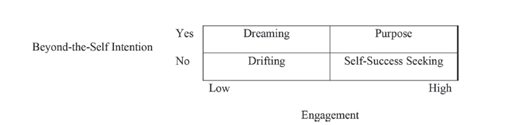
Two Dimensions of Purpose: Beyond-the-Self Intention and Engaged goal Commitment
Two Dimensions of Purpose: Beyond-the-Self Intention and Engaged goal Commitment
Although these categories represent greater and lesser purpose achievement, they do not appear to reflect a stage-by-age framework of purpose development. Qualitative research suggests that adolescents do not progress in a predictable pattern from lesser developed to more developed forms of purpose (Malin, Reilly, et al., 2014). Instead, the form of purpose participants in that study had at different times over the course of adolescence was dependent on the social context and developmental processes occurring at the time and do not necessarily indicate forward progress in purpose development. For example, among middle adolescents (14-to 16-year-olds), some went from purposeful at Time 1 to not purposeful or a precursory form of purpose two years later. While they appeared to “lose their purpose,” they were in fact making progress in their purpose development because they left behind their early commitment to childhood purpose goals to explore a variety of mature adult roles that they could pursue to act on their beyond-the-self aspirations. Though fully realized purpose does not appear to develop in a linear trajectory in adolescence, it may be that there are patterns to the development of the dimensions of purpose that can be observed in early adolescence.
Internal Capacity for Developing Purpose
Defining purpose as a beyond-the-self life goal suggests that purposeful people are aware of the perspective of others, have some well-developed other-oriented values, such as compassion, justice, or equality, and have a sense of social responsibility. It also suggests that they can identify themselves as the person who should do something about it, and the agency needed to commit to and act on goals based on these other-oriented values. These are not prerequisites for purpose, but rather they are internal assets that generally develop before purpose and can provide a foundation for developing purpose. Empathy, for example, as a form of emotional perspective taking, can motivate prosocial action and thereby set the stage for purpose to develop (Hardy & Carlo, 2005; Hoffman, 2000). Moral-social values such as compassion and justice, when central to an adolescent’s identity, can likewise spark purpose. One interview study found that adolescents who describe these moral values when asked to talk about what is most important to them were more likely than their peers to be purposeful (Malin, Ballard, & Damon, 2015).
However, people with purpose do not just have an other-oriented, compassionate, or empathetic nature. To become purposeful, these beyond-the-self values must be a driving force that compels goal setting, life planning, and action such that life goals and actions are consistent with those values. According to positive youth development theory, the level of goal commitment and engagement that is required of purpose comes when individuals have sufficiently developed the capacity for prioritizing, planning, and self-regulation needed to sustain interest in a long-term goal, and take effective action to pursue the goal. This theory proposes that intentional self-regulation—the capacity to select appropriate goals, optimize resources to pursue goals, and compensate when goals cannot be reached— emerges in adolescence and provides the foundation for setting and pursuing important life goals such as purpose goals (Gestsdottir, Urban, Bowers, Lerner, & Lerner, 2011). Though intentional self-regulation, like the foundation of empathy and moral values, is not a proven prerequisite for developing purpose, our dimensional model of purpose suggests that a well-developed capacity to successfully set, commit to, and act on higher order goals should be necessary for pursuing purpose.
Demographic Characteristics and Purpose. Little research has examined the effect of demographic factors on purpose development. Studies that investigate the relationship between purpose and demographic factors such as ethnicity, socioeconomic status, and gender generally find no strong relationships, suggesting that purpose is available to everyone regardless of an individual’s background (e.g., see Hill, Burrow, & Bronk, 2016, for gender comparisons among a sample that was 75% female and Liang et al., 2017, for race comparisons among a sample that was 84% White). However, a study of adulthood purpose found an interaction of race and educational attainment in predicting purpose, with African American participants (11% of the sample) showing more purpose in life with higher educational attainment, which was not true of other groups, suggesting that education may differently relate to purpose development for people of different races (Ryff, Keyes, & Hughes, 2003).
Though demographic factors have little bearing on the extent to which people develop purpose, there is some indication that negative life experiences can, for some people, act as a spark for purpose (Malin et al., 2015). This might be related to a process called posttraumatic growth, in which some people process adverse events in a way that promotes positive psychological outcomes (Tedeschi & Calhoun, 2004). The limited research on purpose outcomes of social status and negative life events suggests that purpose can be not only supported among diverse student populations, but also can be promoted as a source of resilience for students experiencing adversity.
Supporting Purpose Development
Practitioners seeking to support student purpose development have a small but growing body of research to draw upon that examines social supports for purpose and the potential for using interventions to promote purpose development (e.g., Bronk, 2012; Koshy & Mariano, 2011; Moran, Bundick, Malin, & Reilly, 2013). To date, this research does not use a uniform definition of purpose or consistent measure of purpose, but instead comprises exploratory methods using qualitative data and diverse self-report measures based on different definitions of purpose. Some of these studies look at factors that impact a person’s sense of purpose in life, whereas others look for factors that might promote more meaningful engagement in life, and yet others specifically measure the impact that social factors and interventions have on higher order goal setting and goal commitment.
Research on the social factors that support purpose suggests that family can be a particularly important source of support (Moran et al., 2013). At the most fundamental level, adolescents who report healthy attachment to their parents also score higher on the Life Engagement Test (Scheier et al., 2006), which asks respondents to rate the extent to which their life has purpose and activities have value (Hill, Burrow, & Sumner, 2016). In research interviews, adolescents described how parents and other significant family members support their pursuit of purpose goals by encouraging their interests and goals, providing emotional and material support for their goal pursuits, and modeling prosocial and altruistic behavior (Moran et al., 2013). Another interview study with adolescent girls found that family members and other significant adults inspired and catalyzed interests that had potential to develop into purpose and scaffolded adolescents in their pursuit of purpose goals (Liang et al., 2016). Even when life stressors were acting as a barrier to purpose pursuit, adolescents reported in interviews that the support of family and friends counteracted the impact of stress on their emerging purpose (Gutowski, White, Liang, Diamonti, & Berado, 2017).
Outside the home, supports for adolescent purpose are found in community-based organizations, church, and other group settings. These groups are often run by caring adults who provide much of the same encouragement and modeling that supports adolescent purpose development at home. Adults working with youth in community-based organizations can invite adolescents to participate in activities that align with their interests and can help them further their personal goals. As reported in interview studies with high school students, these interest-based invitations are likely an important support for youth purpose development (Liang et al., 2016; Malin et al., 2015). Organizations and other institutional contexts also nurture youth purpose by offering an integrated web of support. Church youth groups, for example, provide opportunities for young people to get involved in service activity, along with opportunities to reflect on their values in relation to their service, in a setting that provides social networking with peers and adults to further their goals and offer encouragement (Moran et al., 2013).
Interventions That Promote Purpose
Few purpose interventions have shown clear results demonstrating that such programs have an impact on purpose development. However, the research so far does offer some evidence that interventions aimed at increasing purpose can have positive impacts on the different dimensions of purpose. Bundick (2011) tested the impact of participating in a purpose interview—in which participants reflected aloud about their purpose goals—on adolescents’ life satisfaction (Satisfaction With Life Scale, Diener, Emmons, Larsen, & Griffin, 1985), goal directedness (as measured with a short version of the purpose in life subscale, Ryff, 1989), and sense that they have identified a life purpose (Meaning in Life Scale, Steger, Frazier, Oishi, & Kaler, 2006). Students who participated in the interview showed significantly higher life satisfaction and goal directedness 8 months later, compared to students who did not participate in the interview, but there was no significant difference in sense of purpose scores between the two groups. A preliminary study of an intervention that used a modular approach to develop different aspects of purpose, including identity, self-efficacy, values, and community interdependence showed no significant impact on purpose, as measured with a self-report questionnaire (Dik, Steger, Gibson, & Peisner, 2011). However, significant increases were seen in students’ understanding of their interests, strengths, and weaknesses, and in their sense of being prepared for the future. A third intervention, which engaged high school students in bimonthly, small-group discussions about their plans for the future and how to act on them, did show significant differences in purpose scores for the intervention group compared to a control group. The intervention group had significantly higher change scores on the revised Purpose in Life Test (Crumbaugh & Maholick, 1969), and a measure of internal control of academic achievement following the intervention, compared to the control group (Pizzolato, Brown, & Kanny, 2011).
How Schools Might Support Purpose Development
The evidence described above suggests that significant adults and opportunity contexts are important for supporting youth purpose development, but little is known about the specific role that the school context plays in supporting students to develop purpose. Research on socioemotional learning more broadly conceived has found that establishing a caring school environment, in which students feel valued, is one avenue to supporting socioemotional development (Durlak, Weissberg, Dymnicki, Taylor, & Schellinger, 2011). Another avenue for school-based social emotional learning is through direct instruction programs that provide for, among other things, adult modeling of socioemotional skills and opportunities to practice using those skills (Durlak et al., 2011). Because purpose develops out of other-oriented emotions, social responsibility, and self-awareness, it is likely that the same school factors that promote social emotional learning will also support purpose development.
Taken together, the research on social and environmental supports for purpose, findings about social emotional development at school, and the limited existing research on purpose interventions, suggest that students can find support for purpose at school. There are four overarching types of support implied by previous research results. First, the findings about family encouragement and the role that significant adults in general play in supporting purpose indicates that students might gain support for purpose from teachers who express interest in and encourage their personal interests and goals (Hill et al., 2016; Liang et al., 2016; Moran et al., 2013). Second, the specific findings about the impact that purpose role models have on youth purpose development suggest that having adult purpose role models at school could support students in setting beyond-the-self oriented goals. Third, findings from the intervention studies and social emotional learning research suggest that there might be some benefit for purpose development in providing curricular opportunities to reflect on goals, values, and purpose (Bundick, 2011; Dik et al., 2011; Durlak et al., 2011; Pizzolato et al., 2011). Finally, the research suggesting that adolescents need more opportunities to act on their beyond-the-self goals indicates that student purpose might benefit from extracurricular activities that allow them to engage in potentially purposeful pursuits (Durlak et al., 2011; Moran et al., 2013).
Beyond the overall potential impact of the school context on purpose development, the research on the social supports for purpose, combined with the understanding of purpose as comprising a cluster of internal dimensions, suggest that the distinct dimensions of purpose may be supported differentially by different aspects of the school context. That is, the studies showing that purpose interventions predict goal commitment but not sense of purpose (Bundick, 2011), and understanding of interests but not purpose (Dik et al., 2011), along with the finding that young adolescents develop empathy and beyond-the-self goal setting before they have capacity to act on those feelings and goals (Malin et al., 2014), suggest that the dimensions of purpose develop independently and may be nurtured at different stages by different types of support.
The Present Study
We conducted a longitudinal study with young adolescents to better understand how purpose develops and the role that school can play in supporting student purpose development in its early stages. The current analysis was part of a larger study of character development in early adolescence, in which middle school students from different regions of the United States completed a self-report survey at 6-month intervals for 2 years. The survey included a new instrument for assessing purpose, which asked respondents to identify their most important life goals by selecting from a list that included both beyond-the-self and self-oriented goals and indicate their level of engaged commitment to their most important goals. This survey instrument was two-dimensional, capturing the beyond-the-self intention dimension of purpose by counting how many beyond-the-self life goals the respondent selected, and the engaged commitment dimension as a continuous indicator of level of commitment to the goals they selected. In the following study, we analyze beyond-the-self life goal selection as an independent dimension of purpose, and then analyze level of commitment to beyond-the-self life goals. According to the purpose construct defined in this article, this integrated variable indicates level of purpose commitment, because a high level of commitment to higher order, beyond-the-self goals suggests that an individual has purpose.
Prior qualitative research showed that individuals in this age group can have some or all dimensions of purpose at one time point, and then not have them later, or gain dimensions of purpose over the course of adolescence (Malin, Reilly, et al., 2014). Based on those findings, we expected that young adolescents would not show consistent age-related purpose development over 6-month intervals. However, the same study showed that the number of people with purpose does increase from early to middle adolescence; therefore, we sought to understand more about developmental patterns at this age in the dimensions of purpose. We did so in this study by posing the questions: Is there an overall increase in young people selecting beyond-the-self life goals over time in early adolescence? And, is there an overall increase in the level of beyond-the-self life goal commitment over time in early adolescence?
Additionally, respondents indicated the extent to which they perceived different aspects of the school environment supported their most important goals. We ask students to report the supports as they experienced them, rather than collecting data on actual supports in the school context because students are not necessarily aware of or taking advantage of resources available in the school context to support them in their goal pursuits. By asking students which resources they find in the school environment, we learn about the impact of supports that students are aware of and have access to. Based on the prior research on purpose supports discussed above, we hypothesized that these aspects of the school environment would support student purpose: (1) school assignments that relate to important life goals; (2) teacher interest in important life goals; (3) extracurricular opportunities to act on important life goals; and (4) adult role models for important life goals. We further hypothesized that different elements of the school context would differentially support the two dimensions of purpose. Specifically, we hypothesized that purpose commitment would be higher in students who perceived more opportunities at school to act on their goals, such as through classroom assignments or extracurricular activities, whereas students’ selection of beyond-the-self life goals would more likely be influenced by adults at school who showed interest in, or acted as role models for, their most important goals. The relationship between purpose and these variables was tested in both cross-sectional and longitudinal analyses, to gain a complete understanding of how the school environment affects purpose both at a single stage of development and over time.
Method
Participants
Participants were selected for ethnic and socioeconomic diversity from eight public district and charter middle schools in different regions of the United States (80.4% Pennsylvania, 6.0% California, 2.6% Idaho, 11.0% Texas). For this study, we examined survey data collected from participants during the spring of their eighth-grade year (Time 1; n = 1,304; 49.8% female, 47.2% African American, 24.2% Caucasian, 16.0% Hispanic, 11.3% Asian American, 0.8% multiracial/ other; 65.5% free/reduced lunch), fall of their ninth-grade year (Time 2; n = 1,009) and spring of their ninth-grade year (Time 3; n = 960). Demographic characteristics did not vary significantly over the course of the study. At each school, all eighth graders were invited to participate in the survey. Students’ parents were given the opportunity to opt their child out of participation and over 90% of invited students completed the survey at Time 1.
One of the selection criteria for middle schools participating in this study was that they had to feed into a single high school. That is, the students at a middle school site had to be expected to continue at a single high school, rather than dispersing to different high schools. The ninth-grade surveys were administered at the high school sites, ensuring that longitudinal participants would have a consistent school background. Table 1 shows the demographic information for students at each school.
Demographic Characteristics of Each School Site
| School | Type | Location | N | % African American | % FRL | % Female |
|---|---|---|---|---|---|---|
| School 1 | Public | Pennsylvania | 398 | 26 | 39 | 47 |
| School 2 | Public | Pennsylvania | 430 | 64 | 75 | 52 |
| School 3 | Charter | Texas | 143 | 10 | 96 | 53 |
| School 4 | Charter | Pennsylvania | 102 | 99 | 86 | 55 |
| School 5 | Charter | Pennsylvania | 119 | 96 | 82 | 44 |
| School 6 | Charter | Idaho | 34 | 3 | 0 | 65 |
| School 7 | Charter | California | 78 | 4 | 69 | 44 |
Data Collection Measures and Procedures
The survey included items to examine the two dimensions of student purpose (beyond-the-self life goal selection and beyond-the-self life goal commitment), and four aspects of school supports for purpose goals (school assignments, teacher interest, extracurricular activities, and adult role models). In addition, we collected demographic data (gender, race/ethnicity, and socioeconomic status) and school data (school attended and grade point average). Participants took the surveys in computer labs at their schools during class time and took on average 25–35 minutes to complete the surveys. They read an assent form prior to agreeing to complete the survey. The survey began with an explanation that we were interested in learning about their interests, habits, and beliefs, and that they would be asked to complete the survey four times in two years.
Purpose Dimensions. We developed a new, two-dimensional instrument to measure adolescent purpose based on prior interview-based research (Damon, 2008; Malin, Reilly, et al., 2014; Moran, 2009). This instrument, the Stanford Assessment of Purpose for Youth (Malin, Damon, & Colby, 2014), first showed respondents a list of 10 life goals—five that are self-oriented (e.g., be athletic or physically strong, have a high-paying career) and five that are beyond-the-self oriented (e.g. improve the lives of others, provide support for my family)—asking respondents to select up to three that best represent their most important life goals. Appendix A shows the full list of goals indicating which were used to indicate beyond-the-self life goals. If respondents selected one or more beyond-the-self goals, they completed a 6-item scale to measure their internal investment (e.g., “I feel that it is my mission in life to [goal]”) and active engagement (e.g., “In my free time, I am usually doing something to [goal]”) in pursuing each beyond-the-self goal, which we broadly assessed as beyond-the-self goal commitment. Goal commitment items were on a 5-point scale (strongly disagree to strongly agree) and the commitment scales were reliable for each of the five beyond-the-self goals (α = 0.71− 0.79). For this study, we only had respondents who selected one or more of the beyond-the-self goals complete the goal commitment scale so that we could focus our analysis on these two dimensions of purpose: (1) presence of a beyond-the-self goal and (2) level of beyond-the-self goal commitment.
Because respondents completed the commitment scale for every beyond-the-self goal they selected, some might have more than one beyond-the-self goal commitment score. In cases where the respondent selected more than one beyond-the-self goal, their score is the highest scale mean they obtained out of all the beyond-the-self goals they selected. Because participants only completed the scale for the beyond-the-self goals they selected, it is possible that some might have remembered which goals the researchers were most interested in. However, we found that the percentage of participants selecting at least one beyond-the-self goal did not vary across time points (approximately 40% at each time point), suggesting that respondents were not biased in subsequent surveys by completing the scale only for certain goals.
School Supports. School support was assessed with a 4-item scale that measures students’ perceptions of support for their most important life goals at their current school. This was used both as a composite scale to indicate overall sense of support from the school environment (α = 0.72−0.74), as well as four single-item measures. Each item addressed a different aspect of school support: assignments (“School assignments help me learn about one or more of my top ranked goals”), teacher interest (“At least one teacher is interested in one or more of my top ranked goals”), extracurricular activities (“My school offers clubs and other activities that help me pursue one or more of my top ranked goals”), and role models (“At least one adult in my school is a role model for one or more of my top ranked goals”). Each item had a 5-point response scale from strongly disagree to strongly agree. The school support items were adapted from the Stanford Youth Purpose Survey (Bundick et al., 2006).
Analytic Strategy
We used mixed-effects regression models to examine whether change in either of the dimensions of purpose was significantly predicted by students’ perception of receiving the four school supports for their important life goals. The mixed model regression analyses allowed us to account for between- and within-individual variations in the longitudinal data (Gueorguieva & Krystal, 2011). We tested our hypotheses by building mixed models for each of the two dependent variables—beyond-the-self life goal selection and beyond-the-self goal commitment. For each dependent variable, Model 1 estimates change in the dependent variable over time with random slopes and intercepts at the individual level, indicating the change in the dimensions of purpose absent predictor variables. By including the random slope and intercepts at the individual level, and the covariance between them, we can account for variance within the same individual. Model 2 builds on Model 1 by including the middle school attended as a fixed effect to examine if there were between-school variations in students’ beyond-the-self life goal selection and beyond-the-self life goal commitment. Model 2 also adds students’ overall perception of school support for their important life goals (the school supports composite variable), and controls for students’ demographic characteristics. In Model 3, we added an interaction effect between school support at Time 1 and time to examine whether school support at Time 1 was a significant predictor of change in beyond-the-self life goal selection or beyond-the-self life goal commitment over time. We centered all continuous variables around their mean to facilitate interpretations of results. All models were compared for best fit using AIC and BIC values.
Separately, we built models to test the effect of each individual school support variable on both dimensions of purpose. The same model building strategy used for Models 1 and 2 was applied to these models. We did not test the interaction with time for these models, because the interaction with time in Model 3 was not significant for both dependent variables.
Results
Descriptive Statistics
The means and standard deviations of the dependent and independent variables at each time point are presented in Table 2. Table 3 shows the Spearman’s rho correlations between all variables at Time 1. The significant positive correlations between the two purpose dimensions and the school support measures (both composite and individual items) provided preliminary support for our hypotheses that school support could be significant predictors of purpose.
Descriptive Statistics of Dependent and Independent Variables at Times 1, 2, and 3
| Variables | Time 1 | Time 2 | Time 3 | ||||
|---|---|---|---|---|---|---|---|
| Mean (SD) | N | Mean (SD) | N | Mean | N | Range | |
| Number of beyond-the-self goals selected | 1.27 (.81) | 1,358 | 1.29 (.79) | 1,240 | 1.29 (.78) | 1,201 | 1–3 |
| Beyond-the-self goal commitment | 3.42 (1.52) | 1,303 | 3.41 (1.51) | 1,223 | 3.45 (1.46) | 1,184 | 0–5 |
| School support composite | 3.42 (.91) | 1,337 | 3.46 (.86) | 1,220 | 3.40 (.85) | 1,193 | 1–5 |
| School assignments | 3.33 (1.21) | 1,337 | 3.31 (1.14) | 1,219 | 3.22 (1.13) | 1,193 | 1–5 |
| Teacher interest | 3.47 (1.17) | 1,337 | 3.34 (1.12) | 1,219 | 3.35 (1.14) | 1,193 | 1–5 |
| Extracurricular | 3.42 (1.25) | 1,337 | 3.83 (1.13) | 1,220 | 3.66 (1.12) | 1,193 | 1–5 |
| Adult role model | 3.48 (1.25) | 1,337 | 3.35 (1.24) | 1,218 | 3.38 (1.20) | 1,191 | 1–5 |
Spearman’s Rho Correlations of Time 1 Variables
| Variables | 1 | 2 | 3 | 4 | 5 | 6 | 7 |
|---|---|---|---|---|---|---|---|
| 1. Number of beyond-the-self goals | — | ||||||
| 2. Beyond-the-self goal commitment | .65** | — | |||||
| 3. School supports composite | .11** | .25** | — | ||||
| 4. Assignments | .12** | .25** | .72** | — | |||
| 5. Teacher interest | .08** | .18** | .72** | .37** | — | ||
| 6. Extracurricular | .01 | .13** | .72** | .40** | .38** | — | |
| 7. Adult role model | .13** | .19** | .74** | .39** | .46** | .35** | — |
| Female | .08** | –.02 | –.10** | –.10** | –.06* | –.13** | –.02 |
| Caucasian | –.09** | –.16** | –.08** | –.15** | –.01 | –.06* | .01 |
| Hispanic | .00 | .03 | .00 | .01 | –.04 | .02 | –.02 |
| Asian | .01 | –.06* | –.02 | .04 | –.03 | –.05 | –.04 |
| African American | .07* | .16** | .08** | .10** | .05 | .08** | .03 |
| Multiracial/Other | –.01 | .00 | –.01 | –.01 | .02 | –.02 | –.01 |
| Free/reduced lunch | .06* | .14** | .10** | .19** | .02 | .07* | .08** |
| GPA | .18** | .05 | .06* | .05 | .03 | .01 | .06* |
Change in Purpose Dimensions Over Time
The mixed model analyses showed that there was no significant effect of time on selection of beyond-the-self life goals or commitment to beyond-the-self goals. Tables 3 and 4 show the results of the change over time analyses. As the tables show, the effect of time was nonsignificant in all three models for both dependent variables.
Mixed Model Analysis Predicting Number of Beyond-the-Self Goals Selected From School Support (Composite Variable) and Over Time
| Variables | Model 1 | Model 2 | Model 3 | |||
|---|---|---|---|---|---|---|
| Coeff. | SE | Coeff. | SE | Coeff. | SE | |
| Fixed effects | ||||||
| Time (ref: T1) | ||||||
| T2 | .02 | .02 | .00 | .02 | .00 | .02 |
| T3 | .01 | .02 | −.004 | .03 | −.01 | .03 |
| Female | .05 | .04 | .053 | .04 | ||
| Ethnicity (ref: African American) | ||||||
| Caucasian | −.26*** | .06 | −.26*** | .06 | ||
| Hispanic | −.22** | .08 | −.22** | .08 | ||
| Asian | −.21** | .06 | −.21** | .06 | ||
| Multiracial/other | −.14 | .17 | −.13 | .17 | ||
| Free/reduced lunch | −.03 | .04 | −.03 | .04 | ||
| Grade point average | .07*** | .02 | .07*** | .02 | ||
| Middle School (ref: School 1) | ||||||
| School 2 | .07 | .05 | .06 | .05 | ||
| School 3 | .20* | .09 | .19* | .09 | ||
| School 4 | −.13 | .08 | −.13 | .08 | ||
| School 5 | −.07 | .08 | −.07 | .08 | ||
| School 6 | −.31* | .12 | −.31* | .12 | ||
| School 7 | .03 | .10 | .03 | .10 | ||
| School Support | .04** | .02 | .03 | .02 | ||
| School Support T1* Time | .02 | .01 | ||||
| Est. | SE | Est. | SE | Est. | SE | |
| Random Effects | ||||||
| Variance (slope) | .03 | .01 | .03 | .01 | .026 | .019 |
| Variance (intercept) | .67 | .11 | .58 | .11 | .57 | .11 |
| Covariance (intercept−slope) | −.10 | .03 | −.09 | .03 | −.086 | .032 |
| Variance (residual) | .28 | .01 | .28 | .01 | .280 | .013 |
| Model characteristics | ||||||
| AIC | 8,279.12 | 7,326.03 | 7,325.78 | |||
| BIC | 8,322.82 | 7,454.90 | 7,460.78 | |||
| Log likelihood | −4,132.56 | −3,642.02 | −3,640.89 | |||
p < .05.
p < .01.
p > .001. N of observations = 4,968
Beyond-The-Self Life Goals Selected and School Supports
In the mixed-effects regression analyses predicting selection of beyond-the-self life goals, Models 2 and 3 fit the data better than Model 1, indicating that school attended was an important factor in the number of beyond-the-self goals selected. There were significant differences in the number of beyond-the-self life goals selected by students attending different schools. School support was not a significant predictor of the number of beyond-the-self life goals selected (B = .03, SE = .02, p > .05), nor was the interaction of school support at Time 1 with time (B = .02, SE = .01, p > .05). The number of beyond-the-self life goals selected did not differ significantly over time. Ethnicity was a significant predictor of beyond-the-self goal selection, where Caucasian, Hispanic, and Asian students reported significantly lower beyond-the-self goal scores than African American students. Grade point average (GPA) was also a significant predictor of beyond-the-self goal selection (B = .07, SE = .02, p < .001), however, the effect size for this relationship was small. The negative covariance between the random slope and random intercept indicates that students who started with a relatively low number of beyond-the-self life goals tend to increase the number of beyond-the-self goals they selected faster over time than students who started with a relatively high number of beyond-the-self goal (Estimate = −.09, SE = .032, 95% CI −.14 to −.02). See Table 4 for full results.
The model was run again using the school supports items as individual variables instead of the composite school supports variable. Two of the individual school support items were significant, however the coefficients for both were below .10, indicating no practical significance (School Assignments B = .03, SE = .02, p < .05; Adult Role Model B = .02, SE = .01, p<.05). Table 5 shows the results of this analysis.
Beyond-The-Self Life Goal Commitment and School Supports
The mixed-effects regression analyses of beyond-the-self life goal commitment included only those respondents who selected a beyond-the-self goal in at least one time point. Those who selected a beyond-the-self goal at one time but not at all time points were scored ‘0’ during the time points in which they did not select a beyond-the-self goal. Those who never selected a beyond-the-self goal were omitted from the longitudinal analysis, so that this analysis would only measure beyond-the-self goal commitment and not beyond-the-self goal selection. In the analysis of the composite school supports variable predicting beyond-the-self life goal commitment, Models 2 and 3 fit the data better than Model 1, indicating that schools were important factors in predicting beyond-the-self life goal commitment. There were significant differences in beyond-the-self goal commitment by school attended. The main effect of school support was a significant predictor (B = .14, SE = .04, p<. 001), indicating that sense of school support for important goals is correlated with beyond-the-self goal commitment (purpose) at any given time point. The interaction effect of school support at Time 1 with time was not significant B = .01, SE = .03, p > .05), indicating that students’ perception of school support for their important goals at Time 1 did not have a lingering effect on their beyond-the-self goal commitment at later time points. Ethnicity was a significant predictor of beyond-the-self goal commitment, with Caucasian and Asian students reporting significantly lower scores than African American students. GPA was a significant positive predictor (B = .10, SE = .03, p <.001). The negative covariance between the random slope and random intercept showed that students who started with a relatively low beyond-the-self commitment score tend to increase their beyond-the-self goal commitment faster than the students who started with a relatively higher beyond-the-self commitment. beyond-the-self life goal commitment did not differ significantly across the time points (Estimate = −.31, SE =. 14, 95% CI −.60 to −.03). See Table 5 for full result.
Mixed Model Analysis Predicting Beyond-the-Self Goal Commitment From School Support (Composite Variable) and Over Time
| Model 1 | Model 2 | Model 3 | ||||
|---|---|---|---|---|---|---|
| Coeff. | SE | Coeff. | SE | Coeff. | SE | |
| Fixed effects | ||||||
| Time (ref: Time 1) | ||||||
| Time 2 | −.01 | .05 | .00 | .05 | .00 | .05 |
| Time 3 | .01 | .05 | .01 | .05 | .01 | .05 |
| Female | −.04 | .06 | −.04 | .06 | ||
| Ethnicity (ref: African American) | ||||||
| Caucasian | −.43*** | .10 | −.43*** | .10 | ||
| Hispanic | −.23 | .14 | −.23 | .14 | ||
| Asian | −.48*** | .11 | −.48*** | .11 | ||
| Multiracial/other | .09 | .29 | .09 | .29 | ||
| Free/reduced lunch | −.02 | .08 | −.02 | .08 | ||
| GPA | .10*** | .03 | .10*** | .03 | ||
| Middle School (ref: School 1) | ||||||
| School 2 | .15 | .09 | .14 | .09 | ||
| School 3 | .53*** | .17 | .53 | .17 | ||
| School 4 | −.02 | .15 | −.02 | .15 | ||
| School 5 | .21 | .14 | .21 | .14 | ||
| School 6 | −.63** | .22 | −.63 | .22 | ||
| School 7 | .12 | .18 | .12 | .18 | ||
| School Support | .15*** | .03 | .14*** | .04 | ||
| School Support Time 1* Time | .01 | .03 | ||||
| Random-effects | Est. | SE | Est. | SE | Est. | SE |
| Variance (slope) | .06 | .02 | .09 | .05 | .09 | .05 |
| Variance (intercept) | 1.2 | .15 | 1.8 | .47 | 1.8 | .47 |
| Covariance (intercept-slope) | −.15 | .05 | −.32 | .14 | −.31 | .14 |
| Variance (residual) | 1.35 | .04 | 1.3 | .06 | 1.23 | .06 |
| Model characteristics | ||||||
| AIC | 17,499.39 | 11,694.77 | 11,696.64 | |||
| BIC | 117,551.47 | 11,823.21 | 11,831.2 | |||
| Log likelihood | −8,741.69 | −5,826.38 | −5,826.32 | |||
p < .05.
p < .01.
p > .001. N of observations = 3,348.
The model was run again using the school supports items as individual variables instead of the composite school supports variable. Two support items were significant, however only “school assignments help me learn about one or more of my top ranked goals” was significant and had an effect size over .10 (B =.11, SE = .02, p < .001). Table 6 shows the results of this analysis.
Discussion
This study sought to examine some aspects of purpose development among young adolescents, focusing on the role that the school context can play in supporting early purpose development. We know from qualitative research that there is a lot of individual variation in purpose at this stage of development (Malin et al., 2014). Young adolescent purpose does not necessarily grow on a clear positive or forward trajectory over time; rather, the potential for purpose emerges with development of moral emotions and reasoning, future-mindedness, and capacity to act on higher order goals, and depends on the external circumstances that support and hinder each of these aspects of purpose. The authors of that study found that individual young adolescents can go forward and back in these dimensions of purpose, showing full purpose at one time point but not two years later, or vice versa. Therefore, we conducted this study to see what the overall pattern of purpose development looks like at this age when considered as made up of distinct but integrated dimensions. Among our sample of eighth graders, we found no significant changes over the course of a year in both the selection of beyond-the-self life goals and level of commitment to beyond-the-self life goals, suggesting that there is no overall forward purpose development at this age. In terms of interindividual change over time, the negative covariance between the random slopes and intercepts for both purpose dimensions suggested varying degrees of change. Students who initially reported lower scores in the two purpose dimensions increased in both of these dimensions showing larger degrees of change over time than those who started with higher scores.
Prior qualitative research also provided some hypotheses about what adults can do to support adolescents in developing purpose. Significant adults are clearly important for supporting purpose, especially parents and other family members. However, educators want to know what role they can play in helping their students create a purposeful life. Moreover, when students sense that their teachers and the school context are responsive to what matters to them, they are more likely to be engaged and motivated at school (Osterman, 2000). This study sought to contribute to our understanding of how schools and teachers can best support student purpose development in early adolescence. We examined the role that school-based supports might play in students’ purpose by first testing the relationship between students’ overall perception of support for their important goals at school (the composite school support variable) and the two dimensions of purpose—beyond-the-self life goal selection and beyond-the-self life goal commitment. The results provide evidence that, among students who selected beyond-the-self life goals, those who perceived an overall context of support for their important goals reported greater commitment to acting on their beyond-the-self life goals. However, there appears to be no association between perceived school supports and the number of beyond-the-self life goals selected. These findings indicate that perceived supports in the current school environment are more relevant to how students engage in pursuing their most important goals than whether they come to be beyond-the-self oriented in thinking about their life goals.
Mixed Model Analyses Predicting Beyond-the-Self Goal Selection and Beyond-the-Self Goal Commitment from Individual School Support Items
| Beyond-the-Self Goal Selection | Beyond-the-Self Goal Commitment | |||
|---|---|---|---|---|
| Coeff. | SE | Coeff. | SE | |
| Fixed effects | ||||
| Time (ref: Time 1) | ||||
| Time 2 | .004 | .02 | .01 | .05 |
| Time 3 | −.001 | .03 | .02 | .05 |
| Female | .05 | .04 | −.05 | .06 |
| Ethnicity (ref: African American) | ||||
| Caucasian | −.26*** | .06 | −.41*** | .10 |
| Hispanic | −.22** | .08 | −.24 | .14 |
| Asian | −.22** | .06 | −.49*** | .11 |
| Multiracial/other | −.13 | .17 | .10 | .29 |
| Free/reduced lunch | −.03 | .04 | −.02 | .07 |
| GPA | .07*** | .02 | .10** | .03 |
| Middle School (ref: School 1) | ||||
| School 2 | .06 | .05 | .14 | .09 |
| School 3 | .20* | .09 | .52** | .17 |
| School 4 | −.13 | .08 | −.01 | .15 |
| School 5 | −.07 | .08 | .20 | .14 |
| School 6 | −.30* | .12 | −.62** | .22 |
| School 7 | .03 | .10 | .12 | .18 |
| School Support | ||||
| School assignments | .03* | .02 | .11*** | .02 |
| Teacher interest | −.02 | .01 | −.01 | .03 |
| Extracurricular | .00 | .01 | .01 | .02 |
| Adult role model | .02* | .01 | .05* | .02 |
| Random−effects | Est. | SE | Est. | SE |
| Variance (slope) | .03 | .01 | .08 | .05 |
| Variance (intercept) | .57 | .11 | 1.75 | .47 |
| Covariance (intercept-slope) | −.09 | .03 | −.29 | .14 |
| Variance (residual) | .28 | .01 | 1.28 | .06 |
p < .05.
p < .01.
p > .001.
That said, we did find that the school attended was associated with both beyond-theself life goal selection and commitment, so it is likely that factors in the school environment other than those we asked about had an even stronger effect on how students think about the content of their life goals. Students at School 6 were significantly less likely than the reference school to select beyond-the-self goals and showed less commitment to acting on beyond-the-self goals, whereas students at School 3 were significantly more likely to select beyond-the-self goals and be committed to acting on those goals. This might be an artifact of the demographic features of School 6 and School 3; however, it also indicates a need to further examine the role of school context in supporting and inhibiting purpose.
Overall, ethnicity appears to be correlated with purpose in early adolescence, with African American youth being more likely than others to report both beyond-the-self life goals and commitment to pursuing those goals. Given the lack of consistent findings from previous research on ethnicity and purpose, and the complex relationship between purpose, race, and educational attainment found by Ryff et al. (2003), we expect that this finding would require further investigation of interactions to interpret. In particular, prior research and theory about the interaction of contextual factors with constructs related to purpose suggest that we need deeper investigation of purpose as an outcome of individuals’ diverse experiences in society. For example, research on Mexican American youth suggests that prosocial behavior is shaped by culturally informed family values and socialization practices (Knight & Carlo, 2012) and theory about racial identity formation suggests that racial and cultural socialization promotes positive development among African American youth (Swanson et al., 2002). Although there may be theoretical reasons to believe that the higher level of purpose among young African American adolescents is related to their experiences at school, specifically that negative experiences at school or low expectations of them by their teachers might encourage them to seek meaning outside of school, in beyond-the-self domains such as family, community, church, and society (Swanson et al., 2002), our findings suggest that unknown factors in the school environment contribute to differences in purpose development regardless of race.
The interaction between school supports and time was not significant, indicating that the effect of perceived supports on beyond-the-self life goal commitment at each time point did not carry over to future time points. There are a few possible explanations for this finding. First, survey participants transitioned from middle school to high school during the study, so the support environment, as well as the general relationship between beyond-the-self goals and school might have shifted for most students. Another explanation, as will be discussed more below, is that perceived supports in the school environment are not causing commitment to beyond-the-self goals, and therefore the relationship between school supports for goals and beyond-the-self goal commitment only exists concurrently.
Next, we sought to find out whether any specific aspect of perceived school support is more associated with purpose than others by regressing the school support items as individual variables on both of the dimensions of purpose. As expected, based on the finding that perceived school supports overall were not associated with beyond-the-self life goal selection, neither were any of the individual school support items. However, for beyond-the-self life goal commitment, we found that the most significant single source of school-based support was school assignments. Specifically, students with higher levels of commitment to beyond-the-self life goals were more likely to agree that school assignments helped them learn about their life goals. It is possible that students who are most committed to beyond-the-self goals are in classes that provide assignments that connect with their life goals, but further research would be needed to examine this interpretation. Based on prior research, it is also possible that students who are strongly committed to beyond-the-self life goals are better able to find support for their goals in required school work. Previous research indicated that purposeful adolescents can be proactive about identifying and even creating resources for pursuing their purpose (Moran et al., 2013). Another study found that students with beyond-the-self career goals found their school work more engaging and meaningful than those without beyond-the-self career goals (Yeager & Bundick, 2009). Therefore, it might be that the students in this study who were committed to beyond-the-self life goals were also more likely to seek or make connections between required school assignments and their most important goals. If this is the case, it supports research showing that teachers can increase both students’ purpose and their engagement in school work by helping students identify beyond-the-self purposes for their school assignments (Yeager et al., 2014).
Notably, perceiving extracurricular opportunities to act on life goals at school was not significantly associated with beyond-the-self life goal commitment. In a previous study, purposeful eighth and ninth graders tended to describe acting on their beyond-the-self goals through organized and independent activities outside of school, such as at their local Boys & Girls Club, through social media, or by creating things at home (Malin, Liauw, & Damon, 2017). It may be that school-based extracurricular activities are not well-aligned with the beyond-the-self interests of adolescents, and therefore they find opportunities to act on them outside of school. Another study found that students are likely to act on beyond-the-self interests when they are invited to do so (Malin et al., 2015). It might be that young adolescents do not find that invitation at school, or do not feel school is a place for them to pursue their meaningful life goals. Schools seeking to support student purpose might consider engaging student voice in developing extracurricular offerings, specifically to learn from students about their beyond-the-self values, interests, and goals. A similar phenomenon might explain why there was no association between students’ beyond-the-self goal commitment and feeling that teachers are interested in their most important goals. If students do not feel that their voice is heard at school, or do not feel invited to bring their purpose to school, they may not feel that teachers are interested in the goals that matter most to them, regardless of whether they are actively pursuing purposeful goals outside of school.
Limitations
This study investigated two dimensions that, when integrated, are theorized to give people purpose in life. Although there is general consensus that purpose is a multidimensional construct, the existing literature varies on which dimensions or aspects are integral to purpose and how they are defined. Therefore, this study proposes an approach for investigating purpose development as the development and integration of multiple dimensions, and the analysis presented here is a first step in using this approach to understand how purpose develops and under what conditions, more so than a conclusive study. The new survey instrument used to measure purpose in this study was designed for flexible assessment of purpose dimensions separately as well as integrated, allowing for different variable-centered and person-centered approaches to analyzing the data and addressing research questions. Although the approach used here was a simple measure of commitment to beyond-the-self life goals, future studies could use the instrument in different ways to identify person-centered profiles of purpose and gain different insights about purpose development.
The school support analysis items tested in this analysis were not measured in the school context but were reported by student respondents. By measuring school supports this way, we gain understanding of how students perceive and potentially make use of school supports, which is one aspect of the role that the school context plays in student development. However, this analysis cannot inform us about the actual supports available to students in the school environment. The analysis of school supports provides a starting point for understanding the relationship between the school context and purpose. It remains unclear, however, whether the association is causal, with aspects of the school context (specifically, school assignments) supporting some students to develop commitment to their beyond-the-self life goals, or the relationship is more bidirectional, with purposeful students identifying resources in the school environment and using them to support their developing purpose.
Conclusion
This study assessed purpose in young adolescents over a year-and-a-half period and found no overall pattern of purpose development during this time. This finding was expected, based on prior research that showed young adolescents are less likely to have purpose than older adolescents and adults, and also less likely to sustain purpose over time if they do show purpose at a young age. Although no developmental patterns were found, this study introduces the potential of investigating purpose development in the earliest stages by identifying and assessing dimensions that precede purpose, developmentally. In particular, we argue that purpose results when young people develop and integrate higher order goal setting, beyond-the-self orientation, and ability to commit to and act on higher order, beyond-the-self goals.
Building on a small but growing body of research that examines the role that the social context plays in developing purpose, this study found that school is associated with purpose development, though the relationship needs further research. The control variable of school site was significant, indicating that some schools might be better than others at supporting purpose. Rather than providing clear evidence that certain aspects of the school context support purpose, the results of this study give additional weight to previous research suggesting that young people with purpose are proactive about identifying and utilizing purpose supports in the world around them, and they are more inclined than others to make connections between school work and their most important and meaningful goals. The lack of relationship between the dimensions of purpose and other aspects of the school context, in particular extracurricular activities and teacher interest, suggests that although purposeful students make connections between their required school activities and their purpose, they do not think of school as a place to share and develop their purpose, but instead seek support in other settings. Another finding in this study indicated that the relationship between school supports and dimensions of purpose only exists concurrently, and school supports at one time point do not predict or support purpose growth after that time. Taken together, the results of this study indicate that schools that want to support students to develop purpose may need to provide intentional and sustained support for both beyond-the-self oriented, higher order goal setting and beyond-the-self goal commitment. In particular, finding ways to support the beyond-the-self dimension of purpose for young adolescents may be an area of growth for schools aspiring to support purpose development.
References
Appendix A
Following are the 10 goals listed in the Stanford Assessment of Purpose for Youth, indicating which were considered “beyond-the-self oriented” (BTS):
be physically strong or athletic;
improve the lives of others (BTS);
live an adventurous life;
serve God or a higher power (BTS);
provide support for my family (BTS);
create, invent, or discover things that will make a difference in the world (BTS);
live a life full of fun;
have a high paying career;
contribute to solving a problem in the environment or society (BTS); and
have good friends.

