


The mission of the U.S. Military Academy (USMA), commonly known as West Point, is “to educate, train, and inspire the Corps of Cadets so that each graduate is a commissioned leader of character committed to the values of Duty, Honor, Country and prepared for a career of professional excellence and service to the Nation as an officer in the United States Army.” As the mission statement clearly articulates, character is a core competency needed to be an effective Army officer. Based on the practical experiences of armies throughout history and around the world, positive character is necessary to both serving as a soldier and leading soldiers in combat. The idea that character development is crucial in officer training and development is not a recent one. West Point and other military academies have long adhered to an honor code of “a cadet will not lie, cheat, steal, nor tolerate those who do.” But the lessons of a protracted period of war and conflict, beginning with the events of September 11, 2001, have underscored the importance of character in the military domain.
In 2013, Lt. Gen. Robert L. Caslen, was appointed the 59th superintendent of West Point. Prior to this appointment, Caslen had served in a variety of leadership positions in the Army, including combat tours in the Gulf War, two tours in Afghanistan, and as commander of the 25th Infantry Division in Iraq. It was during his command of the 25th Infantry Division that the primacy of character in officership became evident to him. In his own words,
I always knew character was a central part of leadership, but I saw it up close and personal when I was a division commander in Iraq during the surge in northern Iraq. I had 22,000 soldiers and, as a division commander, I was responsible for dealing with the misconduct of any senior noncommissioned officer (E7 or above) or any officer or warrant officer. About halfway through the rotation of a year, I asked the division lawyer “Why am I writing so many Article 15s (punitive actions), or general officer letters of reprimand, to senior leaders?” The consequence of these are for the most part termination of one’s career. And I was writing almost one a week. It was kind of disturbing. I said, “Why do we have so many character issues with our leadership in our division?” If you go back, I mean one or two a week, for 52 weeks, is about 72 or 74. In the end, there were 74 times I had to deal with character issues of our leadership. (Personal communication, September 27, 2018)
It became clear to Caslen that the impact of character failure went far beyond the offending officer or noncommissioned officer.
The consequence is significant not only on the person, but on the unit itself. I remember early on in the rotation, I had a battalion commander who was killed by a vehicle borne explosive device. This commander was a soldier’s soldier—he was loved by his unit, he was loved by the senior leadership of that battalion, and his loss was significant. It was emotional for the unit. And it took a while for them to get back. So we had to find someone to take over that battalion as quickly as we could. The brigade was not assigned to 25th Division; it was assigned to 1st Cavalry, but it was under my operational control. I asked the division commander who had oversight of Baghdad, “Do you have anybody down there that has been selected for command … that could come up here and take over?”1 And he did. He found someone, and they came up here.
The new commander, who was a very competent person, had been in place for about a month, when suddenly I got a phone call from the brigade commander saying that we’ve got ethical issues with this battalion commander, and that we’re starting an investigation. Without going into all the details, sure enough, the investigation led to the relief of his command, which meant the end of his career. Period. But the fact of the matter, that battalion went through so much, losing two battalion commanders in a very crucial part of the fight, it was affected, that battalion was seriously degraded. There were discipline issues, there were communication issues, there were effectiveness issues. It was a result of sort of losing the leadership of the first battalion commander, but more so, when we put another battalion commander in place that had the character issues that he could no longer command, you know it really had a significant impact. (Personal communication, September 27, 2018)
With these experiences in mind, when Caslen became Superintendent of West Point, character development became one of his strategic priorities. He carefully reviewed existing elements of West Point’s curriculum and cadet development programs. Although character was part of the institution’s mission statement, the three pillars of focus were academic, physical development, and military development. Caslen sensed a disconnect:
We looked at character development at West Point and we realized that it’s tremendously important, its foundations are on the honor code of you don’t lie, cheat, or steal or tolerate those who do. But we found out that we didn’t necessarily have an organized program to really define character, assess what it is, and to build it. Character was developed through the osmosis of our other programs. It was developed through the osmosis of the environment the cadets found themselves in. (Personal communication, September 27, 2018)
As a result of this observation, Caslen directed the establishment of a formal character program to capture and assign responsibility for those character development activities that occur outside curricula in the academic, military and physical programs.
How West Point Develops Character: A Brief History
Historically, West Point’s character development system may be classified into four periods. From 1802 (the year West Point was founded) to 1990, a primarily punitive, attrition-based system was in place. Compliance to standards of conduct and character were the desired outcomes with emphasis on prohibited behaviors that a cadet should avoid. If a cadet committed one of these infractions, that is, failed in character, he or she (beginning in 1976 when women were first admitted to the Corps of Cadets) was expelled. Little thought was given to character development after completing West Point. The assumption was that if a cadet survived the attrition-based system, the graduate would be an effective and honorable officer for the duration of their career. For an in-depth review of the history of West Point and its approach to officer leader and character development, see Betros (2016).
In 1991, West Point instituted the Cadet Leader Development System. The system specified several desired outcomes, including four components of officership—being a member of a profession, leader of character, servant to the nation, and warrior—that a cadet should internalize prior to graduation. Rather than automatic expulsion from the institution for character failures, under the Cadet Leader Development System some offenders were put into special development programs aimed at rehabilitation and, if successful, allowed to graduate. Thus, the academy began transitioning toward a development focused system. This change proved to be an advance over the compliance/attrition system that had been in place for nearly two centuries because, for the first time, it acknowledged that cadets could fail in character but still, under some circumstances, prove to be good officers if retained and given further training and development opportunities.
In 2011, the Cadet Leader Development System was replaced with the West Point Leader Development System, or WPLDS. The rationale was that a leader development system should be inclusive of all West Point stakeholders, not just cadets. Accordingly, the new system emphasized the critical role that all faculty and staff play in cadet development by emphasizing the role of everyone who has contact with cadets. From Army officer to civilian professor to the barber who cuts cadets’ hair, every person shared in the responsibility for developing these leaders’ character in some way (although the program did not specify who was accountable for what).
Initially, the system specified 10 outcomes with 75 suboutcomes for cadets to achieve by graduation; numbers that were whittled down to 8 and 47 respectively after the first assessment cycle in 2013 as follows:
Upon commissioning, West Point graduates are leaders of character committed to the ideals of duty, honor, country, and prepared to accomplish the mission. They will:
live honorably and build trust;
demonstrate intellectual, military and physical competence;
develop, lead, and inspire;
think critically and creatively;
make sound and timely decisions;
communicate and interact effectively;
seek balance, be resilient, and demonstrate a strong winning spirit; and
pursue excellence and continue to grow.
Importantly, the system shifted fully to an aspirational developmental model highlighting what cadets should do in order to be leaders of character. Although cadets were still subject to expulsion for particularly egregious actions and character failures, the emphasis was squarely developmental: Helping cadets along their 47-month journey understand character and to grow personally in ways that would allow them to achieve the eight outcomes and to serve as leaders of character in the Army upon graduation.
Upon his arrival to the academy, Caslen had character development at the center of his radar. In addition to his aforementioned personal experiences in Iraq, he was also hearing the same types of concerns from alumni and members of his transition advisory team regarding honorable living. Accordingly, he directed the publication of several strategic documents related to character including the Character Development Strategy and the “Gold Book” (United States Military Academy, n.d.). Additionally, he reconstituted the superintendent’s honor review committee to serve as a steering group for all matters pertaining to honor and reenergized the National Conference on Ethics in America, inviting college students from across the nation to participate in a discussion of character-based leadership alongside cadets. Still, Caslen sensed that these initiatives were lacking cohesion and efficiency. After several cycles of thorough data collection and analyses of all the programs, a complete revision of WPLDS was implemented in 2018. The revision achieved several goals: It streamlined several disjointed strategic character related documents into one, it provided a common language for all stakeholders with regard to how USMA develops leaders of character, and it provided a better understanding of how character is related to the operational structure and culture of West Point. Furthermore, the character model shifted from exclusively development, to development with accountability. In this version, the roles and responsibilities for all stakeholders in the development of leaders of character are more clearly articulated.
Another significant change saw the outcomes reduced from eight to three: (a) live honorably; (b) lead honorably; and (c) demonstrate excellence. This was largely in response to feedback that eight outcomes were unwieldy and difficult to remember. The previous outcomes are incorporated as suboutcomes in the revision. The updated WPLDS incorporates five facets of character—moral, social, civic, performance, and leadership—that directly support each of the three outcomes. Moral, social, and civic character attributes map to living honorably, performance maps to the outcome of demonstrating competence, and leadership maps to the outcome of leading honorably. Caslen’s objective with the revision was, then, to underscore the importance of character development alongside academic, physical, and military development due to its critical role in effective leadership.
You can be number one in your class academically, or number one in your class physically, but if you fail in character, you fail in leadership. It is as simple as that. Building leaders of character for our nation is the most important thing we do at West Point. (Lt. Gen. Caslen, personal communication, April 8, 2018)
WPLDS acknowledges that new cadets enter West Point from diverse backgrounds and experiences. Therefore, each one might require a different approach to character development. Applying Kegan’s (1983) model of development, the majority of new cadets are viewed as being in the “imperial stage” of development, characterized by self-focus. With training, development, and socialization, upper class cadets enter the interpersonal stage of development, where their focus shifts from themselves to approval from others, such as teammates or members of their cadet company. West Point aims to set the conditions for graduates to enter the “self-authored” stage of development, with an internalized moral compass that incorporates the seven Army values of loyalty, duty, respect, selfless service, honor, integrity, and personal courage, and the five WPLDS facets of character.
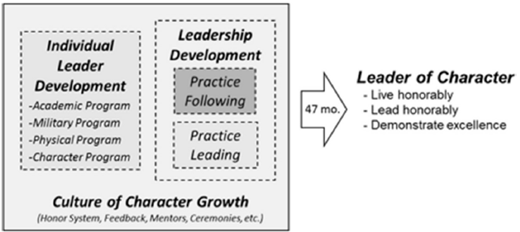
Figure 1 summarizes the WPLDS approach to character development. Individual leader development is cultivated and shaped by four distinct programs in place at West Point. The academic program shapes intellectual honesty and disciplinary competence. The military program instills the internalization of military values reflected in the seven Army values. The physical program ensures that all graduates are physically ready to assume leadership roles in ground combat. The character program, infused also in the other three, focuses on the five moral facets. Leader development involves practice in following, as well as extensive practice in leading. All of the above occur within a “culture of character growth.” The net outcome is producing leaders of character who live honorably, lead honorably, and demonstrate excellence.
Theoretical and Empirical Bases for Wplds
An element missing in previous West Point character development efforts was a conceptual framework based on empirical investigation of character development. In 2016, the authors of this article were awarded a grant from the Templeton Religion Trust. The research goals of the 5-year study, named Project Arete (arete is the Greek word for excellence) were to examine how West Point develops excellent cadets—that is leaders of character—and to extrapolate lessons learned that would benefit both West Point and other institutions of higher learning that share West Point’s concern with character development. The principal investigators of the research effort met with Caslen and briefed him on the objectives of the study, to both solicit his support and also to learn from him ways in which the project could benefit West Point’s cadet development model. Caslen gave Project Arete his full support and directed his subordinate staff members to facilitate data collection.
Given the importance of the project to West Point, Caslen requested regular updates on the progress of the study. Thus, Project Arete served his vision of including evidence-based knowledge into the continued development of West Point’s character development strategies (e.g., Callina et al., 2017; Callina et al., 2018).
A key theoretical frame for the ways in which the WPLDS model could create a context at USMA for cadet character development was provided by concepts within the literature of positive youth development (e.g., Lerner, Lerner, Bowers, & Geldhof, 2015), a model of development that is derived from a relational developmental systems metatheory of the dynamic, holistic, and integrated relations that characterize the process of human development (Overton, 2015). Given its relational focus, research derived from the positive youth development model has focused on how specific contexts—youth development programs—could create coactions between a young person and the people and institutions in his or her context (represented as individual ^ context relations) that could promote character and, as well, other facets of positive development consistent with the WPLDS model (i.e., competence, confidence, connect, and caring; Lerner, et al., 2015). This research has found that, when character and these other positive attributes were developed, the young person would also be an individual oriented (dedicated) to contributing positively to his or her community and to the institutions of civil society and democracy (Lerner, 2004, 2018).
Lerner et al. (2015) noted that when youth development programs had three key features (termed the “Big Three”; Lerner, 2004), then character and other attributes of thriving and contribution would be likely to emerge: (a) Positive and sustained relations between a young person and an adult who is competent, caring, and continually available for at least one year, such as a mentor, coach, or teacher; (b) Life-skill building activities (e.g., enhancing skills pertinent to the selection and pursuit of positive life goals; attaining skills such as executive functioning, self-regulation, and resource recruitment, to optimize the chances of attaining goals; and compensating effectively when goals are blocked or when failure occurs; i.e., a thriving young person can make a loss-based selection of another goal and continue to move forward in life); and (c) Opportunities to both participate in and to take a leadership role in values-positive activities.
Although derived from the youth development literature, the Big Three has been found useful in accounting for positive individual ⬄ context relations in other college settings (DeSouza, 2017). We believe it is useful as well in understanding the system of character-building relationships that Caslen promoted among cadets and faculty and staff models and mentors at USMA.
Building Character At West Point
From the day that a new cadet arrives at West Point, referred to as “R-Day” (R is for “Reception”), they begin a 47-month long program of academic, physical, military, and character development experiences aimed at achieving the mission statement’s goal of producing commissioned officers of character. These programs and opportunities are carefully orchestrated in order to provide an integrated developmental experience. These experiences may be usefully organized in regard to the Big Three.
Skill Building Curricula
New cadets spend their first 6 weeks at West Point in Cadet Basic Training. The honor code and the concept of living honorably, leading honorably, and demonstrating excellence are a core part of their daily instructional experiences. As new cadets, the immediate focus is on field training and specifically on learning to be a follower. Field training begins to instill a sense of developing and demonstrating competence, for example, by becoming proficient in rifle marksmanship. In learning to follow, cadets observe and model the leadership and character of the cadet cadre who are in charge of day-to-day training. They get a chance to observe effective leaders and, sometimes, ineffective ones. By the time they are accepted into the Corps of Cadets, following successful completion of Cadet Basic Training, they (now called plebes) have begun to internalize the precepts of the honor code and character-based officership expected of them as they progress toward eventual graduation and commission as Army officers.
In their plebe year, all cadets are required to complete a semester-long academic course in introductory psychology—General Psychology for Leaders. This course provides the academic foundation for understanding their own behavior and that of others. While covering all the topics typically included in a general psychology course, the lessons in psychology for leaders apply key concepts to the context of leadership. For example, when studying stress, cadets learn the common models of the human stress response but relate it to combat stress that they or more importantly the soldiers they will lead may someday experience. In covering social psychology, cadets learn about social influence, but couch that learning in the context of how to lead others. A major writing assignment to reinforce the section on lifespan development requires cadets to reflect on a challenging experience since arriving at West Point and apply theories of human development to understand their behavior. Thus, each topic of the course is designed to infuse an understanding of oneself and of others, and to relate both to leading effectively. Taught by a mix of both civilian and military faculty, topics of character are routinely discussed in this context, reinforcing what cadets learned during Cadet Basic Training and in other, ongoing contexts at West Point.
In the summer following their plebe year, cadets engage in further field training. Lessons learned from the core psychology course are applied in realistic field settings. During their second academic year at West Point, cadets (now called yearlings) are each assigned the job of team leader, in which they are responsible for the day-to-day leadership of one or two plebes. The team leader experience is their first chance at West Point to serve in a formal leadership position and gives them the opportunity to develop their own leadership skills and character strengths while simultaneously being responsible for shaping these qualities in their subordinates.
During the third academic year (during which cadets are referred to as cows), all cadets complete a one-semester academic course entitled Military Leadership. This course builds on the cadets’ previous practical experiences as leaders both in the field and in other contexts, and on the foundations of human behavior learned as plebes in the General Psychology for Leaders course. One of the first lessons in this course is on character and the topics that follow in the course frequently refer back to character as the basis of effective leadership. Besides studying formal theories and models of leadership, cadets complete three written exercises during the course that are designed to encourage self-reflection on their character and approach to leadership. The first assignment is the journey line narrative, where cadets identify and reflect on three key experiences prior to and during their first two years at West Point that shaped their development, with the goal of evaluating “how I came to be who am I now.” The second assignment is to create an individual development plan, much of which involves reflecting on character and how to improve it by considering “who do I aspire to be.” The culminating assignment is the leader philosophy paper. In this exercise, cadets integrate what they have learned about character and leadership to articulate how their personal principles and philosophy of leadership will guide their actions as leaders.
During their last summer at West Point, cadets once again return to the field where they use their leadership philosophy in various roles leading new cadets and yearlings. Finally, during their senior (firstie) year, all cadets complete a course called Officership taught exclusively by experienced Army officers. At this point in their development, the idea that they will soon be officers and leading soldiers—sometimes in combat—becomes very tangible for cadets. Thus, the course marks a shift from peer leadership at the academy to an outward focus on the Army. Almost all cadets will, shortly after graduation, become platoon leaders and as such, will be responsible for the readiness, safety, and well-being of about 3035 soldiers and their families. The Officership course thus serves as a capstone of the highly integrated 47-month curriculum of character and leader development preparing cadets for their immediate futures as U.S. Army officers.
Positive and Sustained Mentoring
From the time they arrive for R-Day to the day they graduate, cadets are surrounded by role models who serve as tangible examples to be emulated. Of particular importance are the tactical (TAC) officers who assume responsibility for coaching, advising, and mentoring within respective cadet companies. Immediately prior to this assignment, TACs complete a master’s degree in social and organizational psychology from Teachers College (at Columbia University) as part of the Eisenhower Leader Development Program. Using feedback collected from peers, cadet leaders, faculty, and staff regarding each individual cadet, TACs regularly assess the strengths and weaknesses of the cadets in their companies. TACs also serve as key integrators, guiding cadets to appropriate and necessary experiences to propel their development in pursuit of WPLDS outcomes. Caslen served as a TAC officer at West Point early in his career, an experience which certainly shaped his view on their role in cadet development.
During their summer as new cadets, all cadets are assigned a sponsor. The sponsor can be anyone in the West Point community who is involved in cadet academic, physical, or military development. Sponsors welcome cadets into their homes, and provide a personal support role as needed. Sponsors play a key role in mentoring cadets in all phases of their development, including character. The relationships formed between cadets and sponsors often extend far beyond the cadet’s time at West Point.
On the academic side, during their plebe year cadets select a faculty member to serve as their academic counselor. Academic counselors, who are either civilian or military faculty members, assist with mundane issues of course scheduling and advising, but frequently guide the ethical and character development of cadets as well.
A signature feature of the aforementioned Military Leadership course is the requirement for every cadet to identify a mentor with substantial military experience to consult with on their assignments. The mentor interactions include several guided prompts to elicit a deeper understanding of the significance of course concepts in the practice of effective leadership. Prior to this course, cadets are not required to participate in formal mentoring although some seek out informal opportunities by their own initiative. A recent study found that cadets who previously were skeptical about the value of mentoring, or had difficulty finding a mentor gained greater appreciation for and were more committed to pursuing mentorship in the future as a result of this course requirement (Ryan & Peterson, 2017).
Finally, over 25% of cadets are Division I athletes, and their coaches and staff provide additional mentoring and guidance. As General Douglas MacArthur observed, “Upon the fields of friendly strife are sown the seeds that upon other days and other fields will bear the fruits of victory,” highlighting the significance of sports in character development. Caslen, a former Army football player, recognized the key role that coaches and mentors play in cadet development. In 2013, Caslen inherited a highly publicized misconduct scandal involving the USMA Rugby team. In addition to removing the coaching staff, Caslen disbanded the team and enrolled them in special mentoring and training, designed to allow them to understand the harm their actions had on the academy’s morale as well as the poor example it set for others. He was unprepared for the players’ response:
We brought all of the remaining rugby players through a character development program and the testimony of the players in the sensing session that followed, just floored me. The players realized how wrong they were, how grateful they were that they had gone through this session, and how proud they were of the rugby team of today and the values that the rugby team stood for (Personal communication, September 27, 2018).
Although the experience stemmed from corrective action driven by character failures, because of mentoring and systematic character development programs, the ultimate outcome was positive.
Remedial Mentoring
As with the rugby team, some cadets need more individual attention than others. Cadets who fail in character by violating the honor code or committing other disciplinary infractions face thorough investigation and, depending on the severity of the offense, can be subject to expulsion, even under WPLDS. If a cadet is found guilty of an offense, the Superintendent ultimately must decide whether they will be retained or dismissed. In reviewing these cases and rendering judgment, Caslen adhered to a strong belief that many cadets actually learn from their mistakes and ultimately become better officers, and with higher character than had they not experienced this failure. This remedial attitude toward character and conduct failures had their roots in his prior assignment at West Point as the commandant of cadets, responsible for the military training and day-to-day well-being of cadets. Here, Caslen comments on a critical observation he made in his first days as Superintendent:
I had a fundamental changing experience when I was beginning my time as Superintendent. Camp Buckner had just started, and I remember going out to get a briefing from the cadet commander of Camp Buckner [where cadet field training is conducted during the summer] and I was floored. This cadet was incredibly competent. She was articulate. She knew her stuff and I said, she’s going to be a general someday. I mean, she had it all together. She was a perfect package. Then, I think we were driving back to Camp Buckner the next day, someone said that she had an honor violation earlier as a cadet and I said, “You’re kidding me!” And then they explained the honor mentorship program and all of that. And I said, “Wow!” Because up to that point, there was no honor mentorship program. If you had committed an honor violation, from my personal experience both as a cadet, as a TAC officer or whatever, that cadet is going to be separated. (Personal communication, September 27, 2018)
Here, Caslen is referring to the West Point’s Special Leader Development Program (SLDP). Under the SLDP, cadets found guilty of misconduct are enrolled in an intense 6-month long mentorship program. Together with an assigned mentor, the cadet meets with the officer in charge of the SLDP to develop an individualized plan involving self-reflection and in-depth interactions with officers and others in a position to help the cadet to internalize and come to grips with the importance of honor and character in a military setting. Caslen has found the SLDP program to be extremely effective. Indeed, his preference would be for all cadets to be enrolled, but the intense one-to-one nature of the SLDP makes this scale unfeasible. Nevertheless, he reported many exemplary graduates of the SLDP. The analogy he uses to explain the impact of the SLDP is that of a broken bone, which grows back stronger than prior to the break.
So, this [previous experiences in the Army and at West Point] had an impression on me as the commandant. An orthopedic doctor said, you break a bone, and if it heals correctly, it’ll never break again where it broke before. It would become stronger as a result of the trauma. That is a phenomenal analogy. So, if someone has a character defect and if it is dealt with correctly, they’ll become stronger in character than they were before. And if you read the honor mentorship package and the reflective essays, and you read how the mentors have actually worked with these young men and women, it’s amazing: Amazing to see the transformation by the developmental process that took place. So, I’d probably say I’ll be an advocate of it forever. That the mentorship program is a phenomenal option to heal a character defect in a cadet or a character mistake that took place. (Personal communication, September 27, 2018)
Opportunities to Lead
The final facet of character development within the Big Three conception is providing opportunities to lead. One of the selection criteria for being admitted to West Point is demonstrated leadership experience during high school, as a sports team captain, club or class official, or related activities. Upon arrival at West Point, cadets are immersed in a leadership intensive environment from R-Day to graduation.
Leadership experiences at West Point are sequentially designed, beginning with learning followership skills as a new cadet and plebe, then assuming progressively more leadership responsibility as they advance through their second, third, and final years at West Point. Organized as a traditional Army brigade, all cadets are team leaders (as yearlings) and later serve as cadet noncommissioned officers, and in cadet officer command and staff positions at the platoon, company, battalion, regiment, and brigade levels. Positions are rotated each semester to maximize the leadership opportunities for every cadet. In addition, during summer military training, senior cadets are assigned key leadership positions during Cadet Basic Training and during military field training for upper class cadets.
Other leadership experiences come from cadet involvement in sports teams and/or clubs. All cadets must participate in either intercollegiate (National Collegiate Athletic Association) athletics or in the intramural sports program. There are over 100 diversity, hobby, military, religious, and support clubs providing leadership opportunities available to cadets. Managing and leading club activities requires cadets to learn skills similar to those they will need as officers, both in regard to pragmatic aspects of managing travel and budgets, and in regard to honing and exercising effective interpersonal and leadership skills.
Putting it All Together
West Point provides a fertile environment for cadets to practice and grow as followers and leaders of character. They benefit from a carefully designed and systematic character and leader development curriculum. They are surrounded by role models and mentors in every aspect of their cadet lives. In addition, they receive numerous opportunities to lead others.
The unique character development approach initiated by Caslen recognizes that cadets come from diverse backgrounds, and that not all cadets have the Army and West Point values internalized when they first arrive. Under the developmental WPLDS model, and with the support of the curriculum, mentors, and leadership opportunities, all cadets are thought to have the potential of fulfilling the mission of West Point by becoming the leaders of character vital to the Army and the nation. Reflecting on this process and the needs of the 21st century Army:
In our diversity programs we’re looking for a range of talented, future officers to lead a diverse Army and to build that inclusive teamwork. But what are you going to find? You’re going to find some of these young people in neighborhoods where they have pretty traumatic upbringings. They’ve learned how to survive in that sort of network and they find themselves all of a sudden challenged at West Point. Some of their survival techniques are contrary to the values of duty, honor, country.
But that doesn’t mean we don’t want to take them in because in the end they’re going to be great leaders, and they’re going to be great leaders of diverse units. Our job is to recognize where they’re coming from, what that starting point is when they enter the military academy, and what programs will develop them, so that by the time they graduate they will have internalized duty, honor, country. The West Point experience is easier for someone who grows up in an environment focused on duty, honor, country, with a solid family nucleus that teaches these values to their kids every single day. But not all the kids coming to West Point today are like that. As a result, the military academy is responsible for these developmental programs. That’s going to be an increasing challenge as our nation and our Army become more and more diverse. (personal communication, September 27, 2018)
Beyond West Point
The study of human development has documented that there are numerous pathways that may be taken across life and, in some respects each person’s pathway is unique (Rose, 2016). Caslen recognized this diversity of pathways but, as well, understood implicitly that there can be equifinality in human development. No matter where a young person starts in life, with mentoring, skill-building experiences, and opportunities to take a leadership role in enacting these skills in valued activities, every young person can develop into a leader of character.
West Point is a 200+ year old institution that takes great pride in its traditions and resists change. But Caslen’s unique experiences spanning from his days as a cadet to his time in combat and back again, inspired him to undertake this transformation effort that integrates character development into every aspect of the 47-month experience in a deliberate and pronounced way. The emphasis on character as the essence of leadership will have a profound impact on the Army and the Nation for generations to come, and is the defining feature of Caslen’s legacy.
As much as I’d like to be able to say that I fixed the character of the West Point, I can never say that because I recognize it is a never-ending process. Because the more important issue is: do we have the right process and procedures to develop character in our future leaders of our Army? And, when these future leaders are out of line, they are dealt with appropriately so that we give them the opportunity to come back in and be stronger as a result of that experience. (Personal communication, September 27, 2018)
Arguably, West Point is a model of higher education devoted to student development for life and not just student education. That this development integrates the values of honor and duty with an uncompromising commitment to a lifetime of selfless service is a model worth emulating. Indeed, we believe that close study is merited of the changes created at West Point as a value-based developmental organization and as a context that enhances the knowledge, skills, and moral lives of the diverse young people the organization trains. We also believe that organizations across the public and private sectors of our society—educational, business/industry, and governmental—would gain immeasurably from studying the leadership and contributions to character development made by Lieutenant General Robert L. Caslen, the 59th superintendent of West Point.
In August of 2019, Caslen became the president of the University of South Carolina. We are confident that under Caslen’s leadership, the University of South Carolina will reap the benefits of his focus and approach to character development.
The writing of this article was supported in part by a grant from the Templeton Religion Trust.
Notes
Officers for battalion-level command and above are centrally selected and slated through a Department of the Army promotion board approximately a year before assuming responsibility of a unit.

