


Educating for peace should be informed by lessons learned from the past. The Peace and Values Education programs of Aegis Trust in Rwanda apply lessons learned from the 1994 genocide against the Tutsi and its aftermath to shape a peaceful future. In this article, we present the Aegis Trust approach to educating for peace, focused on promoting critical thinking, empathy, and personal responsibility. We describe the Aegis Trust storytelling approach that emphasizes listening and dialogue with empathy and forgiveness. We discuss how Aegis Trust also works to adapt its approach to be relevant to promoting peace across diverse national and cultural contexts. We conclude by introducing a researcher-practitioner partnership between Tufts University and Aegis Trust, aimed at evaluating and scaling the Aegis Trust programs, aligning with the 30th commemoration of the genocide against the Tutsi and the launch of a global peace institute from Aegis Trust.
Today’s social and political climate is rife with polarization. Worse yet, this troubling problem is a global one, increasingly affecting democracies, old and new alike, worldwide (Carothers & O’Donohue, 2019; see also Burgess et al., 2022). For example, in the U.S., research has found that political party affiliation is based more on a shared animosity and hatred for the opposing party than on a love for one’s own party and its ideals, goals, and values (Aschwanden, 2020; Finkel et al., 2020; LaMotte, 2020; Pew Research Center, 2018, 2019). Headlines even suggest that the country is on the verge of a new civil war (Blow, 2021; Elvin, 2022; Gault, 2020; Hoffman & Ware, 2024; Jaffe & Johnson, 2019; Simon & Stevenson, 2023; Stokes, 2024).
How can communities overcome such conflict and division and navigate toward peace and flourishing? Are there lessons to be learned from the past? We believe that there are lessons to be learned from the people of Rwanda, who experienced the state-sponsored 1994 genocide against the Tutsi, which incited neighbors to take up arms against neighbors, killing over one million people in 100 days (Brehm et al., 2014; Center for Conflict Management of the University of Rwanda, 2012; McDoom, 2020). Not only have the people of Rwanda seemingly overcome the extreme polarization that led to genocide, they also (incredibly) have been successful in rebuilding Rwanda in its aftermath, including, in some cases, again living side-by-side with the neighbors and community members that killed their families. They have forged a new national identity of “we are one,” called “Ubunyarwanda” or Ndi Umunyarwanda, meaning Rwandaness or being a Rwandan, which focuses on what Rwandans have in common rather than on differences.
The restorative justice- and peacebuilding-related efforts that followed the genocide against the Tutsi in Rwanda provide timely and important lessons about educating for peace. As Rosoux (2022) summarized, the case of Rwanda is “a ‘textbook example’ illuminating the complexity of reconciliation processes after mass atrocities” (p. 1718), and thus an important case to study. In the present article, we focus on the Peace and Values Education programs of Aegis Trust, which uses storytelling and dialogue to combine a focus on memory of the past with education for the future to prevent mass atrocities and promote peace. To illustrate the Aegis Trust approach, we present curriculum provided in teacher trainings to reach youth in schools, and describe how out- of-school youth are reached through the Aegis Youth Champions program. We then introduce a researcher-practitioner partnership aimed at describing, explaining, and optimizing (i.e., measuring, evaluating, and enhancing/scaling; see also Baltes et al., 1977) the Aegis Trust programs to promoting peace.
The Aegis Trust Mission and Approach
Aegis Trust is a non-governmental organization that campaigns to prevent genocide worldwide. Its values are reflected in the Kinyarwanda word “Ubumuntu,” which refers to the qualities of humanity, greatness of heart, altruism, compassion, understanding, forgiveness, empathy, generosity, kindness, and trust. Headquartered in the UK, Aegis Trust works in Rwanda to curate the Kigali Genocide Memorial on behalf of the Ministry of National Unity and Civic Engagement. The Kigali Genocide Memorial is where 250,000 victims of the genocide against the Tutsi have their final resting place, and where people from Rwanda and all over the world come for remembrance and learning.
The mission of Aegis Trust is to work toward the prediction, prevention, recovery from, and ultimate elimination of identity-based violence, mass atrocities, and genocide through research and education. Aegis Trust takes a public-health approach to peacebuilding by working to identify the pathways and risk factors that lead to cycles of violence and atrocities, and how to effectively recognize and counter them (see Mercy et al., 1993). If such risk factors are understood, it may be the case that they can be identified, predicted, and prevented, which is the mission of Aegis Trust.
The Peace and Values Education Programs of Aegis Trust
Toward this mission, Aegis Trust delivers Peace and Values Education programs. These programs are developed for specific ‘boundary partners’ or target groups, that is, teachers (pre-service and in-service), parents, decision-makers, and youth. Through the Memorial as well as through traveling exhibitions and community visits, Aegis Trust delivers programs that train and support tens of thousands people, aiming to equip them with knowledge and skills for conflict resolution and peacebuilding to overcome the legacy of genocide (see Gasanabo et al., 2016; Grayson, 2017; Shenge, 2021). The success of these programs contributed to their being adopted into the national curriculum in Rwanda, now reaching over 2.5 million students. Shenge (2021) outlined the key definitions used by Aegis Trust for their programs:
“Aegis defines peace education as education that promotes social cohesion, positive values including pluralism and personal responsibility, empathy, critical thinking and action in order to build a more peaceful society (or a society that does not use violence to resolve conflict). It also constitutes the process of acquiring values and knowledge, and developing attitudes, skills and behaviour to live in harmony with oneself, with others and with the natural environment.
Positive values are considered core values that support social cohesion and peace, including caring, a belief in equality and social justice, respect for oneself and others, personal responsibility, willingness to act and ethical conduct.
Social cohesion is viewed as the capacity of a society to ensure the well-being of all its members, minimising disparities and avoiding marginalisation, promoting inclusivity and reducing injustice and inequality. It is also the status of a pluralistic society that permits diversity of opinion and protects citizens through security and justice mechanisms.” (p. 12)
To reach the wide range of beneficiaries across boundary partners, Aegis Trust produces key materials in the form of facilitator guides and handbooks, as well as mobile exhibitions and digital resources to increase accessibility. Although it is beyond the scope of the present article to describe all Aegis Trust programs across all boundary partners, we illustrate the Aegis Trust approach to Peace and Values Education by, first, describing its storytelling methodology and, then, focusing on trainings designed for two boundary partners: teachers and youth. We present the curriculum taught to teachers—especially given that the Aegis Trust approach is now adopted into the national curriculum in Rwanda (described below)—and then present how Aegis Trust reaches youth who are not in school and, as such, are often considered at risk of being radicalized.
A Storytelling Approach for Listening and Dialogue
Central to the Aegis Trust approach is storytelling, listening, and dialogue. The Peace and Values Education programs are designed to be narrative-based and experiential, using storytelling and thematic discussions—listening and dialogue—to raise awareness of and to promote the above-noted positive values (see Palmer et al., 2021; Shenge, 2021). Through listening and dialogue, the Aegis Trust programs teach forgiveness and nonviolent conflict resolution, with the aim of creating just and inclusive communities.
This values-led approach to listening, including its emphasis on fostering harmonious living with oneself, with others, and with the natural environment, reflects what Vuslat Doğan Sabanci (2021, 2023, 2024) describes as generous listening. Generous listening—listening to understand, rather than to be understood; listening with curiosity and empathy and without judgment; listening to make meaningful connections, recognizing a common shared humanity—serves to promote trust, empathy, understanding, and a sense of belonging. Such listening and dialogue, marked by these values, allows for healing and building community.
To facilitate such healing and community-building in the post-genocide Rwanda context, Aegis Trust uses the stories of survivors, rescuers, and those who contributed to bringing people together and mending the differences among Rwandans, as well as the stories of those responsible for genocide crimes who have since confessed and been forgiven. Stories are shared using visual materials, including physical exhibitions and videos. To emphasize the positive values, the stories are situated in the full context of the conflict; for instance, stories highlight the lives of people before the genocide, as well as during reconstruction and reconciliation.
The stories are not far-fetched; they are relatable stories of people and places that might be known by or familiar to the participants. Using relatable stories serves to more meaningfully convey the values being promoted in the programs (e.g., Han et al., 2017, 2022). As Marc Gwamaka, program and outreach coordinator at Aegis Trust, explained, “Stories carry unforgettable lessons; stories rehumanize people. It rehumanizes the community and makes it easy for people to collaborate. Then they can deal with emotions, including the feeling that they are not all the same [that is, that they do not all have a common shared humanity, as Tutsi were considered snakes and cockroaches], which the education curriculum taught before 1994” (personal communication, April 24, 2024; see also Tirrell et al., 2024).
This storytelling approach is integrated with the trainings to promote skills and values which, together, aim to foster transformational changes in attitudes and behaviors among participants. Furthermore, the programs are intended to scale change at the grassroots level, as participants are encouraged and empowered to bring the lessons learned back to their respective communities, themselves becoming trainers in the Peace and Values Education programs (see Shenge, 2021). As Gwamaka (personal communication, April 24, 2024) explained, “Transformation is not within the classroom; it comes when they start doing actions in their community” (see also Tirrell et al., 2024).
To illustrate this values-led storytelling approach to Peace and Values Education, we next focus on programs for teachers and for youth. We share how teachers are trained to integrate Peace and Values Education in their classrooms, which, as described in the next section, has been adopted into the national curriculum in Rwanda. We then describe the Aegis Youth Champions program, which seeks to benefit youth who are not in school. Through such programs, as well as through related trainings designed for parents, families, decision-makers, and other boundary partners, Aegis Trust aims to promote a sustainable peace.
Preparing Teachers to Integrate Peace and Values Education into Rwandan Classrooms
Aegis Trust provides teacher trainings for pre-service and in-service teachers to integrate Peace and Values Education as a cross-cutting theme throughout the curriculum (meaning it is incorporated into every subject and across all academic years, rather than simply being a one-class subject). Its teacher guidebook is presented in five sections focused on (1) the skills and values of sustainable peace, (2) helping students develop critical thinking skills, (3) helping students develop positive values and attitudes, (4) including peace and values learning into classroom content and methods, and (5) teaching peace and values through assessment, feedback, positive discipline, and personal example.
The teacher program begins by describing the path to genocide, explaining how an individual goes from being a human being and community member, to becoming a killer. Informed by the work of Ervin Staub (e.g., 1989a, 1999, 2001, 2003, 2006, 2011, 2014, 2018), Aegis Trust understands genocide as the final endpoint on a continuum of violence. The Continuum of Violence (see Figure 1) is shared, demonstrating how poor living conditions can lead to othering, polarization, discrimination, and dehumanization, and ultimately extreme violence and genocide, destroying community. In turn, Aegis Trust describes peace and building peaceful communities as the ideal endpoint on a Continuum of Benevolence (see Figure 2), where indifference, fear, mistrust, and anger are transformed through openness, acceptance, respect, empathy, caring, connection, community, and love (e.g., Staub, 1988, 1989b, 2002, 2015, 2018). The programs of Aegis Trust therefore capitalize on these values to build social cohesion and prevent identity-based violence—to promote peace.
Teachers are next taught about how students develop critical thinking skills with positive values and attitudes. Using quotes from educators across the world and throughout history (e.g., Confucious, Socrates, Plutarch, Galileo, Rwandan proverbs, and more), a constructivist approach to education is emphasized (e.g., Bada, 2015)—for example, “The mind is not a vessel to be filled but a fire to be ignited” (Plutarch, Greece and Rome); “You cannot teach a man anything; you can only help him find it within himself” (Galileo Galilei, Italy); and “Education contributes more to character than what one is born with” (Rwandan proverb). Being that we are active creators of our own knowledge, critical thinking skills are emphasized using Bloom’s (1956) taxonomy of cognitive skills. Whereas education may have previously focused on “filling the mind with the right knowledge” (reference to the Plutarch quote) through rote memorization, Bloom’s taxonomy describes remembering as only the base of a hierarchy of critical thinking skills—remembering, understanding, applying, analyzing, evaluating, and creating.
Accordingly, the Aegis Trust programs train teachers to empower students to think critically and make positive decisions, moving beyond remembering and understanding in order to apply, analyze, evaluate, and create. To do so, encouraging and asking questions is emphasized to pursue curiosity. Sample lesson plans and stories provide examples of questions to ask across subject areas, including questions of fact, questions of preference, and questions inviting critical inquiry. To further reinforce critical thinking, activities involving teamwork and problem-solving allow students to learn by doing.
Aegis Trust promotes that actions are the result of critical thinking combined with values and attitudes—in its Peace and Values Education, they present the idea as an equation: critical thinking + positive values and attitudes (like empathy) = positive choices and actions. To foster the development of positive values and attitudes like empathy, then, teachers are instructed on three methods of learning: learning by imitation (e.g., using And being role models), learning by experience, and learning by repetition or practice.
Regarding learning by imitation, or learning by example, the work of Bandura (e.g., 1963) is presented. Just as a child acquires parental attitudes and behaviors through parental modeling (whether intended or not), students may also imitate and learn from teacher attitudes and behaviors. Teachers are therefore encouraged to model positive values and attitudes, including patience and peaceability, empathy and concern for others, humility and openness, diligence and dependability, and kindness.
Regarding learning by experience, teachers are instructed on the Krathwohl et al. (1964) taxonomy of learning in the affective domain. Similar to how higher cognitive skills are built on a foundation of lower ones (as presented in Bloom’s [1956] taxonomy), higher attitudes and values are built on a strong affective or emotional foundation. The Krathwohl et al. taxonomy begins with a base of receiving and engaging (listening and observing), to responding (actively participating), to valuing, then organizing, and, last, internalizing or integrating. Aegis Trust explains that values such as empathy begin to develop in the valuing and organizing levels; and that these steps occur continuously and iteratively as learners respond to new experiences. The role of consequences for actions is emphasized—for instance, a harsh punishment (e.g., threat of being beaten for not completing one’s homework) may not result in desired learning, as the consequence is questioned or the violence is imitated; in turn, a fair and natural consequence (e.g., being made to stay behind during break to complete the homework) is likely to be accepted and internalized, thus changing behavior.
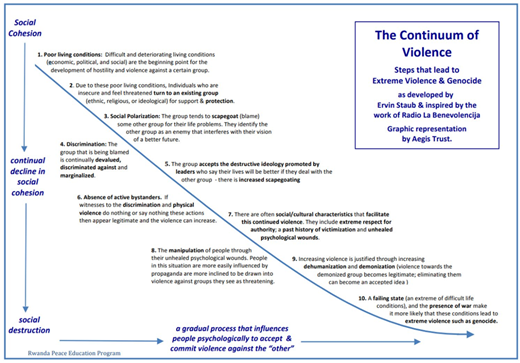
The Continuum of Violence,’ Rwanda Peace Education Program (2013). Reprinted with permission.
The Continuum of Violence,’ Rwanda Peace Education Program (2013). Reprinted with permission.
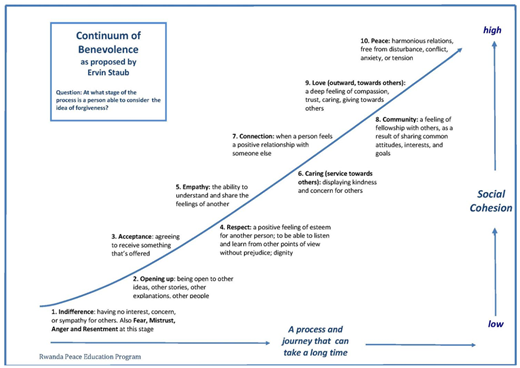
The Continuum of Benevolence,’ Rwanda Peace Education Program (2013). Reprinted with permission.
The Continuum of Benevolence,’ Rwanda Peace Education Program (2013). Reprinted with permission.
The teacher training then emphasizes that development of positive attitudes and values is supported through actions—learning by doing, repetition, and practice. Teachers are taught to provide opportunities for students to apply and experience the attitudes and values to support their integration. This “learner-centered” approach—one that is interactive and participatory, where the student is an active agent in their own development—is emphasized. To create a learner-centered environment, teachers are taught to present problems (including moral problems) for students to resolve, to work together as a group, to discuss and analyze moral lessons, and to practice active (or generous, as described above) listening.
The final sections of the teacher training focus on integrating the above peace-and-values principles into classroom content and methods, and on teaching peace and values through assessment, feedback, positive discipline, and personal example. Four components of classroom learning are described: curriculum (content), pedagogy (methodology), evaluation (assessment), and modeling (teacher attitudes and actions). These four pillars are described as supporting the knowledge, skills, and values learned in the classroom. Examples are provided across subject areas, with lesson plans, example stories, and modules describing specific values (e.g., empathy, caring, tolerance, cooperation, critical thinking, respect, honesty, etc.) to integrate and reinforce the principles taught in the training.
Last, feedback, positive discipline, and personal example are emphasized as reinforcing positive values and critical thinking. For example, teachers are presented with tips on giving positive feedback, including providing qualitative feedback (beyond simple scores, marks, and ranks). These tips include: to be specific; to be positive, showing how to improve; to correct the work, and not the student; to keep feedback manageable; and to provide five praises and encouragements for every one negative feedback. When discipline is needed, positive discipline is emphasized, recognizing that roots of negative behavior may include poor home conditions such as growing up around violence that foster fear and insecurity, low self-esteem, loneliness, anxiety and worries at home, and embarrassment and sense of not being valued by others. Instead of using physical punishment or humiliation, which may bring compliance but also reinforces these roots of negative behavior, teachers are instructed to learn the students’ backgrounds by asking questions with empathy, help the student understand the consequences of their behavior, to allow the student to experience the consequences when necessary, and to restore confidence in the student and to proactively praise good behavior. An exercise of developing a class contract is used, and teachers are encouraged to lead by example, teaching peace and values through attitudes and examples.
Teacher trainings are intended to benefit all students. However, Aegis Trust recognizes that not all youth are in school. Accordingly, we next describe an Aegis Trust program designed to reach out-of-school youth.
Reaching Youth Not in Schools
Another exemplary Peace and Values Education program of Aegis Trust is the Youth Champions program. Youth Champions is a community-based program, designed mainly for young people who are not in school. As described below, youth in school receive Peace and Values Education through the national curriculum, so out-of-school youth are considered more at risk of being radicalized and recruited into violent extremism. Aegis Trust describes these young individuals as lacking a sense of connection to their communities and a sense of responsibility to ensure their safety; lacking hope and purpose; having limited access to resources to support themselves; and relying on the companionship of criminals, thereby increasing their susceptibility to violent extremism. Additionally, exposure to unresolved trauma heightens their risk, as it can lead to impulsivity, quick anger and violence, suspicion, disconnection from others, and an inability to envision and navigate the future. The Aegis Youth Champions program therefore seeks to be responsive to these issues in their curriculum.
The Youth Champions program involves three-day trainings that begin with learning the history of the genocide against the Tutsi. As with the teacher training, the Continuum of Violence (Figure 1) is presented, followed by the Continuum of Benevolence (Figure 2). The Continuum of Benevolence is emphasized as a process, a sometimes-long journey, marked by interpersonal values like listening and dialogue with acceptance, empathy, and respect, which leads to caring, connection, and community, and ultimately love and peace.
In regard to the Aegis storytelling approach, the Youth Champions program uses stories related to the genocide to introduce the idea of “upstandership.” It is explained how lack of critical thinking, empathy, and personal responsibility lead to lack of people standing up for others (hence upstandership, in contrast to bystandership), which makes it possible for people to commit acts of genocide, even coming to kill one’s own neighbors. To illustrate the idea of upstandership, the story of Jack and Martin is shared, about two teenagers from the same school who come to stand up for one another. When Jack realized that Martin had needs, he invited Martin over to stay with him and his family. However, when Jack’s parents realized that they and Martin were of different ethnic groups (Hutu and Tutsi), they tried to kick Martin out of the house—they did not approve of a Tutsi living in their house, and worried about what the neighbors would think. Jack decided to stand up for his friend and, in doing so, became a champion for encouraging his family and neighbors to listen, understand, and accept. Jack was a model upstander.
Another story shared is that of Grace and Vanessa. When the genocide started, Grace and her grandmother were told to flee for their safety. Along the way, they heard someone moaning in agony and found a woman that had been badly attacked with a machete and left for dead. The woman had a baby on her, still breastfeeding, and begged Grace to take the baby so that she might survive. Grace’s grandmother did not want to take the baby because she was a Tutsi baby and they were Hutu—she feared that taking her would bring misfortune to them. Grace, however, at only 10 years old, insisted on taking the baby, even saying she was willing to die to protect the baby. She saved the Tutsi baby’s life and named her Vanessa. Even when the baby was a burden and Grace’s family begged her to abandon the baby, Grace refused. Despite Grace being Hutu and Vanessa being Tutsi, Grace raised Vanessa, serving as both her mother and her sister.
Through these stories, upstanders are described as being voices of reason for others who might easily become radicalized—they demonstrate critical thinking. They prevent crimes before they happen by bringing people together and seeking to understand one another—they demonstrate empathy. They actively engage in what they are doing, developing their character through their actions—they demonstrate personal responsibility. Critical thinking, empathy, and personal responsibility are three key pillars of the Aegis Trust Peace and Values Education programs (see Shenge, 2021).
Using such stories, program facilitators emphasize human-to-human connections, with a particular focus on forgiveness and healing. The focus shifts to listening as a means to forgive and heal—the trainings teach what facilitators describe as both the physical and mental posture of listening. The physical posture refers to the behavioral skills often described as active listening (e.g., Rost & Wilson, 2013); in turn, the mental posture of listening refers to the values one embodies when listening generously (e.g., Doğan Sabanci, 2021, 2023, 2024)—together, listening with the body, heart, and mind; seeking to understand one’s experience without judgment but with empathy and curiosity; generously giving the gift of attention which, as McGilchrist (2009, 2021) describes, is a moral act.
Aegis Trust promotes that such listening facilitates dialogue that is meaningful and productive—as Gwamaka (personal communication, April 24, 2024) explained, dialogue that is focused on “trying to find the issue itself, rather than viewing the other [person or group] as the issue.” Generous listening and dialogue are therefore an important part of conflict resolution as well as healing. Youth participating in the Youth Champions program are trained to bring these listening and dialogue skills back to their communities, and to become changemakers themselves by starting and leading grassroots peacebuilding projects.
Intended Outcomes at the Grassroots Level
The Aegis Trust Peace and Values Education programs, and perhaps the Youth Champions program especially, is designed to equip, encourage, and empower youth with the skills, tools, confidence, and support needed to start their own grassroots peacebuilding projects. In doing so, they build a network of peer community peacebuilders and form local peer groups called Youth Clubs. As examples, some Youth Clubs mediate conflicts and are thus called Dialogue Clubs; others focus on mental health in the community, and they are called Healing Champions. Through these Youth Clubs, Dialogue Clubs, and Healing Champions, peacebuilding grows at the grassroots level, as beneficiaries of the Aegis program become changemakers and leaders in their own communities.
As described by Gwamaka et al. (2019), youth who went through the program emerged with both the desire and a greater ability to contribute to community. Through designing and implementing their community-based projects, they gained experience in collaborating, building, and organizing, and they learned to produce documents, manage finances, design business plans, and act as entrepreneurs. They became more confident in speaking with adults, offering their opinions in intergenerational forums, and appropriately engaging adults who held different views. These youth reported markedly fewer symptoms of trauma and depression, describing better sleep, ability to concentrate, and less anxiety, fear, anger, sadness, sleeplessness, and powerlessness—for many, the trauma-healing experiences were transformative. Some reported that physical ailments and nightmares that had plagued them for decades had been resolved. Some overcame isolation to rejoin other community members. Some found themselves able to forgive perpetrators or their families, either internally, for peace of mind, or by seeking out and reconciling with those persons in the weeks and months after the workshops.
Indeed, many of the at-risk youth who went through the program tell stories of reconciling with their families and feeling a sense of belonging in their communities, overcoming fear and convincing community members that their change is real. They report a greater willingness to trust and help people who are different from them, as well as a greater openness to others’ points of view. These youth recognized their own capacity to contribute to community life and came to understand that genocide is not solely an adult issue, but rather a part of their own lives as well. They understand that it is their responsibility to eradicate its roots, beginning with its ideology, through their educational and inclusive youth projects. They therefore designed their projects with a strong fabric of social cohesion and economic transformation, recognizing the importance of ‘finding peace on an empty stomach’ (Gwamaka et al., 2019).
Not only do the youth experience working as a team by volunteering alongside other young people, but they have over the years created a greater sense of community overall by providing something positive for their neighbors. Several district government officials comment that the Youth Clubs, including the Dialogue Clubs and Healing Companions, make their jobs easier, as community members approach the clubs first, instead of the government, for support. In northern Rwanda, for example, the Gicumbi Dialogue Club has reunited 30 couples. As well, local officials routinely solicit the opinions of the Aegis Youth Champions during their sector meetings. For instance, in Nyamasheke, they invited a Youth Champions program beneficiary—a youth formerly considered at-risk—to serve on the Elections Committee; in Gisagara, they requested the Youth Club to assist in building the village office.
Furthermore, over the years, their Youth Clubs have emerged with an identity as community problem-solvers. They not only support the seeking and granting of forgiveness among members of the club, but they also facilitate those conversations among families in the community, guide conversations to locate unburied bodies, and mediate other types of conflict. They are transforming their communities and shaping the next generation toward ensuring sustainable peace.
The History, Reach, and Impact of Aegis Trust in Rwanda
Aegis Trust first piloted their program in 2008 with Rwandan secondary school students, which has since been developed it into different programs for a range of participants, including community members, parents, teachers, students, and out-of-school youth. By 2013, they had expanded to 22 districts (out of 30 districts across five provinces in Rwanda), with partnerships including USC Shoah Foundation, Radio la Benevolencija, and the Institute of Research and Dialogue for Peace (IRDP). Their work attracted support from several donors including, but not limited to, the Swedish International Development and Cooperation Agency (SIDA), the United Kingdom Department for International Development (DFID), and the Embassy of the Kingdom of Belgium.
Rwandan authorities stated that peace and values should be a foundation of its education and invited Aegis Trust to support efforts at integrating peace and values across the education system in Rwanda. In 2016, the Rwanda Education Board adopted the Aegis Trust Peace and Values Education model in its entirety for the new national school curriculum and invited Aegis Trust to integrate it as a cross-cutting theme through teacher training and model lesson plans. From 2016 to date, through its Education for Sustainable Peace in Rwanda (ESPR) program and then its Action for Sustainable Peace, Inclusion, Rights & Equality (ASPIRE) program, the Aegis Trust has been contributing to sustainable peace in Rwanda by supporting this curriculum change focused on peace and values in formal and informal settings.
When Aegis Trust started its interventions in Rwanda in 2001, there was no formal teaching in Rwanda about the genocide. From 2016 to 2019, through partnerships with the Institute of Research and Dialogue for Peace and La Benevolencija, the Aegis Trust programs reached 45,000 beneficiaries (see Shenge, 2021). Today, what began as a pilot at the Kigali Genocide Memorial now impacts the educational experience of over 2.5 million Rwandan students every year. Furthermore, their programs are scaling organically, with program participants becoming peacebuilders and leaders themselves, as evidenced by the ongoing success of the Aegis Youth Champions program.
Aegis Trust has been lauded for its tangible, transformational impact on participants since its inception. Research has demonstrated that the Aegis Trust approach is effective in reducing trauma symptoms, fostering non-violence, increasing well-being, and promoting peace (e.g., Framing et al., 2016-2021; Pells et al., 2017; Stevenson, 2012; Uwizeye et al,. 2022). It has also been recognized for its humanity-based approach which has been demonstrated to be useful for healing and growth (Gutierrez et al., 2019). As one young man said at the end of an Aegis Trust program some years ago, “Thank you for saving my life and the lives of the people I was going to kill [out of revenge], because until today that was my only plan. Now I see this is not a good plan, so thank you.”
The work of Aegis is also celebrated globally. For example, as compiled by Aegis Trust (e.g., 2024):
Ban Ki Moon, Secretary General of the UN (2007-2016), reflected, “We failed in Rwanda. We failed in Srebrenica. But you [Aegis Trust] are writing a different future.”
Cardinal Dieudonne Nzapalainga of the Central African Republic (CAR) proclaimed, “The Aegis Trust has helped Rwanda to rise from the ashes. We have seen the result: Rwandan youth have understood the past that led them into darkness.”
From Brice Emotion, former CAR militia spokesperson, “What I learned here [at Aegis Trust] I will put at the service of my brothers with weapons in their hands, so that everyone can get the idea about sincere reconciliation and forgiveness.”
Father Charles B. Chilufya, Jesuit Conference of Africa’s Director of Justice and Ecology, praised, “We need an education that forms hearts and consciences, not just brains. It is graduates whose hearts are trained towards love and justice, care and responsibility, that will transform Africa and eradicate poverty and not just economic policies. Together with Aegis Trust we’ll spread this all-rounded education all across Africa in our schools and all public schools.”
Broadening its impact beyond Rwanda, Aegis Trust trains individuals and communities from other countries by adapting and contextualizing curricula while also providing immersive experiences into the Rwandan culture. Participants visit historical sites of the genocide, meet with genocide survivors, visit a reconciliation village (where victims and perpetrators of genocide are reconciled and living together again peacefully), and pay tribute to the victims of the genocide. They engage in Aegis Trust’s humanity education, learn about forgiveness, and engage in personal forgiveness reflections. Participants in this process learn from the example in Rwanda about post-traumatic growth, reconciliation, forgiveness, and hope, and are expected to make connections with and apply lessons to their own contexts.
Situating the Aegis Trust Programs in Developmental Science Theory and Evidence
Contemporary approaches to studying human development and promoting character development and human flourishing are strengths based, recognizing that all individuals have strengths (e.g., character virtues, values, agency), and all contexts have assets (e.g., resources, people, programs, institutions). To promote thriving and human flourishing, peace education programs can work to align individual strengths and contextual assets in mutually beneficials ways (Lerner & Callina, 2014; Overton, 2015). The use of generous listening and dialogue (see Doğan Sabanci, 2021, 2023, 2024) may be a meaningful way to realize this optimism, to navigate and celebrate our interdependence. Indeed, the Aegis Trust storytelling approach for listening and dialogue aims to appeal to our shared humanity, by humanizing and rehumanizing those involved, in contrast to the dehumanization that occurs in polarization and othering.
Strong foundations exist in the literature supporting the approaches taken by Aegis Trust as being effective in educating for peace and reconciliation. For instance, using the stories of moral exemplars as role models for post-conflict reconciliation was supported by Čehajić-Clancy and Bilewicz (2017, 2020) and, specifically, the effectiveness of using role models that are relatable, relevant, and attainable for character education was demonstrated by Han et al. (2017, 2022). Regarding the use of dialogue, Audergon and Audergon (2017) used Rwanda as an illustrative case to describe the roles of facilitated dialogue and community engagement in recovering from and preventing mass violence and genocide. They described community dialogue for bringing awareness to polarization tactics and associated emotions, manipulations, and trauma, as well as awareness to the importance and effectiveness of facilitating shared storytelling and witness-bearing. As Audergon and Audergon (2017) summarized, “The story [e.g., of injustice] also needs to be witnessed in community and included in our collective history or narrative. Witnessing and including our traumatic histories, as individuals, societies, and as a world, is a form of accountability so that as a society, we become whole and can create a different future” (p. 5).
Further supporting dialogue and storytelling as meaningful and effective approaches to peace and reconciliation, Clark (2009) presented evidence from over a dozen reconciliation projects across nine states, describing narrative as a powerful tool for depolarization and the importance of engaging participants on both sides of conflict. As Clark (2009) noted, narrative and dialogue are effective in reconciliation for the role they play in appealing to human emotions, which are often manipulated during polarization (see also McDoom, 2012). Bordone (2018) also described dialogue as an opportunity to bring awareness to the value of sitting with and embracing differences and conflict as a means of building conflict resilience. As Cleven et al. (2018) described, the use of dialogue in response to polarization can be transformative, enabling participants to reclaim their identities and to consider the perspectives of others—despite holding different opinions—contributing to greater tolerance and opportunities for finding common ground. In contexts such as Rwanda, where intergroup conflict was fueled by colonialism and nativism (Mamdani, 2001), by the politicization and polarization of ethnicity (Brehm et al., 2014), and by negative emotions of fear, anger, resentment, and hatred (McDoom, 2012), the transformative potential of listening and dialogue in peacebuilding work offers promise worthy of further study.
Last, the focus on forgiveness in Aegis Trust’s programs is also supported by developmental science. Forgiveness involves letting go of negative thoughts, feelings, and behaviors following a transgression, while fostering positive character strengths such as compassion, generosity, and even love for the offender (Enright et al., 1998). Such attributes may be called an “altruistic gift” (Worthington, 2020). In societies that are increasingly multicultural and burdened by histories of conflict and polarization, evidence suggests that forgiveness promotes social harmony (e.g., Hui et al., 2011), and even has transformative potential (e.g., Misztal, 2016), for instance, by transforming negative emotions associated with intergroup conflict and polarization toward peace and justice (McDoom, 2012; Tirrell, 2022, 2024).
As Tirrell et al. (2023) reported, to exemplary community members in Rwanda, forgiveness was considered a civic virtue that, over time, enabled and motivated survivors to engage with their community, heal, and move forward. Forgiveness, to them, facilitated and completed a restorative approach to justice. Furthermore, the exemplars in Rwanda described forgiveness and justice as emerging from engagement in community-based peacebuilding work, including service, storytelling, listening, and dialogue. Nonetheless, burgeoning research on forgiveness in African nations has highlighted the culturally mediated differences in definitions, expressions, and promotions of forgiveness, which led Worthington et al. (2019) to call for a campaign of forgiveness research in Africa to deepen understanding of the contributions of forgiveness in African peacemaking efforts. There is more work to be done.
Future Directions
To date, the evaluations of the Aegis Trust programs remain mostly descriptive and without comparison groups which would allow causal conclusions to be drawn. Furthermore, as described by Shenge (2021), the Aegis Trust programs are only one approach to peace education among a diverse set of interventions to which Rwandans are exposed, and from a range of actors. Further research is therefore needed to evaluate the specific impact of the Aegis Trust programs, and to equip participants with skills to differentiate impartial approaches to peace education from approaches found to present significant and problematic biases (Shenge, 2021). As described further below, the authors of the present manuscript are seeking to build a strong theory-predicated and evidence-based foundation for evaluating, enhancing, and scaling the Aegis Trust peace and values education programs by bringing robust and rigorous developmental science to bear in a researcher-practitioner partnership.
At this writing, the authors of the present article and their respective institutions (Tufts University and Aegis Trust) are embarking on a researcher-practitioner partnership, funded by the Templeton World Charity Foundation (TWCF). TWCF is a leader in philanthropic support of research building the field of human flourishing, with recent funding initiatives including the Global Innovations in Character Development initiative and the Listening and Learning in a Polarized World initiative. At Tufts University, the Institute for Applied Research in Youth Development (IARYD) has been leading world-renowned research in applied developmental science and positive youth development (PYD) since 1999. The mission of IARYD is to understand “what goes right in the lives of youth” and, in studying PYD, character development (including forgiveness), and related fields, to promote health, well-being, justice, and thriving for all. Over the past two decades, IARYD has built several successful researcher-practitioner partnerships to support, evaluate, and scale important and impactful programs—much like the programs of Aegis Trust. Last, the Generous Listening and Dialogue Initiative (GLADi) is part of the Tisch College of Civic Life at Tufts, which is oriented by Tisch College’s North Star of building a robust and inclusive civil society. The GLADi is supported by the Vuslat Foundation (generouslistening.org; founded by Vuslat Doğan Sabanci) and is presently being launched as a research center seeking to describe, explain, and optimize (see Baltes et al., 1977) listening and dialogue—namely, generous listening and dialogue (see Doğan Sabanci, 2021, 2023, 2024)—for character and community development, where differences are viewed as strengths and conflicts as opportunities.
The Aegis-Tufts research-practice partnership intends to capitalize on the team’s respective areas of expertise, bringing developmental science theory and evidence to bear on the peace education programs of Aegis Trust. By designing and developing robust and rigorous evaluation methods and measures, the team will work toward scaling the Aegis Trust approach to peace education globally. Indeed, this researcher-practitioner partnership is timely and important. At this writing, Rwanda is commemorating the 30th anniversary of the 1994 genocide against the Tutsi, and Aegis Trust announced plans to launch a global peace institute, the Isokō Center for Humanity to further realize its overarching mission of promoting peace and ending mass atrocities and genocide. The work of the partnership will lay a strong, theory-predicated, and evidence-based foundation for the Isokō Center for Humanity and will enable the team to collaborate in future efforts to amplify and scale the programs of Aegis Trust and, in turn, to amplify and scale peacebuilding worldwide. Reference to the United Nations (2015) Sustainable Development Goals (SDGs; specifically, SDG #16), this work aims to make progress toward realizing a world marked by peace, justice, and strong institutions—shaping a peaceful future by learning lessons from the past. As the past of Rwanda demonstrates, peace and justice may be achieved through fostering forgiveness and reconciliation, and by reconnecting with ourselves, with others, and with our environment through listening and dialogue.
This work was supported in part by the Templeton World Charity Foundation (TWCF-2023-32222) and by the Vuslat Foundation.

