


This article outlines the research design and methodological concerns beneficial to consider when investigating how racial, historical, and cultural factors shape Black theories of character education. A modified cultural historical activity theory (CHAT) paradigm (e.g. social, cultural, and historical factors, rules/norms, division of labor) was incorporated into a teacher personal theorizing framework to offer a culturally sensitive research framework. A data example, which employes a three-dimensional narrative inquiry space (temporal, personal/existential, and place), illuminates how race, historicity, and cultural identity steer an African American character educator’s: (a) curricular/instructional decision making (b) motivation, and (c) teaching and learning expectations. A modified CHAT paradigm coupled with a teacher personal theorizing framework is suggested as an appropriate means for analyzing character education as culturally mediated activity.
The popularity of today’s character education movement has prompted an upswing in research efforts that consider character education’s uses and impacts (e.g., Hoge, 2002; Glanzer & Milson, 2006; Howard, Berkowitz, & Shaeffer, 2004; Muscott & O’Brien, 1999; Smagorinsky & Taxel, 2005; Schultz, Barr, & Selman, 2001). Prominent research approaches put forward descriptive and/or quasi-experimental frameworks designed specifically to elucidate (a) outcomes as a result of character instruction (b) teachers’ opinions/attitudes toward character education, and (c) program models and effectiveness (e.g. Battisch, Dong-il, Watson, & Schaps, 1995; Berkowitz & Bier, 2004; Cassell, 1995; Leming, 1997a, 1997b, 2000; Mathison, 1998).
As an African American researcher, I am not convinced that our prominent research approaches can unearth the racial, historical, and cultural standpoints of character educators who are Black. Whereas race represents a social construct that assigned power and privilege (Mills, 1997), the influence of race is profound in our society. Race, culture, and history have a bearing on the agency and negotiation of character theories (Green, 2004; Johnson, in press; Siddle-Walker & Snarey, 2004). To address the complexities and nuances associated with African American theories of character development fosters reconciliation of the double consciousness that scaffolds the African experience in America (DuBois, 1903). Double consciousness refers to a peculiar sensation where Africans in America observe “one’s self through the eyes of others” (DuBois, 1903, p. 3). This group recognizes and acts on the contradictions of being African, yet, distinctly American. Such contradictions create “two warring ideals in one dark body, whose dogged strength alone keeps it from being torn asunder” (Dubois, 1903, p. 3). Further, to ignore how a character educator’s race, historicity, and sociocultural identity inspires her practice and motivation obscures the multidimensional nature of character education curricular/instructional decision making. It is this multidimensional nature that greatly structures the type and extent of character instruction offered to students. Given that race, historicity, and cultural factors sway those actions and words that become a part of character educators’ knowledge (Vasquez-Levy, 1993), they merit further review. This paper examines the research design and methodological concerns that are beneficial to consider when investigating African American theories of character development.
I contend that the epistemological assumptions undergirding prominent research in our field disavow ways of knowing connected with people of color, particular those comprising the African diaspora. I also claim that a modified cultural historical activity theory (CHAT) coupled with a teacher personal theorizing framework provides a culturally sensitive method for investigating Black theories of character development. Together, a modified CHAT (e.g., social, cultural, and historical factors, rules/norms, division of labor) and teacher personal theorizing brings into relief the historical and cultural tone of Black character educators’: (a) curricular/instructional decision making (b) motivation, and (c) teaching and learning expectations. Character education, like most socially and culturally situated events, is primarily a mediated activity (Court, 2004; Johnson, 2005). Race, historicity, and cultural identity contextualizes teacher motivations for incorporating character development into the overall classroom environment. This perspective enables black character educators to negotiate character education expectations and create common sense character development theories (Ross, Cornett, & McCutcheon, 1992; Schubert, 1992). A data example is provided that supports this methodological approach.
In this article, I use the term historicity to refer to collective experiences situated in the past. Historicity serves as a foundation that validates one’s own life story. At the heart of historicity is the notion that our past shapes our future. Who we are now is a direct result of who we were previously. This concept is significant in understanding black theories of character education as it signifies that the African American experience is not devoid of cultural importance or relevance.
In the next section, I situate my work in the larger area of character education research. The subsequent section describes character education, followed by an introduction to those theoretical orientations grounding the nature, purpose, and extent of character education practice. After discussion of prominent research studies, I offer limitations associated with descriptive and/or quasi-experimental research in the field. I outline assumptions underlying prominent methodological approaches in character education research and detail why a modified CHAT paradigm coupled with a teacher personal theorizing perspective is culturally responsive to African American researchers, and educators. From there, I provide a brief summary of CHAT and teacher personal theorizing focusing specifically on the relationship between these research perspectives. I then detail methods utilized and analyze how it addresses issues raised earlier. The final sections, based on the data example, illustrate the thesis of this paper and are devoted to conclusions and potential implications.
Perspectives of Character Education
What is character education? The term is highly ambiguous. Howard, Berkowitz, and Schaeffer (2004) asserted character education as preparing individuals to think and behave ethically though Milson and Mehlig (2002), citing a common definition, described character education as individual development of an understanding, commitment, and tendency to behave according to core ethical values. Brohlin, Farmer, and Ryan (2001) listed character education as promotion of “habits of mind, heart, and action,” which allow students to develop and flourish (p. 1-2). Bohning, Hodgson, Foote, McGee, and Young (1998) defined character education “as whatever schools do to influence students’ moral growth and how they think and act regarding issues of right and wrong” (p. 265). What we know is that character education refers not only to an entire field but also to pedagogical approaches for civic and moral development (Hoge, 2002; Howard et al., 2004; Haynes et al., 1997; Lockwood, 2001). Whether values education, moral instruction, efficacy training, or civic development, the intent is the same—to promote desirable traits in young citizens (Hall, 2000).
Much has been written on those theoretical perspectives grounding character education (e.g., Eztioni, 2002; Glanzer & Milson, 2006; Hunter, 2000; Nash, 1997; Noddings, 2002; Schubert, 1997). Theorists and researchers alike have advanced theoretical perspectives as a way to comprehend variations in character education content, approaches, the character educator’s role and the role/position of the individual in the character development process (Nash, 1997). Glanzer and Milson (2006) suggested two conceptions of character education, traditional and comprehensive. Citing Lickona (1991), Glanzer and Milson (2006) suggested that comprehensive character education emphasized “the cognitive, the affective, and the behavioral domains of education” (p. 532) and included leadership, curriculum, and school climate as important in the character development process. The traditional conception, on the other hand, stressed virtue inculcation. Through adult encouragement, virtues such as obedience, loyalty, and patriotism maintained compliant student behavior. Nash (1997) claimed that three prominent theoretical orientations shape character practice: (1) feminist, 2) communitarian, and 3) neoclassical. Each orientation articulated character education as integral to public schooling and refined character development’s focus toward the moral and ethical behavior of people. For this article, I focus on Nash’s constructs as elements from each are evident in the data example provided.
Theoretical Orientations
Feminist
The feminist perspective offered an alternative approach to what were considered masculine ways of conceiving character education. The colonial period, which valued the mother’s role as primary moral instructor (Laud, 1997; McClellan, 1999; Norton, 1996), ascribed to women distinctive moral traits. Popular books of the time encouraged women to develop their instinctive traits of godliness, submissiveness, and joviality. Men, conversely, were expected to prepare for “more competitive, political, and economic arenas, which distracted them from spiritual and altruistic pursuits” (McClellan, 1999, p. 12). The initial delineation of educational responsibilities gendered moral education, and it established women as the special conservators of morality and piety in the society. This subtle gendering of moral education, however, did not bring forth a differentiated approach to moral formation and thinking. While women assumed the role of moral conservators, their voices were often unheard or misrepresented in the character education literature.
Gilligan (1982), responding to Kohlberg’s (1981) moral development theory, first suggested integrating women’s experiences and ways of knowing into the realms of moral, ethical, and civic development; thus crafting a care ethic. Kohlberg’s (1981) research on children’s moral reasoning focused on males and adopted logical and hierarchical views of character development. He concluded that as children move through his six stages of moral development, they engage in reasoned decision making to obtain absolute and invariant truth (Green, 2004; Johnson, 2005; see also Kohlberg, 1981). This knowledge facilitates children’s engagement with abstract knowledge of “rightness” and is observable and measurable by a researcher (Green, 2004, p. 57). Little, if any, consideration was given to influence of race, historicity, or cultural identity in children’s moral decision making.
Unlike Kohlberg’s moral development theory, care advocates (Gilligan, 1982; Noddings, 2002) argued that caring, an operational, powerful virtue, facilitated moral decisions and ethical behaviors while simultaneously empowering and offering humility. By integrating women’s experiences and ways of knowing into the realms of moral, ethical, and civic development, a care ethic is formed. Universal and dynamic, a care ethic recognized that individuals desire caring relationships, despite racial, gender, location, age, and temporal differences (Noddings, 2002). An element of the human condition, a care ethic required two conceptualizations: (a) natural caring and (b) memory of being cared for. Caring, an operational, powerful virtue, facilitates moral decisions and ethical behaviors while simultaneously empowering and offering humility (Noddings, 2002).
Care advocates disagreed with logical and hierarchical views of character development. Although they share traditionalists’ and communitarian perspectives that modern moral philosophy greatly emphasized individualistic moral agents, care theorists disdained inculcation of values. Meaningful dialogue and reflection is essential to the care ethic educator. Conversations, whether formal, informal, or ordinary generate environments where good character is desired and a more just society is plausible. Dialogue and reflection permit the carer to understand and meet the needs of the cared-for and the cared-for must receive the carer’s efforts (Noddings, 2003). Individuals who engage in the care ethic entertain a reciprocal relationship with the character educator and his/her peers. In the classroom environment, expectations are established that foster an individual’s best.
Neoclassical
The neoclassical perspective stressed enduring moral truths that operate universally across civilizations (Nash, 1997; see also Bennett, 1993). Steeped in Aristotelian and Platonic traditions (Hunter, 2000), this ideological position cast moral relativism aside for essential qualities directing right from wrong. As the colonial period valued the mother’s role as primary moral instructor, early nineteenth century Americans expected public, private, and Sunday schools to reinforce the moral education of the home; thus, transferring a largely female oriented responsibility to the male dominated public sphere (McClellan, 1999; Norton, 1996). With the creation of public schools, moral education appeared in classrooms and textbooks. Values espoused included honesty, hard work, love of country, thriftiness, love of God, duty to parents, and citizenship (McClellan, 1999; Smagorinsky & Taxel, 2005). The McGuffey Readers, as an instructional tool for moral development, incorporated secular Protestant views (Hunter, 2000; Smagorinsky & Taxel, 2005). Children learned culturally defined lessons about honesty, love of neighbor, kindness to animals, hard work, thriftiness, patriotism, and courage (Lickona, 1993).
For the neoclassicalist, character education functioned as a means for transmitting proper cultural values while curbing cultural moral erosion (Nash, 1997). During the early twentieth century, the neoclassical approach desired to meet the challenges of social and economic change by reinforcing values developed in the nineteenth century. Not just a reaction against modernity, this effort attempted to create new educational processes to curb erosion of traditional moral training (Hunter, 2000; McClellan,1999). As society changed, so did public schools. Public classrooms implemented new programs for character education and citizenship training (Hunter, 2000; Johnson, 2005). Educators from this period recognized the importance not only of religion in moral education but “that the institutions of democracy and capitalism carried important moral influence too” (Hunter, 2000, p. 60). Particular ideas such as “justice, individual liberty, and the consent of the governed” were sacrosanct in mainstream American life (Smagorinsky & Taxel, 2005, p. 26).
Such ideas gave rise to competing views of moral issues among public school teachers, developmental versus traditional. The developmental method minimized teaching specific moral tenets and cultivation of special traits (Hunter, 2000). A result of progressive thought, this style emphasized a more flexible and critical method toward morality “that would meet the evolving needs of an ever-changing order” (McClellan, 1999, p. 48 ). The traditional view, on the other hand, advocated intellectual understanding by practicing absolute moral traits. Not just a reaction against modernity, this effort attempted to create new educational processes to curb erosion of traditional moral training (Hunter, 2000; McClellan, 1999). The developmental method received significant attention beginning in the mid-1920s. In the 1930s, the Character Education Committee of National Education’s Department of Superintendence advocated a moral education where relativity “must replace absolutism in the realm of morals was well as in the sphere of physics and biology” (McClellan, 1999, p. 56). Even with such a call, neoclassical perspectives dominated character education discourse and practice (Hunter, 2000; McClellan, 1999).
Even in today’s character education discussions, the neoclassical perspective of character development is duty bound; thus, character education is approached from a dutiful position. The major role of character instruction is to help students discover the moral core. As a didactic teaching approach, assumptions are made that character educators will intuitively teach in a morally compelling manner. An individual attains good character by engaging in moral actions. Constant repetition of virtuous acts instills moral actions into the psyche; thus, moral acts become inculcated. The neo-classicist orientation stressed the importance of the Western cultural heritage in embodying the universal truth and the responsibility of the schools to transmit this truth to all children (Nash, 1997). Character education reflected the moral facts of life, those transcendent precepts crucial for people to live in harmony and peace with others.
Communitarian
A third theoretical perspective for character education evolved from the communitarian initiative, which sought civic regeneration through revival of important mediating institutions—the family, the school, and the church (Eztioni, 2002). During the early republic, relative stability permitted parents and civil authorities to develop confidence in “the corrective and educative powers of community life” (McClellan, 1999, p. 10). Communities, as networks of associations and institutions, operated to morally educate children.
The communitarian thought derived from Plato’s Republic and Hegel’s idea of the human as a collective subject. It asserted that an essential relationship exist between the character of a citizen and the welfare of the community (Nash, 1997). In contrast to the neo-classicalist, for whom the individual is the ultimate source of virtue development, the communitarian recognized that individuals, as social beings, are rooted and personified in their community. The assertion followed that, “human life will go better if communitarian, collective, and public values guide and construct” life decisions (Nash, 1997, pp. 54-55). Accordingly, the communitarian perspective focused on embracing and restoring a common bond, which in the end jettisoned excessive forms of individualism.
The communitarian perspective advocated a move away from the “great books” pedagogical approach. Since mediating institutions naturally fostered civic virtue, schools should serve as breeding grounds for promoting civic and democratic virtues, which will sustain local communities. Content wise, Communitarians utilized literature, history, and religion to fortify community, transcendence, and civic responsibility necessary for civic development (Nash, 1997). This perspective, however, did not put to rest issues of conformity and restrictive provincialism (Nash, 1997).
Research in Character Education
The history of research in character education has been dominated by approaches that examine outcome specific behaviors, and while recent attention focuses on teachers’ opinions/attitudes toward character education, studies with foundations in outcomes as a result of character instruction constitute the bulk of the literature. In addition, program models and effectiveness are features of research that produce desired behaviors in students. For those reasons, the focal point of this section is on character education research that elucidated (a) outcomes as a result of character instruction, (b) teachers’ opinions/attitudes toward character education, and (c) program models and effectiveness (e.g., Battisch et al., 1995; Berkowitz & Bier, 2004; Cassell, 1995; Leming, 1997a, 1997b, 2000; Mathison, 1998).
Outcomes as a Result of Character Instruction
Research findings often detail character education’s influence on student behaviors, attitudes, and academics (Hoge, 2002; Johnson, 2005). Each descriptive study differs, but they are all, in essence, attempts to legitimize character education’s principle of practice. Some researchers seek comprehensive (large scale) classifications of outcome oriented character education. Others have chosen to center their investigations on a smaller group of subsets. Examples below are not meant as a comprehensive description of work in the field, rather they are meant only to illustrate the kinds of categorized and classified outcomes researchers have proposed.
For example, Battistich et al. (1995) found that a relatively progressive approach emphasizing the development of a caring community benefited all students regardless of socioeconomic status. The statistically significant results showed that students’ sense of community was positively associated with their prosocial attitudes, motives, and behavior. Also, the student’s sense of community was positively associated with an optimistic outlook toward school and learning. Cassell (1995) conducted a program designed to improve self-control; citizenship building skills were taught to 237 fourth through sixth grade students. One character trait was taught a month using a standard social studies text supplemented by role playing, literature and debates. Using other observation and referral records, Cassell found a 34% decrease in administrative referrals for serious misbehavior and 49% decrease in observable out of control behaviors in the cafeteria, library, and playground.
Schultz et al. (2001) utilized a developmental evaluative approach to character education programs. To determine the effectiveness of the Facing History and Ourselves program, Schultz et al. (2001) employed an evaluative method developed by the Group for the Study of Interpersonal Development (GSID). Schultz et al. (2001) found that from the 346 subjects, gains in moral reasoning development and civic attitudes were not significantly different from the control group. Leming (2000) conducted an evaluation of the Heartwood curriculum, which is a literature based character education program. Leming’s (2000) sample consisted of 965 first to sixth graders in two geographically remote American school districts. Leming’s (2000) results depicted that the curriculum had a positive effect on cognitive outcomes. Affective and behavioral outcomes, however, displayed mixed results. In addition, Regression analyses on selected classroom dimensions found that an emphasis on matters of character throughout the curriculum contributed greatly to achieving character outcomes.
Muscott and O’Brien (1999) conducted a study examining the effectiveness of a character education program on students with behavioral and learning disabilities. The service-learning opportunities prepared for the citizenship program covered the six pillars of character developed by the Josephson Institute. This afterschool program utilized high school and college mentors to introduce the curriculum to the children and build friendships. Data gathered from interviews illustrated that students with disabilities expressed responsibility for their actions, responded to the ideas of cooperation, teamwork, and respect, learned to make new friends, and found learning about character to be rewarding.
Outcome oriented character education research identified character education’s impact on student behaviors, attitudes, and academics (Hoge, 2002; Johnson, 2005). The research reviewed supports the following hypotheses which could guide future research: (a) There is a close interaction between prosocial behaviors, attitudes, and outlook toward learning; (b) Good character development requires attention toward the cognitive, affective, and behavioral domains.
Teacher Opinions/Attitudes
Inconsistencies between character education beliefs and practices generated research investigating teacher opinions/attitudes toward character instruction. Matousek (1996) developed a survey instrument to measure teacher perceptions of certain character traits and classroom methods employed to teach character. Surveying selected teachers in Arizona, Matousek (1996) found that teaches felt that such traits as compassion, honesty, responsibility, and civic mindedness should be taught in public schools. Teachers indicated a strong tendency to use role modeling and spontaneous class discussions when teaching character traits. Extending Matousek’s (1996) research, Campau (1998) examined fifth grade social studies teacher description of character education and how character education is implemented in their social studies classes. Milson and Mehlig (2002) surveyed 254 elementary school teachers regarding efficacy beliefs for character education. Results suggested that elementary teachers felt efficacious towards many aspects of character education.
Program Models and Effectiveness
Leming (1997b) compared 10 contemporary character education programs-AEGIS, Character Education Curriculum, The Child Development Project, Community of Caring, Project Essential, An Ethics Curriculum for Children, The Giraffe Program, Lessons in Character, Lions-Quest: Skills for Growing, and the Responsive Classroom. He found similarities and differences in program objectives, pedagogy, and research. Based on his findings, Leming (1997b) concluded that theory and practice may be advanced in a systematic manner. Vessels (1998), however, examined character programs in the school setting. In his study of seven public schools in Georgia, Vessels (1998) evaluated the character education programs at each school by observation, school climate survey, classroom climate survey, and student character questionnaires. Vessels (1998) found that schools with dedicated principals and the best character education implementation had positive results.
Berkowitz and Bier (2004) conducted an investigation into what works in character education. The authors concluded that: quality of implementation, a multifaceted character education program, student bonding to school, leadership, character education as a positive trait of good education, character education as primary prevention, and staff development were some features evident in effective character education programs.
Limitations
Despite a voluminous research base, there has been little inquiry into the epistemological assumptions sustaining prominent methodological approaches toward character education research. Research examples listed in the previous section assume a white, middle class, heterosexual view of character theory and development. The paucity of race, historicity, and cultural identity in character education research leaves a void where privilege recycles attitudes, values, and viewpoints of Whites. As such, character education researchers have no need to address race, historicity, and cultural identity. The emergence of culturally sensitive research frameworks is likely to make substantial contributions to theory, methods, and findings. Research in character education may be poised to experience substantial advances brought about by deconstructing those prominent epistemological assumptions guiding character education inquiry. In the next section, I discuss the epistemological assumptions scaffolding prominent research in our field.
The Epistemological Condition
The nature, purpose, and extent of character education has been enumerated in numerous areas (e.g., Battisch et al., 1995; Berkowitz & Bier, 2004; Cassell, 1995; Leming, 1997a, 2000; Mathison, 1998). Particular emphasis has been placed on theoretical orientations grounding character development, why character instruction is relevant in a democratic society, and the historical premise behind character education in American schools. The history of research in this area has been dominated by approaches that examine outcome specific behaviors, and while recent attention focuses on teachers’ opinions/attitudes toward character education, studies rooted in outcomes as a result of character instruction constitute the bulk of the literature. Program model and effectiveness are also features of research that produce desired behaviors in students. At the heart of character education theory and research lies an epistemological condition. This condition, based in Western philosophical tradition, classifies character knowledge and practice as either largely objectivist or constructivist (Green, 2004; Siddle-Walker & Snarey, 2004).
The objectivist position, rooted in Western philosophical tradition, is based on the presumption that a real world with verifiable patterns can be observed and predicted; it assumes that reason and measurement are the basis for all scientific inquiry. Because reality is single and tangible, time and context-free generalizations are possible. In character education, this means that character development is structured, observable, and static. Race, historicity, and sociocultural identity, for the most part, do not affect the character teaching and learning process. The constructivist stance, born of a suspicion toward objectivism, brings into focus knowledge as socially constructed. The subjectivist stance raises as a concern the assumption that good character is an external fixed reality. For constructivists, character development is identity based and depends on relationships between individuals and their environments (Green, 2004).
Vanessa Siddle-Walker (2004) and others, though, have argued that these epistemological assumptions overlook cultural and racial nuances; in fact, Green (2004) goes as far to suggest that both objectivist and constructivist stances position Black theories of character development as morally degenerate, intellectually inferior, or as simply nonexistent. How can we insert race, historicity, culture into character education development and research? The answer to this question is a complicated one; it requires concession that race, historicity, and culture matter in character theory and development. It further requires the acknowledgement, accommodation, and acceptance of research epistemologies that highlight race, historicity, and culture (Green, 2004; Tillman, 2006).
Culturally sensitive research frameworks utilize the “cultural standpoints of both the researcher and the research participants as a framework for research design, data collection, and data interpretation” (Tillman, 2006, p. 265). It acknowledges race and historicity, but places culture as integral to the inquiry process. Culturally sensitive research is required to adequately represent the African American experience in America. It yields comprehension of the impact that double consciousness has on African Americans’ ways of knowing. The dearth of research epistemologies that highlight race, historicity, and culture, particularly in character education, have positioned black character education theories as culturally subordinate.
A modified CHAT paradigm coupled with a teacher personal theorizing perspective sheds light on the uniquely self-defined experiences of African Americans; thus it leads to creation of theories and practices that address the culturally specific circumstances of African Americans character educators. It also allows for the researcher to rely on participants’ perspectives and cultural understandings of character education. Because this approach is attuned to racial, historical, and cultural standpoints, the African American experience is centered rather than marginalized. The following section provides a brief summary of CHAT and teacher personal theorizing focusing specifically on the relationship between these research perspectives.
Cultural Historical Activity Theory
Cultural historical activity theory (CHAT) is a sociocultural and historical lens utilized to holistically analyze human activity systems. CHAT is derived from Lev Vygotsky’s social-cultural learning theory and classical German philosophy (Roth & Lee, 2007). Vygotsky suggested that thinking and learning occur in social activities of our everyday lives. Because knowledge is socially constructed, it requires communication (semiotic mediation) and involves tools (physical, symbolic, or both). He also proposed that to understand any psychological phenomenon one needs to investigate it historically, thus, human behavior is best understood as a transformative process (Vygotsky, 1978).
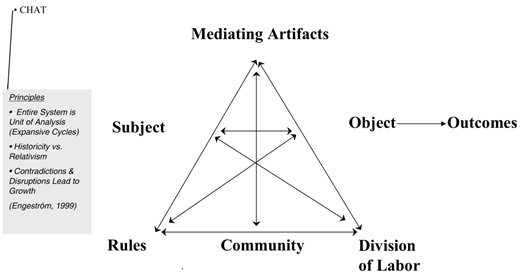
CHAT was conceived of as a concrete psychology immersed in everyday (work) praxis (Vygotsky, 1987). It focuses on the interaction of human activity and human thought within its particular environmental context (Engeström, 1999; Jonasson & Rohrer-Murphy, 1999). The term activity is not to be equated with brief events characteristic of school-based tasks. It is, however, an evolving, complex structure of mediated and collective human agency. The internal tensions and contradictions within and among elements of human activity lead to the transitions and transformation of knowledge. Basic elements of activity (see Figure 1) include subject, object, tools, community, rules, and division of labor (Engeström, 1987; Kuuttii, 1991, 1996). With the production of an outcome (object) as the primary focus of any activity, the subject, an individual or group, determines the need or motive to fulfill the object. Using the tools (e.g., training, conceptual ideas, pedagogical context, and human relationships) the subject moves toward accomplishing the object.
Structure of Learning Community (Activity System)
Structure of Learning Community (Activity System)
The community members set rules and norms under which the subject operates and establishes how the community members organize (division of labor) to meet goals. All of the elements influence the others and are influenced by social, cultural, and historical factors such as background knowledge and personal bias. Specific individual activity is also affected by other surrounding activities that may have a tool, community, rule, or some other activity element focus. Thus, activity has motive and is complex, dynamic, historically driven, and transforming (Koszalka & Wu, 2002).
Teacher Personal Theorizing
Teacher personal theorizing consists of conceptual ideologies that influence classroom practice and curriculum decision making (Ross, Cornett, & McCutcheon, 1992). Teacher personal theorizing assumes that all activities, such as teaching, are guided by some theory. This perspective is grounded in Dewey’s concept of curriculum as experience. For Dewey (1938), experience is grounded in the natural setting. It is mediated by common social symbols that actively explore and respond to the vagueness of the world. The primary factor in education is culture itself, which is not self critical or self-conscious.
Teacher personal theorizing enables teachers to negotiate professional expectations and create practical theories of teaching (Ross et al., 1992; Schubert, 1992). Grounded in a teacher’s frame of reference, which includes sociocultural and historical background, teacher personal theorizing is based on knowledge structures constructed as a result of personal and professional experiences (McCutcheon, 1992); thus, these knowledge structures are fluid and unique to individual teachers. Several studies suggest that teachers utilize a personal guiding theory to shape instructional practices and classroom decision-making (Chant, 2001; Clandinin, 1986). A teacher personal theorizing research focus has contributed to understanding the complex and multileveled aspects of curriculum and teaching. Given that a teacher’s race, historicity, and cultural identity influence their personal theorizing, the inclusion of CHAT may represent a logical precursor to the investigation of teacher knowledge development and meaning constructs.
Connecting Chat and Personal Theorizing
Central to CHAT and teacher personal theorizing is the notion that sociocultural conditions shape learning and mediate curricular/instruc- tional decision making and motivation. Each theoretical position articulates the intricate, often complex, relationship between sociological factors and cognition. CHAT holistically explores curriculum as experience. It places social, cultural, and historical experiences as mediated activity and illuminates interactions amongst teachers’ identity, student learning, teaching/learning artifacts, and the school environment. CHAT affixes detail to the systemic flow associated with teacher personal theorizing and how this form of knowledge construction guides professional practice. By integrating a modified CHAT paradigm within a teacher personal theorizing framework, situational components normally reserved as backdrops are holistically viewed as integral to the richness expressed in character educators’ curricular/instructional decision-making and motivation.
Context Of Study
The case presented in this article is what Stake (1995) describes as an instrumental case study. It is meant to illuminate the research design and methodological concerns that are beneficial to consider when investigating those social, cultural, and historical factors that shape a character educator’s curricular/instruc- tional decision making. The subject of the activity system consisted of Gerry Richmond, a 40 something African American female. Raised in a military household that shuttled between Europe and the United States, Gerry intermittently encountered the peculiarities of segregated society in the south. While these and other events framed her life story, what she vividly recalled was the assassination of Dr. Martin Luther King. Dr. King’s emotive message coupled with images of urban Black youth releasing their frustration affected Gerry’s thoughts and behaviors, especially in how she conceived of character development. Her expressive nature and demonstration of love blended our interviews into conversations.
Our conversations reflected sessions of shared histories by two African American females. In our conversations, we were free to share in an ongoing discussion of race, character values, and schooling. Seated across from one another were two Black females with similar backgrounds and who both attended historically Black colleges and universities (HBCUs). While we rejoiced and laughed during our talks, Gerry engaged in a form of mentoring termed othermothering, where women share the responsibilities of nurturing with a child’s mother (Thompson, 2004; see also Hooks, 1990). An African American tradition, othermothering made it permissible for Gerry to care for my social-emotional needs while strengthening the communal bond between two Black women.
Gerry Richmond has 20 years teaching experience, with 18 of those in Perch County School District (PCSD). Perch is one of 134 school districts in Virginia. The 2004-05 end of year enrollment of 12,488 students was the 20th largest in the commonwealth. Each of five middle schools enroll between 395 and 677 students. Each of three comprehensive high schools enroll between 1056 and 1657 students. Thirteen percent of the students were classified as African American while 79 percent were categorized as Caucasian. The remaining 8% were listed as “other” (e.g. Asian, Hispanic, and Native American).
During the 2004-05 academic year, PCSD provided a comprehensive professional development program for a total of 1,149. The workshops, seminars, courses, study groups, mentoring and symposia during 2004-05 focused heavily on data analysis, technology, teacher performance appraisal training, and building long-term mentor relationships. Though Perch County maintained a professional character education coordinator, the 2004-05 annual progress report did not specify whether this district offered professional development in character teaching and learning.
Recognized statewide for its character education program, PCSD’s character education mission statement acknowledged a responsibility for promoting, teaching, and modeling universal character traits that transcend socioeconomic, cultural, and religious differences. These universal character traits included: (a) trustworthiness, (b) respect, (c) responsibility, (d) fairness, (e) caring, and (f) citizenship. While adhering to the criteria established by Virginia’s Board of Education, Perch County stipulated that each middle and high school create, adopt, or adapt a particular character education approach as long as it reflected the district’s character education mission statement and state guidelines.
At Prescott High, Gerry taught four sections of practical level World History I, one section of advanced level World History I, and one section of African American studies. Gerry’s extended responsibilities included step-team sponsor and Teachers as Mentors and Advisors program (TMA). Opened in 1998, Prescott High School is a rural school located south of a major research university. Prescott served approximately 1113 students. Seventeen percent were African American, 76.1 % were Caucasian, and 3.95 % were Hispanic. One percent were Asian and .09 % were classified as American Indian. Twenty-one percent qualified for free/reduced lunch, which was the largest out of all high schools in PCSD.
Gerry, the subject of the activity system, focused her attention toward the character development of 22 of her students (one section of Gerry’s practical level World History I class). Of this group, 6 were African American and 13 were Caucasian. There were 3 students classified as Hispanic. Five were categorized with learning disabilities. She also directed her character beliefs and concerns toward Prescott High’s character education program. Prescott approached character education through the TMA program. A systematic plan, TMA engaged all teachers as a mentor, advisor, and role model to approximately 14 students. Students remained with their mentor teacher until their senior year. At that point, students moved, as a group, to a senior mentor teacher. A cohesive, complementary group, members fulfilled specific functions that built character in the school community. A mentorship committee developed the calendar and the topics for the mentor groups. A student leadership team designed and developed activities facilitated through the mentor groups, and they assumed planning and implementation responsibility for student government proposals and activities throughout the year.
A student mediation team was responsible for maintaining and modeling peace at Prescott High School. To meet this goal, team members instructed the entire student body on mediation, served as peer mediators (available every period throughout the day) and sponsored the mediation summit for surrounding school divisions. Peer counselors helped fellow students with problems; a service-learning component permitted Grade 12 students to actively participate in their community by engaging in organized experiences that meet actual community needs. Student participation reflected each senior’s area of interest and provided opportunities to use academic skills and knowledge in authentic situations. This experience further provided structured time for students to think, talk, and write about what he/she did and saw during the actual service activity to help foster the development of a sense of caring for others.
Methodology
This article derived from a larger investigation3 centered on secondary social studies teachers’ definitions and perceptions of character education and whether and how each integrated character education into their grade level curriculum and daily instruction. Rooted in a case study method, the investigation offered complex examples of character teaching in secondary social studies classrooms. I purposefully sampled two experienced social studies teachers who taught at the secondary level. Teachers were selected based on their race/ethnicity, levels of education, grade level/ subject taught, political affiliation, religious orientation, and frequency of church attendance. I felt these categories would be able to provide a deeper sense of curricular/instructional decision making and illustrate how social, cultural, and historical factors influenced character conceptions and implementation strategies. Review of research indicated (e.g., Battisch et al., 1995; Cassell, 1995; Mathison, 1998; Milson & Mehlig, 2002) that religious orientation, political affiliation, grade level/subject taught served as indicators regarding the degree of character implementation. These studies, however, did not indicate whether or how race, historicity, and culture influenced teachers’ definitions and perceptions of character education.
In the larger investigation, data collection lasted for four months and comprised fieldnotes, interviews, conversations, and archival data. I utilized a constant-comparative (Strauss & Corbin, 1998) method to construct a working theory of character education in secondary social studies classrooms. The constant-comparative method produced findings that clearly demonstrated how pedagogical, occupational, and social/cultural contextual factors generated variations in character education comprehension and application at the secondary level. When I extricated a particular case from the larger investigation, race, historicity, and culture fueled Gerry’s character education theory. Her character knowledge embodied cultural norms associated with the African American perspective of care and justice. Her case extended previous scholarship on the phenomena of double consciousness by presenting the inherent contradictions in how Gerry understood and responded toward character education. Her case presented personal bias toward character approaches that deprived racial and cultural nuances; thus, Gerry’s race, historicity, and culture promulgated personal bias, which influenced her character education knowledge construction. Her personal character education philosophy could not, however, reconcile dominant ontological facets of character education. Here is where, methodologically, a dilemma resided. I needed a method that examined Gerry’s character practice as culturally mediated activity (Roth & Lee, 2007; see also Engeström, 1987) and unpacked her motivation and character teaching and learning expectations. A modified CHAT approach was used to inform and support a teacher personal theorizing framework. The integration of a modified CHAT and teacher personal theorizing framework acknowledged race and historicity, but placed culture as integral to the inquiry process. This approach brought forth the totality of Gerry’s character education theory. Moreover, a modified CHAT and teacher personal theorizing framework illuminated character education as culturally mediated. The following research questions guided the investigation:
What assumptions underlie traditional methodological approaches in character education research?
What, if any, methodological approach illuminates character instruction as a culturally mediated activity?
What, if any, data examples support this methodological approach?
Data Collection
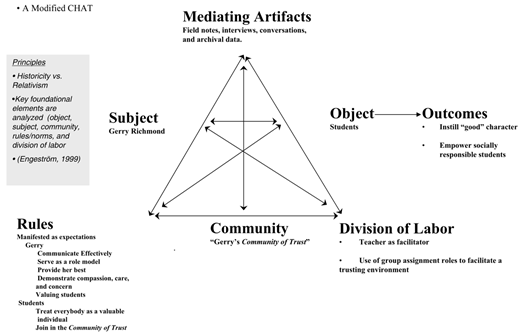
I used multiple data collection tools or mediating artifacts to document Gerry’s character practice. Mediating artifacts included field notes, interviews, conversations, and archival data. My field notes detailed not only the object of Gerry’s character practice but also the means by which she attempted to instill “good” character in her students. Interviews conducted with Gerry ascertained not only her historicity, but how her personal bias and collective school culture motivated her character teaching. Conservations further explored interactions between her historicity, character education knowledge, application, and comprehension. During our conversations, Gerry and I engaged in ongoing discussions on race, character values, and schooling. Posters reflected Gerry’s character education theory and contradicted, yet, reaffirmed aspects of the character education approach promoted by her school and school district.
Data Analysis
Analysis of conversations provided comprehension of Gerry’s personal theorizing as evidenced through her language of practice. Images, rules, and practical principles guided Gerry’s character teaching. As components of her language of practice, these images, rules, and practical principles interrelated her identity and professional experience, which embodied her character practice. Gerry’s language of practice personified her character education practice as well as her relationship with her students. In this study, her race, historicity, and cultural identity coupled with Gerry’s language of practice explained her character education motives (Connelly & Clandinin, 1988; Connelly, Clandinin, & He, 1997; Whelan et al., 2001).
Because I was interested in Gerry’s theorizing of character education, I inserted data into a three-dimensional narrative space, with the dimensions being temporal (past, present, and future), personal/existential, and place (Connelly & Clandinin, 1988; Connelly, Clandinin, & He, 1997; Whelan et al., 2001. Three dimensional narrative space presupposes that three commonplaces exist. These places serve to direct ones attention when conducting narrative inquiry.
The personal/existential dimension focused on Gerry’s meaning constructs. Meaning constructs are “founding, ideational, multiple, and fluid structures” that shed light on more specific “beliefs, ideologies, theories, practices, and institutions” (Stone, 1992). During this phase, Gerry and I discussed her character education beliefs and values, personal knowledge, professional knowledge, and how she implemented character education into her classroom. Her meaning constructs derived from her racial, historical, and cultural background. The meaning constructs created storylines that framed and provided interpretation of her character education curricular/instructional decision-making. Gerry deeply imbedded issues concerning self-awareness and commitment in her responses. She developed an image of her personal and professional self that facilitated a care and justice oriented approach toward character education. Data gleaned from the temporal dimension were juxtaposed with elements arising from the personal/existential dimension. Such action structured her character education theory and directed her character education practice.
Place, the third dimension, represented an important aspect in understanding Gerry’s theorizing of character education. Observations noted a distinct climate within Prescott High. Throughout Prescott posters advertised such events as pep rallies, school dances, and talent shows. In particular areas of the school building, small 8½ by 11 framed posters highlighted Prescott Mustangs have PRIDE. An acronym, PRIDE represented personality, responsibility, integrity, discipline, and enthusiasm. At the bottom of this poster several statements read as followed:
We are upbeat and optimistic about our friends, our school, and our community.
We understand that we are accountable for our actions and that our actions have consequences.
Aside from posters and student interaction, Prescott High acknowledged that it strives for honor, service, technological competence, and life-long learning in their students. Their mission statement further contended that Prescott High represents a community of students, parents, and staff collaborating to build an environment conducive to learning and developing good character. To reach this goal, Prescott established specific rules/norms that permitted all students to experience success.
To assert character education as culturally mediated activity (Engeström, 1987), I holistically examined Gerry’s character instruction. The foundational elements of Gerry’s character education activity (object, subject, community, rules/norms, and division of labor) were articulated (see Figure 2). As the three dimensional narrative space gave rise to Gerry’s character education knowledge construction and her school’s character education approach, CHAT demonstrated activity flow and brought forth the magnitude of her race, historicity, and cultural background.
Structure of Gerry’s Character Practice and Community of Trust (Activity System)
Structure of Gerry’s Character Practice and Community of Trust (Activity System)
As I reevaluated categories from the original data analysis, categories reemerged that contained properties similar to those outlined in both the teacher personal theorizing literature and character education literature. These categories provided a source for comparing data at the dimensional level. I was enabled to differentiate and provide specificity to (re) emergent concepts. I recognized how emergent categories, when presented in a data flow, demonstrated an initial structural basis for how Gerry’s race, historicity, and cultural identity shaped her curricular/instructional decision-making and motivation. Once I (re) organized and (re) ordered interview data and field notes into discrete characteristic categories Gerry employed to describe her personal/pro- fessional self, I inserted her descriptive narrative into each category.
Categories derived from the teacher personal theorizing literature were placed within descriptions of foundational elements derived from the activity system. If a concept emerged from the data that supported or defined one recalled from the literature, then the concept was elaborated in terms of its properties and dimensions. This differentiated and specified conceptual understandings associated with a modified CHAT and a teacher personal theorizing framework.
Gerry’S Case: A Data Example Of Character Education As Mediated Activity
Gerry’s case is framed according to characteristics she employed to describe her personal/professional self and character practice. These characteristics, which derived from her race, historicity, and cultural identity, give way to comprehending this character educator’s: (a) curricular/instructional decision making, (b) motivation, and (c) teaching and learning expectations. The following illustrations poignantly depict one black woman’s struggle to extend her ways of knowing and creativity into the dominant culture. The images she constructed elucidated the influential nature Black womanist values had on Gerry’s character education theory. As a Black women in America, Gerry moved back and forth between a character theory that was distinctively African yet, accommodated her current situation in America. This engagement with double consciousness gave rise to themes rooted in her cultural experience: spirituality, improvisation, suspicion of assimilation, and interconnectedness (Green, 2004).
Spirituality: The Christian
Gerry’s description of herself as a Christian framed her meaning constructs. Similar to other frames of reference such as race and gender (Stone, 1992; Thornton, 1991), Gerry’s meaning constructs unified and sustained her social and cultural views. Caught in the duality of her spirituality and religion, Gerry believed her particular orientation promoted a comprehensive “view of how people interpret religions and how those religions play out on the world scene.” She did, however, adhere to her own personal covenant created within her southern Baptist understanding of Christianity. She clarified the meaning of a “Christian” as one who simply behaves in a “Christlike” manner, thus displaying compassion, care, and concern for all people inside and outside the classroom setting.
Gerry’s religious/spiritual beliefs undergird the approach she takes to professional tasks (Green, 2004; McCutcheon, 1992). She described her personal covenant as buttressing her teaching and learning approaches, thus, it operated as her theory of action ( McCutcheon, 1992). Positioned around the totality that something greater exists, Gerry’s personal knowledge shaped her professional knowledge construction; it guided her through both the life and teaching process. You will not, for example, find her door open before the morning bell as she meditates each morning before classes. During her meditation, she prays for all children as well as for herself. She seeks to cultivate a spirit that fosteres what is true and good, not only in her students but in her teaching as well. For Gerry, it is essential she acquire “the right energy, the right spirit” within her heart as to not offend or mistreat her students. Gerry elaborated that she also prays for forgiveness in case her actions offend students or fellow colleagues.
Her religious/spiritual beliefs, ideologies, theories, and practices helped her to craft common sense character education knowledge (Green, 2004; McCutcheon, 1992). She integrated her spiritual experiences and ways of knowing into the realms of moral, ethical, and civic development (Noddings, 2002). This knowledge provided Gerry with a sense of how to approach character development that accommodated her racial, historical, and cultural identity. Her southern Baptist background propelled Gerry to construct and implement a character education curriculum that values all students while demonstrating compassion. Her motivations were based on what she perceived to be the lack of multiple perspectives associated with mainstream character education programs and policies.
Improvization: The Facilitator
Gerry described her facilitator role in terms of being organized, logical, and analytical. The organized, logical, and analytical facilitator represented an image that informed her character teaching and student expectations. Gerry’s own words explain her conceptualization of a facilitator.
I do believe that I’m my students’ facilitator. I think that my relationship changes over time. I think that when they first come to school, they’re just so amazed that I have such high expectations of how things are supposed to be done and how we’re going to be in the community… and then I think because I do a set of specific things like Martin’s Operating Styles so that they can see how they operate in a group and how I am and then when they see oh this is the nature of Ms. Richmond … she’s organized, she’s logical, she’s analytical, she needs things in order … and then I show them who they are then they’re more able to accept me and what I’m asking them to do.
Her facilitator description suggested that Gerry viewed her professional self as operating in a way that promoted empowerment and growth. She recognized that the relationship with her students changes as each grows cognitively and emotionally.
Suspicion of Assimilation
Gerry classified the term character according to a specific vision—one that highlighted student identity, community ideology, and individual learner needs. Gerry’s motivations were based on what she perceived to be the lack of multiple perspectives associated with mainstream character education programs and policies. She remarked that to categorize character education simplistically and rigidly is difficult for her, as an African American, to accept. She added that “in our culture there are ways we deal with things that just is not the same.” As a result, Gerry acculturated the concept of character education to fit her ideology and what she assumed was best for her class community. Suspicion of assimilation is recognized as a form of unction. This type of resistance, though, centers on the inherent danger of accepting the dominant character values (Green, 2004). This distinction was in contrast to character development standards outlined by Prescott High. A key principle in Gerry’s character education theory, multiple perspectives, was not mentioned in Prescott’s approach to character development.
Gerry was motivated to implement her ideology of character education in order to provide a sense of responsibility and empowerment. First, Gerry attempted to remove her biases from her classroom teaching. She described how she gave each child her best and made sure they had access to information and an environment that afforded an opportunity to acquire knowledge. She indicated that she did not confine herself or her students to the traditional student-teacher role. She insisted, rather, that she considered everyone as individuals. Gerry’s noble endeavor to construct a classroom where her counterconventional character theory defied traditional approaches represented a noble cause. She creatively nuanced particular character precepts into a more culturally relevant form of character development (Green, 2004).
She acknowledged that she placed community and trust-building activities in her curriculum. In her words, housekeeping, trust, and community building were “all quizzable.” Gerry asserted that she tests her students on these items because it is “important that every time I ask why is that significant to us” students realize that the classroom community has to be constructed and valued; thus, “it is a part of the curriculum and so therefore we will be getting some measurement or assessment on what you’re willing to do and build as a student in the community.” Although such behaviors depict a character practice behavioral in nature, Gerry indicated that this regiment facilitated student empowerment and responsibility.
Interconnectedness: Gerry’s Character Theory and Practice
Gerry attempted to create a caring, trusting, and nurturing classroom environment that flowed with interconnectedness (Green, 2004). Gerry intensely stated to her students “You can’t get tired in life… we’ve got things that must be taken care of.” After which, she began to call students to her podium in order to collect their projects. One by one, students walked toward her podium. When she called on Martin, however, he quietly walked toward her and stated “Ms. Richmond, I don’t have it.” She said, “O.K. Martin, grab a piece of orange paper and tell me why you don’t have your project and when do you plan to turn it in.” At that point, Martin grabbed an orange sheet of paper and began to write his explanation. Once finished, he submitted his explanation to Gerry. Upon receipt, she remarked, “Thank you, Mr. Bracero. I am trusting you to keep your word.” Her intent was to promote trust as a desirable trait in her student (Hall, 2000).
Gerry’s beliefs about her role as an organized, logical, and analytical facilitator inspired a series of expectations that strengthened her community of trust. Building community, according to her, required specific behaviors from her and her students. Gerry felt that all members of the community should comprehend community behaviors and expectations. When observed, expectations guided how Gerry’s community of trust operates. By focusing on rules/norms and division of labor, Gerry’s students developed a sense of self and expectations for community cohesion. As the facilitator and class leader, Gerry modeled and taught behaviors that supported her character education approach.
With her students, Gerry set the following expectations: (1) to know how the community operates, (2) to know the appropriate behaviors of the community, (3) to trust everyone, including teacher and peers, in the community, (4) to allow her to provide an optimal learning environment, and to value everyone, including teacher and peers, in the community. Foremost, Gerry noted that she expects her students to exhibit knowledge “of how things are supposed to be done,” to exhibit knowledge of “how we’re going to be” in the community, to trust “each other to do certain things,” and to tell her things “like Ms. Richmond, I don’t have my homework today.” These roles included orators, scribes, and argons. Argons passed out materials such as group and individual folders, red pens, and highlighters. Orators, on the other hand, delivered information during group presentations while scribes were responsible for writing group responses during instructional activities. The following section demonstrated rules/norms and role assignment (division of labor) in Gerry’s community of trust.
Prior to students entering her class, Gerry arranged desks into seven stations. At each station, she placed different articles for the students to read, digest, and write a two-sentence summary. After morning announcements, the pledge of allegiance, and the moment of silence, Gerry asked her students to take out two sheets of loose leaf paper. As a class, she told her students “I need your energy today … we can not have a draggy class today.” Afterwards, Gerry described the activity. She informed students that as part of the reading across the curriculum initiative they would read seven stories dealing from different regions in the world. She noted that “particularly I want you all to focus on the readings from Africa and Asia.” With her collaborating teacher, Gerry stated that once students finished the readings, as a group they should come up with a two-sentence summary. She then said, “scribes, do you know what to do?” Students replied, “Yes!” Group A, comprised of students Amber, Tom, and Grace began to read an article titled “A Grandmother’s Tale.” Once students in Group A finished the reading, they discussed as a group. Tom, the group scribe, wrote down their agreed on summary. Group A circulated throughout five of the seven stations prior to class ending. At the end of class, Grace, Group A’s argon, collected all folders and returned highlighter markers to the materials cart.
Gerry approached character practice through interconnectedness. She understood that building a community of trust required an interplay amongst students and teacher. The interplay represented cohesion as a result of following rules/norms and role assignments. While students exhibited some off task behaviors, each performed their assigned role.
Conclusions and Implications
In this article, I explored the research design and methodological concerns beneficial to consider when investigating an African American approach to character education. In my investigation, I examined epistemological assumptions that underlie traditional methodological approaches in character education research. I also articulated a culturally sensitive methodological approach that illuminated character instruction as culturally mediated activity and provided a data example to support this methodological approach. Gerry’s case illuminates the impact race, historicity and cultural identity have had on her character education theory, practice, and motivation. The four central themes in Gerry’s theory and practice: spirituality, improvisation, suspicion of assimilation, and assumption of interconnectedness are based in her identity and experience as an African American woman. Her racial, historical, and cultural tone encouraged personal theorizing that creatively improvised a culturally consonant form of character action. She willingly opted to rename her classroom community a community of trust, which was based on her notions of spirituality and interconnectedness. Suspicious of dominant forms of character education, Gerry acculturated character and character education to fit her ways of knowing. Her character education theory extended DuBois’ (1903/1996) double consciousness perspective as Gerry’s character education model fashioned a language of practice attuned with black womanist values. Her language of practice directed the extent of Gerry’s character education curricular/instructional decision making, motivation, and teaching/learning expectations.
The present findings have potential implications for research on character teaching and learning. Research on character education often documents descriptive and/or quasi-experimental frameworks designed specifically to elucidate (a) outcomes as result of character instruction (b) teachers’ opinions/attitudes toward character education, and (c) program models and effectiveness (e.g., Battisch et al., 1995; Berkowitz & Bier, 2004; Cassell, 1995; Leming, 1997a, 1997b, 2000; Mathison, 1998). Epistemological assumptions, whether from an objectivist or subjectivist perspective, disavow Black perspectives of character development (Green, 2004; Siddle-Walker, 2004). It is possible that current character education policy supports these types of investigations. For example, it is possible that character education mandates require researchers, practitioners, and policymakers to justify relevance, application, and importance of character instruction in school settings rather than examine character education as a complex, culturally mediated activity, where historicity and sociocultural identity shape character education theory and practice.
The paucity of culture and race in character education research leaves a void where privilege perpetuates a reproduction of white cultural values. Character education researchers have no need to address culture and race. As character education researchers condone practices of racilization and cultural assumptions, a one-dimensional space is left behind. This one-dimensional space offers no room for culturally sensitive frameworks. Methods utilized brought into relief the historical and sociocultural tone of Gerry’s: (a) curricular/instructional decision-making, (b) motivation, and (c) teaching and learning expectations. The use of a modified CHAT coupled with a teacher personal theorizing framework provide a culturally sensitive method for investigating black theories of character development that allows for the recognition of the double consciousness that scaffolds the African experience in America. In the end, it allows us, as black character educators and researchers to find our place in the field.
Notes
Name changed to ensure anonymity and confidentiality.
The larger investigation represented my dissertation (2005), which further outlined character education as culturally mediated activity.
Based on a 2004-05 student population of 1,113.

