


This article explores The Nicomachean Ethics for what it has to say to a major contemporary theme in moral philosophy, psychology, and education, the moral self, and what a contemporary perspective on the importance of caring relations between adult and child has to say to Aristotelian ethics. While “moral self” is not a term or concept that appears explicitly in NE, it will become evident that Aristotle is indeed a rich resource for reflection. Principal sources for this reconceptualization of the moral subject are developmental psychologist Augusto Blasi and educational philosopher Nel Noddings. Within an expanded understanding of the importance of adult-child relations, Aristotelian moral education is analyzed as both rational and sentimental, cognitive and affective, deliberative and desiderative. It is directed by wise, just and caring adults to both mind and heart, the full moral self, of the developing child.
Introduction
At least four reasons for investigating Aristotle’s relevance to contemporary moral education present themselves. (1) His influence on the history of Western ethics generally is enormous; it would be unthinkable to teach a course or publish an anthology on the topic that did not devote substantial time or space to Aristotle. (2) But interest in Aristotle is not just historical. With the return of virtue ethics to prominence over the last half-century, Aristotle is again a major figure in moral philosophy. (3) In the field of moral education specifically, character development has captured the allegiance of many in both the academy and the public, and Aristotle is often cited as the primary historical resource. (4) And finally, there is substantive reason for this threefold influence. In the words of educational philosopher David Carr (1991, p. 60), “all in all Aristotle provides us with an account of the structure of virtue and moral character that is quite without equal in moral philosophy.”
This article explores The Nicomachean Ethics (NE) (1998) for what it has to say to a major contemporary theme in moral philosophy, psychology, and education, the moral self (Bergman, 2005, pp. 39-40), and what a contemporary perspective on the importance of caring relations between adult and child has to say to Aristotelian ethics. While “moral self” is not a term or concept that appears explicitly in NE, it will become evident that Aristotle is indeed a rich resource for reflection. But why is the moral self, rather than character, a term that is found in NE, a better lens through which moral educators should view their students? Why shift to a relatively novel concept when a traditional and popular one is at hand?
From Character to the Moral Self
Larry Nucci in Education in the Moral Domain observes that “it has been clear to most psychologists for decades that the traditional character construct has fundamental flaws and cannot serve as the basis for an account of moral action” (Nucci, 2001, p. 124).1 “Beginning in the 1950s,” explains Nucci,
personality and social psychologists conducted several decades of careful research into whether there is behavioral consistency within individuals with presumed personality traits.… These researchers concluded that people cannot be accurately described in terms of stable and general personality traits, since people tend to exhibit different and seemingly contradictory aspects of themselves in different contexts. (p. 126)
Rather, “people have scripts, knowledge systems, and reasoning capabilities that allow them to pick out what are to them the salient features of immediate situations and to act accordingly. Thus, one should view dispositional tendencies as a set of ‘if-then’ propositions, rather than traits” (p. 126). This suggests that the moral dimension of personality is best thought of not so much as character, understood as “something one has independent of context,” but as “something one does in particular settings” (p. 126, emphasis in original). This more complex, dynamic understanding points us in the direction of the moral self.
For the purposes of this article, I define the moral self as the human person as a moral being and actor, especially as morally self-conscious and self-responsible, and including both cognitive and affective dimensions, both reflection and habit. In moving from character to moral self, I have in mind the following kind of distinction, similar to the one above: I do not have a conscience; I am a conscience. The distinction is between a superego which refers all moral issues to an internalized but originally external moral authority (akin to Piaget’s heteronomy) and a personally constructed moral identity (akin to Piaget’s autonomy; Piaget, 1932/1997). The term moral self is meant to be inclusive of all the ways in which a person participates in the moral domain: through feelings, desires, motivations, commitments, convictions, judgment, reflection, action, etc. Just as character carries a normative connotation of stability, so does moral self imply the normative value of integrity—an integrity not fixed but sensitive to the uniqueness of each moral experience, so that the moral self can be said to be always under construction.2
Readers familiar with the important work of psychologist Augusto Blasi will recognize certain affinities to the approach taken here. For those unfamiliar with Blasi’s work, a brief explanation may be helpful. More than any other researcher or theorist, Blasi is responsible for the development of the “moral self model” and of the concept of moral identity.3 As summarized by Lawrence Walker (2004, p. 2), Blasi’s model “uses self-identity as the central explanatory conception in moral functioning, and it is intended to integrate moral cognition and moral personality within a framework that better explicates moral behavior.” The model has three main components. First, the moral self “focuses on the significance and salience of moral values in one’s self-identity” (Walker, 2004, p. 2). This moral identity varies from individual to individual as moral values are more or less central to self-identity. As Blasi (1995, p. 229) himself has written, “the highest degree of moral integration is achieved when one’s moral understanding and concerns become a part of one’s sense of identity.” This bears heavily on how we understand the fundamental issue of moral motivation, since for Blasi, as Daniel Lapsley (1996, p. 86) puts is, “moral motivation to act is a consequence of one’s moral identity, and not to act is to betray the self.” I have suggested elsewhere that “fidelity to self—or the threat of self-betrayal, of self-dis-integration” would seem to have great motivational potential (Bergman, 2004b, p. 34).
The second component of Blasi’s self-model “refers to individuals’ sense of personal responsibility for moral action … [which] is an important aspect of the connection between judgment and action because it implicates the self in action and because it reflects a personal sense of moral worth (thereby connecting the judgment of responsibility to one’s self-definition [that is, to one’s moral identity])” (Walker, 2004, p. 3, emphasis in original). Continuing with Walker’s (2004, p. 4) summary, “the third component is Blasi’s self model is self-consistency or integrity.” Blasi has argued that psychological self-consistency is “a fundamental motive in personality functioning” and represents “a motive that can only be satisfied by congruence between judgment and action,” and that “it is this sense of the self’s integrity that is at stake in moral action” (Walker, 2004, p. 4).
The purpose of this paper is not to substitute wholesale the language of the moral self for the language of character; rather, the moral self model can be taken as background in what follows, especially as its emphasis on personal moral understanding addresses Nucci’s other major criticism of conventional accounts of moral character, which may not always be completely faithful to their alleged source in Aristotle.
A “second major limitation of traditional accounts of character formation and education” (p. 127) is especially relevant to this paper because it takes us directly to Aristotle and moral educational approaches said to be inspired by him. According to Nucci, “by focusing heavily on efforts to instill proper values and habits, such approaches fail to develop students’ capacities to make the social and moral judgments that contextualized actions require” (p. 127). As we will see in my account of Aristotelian moral education, this is a false choice, for, as Nucci points out, “Aristotle was not as limited in his approach to virtue and moral habit as some of his twentieth-century interpreters” (p. 127). This key point leads Nucci to propose that moral educators “reconceptualize what is meant by moral character in a way that does not rest on assumptions about personal virtues or traits, while capturing the essential notion that morality cannot be divorced from the person as a moral being” (p. 128). What follows is an attempt to do such reconceptualization by returning to one of the great sources of Western moral philosophy, the Nicomachean Ethics. What can Aristotle teach us about the education of the moral self?4
Can Virtue be Taught?
As if often pointed out, concern with moral education is as ancient as Western philosophy and culture itself (e.g., Frankena, 1965, p. 15). Plato’s The Meno famously asks, “Can virtue be taught? Or if not, does it come by practice? Or does it come neither by practice nor by teaching, but do people get it by nature, or in some other way?” (Plato, 1984, p. 28) Equally famously, Aristotle, having posed almost the same question (099b9-11), answers that while “intellectual virtue in the main owes both its birth and its growth to teaching,” and that while “none of the moral virtues arises in us by nature … we are adapted by nature to receive them, and are made perfect by habit.… For the things we have to learn before we can do them, we learn by doing them … we become just by doing just acts, temperate by doing temperate acts, brave by doing brave acts” (1103a15-1103b2). Of course it is not as simple as that makes it sound.
For one thing, practical wisdom, the intellectual virtue of phronesis, is constitutive of moral virtue, as is indicated by Aristotle’s formal definition: “Virtue … is a state of character concerned with choice, lying in a mean, i.e., the mean relative to us, this being determined by a rational principle, and by that principle by which the man of practical wisdom would determine it” (1107a1-3; emphasis added). Thus it would seem that moral virtue in the fullest sense is acquired not only by habituation but also by instruction. Why else would Aristotle have bothered to give lectures on ethics in the first place, since ethics is concerned primarily not with knowledge but with action, if he did not think instruction could contribute, however indirectly, to moral living? As he says—but notice the important qualification—“to those who desire and act in accordance with a rational principle knowledge about such matters will be of great benefit” (1095a10-11; Ross translation; emphasis added).
For another thing, what does Aristotle mean by “a state of character concerned with choice” or “a settled disposition to choose”? (Frankena, 1965, p. 31) Presumably that has to do with the practice or habituation side of the equation, but how are we to understand the relationship between habit and intellect? The picture is further complicated by Aristotle’s insistence that “moral excellence is concerned with pleasures and pains” (1104b9), for “to feel delight and pain rightly or wrongly has no small effect on our actions” (1105a7; emphasis added). Finally, Aristotle’s “account of the structure of virtue and moral character that is quite without equal in moral philosophy” (Carr, 1991, p. 60) includes a prominent place for desire (orexis), for “both the reasoning must be true and the desire right, if the choice is to be good” (1139a24-25).
We have, then, at least the following elements to put into relationship with one another if we are to comprehend Aristotle’s portrait of the moral self: desire, feelings (emotions or passions), choice, habit (character, disposition), and reason. But perhaps “portrait” is not quite right, for what we are after ultimately is more like a “moving picture” of how these relationships can be built, over time, through education broadly conceived, into a dynamic, integral whole that expresses itself in a virtuous life.
Aristotle’S Moral Psychology
But let’s start with the portrait, which Aristotle himself goes a long way toward providing by articulating the structure of the human soul, which MacIntyre suggests we moderns can understand as “personality” (MacIntyre, 1966, p. 64) and which this paper will understand as the (moral) self. The basic division is between the rational and what Cooper (1999, p. 238) calls the nonrational (rather than Ross’s “irrational”) faculties. Each is further sub-divided, on the one hand, into theoretical and practical wisdom, and, on the other, the appetitive [competitive, spirited, desiderative, sensitive, or “semi-rational faculty of desire” (Ross introduction to NE, p. viii)] and nutritive faculties. Figure 1 may be helpful
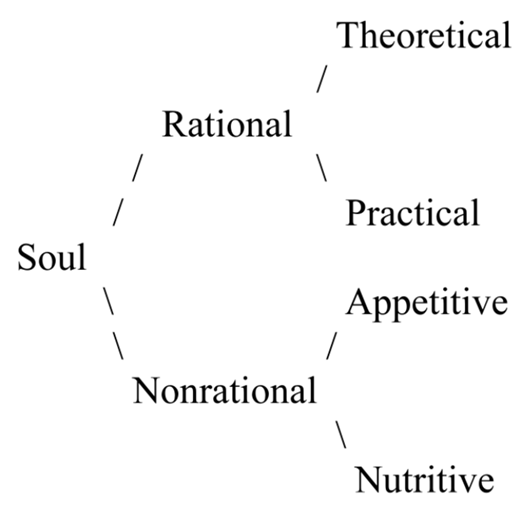
Theoretical reason Frankena also calls “scientific” and describes as “knowing that something is or is not the case.” Practical reason is “deliberative” and is “knowing what to do or how to do it” (Frankena, 1965, p. 26, emphasis in original). Activities of the appetitive part are “sensing, imagining, remembering, desiring, locomotion, [and] feeling various kinds of emotions,” whereas activities of the nutritive part include “digestion, growth, [and] reproduction” (Frankena, 1965, p. 26). The figure suggests the hierarchical ordering of the faculties, with theoretical reason as the most excellent, unique, and therefore most definitive capacity of the human. Significantly for Aristotle’s entire approach, it is in the exercise of theoretical reason, in contemplation, in the understanding, that happiness (eudaimonia), the highest form of human flourishing, is to be found (NE, X.7-8).
The nexus of the moral life, however, is in the interplay between the two “middle” parts, practical wisdom, on the one hand, and feeling and desire, on the other. As Cooper puts it, virtuous character is understood by Aristotle “as a certain unified condition of both feeling and reasoned judgment,” which makes Aristotelian virtues “properties of great psychological complexity and depth” (1999, p. 237; emphasis in original), since they are “dispositions not only to act in particular ways, but also to feel in particular ways.” Indeed, “to act virtuously is not, as Kant was later to think, to act against inclination; it is to act from inclination formed by cultivation of the virtues,” which makes moral education, in Aristotelian perspective, “an ‘education sentimentale’” (MacIntyre, 1984, p. 149). Frankena makes the same affirmation: virtuous character is “a single complex excellence [areté, virtue] which has two aspects, one a cognition of the proper ends, principles, and means of practical action, the other a fixed disposition to act accordingly for its own sake” (1965, p. 51; emphasis added). Similarly, according to Kosman, “Aristotle’s moral theory must be seen as a theory not only of how to act well but also of how to feel well; for the moral virtues are states of character that enable a person to exhibit the right kinds of emotions as well as the right kinds of actions” (1980, p. 104; emphasis in original).
To put a somewhat finer point on the claim, a “moral virtue … is the power to have and to avoid certain emotions, the ability to discriminate in what one feels” (Kosman, 1980, p. 107). As Aristotle says, “but to feel [the passions] at the right times, with reference to the right objects, towards the right people, with the right motive, and in the right way,… this is characteristic of virtue” (1106b21-23). Cooper takes it as a central claim of Aristotle’s moral psychology that “virtues of character belong [emphasis added] to what Aristotle calls the nonrational part of the soul … insofar [emphasis in original] as that part is capable of following reason” (1999, p. 251). Reason makes the difference, but the difference it makes is in feeling and desire. MacIntyre suggests just how fundamental an insight this is: “For the education of the passions into conformity with pursuit of what theoretical reasoning identifies as the telos and practical reasoning as the right action to do in each particular time and place is what ethics is about” (1984, p. 162).
Responsibility For Feelings
But is it not true that “one does not have direct control of one’s feelings” (Kosman, 1980, p. 112)? How can moral responsibility depend so heavily on something so slippery and for which we are at least not directly responsible? Is not the very idea of feelings or emotions (pathé, from which comes, by way of the Latin passus, the English “passive” and “passion”) that we are being acted upon? How can we be made responsible for something out of our direct control? How does the rational come to control or direct the nonrational? This takes us from Aristotle’s theory of moral psychology to his theory of moral education, but the connection could not be more intimate. As Broadie points out, according to Aristotle “the purpose of moral education is to render the nonrational part of the soul amenable to autonomous rational prescription” (1991, p. 104). Or as Verbeke puts it, “it is the proper duty of moral education to assist man in bringing his internal conflict or split to a balanced and enduring solution, a coherence under the direction of reason” (1990, p. 136). But how? “How does reason take hold on us so as to form and shape for the best the patterns of motivation and response which represent the child in us?” (Burnyeat, 1980, p. 86) The theoretical ground is cleared by remembering that, for Aristotle, “all the other emotions [except jealousy and hatred] may be subdued to reason and may contribute to the progress of moral behavior; in this sense the passions are not totally irrational; they may be controlled and directed by reason” (Verbeke, 1990, p. 141).
Stages of Moral Development
The short practical answer to the question, how can virtue be taught?, as we have already indicated, is that moral education proceeds by both habituation and instruction. Burnyeat’s more suggestive answer is that “what is exemplary in Aristotle is his grasp of the truth that morality comes in a sequence of stages with both cognitive and emotional dimensions” (1980, p. 70-71). Remembering that “the ultimate goal toward which the beginner’s practice is aimed is that he should become the sort of person who does virtuous things in full knowledge of what he is doing, choosing to do them for their own sake, and acting out of a settled state of character” (1980, p, 73; see 1105a31-35), Burnyeat gives us the following view of the process or stages of Aristotelian moral development:
You need a good upbringing not simply in order that you may have someone around to tell you what is noble and just … you need also to be guided in your conduct so that by doing things you are told are noble and just you will discover that what you have been told is true. What you may begin by taking on trust you can come to know for yourself. This is not yet to know why it is true, but it is to have learned that it is true in the sense of having made the judgment on your own, second nature to you… Nor is it yet to have acquired any of the virtues, for which practical wisdom is required … that understanding of “the because” which alone can accomplish the final correcting and perfecting of your perception of “the that” (1980, p.74; emphasis in original).
This process can be spelled out stage by stage as follows:5
Doing things you are told are noble and just;
Learning that, in your own judgment, these actions are indeed noble and just;
Learning why these actions are noble and just; and
Becoming practically wise and properly motivated (acquiring the virtues).
Stage 1 is the realm of guided practice and habituation. As Cooper puts it, a “virtue of character is brought into being by repeatedly feeling and acting precisely (or as nearly as possible) as, in the given circumstances, the person having the virtue would feel and act” (1999, p. 251). Kosman describes this stage succinctly and provocatively: “one becomes virtuous by impersonating a virtuous person” (1980, p. 112; emphasis added). Stage 2 is the result of spontaneous personal reflection on practice; “habituation cannot be a mindless process” (Broadie, 1991, p. 109). Given a chance, the noble and the just present themselves and can be recognized as intrinsically attractive. As Burnyeat says, “practice has cognitive powers” (1980, p. 73). Stage 3 begins the process of instruction by one who is him or herself a reflective practitioner, such as Aristotle in the Nicomachean lectures. Stage 3 can be engaged only by those with sufficient life-experience and incipient virtue born of proper upbringing (1095a3-13).
Stage 4 requires a deeper level not only of personal reflection but also of personal appropriation, of identifying oneself with the noble and just. By doing just acts we become just, not by mere habituation but only with the intervention, as it were, of intelligent reflection, our own and that of practically and intellectually virtuous others. As Kosman puts it, while it may be true that “one does not have direct control over one’s feelings … one does have control over one’s actions that establish the dispositions … which are the source of our feeling in appropriate ways at appropriate times and in appropriate circumstances.” Thus, “although we are not [directly] responsible for our feelings, we are responsible for our character as the dispositional source of those feelings” (Kosman, 1980, p. 112). Stage 4 represents personal identification with the noble and just and the acceptance of personal responsibility for one’s own character, of one’s feelings, desires, and motivations—in a word, for one’s moral self. But how is this identity achieved at the level of feeling and desire?
First Principle in Nature
According to Burnyeat, in Aristotle’s understanding of moral development, “the underlying idea is that the child’s sense of pleasure, which to begin with and for a long while is his only motive, should be hooked up with just and noble things so that his unreasoned evaluative responses [feelings] may develop in connection with the right objects” (1980, p. 80). The burden of Stage 1, in other words, is “the gradual development of good habits of feeling” (Burnyeat, 1980, p. 70). And the endpoint of moral development is the fully virtuous person for whom “nothing else will seem as pleasurable” (Burnyeat, 1980, p. 88) as attractive, as alluring—as tempting, one might say—as virtuous action.
It may be that at this point we cannot reach beyond what seems to be a foundational or first principle for Aristotle: “Now of appetites and pleasures some belong to the class of things generically noble and good—for some things are by nature worthy of choice” (1148a23-25). Humans are, also by nature, inclined toward the noble and the good, although, as the whole of the NE makes clear, this inclination—which is only that—must be educated. It is simply the case that for Aristotle the pleasures associated with the noble and just are the pleasures proper to human beings. But having reached this first principle does not mean we have said all there is to say about the Aristotelian understanding of moral development. The themes of shame and choice will take us more directly into a consideration of the moral self.
Shame
Aristotle describes shame, “a kind of fear of dishonour,” as “more like a passion than a state of character,” since “people who feel disgraced blush,” a bodily condition, “which is thought to be characteristic of passion rather than a state of character” (1128b11-17). The Ross translation subheading calls shame a “quasi-virtue” (NE, p. 104) and Burnyeat describes the feeling as “the semivirtue of the learner” (1980, p. 78). As Aristotle observes, “the passion is not becoming to every age, but only to youth,” and “we praise young people who are prone to [it] … for young people commit many errors but are restrained by shame.” Shame therefore “may be said to be conditionally a good thing” (1128b30) since it serves as a corrective at the all-important level of pathé in the process of becoming virtuous.
The burden of the argument seems to be that shame motivates a learner to try harder. It is superior to fear of punishment as a motivation since shameful “actions pain him internally, not consequentially. He is therefore receptive to the kind of moral education which will set his judgment straight and develop his intellectual capacities (practical wisdom) which will enable him to avoid such errors” in the future (Burnyeat, 1980, p. 79; emphasis added). Shame in the young is a sign that moral development is taking place, but in the mature a sign that moral development has faltered, since the virtuous person will not commit bad actions and will therefore have no cause to feel ashamed. The shame of the young person, however, is the appropriate affective response to having done unjust, ignoble—shameful— acts. It presents him or her with a choice of whether or not to recommit to “learning to be good” (Burnyeat, 1980, p. 69).
Shame would seem to be constitutive of Stage 2, of learning that the actions one has been practicing are indeed noble and just and that contrary actions are indeed ignoble and unjust in one’s own judgment, one’s “second nature” (Burnyeat, 1980, p. 74), one’s moral self. The feeling of shame makes this personal judgment possible. And the judgment calls for a choice about one’s future conduct.
Choice
“Virtue … is a state of character concerned with choice” (1006b36) and thus choice (prohairesis) is at the heart of Aristotelian ethics. And it is not just the obviously fateful choices that are significant, for “an Aristotelian theory of the virtues does not…presuppose a crucial distinction between what any particular individual at any particular time takes to be good for him and what is really good for him as a man. It is for the sake of achieving this latter good that we practice the virtues and we do so by making choices about means to achieve that end” (MacIntyre, 1984, p. 150). That choice and choices are central to Aristotele’s ethics is especially evident in his discussion of akrasia, incontinence or weakness of will, of knowing the good but doing the bad. “Socrates,” Aristotle reminds us, “was entirely opposed to the view in question, holding that there is no such thing as incontinence; no one, he said, when he judges acts against what he judges best—people act so only by reason of ignorance. Now this view plainly contradicts the apparent facts” (1145b26-28). An “incontinent man,” says Aristotle, “is like a city which passes all the right decrees and has good laws, but makes no use of them” (1152a20-21). An incontinent person “has the knowledge but is not exercising it” (1146b33), and so “must be said to be in a similar condition to (a person) asleep, mad, or drunk” (1147a18). One who acts incontinently is “out of his mind,” but is so by choice (at least if not clinically insane). It is the very definition of a virtuous person always to choose to act according to practical wisdom.
Virtue, to put it plainly, is a state of the whole self not merely a state of mind, and the difference is the settled disposition to choose the good and act on that choice, so that “the immediate outcome of the exercise of a virtue is a choice which issues in right action” (MacIntyre, 1984, p. 149). That requires, as we have seen, the education of the emotions, desires, and motivations through the four stages outlined, so that the Stage 4 virtuous person, in a strange twist of language, can be said to have no choice but to act virtuously, since the choice for a virtuous life has already been made at a deeper level. The continent person may do the right but only with a struggle (the same struggle the incontinent person loses), for the continent person does not take pleasure in virtue only, as does the virtuous. As Aristotle puts it, “both the continent man and the temperate man are such as to do nothing contrary to the rule for the sake of bodily pleasures, but the former has and the latter has not bad appetites, and the latter is such as not to feel pleasure contrary to the rule, while the former is such as to feel pleasure but not to be led by it” (1151b35-1152a4, emphasis added).
Eudaimonia, Virtue, and Self-Love
But what is it that the virtuous person is choosing in such decisions? Choice, for Aristotle, “is not a concept having to do with individual moments in an agent’s life, nor with individual single actions, but with the practices of that life within the larger context of the character and intentions of a moral subject, ultimately within the context of what it has become fashionable to call one’s life plan” (Kosman, 1980, p. 115). In each action, the virtuous person is choosing not just the good but eudaimonia; “the virtuous man is influenced every time, albeit sometimes unconsciously, by his conception of the good life” (Sorabji, 1980, p. 210). This is “moral choice in the deepest sense” (Kosman, 1980, p. 115). Through particular choices a “virtuous individual intends his own perfection or happiness” (Verbeke, 1990, p. 206). Like Plato, Aristotle criticizes “the simple sophistic picture of human desires. We have to ask not only what we do now in fact happen to want, but what in the long run and fundamentally we want to want” (MacIntyre, 1966, p. 87, emphasis added). According to Aristotle, it is only the virtuous person who can honestly affirm, “I want to be truly happy, to flourish as a human being.” For such a person, “moral virtue is an expression of faithfulness: a virtuous individual, having acquired firm moral habits, demonstrates that he remains faithful to his ethical ideals” (Verbeke, 1990, p. 145).
That is, there is no necessary contradiction in acting morally and in acting on behalf of one’s (moral) self. For example, “perhaps as well as choosing the courageous act because it is an instance of courageous conduct, the brave man can also be said to choose it as a means to his goal of continuing to be a courageous man” (Sorabji, 1980, pp. 202-203, emphasis added). The virtuous individual wants the best for herself just as she wants it for her friend, and does so out of a similar love. Indeed, as Aristotle himself says, “the defining features of friendship that are found in friendships to one’s neighbors would seem to be derived from features of friendship toward oneself” (1166a1; emphasis added). One cannot befriend or love another unless one has first befriended oneself. One cannot desire and act for the good of another unless one has first learned to desire and act for the good of oneself.
That is, “self-love is not the same as egoism” (Verbeke, 1990, p. 184). And yet, “it is a central Aristotelian claim … that the relation that the self has to itself has priority over its relations to others: virtuous conduct depends on the relation to the self which Aristotle terms ‘love of self’” (Chazan, 1998, p. 63, emphasis added).
And when everyone strains to achieve what is fine and concentrates on the finest actions, everything that is right will be done for the common good, and each person individually will receive the greatest of goods, since that is the character of virtue. And so the good person must be a self-lover, since he will both help himself and benefit others by dong fine actions. (1169a9-14).
It would seem that such love is the deepest foundation for both doing good for others and being good oneself, for both virtue and self-realization, as Aristotle conceives them, two complementary ways of describing human flourishing. For it is simply the case that for Aristotle the pleasures of virtue are proper to human beings and, as such, are worthy of our choice as objects of our deepest desire, commitment, and motivation. Especially in this context, one can see why Carr would contend that “all in all Aristotle provides us with an account of the structure of virtue and moral character that is quite without equal in moral philosophy” (1991. p. 60).
Summary
Can virtue be taught? Yes, says Aristotle, but only if we think of moral education as requiring both “sentimental education” (Kosman, 1980, p. 106) and cognitive education in dynamic relationship to each other, each brought into the developmental process at the right time, in stage-appropriate ways, by practically wise guides, mentors, and teachers. MacIntyre makes exactly this point: “We become just or courageous by performing just or courageous acts; we become theoretically or practically wise as a result of systematic instruction. Nonetheless these two kinds of moral education are intimately related” (1984, p. 154). Our telos (goal or end), the fully developed moral self capable of theoria, is “a unified condition of both feeling and reasoned judgment” (Cooper, 1999, p. 237, emphasis in original). And that is the character of human happiness, of the fully realized moral self, according to the Nicomachean Ethics. But that may not be the whole story.
Aristotle And Caring Relations
The influential contemporary feminist philosopher of moral education Nel Noddings (1984; Bergman, 2004a) has distanced herself form Aristotelian virtue ethics and aligned her caring perspective, in contrast, with a Humean emphasis on the moral sentiments. Virtues, she has said, are secondarily necessary to caring but caring is primary. She also distinguishes her relational ethics and theory of the relational self from the autonomous agent of virtue ethics. But what has been said earlier about the centrality of affective education and the importance of social interaction during childhood and youth in Aristotelian perspective suggests there may be more convergence between an ethics of care and an ethics of virtue than Nod- dings has recognized. I explore that possibility in this final section for its contribution to a coherent theory of the moral self and its education based in but expanding on the Nicomachean Ethics.
Steutel and Spiecker (2004, p. 531)6 observe that “according to the Aristotelian tradition of moral thinking and acting, any parent or teacher who takes moral education seriously should be engaged in the practice of cultivating the child’s feeling—his passions, inclinations, emotions, appetites, pains and pleasures.” The rationale is clear: “if the proper aim of moral education is the virtuous person, and if having proper feeling is partially constitutive of being virtuous, promoting proper sentimental dispositions will be an important task for moral educators” (p. 532). Furthermore, “it is up to us [as moral educators] to decide what kinds of and degrees of affection and sympathy we should cultivate in ourselves and encourage in our children” (p. 533; emphasis added).
In Aristotelian mode, such sentimental education implies habituation, and habituation “consists in (i) practicing the virtues, or, more precisely, performing those actions that correspond with virtuous sentimental dispositions, (ii) performing such actions frequently and consistently, and (iii) doing so under the guidance or authority of a virtuous tutor” (p. 536). The accents are certainly different, but this language (or the activities it refers to) will be familiar to those who have read Noddings. Noddings (i) emphasizes practice of the virtues that enable caring, (ii) doing so as a central and constitutive dimension of school life and (iii) in the context of the dialogical, modeling, and confirming relation of the adult to the child. While Aristotle apparently assumes at least a minimally caring relation between the adult and child, Noddings places it front and center. While Aristotle makes the virtues primary (but also instrumental to human happiness or flourishing), Noddings makes them secondary and instrumental to caring relations (which are themselves the source of human flourishing and happiness).
Steutel and Spiecker (p. 545) make the convergence (certainly not identity) between virtue and caring ethics more apparent by pointing out that “being a virtuous person not only implies having the intellectual virtue of practical wisdom; it also implies having the essentially moral virtues, and these virtues might best be construed in terms of particular cares or concerns” (emphasis in original). Such a care or concern “is a disposition that can be explained by subjunctive conditionals that relate the disposition to observable phenomena, including different kinds of affective response.”7 And “if there is a mutual loving relationship between the child and his tutor,… the child will experience the tutor’s positive affective responses as pleasurable and the negative affective responses as painful.” Moreover, echoing the emphasis on the ethical ideal in Noddings (1984; Bergman, 2004a) closely, “the tutor will function as a model,” and if the child “recognizes that his behaviour is contrary to the ideal set by his tutor, he will feel ashamed or be angry with himself, and when he succeeds in approximating the ideal, he will feel pleased or respond with feelings of pride, which may stimulate further moral growth” (p. 545; emphasis added).
Whereas our discussion of Aristotle has emphasized the role of shame (failure to live up to the ethical ideal), and whereas Noddings emphasizes the role of confirmation (keeping the child in positive relation with her own best self even in moments of failure), it may be, as Steutel and Spiecker suggest, that both are necessary to moral development, whether conceived as growth in the virtues or as growth in the capacity to care. Too radical a shame may demoralize; too glib a confirmation may undermine accountability.
Without mentioning Noddings by name as a possible corrective or complement, Steutel and Spiecker do explicitly seek to expand on Aristotle’s own conception of moral education in a direction congenial to Noddings. They write that “according to Aristotle, doing the virtuous things frequently and consistently is in itself an effective way of cultivating virtuous sentimental dispositions.” Steutel and Spiecker argue, however, that “it is hard to conceive how acting as virtue requires on a regular and consistent basis could in itself be an effective way of boosting the growth of affective dispositions where these are deficient,” and they stress, alternatively and in a caring vein, “the importance of the role of the tutor, probably much more than Aristotle would be inclined to do” (p. 546). Noddings would agree with this emphasis on the affective or sentimental (which she sees emphasized in Hume but not in Aristotle) and on the relational role of the caring adult, and so might acknowledge a closer affinity than she has heretofore between Aristotelian moral education, as interpolated by Steutel and Spiecker, and her own pedagogy of care.
To reiterate, but within an expanded understanding of the importance of adult-child relations, Aristotelian moral education is both rational and sentimental, cognitive and affective, deliberative and desiderative. It is directed by wise, just and caring adults to both the mind and the heart, the full moral self, of the developing child.
Notes
All page citations in this section, unless otherwise indicated, are to Nucci (2001).
I owe to Nel Noddings (2002, chap. 5) the notion of the self (as a relation) always under construction.
For an award-winning Festschrift on “Blasi’s monumental contribution to moral, personality, and developmental psychology” (p. viii), see Lapsley and Narvaez (2004).
In this reconceptualization of moral character, of shifting the language of moral education from character to self, the traditional vocabulary will often reassert itself. The point is not to discard the term character but to rethink it
Neither Burnyeat nor the present author means to suggest that in NE one finds “hard” developmental stages—discretely structured and invariant—as theorized by twentieth-century researchers such as Piaget and Kohlberg. It may be appropriate to think of the Aristotelian stages as more prescriptive and pedagogical than descriptive and developmental, although there is certainly overlap.
All page citations in this section, unless otherwise indicated, are to Steutel and Spiecker (2004).
“Subjunctive conditionals” is analogous to Nucci’s “’if-then’ propositions.

