


This study examined the effectiveness of a multicomponent psychoeducational prevention program (EQUIP for Educators) Two aspects were examined: (1) if there was a significant relationship among the three psychometric measures: Social Skills Rating System (SSRS), Children’s Inventory of Anger (ChIA), Sociomoral Reflection and Measure-Short Form (SRM-SF); and (2) if the treatment (EQUIP for Educators) and control groups differed on the SSRS, ChIA, and the SRM-SF, from pretest to posttest, and if these effects were different by levels of achievement. This exploratory study was a first attempt to expand EQUIP for Educators from a treatment-only program to a treatment-and-academic-learning program. Subjects (N = 45) aged 10.1–11. 8 years (M = 10.9) participated in this 10-week study. A quasi-experimental 2 X 2 X 2 repeated measures MANOVA was conducted. A Pearson’s product-moment correlation was conducted to examine the statistical correlation of 3 dependent variables: (1) SSRS; (2) ChIA; (3) SRM-SF. Results of the Pearson r analysis indicated statistically significant correlations between the SSRS, ChIA, and the SRM-SF (p < .05). A statistically significant multivariate effect for the Time X Group interaction was found (p <. 001, ES = .86). Further, a statistically significant multivariate main effect for achievement was found across the dependent variables (p < .001, ES = .56). The univariate 2 X 2 ANOVA for the Time X Group interaction evinced statistically significant results for the social skills (p <. 001, ES = .77), anger management (p < .001, ES = .59) and the sociomoral reasoning (p < .001, ES = .46). EQUIP for Educators treatment was effective in equipping behaviorally at risk students with: (a) skills for managing anger and correcting cognitive distortions; (b) social skills for constructive social behavior; and (c) remediating development delay in moral judgment. Results suggest that EQUIP for Educators had an impact on cognitive distortions, social skills deficiencies, and sociomoral delays. Implications and recommendations for use of multicomponent prevention programs are discussed
Increasing numbers of students enter school possessing well-developed patterns of aggressive, oppositional, and disruptive behavior (Lane, Wehby, & Barton-Arwood, 2005; Latimer, Kleinknecht, Hung, & Gabor, 2003; Tremblay, 2006). If these children fail academically and have persistent patterns of escalating antisocial behavior over the primary and intermediate grades, they may become candidates for school dropout (Bullis, Walker, & Sprague, 2001). It is important that students be provided with the opportunity for full engagement with the schooling process and bonding-attachments to it, which can serve as powerful protective factors, and may buffer and offset these outcomes. Research on behaviorally at-risk children has confirmed the hypothesis that early factors are salient predictors of delinquency (Bullis et al., 2001; Crews, Bender, Cook, Gresham, Kern, & Vanderwood, 2007; Forness, Kavale, MacMillan, Asarnow, & Duncan, 1996; Gulchak & Lopes, 2007; Kauffman & Landrum, 2009; Lane et al., 2005; Latimer et al., 2003; Powell, Dunlap, & Fox, 2006; Severson, Walker, Hope-Doolittle, Kratochwill, & Gresham, 2007; Walker, Ramsey, & Gresham, 2004).
Specifically, findings have evinced that this population of students becomes extremely resistant to intervention with increasing age (Gibbs, Potter, DiBiase, & Devlin, 2009; Lane et al., 2005; Walker et al., 2004). There is limited opportunity to intervene with effective results, given that stability of antisocial behavior increases dramatically over time (Bullis et al., 2001; Hood, 2002). Thus, there is a need for proactive support and early intervention to meet the needs of behaviorally at-risk students. Moreover, if antisocial behavior patterns are not addressed early on, these children tend to experience numerous long-term negative consequences such as academic failure, impaired social relationships, escalating rates and forms of aggressive behavior, substance abuse, and delinquent behavior (Bullis et al, 2001; Crews et al., 2007; Dunlap et al., 2006; Lane, 1999; Lane et al., 2005; Powell et al., 2006). Such negative consequences collectively result in substantial costs to society and to the individual students themselves (Coie & Jacobs, 1993; Dodge, 1993; Kazdin, 1987; Lane et al., 2005; Latimer et al., 2003; Tremblay, 2006).
Recent events of school shootings, increase in criminal adjudication, and an escalation of aggressive behavior among youth, have galvanized public concern, augmenting the issue of antisocial behavior of youth to a national health care issue. Specifically, societal pressure for extensive investments in evidence-based programs has resulted in a stronger emphasis on prevention and acceptance of the contention that proactive screening of difficulties early in their developmental trajectories are essential to later successful outcomes (Report of the Alliance for School Mental Health, 2005). Severson, Walker, Hope-Doolittle, Kratochwill, and Gresham (2007) argue for proactive universal screening of behaviorally at-risk students, who may be on a trajectory to later destructive outcomes, due to the risk factor exposure in the first 5 years of life. These particular students present moderate to severe behavioral challenges to their teachers, peers, and caregivers.
Given the multifaceted nature of antisocial behavior patterns, intervention programs should be multimodal, including: social skills training, ethical responsibility and moral development, anger management, and problem solving (Bullis et al., 2001; Hood, 2002; Lane et al., 2005). EQUIP for Educators: Teaching Youth (Grades 5-8) to Think and Act Responsibly is a multicomponent prevention program that seeks to proactively address three core limitations for the behaviorally at-risk students: (1) social skills deficiency correction, for balanced and constructive social behavior (social skills); (2) skills for managing anger and correcting self-serving cognitive distortions (anger management); and (3) developmental delays in moral judgment (social decision making). At the core of these limitations is pronounced egocentric bias or self-centred orientation. Accordingly, learning to take the viewpoint of others should then be a prominent theme in prevention programs. This study investigated psychoeducational prevention program (i.e., EQUIP for Educators) that seeks to remediate the deficiencies, delays, and distortions for behaviorally at-risk youth (DiBiase, Gibbs, & Potter, 2005). For the purpose of this study behaviorally at-risk is operationally defined by social skills deficiencies, cognitive distortions and delays in moral judgment. Within this definition, includes a spectrum of specific risk factors for antisocial behaviors, which are aggressive, and have in common transgressions against societal norms. Specific at-risk antisocial behaviors include: lying, truancy, fighting, vandalism, and theft.
Aggressive behavior is typically quite difficult to change; at-risk youth are often resistant to intervention (Bullis et al., 2001; Gibbs et al., 2009; Gibbs, Potter, DiBiase, & Devlin, 2008; Gibbs, Potter, & Goldstein, 1995). For many children, its success is frequent, its rewards are generous, and its punishments are few. Of critical importance is the complex character of aggression. Aggression is an overt behavior often employed by those lacking prosocial alternatives. It is frequently initiated by anger stemming from the child’s cognitive perceptions of the interpersonal world (DiBiase et al., 2005; Gibbs et al., 2008; Gibbs et al., 2009; Gibbs et al., 1995; Goldstein, 1991). Aggression is given sustenance by the emotional arousal such cognitions usually generate. Aggression is, then, simultaneously a behavioral, cognitive, and emotional phenomenon. Hence, interventions that seeks to address aggression, must account for the multifaceted composition of aggression.
The School’s Role in Aggression
Schools are faced with a salient dilemma of working with students with externalizing behavior patterns. This quandary has several contributing aspects. First, due to the educational system’s intermittent, reactive approach to addressing behavior problems and a lack of definitional clarity (Forness, 1992; Gulchak & Lopes, 2007; Kauffman & Landrum, 2009; Latimer et al., 2003; Skiba & Grizzle, 1992; Slenkovich, 1992), numerous students with behavior disorders go unidentified and, consequently, unserved during the early years of their educational career. Part of this delay in identification may be due to the limitation of available resources for psychoeducational assessment and diagnosis. That is, school boards may have limited funds available for completing the needed psychoeducational assessments, and hence wait times for assessments can be extensive (Gulchak & Lopes, 2007; Kauffman & Landrum, 2009; Severson et al., 2007). Specifically, Latimer et al. (2003) found this reactive approach is evidenced in the increasing rates of delinquency. Services for students with antisocial behavioral patterns are often delayed until a learning disability is identified or until significant underachievement is obvious (Lane, 1999; Lane et al., 2005; U.S. Department of Education, 2002).
Second, research has shown that this population of students becomes extremely resistant to intervention with increasing age (Bullis et al., 2001; Gibbs et al., 2009; Kazdin, 1987; Walker, Colvin, & Ramsey, 1995). There is limited opportunity to intervene with effective results, given that the stability of antisocial behavior increases dramatically over time (Hood, 2002; Lane et al., 2005; Severson et al., 2007). Thus, proactive and early prevention efforts aimed at preventing behavioral disorders, is preferable to remediation efforts (Lane et al., 2005). Moreover, if antisocial behavior patterns are not addressed early on, these children tend to experience numerous long-term negative consequences such as academic failure, impaired social relationships, escalating rates and forms of aggressive behavior, substance abuse, special education and mental health services, and delinquent behavior (Crews et al., 2007; Chandler, Chapman, Rand, & Taylor, 1998; Gulchak & Lopes, 2007; Lane, 1999; Lane et al., 2005). Such negative consequences collectively result in substantial costs to society and to the individual students.
Cognitive-Developmental Theory and Antisocial Behavior
Cognitive-developmental theory (e.g., Kohlberg, 1984) posits a primary role for cognition in the motivation of moral or antisocial behaviors. According to this theory, antisocial behavior is attributable, at least in part, to sociomoral developmental delay—that is, the persistence beyond early childhood of (1) immature or superficial moral judgment; and (2) a pronounced degree of egocentric bias (DiBiase et al., 2005; Gibbs et al., 1995; Higgins, 1995; Kohlberg, 1971; Kohlberg & Higgins, 1987; Power, Higgins, & Kohlberg, 1989). Cognitive-developmental interventions attempt to provide social perspective-taking opportunities that address both of these aspects of sociomoral developmental delay. EQUIP for Educators is a prevention program that addresses the sociomoral developmental delay of behaviorally at-risk children and uses the Kohlbergian stages (1984) of moral development as a frame of reference for development. I argue that the prevention rationale of antisocial children should entail remediation of this developmental delay. In theoretical terms, moral judgment-delayed children need an enriched, concentrated opportunity for social-perspective-taking, to stimulate an age-appropriate level of moral judgment. In EQUIP for Educators, peer group discussions of sociomoral dilemmas are a stimulus for perspective-taking experiences.
Another aspect of the sociomoral developmental delay of children at risk for antisocial behavior is the persistence, into adolescence, of a strong egocentric bias, a natural feature of thought and behavior in early childhood. Likona (1983, 2004) characterizes the general orientation of the young child as “whatever I want is what’s fair” (p. 91). Piaget (1932/1965) and Flavell, Miller, and Miller (1993) suggested that egocentric bias is pronounced in early childhood because interchanges with peers and others have not yet prompted children to decenter from their own salient needs or impulses. Antisocial youth’s egocentric bias has remained at the pronounced levels characteristic of childhood. Specifically, if the developing child’s egocentric bias persists, it tends to become consolidated into a primary cognitive distortion (DiBiase et al., 2005; Gibbs et al., 2009; Gibbs et al., 1995). Pronounced egocentric bias and primary cognitive distortions are the basic conflicts of the antisocial youth. Accordingly, learning to take the viewpoint of others should then be a prominent theme in intervention programs.
Limitations of the Behaviorally At-Risk Youth Contextualized in a Prevention Program
Behaviorally at-risk students have multiple needs in the social and cognitive domains; effective remediation of these comorbid skill deficits can be addressed in a multicomponent prevention program. Bullis et al. (2001) indicated that three meta-analyses of the efficacy of social skills intervention studies produced magnitude of treatment effects averaging 0.35. This effect size defines weak to moderate treatment outcomes for social-skills-only treatment intervention. Hence, the need for multicomponent interventions that address the multifaceted needs of the behaviorally at risk students. EQUIP for Educators aims to arrest three fundamental limitations of behaviorally at-risk students: social skill deficiencies, socio-moral developmental delays, and social cognitive distortions. These limitations are interrelated, and so are the components of EQUIP for Educators. The three components of EQUIP for Educators can remedy these delays, distortions, and deficiencies by equipping at-risk students with: (1) skills for balanced and constructive social behavior (social skills); (2) skills for managing anger and correcting self-serving cognitive distortions (anger management); and (3) mature moral judgment (social decision making). Remedying moral judgment delay, cognitive distortions, and social skills deficiencies are at the heart of the EQUIP for Educators psychoeducational curriculum.
DiBiase et al. (2005) interprets at-risk students’ superficial and egocentric moral judgment in terms of stage development. That is, moral judgment maturity culminates in a natural direction of development identified by Piaget (1932/1965) and Kohlberg (1984). Moral maturity includes mutual caring, respect, or trust—what Piaget (1932/1965) called “ideal reciprocity or do as you would be done by” (p. 323). The superficiality of moral judgment developmental delay is egocentric. If moral judgment develops through taking and coordinating the perspectives of others, then the developmental delay of many at-risk students should not be surprising. EQUIP for Educators provides enriched, concentrated perspectives-taking opportunities to stimulate age-appropriate or mature level of moral judgment.
Delay in development of moral judgment is but one limitation of the behaviorally at-risk youth. Self-centered attitudes are most aptly depicted as distortions. Impulsivity and other cognitive deficiency-related problems may not lead to consistently antisocial behavior unless cognitive distortions are also present (Gibbs et al., 1995). In EQUIP for Educators, (within the anger management component) there is an emphasis on overcoming self-centred attitudes at the level of both the group (promoting a positive student culture) and individual (by promoting social perspective taking). Specifically, direct and prescriptive intervention strategies, are delineated in EQUIP for Educators, rather than merely proposing an alternative attitude. Facilitation of the correction of, at-risk students’ self-serving cognitive distortions or thinking errors, is central this psychoeducational program. Moreover, the development of appropriate social skills is of paramount importance to the displacement of aggression and the development of perspective taking (DiBiase et al., 2005).
Equipping Youth to Engage in Social Perspective-Taking
Attitudes of inflated self-esteem, entitlement, and immediate self-gratification (e.g., “If I like something, I take it!”) are evident in those three socially problematic D’s: egocentric bias in developmental moral judgment delays, self-serving cognitive distortions of anger, and imbalanced behavior that disrespects others (i.e., threats or put downs) in the deficiencies of social skills (Gibbs et al., 2009; DiBiase et al., 2005). The group should convert its culture from self-centred to mutual caring, and so too, should the individual student convert from superficial centration upon self to a deeper, decentered stance that respects the view points of others (Gibbs, 2009). Accordingly, a fundamental theme that pervades all three components of the EQUIP for Educators program is becoming less self-centered—spontaneously taking the perspective of others. Remediating self-centered attitudes with social perspective taking is central to the anger management component. Here students are taught perspective taking to use in frustrating or provocative situations. For example, the use of positive self-talk such as “I can’t always expect people to act the way I want them to.” Social perspective taking is at the heart of the social skills component EQUIP for Educators. Perspective taking is implicitly and explicitly facilitated in the social skills activities. For example, in Skill 9 (Dealing Constructively with Someone Accusing You of Something), students are invited to think what the other person is accusing them of, and consider whether they are right. In the social decision making component, social perspective taking opportunities are provided through discussion. For example, consider Angelo’s Problem Situation, concerning whether Angelo should join a friend in stealing from a car. After students role-play the situation, they discuss the problem situation in a way that remediates egocentric bias—that is, that promotes mature morality, as well as positive social culture (DiBiase et al., 2005).
Equipping Youth to Correct Their Cognitive Distortions
Self-centered attitudes are fundamental to the at-risk students who comprise negative peer cultures (Gibbs et al., 2009; Gibbs et al., 2008). Specifically, self-centered attitudes manifest in egocentric biases (in the context of moral judgment) and disrespectful imbalances (in social skill deficiencies). Yet, within the context of the anger management component, self-centered attitudes are appropriately depicted as distortions. Self-centered attitudes are not just “different” or “right for them”; they are distorted (erroneous, inaccurate, nonveridical, faulty) (DiBiase et al., 2005). Self-Centered is the primary self-serving cognitive distortion or thinking error. Gibbs et al. (1995) define this errors as: “According status to one’s own views, expectations, needs, rights, immediate feelings, and desires to such an extent that the legitimate views of others (or even one’s own long-term best interest) are scarcely considered or are disregarded altogether” (p. 108). Self-Centered is a key risk factor for aggression and other antisocial behaviors.
Yet, Self-Centered is not the only thinking error. To continue a Self-Centered attitude and antisocial behavior, the at-risk student typically develops protective rationalizations, or what is coined as secondary cognitive distortions (DiBiase et al., 2005; Gibbs et al., 2009). The negative peer culture’s in-your-face counter-norms (described by Kohlberg) illustrate these secondary thinking errors. Disparaging caring as “sissy” or praising behavior that harms others as “cool” illustrates Minimizing/Mislabeling one’s destructive behavior; “Look at me the wrong way and you’re in for a fight” illustrates Assuming the Worst about others’ intentions; and “It’s your fault if something is stolen—you were careless and tempting me” illustrates Blaming Others for one’s own irresponsible behavior. When we help the students to correct their thinking errors, we are helping them to refute the rationalizations that block or neutralize their empathy for actual or prospective victims (DiBiase et al., 2005). Correction of thinking errors, then, is a crucial precondition to social perspective-taking.
Rationale, Significance and Contribution to Knowledge
Children with behavioral disorders are: (1) more likely to come into contact with the juvenile justice system; and (2) more likely to be incarcerated (Health Canada, 2001; Hood, 2002; Leone, Rutherford, & Nelson, 1991; Report of the Alliance for School Mental Health, 2005; U.S. Department of Education, 2002). Substantive research validates a relationship between children with behavioral disorders and an increased risk for subsequent involvement in antisocial behavior (Biederman et al., 1996; Bullis et al., 2001; Crews et al., 2007; Gulchak & Lopes, 2007; Hechtman, 1996; Lane et al., 2005; MacDonald & Achenbach, 1996; Severson et al., 2007). Aggressive behavior measured from ages 6 to 13 consistently predicts later violence among males (Enebrink, Langstrom, & Gumpert, 2006; Latimer et al., 2003; Schaeffer et al., 2006).
Several researchers have noted the continuity in antisocial behavior from early aggression to violent crime (Hawkins et al., 2000; Loeber, 1990, 1996; Loeber & Hay, 1994; Olweus, 1979; Tremblay, Masse, Pagani, & Vitaro, 1996; Wasserman, Miller, & Cothern., 2000). Although serious delinquency often reaches its apex during adolescence, the onset of delinquent and antisocial behavior occurs much earlier for most offenders (Hawkins et al., 2000; Thornberry, 1994). Well-designed prevention programs for children with developmental lags or early indications of behavioral problems, can preempt a host of subsequent difficulties (Bullis et al., 2001; Severson et al., 2007).
The children in classrooms, who are the most disruptive and those with behavioral disorders, are likely to have problems that have originated in abuse, neglect and exposure to violence in their families (Kauffman & Landrum, 2009). These children are difficult to manage and their poor behavior can be disruptive in classrooms and dangerous to peers. Yet, these children can be understood and assisted from a cognitive frame of reference, which addresses their cognitive deficits. Investments to support teachers in the early identification and timely remediation of behavioral difficulties can preempt chronic learning difficulties, educational failure and the consequential slide into delinquency (Bullis et al., 2001; Kauffman & Landrum, 2009; Wasserman et al., 2000). This is precisely what EQUIP for Educators, as a psychoeducational, prevention program seeks to remediate, cognitive deficits.
Youth require sustained, multicomponent, effective prevention (Bullis et al., 2001; Dishion & Kavanagh, 2000). Goldstein, Glick, and Gibbs (1998) argue for the potency of multifaceted preventions. Behavior change may result from preventions which are: explicitly targeted an overt behavior; seek to diminish emotional responses; inhibit use of behaviors existing in the individual’s behavioral repertoire; and provide information about the consequences of alternative behaviors (Goldstein et al., 1998). The source and maintainers of aggression are diverse and multichanneled. EQUIP for Educatorsaddresses this multicomponent approach: (1) social skills (behavioral component); (2) anger management (affective component); and (3) moral judgment (cognitive component). Bullis et al. (2001) argues that interventions for behaviorally at-risk children are often insufficient in duration and intensity (i.e., weeks rather than months). Alternatively, Bullis et al. (2001) contends that multicomponent interventions are more powerful and produce more robust outcomes with their target populations, than single component (e.g., social skills) programs applied in isolations. The researcher in the present study inculcates this contention by implementing a multicomponent intervention (i.e., EQUIP for Educators) over the course of 10 weeks.
The present study augments and extends the existing body of research on aggressive behavior and youth. Leeman, Gibbs, and Fuller (1993) evaluated a multicomponent group treatment program for juvenile delinquents and youths with antisocial conduct disorders. The subjects exposed to the multicomponent intervention program evidenced significant improvements in instructional conduct and recidivism rates, with some gains in social skills. Moreover, evaluations have been conducted on Goldstein’s et al. (1998) Aggressive Replacement Therapy (ART), yet, these evaluations have been conducted primarily in limited security delinquency facilities, residential school and treatment facilities, and youth centers. This empirical study was a first attempt to expand EQUIP for Educators from a treatment-only program to a treatment-and-academic-learning program.
Equip for Educators as a Prevention Program
EQUIP for Educators is dedicated to the aim of prevention in either the primary or secondary sense:
Primary Prevention is directed toward meeting the needs of the majority of the school population (80%). Students in this group do not have serious behavior problems…. However, given certain circumstances…this group may act out. The need at this level is for university interventions, or school wide systems that target all students…. Secondary Prevention (targets) students with at-risk behaviors. This group has not responded sufficiently to primary prevention efforts and may comprise 15% of our student population…. Finally, Tertiary Prevention … is necessary for students (5%) whose patterns of behavior are more intense and chronic. (McGinnis, 2003, p. 163)
In these terms, EQUIP for Educators is dedicated to prevention that is either: (a) primary, with the sometimes-acting-out 80% (requiring a universal intervention or one that targets all students at a particular grade); or (b) secondary, with 15% of students who already evidence at-risk behaviors. In the present study a combination of both primary and secondary prevention characteristics were exhibited by the sample participants.
Prevention curricula, programs, and strategies abound. The U.S. Department of Health and Human Services (Thornton, Dahlberg, Lynch, & Baer, 2000) and the U.S. Justice Department (Office of Justice Programs, 2000) provide sourcebooks of school-, home-, and community-based strategies for preventing youth violence. Preventative character education in the elementary school is stressed at the Center for the Fourth and Fifth R’s (Lickona, 2004), and other centers, programs, or projects (Berkowitz & Bier, 2006). Sharing EQUIP’s heritage from Arnold Goldstein’s and colleagues’ Aggression Replacement Training (Goldstein et al., 1998) and PREPARE Curriculum (Goldstein, 1999) are educational resources available from the Center on Positive Behavioral Interventions and Supports (McGinnis, 2003), the Collaborative Intensive Community Treatment Program (Amendola & Oliver, 2003), and the Center for Safe Schools and Communities (Salmon, 2003).
EQUIP for Educators is based on the premise program that behaviorally at-risk children will help one another effectively—and in the process help themselves—only if they and their group are equipped with certain skills and techniques. EQUIP for Educators remediates social skill deficiencies, sociomoral development delays, and social cognitive distortions and renders the mutual help meeting more profound by requiring group members to report their underlying cognitive distortions or thinking errors. Equipment sessions are based on a coordinated curriculum that deals with moral education, anger management/correction of thinking errors, and social skills.
Program Component One: Equipping With Skills to Manage Anger and Correct Thinking Errors
The focus of the anger management component of EQUIP for Educators is to facilitate skills for managing anger and correcting self-serving cognitive distortions. For example, students are taught techniques like deep breathing and peaceful imagery. The anger management curriculum component becomes more direct and specific as the sessions progress. The early sessions provide students with the opportunity to step back and learn about anger and aggression “from a distance.” The students learn, for example, the key role of the mind in creating the storm of anger and violence, monitoring and correcting thinking errors, and relaxation and self-talk techniques. With each week, as the students become more objective and less defensive, the teaching applies more specifically to their own aggressive behavior and its consequences. Since correcting thinking errors is central to responsible thinking and behaving, thinking error vocabulary is taught before the curriculum component sessions begin (DiBiase et al., 2005).
There are four main thinking errors, which are facilitated throughout the EQUIP for Educators curriculum. First, is the Self-Centred thinking error, which includes students thinking that their opinions and feelings are more important than those of others; thinking about what the students want and not thinking about how their behaviors will affect their future or others. Second, is the Minimizing/Mislabeling thinking error, which includes students thinking that their problems or behaviors are not as wrong or harmful as they are. Students put a label on their negative behavior to make it sound okay or good, or they describe someone with a bad name (e.g., snitch) so it will seem okay to hurt the person. Third, is the Assuming the Worst thinking error. This thinking error includes the student thinking that everyone is out to get them (or someone else). For example, if someone accidentally bumps into the student in the hall, they assume the person did it on purpose instead of thinking it was an accident. Assuming the Worst means that students will think only bad things can happen to them and the students cannot do anything about such negative occurrences. Moreover, Assuming the Worst can include that students think you or other people will not be able to change, or improve or do anything to remediate the negative life occurrences. Forth, is the Blaming Others thinking error. Here, students do not take responsibility for their own behavior; rather they blame other people for harmful behavior when it is really the student’s fault. Students may think that they can harm innocent others—that they deserve it because people in the past treated them poorly (DiBiase et al., 2005). In this curriculum component, students use Self-Help Behavioral Logs to track their behavior and thinking errors (DiBiase et al., 2005).
Program Component Two: Equipping With Social Skills
The focus of the social skills component, of EQUIP for Educators, is social skills deficiency correction, for balanced and constructive social behavior. A student who deals with negative peer pressure by suggesting a constructive alternative activity illustrates the use of social skills, as does the student who calmly offers clarification or apologizes to an angry accuser. Within the social skills curriculum component, students are provided with other social opportunities including: expressing a complaint constructively, caring for someone who is sad or upset; keeping out of fights; preparing for a stressful conversation; expressing care and appreciation; and responding constructively to failure (DiBiase et al., 2005).
Teaching the steps involved in social skills or balanced and responsible interpersonal behavior is the focus of this curriculum component. Social skills are typically learned in the context of the four phases. Such phases include: (1) showing (modeling) the skills; (2) trying the skill (enactment); (3) discussing the skill (feedback); and (4) practicing the skill. These four phases (following the introduction to the skill being taught) constitute the teaching format for each of the 10 sessions in the social skills component of EQUIP for Educators. Through whole group discussion and work in student triads, students engage in role-playing and small and large group discussion of the different social skills (DiBiase et al., 2005).
Program Component Three: Equipping With Mature Moral Judgment (Social Decision Making)
The Social Decision Making component of EQUIP for Educators focuses on developmental delays in the moral judgment of behaviorally at-risk students. Delays are the third “D” addressed in EQUIP for Educators, the other “D’s” being self-serving cognitive distortions, and social skills deficiencies. At the heart of the three D’s are self-centered attitudes, central to antisocial behavior. Accordingly, central to EQUIP for Educators is the remediation of self-centeredness through the inculcation of social perspective taking skills. For anger management, the teaching of skills for identifying and correcting self-serving thinking errors is particularly germane to this issue. For equipping students with social skills, inculcating social perspective taking means, in part, teaching students to include thinking of others as a step among other steps comprising balanced and constructive social behavior. Remedying moral judgment delays of behaviorally at-risk students is just as important as remedying students’ cognitive distortions and social skills deficiencies.
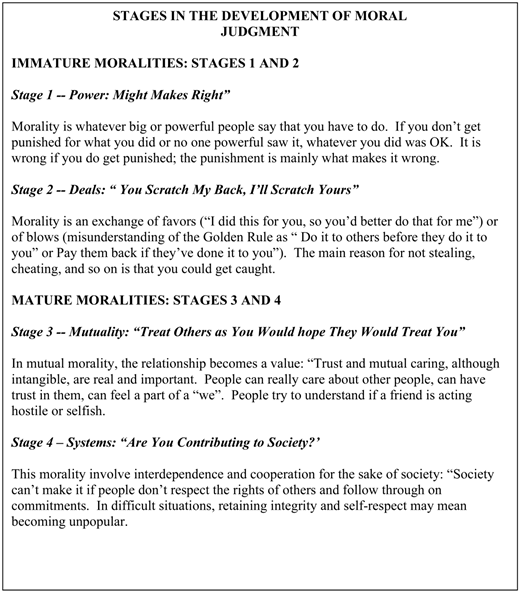
Moral judgment pertains to both the evaluation and the justification of decisions and values pertaining primarily to the right (fairness and justice) and the good (empathy and caring) of human social life (Gibbs, 2009). We interpret at-risk students’ superficial and egocentric moral judgment in terms of state development. In this part of the EQUIP curriculum, the “equipping” moral judgment maturity culminates in a natural direction of development identified by Piaget and Kohlberg (Gibbs, 2009). Our adaptation from Kohlberg’s (1984) stage model of moral judgment development is depicted in Figure 1.
Stages in the Development of Moral Judgment
Stages in the Development of Moral Judgment
Mature maturity has to do with mutual caring, respect, or trust—what Piaget (1932/1965) called “ideal reciprocity [or] do as you would be done by” (p. 323)—whether on the scale of interpersonal relationships (Stage 3) or social systems (Stage 4). The immature stages are superficial insofar as they confuse such moral ideals with physical power (Stage 1) or pragmatic deals and advantages or disadvantages (Stage 2). And the superficiality of moral judgment development delay is egocentric. That is, a superficial reason focuses on something immediately salient (e.g., jail) and the immediate desires or impulses of the ego. In the context of moral judgment delay, self-centered attitudes are egocentric biases (DiBiase et al., 2005).
If moral judgment develops through taking and coordinating the perspectives of others, the developmental delay of many at-risk students should not be surprising. Accordingly, the problem situations and procedures in the moral judgment component of the EQUIP for Educators curriculum provides an enriched, concentrated dose of perspective taking opportunities to stimulate the delayed students to catch up to an age-appropriate or mature level of moral judgment. The students must justify their decisions in social problem situations set in school, work, home, and other contexts. As others’ perspectives are considered in their own right, superficial judgments give way to the construction of more ideal moral understanding. Discussion of the situations is designed to stimulate perspective taking and hence a deeper understanding of the reasons for moral values or decisions such as telling the truth, keeping promises, not stealing or cheating, having honest peer and family relationships, resisting drugs, and preventing a suicide or school shooting (DiBiase et al., 2005).
The potential of the problem situations to stimulate perspective taking is exploited through their associated probe questions. Some of the probe questions ask students to imagine that the victim of an antisocial act is their sister or another family member—and then to consider whether the act is any less wrong if the victim happens to be a stranger. In addition to the stimulation from the probe questions, challenges to take the perspectives of others are also provided through the format of the class session. The discussion format proceeds through four phases: (1) introduction to the problem situation; (2) cultivating mature morality; (3) remediating developmental delay; and (4) consolidating mature morality.
There were two main purposes of this study. The first purpose was a seminal implementation of a psychoeducational multicomponent prevention program (EQUIP for Educators), which considered the following elements: (1) the limitations of children at risk for antisocial behavior; and (2) skills to equip children with the skills they need to think and behave in ways that are positive rather than harmful to themselves and others. The second purpose of this study was to evaluate the effectiveness of EQUIP for Educators, with regard to remediating the limitations of the behaviorally at-risk students.
Research Questions
The general research questions for this study were: (1) Is there a relationship between the three psychometric measures, Social Skills Rating System (SSRS), Sociomoral Reflection Measure Short-Form (SRM-SF), and the Children’s Inventory of Anger (ChIA)?; and (2) Do the groups (Treatment—[EQUIP] and Control) differ on the Social Skills Rating System, Children’s Inventory of Anger, and the Sociomoral Reflection Measure-Short, from pretest to posttest, and are these effects different by levels of achievement.
Method
Subjects
The total sample consisted of 45 participants (20 female and 25 male). The chronological age range of the subjects is 10.1 to 11.8. The mean chronological age of the subjects was M = 10.95 years. The total sample consisted of 5th graders (22 treatment and 23 control). Twenty-two subjects constituted the EQUIP for Educators treatment group and the control groups included 23 subjects. The racial distribution of this sample was 100% Caucasian. The average SES, as measured by the revised Duncan scale (Stevens & Featherman, 1981) (M = 29.90) represents working class to welfare families. Originally, the sample consisted of 51 subjects, yet, 6 subjects did not participate in the full study due to school transfers. Forty-five subjects remained after attrition. The treatment and control teachers were individuals who had volunteered to participate in the study. A notice was posted in the 5 randomly selected schools from an Elementary School list in a medium school board in Southern, Ontario, Canada. The treatment teacher had 10 years teaching experience and the control group teacher had 8 years of teaching experience. Both teacher participants were female.
The treatment and control teachers were not known to the researcher, prior to the study. The two participants that volunteered for the study were the first two teachers to contact the researcher. A coin toss was conducted to randomly assign teachers to the treatment and control conditions. Once the teacher was assigned to the treatment condition, the treatment teacher was trained by the researcher in two 90-minute workshop sessions, on program implementation of EQUIP for Educators. These training sessions occurred after the school hours in the treatment teacher’s classroom.
Dependent Measures
The Sociomoral Reflection Measure-Short Form—SRM-SF. To measure subject’s social-decision making behaviors, for the EQUIP for Educators program, the SRM-SF was administered as a pretest and posttest. Administration of the SRM-SF takes approximately 20–25 minutes and can be used with individuals from 6 years to adult. The SRM-SF (Gibbs, Basinger, & Fuller, 1992) contains 11 items: Items 1–4 pertain to the values of contract and truth; 5 and 6, the value of affiliation; 7 and, to life; 9 and 10, to property and law; and Item 11 to legal justice. Each item entails two questions, to evaluate and to justify the importance of each value. The justifications are then scored for stage of moral reasoning. Protocols producing fewer than seven scorable item responses were found to evince markedly poorer test-retest reliability (Basinger, 1990); and, hence are considered unscorable. The primary summary score in SRM-SF assessment is the Sociomoral Reflection Maturity Score (SRMS), which is the arithmetic mean of the item ratings. The SRMS can range from 1.00 (questionnaire yielding exclusively Stage 1 ratings) to 4.00 (a questionnaire yielding exclusively Stage 4 ratings). For data-analytic purposes it is helpful to multiply the SRMS by 100, yielding a range of scores from 100 to 400. The SRMS raw score was used for data analysis in this study. It is important to note that higher raw scores on the SRM-SF indicate more sophisticated levels of sociomoral reasoning.
A Global Stage can also be assigned to each questionnaire, which represents developmental vicinity in which a SRMS is located. Global Stage is a ten level scale that in terms of SRMS scores, is represented as follows: 100–125 = Stage 1; 126–149 = Transition 1(2); 150–174 = Transition 2 (1); 175–2.25 = Stage 2; 226–249 = Transition 2(3); 250–274 = Transition 3 (2); 275–325 = Stage 3; 326-349 = Transition 3(4); 350–374 = Transition 4(3); and 375–400 = Stage 4 (Gibbs et al.,1992). Where global stage represents transitional levels, the preponderant stage is indicated first with the minor stage following in parentheses.
The SRM-SF shows acceptable levels of test-retest reliability and internal consistency for fourth through 12th graders, university students, and a delinquent male sample (Basinger, 1990; Gibbs et al., 1992). In addition, the SRM-SF has evidenced acceptable concurrent validity with the Moral Judgment Interview (Colby & Kohlberg, 1987) and convergent validity with age, verbal intelligence, and SES for these samples. This measure has been shown to discriminate between nondelinquent and delinquent male adolescents on levels of moral judgment (Basinger, 1990; Garmon, Basinger, Gregg, & Gibbs, 1996; Gregg, Gibbs, & Basinger, 1994).
Interrater reliability was established between the author and a colleague with a doctorate in developmental psychology. The SRM-SF protocols were scored blind with regard to demographic characteristics and treatment condition of the protocols. Interrater correlations for the experimental group (N = 22) was .94, p < .001, with the percent of global stage agreement of 96.4%. Interrater correlation for the control group (N = 23) was .94, p < .001, with a percent of global stage agreement of 95.2%.
Social Skills Rating System-SSRS. To measure a subject’s social skills behavior in the EQUIP for Educators program, the SSRS (Gresham & Elliot, 1990) was administered as a pretest and posttest. The SSRS provides a broad, assessment of student assessment of student social behaviors that can affect teacher-student relations, peer acceptance and academic performance. These standardized, norm-referenced scales may be used with preschool, elementary, and secondary students. The SSRS documents the perceived frequency and importance of behaviors influencing the student’s development of social competence and adaptive functioning at school.
The SSRS assists in screening and classifying children suspected of having significant social behavior problems and aids in the development of appropriate interventions for identified children. The SSRS represents an assessment system for students considered to be at risk for serious interpersonal difficulties. The SSRS may also be used to assess important social behaviors and suggest possible interventions for students in regular classrooms who may not meet formal classification criteria under special education statues, but whose social behavior is of concern to teachers, parents, or others.
The four Subscales include: (1) Cooperation Subscale; (2) Assertion Subscale; (3) Empathy Subscale; (4) Self-Control. Each Subscale yields a subtotal raw score. Each subtotal raw score is totaled for each for the four subscales. The sum of the subscale raw scores is then calculated to obtain the Social Skills total raw score. It is important to note that higher scores on the SSRS represent more positive social skills.
The SSRS uses a rating based on frequency. Frequencies rating, which are made by all subject-raters, reflect “How Often” a social behavior occurs (Never, Sometimes, or Very Often). In general, the SSRS form should take a rater no more than 25 minutes to complete. The SSRS evinced a high degree of scale homogeneity (i.e., homogeneity of item responses within the scale; the extent to which all items on a scale measure the same construct). That is, the internal consistency estimates for the SSRS, ranged from .83 to .94. Test-retest reliability of the SSRS was measured 4 weeks after their original standardization ratings. Substantial evidence of temporal stability was shown for the ratings, with test-retest correlations of .85. Social skills subscale reliability coefficients ranged from .75 to .88 (Gresham & Elliot, 1990). These results demonstrate good to excellent stability for the Social Skills Scale and subscales.
The SSRS evinced acceptable criterion-related validity with the Social Behavior Assessment (SBA) (Stephens, 1978). The moderate to high correlations between the SSRS and SBA (.68–.83) suggest that these scales are measuring similar constructs and support the criterion-related validity of the SSRS. Further relatively high correlations between the SSRS and The Child Behavior Checklist-Youth Self Report Form (Achenbach & Edelbrock, 1988) were found (.82). Further, a moderate correlation was found between the Walker-McConnel Scale of Social Competence and School Adjustment and the SSRS.
Children’s Inventory of Anger-ChIA. The ChIA (Nelson & Finch, 2000) is an efficient routine assessment of young children’s anger. It was administered at the pretest and posttest periods. The ChIA measures various aspects of a young child’s experience of anger. The ChIA is a 39-item self-report measure. The child is asked to rate each item on a 4-point numerical sale. These ratings denote the degree of anger he or she experiences when imagining that the various provocations described by the items are actually happening. A unique feature of the ChIA is that the 4-point numerical rating scale is also anchored to pictorial representations of the response choices. In addition to a Total score, the ChIA yields an Inconsistent Responding validity index (INC) and four subscale scores covering four different areas that might lead to an angry response in youngsters: Frustration (FRUST). When the INC score is 5 or higher, there is 84% likelihood that item content was ignored when the responses were given.
The four subscales (FRUST, PHYS, PEER, AUTH), yields a subscale raw score. Each of the four subscale, raw subtotals are summed and that evinces the Total Raw Score. In this study the Total Raw Score was used for data analytic purposes. It is important to note that higher Total Raw Scores on the ChIA indicate more frustration/aggression/anger. The ChIA may be administered either individually or in groups. Administration time is typically 10–15 minutes, although children may vary considerably in the time taken to complete the inventory. The ChIA is appropriate for children and adolescents ages 6 through 16 (Grades 1–11).
Internal consistency, which addresses whether all items on a given scale measure the same dimension consistently or reliably, is quite high for the ChIA. The range alpha coefficients for the ChIA Total score are .85 to .87, which indicates high internal consistency for the ChIA. Further, the ChIA was found to have above average test-retest reliability at .75 (Nelson & Finch, 2000). The ChIA evinced acceptable levels of construct and concurrent validity. In the case of the ChIA, construct validity refers to the extent to which the instrument measures the theoretical construct of anger in particular, and the extent to which the subscales measure specific facets of anger. The ChIA evinced acceptable levels of concurrent validity with the Attitudes toward Guns and Violence Questionnaire (AGVQ; Shapiro, 2000) and the Novaco Anger Scale and Provocation Inventory (NAS and PI; Novaco, 1975, 2003). Notably, a relatively strong correlation was observed between the ChIA Frustration score and the PI Frustration score. Another means of determining the ChIA’s validity was to evaluate the performance of the scale in identifying children in correctional settings (i.e., discriminant validity). ChIA data was collected on children in a residential juvenile delinquent treatment center and a subgroup of the standardization sample, matched for age (Nelson & Finch, 2000). The youths in the correctional settings had higher ChIA scores than did those in the standardization sample (Nelson & Finch, 2000). Thus, the ChIA evinced acceptable levels of discriminant validity. Data show the ChIA to be a psychometrically sound, reliable, and valid measure of anger among children and adolescents.
Academic Competence Scale. The Academic Competence Scale (ACS)-Teacher Form, measures academic functioning. The ACS can be used with Preschool, Elementary, and Secondary students and is completed by the teacher. The scale consists of a critical sample of relevant academic behaviors. Items are rated on a 5-point scale that corresponds to the percentage cluster (1 = lowest 10%, 5 = highest 10%). The scale measures reading and mathematics performance, grade-level expectations, motivation, parental support, and general cognitive functioning (Gresham & Elliot, 1990). The ACS evinces a total raw score, standard score and percentile rank. The total raw score was used in this study to identify subjects as high, average or low achieving. The ACS is a useful instrument that combines standardized achievement scores, as well as teacher-observed academic classroom behaviors, documented in the teacher’s anecdotal records. As part of the Social Skills Rating System, the ACS inherits the strong internal consistence, test-retest reliability and validity as the SSRS.
The ACS was completed by the treatment and control teachers, who extrapolated data from the subjects’ existing standardized achievement scores, on the Wide Range Achievement Test-WRAT3 (Wilkinson, 1993). Specifically, the items that used extrapolated data directly from the WRAT3 were: reading and mathematics performance, grade-level expectations and general cognitive function. The two other items on the ACS (motivation, parental support) were completed from the teacher’s formative assessments of each child (e.g., report cards and anecdotal records). The WRAT3 is a single level format for use with all individuals aged 5–75. The three subtests on the BLUE and TAN forms are: reading, spelling, arithmetic. Each subtest evinces a Total Score (i.e., Total Reading, Total Spelling, and Total Arithmetic). In this study, the three total scores were used in the data interpretation and extrapolation process, to complete the Academic Competence Scale.
EQUIP for Educators: Equipping Children to Think and Behave Responsibly. The 10 week intervention program (i.e., three, 50-minute sessions per week for 10 weeks) for the treatment group included activities that seek to facilitate efficient anger management, social skills, and social decision-making techniques in children. The treatment teacher was trained by the researcher in two 90-minute workshop sessions, on program implementation of EQUIP for Educators. These training sessions occurred after the school hours in the treatment teacher’s classroom. To ensure treatment fidelity of the EQUIP for Educators program, the researcher was available in the school during each EQUIP session. The researcher was present in the classroom throughout the duration of the first two EQUIP sessions and then remained available in a separate location to debrief with the treatment teacher after each session.
Procedure
Two intact fifth grade classes formed the treatment and control groups. The EQUIP for Educators program was blended into the student’s regular Health Education curriculum. Specifically, the children in the EQUIP for Educators treatment group, engaged in activities three times per week, for 50-minute duration, per session, for 10 weeks. That is, the EQUIP sessions replaced the students regular health education curriculum for the 10-week period. The EQUIP sessions did meet the curriculum expectations that were required for the student report card data. The agenda for the EQUIP for Educators program implementation followed interspersed sessions, alternating between the three program components anger management, social skills, and social decision-making. That is, the sequence of anger management, social skills, and social decision-making, was followed, sequentially, until all sessions were complete. This organization permits helpful interrelationships and interconnection to themes, which emerge as the curriculum components develop concurrently. The control group was administered their regular Health Education curriculum, which entailed three 50-minute periods of health per week for 10 weeks.
Prior to beginning the implementation of the treatment program, data were collected for the subject’s achievement scores on the Academic Competence Scale (ACS). The ACS was completed by the treatment and control teachers, who extrapolated data from the subjects existing standardized achievement scores, on the WRAT3, as well as their anecdotal records of teacher-observed academic behaviors. The subjects were then pretested on the three dependent measures. All subjects (treatment and control) completed the three pretests (i.e., ChIA, SSRS, SRM-SF). The three pretests were administered on three separate days (i.e., one test per day), in the same order, (e.g., ChIA, SSRS, and SRM-SF) for both the treatment and the control group, and were administered by the researcher. Each separate administration of each assessment occurred at the same time each day. The researcher administered all pretests and posttests, to both the treatment and the control groups, to provide consistent testing conditions.
The instructions, provided by the researcher, prior to the administration of the questionnaire were the same for both treatment and control groups, except that the treatment group would be participating in the EQUIP for Educators program. Both groups were informed that the questions they would be answering were related to the activities they would be learning about over the next several weeks. Specifically, both groups were told that the questions they responded to were going to help people better understand how children control their anger, make decisions in difficult situations, and get along with friends, parents, and their teacher. All subjects were informed that they could discontinue their participation at any time.
Subsequent to the completion of the three pretests, the teacher of the treatment group implemented the EQUIP for Educators program. To ensure treatment fidelity of the EQUIP for Educators program, the researcher was available in the school during each EQUIP session. The researcher was present in the classroom throughout the duration of the first two EQUIP sessions and then remained available in a separate location to debrief with the treatment teacher after each session.
The control group initiated their regular Health Education curriculum. Both the EQUIP for Educators program and the control group’s regular Health Education program were implemented for a 10-week duration. Subjects completed the three posttests (ChIA, SSRS, and SRM-SF), in respective order, subsequent to the completion of the EQUIP for Educators program. The posttests were administered on three separate days (i.e., one assessment per day). Each separate administration of each posttest assessment occurred at the same time each day. Subjects’ responses on the questionnaires were coded with numbers (e.g., S#1, S#2, etc.), in order to protect the anonymity and confidentiality of the subject. Thus, a particular response could not be associated with a specific student’s response. The subjects in the treatment and control group were debriefed, separately, regarding the specific learnings that have been acquired, as a result of their participation, in a whole group discussion at the completion of the study.
This study was vetted through the University Research Ethics Board (File #92701) and the School Board Research Ethics Officer and School Board officials Ethical clearance was provided by first by the university and then subsequently by the school board. A final report was provided to the university and an executive summary (in writing and in person) was provided to all participants. Additionally, the researcher debriefed the school principal, teachers and parents in an information session at the completion of the study. A final written report was provided to school board officials.
Data Analysis
Research Design, Independent, and Dependent Variables. The design of this study was a 2 x 2 x 2 repeated measures MANOVA pretest-posttest, quasi-experimental design. It is a mixed (between subjects, within subjects) design, with repeated measures on the factor time. A 2 x 2 x 2 repeated measures MANOVA was conducted. Factor I, Educational Program (L1 = EQUIP Treatment Group, L2 = Controls, is a between-subjects factor. Factor II, Achievement Level (L1 = Low, L2 = Average), is a between subjects factor. Factor III, Time (L1 = Pretest, L2 = Posttest) is a within-subjects factor, meaning that all subjects are exposed to the two levels (pretest and posttest) of this factor. A repeated measures MANOVA was selected for several reasons. Specifically, the researcher was interested in whether changes in behavior for the treatment group differ from the changes in behavior for the control group, across all three dependent variables, from pretest to posttest, when considering achievement level.
This design is powerful because error variance is reduced substantially and is efficient because fewer subjects are needed than in nonrepeated measures designs. In a repeated measure MANOVA, there are two or more dependent variables, measured at two or more points in time. This is precisely the case in this study, where three dependent variables were measured at two different times. The three dependent variables for the present study include: DV (1) = score on the Social Skills Rating System-SSRS (Gresham & Elliot, 1990); DV (2) = score on the Children’s Inventory of Anger-ChIA (Nelson & Finch, 2000); and DV (3) = score on the Sociomoral Reflection Measure-Short Form—SRM-SF (Gibbs et al., 1992). Use of multivariate analysis of variance has the significant benefit of decreasing the probability of a Type I error—rejecting the null hypothesis, when the hypothesis is true (Grimm & Yamold, 1995; Huck, 2007; Tabachnick & Fidell, 2007). A Pearson product-moment correlation was conducted to explore whether there was a moderate correlation between the dependent measures. All SRM-SF, SSRS, ChIA protocols were scored by the researcher. Data analysis was conducted using the SPSS 16.0 (Statistical Package for the Social Sciences) statistical analysis computer software program.
Results
Correlational Analysis
The researcher was interested in the following research question: Is there a relationship between the three psychometric measures, Social Skills Rating System (SSRS), Sociomoral Reflection Measure Short-Form (SRM-SF), and the Children’s Inventory of Anger (ChIA)? The constructs of social skills, anger, and sociomoral reasoning, assessed by the three dependent measures, have been identified as conceptually related. Thus, a correlational analysis was conducted to identify if the constructs were statistically correlated. A Pearson product-moment correlation was conducted on the pretest scores of the three dependent variables. Specifically, pretest social skills, anger management and sociomoral reasoning scores, on the SSRS, ChIA, and the SRM-SF, were used in the correlational analysis. Table 1 provides the correlation coefficients, indicating the statistical relationships among three constructs.
Correlations of Social Skills, Anger Management, and Moral Reasoning
| SS N = 45) | AM (N = 45) | MR (N = 45) | ||
|---|---|---|---|---|
| SS | Pearson Correlation | 1.000 | .560* | .591* |
| (N = 45) | Sig. (2-tailed) | . | .030 | .028 |
| AM | Pearson Correlation | .560* | 1.000 | .456* |
| (N = 45) | Sig. (2-tailed) | .030 | . | .033 |
| MR | Pearson Correlation | .591* | .456* | 1.000 |
| (N = 45) | Sig. (2-tailed) | .028 | .033 | . |
* Correlation is significant at the p < 0.05 level (2-tailed).
Results of the Pearson r statistical analysis indicate that the correlation between social skills and anger management measures was r = 0.56. The coefficient of determination was obtained by squaring the obtained correlation, r2 = 0.31. A correlation of 0.56 indicates that 31% of the variability in social skills is accounted for or predicted by knowing the scores on the anger management measure. That is, 31% of the proportion of variance is accounted for in one variable, which can be determined from the relationship with the other variable. A correlation of r = 0.59 was found between social skills and moral reasoning measures. Thus, the coefficient of determination was calculated r2 = 0.34. A correlation of 0.59 indicates that 34% of the variability in social skills is accounted for or predicated by knowing the scores on the moral reasoning measure. That is, 34% of the proportion of variance is accounted for in one variable, which can be determined from the relationship with the other variable.
A correlation of r = 0.46 was found between moral reasoning and anger management measures. Thus, the coefficient of determination was calculated r2 = 0.21. A correlation of 0.46 indicates that 21% of the variability in moral reasoning is accounted for by knowing the scores on the anger management measure. That is, 21% of the proportion of variance is accounted for or predicted by in one variable, which can be determined from the relationship with the other variable. Thus, statistical correlational analysis evinces results that suggest that the three dependent constructs are significantly correlated at the p < .05 level (2-tailed). These statistical findings were used as a guide for the researcher to conduct multivariate analysis.
Multivariate Analysis of Variance Results
The second research question was explored: Do the groups (treatment—EQUIP and Control) differ on the SSRS, ChIA, and SRM-SF from pretest to posttest, and are these effects different by levels of achievement? To test the within-subjects effect of time and the between subjects effect of group and achievement, a repeated measures MANOVA was conducted.
Descriptive Statistics
Table 2 provides the descriptive statistics for the treatment group (EQUIP), control group, and achievement level for the three dependent measures (SSRS, SRM-SF, ChIA). Table 3 provides a comparison between the multivariate results from the 2 X 2 X 2 repeated measures MANOVA and the univariate results. Included in this Table 3 are: the main effects for group, achievement, time; the interaction effects of Time X Group, Time X Achievement, Group X Achievement, and Time X Group X Achievement; Wilks’ Lambda (7), Wilks’ Lambda associated F-statistic; multivariate degrees of freedom, Eta squared (η2 ); F-statisic for the univariate results; and the statistical significance level.
Descriptive Statistics for EQUIP for Educators Group and the Control Group (Means, Standard Deviations) for Three Dependent Measures SSRS, ChIA, SRM-SF
| Measures | ||||||
|---|---|---|---|---|---|---|
| SSRS | SRM-SF | ChIA | ||||
| Pre | Post | Pre | Post | Pre | Post | |
| Mean (SD) | Mean (SD) | Mean (SD) | Mean (SD) | Mean (SD) | Mean (SD) | |
| GROUP | ||||||
| EQUIP | 52.64 | 58.68 | 210.08 | 216.99 | 112.45 | 106.77 |
| (n = 22) | (7.78) | (6.31) | (9.92) | (9.57) | (16.54) | (14.22) |
| Control | 49.61 | 51.86 | 206.86 | 207.65 | 113.09 | 116.26 |
| (n = 23) | (8.08) | (8.01) | (5.64) | (6.10) | (16.59) | (18.50) |
| ACHIEVEMENT | ||||||
| Average | 54.44 | 58.15 | 209.01 | 212.86 | 114.00 | 112.47 |
| (5.01) | (5.03) | (8.24) | (9.19) | (16.33) | (16.93) | |
| Low | 40.72 | 46.09 | 206.67 | 210.23 | 109.00 | 109.00 |
| (6.50) | (8.54) | (7.72) | (9.38) | (16.72) | (17.98) | |
| TOTAL | 51.09 | 55.20 | 208.44 | 212.22 | 112.78 | 111.622 |
| (7.80) | (7.94) | (8.10) | (9.20) | (16.38) | (17.05) | |
Note: Higher scores on the SSRS, indicate more frequent demonstration of social skills behaviors; higher scores on ChIA, indicate more frequent demonstration of anger/frustration; higher scores on the SRM-SF, indicate higher levels of moral reasoning. Standard deviations are noted in brackets.
Source Table for 2 x 2 x 2 Repeated Measures MANOVA for the Social Skills Rating System, Children’s Inventory of Anger, and the Sociomoral Reflection Measure-Short Form and Univariate F-Statistics
| Multivariate Results | Univariate Results | ||||||
|---|---|---|---|---|---|---|---|
| Source of Variation | Ʌ | F | df | η2 | SSRS | SRM-SF | ChIA |
| Main Effects | F | F | F | ||||
| Group | .78 | 3.62* | 3, 39 | .218 | 6.580** | 5.593* | .699 |
| Achievement | .44 | 16.41*** | 3, 39 | .558 | 50.326*** | .575 | .577 |
| Time | .09 | 118.76*** | 3, 39 | .901 | 139.927*** | 207.159*** | 2.791 |
| Interactions | |||||||
| Time x Group | .142 | 78.54*** | 3, 39 | .858 | 35.004*** | 133.859*** | 60.110*** |
| Time x Achievement | .86 | 2.16 | 3, 39 | .142 | 6.042** | .000 | .830 |
| Group x Achievement | .99 | .033 | 3, 39 | .002 | .009 | .097 | .013 |
| Time x Group x | .89 | 1.51 | 3, 39 | .104 | 4.198* | .048 | .364 |
| Achievement | |||||||
Note: *p < .05
** p < .01
*** p < .001.
There was not a statistically significant multivariate effect found across the three dependent variables for the Group X Time X Achievement interaction (2 X 2 X 2), F (1, 39) = 1.51, p =. 23. Similarly, a statistically significant multivariate effect was not found for the Time X Achievement interaction, F (1, 39) = 2.16, p = .11. The multivariate effect of the group x achievement interaction was not found to be statistically significant, F (1, 39) = .033, p = .99. Conversely, the multivariate effect for the Time X Group interaction was statistically significant, F (1, 39) = 78.54, p <.001, η2 =.86. That is, the difference between the EQUIP for Educators and control groups at the pretest is different from the difference between the EQUIP for Educators and controls groups at the posttest. The effect size suggests that the Time X Group interaction accounts for 86% of the variance across all three dependent variables. With regard to the interaction effect in this finding, the practical significance of .86 would be considered a large effect according to Cohen’s (1977) classification. Since, a statistically significant interaction was found between time and groups; no further analysis was conducted on the main effects of time and group.
Analysis of the main effect of achievement was permitted, since there was not a statistically significant interaction with achievement. A statistically significant multivariate main effect for achievement was found across the three dependent variables, F (3, 39) = 16.41, p <.001, η2 =.56. Time was collapsed (pretest and posttest scores were averaged for each subject). This suggests that behavior, as measured by the three dependent variables (i.e., SSRS, ChIA, SRM-SF) was different for the low achievement group, as compared with the average achievement group, when pretest and posttest scores were averaged. Moreover, in terms of practical significance the multivariate main effect of achievement accounts for 56% of the variance across all three dependent variables (i.e., SSRS, ChIA, SRM-SF). The effect size of .56 would be considered a medium effect by Cohen (1977). Because there was a significant multivariate main effect for achievement, an examination of the univariate analysis of achievement was investigated. Specifically, a statistically significant univariate main effect for achievement was found for the dependent measure of social skills, F (1, 41) = 50.326, p <.001, η2 =.55. Interpretation of this main effect suggests that time was collapsed, thus pretest and posttest scores were averaged for each subject on the SSRS.
This suggests that the social skills behavior, as measured by the SSRS, was different for the low achievement group, compared with the average achievement group, when pretest and posttest scores were averaged. In terms of practical significance, the univariate main effect of achievement accounts for 55% of the variance in the dependent variable SSRS. The univariate main effect of achievement of .55 would be considered a medium effect. The univariate main effect for achievement was not statistically significant for the dependent measure of anger management (i.e., ChIA) F = (1, 41) = .577, p = .45 or sociomoral reasoning (i.e., SRM-SF), F = (1, 41) .575, p =. 45. Conversely, on the social skills measure (i.e., SSRS) the subjects in the average and low achieving groups demonstrated different levels of social skills behaviors.
Univariate Analysis of Variance
Univariate ANOVAs were conducted based on the statistically significant multivariate Time X Group interaction. Thus, univariate tests were run for each of the three dependent variables (i.e., SSRS, ChIA, SRM-SF), to test the significance of the multivariate time x group interaction. The analysis was conducted to test the significance of whether changes in children’s social skills, anger management and social decision-making differed by group. Specifically, to explore which dependent variables contribute most to group separation and to evaluate the relative contribution of dependent variables, univariate ANOVAs were run to determine if the groups differ on one dependent variable at a time (Grimm & Yamold, 1995; Huck, 2007; Tabachnick & Fidell, 2007). To break down this significant univariate 2 X 2 (time x group) interaction further, two follow-up one-way ANOVAs were performed (i.e., simple effects) for each of the three separate dependent variables (SSRM, ChIA, SRM-SF). That is, three separate 2 X 2 mixed ANOVAs were run for each of the three separate dependent variables (i.e., SSRS, ChIA, SRM-SF), to test the significant of the multivariate Time X Group interaction. Additionally, to break down the significance of the univariate 2-way time x group interaction, six one-way ANOVAs were run in the follow-up analysis, for each of the separate two-way ANOVAs (i.e., Simple Effects). Specifically, one-way ANOVAs were run for the pretest data for the three dependent measures, and one-way ANOVAs were run for the posttest data for the three dependent measures. The follow-up univariate analyses were conducted to examine whether the groups differed at the pretest and posttest.
Social Skills Rating System (SSRS) Univariate Analysis of Variance
An analysis of variance was performed, to test the within-subjects effect of time and the between subjects effect of group. This analysis was conducted based on the statistically significant multivariate Time X Group interaction. Table 4 provides sources of variation for the SSRS for all the univariate analysis of variance results. Data are listed for all the effects (Group; Time; Achievement; Time X Achievement; Group X Achievement; Time X Group X Achievement) but no further analysis or discussion was permitted on these effects, based on the nonsignificant multivariate effects. The statistically significant multivariate and hence univariate main effect of achievement was previously discussed in the multivariate analysis and discussion section.
Source Table for the Dependent Variable of SSRS-Univariate ANOVAs
| Source of Variation | df | SS | MS | F | p | η2 |
|---|---|---|---|---|---|---|
| Main Effects | ||||||
| Time | 1, 41 | 361.470 | 361.470 | 139.927*** | .000 | .773 |
| Group | 1, 41 | 346.626 | 346.626 | 6.580** | .014* | .138 |
| Achievement | 1, 41 | 2651.282 | 2651.282 | 50.326*** | .000 | .551 |
| Interactions | ||||||
| Time x Group | 1, 41 | 90.424 | 90.424 | 35.004*** | .000 | .461 |
| Time x Achievement | 1, 41 | 15.608 | 15.608 | 6.042* | .018 | .128 |
| Group x Achievement | 1, 41 | .472 | .472 | .009 | .925 | .000 |
| Time x Group x | 1, 41 | 10.845 | 10.845 | 4.198* | .047 | .093 |
| Achievement |
***p < .001,
* p <. 05
From Table 4, a statistically significant univariate interaction between group and time, F (1, 41) = 35.004, p < .001, η2 = .461, was found on the SSRS. That is, the difference between the EQUIP for Educators treatment group and the control group at time 1 is different than time 2. The effect size suggests that 46% of the variance associated with social skills, is due to the group by time interaction. In terms of practical significance this interaction effect of .46 would be considered a relatively small effect.
A more precise understanding of this statistical relationship can be understood with follow-up unvariate ANOVAs. That is, to break down this significant time x group interaction further, two follow-up one-way ANOVAs were performed. The follow-up univariate analyses were conducted to examine whether the groups differed at the pretest and posttest. Specifically, this analysis evinced findings, which indicated whether the EQUIP for Educators treatment group and control changed over time, at a statistically significant level. Levene’s test of equality of error variances suggests that there is no significant difference between groups at the pretest, F (1, 43) = .032, p > .05. That is, prior to the intervention, at the pretest, both the treatment and control groups were equal. To break down the significant univariate time x group interaction, two follow-up one-way ANOVAs were performed.
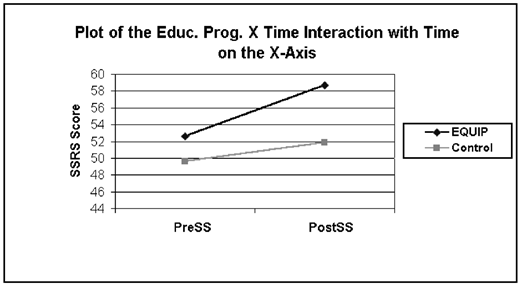
Table 5 provides the test of between-subjects effects. The first one-way ANOVA evinced a nonsignificant simple effect on the pretest. That is, there was no significant difference between groups on the pretest F (1, 43) = 1.64, p > .05. The second, one-way ANOVA evidenced a significant difference between groups on the posttest, F (1, 43) = 9.98, p < .01, η2 = .188. In terms of practical significance, this second unvariate analysis suggests a relatively small effect size (.19). That is, 19% of variance on the posttest can be attributed to the difference in groups. These results suggest that the EQUIP for Educators group exhibited more positive social skills than the control group at the posttest period. This finding is also reflected in the means of the subjects: EQUIP for Educators scores increased from 52.64 to 58.68; control group increase from 49.61 to 51.87. Figure 2 includes a plot of the Group (educational program) X Time interaction simple effects with time on the x-axisfor the dependent variable SSRS.
Source Table for Two Separate One-Way ANOVAs for the Dependent Variables: Pretest-SSRS and Posttest-SSRS
| Source of Variation | df | SS | MS | F | p | η2 |
|---|---|---|---|---|---|---|
| Pretest | ||||||
| Group | 1, 43 | 103.075 | 103.075 | 1.64 | .208 (n.s) | .037 |
| Posttest | ||||||
| Group | 1, 43 | 521.819 | 521.819 | 9.98 | .01* | .188 |
* p < .05
Plot of the Educational Program X Time Interaction Simple Effects With Time on the X-Axis- For the Dependent Variable SSRS
Plot of the Educational Program X Time Interaction Simple Effects With Time on the X-Axis- For the Dependent Variable SSRS
Children’s Inventory of Anger (ChIA) Univariate Analysis of Variance
An analysis of variance was performed, to test the within-subjects effect of time and the between subjects effect of group. Table 6 provides sources of variation for the ChIA for all the univariate analysis of variance. Yet, it is important to note that data analysis and follow-up analysis are only conducted on the Time X Group interaction. This statistical analysis is based on the multivariate significant Time X Group interaction effect. The statistically significant multivariate and hence univariate main effect of achievement was previously discussed in the multivariate analysis and discussion section.
Source Table for the Dependent Variable ChIA-Univariate ANOVAs
| Source of Variation | df | SS | MS | F | p | η2 |
|---|---|---|---|---|---|---|
| Main Effects | ||||||
| Time | 1, 41 | 16.180 | 16.180 | 2.791 | .102 | .064 |
| Group | 1, 41 | 392.250 | 323.724 | .699 | .408 | .017 |
| Achievement | 1, 41 | 323.724 | 323.724 | .577 | .452 | .014 |
| Interactions | ||||||
| Time x Group | 1, 41 | 348.409 | 348.409 | 60.110*** | .000 | .595 |
| Time x Achievement | 1, 41 | 4.811 | 4.811 | .830 | .368 | .020 |
| Group x Achievement | 1, 41 | 7.116 | 7.116 | .013 | .911 | .000 |
| Time x Group x | 1, 41 | 2.109 | 2.109 | .364 | .550 | .009 |
| Achievement |
** p < .05
From Table 6, a statistically significant unvariate interaction between Time X Group, F (1, 41) = 60.110, p < .001, η2 =0.595 was found on the ChIA. That is, the difference between the EQUIP for Educators treatment group and the control group at time 1, is different than time 2. The effect size suggests that 60% of the variance associated with anger management techniques, is due to the group by time interaction. In terms of practical significance .60 would be considered a medium effect. Since, a statistically significant interaction was found; no further analysis was conducted on the main effects of time and group. A more precise understanding of this statistical relationship can be understood with follow-up unvariate ANOVAs. The follow-up univariate analyses were conducted to examine whether the groups differed at the pretest and posttest. Specifically, this analysis evinced findings, which indicated whether the EQUIP for Educators treatment group and control changed over time, at a statistically significant level. Levene’s test of equality of error variances suggests that there is no significant difference between groups at the pretest F (1, 43) = .010, p > .05. That is, prior to the intervention of the EQUIP for Educators program, at the pretest, both the treatment and control groups were equal.
To break down the significant univariate Time X Group interaction, two follow-up one-way ANOVAs were performed. Table 7 provides the test of between-subjects effects. The first one-way ANOVA evinced a nonsignificant simple effect on the pretest. That is, there was no significant difference between groups on the pretests F (1, 43) = .016, p = .899. The second, one-way ANOVA evidenced a nonsignificant difference between groups. F (1, 43) = 3.69, p =.06.
Source Table for two separate One-Way ANOVAs for the Dependent Variables: Pretest-ChIA and Posttest-ChIA
| Source of Variation | df | SS | MS | F | p | η2 |
|---|---|---|---|---|---|---|
| Pretest | ||||||
| Group | 1, 43 | 4.497 | 4.497 | .016 | .899 (n.s) | .000 |
| Posttest | ||||||
| Group | 1, 43 | 1012.279 | 1012.279 | 3.694 | .06 (n.s.) | .079 |
These statistical findings suggest that it appears as though the EQUIP for Educators treatment did not have a statistically significant effect on reducing anger. Yet, it is critical to note that, although the inferential statistics suggest a nonsignificant effect, the descriptive statistics evince a highly interesting trend. Specifically, the EQUIP for Educators treatment group pretest mean score of 112.45 (SD = 16.54) decreased to 106.77 (SD = 14.22) at the posttest, a difference of 5.68. Whereas, the control group mean pretest score of 113.08 (SD = 16.54) increased to 116.26 (SD = 18.50) at the posttest, an increase of 3.18.
That is, when one examines the standard deviations, a more comprehensive understanding of the nonsignificant result can be obtained. More germane to the issue, at the pretest the EQUIP for Educators and control group’s standard deviations were spread out approximately the same around their respective means (i.e., EQUIP, SD = 16.54; controls, SD = 16.54). Yet, at the posttest, the standard deviation for the EQUIP for Educators treatment group got smaller (SD = 14.22) or more homogeneous, and was more centered around the mean of 106.77. However, at the posttest, the control group standard deviation was more spread out (SD = 18.50), around the mean of 116.26. Thus, a statistically significant finding may have been evinced if the standard deviations were more similar at the posttest.
This finding is critically relevant on two levels. First, lower scores on the ChIA represent more competent anger management and less aggression/frustration/anger; higher scores on the ChIA represent less competent anger management and thus more aggression/frustration/ anger. Thus, consideration of these descriptive statistics suggests that the treatment EQUIP for Educators group mean scores decreased from pretest to posttest scores (112.45 to 106.77 respectively) evidencing more effective anger management, and less frustration/aggression/ anger, at the posttest period. More important, the control group mean scores increased from pretest to posttest (113.09 to 116.26 respectively) evidencing less effective anger management, and an increase in anger/frustration/aggression. Caution must be exercised when interpreting this finding since the inferential statistics were nonsignificant. An examination of the descriptive statistics here only provides a delineation of a trend. Such a trend suggests that the treatment appeared to have facilitated more competent anger management; and it may have prevented a decline in functioning level. Generalization of this finding is limited, but future interventions studies, with a larger sample size, which examine the effect of EQUIP for Educators on students’ anger, should be given careful consideration. Figure 3 above is a plot of the Group (Educational Program) X Time interaction simple effects with time on the X-Axis for the Dependent Variable ChIA.
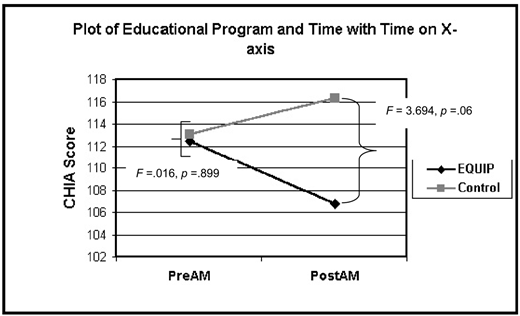
Plot of the Educational Program X Time Interaction Simple Effects with Time on the X-Axis For the Dependent Variable ChIA
Plot of the Educational Program X Time Interaction Simple Effects with Time on the X-Axis For the Dependent Variable ChIA
Sociomoral Reflection Measure-Short Form Univariate Analysis of Variance
An analysis of variance was performed, to test the within-subjects effect of time and the between subjects effect of group. This analysis was conducted based on the statistically significant multivariate Time X Group interaction. Table 8 provides sources of variation for the SRM-SF for all the univariate analysis of variance. This statistical analysis is based on the multivariate significant time x group interaction effect.
Source Table for the Dependent Variable SRM-SF-Univariate ANOVAs
| Source of Variation | df | SS | MS | F | p | η2 |
|---|---|---|---|---|---|---|
| Main Effects | ||||||
| Time | 1, 41 | 244.747 | 244.747 | 207.159*** | .000 | .835 |
| Group | 1, 41 | 732.150 | 732.150 | 5.593* | .023 | .120 |
| Achievement | 1, 41 | 75.279 | 75.279 | .575 | .453 | .014 |
| Interactions | ||||||
| Time x Group | 1, 41 | 158.148 | 158.148 | 133.859*** | .000 | .766 |
| Time x Achievement | 1, 41 | 6.006 | 6.006 | .000 | .994 | .000 |
| Group x Achievement | 1, 41 | 12.663 | 12.663 | .097 | .757 | .002 |
| Time x Group x Achievement | 1, 41 | 5.667 | 5.667 | .048 | .828 | .001 |
***p < .001
p < .05
From Table 8, a statistically significant unvariate interaction between Time X Group, F (1, 41) = 133.859, p < .001, η2 =0.766 was found, on the SRM-SF. That is, the difference between the EQUIP for Educators treatment group and the control group at time 1, is different than time 2. The effect size suggests that 77% of the variance associated with sociomoral reasoning (or social decision making) techniques, is due to the group by time interaction. In terms of practical significance .77 would be consider a medium effect, according to Cohen (1977). Since, a statistically significant interaction was found, no further analysis was conducted on the main effects of time and group.
A more precise understanding of this statistical relationship can be understood with follow-up unvariate ANOVAs. That is, to break down this significant time x group interaction further, two follow-up one-way ANOVAs were performed. The follow-up univariate analyses were conducted to examine whether the groups differed at the pretest and posttest. Specifically, this analysis evinced findings, which indicated whether the EQUIP for Educators treatment group and control changed over time, at a statistically significant level. Levene’s test of equality of error variances suggests that there is a significant difference between groups at the pretest F (1, 43) = 4.696, p < .05. Consideration of the standard deviation provides an understanding for this significant finding in error variances. That is, the standard deviations for the EQUIP for Educators group at the pretest were 9.92 and for the control group 5.63; at the posttest the EQUIP for Educators group standard deviation was 9.57 and the control group 6.10. To break down the significant univariate time x group interaction, two follow-up one-way ANOVAs were performed. Table 9 provides the test of between subjects effects.
Source Table for Two Separate One-Way ANOVAs for the Dependent Variables: Pretest-SRM-SF and Posttest SRM-SF
| Source of Variation | df | SS | MS | F | p | η2 |
|---|---|---|---|---|---|---|
| Pretest | ||||||
| Group | 1, 43 | 116.372 | 116.372 | 1.808 | .186 (n.s) | .040 |
| Posttest | ||||||
| Group | 1, 43 | 982.033 | 982.033 | 15.404 | .001*** | .264 |
***p < .001
The first one-way ANOVA evinced a nonsignificant simple effect on the pretest. That is, there was no significant difference between groups on the pretest F (1, 43) = 1.808, p = .186. The second, one-way ANOVA evidenced a statistically significant difference between groups on the posttest F (1, 43) = 15.404, p, <.001 η2 = .264. In terms of practical significance, this second univariate analysis suggests a relatively small effect size (.26). That is 26% of the variance on the posttest can be attributed to the differences in groups. These results suggest that the EQUIP for Educators group exhibited more sophisticated social decision making (or sociomoral reason Source Table for Two Separate One-Way ANOVAs for the Dependent Variables: Pretest-SRM-SF and Posttest SRM-SF ing) skills than the control group at the posttest period. Figure 4 includes a plot of the educational program X time interaction simple effects with time on the x-axisfor the dependent variable SRM-SF.
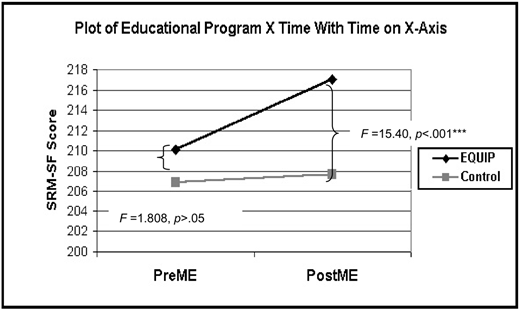
Plot of the Interaction between Educational Program and Time, with Time on the X-axis for the Dependent Variable SRM-SF
Plot of the Interaction between Educational Program and Time, with Time on the X-axis for the Dependent Variable SRM-SF
Summary of Findings
Correlational analysis was conducted to address the first research question: (1) Is there a relationship between the three psychometric measures, Social Skills Rating System (SSRS), Sociomoral Reflection Measure Short-Form (SRM-SF), and the Children’s Inventory of Anger (ChIA)? Results of the Pearson r statistical analysis indicated that there was a correlation between social skills and anger management measure, between social skills and moral reasoning measures, and the moral reasoning and anger management measures. Thus, statistical correlational analysis evinced results that suggest that the three dependent constructs are significantly correlated at the p < .05 level (2-tailed). This statistical correlation, between the dependent measures, provided the opportunity to conduct multivariate analysis of variance.
Multivariate and unvariate analyses were conducted to address the second research question: (2) Do the groups (EQUIP and Control) differ on the SSRS, ChIA, and the SRM-SF from pretest to posttest, and are these effects different by levels of achievement? A statistically significant multivariate effect was found for the Time X Group interaction. That is, the difference between the EQUIP for Educators and control groups at the pretest is different from the difference between the EQUIP for Educators and controls groups at the posttest. In terms of practical significance, the effect size suggests that the Time X Group interaction accounts for 86% of the variance across all three dependent variables. A statistically significant multivariate main effect for achievement was found across the three dependent variables. This suggests that behavior, as measured by the three dependent variables (i.e., SSRS, ChIA, SRM-SF) was different for the low achievement group, as compared with the average achievement group, when pretest and posttest scores were averaged. Moreover, in terms of practical significance, the multivariate main effect of achievement accounts for 56% of the variance across all three dependent variables (i.e., SSRS, ChIA, SRM-SF). Because there was a significant multivariate main effect for achievement, an examination of the univariate analysis of achievement was investigated. Specifically, a statistically significant univariate main effect for achievement was found for the dependent measure of social skills. This suggests that the social skills behavior, as measured by the SSRS, was different for the low achievement group, compared with the average achievement group, when pretest and posttest scores were averaged. In terms of practical significance, the univariate main effect of achievement accounts for 55% of the variance in the dependent variable SSRS.
The statistically significant multivariate effect of the Time X Group interaction and the significant multivariate main effect of achievement permitted further univariate analysis. Univariate tests were run for each of the three dependent variables (i.e., SSRS, ChIA, SRM-SF), to test the significance of the multivariate Time X Group interaction. This analysis was conducted based on the statistically significant multivariate Time X Group interaction. Thus, univariate tests were run for each of the three dependent variables (i.e., SSRS, ChIA, SRM-SF), to test the significance of the multivariate Time X Group interaction. To break down this significant univariate Time X Group interaction further, two follow-up one-way ANOVAs were performed (i.e., Simple Effects) for each of the three separate dependent variables (i.e., SSRM, ChIA, SRM-SF).
Discussion
Positive social skills gains were found in the present study for the EQUIP for Educators experimental group. A statistically significant univariate interaction between group and time was found on the SSRS. The follow-up univariate analyses (i.e., simple effects) were conducted to examine whether the groups differed at the pretest and posttest. The first one-way ANOVA evinced a nonsignificant simple effect on the pretest. That is, there was no significant difference between groups on the pretest. The second one-way ANOVA evidenced a significant difference between groups on the posttest for the SSRS.
These results suggest that the EQUIP for Educators group exhibited more positive social skills than the control group at the posttest period. The EQUIP for Educators social skills training component provided modeling and practice in handling socially stressful situations in a positive, balanced, and constructive manner. This finding corresponds with Leeman et al’s (1993) results. Leeman et al. (1993) found significant gains in social skills for the EQUIP treatment group, for a sample of antisocial children. Further, Hawkins, Catalano, Kosterman, Abbott, and Hill (1999) found that students who participated in a full social skills training program beginning in first grade were, at age 18, 20% less likely to commit violent acts, 38% less likely to drink heavily, and 35% less likely to become pregnant or contribute to a pregnancy. More germane to the issue, students were bonded and attached to the schooling process more fully, which can serve as important protective factors against a host of negative developmental outcomes. Hawkins et al.’s findings are impressive in that it involved 600 school-aged children over a 12-year period, which buttresses the contention that early prevention can produces efficacious results in comparison with later intervention.
Social problems can be viewed as the result of inadequate performance on developmental social tasks such as interacting with peers. This inadequate performance can be denoted as social incompetence. According to the social skills deficit model a socially incompetent child lacks the appropriate skills to perform adequately on a given social task. From a treatment perspective this implies that a socially incompetent child needs a social skills training. Within the skills approach, a distinction has been made between acquisition deficits and performance deficits (de Boo & Prins, 2007; Gresham, 1998). Children with acquisition deficits lack particular skills in their behavioral repertoire. Children with a performance deficit possess adequate skills but fail to apply them in specific social situations. In the present study, the social skills component of EQUIP for educators seeks to facilitate the acquisition of social skills, as well as apply such skills in multiple contexts, with various stakeholders. Hence, the findings in the present study appear to provide support that the EQUIP for Educators is effective in imparting efficient social skills techniques for the specified sample. This finding highlights the importance of a social skills component in a multicomponent intervention program.
Specifically, social skills training used exclusively has not been found to produce durable behavioral effects (Hollin, 1990; Long & Sheer, 1985; Maag, 2006). Maag (2006) extensively reviewed meta-analytic reviews and found that single component social skills training as results in only modest changes in social competence of children with emotional and behavioral disorders. Maag (2006) suggests that most social skills training programs follow the skill-deficit approach, acknowledging that Goldstein’s (1999) Prepare Curriculum was the only program that focused on intervention systematically geared toward different performance deficits.
It is precisely both skill deficits and performance deficits, which is inculcated into the social skills component of EQUIP for Educators, to improve constructive social behavior. Specifically, DiBiase et al. (2005) argues for equipping students with the constructive social skills, and providing extensive opportunities for students to pragmatically apply and practice such skills in various contexts with different individuals (i.e., peers, teachers).
The EQUIP for educators experimental group did evidence significant gains in moral judgment. A statistically significant univariate interaction between Time X Group was found on the SRM-SF. The EQUIP for educators experimental group did evidence significant gains in moral judgment. A statistically significant univariate interaction between Time X Group was found on the SRM-SF. This statistical relationship can further explicated with follow-up unvariate ANOVAs (i.e., simple effects). Specifically, this analysis evinced findings, which indicated whether the EQUIP for Educators treatment group and control changed over time, at a statistically significant level.
The first one-way ANOVA evinced a nonsignificant simple effect on the pretest for the SRM-SF. That is, there was no significant difference between groups on the pretest. The second, one-way ANOVA evidenced a statistically significant difference between groups on the posttest, for the SRM-SF. These results suggest that the EQUIP for Educators group exhibited incremental, higher levels of sociomoral reasoning skills than the control group at the posttest period. Through group discussion, subjects are stimulated to age-appropriate moral reasoning. EQUIP for Educators social decision-making sessions focus on the remediation of the developmental delays in moral reasoning. Through problem situational discussion, children’s moral-cognitive development is facilitated, along the lines that it would naturally take, so that children will make more mature decisions in social situations.
This result corresponds to the extensive body of research, indicating developmental delays in antisocial children’s moral judgment (Chandler & Moran, 1990; Gavaghan, Arnold, & Gibbs, 1983; Gibbs et al., 2009; Gibbs & Potter, 1992; Gibbs et al., 1995). Conversely, in Leeman et al.’s (1993) evaluation of the EQUIP program, significant gains were not found for the social decision-making component with antisocial children. Leeman et al. (1993) predicates that this nonsignificant finding opposes the extensive literature that supports a sociomoral delay in antisocial children. Yet, Leeman et al. (1993) highlight that the SRM-SF scores represent subjects’ basic reasoning level with respect to justifying the importance of keeping promises, telling the truth, not stealing, and other moral values. Whereas, Leeman et al.’s (1993) measure of social skills, was more of a behavioral self-report response to specific situations and questions (e.g., “What do you say and do now?”). Thus, Leeman et al. (1993) suggest that operationalized, social skills responses are much more proximal to specific situational behaviors than were the moral judgment responses.
Nonetheless, Leeman et al., (1993) vehemently argue that it would be premature to discard the moral component from the EQUIP program. Leeman et al. (1993) maintain that though not proximal to situational behavior, mature moral judgment may serve as a foundation for mature social behavior in a general and long-term sense. In this connection, it is noteworthy that EQUIP group moral judgment gains correlated inversely at a highly significant level with recidivism even at 12 months.
Moreover, further exploration of the findings of the present study, with regard to moral judgment, is buttressed by van der Velden, Brugman, Boom, and Koops (2010) study, which explored the effects of EQUIP for Educators on self-serving cognitive distortions, moral judgment and antisocial behavior, in prevocational secondary school students. van der Velden et al. did find a small increase in moral judgment immediately after the intervention, suggesting that the impact of EQUIP for Educators on moral judgment might be a more gradual process. Longitudinal data, which explores the developmental trajectory of student’s moral judgment, subsequent to exposure to EQUIP for Educators, would be helpful in discerning the enduring impact on sociomoral reasoning.
An impressive study on the remediation of moral developmental delay was conducted by Arbuthnot and Gordon (1986). A 4-month microintervention on the remediation of moral developmental delay entailing small-group discussions was explored by Arbuthnot and Gordon (1986). This program involved antisocial children as identified by teachers. The subjects showed gains not only in moral judgment but also in behavior (in terms of disciplinary referrals, tardiness, and grades), both on short-term assessments of conduct made 2 or 3 weeks after the intervention and on 1-year follow-up posttests, relative to a randomly assigned, passage-of-time control group. Several differences between the experimental and control groups increased on the follow-up assessment. Similarly, changes in classroom conduct (in terms of absenteeism and teachers’ ratings) did not reveal significant improvement for the experimental group relative to the controls until the 1-year follow-up, suggesting a possible sleeper effect.
Although some moral-cognitive interventions generally seem to stimulate more mature moral judgment, the reduction of antisocial behavior does not necessarily follow. Comparatively, in the present study, gains were found in moral judgment, in the experimental group, at the posttest level. Further, longitudinal follow-up of this study may evidence sustainability of these gains. Yet, with regard to the previous research on moral-cognitive interventions, previous findings suggest that cognitive-structural theory may fall short in comprehensiveness. For example, existing cognitive-structural interventions (other than EQUIP for Educators) have attended to moral judgment delays but not explicitly to egocentric bias or to primary cognitive distortions. I suspect that, although some interventions have facilitated gains in moral judgment, the subjects’ self-centered orientation (in terms of both egocentric bias and primary cognitive distortion) and associated secondary cognitive distortions have remained more or less in place.
It may be possible for individuals to evidence Stage 3 moral judgment and simultaneously engage in seriously antisocial behavior, if egocentric bias and associated distortions preempt consideration of the legitimate expectations and feelings of others in actual social situations. This is precisely where the EQUIP for Educators differs from other cognitive-developmental interventions. Specifically, EQUIP for Educators does indeed address the egocentric bias and primary cognitive distortions of the child at risk for antisocial behavior.
Kohlberg and Higgins (1987) found that some antisocial children show Stage 3 competence in certain areas, but evidence Stage 2 moral judgments when unvalued others (mere acquaintances, strangers) are involved. It is noteworthy that Kohlberg encountered evidence of cognitive distortions in his macro-intervention work. Kohlberg and Higgins (1987) found that students in a Just Community program in a Bronx, New York, were:
morally immobilized by what we would call counter-norms, peer norms or expectations that violate not only conventional moral norms but the capacity to empathize with each other or take each other’s viewpoint…. (One counter-norm was) “Look at me the wrong way and you are in for a fight.” One of us accidentally brushed against a student in the hall and he angrily yelled and continued threatening even after an explanation and an apology. As far as the norm of trust (is concerned)…. There was the counter-norm…. “It’s your fault if something is stolen—you were careless and tempting me.” (p. 10)
Partly because of the discovery of these “counter-norms” or externalizing distortions, Kohlberg and Higgins (1987) suggest taking a multifaceted approach—that is, adding a “critical role” for “teacher structuring and teacher advocacy” to “Piaget’s emphasis on noninterference with the spontaneous process of peer interaction as the center of developmental moral education” (p. 125). In other words, teachers are encouraged to participate in peer discussions and to assert mature moral arguments. The teacher in Kohlberg and Higgins’ study concurred with this contention. That is, the teacher emphasized a critical importance and benefits of their involvement in visiting the students’ triads as well as being actively involved in small and whole group discussion, to facilitate higher levels of learning.
With regard to changes in anger/frustration, a statistically significant univariate interaction between Time X Group was found on the ChIA ( p < .001), yet follow-up simple effects on the CHIA indicated nonsignificant results. The one-way ANOVA evidenced a nonsignificant difference between groups. F (1, 43) = 3.69, p = .06, on the posttest for the ChIA. The anger management component of EQUIP for Educators emphasizes the correction of cognitive distortions (e.g., Self-Centered, Minimizing/Mislabeling, Assuming the Worst, and Blaming Others). van der Velden et al. (in press) found a similar inverse relationship for the EQUIP and control group, as in the present study. Specifically, there were significant differences found in both antisocial behavior and self-serving cognitive distortions between the EQUIP and control group. The EQUIP group evinced more substantive reductions of antisocial behavior and self-serving cognitive distortions, compared to the control group (van der Velden et al., in press). That is, the percentage of EQUIP participants in the borderline and clinical group decreased, and the normal range increased. Yet, the control group participants increased within the borderline and clinical group and, decreased in the normal range, at the posttest period (van der Velden et al., in press). The findings of van der Velden, combined with the findings from the present study in the target areas of regarding anger management, cognitive distortions, and antisocial behavior suggest that EQUIP for Educators may serve to remediate cognitive distortions, reduce anger, and prevent a decline in functioning level, however, further exploration of this result should be explored in future studies, with larger sample sizes.
More important, there is extensive literature (Gibbs, Basinger, Grime, & Snarey, 2007; Gibbs, 2004, 2009; Gibbs & Potter, 1992; Gibbs, Potter, DiBiase, & Devlin, 2008; Goldstein, 1988, 1991, 1993, 1999; Goldstein et al., 1998; Liau et al., 2004; McCrady et al., 2008; Stams et al., 2006), which suggests that antisocial individuals endure cognitive distortions and thinking errors. This limitation is precisely what the anger management component of EQUIP for Educators purports to remediate. This existing body of research combined with the findings of the present study and van der Velden’s (2010) study, point toward a need for further empirical research on the EQUIP for Educators program.
Limitations
The present study was limited by the small sample size, and should be deemed preliminary. Future research should consider a larger sample size, multiple treatment and control classes, to augment the robustness and generalizability of the findings. Although the impressive study by van der Velden et al. (2010) included a larger sample (N = 775), only effects of EQUIP for Educators on moral judgment, self-serving cognitive distortions, and antisocial behavior were explored. Future research should examine the impact of EQUIP for Educators on all target areas of the program, social skills, anger management, sociomoral reasoning, with particular attention to cognitive distortions and antisocial behavior. This would provide the opportunity to explore the association of cognition and behavior. Triangulation of data sources would serve to cross-validate findings on the psychometric measures. That is, alternative outcome measures such as direct behavioral observation of students in various contexts (e.g., classroom, playground) would provide additional data sources to triangulate findings. Moreover, behavioral tracking, as measured by school suspensions (in-school and out-of-school), and behavioral referrals to the office, would provide additional data on the impact of EQUIP for Educators on children’s behavioral development. In the present study, the researcher was limited to preand post-testing. The school board did not provide permission for any observations or access to the Ontario Student Record (OSR), which would have included individual data on truancy and suspension. Future studies could be enriched by such data.
Treatment fidelity is a salient aspect of program implementation. The researcher was available in the school during each EQUIP session in the present study to augment treatment fidelity. Specifically, the researcher was present in the classroom throughout the duration of the first two EQUIP sessions and then remained available in a separate location to debrief with the treatment teacher after each session. The researcher assisted the educator in both pedagogical and content knowledge, and application of this knowledge to the classroom context. EQUIP for Educators invites a scaffolding procedure, where educators gradually relinquish control of the sessions and skill acquisition to the students. Initially, educators are requested to model particular cognitive, social and behavioral strategies for students. Educators model instructional approaches and strategies (e.g., role play). Effective professional development in-servicing for educators should equip teachers with authentic program implementation skills. Historically, individual’s social competence has been found to improve more when they receive training related to the associated individual problems (Maag, 2006; Trower, Yardley, Bryant, & Shaw, 1978). Thus, training procedures would appear differently, when facilitating specific behavioral skills in students, versus training social problem solving skills. Yet, there are some solid pedagogical principles that can be applied across the intervention (e.g., use of instructions, modeling, rehearsal, role playing, and reinforcement.) EQUIP for Educators inculcates these principles when educators are facilitating skill development in anger management, social skills, and social decision-making. Hence, it is necessary that the educators are comfortable with these instructional strategies in order to facilitate effective skill acquisition in these students. Professional development workshops targeted specifically at the application of these strategies to the EQUIP for Educators content, would augment treatment fidelity.
Generalizability of the findings from the present study is limited by reactive arrangements, specifically social desirability. Since the researcher administered both pretest and posttests to both groups, it is conceivable that the researcher’s presence may have affected the participant’s responses on the dependent measures. That is, the participant’s cognizance of being involved in a research study could have affected their responses on the measures, particularly since the researcher administered all dependent measures. Similarly, generalization of the findings from this study may be limited to the external validity threat of pretest-posttest sensitization and the internal validity threat of testing effect. Since the same pretests were used as posttests were administered, this could have interacted with the treatment. Alternative forms of the same tests could serve to minimize these threats to validity.
Recommendations and Implications for Research
At-risk behavior is associated with and is a product of multiple influences that have significant consequences across a range of outcomes (Crews et al., 2007). Effective prevention programs should be offered in coordinated sequence, over substantial time, with sufficient intensity to alter the deeply ingrained consequences of exposure to host of negative risk factors. Longitudinal data is needed to ascertain any sustaining benefits that EQUIP for Educators might have on functioning level. Additional “booster” training sessions should be offered to treatment educators, to assist in pedagogical training.
Multicomponent prevention programs are powerful and tend to produce more robust outcomes with their target populations than single component programs (e.g., social skills training) (Dunlap et al., 2006; Gulchak & Lopes, 2007; Maag, 2006). Specifically, students who are behaviorally at risk often endure multifarious limitations (DiBiase et al., 2005; Gibbs et al., 1995; Stams et al. 2006). Hence, prevention programs should be multimodal to address the heterogeneity of maladaptive behavior. Thus, the impact of EQUIP for Educators on the three core limitations for the behaviorally at-risk students: (1) social skills deficiency; (2) self-serving cognitive distortions; and (3) developmental delays in moral judgment, need to be followed longitudinally, to ascertain the sustainability of strategy acquisition. Multicomponent interventions implemented over time and across multiple relevant environments can produce durable, generalized increases in prosocial behavior and reduction of challenging behaviors (Dunlap et al., 2006).
It is important that researchers conduct pretreatment assessments to determine the nature of participants’ performance deficits. Research could be conducted to determine the differential efficacy between behaviorally at risk students, who receive intervention that match their identified deficiencies, and those receiving single performance deficits (e.g., social skills). Similarly, many prevention programs focus on a skill-deficit approach (Maag, 2006). EQUIP for Educators is systematically geared to both skill-deficit and performance deficits.
Reinforcement of an acquired skill is a powerful mechanism for inculcating a particular cognitive/behavioral strategy into a student’s existing repertoire. Parents serve as a salient socializing agent for children. Specifically, Crews et al. (2007) found that nonsupportive home environments, single parent homes, divorce, corporal punishment, and low SES were significantly correlated with externalizing disorders. Thus, it is imperative that parents are trained and enlisted as reinforcers of strategies for balanced and constructive social behavior, managing anger and correcting self-serving cognitive distortions, and ethically responsible social decision making.
Future research should ensure that educators are trained in program implementation to ensure treatment integrity. Similarly, the impact of EQUIP for Educators on the three core limitations for the behaviorally at-risk students: (1) social skills deficiency correction, for balanced and constructive social behavior (social skills) (2); skills for managing anger and correcting self-serving cognitive distortions (anger management); and (3) developmental delays in moral judgment (social decision making), require longitudinal data, to ascertain the sustainability of strategy acquisition.
EQUIP for Educators remediates social skill deficiencies, sociomoral development delays, and social cognitive distortions and renders the equipment sessions more profound by requiring group members to report their underlying cognitive distortions or thinking errors. Equipment sessions were based on a coordinated curriculum that deals with moral education, anger management/correction of thinking errors, and social skills. Future research could consider a comparison of the EQUIP for Educators program with alternative treatment programs that employ certain, but not other EQUIP for Educators curriculum components. For example, random selection of classes, to participate in an anger management curriculum, social skills curriculum, or social decision-making curriculum, would have permitted a more precise assessment of whether the treatment effect is EQUIP for Educators curriculum specific.
Conclusions
The findings in the present study demonstrate promising gains in children’s social skill, social decision-making, and anger management. Future research that seeks to consider the impact of EQUIP for Educators on behaviorally at risk students should include multiple data sources (e.g., direct observation, time sampling, frequency of office referrals, school suspensions). Additionally, multiple treatment and control groups, and a augmented sample size, to increase statistical power, should be considered. Longitudinal studies may evince data that buttress the sustained benefits of EQUIP for Educators.
A particular school’s plan for evaluating EQUIP for Educator’s effectiveness should be the product of a collaborative, democratic decision-making process. Although the specifics will vary, evaluation procedures should satisfy certain basic requirements. The first requirement is to ensure that the actual initiation and continued implementation do not depart substantially from the agreed-upon plan (Gibbs et al., 1995; Gibbs et al. 2009). In order to improve the prospect for program fidelity, it is important to specify the plan as precisely as possible. Explicit and specific procedural materials, however, are not by themselves sufficient to ensure program integrity. As Goldstein (1991) indicates a wide and usually unpredictable variety of “emergencies”, “exigencies”, “realities”, and the like may arise (p. 483). Teachers or students may become fatiqued or overburdened. Even if appropriately described, detailed, and exemplified, the intervention plan may fail to anticipate an array of crucial circumstances. Goldstein (1991) contends that a diminished intervention will likely impede program efficacy. Thus, Kazdin (1995) recommends program monitoring to ensure that the intervention conforms to prescribed procedures.
The second requirement for effective program evaluation is for standardized measurement of the target behaviors. Kazdin (1995) predicates that it is difficult to assess the magnitude of a child’s maladaptive behavior, with-out the use of standard diagnostic criteria, or assessment instruments. Furthermore, the establishment of a baseline, prior to the treatment, is a prerequisite for assessing whether a program has been successful in reducing severity. The SSRS, the ChIA, and the SRM-SF are helpful prepost assessment devices for this purpose. Goldstein (1991) refers to similar measures as proximal—that is, directly tied to the content of the intervention. Proximal outcome evaluations are particularly helpful as constructive feedback to staff on the strengths and weaknesses of the program components. EQUIP for Educators is a concrete program with explicit directives, and such a program deserves to be accurately implemented, authentically maintained, and rigorously evaluated.
If children with significant behavioral difficulties are neither identified in a timely manner nor provided appropriate education and treatment, their challenging behavior may be enduring, requiring more intensive services and resources. Moreover, when the challenging behavior is not addressed in a direct manner, poor academic outcomes, peer rejection, adult mental health concerns, and adverse effect on families, service providers, and communities may be inevitable. If prevention and early intervention is implemented, challenging behavior may not escalate. It is critical that evidence-based practices are provided and sustained for all children who may benefit from targeted preventive and early intervention efforts.

