


The Capuchos Convent of Alferrara has remained in ruins for over two centuries. Rather than physically restore it to an image of the past, this paper aims to investigate to what extent its ongoing ruination could offer a viable path for shaping its future.
A design-research methodology is used to frame this question within an architectural design course. The course is informed by heritage and conservation theories to arrive at five non-invasive intervention paths.
The five interventions suggest that active elements like water and plants can reframe static perceptions of heritage as fixed cultural assets. They can catalyze the site as a locus of cultural and ecological practices rooted in the site’s intangible values, particularly its ascetic tradition.
The research is pivotal by exploring future revitalization directions for the convent in line with its past ethos. It offers alternative paths to commercialization and responds to climate threats like drought that will likely plague the region in coming years. More broadly, the paper contributes to broader discussions in contemporary heritage and conservation practices as well as architectural pedagogy in the era of the Anthropocene.
Situating a convent in ruins
Situated on the southern slope of the Gaiteiros mountains, Alferrara is believed to have derived its name after the Arabic term al kharrarat [1] for a waterfall. It has long been a rich source of water in the Setúbal region. Its water was channeled to Setúbal’s city center via an aqueduct built in the 15th century that brought potable water to public fountains and buildings (Pimentel, 1879). Since the 14th century, the site’s abundant water resources made it an ideal location for establishing two conventual communities, both of which developed hydraulic systems fed by high concentrations of groundwater and mines dug through the limestone bedrock. These systems relied exclusively on the natural slope of the terrain, which allowed them to channel water through gravity alone. Combined with dense vegetation, sea breezes, high-altitude rainfall and its highly soluble limestone, the site of Alferrara has developed hydrogeological conditions ideal for groundwater retention, ensuring the continued flow of water even until today (Pessoa, 2017).
It was this attraction to water that originally drew conventual communities to the site, beginning with monks from the Order of São Paulo in 1385, followed by Capuchos friars in 1578. Despite their different religious orientations, water was a key resource in unifying the spiritual and practical purposes of these self-sufficient communities. The hydraulic systems supported cooling huts – known as Casas de Fresco (fresh houses) – and fountains used for spiritual retreats and purification. Irrigation tanks, channels and mines supported daily functions like drinking and washing. These waters nourished the terraced gardens that the convents would rely on as a primary food source, as in the case of the Paulist’s but also to support limited economic activity for basic survival in the case of the Franciscans (Volzone et al., 2023).
In 1834, the two convents were abandoned following the suppression of religious orders across Portugal. This resulted in years of vandalism and looting, until the land was sold at public auction in 1937 when its new owners expanded the hydraulic system to support agricultural use, with oranges becoming the primary produce. During this time, the convents remained in ruin and the water systems were altered to divert water away from them and into modern steel irrigation channels built in the flat areas below the mountains. In 1986, the Association of Municipalities of the Setúbal Region (AMRS) – which encompasses nine municipalities in the region and a key actor in shaping regional policies on public services, culture and education – purchased and redeveloped the surrounding areas into a pedagogical farm, with the long-term goal of rehabilitating the convents. Unlike the Convent of São Paulo, which was rehabilitated in 2017, the Capuchos Convent [2] has experienced gradual ruination ever since its abandonment. Today, the ruin is a palimpsest of the passing centuries from the strict rules of its ascetic origins, followed by layers of vandalism, vegetal overgrowth and degradation (Figure 1).
 A landscape photo of an ancient, decaying structure with sunlight illuminating the interior through an opening. The structure features stone columns and walls, with visible signs of wear and overgrowth. The sunlight creates a contrast between the bright interior and the darker surroundings.
The convent’s central cloister where overgrowth and decay track the passage of time. Source: Authors’ own work
A landscape photo of an ancient, decaying structure with sunlight illuminating the interior through an opening. The structure features stone columns and walls, with visible signs of wear and overgrowth. The sunlight creates a contrast between the bright interior and the darker surroundings.The convent’s central cloister where overgrowth and decay track the passage of time. Source: Authors’ own work
Between 2010 and 2012, the AMRS stabilized the ruins using a temporary wooden structure still in place today. The architects propose that it suspends time both tectonically and visually, drawing on medieval scaffolding techniques to evoke the convent’s lost origins while simultaneously opening the site to future interpretations as part of a 25-year recovery plan (Aleixo and Mestre, 2020). This intervention was conceived as a proposition to allow time to think slowly about the future of the ruin in a reversible act. Within the ruin, a visitor route was introduced with a shallow dirt path to support public engagement. Around this time, an interdisciplinary team including a conservation architect, structural engineer, stone specialist, landscape architect, hydrologist, archaeologist, art historian and a scholar of monastic history was also assembled to gather historical research and inform its long-term revitalization.
Now, over a decade later, however, the Capuchos Convent remains unchanged with uncertainty about how it can be safeguarded, made economically viable and rendered meaningful to the broader community in ways that still honor its past. A certain urgency is felt by its management as pressure from the expanding tourism sector continues to rise across Portugal. In order to remain economically viable, many heritage properties across the country have been swallowed by private investors and turned into charm hotels or other functions that accommodate mostly foreign tourist functions [3]. Shifting political landscapes in the region could also have direct implications for the site’s future use and for shaping intervention strategies, which remain contingent on external funding.
Despite, or arguably due to its present state of ruination, the Capuchos Convent has continued to draw interest from the public and scholars through hosting activities such as nature excursions, research gatherings, concerts, treasure hunts and theatrical performances. This sustained interest, coupled with the fact that the convent has persisted in public memory as a ruin for the last two centuries, has led the AMRS to consider whether it might be precisely the perpetual state of ruination that constitutes the site’s future direction, and if so, how might this be explored in practical terms so that a ruin may be useable? [4] In this sense, the liminal status of the ruin, suspended between memory and an undecided future assumes a multifaceted role that this paper examines through critical reflections intersecting heritage studies, conservation theory and Franciscan asceticism that are channeled through the design-research activity of an architectural design course (Figure 2).
 A group of students stands in front of an old, dilapidated building with a central archway and a small tower on top. The building is surrounded by greenery and appears to be in a state of disrepair. The students are listening to a guide who is explaining the historical significance of the structure.
Students were introduced to the Capuchos Convent on June 10, 2024. Source: Authors’ own work
A group of students stands in front of an old, dilapidated building with a central archway and a small tower on top. The building is surrounded by greenery and appears to be in a state of disrepair. The students are listening to a guide who is explaining the historical significance of the structure.Students were introduced to the Capuchos Convent on June 10, 2024. Source: Authors’ own work
Within the 21st century, ruins have been important critical sites to challenge conventional narratives of the past, to unsettle normative spatial orders and to destabilize entrenched binaries such as human and nonhuman, preservation and decay, memory and forgetting (Desilvey and Edensor, 2013). The ruin is an opportunity to explore a model of conservation informed by recent trajectories in heritage studies that privilege dynamic engagement with place over the static preservation of material artifacts. Common conservation logic sees ruins as vulnerable sites in need of protection and preservation. A foundational source for this is the International Charter for the Conservation and Restoration of Monuments and Sites, commonly known as the Venice Charter (1964), which outlines interventionist frameworks to preserve and safeguard historic structures against the forces of erosion, weathering and decay. By preserving the ruin as a ruin, the design research project challenges the notion of historical authenticity that treats physical restoration and permanence as inherent heritage goals.
Drawing on Araoz’s (2011) call for a paradigm shift that recognizes intangible heritage as equally significant to tangible artifacts, we focus on the evolving meanings that emerge from lived connections rather than physical restoration of a moment in the past. Exploring DeSilvey’s (2017) notion of heritage as “curated decay,” we embrace the productive potential of ruins, which, through their ongoing material transformation, allows for a degree of reinterpretation and future-making that channel past values into a living process. Here, we anticipate the role of architectural design as an important bridge between natural and cultural heritage, following Harrison’s (2015) proposal for heritage in the Anthropocene that embraces historical, ecological and interdisciplinary perspectives into an active futurology. Through this approach, we trace the site's ascetic past as a generative ethos to forge new interaction between humans and the broader environment through more-than-human actors like water and fauna that define the place.
Reviving water for cultural and environmental heritage
Today, the Capuchos Convent’s hydraulic system lies dormant, despite the presence of water on site. Reactivating this system would be a central catalyst for linking the memory of the friars symbolically, aesthetically and practically, to new programs. Throughout Medieval and Early Modern Europe, monastic communities served as important centers for spiritual guidance, education, healing and agriculture in both urban and rural settings. Hydraulic systems were an integral part of this by providing potable water for hygiene, cooking, liturgical practice and agriculture (Jorge, 2018). From an atmospheric perspective, the sound and visual presence of running water would re-introduce a contemplative environment. Its cooling effects would facilitate public gatherings in summer months. Water would also be an essential aspect to propose future programming ideas like learning spaces, medicinal gardens, expansion of agriculture and public reservoirs that echo the friars' commitment to serve the local population.
Beyond this, water would be essential for climate responsive strategies in anticipation of the site’s future resiliency. Scholarship has tended to overlook monastic contributions to natural resource management even though sophisticated practices like water management unite directly with contemporary sustainability agendas (Mallarach et al., 2014). As the recent AQUA project’s (2018–2022) interdisciplinary study of early modern hydraulic systems throughout Portugal showed, these historical systems provide valuable models for addressing current water scarcity challenges today by offering more efficient rainwater harvesting, greywater recycling and sustainable drainage practices than even the “smartest” practices (Rodrigues and Monteiro, 2023). Several cities across Europe are investigating historic water systems as adaptive responses to climate-induced drought. Serpa is one example within Portugal that is exploring the reintegration of its 17th-century aqueduct into contemporary water management (URBACT, 2025). Perhaps, the most notable and advanced is Chalandri, Greece, which is reviving Hadrian’s 2nd-century Roman aqueduct to supply water for irrigation and urban cooling as an alternative to its overstressed modern infrastructure (Pappas, 2024).
It is increasingly clear that water management will be crucial given the Iberian Peninsula’s status as a climate change hotspot with even the most optimistic projections calling for increased periods of droughts affecting its water management and agriculture throughout the 21st century (Soares et al., 2023). The region of Setúbal is no exception with rising temperatures and changing precipitation patterns resulting in drier conditions, especially during the summer months that have been increasingly conducive to the spread of forest fires (Fumega, 2014). Despite efforts to mitigate these fires, the reality is that firefighting aircraft still gather water from the sea. This practice has several drawbacks: the travel time between each fill and the detrimental impact of dropping saltwater on protected landscapes, which significantly hinders the regeneration of native forests. Facing this reality, one option under debate by the AMRS is that underground water from the Alferrara spring be revitalized and given back as an emergency reservoir for helicopters to fill the buckets faster and with fresh water.
Framing architectural pedagogy through an ascetic counter-practice
The studio was a collaboration between Université de Montréal, Tokyo College at The University of Tokyo and Instituto Superior Técnico at the University of Lisbon. In total, 20 architecture students from Université de Montréal participated through the Hors les Murs course over the course of two months. During the first month, while still abroad, the students engaged in virtual site analysis aimed at understanding the contemporary context of the region. This phase emphasized skill development through the introduction of digital tools for urban analysis using geographic information systems (GIS), working with previously made digital survey data like point clouds (Rafeiro and Tomé, 2023) to help generate metric site drawings and digital models prior to visiting the country. It also provided theoretical grounding through assigned readings on heritage frameworks like the Nara Grid (ICOMOS, 1994), which uses a matrix scheme for evaluating a historic site’s authenticity. This was contrasted with theoretical texts like DeSilvey’s (2017) “curated decay” to provide students with a range of modalities to think through the question of the ruin. Existing literature on the convent also helped students develop a broader understanding of the cultural, ecological and infrastructural histories that shape the site.
The second month involved fieldwork in Portugal. Students traveled across the country to absorb local culture and examine the diverse ways in which former convents have been reimagined. This experience was complemented by a series of guest lectures by heritage experts that offered insights into Portugal’s water heritage and monastic history. During this second month, a one-week documentation and exploration period was taken at the convent site. Students carried out both digital and analog surveys, while also engaging with experts from a range of disciplines, including historians, hydrologists, heritage managers and geologists. The digital survey results combined a mix of terrestrial laser scanning and photogrammetry aimed at comprehensively visualizing the three-dimensional functionality of the water system. This effort was complemented by initial work carried out by Pina (1996), who undertook extensive analog documentation of the hydraulic system in the 1990s. The remaining time was dedicated to channeling these numerous experiences and skills into proposing new interventions.
Beyond its relevance for the case study in question, the studio was also an opportunity to challenge the underlying technological determinism of sustainability rhetoric in architecture, which, as Moe (2007) argues, exacerbates unsustainable lifestyles by perpetuating cultural norms rather than providing opportunities to challenge them, even when employing benevolent concepts like energy saving and recycling. While the demands of industry are mostly responsible, the space of architectural education is a central breeding ground. Moe (2021) explores this through the concept of agnotology – the study of how ignorance is created and sustained – to examine the cultural production of ignorance within architectural education. He points out that architectural pedagogy tends to focus narrowly on the composition and assembly of architectural objects, neglecting broader social implications and consequences. This narrow approach results in an inadequate conception of the social and terrestrial phenomenon inherent to the discipline. It fails to address how our building practices worsen environmental and even social and economic inequalities through the narrow teaching of “advanced” building practices, which often default to specialized and petroleum-based materials that are more socially and environmentally damaging than ever before.
It seems increasingly evident that current growth patterns and lifestyles are ultimately not sustainable. An economy of perpetual growth is contrary to the capacity for rejuvenation on Earth, challenging the notion that economic growth can be separated from environmental impact (Parrique et al., 2019). To achieve sustainability within the planet’s ecological limits requires downscaling economic production and consumption through lifestyle changes and societal shifts. This suggests that sustainable practices focusing on efficiency should be paired with efforts towards sufficiency, which involves redefining what is “enough” (Parrique et al., 2019).
Turning back to architecture, Mies van der Rohe’s famous dictum “less is more,” may sound like an inviting framework to envision restraint. Yet, as Aureli (2013) argues, such a philosophy of less, explored solely through aesthetic registers risks becoming a cover for the ideological operations of capitalism. We may think here of Apple’s minimal aesthetic branding, which conceals an apparatus of distraction tied to consumerism that diametrically opposes any concept of “less.” Under such conditions, the capitalist creed of more productivity, more labor, more adaptability translates to less security, less support and less ownership for the most vulnerable.
Aureli contrasts this with a reinterpretation of Christian monasticism, especially the Franciscans, whose version of “less” was lived through a radical rejection of ownership and accumulation of wealth in recognition of its potential for power and exploitation. Their form-of-life advocated usus pauper – poor use, without ownership as a form of use tolerating only the strictly necessary for survival. The model for this was Francis of Assisi, the eventual saint who reimagined communal life according to the itinerant, mendicant model of Christ the preacher, healer and beggar. Aureli’s response to Mies draws from these traditions to argue “less is enough.” Such is a call for a political ars vivendi that centers autonomy, mutual care and refusal. Here, “enough” is distinguished from “more” as a self-willed restraint and intentionality aligned to reciprocal and durable modes of living in common.
Following Aureli, we propose that the Franciscan spirituality that grounded the Capuchos Convent offers an alternative lens for reframing architectural pedagogy.
Tracing lines of flight from the Estatutos
In Portugal, Capuchos friars from the Franciscan Order emerged at the beginning of the 16th century. Their rise was a response to the growing institutionalization, clericalization and urbanization of the Franciscan Order which they saw as part of a loosening of values. The Piedade Province was founded in 1517, marking one of the earliest formal establishments. This was followed in 1539 by the foundation of the Arrábida Province, led by Friar Martinho de Santa Maria, the lineage from which the Capuchos of Alferrara derived. These communities aligned with the “Estreitíssima Observância” (Most Strict Observance) and sought to return to the original values of Saint Francis of Assisi marked by radical poverty, austerity and a contemplative, eremitic way of life. The Arrábida Province reform, which began initially with only four friars inhabiting cave dwellings dug from the mountainside, gained significant support from royal and noble patrons who found a kind of spiritual capital (a passage to the afterlife) in backing these austere communities [5].
While the original friars envisioned a far stricter way of life, more animal than human, they were eventually compelled by their land patrons to leave their rocky shelters and inhabit communal buildings (Piedade, 1728). From then on, the convents of the Arrábida Province were constructed according to the Estatutos da Provincia de Santa Maria da Arrábida da mais perfeyta Observancia de nosso Seraphico Padre S. Francisco (1698) (Figure 3). While these structures provided more comfort than the initial caves, they followed imposed regulations for the spatial organization of new communities across the country, each being shaped by the particularities of their geographical context (Rafeiro et al., 2020). The defined spaces for this life included the church, choir, sacristy, chapter, kitchen, refectory, pantry, dormitories, library and hostel. All these spaces are articulated in the 40th chapter, “Dos Edificios” (About the Buildings), which were meant to prevent convents from living excessive lifestyles.
 The cover features the title 'ESTATUTOS DA PROVINCIA DE SANTA MARIA DA ARRABIDA' prominently at the top. Below the title, there is a subtitle 'Da mais perfeyta Observancia de nosso Seraphico Padre S. FRANCISCO, FEYTOS'. The text continues with details about the statutes, mentioning a Breve do Senhor Papa Innocencio XII and the involvement of Irmão Frey Antonio da Appresentação Prégador. The cover also includes the location and publisher information: 'LISBOA, Na Officina DE MIGUEL DESLANDRES, Impressor de Sua Magestade. Com todas as licenças necessarias. Anno de 1698.' At the bottom, there are two symbols: a rose and a shield with a crown and the letters 'S M A'.
Frontispiece of the Estatutos da Província de Santa Maria da Arrábida, 1698. Source: Author’s digitization
The cover features the title 'ESTATUTOS DA PROVINCIA DE SANTA MARIA DA ARRABIDA' prominently at the top. Below the title, there is a subtitle 'Da mais perfeyta Observancia de nosso Seraphico Padre S. FRANCISCO, FEYTOS'. The text continues with details about the statutes, mentioning a Breve do Senhor Papa Innocencio XII and the involvement of Irmão Frey Antonio da Appresentação Prégador. The cover also includes the location and publisher information: 'LISBOA, Na Officina DE MIGUEL DESLANDRES, Impressor de Sua Magestade. Com todas as licenças necessarias. Anno de 1698.' At the bottom, there are two symbols: a rose and a shield with a crown and the letters 'S M A'.Frontispiece of the Estatutos da Província de Santa Maria da Arrábida, 1698. Source: Author’s digitization
As the material medium through which the rule was lived, architecture was an essential force. The convent’s strict physical organization was not meant to impose a rule over life but rather to align the rule so closely with life that the rule itself would disappear into a form of habitus. This is the central argument of Agamben’s (2013) analysis of the Franciscan monasticism, which he suggests, in contrast to the Church’s separation of life and liturgy, operates as a “field of forces,” shaping life both into and from liturgy. By unifying law and liturgy, the monastic tradition invented a “third thing,” which can best be expressed as a “form-of-life.” No longer was devout life about interpreting the gospel but living it, such that the rule would become synonymous with one’s life as habitus – habit. By reading the rule in relation to the ruin, one can reconstruct the rituals of this life as Almeida’s (2023) virtual reconstruction illustrates.
This interconnection between rule and architecture is also prescribed through avoidance of excessive construction materials opting instead for simplicity and modesty. This is especially true of the dormitories, which were to remain utterly unadorned with provisions of a bed of cork for sleeping and a simple stool to sit. The main ornamentations permitted here were wooden crosses, which were to be roughly made. Paintings or personal altarpieces were not tolerated. Only spaces reserved for worship such as the church, choir and sacristy were permitted to invest in ornamentation and expensive materials, as a form of respect for God.
These rules became a guiding principle in the students’ proposals which were to emulate the principles of austerity, building from locally sourced and readily available materials. By reading the convent’s layout and its integration with the surrounding landscape, it becomes clear that the design was conceived with total self-sufficiency in mind. The remains of the onsite quarry and lime kiln are still visible, within only a few hundred meters from where the building stands today allowing visual illustration of the landscape in the architecture.
Re-inventing the Estatutos across five interventions
In dialog with AMRS, it was agreed from the beginning that future design proposals should carry forward the memory of the friars, especially their lessons in humility and community care, while embracing a secular reinterpretation of that memory given changing demographics in the region. The Estatutos provided design constraints within which student imaginations could contribute to sensible and site-specific interventions keeping with the memory of the place.
The spaces of the Estatutos were used as a guideline for potential interventions, maintaining the spirit of poverty. Rather than rigidly enforcing the original rules, the design studio distilled their ascetic ethos into spatial prototypes, each loosely corresponding to the convent’s historical spaces (Figure 4). These interventions were conceived without strictly preserving the original spatial configurations. Here, more-than-human signals a shift in architectural thought that displaces anthropocentric design logics – technocratic fixes, positivist metrics and object-driven formalism – in favor of ethical co-creation with other life forms in response to climate crises (Loh et al., 2020). The students were prompted with the following questions as loose guides to steer their spatial imagination: How might these typical spaces be reinterpreted across different species, time and space? In what ways must they transcend their original spatial bounds while keeping true to the spirit of humble construction?
 The image displays a detailed architectural blueprint illustrating the transformation of dormitories into new temporary shelters. It includes dimensions and layouts for the reinvention of a pantry, kitchen, and refectory. The left side of the image focuses on the dimensions and structural changes of dormitories, while the right side shows the reinvented designs for the pantry, kitchen, and refectory.
Transformations of the Estatutos into new programs. Left: Dimensions of dormitories used to invent new temporary shelters. Right: Reinvention of the pantry, kitchen and refectory. Source: Olivier Corriveau-LeBlanc, Cire Gamboa, Louay Kaoun, Mathilde King and Vincent Levesque, used with permission
The image displays a detailed architectural blueprint illustrating the transformation of dormitories into new temporary shelters. It includes dimensions and layouts for the reinvention of a pantry, kitchen, and refectory. The left side of the image focuses on the dimensions and structural changes of dormitories, while the right side shows the reinvented designs for the pantry, kitchen, and refectory.Transformations of the Estatutos into new programs. Left: Dimensions of dormitories used to invent new temporary shelters. Right: Reinvention of the pantry, kitchen and refectory. Source: Olivier Corriveau-LeBlanc, Cire Gamboa, Louay Kaoun, Mathilde King and Vincent Levesque, used with permission
Below, we present five final group responses to these programs. The proposals can be approached in a way that allows them to function cohesively or individually as distinct explorations. At this stage, they may serve as initial seeds for future built interventions or remain unrealized, acting instead as reflective registers or spatial poetry caught up in the imaginative potential of the ruin.
Intervention 1. Interstices
This intervention reimagines the ruins as a site of slow pilgrimage and healing (Figure 5). In the place of what is believed to be the ancestral medicinal garden, visitors first follow dirt paths bordered by local medicinal flora cataloged from historical and ethnobotanical records. Signs discretely embedded in the earth outline the plant’s traditional uses and preparation methods. Arriving to the main ruins, visitors descend a subtle staircase integrated into a gap between the church walls and the exterior land. A long terracotta paved corridor leads to a small seed bank, designed with local limestone walls integrated seamlessly into the existing conditions. This cool, shaded space becomes a site for vegetal memory and gift-giving where seeds collected from both gardens are stored and shared. A hypothetical connection to Germinar, a local seed conservation initiative, would extend the project beyond the convent, linking it to similar regional activities. A small fountain outside the seed bank connects to the former water path and operates as a kind of secular ablution. Here, visitors can take a short pause to reflect on time’s passage and the cycles of growth and decay as they rinse their hands. Retracing the path out of the convent, the journey concludes at a contemporary garden (Figure 6). The design draws on a mix of medicinal plants informed by contemporary ethnobotany in the region, which highlights the continuities of medicinal traditions until the present (Novais et al., 2004). The proposal reactivates historic memory as a kind of living laboratory. Its material strategy emphasizes integration with the existing ruin and landscape, which are given primacy with new constructions kept light and reversible.
 The left side features a diagram of a winding path through a mountain, illustrating the layout of a garden with labels indicating soil conditions. The right side shows a photo of visitors standing on a stone structure, overlooking a scenic landscape with trees and a distant view.
Left: A winding path through the mountain educates visitors about local plant species on their way to the ruin. Right: visitors gaze down the slope, reflecting on their journey to the ruin. Source: Virginie Angiolini, Sandrine Hébert and Victoria Trépanier, used with permission
The left side features a diagram of a winding path through a mountain, illustrating the layout of a garden with labels indicating soil conditions. The right side shows a photo of visitors standing on a stone structure, overlooking a scenic landscape with trees and a distant view.Left: A winding path through the mountain educates visitors about local plant species on their way to the ruin. Right: visitors gaze down the slope, reflecting on their journey to the ruin. Source: Virginie Angiolini, Sandrine Hébert and Victoria Trépanier, used with permission
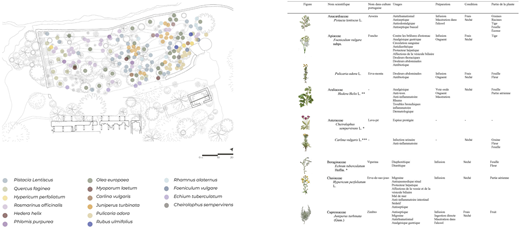 .
.Study of medicinal plants. Source: Virginie Angiolini, Sandrine Hébert and Victoria Trépanier, used with permission
.Study of medicinal plants. Source: Virginie Angiolini, Sandrine Hébert and Victoria Trépanier, used with permission
Intervention 2. Sopa dos Pobres
Inspired by the famous Portuguese legend, sopa da pedra (stone soup) and the concept of sopa dos pobres (poor people’s soup) as simple budget friendly meals, this intervention is centered on the act of cooking as a form of community hospitality and sharing. According to the legend, a hungry friar arrived in the village of Almeirim with no possessions other than a stone. Too proud to beg, he asked for a pot to make stone soup. The onlooking villagers suggested he add ingredients to improve the flavor with each one contributing what they could. Slowly, the culmination of gifted vegetables, meats and herbs provided a hearty meal shared by all. The story is deeply ingrained in the spirit of Portuguese hospitality, but it also reflects the Franciscan ethos of service and humility, which included distributing food to the neediest. Activating these two aspects, the project revitalizes the convent’s refectory and kitchen into a new communal cooking space with ingredients supplied by surrounding gardens and regional agricultural practices (Figure 7). Reclaimed brick is used to repair the vaulted ceiling, following traditional techniques. Locally sourced pine is used as a cost effective and rugged material for furniture. Azulejos (Portuguese painted tiles) mimicking the existing fragments still in place today are used once again to recover the walls. Programmatically, workshops focused on the local Mediterranean diet serve as educational experiences to learn about ecological food practices and a sense of communal living in tune with seasonal cycles. Visitors are invited to engage in the full cycle of harvesting, preparation, and consumption to cultivate a re-appreciation for the process of nourishment. The friar’s form-of-life is subtly referenced throughout the design. The project uses a central communal table where everyone sits together. Certain seats are deliberately removed to accommodate the memory of fasting friars while also crafting sightlines out toward the surrounding landscape. The inclusion of a washbasin outside the space of the meal references ascetic cleansing rituals.
 The left side of the image features a diagram illustrating the cyclical relationship between nature, introspection, and community giving. The right side shows a rendering of a restored refectory with a ceiling design that reinterprets the construction technique of former vaults.
Left: A diagram exploring the cyclical relationship between nature, introspection and community giving. Right: A rendering of the restored refectory. The ceiling design reinterprets the construction technique of the former vaults. Source: Maxim Côté, Ariane Larente, Gabrielle Lemieux, Anabelle Machabée and Dominique Marrelli, used with permission
The left side of the image features a diagram illustrating the cyclical relationship between nature, introspection, and community giving. The right side shows a rendering of a restored refectory with a ceiling design that reinterprets the construction technique of former vaults.Left: A diagram exploring the cyclical relationship between nature, introspection and community giving. Right: A rendering of the restored refectory. The ceiling design reinterprets the construction technique of the former vaults. Source: Maxim Côté, Ariane Larente, Gabrielle Lemieux, Anabelle Machabée and Dominique Marrelli, used with permission
Intervention 3. Between sky and sea
This intervention provides an overnight resting place for hikers along the trail network of the Arrábida Natural Park (Figure 8). The intervention reactivates the site as both a support node and a homage to the Capuchos’ ascetic life. A path guides visitors through the cloister as a historic circulation route. Ascending stairs, one arrives at a lookout platform that shifts visitors’ orientations from the inward focused spaces of the cloister to an outward gaze at the convergence of sea, sky and earth where one can also see where the city of Setúbal meets the Atlantic. The dormitories are limited to four, recalling the last four friars who lived here until the convent’s abandonment in 1834. They hover in the space of the former dormitories with a timber frame structure. Simultaneously, where needed, this frame stabilizes the existing stone walls in places of extreme tilting, ensuring safety while avoiding extensive rebuilding. These four shelters are constructed from modest local materials including pine and cork. This echoes the original poor materials of the friars’ rooms. Cork, an abundant material produced in Portugal, also provides natural insulation against the extremes of heat and cold. A passive strategy minimizes energy and resource use: the refuge operates without any mechanical systems, relying only on what hikers bring with them. Only minimal solar-generated electricity provides for nighttime safety. Natural ventilation, daylight through the open ruins, and water from a restored system meet the essential needs. By working with existing trails and structures, the design minimizes disruption to the surrounding flora and fauna. The placement of paths and micro-structures outside for rest are carefully considered to embrace but avoid disturbing mature trees and sensitive habitats (Figure 9). Everything, including the cells is designed for potential dismantling, reflecting the Capuchos’ embrace of impermanence and the fragility of life.
 The image contains two elements: a map on the left and a photograph on the right. The map shows various hiking trails within the Serra da Arrábida region, with different trails marked in distinct colors. The photograph on the right depicts a resting spot designed for visitors, featuring wooden elements and a view of the surrounding landscape through a large window. The resting spot is inspired by local materials and dimensions similar to the former dormitories of a convent.
Left: Map of local hiking trails within the Serra da Arrábida. Right: A resting spot for visitors inspired by local materials and dimensioned according to the convent’s former dormitories. Source: Olivier Corriveau-LeBlanc, Cire Gamboa, Louay Kaoun, Mathilde King and Vincent Levesque, used with permission
The image contains two elements: a map on the left and a photograph on the right. The map shows various hiking trails within the Serra da Arrábida region, with different trails marked in distinct colors. The photograph on the right depicts a resting spot designed for visitors, featuring wooden elements and a view of the surrounding landscape through a large window. The resting spot is inspired by local materials and dimensions similar to the former dormitories of a convent.Left: Map of local hiking trails within the Serra da Arrábida. Right: A resting spot for visitors inspired by local materials and dimensioned according to the convent’s former dormitories. Source: Olivier Corriveau-LeBlanc, Cire Gamboa, Louay Kaoun, Mathilde King and Vincent Levesque, used with permission
 The left image is a section showing how the resting site for hikers programmatically links the traditional elements of nature: water, earth, fire, and air. The right image is an overview of the minimal design hidden in the existing ruins.
Left: A section showing how the resting site for hikers programmatically links the traditional elements of nature: water, earth, fire and air. Right: An overview of the minimal design hidden in the existing ruins. Source: Olivier Corriveau-LeBlanc, Cire Gamboa, Louay Kaoun, Mathilde King and Vincent Levesque, used with permission
The left image is a section showing how the resting site for hikers programmatically links the traditional elements of nature: water, earth, fire, and air. The right image is an overview of the minimal design hidden in the existing ruins.Left: A section showing how the resting site for hikers programmatically links the traditional elements of nature: water, earth, fire and air. Right: An overview of the minimal design hidden in the existing ruins. Source: Olivier Corriveau-LeBlanc, Cire Gamboa, Louay Kaoun, Mathilde King and Vincent Levesque, used with permission
Intervention 4. A healing journey for body and spirit
This proposal guides visitors along a labyrinthine path (Figure 10) linking four key spaces of the friars’ therapeutic cycle: the medicinal garden as a source of healing, the apothecary as a site of preparation, the infirmary as a space of care and the library as a place of learning (Figure 11). Together, these form a spatial narrative aimed at restoring body and mind. The project builds upon the medicinal garden proposal by activating it in other programs inside the convent’s ruins. The apothecary is reimagined as a demonstrative workshop featuring herbal preparation tools and infusers. The infirmary is reopened as a contemplative pergola for tea-tasting and reading and a space for internal quietude. The library is divided into zones of focused study and digital archives, offering insights into conventual medicine and Capuchos’ form-of-life. Water guides visitors through these spaces via a modern metal conduit. At each space, a spigot or fountain allows direct interaction with the water where visitors can touch and use it. To connect these spaces, the design reinstates access to the convent’s upper floor by reconstructing a stair where traces indicate it once stood historically, as proposed by Almeida (2023). Rather than repair the traditional materials, it uses a perforated aluminum floor to give visibility to the ruin and overgrown flora below. The floating structure for this second level allows for birds, small mammals and reptiles to continue to roam and inhabit the ruins. Wooden frames and surfaces are used to reimagine the interiors in a way that honors the past, as evidenced by the gaps in the stonework that once held traditional timber roof beams and floors.
 The image contains two elements: a diagram on the left and a photo on the right. The diagram shows a detailed plan of a labyrinthine path through ruins, including stairs and various viewpoints. The photo depicts a person walking along a metal walkway through ancient ruins, leading to a resting spot and library where visitors can drink tea and read about medicinal plants.
A labyrinthine path through the ruins takes visitors to a final resting spot and library to drink tea and read about the medicinal plants historically used by the friars. Source: Sandrine Bastien, Félicie Giroux and Tessa St-Laurent, used with permission
The image contains two elements: a diagram on the left and a photo on the right. The diagram shows a detailed plan of a labyrinthine path through ruins, including stairs and various viewpoints. The photo depicts a person walking along a metal walkway through ancient ruins, leading to a resting spot and library where visitors can drink tea and read about medicinal plants.A labyrinthine path through the ruins takes visitors to a final resting spot and library to drink tea and read about the medicinal plants historically used by the friars. Source: Sandrine Bastien, Félicie Giroux and Tessa St-Laurent, used with permission
 The diagram features four main sections, each with an icon and descriptive text. The sections are labeled as Jardin Médicinal, Bibliothèque, Salle de Préparation, and Espace de Dégustation. Each section has a corresponding icon: a watering can, an open book, a bottle, and a teacup. The diagram also includes text explaining the contextual, cultural, historical, environmental, cultural, economic, and social values associated with each section.
A diagram showing how traditional values of the Capuchos can be channeled into new sustainable programs. Source: Sandrine Bastien, Félicie Giroux and Tessa St-Laurent, used with permission
The diagram features four main sections, each with an icon and descriptive text. The sections are labeled as Jardin Médicinal, Bibliothèque, Salle de Préparation, and Espace de Dégustation. Each section has a corresponding icon: a watering can, an open book, a bottle, and a teacup. The diagram also includes text explaining the contextual, cultural, historical, environmental, cultural, economic, and social values associated with each section.A diagram showing how traditional values of the Capuchos can be channeled into new sustainable programs. Source: Sandrine Bastien, Félicie Giroux and Tessa St-Laurent, used with permission
Intervention 5. The way of the water
This proposal seeks to restore the lifeblood of the convent by reviving the hydraulic systems and rechanneling the water throughout the site and convent once again. This reactivation is a technical endeavor that also facilitates deeper public engagement by introducing a subtle minimal pathway made of permeable stones (Figure 12). This would guide visitors around the site to the visible punctures of the water system as a living demonstration of historical water management. This path is integrated into a new landscape design approach, which includes planting native species like lavenders, rosemary and grasses, which are selected for their aesthetic, ecological, and symbolic values (Figure 13). The project does not aim for a single fixed program but a framework of repair through which forgotten knowledge might once again flow, while leaving room for as-yet-undetermined possibilities. The project underscores the importance of preserving the integrity of the original structures, adhering to the principle that historical monuments carry unique intrinsic value in their original state. The project outlines a stone consolidation and “Dutchman repair” approach where deteriorated stone sections are meticulously replaced with new limestone inserts that match the original in composition and appearance. By employing local materials and respecting traditional construction methods, the project bridges historic craftsmanship with modern conservation science. In areas where the historic water system is reconstructed, original materials like terracotta or ceramic pipes could be used to replicate the old channels, or when needed, durable modern equivalents. For the local community and visitors, these aspects mean that the site can host workshops on topics like traditional building techniques, lime mortar repair, rainwater harvesting and as other groups have proposed, the medicinal use of local plants, connecting people to both cultural heritage and environmental practices.
 The image consists of two elements: a digital reconstruction and a photo. The digital reconstruction at the top shows a diagram of the original functions of a hydraulic system. The diagram includes various colored lines representing different aspects of the system: blue for restoration, green for rehabilitation, and purple for reinterpretation. The photo at the bottom depicts a proposed rejuvenation path that takes visitors to various sites of the hydraulic system to learn about sustainable water management techniques. The path is shown winding through an area with ruins and greenery, indicating a historical site being revitalized for educational purposes.
Top: A digital reconstruction showing the original functions of the hydraulic system. Bottom: A proposed rejuvenation path takes visitors to various sites of the system to learn about sustainable water management techniques. Source: Justine Gratton, Roxanne Pichette, Gabrielle Roy Boulanger and Anahita Matlabi, used with permission
The image consists of two elements: a digital reconstruction and a photo. The digital reconstruction at the top shows a diagram of the original functions of a hydraulic system. The diagram includes various colored lines representing different aspects of the system: blue for restoration, green for rehabilitation, and purple for reinterpretation. The photo at the bottom depicts a proposed rejuvenation path that takes visitors to various sites of the hydraulic system to learn about sustainable water management techniques. The path is shown winding through an area with ruins and greenery, indicating a historical site being revitalized for educational purposes.Top: A digital reconstruction showing the original functions of the hydraulic system. Bottom: A proposed rejuvenation path takes visitors to various sites of the system to learn about sustainable water management techniques. Source: Justine Gratton, Roxanne Pichette, Gabrielle Roy Boulanger and Anahita Matlabi, used with permission
 An architectural section through a slope showing soil and plant composition. The section highlights different layers of soil and various plant species. To the right, a site map of the untamed landscape is displayed, showing the distribution of vegetation and natural features across the area.
The design proposes combinations of local plant species to maintain abundant sources of water in the soil to assist the systems’ natural replenishment. Left: architectural section through the slope showing the composition of soils and plants. Right: Site map of the untamed landscape. Source: Justine Gratton, Roxanne Pichette, Gabrielle Roy Boulanger and Anahita Matlabi, used with permission
An architectural section through a slope showing soil and plant composition. The section highlights different layers of soil and various plant species. To the right, a site map of the untamed landscape is displayed, showing the distribution of vegetation and natural features across the area.The design proposes combinations of local plant species to maintain abundant sources of water in the soil to assist the systems’ natural replenishment. Left: architectural section through the slope showing the composition of soils and plants. Right: Site map of the untamed landscape. Source: Justine Gratton, Roxanne Pichette, Gabrielle Roy Boulanger and Anahita Matlabi, used with permission
Conclusion
Ruination can remain a meaningful strategy for the Capuchos Convent of Alferrara when paired with strategic non-invasive interventions. The five interventions proposed within the architectural design studio reflected an ethos of care and restraint in balancing the tangible conditions and the intangible values of the site, particularly in activating its ascetic legacy into new cultural and environmental programs with water as a central element (Figure 14). These interventions proposed active agents like water, plants and decay to work as collaborators in reframing heritage as a living practice. As such, the students’ minimal interventions curated an alternative mode of architectural thinking that opposes the common unsustainable pursuits. Traditional modes of thinking were set aside as students embraced new ideologies and practices, especially as the agency of more-than-human actors emerged as central to the design process.
 An illustration of a tree with buildings and a circular diagram with labeled values. The tree has buildings along its branches, and the circular diagram features labels such as 'valeur historique,' 'valeur architecturale,' 'valeur spirituelle,' 'valeur contextuelle,' 'valeur artistique,' 'valeur sociale,' 'valeur identitaire,' and 'valeur scientifique.'
Conceptual illustration showing how water was positioned as the central catalyst to activate multiple layers of interwoven value including historical, architectural, spiritual, contextual, artistic, social, identity and scientific. Source: Justine Gratton, Roxanne Pichette, Gabrielle Roy Boulanger and Anahita Matlabi, used with permission
An illustration of a tree with buildings and a circular diagram with labeled values. The tree has buildings along its branches, and the circular diagram features labels such as 'valeur historique,' 'valeur architecturale,' 'valeur spirituelle,' 'valeur contextuelle,' 'valeur artistique,' 'valeur sociale,' 'valeur identitaire,' and 'valeur scientifique.'Conceptual illustration showing how water was positioned as the central catalyst to activate multiple layers of interwoven value including historical, architectural, spiritual, contextual, artistic, social, identity and scientific. Source: Justine Gratton, Roxanne Pichette, Gabrielle Roy Boulanger and Anahita Matlabi, used with permission
Beyond this, the research suggests dialogic pathways between academia and heritage management. The outputs of the studio have many practical implications that will allow them to extend beyond an educational function. The digital surveying undertaken as part of this endeavor will provide a foundation for further research into the site’s historical water systems and will contribute valuable resources for future revitalization efforts. The designs themselves may serve as pivotal artifacts and communicative tools to demonstrate viable solutions, to engage the public in future workshops and to help secure external funding to support the site’s long-term care and adaptive reuse. In this way, the research contributes to important debates in architectural pedagogy and heritage in the era of the Anthropocene.
Notes
See Machado (1958, p. 194).
The formal name for the convent is Nossa Senhora da Conceição dos Frades Franciscanos Capuchos de Alferrara (Our Lady of the Conception of the Franciscan Capuchos Friars of Alferrara).
For example, the Convento de São Paulo situated in the Serra d’Ossa—recognized as the foundation of Portuguese hermeticism in the 14th century—is today occupied by a hotel. The REVIVE program, launched in 2017, is a principal driver of this trend. Designed as a public–private partnership, the initiative facilitates the restoration and commercial reuse of state-owned historic properties by leasing them to private enterprises for up to 50 years.
Although the convent is not currently designated as a heritage site, it is very close to the mãe d’água (water source) of the 16th century Setúbal Aqueduct. The AMRS is investigating the possibility of protecting the entire property which falls within the standard protection radius of Municipal designations.
Ironically, it was this elite patronage that enabled the material detachment and extreme poverty characteristic of their lifestyles. Though, given that the properties formally belonged to the patrons rather than the friars themselves, the vow of poverty and lack of ownership could be preserved (Fontes, 2013, p. 57).

