


This article discusses the role of the digital curator in cultural heritage, highlighting trends in training programs and best practices of museums in the digital age. It emphasizes the potential of geolocation in a Web Geographic Information System (Web-GIS) environment to enhance the accessibility and preservation of digitized museums. The analysis, conducted as part of the “DCbox – Digital Curator Mapping and Design” project, emphasizes the need for professionals specializing in digital cultural heritage and redefines the digital curator as a mediator between culture, technology and global audiences.
The study explores the evolution of the curator’s role since 2000, examining opportunities and challenges of digital humanities and analyzing EU-funded projects and emerging trends. It focuses on the incorporation of digital technologies by museums through geolocated analysis, proposing a customized educational program for training professional digital curators. The conclusions and recommendations of the report are based on a thorough analysis of national situations and case studies from neighboring countries.
The analysis of training programs and museum best practices led to the proposal of a customized educational program aimed at training professional digital curators. This program considers various multidisciplinary areas, blending specific topics and subjects to achieve a unique set of functional skills, encompassing both theoretical and practical aspects.
The innovative aspect of this paper is the approach to geolocating digitized museums through a Web-based GIS, providing detailed informational profiles of various offerings, including augmented, virtual, mixed reality and virtual tours.
1. Introduction
In Cultural Heritage (CH) sector, a museum is intended as “a not-for-profit, permanent institution in the service of society that research, collects, conserves, interprets and exhibits tangible and intangible heritage” (International Council of Museums (ICOM), 2022). Today the museums continue to fulfill this role ethically and professionally, maintaining a constant dialogue with the communities and preserving collective memory. They not only conserve and safeguard human cultural heritage but also serve as vital centers for learning, research and communication (Bekenova, 2023; Yudhawasthi et al., 2018). In an increasingly dynamic and diversified world, museums must remain relevant and accessible, adapting to new social, economic and cultural scenarios (Bodo et al., 2009). In this context, museums are actively reconsidering their role and social responsibility, as the potential of museums for social change has been a central focus for the International Council of Museums (ICOM) since its establishment in 1946 (Lanzinger and Garlandini, 2019; Etges and Dean, 2022). They are committed to identifying and responding to the evolving needs of communities, striving to promote equality, respect for the rights of minority groups and sustainability.
In this context, the digital curator comes into play, a professional figure who is not only concerned with “data” but also with designing the entire technological strategy of the museum, from the choice of platforms and the coordination of languages and content to the creation of inclusive visit paths capable of speaking to increasingly diverse audiences. They are therefore required to combine solid digital skills with communication sensitivity and marketing vision, to transform a 3D file into an emotional story or to make a virtual tour not just a simple replica of the room but an immersive experience, accessible even from home. To achieve this, it integrates artificial intelligence, augmented reality and visitor behavior analysis, adapting the offering to the real needs of users. Understanding this profile in depth, precisely mapping the required knowledge and skills, thus becomes the objective and challenge of this study.
As Sandell (1998) observed, museums of all types have long strived to foster inclusivity toward individuals of diverse backgrounds and origins. This is accomplished through granting access to cultural services, facilitating participation in the cultural production process and embracing diversity in collections, interpretations and museum narratives.
In this context, it becomes essential to utilize technology that is continuously evolving and transforming, offering new opportunities to the CH sector both in terms of work organization and in the relationship with visitors. Museums are conducive to the experimentation and adoption of new digital technologies, being complex environments, which are rich in heritage to communicate and with an audience that presents the most diverse cultural, social and linguistic needs.
Moreover, the COVID-19 pandemic accelerated the digital transformation of museums, prompting innovative approaches to digitization, accessibility and audience engagement (Markopoulos et al., 2021). With physical museums closed due to lockdown measures and restrictions on public gatherings, digital platforms provided a way for people to access and explore cultural assets, exhibitions and educational resources from the safety of their homes (Jakovljevic and Kuparic, 2023; Noehrer et al., 2021). This highlighted the importance of digital curation, emphasizing the need for museums to become smart, interconnected entities (Agostino et al., 2020). Museums swiftly adapted to the digital realm, offering virtual tours, online exhibitions, interactive experiences and educational content through websites, social media channels and dedicated apps (Morse et al., 2022). Furthermore, digital museums fostered community engagement through live events, virtual lectures and interactive workshops, creating opportunities for dialogue and collaboration despite physical distancing measures (Meng et al., 2023). These developments motivated the DCbox consortium to investigate what digital curators actually do, what they could and should do and which skills they require to lead the post-pandemic recovery.
Overall, digital tools allow museums to become “experience providers” rather than merely custodians of heritage, enabling them to personalize these experiences through a deep understanding of visitors’ needs and preferences. Digital technologies have sparked a paradigm shift within cultural institutions, moving away from being focused solely on objects to prioritizing the needs and experiences of users (Agostino and Costantini, 2022).
The scope of digital transformation extends far beyond simply creating an attractive website, providing access to online collections or digitizing the onsite experience. To fully seize the opportunities presented by the digital revolution, institutions need to integrate technology throughout every aspect of their organization to enhance performance and efficiency. Digitalization should contribute to added value creation by leveraging digital tools to analyze audience data, enhance and diversify distribution channels, generate new content and optimize operational efficiency (Nikolaou, 2024).
Considering the work of Damala et al. (2019), there is a wide variety of terminologies used to describe the use of digital technology in museums and CH in general. Terms such as “digital media,” “digital heritage resources,” “museum interactivity,” “virtual museums,” “digital humanities” and “digital heritage” are just some examples used to describe the technology in a wide range of activities, including cataloging, documentation, preservation, education, communication and dissemination. Furthermore, a diverse range of digital practices have been employed, ranging from online exhibitions to virtual museums, from digital heritage experiences in virtual and augmented reality to websites and digital multimedia guides.
The advent of digital technology in CH field has brought about the need for new professional figures in the sector (Giannini and Bowen, 2022), who are capable of managing, interpreting and promoting CH using digital tools and resources (Maietti, 2023). These digital curators play a fundamental role in creating and curating online content, designing digital and interactive experiences for the public and managing the digital resources of the museum or cultural institution (Lopes, 2020). Moreover, they can also coordinate projects for digitizing collections, develop strategies for online presence and utilize social media to engage the public and promote accessibility to CH (Palumbo, 2023). Finally, they can be involved in the development of mobile applications, virtual tours and other technological solutions to enhance visitor experiences and make CH more accessible to a wider audience.
In the continuation of this discussion, such an expert will be identified as the digital curator, with the acknowledgement that, in literature, the term does not always consistently represent the professional figure described above. As for example, in the work of Horáková et al. (2022), digital curator is a database that contains many works –mainly paintings, drawings and prints – from the collections of various museums. According to Pankratova et al. (2021), digital curators can also educate the public on how to use digital technologies in their daily lives.
To address the role of the digital curator, the European Project “DCbox – Digital Curator Training and Tool box” (Erasmus+, KA220 – HED Cooperation partnerships in higher education; ID: 2021-1-IT02-KA220-HED-000032253) collected empirical evidence through an international mapping of 186 digitized museums, developed eight learner-centered training modules, released an open Web-based Geographic Information System (GIS) infrastructure providing detailed informational profiles of various offerings – including augmented, virtual, mixed reality and virtual tours – and validated digital curator prototypes in collaboration with partner institutions. These efforts culminated in the publication of the open-access Digital Curator Handbook (Quattrini, Costa and Patricio, 2024).
It highlights the advantages of geolocation as a tool capable of radically transforming the accessibility and experience of CH.
Building on these foundations, the article sets out to profile how European museums define and operationalize the digital-curator role, to distil the knowledge, skills and competences that underpin effective practice and to determine how Web-GIS evidence can guide a modular, outcomes-based curriculum for future digital curators.
The article begins by exploring the technique applied to museum geolocation and data management, followed by an overview of recent progress and related research. Additionally, this study examines the methodologies used to develop training programs and the technologies provided by museums, emphasizing their importance in enhancing visitor accessibility and virtual experience. It underscores the fundamental role of this approach in shaping a new generation of European professionals specialized in digital CH, redefining the role of the digital curator as a mediator between culture, technology and the global public and ensuring that CH is preserved and always shared.
A recent study by the NEMO – Network of European Museum Organizations (2020, 2021) has underscored a significant surge in the volume of digital content that museums are publishing online. These institutions have exhibited remarkable resilience, launching initiatives aimed at preserving connections, engaging audiences and discovering new methods of cultural promotion, while also strengthening their online relationships. Despite certain constraints and limitations, the Internet is increasingly being recognized by museums as a vital platform for engagement. However, it is crucial to examine the quality and strategic planning behind these digital endeavors to ensure they are guided by a well-articulated strategy rather than a mere sense of urgency. The challenge lies in identifying criteria for a quality swift and effective evaluation of their online choices and strategies. Nevertheless, no widely accepted framework currently exists that specifies the necessary skills for a digital curator. In response to these challenges, a consortium, comprising four universities, a research center, an academic network and a private company from Italy, Spain, Portugal, Serbia and Cyprus, initiated the DCbox project. Project DCbox aims to facilitate the digital transformation of museums by equipping trainees with the essential skills and expertise for digital curation. This involves a combination of technical skills and humanities-based knowledge.
2. Related works
The Digital Cultural Heritage (DCH) is a dynamic sector but characterized by a disparity between the skills in social and Humanities and digital literacy. The Digital Humanities (DH) are influenced by initiatives of the European Commission such as DH labs and research infrastructures, which have had a significant impact at both national and international levels. The Commission promotes accessibility and openness of research infrastructures to all researchers, both in Europe and globally. The creation and support of these infrastructures are essential to foster collaboration among diverse disciplines, professions and institutions. Following this premise, DCbox surveyed a set of European initiatives that exemplify four consolidated research topics: integration-oriented research infrastructures, competency frameworks for digital curatorship, data-driven innovation platforms and participatory citizen curatorship models.
2.1 Integration-oriented research infrastructures
The PARTHENOS project (2015–2019) (Maegaard, 2018; PARTHENOS Project, 2022) aimed to unified within the fields of linguistic studies, humanities, history, archaeology and cultural-heritage data services into a single virtual research environment complemented by modular training resources that demystified technical tools for humanities scholars.
In parallel, the Digital Curation Centre (DCC) (operating since 2005) involves long-term preservation workflows and consultancy services for UK higher-education institutions, framing digital curation as an ongoing stewardship process (Madrid, 2013).
Like these infrastructures, DCbox values openness and service modularity; however, it repurposes them to ingest geospatial evidence of digital practice, rather than textual corpora or archival files, thereby aligning infrastructural thinking with the spatial turn in heritage studies.
2.2 Competency frameworks for digital curatorship
Numerous EU programs have focused on professional upskilling. The DigCurV project (Molloy et al., 2014) developed a framework spanning from practitioner to leader, which outlined the specific skills, knowledge and competencies required for the professional training of digital curators in the CH sector.
In addition to these initiatives, the eCult Skills project (2013–2015) (eCult Skills, 2015) and the Mu.SA “Museum Skills Alliance” project (Mu.SA: Museum Sector Alliance, 2017; Silvaggi and Pesce, 2018) developed Massive Open Online Courses (MOOCs) aim at fostering essential digital skills for museum professionals. The results led to the updating and renaming of some role profiles, such as the Digital Strategy Manager, the Digital Collections Curator, the Online Community Manager and the Digital Interactive Experience Developer.
The recently concluded CHARTER “Cultural Heritage Actions to Refine Training, Education and Roles” project (2021–2025) refines this trajectory by mapping sectoral skills and aligning curricula with labor market needs, while the SHARE initiative explores transferable training models (CHARTER Project, 2021; Fondazione Scuola dei beni e delle attività culturali, 2023). A survey on “Practices of Culture in the Digital” (Giorgi, 2019) was conducted by the projects with the objective of investigating the digital skills and experiences of cultural heritage professionals, offering instructive information about the current state of digital transformation in the sector.
DCbox is framed in this approach by grounding its curriculum design in empirical data: competencies emerge from the observed distribution of digital tools and practices across 113 case studies, rather than relying solely on expert opinion.
2.3 Data-driven innovation platforms
The MiNIC – Museums in the National Cultural Innovation Network platform, developed by the Italian Ministry of Culture, provided a comprehensive national network for cultural innovation. The platform showcases an ArcGIS Experience application that geolocates museums, archives, libraries and other cultural institutions, engaged in XR experimentation. By exposing metadata and spatial patterns, MiNIC demonstrates how dashboards can inform decision making on accessibility and engagement with DCH. Related to this, DCbox adopts a comparable Web-GIS layer but treats it as an analytical instrument, using spatial clustering to detect regional strengths and gaps that, in turn, shape its training modules.
2.4 Participatory citizen curatorship models
Furthermore, the SPICE project (2020–2023) explored the concept of citizen curation, following the spirit of the Faro Convention (Colomer, 2023; de l’Europe, 2006), rather than simply providing multiple interpretations for citizens to select from.
In conclusion, while the urgent need to integrate humanistic and technological perspectives persists, there are encouraging signs and clear directions in the current cultural landscape. This integration is necessary to manage both computational tools and resources along with human capital. The digital curator must embody a multifaceted figure capable of conceiving, implementing and promoting a digital strategy for documenting, conserving, enhancing and presenting cultural content. To this end, it is essential to lead the entire process of digitization and preservation by drawing upon a blend of ICT, managerial and humanistic skills, and competencies.
3. Methodology
The driver of the DCbox project is to clarify and provide evidence of the professional role of the digital curator. The geolocalized mapping of digital museums only serves as empirical support: through spatial and descriptive data, it concretely and verifiably demonstrates where and with which practices the digital curator performs his functions.
The project was organized into five work packages (R1–R5) as shown in Figure 1; these outputs constitute both the empirical corpus and the conceptual framework of this article. The main objective was to develop a training program for a new generation of European CH equipped with a recognized set of high-level digital skills.
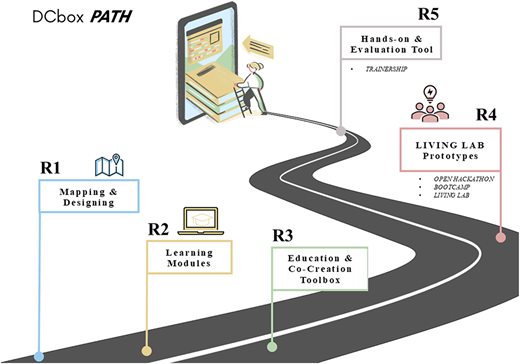
Methodology of the DCBox project: the results are connected to each other forming a complete pathway for learners. Source: Authors’ own work
Methodology of the DCBox project: the results are connected to each other forming a complete pathway for learners. Source: Authors’ own work
In particular, to achieve this goal, the project worked on defining the professional profile of the “digital curator”, highlighting the prerequisite of possessing digital, marketing and communication skills to engage a broader and more diverse audience. Therefore, DCbox analyzed the historical development of the curator profession and searched for related projects, provided valuable guidance on theoretical and methodological issues that emerged during the research. In fact, a review of the state of the art on scholarly articles and European projects from 2005 to 2023 resulted in two key analytical objectives: the degree to which museums are adopting digital technologies and the training paths that can shape the new profile of the digital curator. The main insights of these projects are discussed in Section 2 Related Works, while the results of the review, along with the evidence from R1–R4, form the basis of all subsequent analyses.
Regarding the training pathways, DCbox has structured the knowledge, skills and competencies required for the digital curator into a course consisting of eight learning modules (Table 1). Each module, equivalent to approximately six ECTS, combines micro-video lessons, case study readings, progressive practical exercises and is distributed through a dedicated Moodle LMS; all materials are released as Open Educational Resources, so they can be freely reused or adapted by museums and universities. The order of the modules follows a logical progression that starts with the fundamentals of digital heritage and metadata, moves through web-GIS, 3-D/XR production and audience analytics and concludes with project governance and legal-ethical issues, allowing students to advance without gaps from theoretical foundations to specialized applications. A continuous self-assessment system records progress and allows the accumulation of micro-credentials that can be converted into formal certifications. A fundamental step of the project, and a distinctive feature of the learning path, is the development of prototypes: these were created by teachers and students in the V-Labs, hybrid physical and virtual spaces that adopt design thinking methodologies. Five cycles of living-lab paired a real curatorial brief with multidisciplinary teams of students and academic tutors; following the phases of empathize, define, ideate, prototype and test, the groups produced functional artifacts, including an AI-assisted cataloging interface, an augmented reality way-finding app and an immersive VR tour, then documented in an open repository with source code, interface guidelines and reflections on the learning outcomes achieved. In this way, R2 provides the structured knowledge base, while R4 demonstrates how that knowledge can be applied, evaluated with real users and iteratively refined, ensuring that the curriculum is not only theoretically sound but also field-tested and transferable to other institutions.
Knowledge, skills and competencies acquired by the digital curator upon completion of the course consisting of eight learning modules
| Area | Module | Learning outcomes |
|---|---|---|
| A | 1: Digital transformation in cultural heritage | Students will grasp basic concepts and principles of digital cultural heritage, including keywords like digitization, digitalization, museology, digital humanities, and digital twin. They will explore the evolution of the curator’s role from the 15th century to the digital age, discussing essential humanistic and digital skills needed to preserve, enhance and disseminate Cultural Heritage |
| B | 2: Digitization | Students will develop competencies to plan, perform, process data and deliver high-resolution 3D models or digital products. They will learn to use various sensors on aerial and terrestrial platforms and engage in hands-on exercises with open-source and commercial software, working on real-case studies |
| 3: 3D Modeling and data implementation | Students will understand techniques to process, optimize, and manage 3D models, both reality and non-reality-based. They will use post-processing software and 3D data for objects of various scales, analyzing and discussing real case studies to develop analytical and critical thinking | |
| C | 4: Policy rules and licensing | Students will learn to manage digital cultural heritage according to European and international conventions and guidelines. They will adapt EN and ISO standards for digital sources and use open formats for digital preservation |
| 5: Digital data preservation | Students will develop strategies for preserving and interchanging digital data, creating long- and short-term plans for information management and cataloging. They will understand data models, interact with databases and collaborate with software engineers on data-centric applications | |
| D | 6: Communication and marketing strategies in cultural heritage | Students will navigate digital tools related to cultural heritage and the public, learning to create websites, videos and podcasts. They will design a hypothetical museum website |
| 7: Virtualization | Students will differentiate between VR, AR, MR and XR, learning their concepts, technologies and applications in cultural heritage. They will choose effective technologies for real scenarios and test platforms for developing XR experiences | |
| 8: New frontiers in Cultural Heritage | Students will learn about AI, including machine learning, deep learning and neural networks. They will explore AI applications in Heritage Science and design assessment questionnaires for museum applications |
Desk research therefore provides the link between the context analysis and the training pathway just described. An understanding of how museums implement digital tools, combined with an assessment of students’ readiness to assume curatorial responsibilities, provided the foundational skill on which the eight learning modules were designed and sequenced. The survey results informed the projects used in the V-Labs, ensuring that each prototype addressed a real technological gap or user need identified in the field. In this way, the quantitative and qualitative evidence collected in the partner countries flows directly into the curriculum architecture (R2) and the practical experimentation of the prototypes (R4), closing the methodological cycle that supports the entire DCbox project.
3.1 Process of data collection and geolocalization of digital museum
DCbox required a clearly defined methodology for geolocating digitized museums and providing information about the experiences they offer for visitors. As clarified in the Digital Curator Handbook (Quattrini et al., 2024a), the mapping activity is instrumental to substantiating the emerging role of the digital curator, the Web-GIS therefore operates merely as an empirical support, not as an autonomous research goal. The following section outlines the steps taken to accomplish these goals. The crucial starting point was the collection of data on digitized museums in Europe. A mapping exercise of digital practices in museums and heritage sites across Europe was done to gather and analyze information on best practices relating to DCH tools and digital strategies. Each partner gathered research and information on their own countries, as well as on neighboring countries: museums, archaeological sites and several other cultural heritage sites were investigated to determine the types of digital tools or technologies implemented to offer visitors user-friendly, appealing, innovative and interactive experiences. The data were registered as Good Practices and collected about: ID, Institution, Title, Location, Latitude, Longitude, applied technology, URL/DOI, short description, partner code, validation status and optional notes. The model was collectively drafted and refined through internal iterations, following the method outlined in the methodology document (Quattrini et al., 2024a, b).
Table 2 provides an overview of the digital tools collected by DCbox partners and show how often each technology is employed in the surveyed countries.
Good practices implemented in museums, categorized by country
| Country group | |||||||||
|---|---|---|---|---|---|---|---|---|---|
| Technology | CY + GR | East. EU | IT + HR | ES + FR | PT + de | GB | DK | QA | Other |
| AR-Sensor Based | 1 | 1 | 0 | 5 | 0 | 0 | 0 | 0 | 0 |
| AR-Vision Based | 1 | 2 | 9 | 3 | 0 | 0 | 1 | 0 | 0 |
| Cataloguing | 4 | 0 | 4 | 1 | 1 | 1 | 0 | 0 | 1 |
| Fully Immersive VR (CAVE) | 1 | 1 | 6 | 2 | 0 | 0 | 0 | 1 | 0 |
| Fully Immersive VR (HMD) | 0 | 1 | 5 | 3 | 0 | 0 | 0 | 0 | 0 |
| Mixed Reality (see-through glasses) | 0 | 0 | 1 | 3 | 0 | 0 | 0 | 0 | 0 |
| Non-Immersive VR | 6 | 1 | 8 | 1 | 0 | 1 | 0 | 1 | 0 |
| Semi-Immersive VR | 0 | 0 | 1 | 0 | 0 | 0 | 0 | 0 | 0 |
| Photogrammetry | 0 | 1 | 1 | 0 | 0 | 0 | 0 | 0 | 0 |
| User Guidance | 6 | 1 | 2 | 0 | 2 | 0 | 0 | 0 | 0 |
| User Tracking Behavior | 1 | 1 | 1 | 0 | 0 | 0 | 1 | 0 | 0 |
| Virtual tour | 10 | 4 | 7 | 13 | 11 | 0 | 0 | 0 | 1 |
| Web | 6 | 2 | 12 | 10 | 13 | 2 | 0 | 0 | 2 |
| 3D Print/Models/animations/mapping | 0 | 3 | 2 | 5 | 1 | 2 | 0 | 0 | 0 |
| 4D Models | 0 | 0 | 0 | 0 | 1 | 0 | 0 | 0 | 0 |
Note(s): Cyprus (CY); Greece (GR); Eastern Europe (Est.UE); Italy (IT); Croatia (HR); Spain (ES); France (FR); Portugal (PT); Germany (DE); Great Britain (GB); Denmark (DK); Qatar (QA)
For clarity, the categories are defined as follows:
Usage platforms: Web and Virtual Tour allow access and exploration of digital content via the internet and panoramic images or 3D models.
Augmented Reality: Sensor-Based exploits geolocation and motion data; Vision-Based uses camera and visual recognition to superimpose virtual objects.
Virtual Reality: varies from Non-Immersive (traditional screens) to Semi-Immersive (large screens or simulators), to Fully Immersive via HMD (visors) or CAVE (projected room).
Mixed Reality: combines real and virtual elements coexisting and interacting in the same space in real time.
Acquisition and Modeling: Photogrammetry generates 3D meshes from photos; 3D Printing converts digital models into physical objects; 3D Models, Animations and Mapping create and visualize 3D data; 4D Models add the temporal dimension.
Interaction and Tracking: User Guidance provides instructions and paths; User Tracking Behaviour analyses user movements and actions.
Content Organization: Cataloguing creates structured lists of resources with metadata to facilitate search and preservation.
As evidenced in the table, Portugal and Germany use “Web” tools more than any other country in the reference sample. Other innovative technologies, such as Non-Immersive Virtual Reality and Vision-Based Augmented Reality, are notably prevalent in some countries, including Italy. The creation of virtual tours and websites is a relatively straightforward process that does not require the use of sophisticated equipment. This may be a significant contributing factor to their widespread adoption across countries. However, both technologies still require qualified professionals, although compared to other types, they are certainly less complex and costly (for example, fully immersive Virtual Reality, or CAVE). 4D models, which are considered more expensive, are mentioned only once in our extensive sample. It is plausible that museums may lack the required financial resources to develop such expensive and specialized equipment, as well as the need for specialized personnel to manage these technologies. In general, it can be observed that as the cost of technology increases, the frequency of its use tends to decline.
Descriptive statistics generated from the GRID (country × technology; typology × metadata score) are summarized in Table 2 and Figure 2. Qualitative clustering of the short descriptions, guided by the conceptual categories set out in Digital Curator Handbook, chapter 3 (Quattrini et al., 2024a) allowed the identification of 12 professional responsibilities, 28 competence statements and 19 learning outcomes that inform the discussion in Section 4.
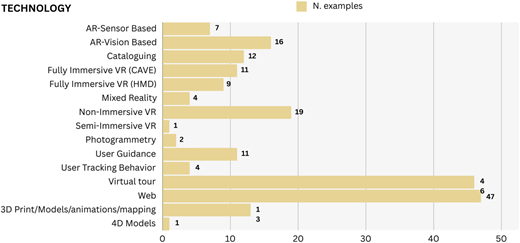
Histogram representing the number of Good Practices used in the Museums under consideration. Source: Authors’ own work
Histogram representing the number of Good Practices used in the Museums under consideration. Source: Authors’ own work
As evidenced by Table 2 and Figure 2, the most frequently used digital tool was the “Web”. This encompasses advancements such as website creation, making museums more accessible online and allowing people to visit from home or any remote location. In some instances, such as in Italy, entire online museums were established with the goal of reaching broader audiences. Mobile applications also fell within the “Web” category, with many countries developing apps for archaeological sites or monuments. For instance, in Cyprus, QR codes were installed in front of significant statues in Larnaca town. Visitors could simply scan the QR codes with their mobile phone cameras, triggering an audio playback describing the statues’ stories and significance. This approach offers an interactive and immersive experience for visitors in major European cities.
In close succession to the “Web” tools was the “Virtual Tour” tool. All countries reported at least one instance of a virtual tour in museums or archaeological sites. Many of these tours were created in response to the pandemic, providing people with the opportunity to experience museums and explore exhibits remotely. The “Virtual Tour” tool also enabled smaller museums and archaeological sites to gain visibility and attract larger audiences. Moreover, the development of new technologies to complement museum exhibits was utilized to engage younger visitors and create educational programs for children. Examples from Spain, Portugal, and various Eastern European countries such as Serbia, Bulgaria, and Romania illustrate this trend. However, it is important to note that the mentioned examples are not limited to virtual tours for engaging young visitors but include initiatives to enhance accessibility and interactivity of museum experiences for a broader audience.
Based on the collected results, an interactive wiki map was produced (Figure 3) that identifies how the project content can be refined to be useful and achieve full efficiency in terms of complementary formal/non-formal training paths.
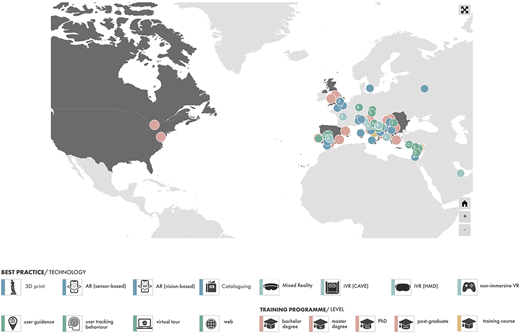
The DCbox project Web-GIS platform interface. Source: DCbox.eu/Authors’ own work
The DCbox project Web-GIS platform interface. Source: DCbox.eu/Authors’ own work
The platform needed to allow geospatial indexing of the museums and the addition of detailed information to their respective locations. Using GIS tools, museums were mapped to the geographic coordinates corresponding to their physical locations (the complete list of georeferenced museums, including their metadata, is available at the link: https://ec.europa.eu/programmes/erasmus-plus/project-result-content/e3738417-d6da-4112-ae3b-5953597cf6c8/DCbox_D1.2__Annex_.xlsx).
This step was crucial in creating interactive maps that allowed the public to easily locate museums of interest. The use of geographic coordinates (latitude and longitude) was essential for accurately localizing the case studies and avoiding overlaps between museums within the same country.
In addition to geolocation, museums were attributed with detailed data about the experiences they offered (Figure 4). This included information on virtual reality, augmented reality, virtual tours and other interactive experiences. To enhance the platform’s usability and facilitate data interpretation, a dropdown menu was implemented, enabling users to view all studied technologies or filter by a specific category. This feature markedly enhanced the map’s usability and readability, facilitating data collection and providing virtual visitors with a more user-friendly and customizable experience. Prior to its launch, the platform underwent rigorous testing to ensure smooth functioning and high-quality user experience. Any identified issues were promptly addressed, and the platform was optimized for enhanced performance and usability.
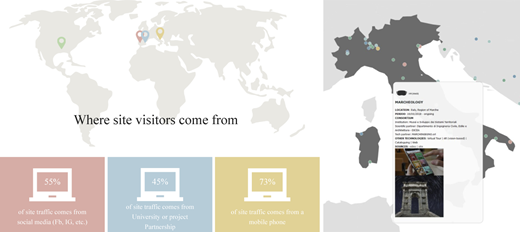
Website user evaluation survey. Source: Authors’ own work
Website user evaluation survey. Source: Authors’ own work
Once the platform was completed, the official launch of DCbox was carried out. Promotion was crucial to attract a wide audience and create awareness of the initiative. During and after the launch, a feedback collection strategy was implemented (Figure 4), enabling the identification of areas for improvement and the implementation of continuous enhancements to the platform and the information provided.
Moreover, the project materials produced, and the results obtained R1-R5 have been released under open-source licensing, permitting their unrestricted download from the official website (https://www.dcbox.eu/). The public version of the interactive map is available on the same portal, and it is possible to contribute new case studies through the form. This contributes to the updating of the database in real time and to the progressive expansion of the geographical and technological coverage of the project. The logic underpinning crowdsourcing ensures the continuous evolution of the mapping process, thereby fostering cooperation and mutual support between museums, researchers and digital heritage professionals.
4. Results
In the context of the dynamic management of CH, the role of the digital curator in Europe is pivotal to the preservation and promotion of cultural artifacts in the digital realm. Placing the digital curator at the core of this investigation reflects the project’s main driver: to understand how a singular, hybrid professional can mediate between technological affordances and the public-value mission of cultural institutions. A digital curator acts as a manager of digital heritage, organizing the care, management and accessibility of valuable resources and playing a fundamental part in shaping the narrative of cultural heritage in the digital era through education and professional development. To support the training of the digital curator, DCbox outlined the macro-level competence clusters identified by the CHARTER Skills Alliance into a practice-oriented micro-level matrix validated through 186 digitized museum case studies. Through the Digital Curator program, apprentices can acquire key skills to enhance the cultural sector, and each responsibility and competence has been aligned with established European frameworks (PARTHENOS Project, 2022; CHARTER Project, 2021; Molloy et al., 2014), which places the DCbox profile within a recognized theoretical discourse and ensures interoperability with current policy initiatives.
4.1 Depicting the figure of digital curator
The role of the digital curator is crucial in the management of cultural assets and information, despite the absence of a specific legal framework regulating this position. At present, a significant number of museums in Europe are augmenting their digital footprint through digitization initiatives, but they rarely mention the role of the digital curator. These figures work, for instance, in museums, libraries, archives and other cultural institutions, where they are responsible for the selection, evaluation and management of digital materials, the development of long-term preservation strategies and the creation of digital exhibitions. The requisite competencies encompass information management, archival practices, digital preservation and technological integration, complemented by exemplary communication abilities to facilitate collaboration with stakeholders.
The relevance of the digital curator is fully understood only by considering the range of needs that today converge on museums. The growing number of digital resources requires specialized skills in organization, cataloging and preservation, as well as the ability to effectively narrate cultural heritage. At the same time, the public expects immediate and interactive access, and technologies such as artificial intelligence, machine learning and augmented reality offer new horizons for presenting and interpreting collections. In this role, the digital curator guides cultural innovation, supports education and academic research, promotes inclusion and participation and also acts as a guardian of intangible heritage, from digital art to born-digital materials. In this context, international cooperation, and indeed the convergence of initiatives like DCbox and CHARTER, allows for the sharing of good practices and the constant expansion of an increasingly interconnected cultural landscape, while remaining flexible enough to respect the different technological, economic and cultural realities of each institution.
4.1.1 Interdisciplinary nature of digital curation
Digital curators in Europe blend interdisciplinary skills in archival science, information management, cultural heritage studies and technology. These competencies are crucial for addressing the challenges of managing digital collections. This interdisciplinary nature reflects the need for professionals capable of integrating knowledge from multiple fields to effectively preserve and present DCH, as Figure 5 summarizes.
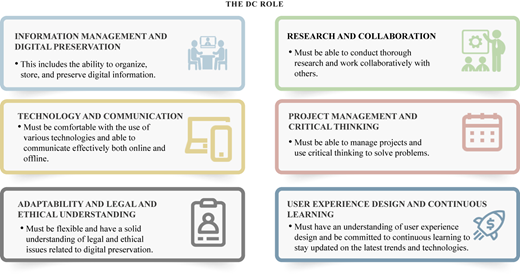
The role and competencies of a Digital curator. Source: Authors’ own work
The role and competencies of a Digital curator. Source: Authors’ own work
It is therefore incumbent upon digital curators in Europe to integrate new technologies as much as possible, to collaborate with one another, to undergo training and to promote cultural heritage consciously. In doing so, they must address both technical, cultural and ethical issues and engage in professional development. Based on these premises, DCbox attempted to provide an interdisciplinary, integrated, heritage-aware and responsive educational program.
Other aspects, recognized as highly significant in Europe, are illustrated in Figure 6. The DCbox educational program aims to offer apprentices broader and more varied job opportunities, recognizing both disciplinary and interdisciplinary knowledge as essential aspects in training. This places DCbox at the vanguard of knowledge and expertise creation. Regarding the disciplinary characteristics of a Digital Curator, DCbox identifies five main, interconnected and interdependent strands: digital humanities, digital museology, digitization and VR, digital communication, digital design and digital management.
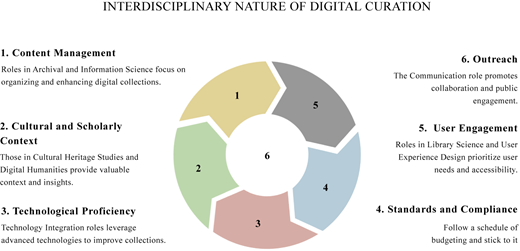
Technological integration, collaborative efforts and the pursuit of continuous professional development. Source: Authors’ own work
Technological integration, collaborative efforts and the pursuit of continuous professional development. Source: Authors’ own work
4.1.2 Key responsibilities and required competencies
The responsibilities and competences presented below derive from a four-step synthesis combining European policy guidelines (Dimitrova et al., 2020), established competence frameworks, empirical mapping of digitized museums identified as case studies (within R1) and validation activities (carried out in R2 and R4) (Quattrini et al., 2024a, b). The profession of Digital Curator lacks an international regulation, thus there are no directives for the exercise of this profession. The DCbox project adopted the recommendations of international and European institutions to define the educational program, such as the “Curricula guidelines for museum professional development” (Boylan, 2004), la “Raccomandazione sulla digitalizzazione e l’accessibilità online dei materiali culturali e la conservazione digitale” (Oriolo, 2010), the “Museum Professions. A European Frame of Reference” (Ruge, 2008) and the “Europe’s Digital Decade: digital targets for 2030” (Commission, 2022). However, according to DCbox (Quattrini et al., 2024a,b) the profession of digital curator is more complex than the mere ordering and managing digital data/information. This profession requires a wide range of skills and competencies to drive digital transformation in the cultural sector and in the field of DCH (Figure 7). As previously indicated, the digital curator is tasked with exploring the complex intersection between technology and culture, employing cutting-edge methodologies to safeguard and enrich digital assets. Ideally, the digital curator is well-positioned to facilitate the integration of digital elements within the operations of museums and cultural institutions, thereby enhancing the dissemination of their assets.
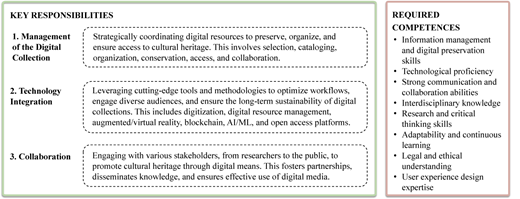
Key responsibilities and required competencies of digital curator figure. Source: Authors’ own work
Key responsibilities and required competencies of digital curator figure. Source: Authors’ own work
The management of digital collections represents a renowned and crucial aspect in digital curation. This involves strategically coordinating digital resources to conserve, organize and ensure access to cultural heritage in the digital context. The knowledge and care of a wide range of materials, from historical documents to multimedia artifacts, requires a meticulous and attentive approach. It also requires a strategic combination of archival principles, technological skills and a deep understanding of the cultural context. The ability to remain up-to-date and integrate cutting-edge technologies allows the digital curator to transcend traditional boundaries, engage diverse audiences and ensure the continued relevance of digital collections in an ever-changing landscape.
Finally, collaboration is a fundamental aspect of the role of the digital curator, not only to achieve goals but also as a dynamic process that enriches cultural heritage through a multiperspective vision. By engaging with a diverse range of stakeholders across academic, community and industrial settings, digital curators ensure that cultural heritage remains vibrant, continually evolving, and accessible to future generations. This commitment to collaboration is a cornerstone of the responsibilities of digital curators, with the objective of fostering meaningful partnerships, disseminating cultural heritage and ensuring the effective use of digital media to share and enhance the richness of cultural resources.
To fulfil these responsibilities, digital curators must possess a diverse set of competencies that seamlessly blend traditional archival expertise with cutting-edge technological prowess (Table 3). These include information management, digital preservation, technological proficiency, communication skills, interdisciplinary knowledge, research abilities, collaboration and teamwork, project management, critical thinking, flexibility and adaptability, legal and ethical understanding, user experience design, and a commitment to continuous learning. These skills, when combined, enable digital curator to navigate the complexities of the digital landscape, ensuring the effective stewardship of digital assets and in fostering deep and meaningful engagement with cultural resources across diverse audiences.
Required competencies for a digital curator organized around four disciplinary areas
| Area | Name | Competencies (A digital curator should be able to) |
|---|---|---|
| A | Digital transformation | Module 1
|
| B | Advanced 3d digitization | Module 2
|
Module 3
| ||
| C | Policies and digital data | Module 4
|
Module 5
| ||
| D | Digital access: universal | Module 6
|
Module 7
| ||
Module 8
|
4.2 Competencies, learning outcomes and KPI of the DC box learning experience
This section presents a comprehensive exploration of competencies, learning outcomes, key performance indicators (KPIs) and the development of an evaluation process within the context of the dynamic learning experience of the DCbox project.
The discussion centered on the intersection of competencies, specifically those pertaining to DCH and the design of museum exhibits. In navigating this terrain, our aim was to elucidate the relationship between theoretical knowledge and its practical application. By establishing clear competencies and learning outcomes, accompanied by measurable KPIs and a robust evaluation rubric, DCbox project established the foundation for an enriched educational journey that not only equips learners with essential skills but also provides an initial understanding of the complexities inherent in digital curation and exhibit design for cultural heritage.
5. Discussions and conclusions
The DCbox project represents a significant advancement in digital curation for cultural institutions, especially for museums, highlighting the pivotal role of the digital curator in making cultural experiences accessible through digital platforms. The comprehensive program it offers has been rigorously tested to define and train the digital curator professionals, and all the resources produced are openly accessible on the portal https://www.dcbox.eu/, including the web map which remains modifiable to accommodate new case studies. This enhanced understanding and accessibility of museum contexts provides fresh opportunities for public engagement and interaction. Furthermore, the data gathered on the digitization of museums revealed specific training gaps and needs that must be addressed to meet the evolving challenges and facilitate the transition toward digital, intelligent and interconnected museums. The Web-GIS, in fact, represents a tool for investigation and documentation, useful for making the work done transparent and for growing the database through collaboration with museums and researchers. The use of different technologies to make cultural heritage more digitally accessible underscores the need for a more structured and internationally recognized professional profile for digital curators. In turn, this demands a clear identification of competencies and skills such a professional should possess. Defining these competencies and skills was at the core of the DCbox project, as their provision and enhancement were essential to delineate and guide a learning process, which should also incorporate self-directed learning.
The project operated through five outcomes: (R1) mapping of practices and pathways, (R2) learning modules, (R3) digital infrastructure, (R4) prototypes validated with museums and (R5) multidisciplinary handbook. The prototypes testify to an important effort and very good results in terms of innovation for the DCH domain and in terms of competencies and practical skills acquired by the learners. Moreover, the production of a training handbook is the most important and representative intellectual output of the whole project, because it collected in a single document all the best practices and the essence of the DCBOX experience (Quattrini et al., 2024a, b).
Overall, the DCbox project represents a significant step forward in the field of curation, emphasizing the crucial role of the digital curator in enhancing the accessibility and experience of cultural heritage in the digital realm. By leveraging innovative technologies and fostering collaboration, the project paves the way for a new generation of European professionals specialized in DCH, redefining the digital curator as a vital mediator between culture, technology and the global public, ensuring the preservation and accessibility of shared cultural legacy.
The study has, however, some drawbacks and limitations. The current framework was developed before the extensive implementation of artificial intelligence, so future updates will integrate skills in prompt design, the use of generative AI tools, the ethical-legal governance of AI and validation of LLM results, recognizing both the opportunities and risks these tools present to museums.
In this sense, and in a broader perspective, the project demonstrated support for the digital transition, emphasizing the value of heritage education and the responsibility of heritage workers in the context of the changes occurring in our era to enable Europe to sustainably protect, promote and enhance its tangible and intangible cultural heritage.
The project also highlighted some gaps between the digital curator and the essential role of mediation figures, enabling to reach a more diverse audience and directly and indirectly promoting a stronger sense of civic co-responsibility toward our heritage.
Moreover, the empirical sample, limited to European institutions and partly self-reported, requires investigations in extra-European contexts to refine and internationalize the model. Despite these restrictions, the project offers a solid foundation of open resources that support the digital transition of heritage and strengthen the educational and participatory role of museums.
The authors would like to thank all the DCBox partners for their fruitful collaboration in the project. We finally would like to thank Dott. Paola Baldassarri for the valuable support in reviewing and editing the final version of the manuscript.

