BRIEFING
Performing through partnering
The innovative Cirque du Soleil has an equally fresh approach to project management. Zara Lamont, director of the Construction Best Practice Programme, reports on a show that depends on partnering (page 3).

Construction safety—time for a legislative tidy-up
The UK's rather messy health and safety legislation inhibits understanding and hinders compliance, believes consultant John Anderson. Clarification would come from a new health and safety Act and a single set of construction regulations (page 4).
NEC partnering agreement launched
The ICE's various New Engineering Contract forms are now extensively used throughout the world and are available electronically. NEC panel member Martin Barnes introduces the new partnering agreement, the latest addition to the family (page 5).
Behaving safely
British Nuclear Fuels Limited has initiated a programme to provide all its employees and contractors – a total of approximately 4000 people – with behavioural safety training. Occupational environment health and safety manager Andy Sneddon describes BNFL's contribution to the award-winning campaign (page 6).

Dams and development—a new framework for decision-making
Balancing the social and environmental costs and benefits of dams has become increasingly difficult. James Workman, senior advisor to the World Commission on Dams, introduces the Commission's recently published guidelines (page 8).

Engineering ecology
Civil engineers often find themselves in conflict with ecologists. Mark Philpotts, project engineer for the Thamesmead Wetlands scheme in southeast London, reports on how much more beneficial it is when they work together (page 9).

Lessons for the UK's 10-year transport plan
Implementing Britain's 10-year plan for improving transport rests heavily on regional authorities. John Dawson, AA policy director and former roads and transport director for London and Scotland, suggests where their priorities should lie (page 10).

Things to do before you sue
A new protocol came into force recently setting out what to do before going to court or arbitration in an English or Welsh construction or engineering dispute. Michael Frisby of law firm Stevens & Bolton explains (page 11).

Errors in adjudicators' decisions
Adjudicators are only human and can make mistakes. Based on two recent cases, barrister and London Association public relations secretary Terence Vaughan warns that their decisions should be checked both carefully and quickly (page 12).
MONITOR
Proceedings
The editor's choice of recently published papers, details of forthcoming papers, a list of on-line discussions on Civil Engineering and the most popular electronic papers (page 13).

Books
On-line book reviews and the current bestsellers at Thomas Telford Bookshop (page 15).
Internet
Mercadium and Construct Plus both adopt BIW project-hosting system, a guide to e-construction and RIBA Product Selector goes on-line (page 16).

Events
Details of all forthcoming events organized by ICE headquarters staff on behalf of ICE boards and associated societies (page 17).
PAPERS
The Three Gorges project on the Yangtze river in China
The £15 billion Three Gorges project in south China – which includes the world's largest flood control dam – is due for completion in 2009. Robert Freer reports on construction progress and the problems of relocating and re-skilling over one million people (page 20).

Business systems engineering—can it work in construction?
Business systems engineering is a well-established management approach in the manufacturing sector. Mike Riley and Denis Towill reveal that various steps of the process are already being used to advantage on some of the M41 demonstration projects (page 30).

Foundations for the future
The ground under our towns and cities is becoming full of bored concrete piles. Tim Chapman, Bryan Marsh and Andy Foster argue that re-use of existing piles is the answer and propose changes in our approach to designing, building and paying for foundations (page 36).

Software-supported risk management for the construction industry
The value of systematic risk management is being increasingly recognised by the construction industry. Jim Hall, Ian Cruickshank and Patrick Godfrey introduce a simple new software tool, based around a risk register, for newcomers to risk management (page 42).

Briefing: Performing through partnering
The innovative Cirque du Soleil has an equally fresh approach to project management. Zara Lamont, director of the Construction Best Practice Programme, reports on a show that depends on partnering.
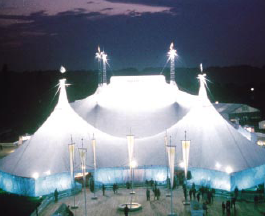
Touring a barren construction site on a frosty November day may not be everyone's idea of fun but this is exactly what happened when I was recently invited to view the work being carried out for the Cirque du Soleil in the grounds of Battersea Power Station, London.
Arriving there with little idea of what to expect, it was soon clear that I was about to learn more about the partnerships evolving on this project rather than the technical superlatives of a high-wire trapeze.
Key to the success of this project is how best-practice principles, so often talked about, but often quite difficult to find implemented, have been picked up by a project team and put in place. One rather refreshing element is how the Cirque du Soleil has allowed best-practice principles to be applied to its projects. Given its ‘circus’ approach to life, which can throw many unplanned demands at the team, new-style partnering arrangements are designed to help avoid confrontation and lengthy contract negotiation.
Working to a deadline of just 6 weeks at Battersea, all of it during the wettest autumn on record, the project team knew that converting an area of wasteland into a technically compliant site encompassing an 11,500m2 car park, a 3,263m2 performance tent and a 20,000m2 village for performers including school and catering facilities, would not be without its difficulties.
Crucially, Cirque du Soleil's ten shows a week, each entertaining up to 2500 people, and its 54 articulated lorries in tow can never accommodate delays. If the infrastructure, anchorage and other technical requirements of the Cirque du Soleil are not 100% correct, the show cannot go on.
Partnering – simply a better way of working
In simple terms partnering is a different way of structuring business relationships, which has profound implications for all parties involved. It should not be confused with other good project-management practice or with long-standing relationships, negotiated contracts or preferred supplier agreements, all of which lack the structure and objective measures that must support a partnering relationship.
Fundamentally, partnering should only be entered into by those who truly share the beliefs that people are honest, want to do things which are valued, and are motivated by challenge. Without these beliefs people will never work together effectively.
Partnering is an appropriate method of working, or mind set, for all types of project whether large or small. In fact projects lasting just a few weeks are often an ideal place to start when deadlines are tight and focus on the end goal is essential.
Mutual objectives, problem resolution and continuous improvement are imperative to any partnering arrangement. In this particular case the client made it clear in initial discussions that it was willing to look at better ways of doing things in return for a unified team keen to promote a ‘no-fail’ policy. As well as proposing no liquidated damages and no retentions the client was instrumental in proposing up-front payments and was willing to commit to costs from day one, believing that it was only right for the project team to receive a fair deal and to be paid accordingly.
Why traditional approaches would not work
The Cirque du Soleil team believes that if the traditional approach had been adopted, the project would not have worked because the changing needs of the client had to be accommodated with cost-impact of each change discussed and agreed with all parties. A considerable success factor appears to have been the permanent on-site presence of the client and both the construction and project managers, Dean & Dyball and Schofield Lothian respectively. This, combined with regular daily progress meetings, undoubtedly helped facilitate fast and effective decision making and ensured that a respectful working relationship with universal trust was established amongst the project team from the very start.
Early discussions with the client had helped to minimise expenditure before the project details had been fully decided with a topo-graphical survey being carried out in advance to determine ground conditions and the design specifications required for anchorage and the car park. Additionally, the four contractors sourced were given just 1 week to tender and the selection of the construction manager was seen to be appropriate as its views on partnering were very similar to that of the client's. The construction manager was also in a position to put forward an immediate in-house team and its own plant provision to speed up the process.
With the first show in mid December and eight man days required prior to this to erect the structures and the tent, a systematic approach to problem resolution was imperative. Partners have to accept that problems will occur but effective partnering is all about seeking solutions and not apportioning blame. Any discussion, particularly when time is restricted, which encourages less paperwork and more constructive correspondence will help to minimise time and cost.
Partnering is not a new buzz word, neither is it a new form of contract, a soft option or a quick fix. Any project using partnering does require a high integration of effort and understanding. Evidence suggests from our findings at the Construction Best Practice Programme that as a direct result of partnering people really do feel more empowered and that it in turn encourages them to work together more effectively.
For information about partnering or on any of the Construction Best Practice Programmes' activities, visit the new website at www.cbpp.org.uk or call the helpdesk on 0845 605 55 56.
Briefing: Construction safety time for a legislative tidy-up
The UK's rather messy health and safety legislation inhibits understanding and hinders compliance, believes consultant John Anderson. Clarification would come from a new health and safety Act and a single set of construction regulations.
The construction industry has in recent times seen an increased emphasis on containing costs and seeking out and applying best practice in the struggle to improve efficiency. Improving effectiveness—the achievement of intended policy outcomes—is also of concern to private companies and organisations.
Health and safety is an issue where organisations and individuals have to work within the constraints of the legislation. How effective and focussed this legislation is in providing a good framework for action is thus important. Piecemeal, overlapping, out-of-date and poorly written legislation inhibits the industry's understanding and can lead to mis-direction and a waste of money and other resources.
Where we are now?
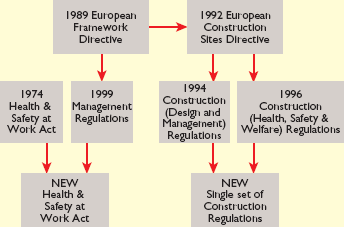
Those drafting the key 1989 European Framework Directive were undoubtedly influenced by both the format and the years of working experience within the UK of the 1974 Robens Health and Safety at Work Act. The section 2(1) duty on every employer ‘to ensure, so far as is reasonably practicable, the health, safety, and welfare at work of all his employees’ is clearly related to article 5(1) of the Directive, which says:
‘The employer shall have a duty to ensure the safety and health of workers in every aspect related to the work.’
The Directive then went further to specify some necessary detail in order to reach this objective, and, in particular, employers were given the duties of
avoiding risks to safety and health
evaluating risks which cannot be avoided
combating risks at source
adapting to technical progress
giving collective protective measures priority over individual measures.
These positive and welcome legislative requirements were brought into being via the 1992 Management Regulations (Fig. 1). Unhappily the strategic importance of these regulations was largely obscured when they were issued not as amendment to the Health and Safety at Work Act but as one set of regulations in a ‘six-pack’.
One of the ‘daughter’ directives arising out of the Framework Directive was the Temporary or Mobile Construction Sites Directive of 1992 which gave rise to two sets of UK construction regulations—the Construction (Design and Management) Regulations (CDM) of 1994 and Construction (Health, Safety and Welfare) Regulations of 1996.
The need for a new health and safety at work Act
There has, probably necessarily, been a piecemeal approach to the creation of new health and safety legislation in the last 10 years but the time has surely come to consider a new health and safety at work Act. We could weld together the hazard identification and risk assessment approaches in the present 1999 Management Regulations with the overall end-objective of ‘ensuring health and safety’.
The new Act should give equal importance given to the three processes
identifying hazards
assessing risks
devising and implementing safe systems of work.
It is these three linked processes, properly applied, that really matter.
Any new health and safety at work Act should specifically mention education as well as training. The core of our national engineering knowledge and practice is in the hands of the 280,000 registrants of the Engineering Council, each one of whom has to undertake an approved course of education. Industry professionals have a leadership role in health and safety, and the training they receive in their early years in industry should supplement what their educational courses have already provided.
The need for a combined set of construction regulations
A new single set of construction regulations derived from the present two sets of 1994 and 1996 would also help matters. The CDM regulations, worthy though they are in principle, are often perceived as rules for designers and clients, whereas the Health, Safety and Welfare regulations are for contractors. Having one set of regulations would reinforce the message that we are all part of the one industry, and the more all the parties of a construction project can work together in their own ways, the better the end result will be for all concerned. Neither accident numbers, nor total cases of ill health are reducing at the present time. We are not working well together at the moment.
Any legal re-drafting could also prompt a debate about whether we really need section 16 of the present Health and Safety at Work Act on approved codes of practice. Surely the wording of modern-day acts and regulations should be of sufficient clarity and definition not to need a further layer of statutory wording to explain what is meant. Guidance is, of course, very important for the information of employers, employees and all others preparing and monitoring health and safety systems, but the days when the enforcement authority was perhaps the only source of such material have long gone. With more openness in the sharing of basic information there are now many other organisations which are perfectly capable of producing just as good if not better advice than the Health and Safety Executive.
Part of the business of legislation is to promote effective responses from those charged with duties and responsibilities. Getting the rules as right as we possibly can will certainly reduce the human and financial costs of unnecessary accidents and disasters which is what we all want.
For further information contact the author on tel/fax +44 ( 0)12 44 68 3124, email ja@nosredna.demon.co.uk.
Briefing: Behaving safely
British Nuclear Fuels Limited has initiated a programme to provide all its employees and contractors – a total of approximately 4000 people – with behavioural safety training. Occupational environment health and safety manager Andy Sneddon describes BNFL's contribution to the award-winning campaign.
BNFL Engineering employs approximately 1700 staff at offices at Risley in Cheshire and Sellafield in Cumbria, and manages nuclear engineering construction projects that involve around 2200 contractor's employees. As a design, procurement and construction management organisation, the company undertakes many of the Construction (Design and Management) Regulations duties on its green and brown-field projects. In the last 12 months it has entered into partnering arrangements with several engineering, procurement and construction contractors with the express purpose of sharing best practice and improving health and safety throughout the entire life-cycle of its projects.
The need to cooperate on safety
As a nuclear site licensee, BNFL often undertakes the roles of client, designer, planning supervisor and the principal contractor on its construction projects. Developing and improving working relationships within the company and with contractors and external suppliers has therefore been vital to improve health and safety performance.
The company undertook to increase the awareness of safety among staff to improve cooperation between all parties. This included office-based design and project staff as well as site-based workers. A significant amount of resource – including an increase safety department staff – has been devoted to address these issues and to provide behavioural safety training over a period of 12 months.
Co-operation with contractors and local suppliers has been improved through the involvement of managers and safety professionals at co-ordination meetings chaired by BNFL's head of construction and senior environment health and safety advisors. In addition, safety advisors from contractors share best practice and help train all managers, supervisors and operatives regardless of their employer. In support of these efforts, senior engineering managers and the head of engineering have made programmed visits to projects solely for the purpose of reviewing safety performance with individual contracting companies.
Training people to recognise hazards
Behavioural safety training has been given to almost 3000 personnel over the last 12 months as part of the company's ‘culture change’ initiative. The trainers for these courses have been recruited from within the company and from contractors on site, thus creating a training environment that is both challenging and focused on the operational realities of each section of workforce.
The courses have been run to include office safety, construction site safety and safety in the home. Issues explored during the courses include how people's seemingly trivial or simple actions can impact on other people further down the line. This raises awareness of the ‘knock-on’ effect of decisions and actions at the ‘front-end’ of projects upon the construction phase, and of decisions made in one functional area upon another. The course material has been adapted to be challenging at an individual level, leading in many instances to forthright and informative debate on organisational and individual responsibilities for safe working.
The awareness training then leads onto an observation process. This involves training people to recognise hazards in their own working environment and to take time to discuss both good and poor performance with colleagues in order to uncover the hidden obstacles to safe working. BNFL Engineering is now working to improve the take up of the observation process by diverting resources towards coaching after the initial training stage. The company believes that the next six months will be a crucial period as raised awareness and employee expectations need to be capitalised on by generating high quality observations that can add value to design and construction operations.
Monitoring and sharing best practice
All information and observations are recorded on Prosafe, a proprietary risk-management system. Reports are then formulated and important and relevant information communicated back to the workforce. The information derived from the behavioural safety observations on construction sites is analysed to identify trends. These are now beginning to be reviewed jointly by BNFL and contractor construction managers and contractor trades union representatives at a monthly liaison meeting.
This has been carried out alongside BNFL's ‘Learning 2000’ campaign, which is designed to eradicate health and safety management inconsistencies across the company's business areas through structured learning and improvement following health-and-safety-related events.
The roll-out of the behavioural safety programme to contractors has been a major undertaking with large resource implications. Contractors have had the vision to accept the long-term benefits and have responded by agreeing to give their time without cost, with the obvious negative effect on profit margins. By working with contractors BNFL has jointly developed strategy, training materials and a delivery programme.
Behavioural safety trainers and co-ordinators have been drawn from both BNFL and contractors, and work together throughout.
In order to share best practice and to ensure that learning from incidents and injuries is disseminated across all projects, a monthly meeting is held between all safety advisers employed on the sites. As well as coordinating safety effort, the meeting also provides a forum for the safety advisers to air concerns and share experiences from other sites. The meeting is supported by a series of safety related presentations which assists both BNFL and contractor safety advisers to keep abreast of current developments in legislation and in safety-related products and services.
The campaign recently won the co-operation category of the Health & Safety Commission's ‘working well together’ national construction awards. Whereas BNFL recognises that much more work is needed truly to ‘work-together’ and drive down accidents and ill-health on construction sites, the award has been welcome recognition of a sustained effort by client and contractors alike.
For further information, contact the author on tel. 019 4678 0350 or via email at andy.sneddon@beltd.com. For Prosafe visit www.eqe.co.uk and for the WWT awards visit www.hse.gov.uk.
Briefing: Dams and development a new framework for decision-making
Balancing the social and environmental costs and benefits of dams has become increasingly difficult. James Workman, senior advisor to the World Commission on Dams, introduces the Commission's recently published guidelines.
The World Commission on Dams recently launched its report Dams and development: a new framework for decision-making in London. The report is likely to have a profound impact not only on the future role of the $42 billion dam industry, but also on how to develop and manage water and energy resources in the new millennium.
Dams have been built for thousands of years—to manage flood waters, to harness water as hydropower, to supply water to drink or for industry and or to irrigate fields. Today there are over 45 000 large dams in the world; one-third of all countries rely on hydropower for more than half their electricity supply; and large dams generate 19 % of electricity overall. In addition, some 30 40 % of the 271 Mha of irrigated land worldwide relies on dams.
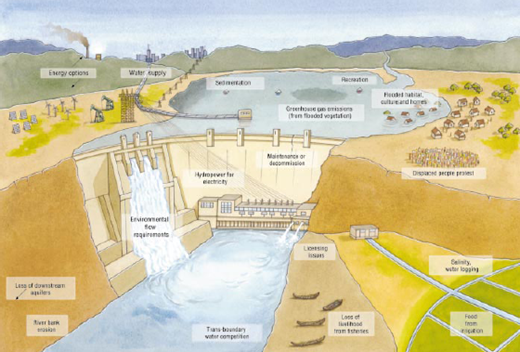
But the last 50 years have also highlighted the performance and the social and environmental impacts of large dams. They have fragmented and transformed the world's rivers and global estimates suggest that 40 to 80 million people have been displaced by reservoirs (Fig. 1). Dams today have become one of the most hotly contested issues in sustainable development today.
The World Commission on Dams is made up of 12 diverse commissioners, ranging from engineering company executives to anti-dam activists. Its recently published report is the culmination of an unprecedented, global public policy process over a 2 year period to provide consensus to what had become an increasingly bitter and divisive debate.
Research and key findings
The Commission received 947 submissions and conducted detailed reviews of eight large dams and country reviews in India and China. A survey of 125 large dams was also undertaken, along with 17 thematic reviews on social, environmental and economic issues; on alternatives to dams; and on governance and institutional processes.
Based on its knowledge base and compelling evidence, the Commission found the following.
Dams have made an important and significant contribution to human development, and the benefits derived from them have been considerable.
Large dams have, however, demonstrated a marked tendency towards schedule delays and cost overruns, as well as often falling short of physical and economic targets, such as predicted water and electricity services.
Large dams have led to the loss of forests and wildlife habitat and the loss of aquatic biodiversity of upstream and downstream fisheries. The Commission found that efforts to counter the ecosystem impact of large dams had met with limited success.
Large dams have also resulted in negative social impacts, which reflect a failure to assess and account for displaced and resettled people as well as downstream communities. Mitigation, compensation or resettlement programs were often inadequate.
Guidelines for decision-making in the future
The report argues that it is not necessary to trade off one person's gain against another's loss. Rather, by negotiating outcomes through multi-criteria analysis—technical, environmental, economic, social and financial— the development effectiveness of water and energy projects will be improved with unfavourable projects being eliminated at an early stage.
The Commission recommended
a set of five core values for future decision-making – equity; sustainability; efficiency; participatory decision-making and accountability
a rights and risks approach for identifying all legitimate stakeholders in negotiating development choices and agreements
seven strategy priorities for water and energy resources development: gaining public acceptance; comprehensive options assessment; addressing existing dams; sustaining rivers and livelihoods; recognizing entitlements and sharing benefits; ensuring compliance; and sharing rivers for peace, development and security.
World Bank president James Wolfensohn said that ‘no country constructing a dam will want to ignore a report of this weight, the most complete that has ever been done’. Other organisations which have said they will respect the Commission's guidelines include the US Export-Import Bank, which has funded many large dams built by American firms in developing countries, and the African Development Bank.
No one is under the illusion that implementing the guidelines will be easy, and many agencies and institutions will take a huge amount of persuading to review their water and energy development polices. The report is an important start, however, in ushering in an era where constructive dialogue and consensus overrides division, polarization and inertia.
The result is a milestone in the evolution of dams as a development option and offers a clear charter for the future - a charter by which every dam in the world can and should measure itself. In the words of Nelson Mandela, who attended the launch: ‘It is one thing to find fault with an existing system. It is another thing altogether, a more difficult task, to replace it with an approach that is better.’
For further information visit www.dams.org or contact the author on tel: +27 21 426 4000, email jworkman@dams.org.
Briefing: Engineering ecology
Civil engineers often find themselves in conflict with ecologists. Mark Philpotts, project engineer for the Thamesmead Wetlands scheme in southeast London, reports on how much more beneficial it is when they work together.
Tucked away in the middle of the massive Thamesmead development in southeast London between the River Thames, a landfill site and the route for the proposed Thames Gateway Bridge, the Thamesmead Wetlands is taking shape.
The site, along with much of the developable land in Thamesmead, is owned by client, Tilfen Ltd, a company formed from the recent demerger of Thamesmead Town Ltd, itself a legacy of the Greater London Council. The site is contaminated with materials such as foundry waste and heavy metals from a previous user, the Royal Arsenal.
The development in Thamesmead is made commercially viable by the presence of an on-site contaminated soil repository, known locally as LF3. Instead of moving contaminated soil several miles from Thamesmead, it is being disposed of locally into a highly engineered licensed facility, which will ultimately be capped and transformed into an urban park next to the River Thames.
The long-term management of LF3 has necessitated the client, with Scott Wilson Kirkpatrick as environmental and ecological consultant, to construct a series of wetland lagoons with extensive reed beds to deal with ammonia-rich leachate being pumped from the facility.
Not just a civils project
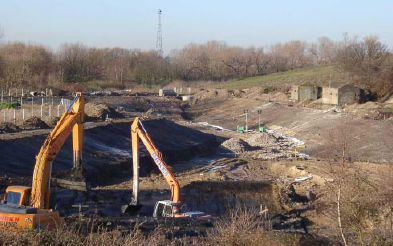
Principal contractor Brett Construction is dealing with a reasonably impressive set of statistics: 2 ha contaminated site, 50 000 m3 of muckshift, 10 000 m2 of geosynthetic clay liner, 10 000 m3 of soil for landscaping, flow control structures and a storm-balancing sewer.
Though looking like a standard recipe for a civils project, there is, however, a difference. Gone are the bad old days of engineers constructing installations for purely engineering reasons and having disagreements with environmental groups in the process. Due to the early and continuing involvement of ecologists and the Environment Agency, the project has a distinctly environmental twist to it.
Reed beds and wetlands are now accepted and important engineering tools for water treatment. They can, however, be more. Along with the beds of phragmites australis (common reed) for water treatment, tailored habitats are being created for the threatened water vole and deep-water fishing areas with vertical banks are being developed for kingfishers.
Widespread planting and landscaping is taking place with a variety of features favouring reptiles, butterflies and insects.
Working with ecologists
The role of civil engineers in a project such as this is central. Our designers and contractors are able to handle the earthworks and structures required to realise such a project, but we are also able to listen to and translate ecologists’ suggestions into a project integrating an engineered solution with a tangible environmental and ecological enhancement. This type of project is especially important in an area such as Thamesmead as important wasteland habitat is being necessarily lost to remediation and development.
Once complete and operational, the Thamesmead Wetlands will be an important study resource for engineers and ecologists alike. Lessons learnt here will be transferred to other projects in the area and hopefully wider afield.
There is one final point to make, constructing such a project is all very well, but who will maintain it? The answer is simple – engineers with ecologists – a refreshing change.
For further information contact the author on tel. +44 (0)20 8320 3421, email Mark.Philpotts@virgin.net
Briefing: Lessons for the UK's 10-year transport plan
Implementing Britain's 10-year plan for improving transport rests heavily on regional authorities. John Dawson, AA policy director and former roads and transport director for London and Scotland, suggests where their priorities should lie.
Implementation of the government's 10-year plan is top of Britain's roads and transport agenda. Responsibility for delivery rests overwhelmingly with the individual transport agencies in the countries and regions that comprise the UK. These agencies must prepare programmes and projects that reflect the policies and priorities of each area.
The role of national government is to oversee the development of efficient networks that will promote national cohesion. Unfortunately little priority has been given so far to completing basic road links between various areas. Severe congestion on roads between the major economic centres is a legacy of under-investment during the last 25 years and historically centralised systems of transport planning and assessment.
Lorries carrying products from Northern Ireland, for example, must travel on more than 100 miles of single-carriageway before they reach the motorway system. Edinburgh, the capital of Scotland, is linked to the northeast of England by an elderly single-carriage-way with an unacceptable level of road accident fatalities. The route from London to Cornwall is not even a completed dual-carriageway, never mind a full motorway.
The lack of commitment to bringing national main routes up to normal European standards percolates down through each region. Britain's primary route network carries heavy through-traffic as well as local vehicles. These roads are of more than local importance, but because the bypass programme has gone sadly awry, the traffic on them all too often intrudes into local communities.
Balancing speed, safety and environmental impact
A natural objective for the primary network is that the inter-urban sections should carry speed limits of not less than 50mph. Addressing congestion hot-spots on the national inter-urban arteries, and on roads around and leading to the major cities, is a national priority.
Another priority is to achieve the govern-ment's ambitious road safety target – a reduction in road deaths and serious injuries of 40% (50% for children) by 2010. This must be reached alongside environmental improvement objectives, and it must be accepted that it will involve costs – from tunnelling through to amenity improvement in ‘home zones’ – that Britain, unlike other European countries, has been unwilling to meet in the past.
The other areas for regional action
There are five other action areas that regional agencies need to address to realise the 10-year plan – repairs, operations, alternative transport, infrastructure and charging.
Repairs–the starting point
Britain's roads and bridges are in their worst condition since formal monitoring began in 1977. Rail and London Underground lines and stations are in a similar state. No region performs well. The 10-year plan pledges money for restoring transport assets, and this is the priority. Noone will believe in future improvements if such basics as traffic signs, bus stops, potholes, decaying car parks and railway stations are not put right first. Traffic accidents are being caused, and lives are being lost, because essentials such as white-lines, traffic signals and skid-resistant surfaces are not being maintained.
Operations–room for improvement
Improvements to the running of the transport system – including the management of road works, the detection and clearance of incidents, the enforcement of traffic regulations, and the deployment of new services to improve information and ticketing – is also an urgent early priority. Greater management attention is needed to raise standards of reliability and punctuality, and to let the traveller know when and why things are going wrong.
Alternatives–pushing rail and bus
More high-quality alternatives to cars and lorries are promised in the 10-year plan. There is popular support for improving public transport to give motorists a choice, and for moving road freight to rail. Investment must be targeted to attract cars and lorries from busy routes at congested times. This will be feasible only where there are dense movements of people and freight. Park-and-ride and light rail have an appeal for motorists and have been identified for increased investment.
Infrastructure–the need for networks
The 10-year plan requires authorities to implement the development of infrastructure plans, particularly through so-called multi-modal studies and local transport plans. The traveller thinks in terms of networks, whether road, rail or Underground. The priorities must be to
reduce road deaths and injuries
tackle congestion hot-spots
support regional development and complete basic trade routes
relieve towns and villages of unsuitable traffic
provide rail and bus alternatives and make walking and cycling more attractive
support home zones and safe routes to schools.
Paying for motoring–reform overdue
The Government must reform the way motorists pay for roads. The new graduated vehicle excise duty (VED) system, as with unleaded petrol before, is an example of what can be done by giving tax reductions to cleaner or more fuel-efficient vehicles. The Government has pledged that changes to VED will be revenue neutral.
The burden of motoring taxes on all drivers is now too high, but the burden on drivers who do most of their driving on uncongested rural roads is particularly unjust. It is also economically and socially irrational. The government has promoted legislation to enable urban authorities to charge more on congested urban roads, but has yet to think systematically through the corollary, such as reducing fixed taxes or fuel duty. The astonishing achievements of vehicle and fuel technology in reducing emissions must be recognised.
Solutions involving taxation, efficient pricing and investment are unlikely to be solved with Britain's current archaic system of transport finance. There needs to be clear separation of the money that motorists pay in fuel tax and general taxation and the money that they pay for the upkeep and development of roads. What is paid in fuel tax should be made clear at the pumps. Such information is crucial to any future discussion about raising some taxes and lowering others, and to the acceptability of paying. There must be confidence that money raised and pledged for a purpose is spent, and spent well.
Capital projects not the only solution
Modern transport plans cannot concentrate solely on delivering major capital projects. There is much greater understanding that the detailed provision of various services is a task that is every bit as challenging. Vehicle security, travel information, management of road-works, cleaning and repairs, signposting and parking are essential elements of the transport package.
The AA's recent report Where you live and what you getshows particularly that the vast majority of car-owning households in Britain have a choice about which town centre they will visit and spend their money in. It is a choice that they are increasingly willing to exercise. Loyalty has to be earned.
It is against this national backdrop that transport authorities must draw up their contributions to the 10-year plan, addressing regional issues and priorities.
For further information visit www.theaa.com or contact the author on tel. +44 (0)12 5649 2927, email john.dawson@theaa.com.
Briefing: Things to do before you sue
A new protocol came into force recently setting out what to do before going to court or arbitration in an English or Welsh construction or engineering dispute. Michael Frisby of law firm Stevens & Bolton explains.
On 2 October 2000 a new ‘pre-action protocol’ came into force in the England and Wales regulating the way in which construction and engineering disputes are dealt with prior to starting legal proceedings. It will affect all those involved in construction and engineering disputes, including professional negligence claims.
The protocol is relevant to cases that are going to be resolved through the courts. However, it will also affect those disputes which are to be resolved by arbitration (for example, the standard ICE form contains an arbitration clause).
Following the overhaul of the civil justice system in light of the Woolf reforms on 26 April 1999, the parties to prospective litigation are required to act reasonably and to take all necessary steps to ensure that there is a flow of information and dialogue between the parties with a view to promoting early settlement of cases. The aim is to avoid the time and expense of litigation.
Specific protocols were envisaged for particular types of dispute. So far, there have been protocols for personal injury and clinical negligence cases. The new protocol relates specifically to construction and engineering disputes.
Four stages before going to court
The pre-action protocol sets out a four-stage procedure
a detailed letter of claim is sent by the proposed claimant
within 14 days of receipt the proposed defendant must acknowledge receipt of the letter
within 28 days of receipt of the claim letter a detailed response must be given
as soon as possible after the response is given the parties are to meet to discuss the case on a without-prejudice basis.
The protocol requires that the letter of claim must set out the name and address of the proposed claimant, the full name and address of each proposed defendant, a summary of the facts on which the claim is based and identify the contract terms which are relied upon. Where damages are claimed a breakdown must be provided showing exactly how they are calculated and if an extension of time is claimed the period claimed must be specified. If a claim has been made previously and rejected then the letter of claim must explain why the rejection was wrong. Where experts are instructed they must be identified and the issues they are to address must also be stated.
Defendant must reveal any defence and counterclaim
The proposed defendant's response letter must give similar details of any counterclaim which it proposes to bring and set out fully all facts and matters relied upon in defence of the proposed claim. If the jurisdiction of the court is to be contested (for example by seeking a reference to arbitration) then the point must be taken in the defendant's response. If the defendant is insured the insurer must be identified. The response is to be given within 28 days of receipt of the letter of claim, although the period can be extended by the consent of the parties by up to 4 months.
The pre-action meeting is to take place on a without-prejudice basis. It's purpose is to identify common ground and matters in dispute and to consider ways in which the disputed matters might be resolved without litigation or if litigation is to follow how the matter might best be dealt with, for example whether or not any form alternative dispute resolution might be suitable and what expert evidence.
Penalites for non-compliance
Non-compliance with the protocol will not debar a party from pursuing either a claim or defence through the courts. However, it is likely that the Court will penalise non-compliance with the protocol by ordering the non-compliant party to pay either all or part of the costs of the action and may also reduce the amount of interest awarded on damages. There is no obligation to follow the protocol where
the claim is for enforcement of an adjudicator's award
the claimant proposes to apply for summary judgment
the claim is for interim injunctive relief
adjudication or ADR on substantially the same issues has taken place.
Things to remember
It should also be borne in mind that where the dispute is referred to adjudication the protocol will not be of any effect nor will any contractual provision purporting to incorporate the pre-action protocol or similar mechanisms. The recent Technology and Construction Court decision in John Mowlam v Hydra-Tight highlighted that there can be no impediment on a party's right to take a dispute to adjudication at any time.
It is important therefore that early advice is taken at the time a claim is contemplated. It is essential that the claim letter is correctly formulated and drafted. Similarly, where a claim letter is received it is important that early advice is taken to ensure that the response is served in time and that the meeting takes place.
Where the contract contains an arbitration clause, the recipient must ensure that in his response letter the arbitration provision is raised as failure to take the point may at worst constitute an agreement to submit to the court's jurisdiction or at best could lead to a liability to pay the costs associated with an application for a stay of proceedings.
For further information contact the author on tel. +44 (0)1483 302264, email Michael.Frisby@stevens-bolton.co.uk
Monitor
Proceedings: EDITOR'S CHOICE
Summaries of all Proceedings papers published since 1998 can be read free of charge at the ICE web site (www.ice.org.uk/jol). To subscribe to a specialist Proceedings journal call +44 (0)20 7655 2135 (members) or +44 (0)20 7665 2460 (non-members).
Forthcoming papers
The following papers have been accepted for publication in future issues of ICE Proceedings journals.
Civil Engineering (CE)
The use of GPS to support the construction of a high speed railway. C. Kelly
Procurement, manufacture and construction of the London Eye. A. P. Mann, N. Thompson and C. Smith
The development of a cable tunnel network for London. M. C. Knight, R. Marshall and R. Mathews
The EPC template for describing output standards in engineering. D. Muir Wood
Geotechnical Engineering (GE)
Managing geotechnical risk: time for change? The Unwin Lectures. C. R. I. Clayton
Geotechnical aspects of lifeline engineering. T. D. O'Rourke, H. E. Stewart and S-S Jeon
Metros under construction around the world. E. Hellawell, J. E. Hawley, A. J. Pooley and S. Degn
A discontinuous future for numerical modelling in geomechanics? P. A. Cundall
Land reclamation technology expanding the geotechnical engineering envelope. J. G. Bagshaw and G. W. Dawson
Municipal Engineer (ME)
Planning for the bicycle: Current issues and future challenges. H McLintock
The role of bus and HGV lanes as part of a balanced strategy for the effective use of road space. A. Hall
Parking strategies across the sub-region. H. Potter
Using bus service subsidy to develop the network. R. Bentley and J. Lynch
Encouraging schools and employers to adopt travel plans. R. Bradshaw
Walking and cycling in the local transport plan. J. Cleary
Can we impose intelligent transport systems on the people. C. Wright
Structures and Buildings (SB)
Flexural behaviour of pre-stressed continuous beams. S. Lopes and J. Harrop
Prediction of the initial stiffness of ductile end-plate steel connections. D. Anderson, N. D. Brown and A. F. Hughes
Blast loading on buildings from explosions in city streets. P. D. Smith, G. Whalen, T. A. Rose and L. J. Feng
A proposed diagnostic survey procedure for cob walls. R. Griffiths, L. Watson and L. Keefe
Development of design form of reinforced concrete water towers. M. H. Gould and D. J. Cleland
Transport (T)
Failure probabilities for plastic utility ducts in roadway trench reinstatements. C. A Fairfield and I. W. S. Hounsome
Rails around London - in search of the railway M25. C. S. Elliff
A new approach for the accelerated ageing of porous asphalt mixtures. H. A. Khalid and C. M. Walsh
The ergonomics of airport passenger terminals. C. Pickard and R. E. Caves
Traffic congestion and the fundamental relationships of traffic flow. C. C. Wright and K. Lupton
Water in rivers: flooding. W. R. White
Water Maritime and Energy (now Water and Maritime Engineering – WM)
The influence of platform on flow resistance in mobile bed compound channels.
J. F. Lyness, R. W. C. Myers, J. B. Cassells and J. J. O' Sullivan
Long term morphological variations of a sandback system. C. A. Fleming, D. E. Reeve and B. Li
Engineering a large reservoir in the Fens. C. W. Scott and G. de Lande Long
On a TVD MacCormack scheme for transcritical flow. C. G. Mingham, D. M. Causon and D. M. Ingram
Discussions on Civil Engineering
The following discussion contributions on articles and papers published in Civil Engineering can now be read together with the authors' replies on the ICE web site at www.ice.org.uk/jol.
Sustainable development in the use of energy for electricity generation, by Taylor, contribution by Thomas Douglas
Developing innovative problem solving skills in undergraduates, by Pender andStewart, contribution by Thomas Douglas
Inspiring engineers to design aesthetically, by Morris, contribution by Ian Hunt
Lines 2 and 3 of the Athens Metro, by Leto and Welburn, contribution by John Anderson
Privately financed infrastructure in the 21st century, by Merna and Smith, contribution by Charles Walker
Professor William John Macquorn Rankine, by Sutherland, contributions by Thomas Akroyd, William Cranston, Michael Gouldand Peter Lowe
The future of civil engineering management, by Barnes, contributions by Gerald Bratchelland Harvey Moores
Regeneration of the Forth & Clyde and Union canals, Scotland, by Paxton, Stirling and Fleming, contributions by John Carmichael and Wilfred Lockett
TOP 10 DOWNLOADS
All papers published in ICE Proceedings journals since 1998 can be downloaded by subscribers from the ICE web site at www.ice.org.uk/jol. The following table shows the top 10 downloads in the quarter to 30 November 2000. Call +44 (0)20 7665 2135 (members) or +44 (0)20 7665 2460 (non-members) to subscribe.
Books
On-line reviews
Expert reviews of the following books which have been submitted to Civil Engineering are available in the on-line version of the journal at www.ice.org.uk.
BOO/BOT projects: a commercial and contractual guide, by Jeffrey Delmon, published by Sweet & Maxwell, 2000, reviewed by David Mizon, Halcrow.
Environmental law – a practical handbook (3rd edition), by John Garbutt, published by Palladian Law Publishing, 2000, reviewed by Jeremy Seldon, West Sussex County Council.
Urban drainage, by David Butler and John W. Davies, published by E&FN Spon, 2000, reviewed by Jonathan Butterworth, Kingfisher Consulting.
Microbiology and chemistry for environmental scientists and engineers (2nd edition), by J. N. Lester and J. W. Birkett, published by E& FN Spon, 1999, reviewed by Robin Colquhoun, Dalriada Faber.
War, technology and experience aboard the USS Monitor, by David Mindell and Johns Hopkins, published by University Press, 2000, reviewed by Susan Hots, ICE Library.
Lightness: the inevitable renaissance of minimum energy structures, by Adriaan Beukers and Ed van Hinter, published by 010 Publishers Rotterdam, 1998, reviewed by David Morris, Brown and Root.
The future of international construction, Ranko Bon and David Croswaite, published by Thomas Telford, 2000, reviewed by Nigel Quick, Ove Arup.
Internet
Mercadium and Construction Plus both adopt BIW project hosting system
Mercadium, a construction industry-sponsored intenet trading hub featuring content from The Stationery Office, and Construction Plus, a business-to-business website run by New Civil Engineer publisher Emap, have both adopted Building Information Warehouse's project collaboration software to deliver their project-hosting services.
Mercadium (www.mercadium.com) was founded in April 2000 and claims to have strong backing from buyers and sellers throughout the European construction sector. Investors include Aggregate Industries, Alfred McAlpine, BPB, Hammer Architects, Pilkington, RMC and WT Burdens. It also has an exclusive partnership with The Stationery Office, official publisher of statutory, parliamentary and government information in the UK, to develop content for the site.
Construction Plus (www.constructionplus.co.uk) was launched by Emap Construct back in January 2000 and now claims to have nearly 50 000 specialist users. The site, which features nine differently focused information portals and three e-commerce businesses, is based on its portfolio of construction media which includes New Civil Engineer, Construction News, Architects' Journal, Interbuild and Glenigan. It is also allied to UK building merchants Wolseley Centers and Travis Perkins.
Both sites have recently adopted the Project Information Channel, an established supply-chain integration product from UK application service provider Building Information Warehouse (www.thebiw.com). The system was launched in 1998 after over 3 years of development and currently has 2600 users on 130 projects, including Sainsbury superstores and Manchester Airport. Construction consultants Gleeds also embeds the system within its services to clients.
The BIW system is designed to streamline the exchange of information between all members on a construction project as well as provide a secure, as-built archive for future maintenance or alteration work. It enables all types of project drawings and documents to viewed and commented on via a normal internet browser, over normal telephone lines and without the need for any other software.
Mercadium plans to use the BIW system as part of its hosted suite of software and information services designed to help the construction industry reduce its procurement and project management costs. The first-phase offering will include UK regulatory information, such as building regulations, planning guidance and legislation relating to construction and health and safety; directories of architects, builders' merchants, contractors, product manufacturers; and a request-for-quotation tool for buyers of building materials.
Construction Plus says the inclusion of the BIW system alongside its existing Construction Intelligence specification and procurement tool will establish the site as a virtual office, where the industry can come to work and find all the information and management tools it needs.
BIW – which also provides its own industry news and supplier databases on its website – believes the partnerships with Mercadium and Construction Plus will help to establish the Project Information Channel as the de-facto standard for managing UK construction projects.
For more information please contact Emma Welsh, Mercadium, tel. +44 (0)20 7766 1800, email emma.welsh@mercadium.com; Ross Sturley, Construction Plus, tel. +44 (0)20 7505 6733, email ross.sturley@construct.emap.com; Paul Wilkinson, Building Information Warehouse, tel. +44 (0)84 5130 0800, email paul.wilkinson@thebiw.com.

Guide to e-construction
Baffled by the proliferation of web-based services for the European construction industry? Then visit www.e-construct.co.uk, where it will all become a little clearer.

Edited by David McAll, who also writes a regular column for Construction Manager magazine, the site provides you with the latest news concerning e-construction services and an independent overview of what each has to offer.
The services are grouped under three headings: project hosting, procurement and information. Of particular value is a checklist of what to look for when selecting a project-hosting service.
For more information please contact David McAll, E-Skills.co.uk Ltd, tel. +44 (0)12 8565 9965, email editor@e-construct.com.
RIBA Product Selector goes on-line
The Royal Institute of British Architects (RIBA) has launched its popular Product Selector service on the Internet at www.productselector.co.uk. It was previously only available in printed form as RIBA Product Selector – the Green Book or on CD as RIBA Product Selector-plus.

The new subscription website provides current details of 30 000 construction products from over 8000 companies. It also includes synopses of more than1000 Agrément certificates, contact details of 1100 advisory organisations and breaking industry news.
The on-line version costs just £12 a year for unlimited access compared to £40 for the CD version.
For further information please contact Stephen O'Reilly, RIBA Information Services, tel. +44 (0)20 7496 8344, email stephen.oreilly@ris.gb.com.
EVENTS
The following meetings, seminars and social events have been organized by ICE headquarters staff on behalf of ICE Boards and Associated Societies. All are free to attend unless indicated by (£). Before traveling, please contact the organizer or visit the ICE web site at www.ice.org.uk to confirm details.
Briefing: NEC partnering agreement launched
The ICE's various New Engineering Contract forms are now extensively used throughout the world and are available electronically. NEC panel member Martin Barnes introduces the new partnering agreement, the latest addition to the family.
The NEC Panel has produced for consultation a simple new partnering agreement to link parties in one or more NEC-procured construction projects in a comprehensive partnering relationship.
It is designed as an ‘umbrella’ agreement to be used alongside conventional NEC contracts, providing everything needed to create a full partnering process and culture around the designers, contractors, subcontractors and suppliers as well as the client and other key stakeholders.
The original NEC contracts were designed to stimulate collaborative working between any two parties in a single project but this was some years before the modern concept of partnering was defined and then promoted by the Egan report Rethinking construction. However, because so much of what a partnering contract requires is already in the basic NEC contracts, the new agreement is very short and straightforward.
It has been prepared in consultation with experts and is fully compatible with existing NEC standard contracts. The content is derived from the guide to project team partnering published by the Construction Industry Council (CIC). All requirements of the CIC document not already in the NEC bi-party contracts are covered. Going further than the CIC proposals, it allows for both multi-project and single-project partnering and enables the composition of the partnering team to be changed from time to time as projects evolve.
What it contains
The agreement follows the normal NEC structure in that it is made up of clauses, data and information but does not have options, as these are unnecessary. It does not duplicate provisions of the appropriate existing contracts in the NEC family, which should continue to be used for the individual contracts.
The agreement includes agreements for joint pursuit of objectives, for working towards achievement of key performance indicators and for the work of the partners to be monitored by a core group of managers from the principal members of the team—all as recommended by the CIC.
The most important performance indicator is perhaps the achievement of the client's objective. This is the objective for ‘the programme of projects’, if more than one, or for ‘the project’ if only one. The objective should be expressed quantitatively if possible (the business case) and should also include the partnering objectives.
Just like works information in the Engineering and Construction Contract (ECC), the agreement includes partnering information. This comprises project-specific requirements for such things as
use of common information systems, sharing of offices
attendance at partners' and core group meetings
participation in partnering workshops
arrangements for joint design development
value engineering and value management
risk management.
How it can be used
The document is intended to be used as a multi-party agreement supplementing the bi-party NEC contract which each party has with the body paying for its work. The parties to the agreement should be all the bodies that are intended to make up the project team.
The agreement is given legal effect by including it in all appropriate bi-party contracts by means of an additional clause (for example as option X12 in the ECC). It is not a free-standing contract but a part of each bi-party contract that is common to all contracts in a project team. Because organisations will join the team at different times, the agreement does not have a date but an identifying number reference instead.
The underlying bi-party NEC contract will be for a contribution as contractor or consultant, the work content of which is sufficiently defined to permit a conventional NEC contract to be signed.
As with all NEC documents, the agreement is intended to have wide-ranging application. It can be used internationally, for projects of any technical composition and as far down the supply chain as required. It is also intended that the agreement should work with both common law and civil law systems and that it should be compliant with EU procurement regulations. It should prove to be a very effective and useful addition to the NEC family.
Copies of the agreement can be obtained from John Hawkins at the ICE on 020 7665 2217 or john.hawkins@ice.org.uk. For further information visit the NEC website at www.newengineeringcontract.com.
Briefing: Errors in adjudicators' decisions
Adjudicators are only human and can make mistakes. Based on two recent cases, barrister and London Association public relations secretary Terence Vaughan warns that their decisions should be checked both carefully and quickly.
There have been two cases recently considering the matter of alleged errors in adjudicators' decisions.
In Bouygues (UK) Ltd v Dahl-Jensen (UK) Ltd (in liquidation) the Court of Appeal considered the earlier judgment of Dyson J, who had enforced the decision of the adjudicator despite it containing an apparent error. The adjudicator did not agree he had made an error but the lower court had held that, provided he had answered the correct question even if the answer was wrong— and had not exceeded his jurisdiction – his decision was valid. The Court of Appeal upheld that decision.
The other matter considered by the court is the ability to correct acknowledged slips in decisions. Both judges and arbitrators have the power to correct ‘slips’ in their judgments and awards respectively, but there is no express term in the Construction Act or the Scheme to allow adjudicators to amend slips in their decisions.
Mistakes are potentially very costly
In Bloor Construction (UK) Ltd v Bowmer & Kirkland (London) Ltd the adjudicator published his decision which included a direction that the defendant should pay the claimant the sum of £122,098.76. When Bowmer received that notice it immediately pointed out to the adjudicator that he had omitted to take account of payments they had made ‘on account’. The adjudicator acknowledged the error and corrected his decision issuing an amended decision within 3 hours of his first decision.
Bloor applied for the first decision to be enforced, accepting that it contained a clear error. The basis of that application rested in the judgments in Bouygues and other cases that, once an adjudicator had made a decision, it was enforceable even where it was manifestly wrong. Bloor also argued that once he had delivered his decision, an adjudicator's role was completed and he had no power to do more. Bowmer argued that an adjudicator must have an implied power to correct an acknowledged error relying on cases of adjudicators' decisions in immigration tribunals and considering the terms of the Arbitration Act, which does allow arbitrators to correct slips within a prescribed period.
Toulmin J came to the conclusion that, in the absence of any express term to the contrary, an adjudicator could correct an error arising from an accidental error if that were done within a reasonable time and if it could be done without prejudice to the other party. In the present case the error was corrected within 3 hours and that was held to be reasonable. Perhaps, understandably, the learned judge did not give further guidance on what might be a reasonable time to correct an adjudicator's decision but, bearing in mind the very tight timetable for the entire process of adjudication, any errors would need to be corrected quickly.
Parties to adjudication should thus check the adjudicator's decision immediately and, if they consider it contains a slip, arithmetic or otherwise, then tell the adjudicator without delay. If he or she does not agree they have made an error, the decision is likely to be enforced as it stands. If the adjudicator agrees he or she has made a slip however then, on the basis of HHJ Toulmin's judgment, the decision could be corrected if it is done quickly.
For further information, the author can be contacted at terencevaughan@compuserve.com