One of the biggest problems facing the UK transport sector is the shortage of suitably trained transport professionals. Hugh Wenban-Smith, a former DETR transport director, explains why the problem exists and what needs to be done.
In the UK there has been a strong growth of transport activity since the war and a marked modal shift towards road transport. In parallel with these trends, there have been changes in the structure, organisation and ownership of transport industries. As a result, responsibility for most commercial transport operations (the main exception being London Transport) has passed to the private sector and so to a large extent has responsibility for the provision of transport infrastructure (with the important exception of national and local roads).
The changes in responsibilities have changed the work of transport professionals. In the private sector, commercial imperatives have become dominant and public interest considerations take second place to shareholder value, albeit with an eye to regulator reaction. The skills required of senior personnel are essentially managerial and, because management structures have been slimmed down, there is greater reliance on consultants for specialised professional inputs.
In the public sector, the emphasis has shifted to policy co-ordination and regulation and (except for roads) away from direct provision of transport services and infrastructure. Publication of the government's white paper on integrated transport policy and its 10-year transport plan are giving a major stimulus to transport planning, and will have far-reaching effects across the whole transport field.
Dealing with the shortage of transport skills
The changing transport context is predicted to increase significantly the demand for transport planners, engineers, researchers, analysts, managers and logistics specialists. There is a clear danger that the supply of skilled professionals will not keep pace with rising demand.
To address the prospective shortages, the Rees Jeffreys Road Fund recently commissioned a report Transport skills for the new millennium.1 This proposed a number of measures including new courses, better training, more involvement from the professional institutions and a stronger image for the profession.
At present most first degrees in transport have a management emphasis so, for work in transport policy and planning, a further degree (MSc typically) is needed. A new first degree in transport studies comparable in weight to first degrees in engineering, planning or economics would provide an additional, quicker route into the transport profession. Additional provision for MSc courses in transport and increased availability of advanced short courses would also help.
Improving training for transport specialists
The increasingly multi-disciplinary nature of transport professionals’ work needs to be reflected in their training. It is not enough to be a good analyst. Transport is above all an applied subject and its practitioners need to be able to deliver their plans and policies in the real world. This requires inter-personal skills (leadership, negotiating, listening to other points of view) and a good grasp of the essentials of project management.
Most MSc courses are now in modular form and can be taken part time over two or three years. This could be taken further by making single modules available for training purposes and developing distance-learning versions. In this way, more people will be able to get the training they need in a form that is compatible with the other constraints on their lives.
There are a number of professional institutions with an interest in the status and development of transport professionals, but from different standpoints. Those principally involved are the ICE, IME and IEE for engineers, the RTPI for planners, and more specifically transport focused, the ILT and the IHT.
But whereas all are concerned with qualifications, continuing professional development and attracting suitable entrants, their specific interest in transport is variable. There is an opportunity either for one of the institutions to take on a lead role for the profession or for the institutions collectively to set up an arrangement—the Transport Planning Society provides a possible model.
Making transport a more attractive career
Transport is a major element of our economy and society. Transport professionals have an important part to play in solving some of the most pressing problems of our time. Work in the transport sector can be both intellectually challenging and personally rewarding. Unfortunately, this is not how it is perceived by students choosing their degree courses and considering their career options.
The problem needs to be urgently addressed if the transport profession is to attract more people of the right calibre to meet the growth in demand. A campaign is needed to raise the profile of careers in transport and also to attract more women into transport work.
Government commitment will also be important. Much of the current revival in demand for transport professionals is attributable to changes in government policy, particularly in the fields of planning, regulation and promotion of public transport.
Successful delivery of the newly re-elected government's aspirations for transport is now critically dependent on there being enough appropriately qualified professionals in place. In the past, confidence has been undermined by periodic shifts in policy. Evidence that the government is committed long-term to the new policies will help.
Briefing: Transport terminals for all
Designers of UK transport terminals must now provide disabled passengers with the same mobility as able-bodied ones. Robert Caves of Loughborough University says it is going to require a lot more than a few wheelchair ramps.
The different classes of people in transport terminals can be summarised as workers, passengers and visitors. They have different purposes, different tasks to perform, are there for differing lengths of time and have different levels of ability and disability. Fortunately there are many tools available to help the terminal designer ensure that these diverse needs are met within economic constraints.
Guidelines, though somewhat imperfect, exist for the sizing of transport facilities to give a required level of service in a defined peak period, and ergonomics can be applied to satisfy health and safety requirements for workers. The same expertise can help the passengers and those accompanying them to negotiate the various obstacles on their way to and from their ferry, train or plane.
The problem of passengers finding their way
However, the primary difference between workers and passengers is that often the latter do not know where they are going. ‘Wayfinding’, or navigating through the terminal, is one of the more stressful parts of a passenger's experience. Only when the stress is relieved will they be in a frame of mind to spend money in terminal facilities such as shops and restaurants—thus improving the profitability of the terminal. As well as missing their own connections, lost passengers can also be the cause of delayed or cancelled services.
The wayfinding problem can be much more serious for the disabled passenger, in particular for the blind and partially sighted. In the UK alone a total of 10 million people suffer some form of difficulty with mobility. Around 1.1 million of these are blind or partially sighted. About 5% of visually impaired people have no sight at all, while the vast majority can identify colours and possibly shades of light and dark. It is a real challenge to terminal designers and operators to meet the requirements of new legislation that the disabled be given the same mobility in public buildings as the able-bodied.
Assessing the difficulty for disabled people
Some recent research1 shows the relative difficulty in wayfinding for the partially sighted. The work amended an existing methodology to take into account the effects of being visually impaired and used it to calculate a reference visibility index for the landside facilities of four airport terminals, for both normal vision and impaired vision. Visibility indexes were also calculated for individual facilities in each terminal.
The surveys were carried out at Liverpool, Munich and London Heathrow terminals 1 and 4 with normal vision and then again with glasses to simulate visual impairment. Not surprisingly, the indices were always worse for the partially sighted. They were affected by the size of the terminal and by colour and tonal contrasts.
More interestingly, though Munich airport had one of the highest normal visibility indices, it also had nearly the lowest when using the visual impairment glasses. This is due to the generally poor colour contrasts used throughout the terminal. Furthermore, despite a poor signage system, Liverpool airport achieved fairly good results—confirming that the smaller the airport, the higher the visibility.
Relying on signs, which is almost inevitable in larger terminals, causes the difference in an index to be greater than if the facility itself is visible directly. The differences between terminals 1 and 4 at Heathrow are due to the latter having much less clutter between the observer and the signage than is generated at the former terminal with its central island check-in desks.
Standard solutions no-longer appropriate
The research shows that providing for the needs of users has been rather neglected, too much reliance being placed on handbook solutions to sizing and signage which are not applicable to the blend of users and uses in today's terminals.
More use needs to be made of innovative but practical interior design which can respond to the wide variety of ergonomic needs among the travelling public, as they are affected by group size, eye height, mobility and the full range of physical and intellectual impairments. It may well be possible to research these needs through virtual reality techniques.
Reference
Briefing: Heathrow tunnel collapse seven years on
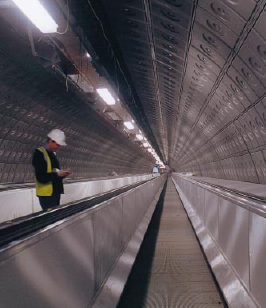
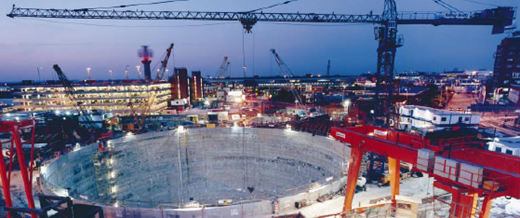
It is nearly seven years since the collapse of a railway tunnel under construction at Heathrow Airport, but only a year since the final report was presented. Now the dust has finally settled, Douglas McBeth of the ICE's health and safety board reflects on the real implications for civil engineers.
Many years ago as a young graduate engineer I worked on the construction of London Underground's Victoria Line. New tunnelling techniques were being used including drum-digger machines, flexible-knuckle jointed linings and so on. The majority of the workforce were inexperienced in the type of tunnelling being carried out, including me!
However, on each shift there was an experienced inspector employed by the resident engineer's staff. These inspectors were mainly from the ‘old school’ of London's tunnelling fraternity. On one of the drives the inspector noticed a change in the colour of the clay in the face of the tunnel. The roof started flaking. He was not happy with what he saw and immediately instructed the face miners to get out of the tunnel. As they approached the bottom of the access shaft, some 60 m away, there was a sound of rushing torrent and tonnes of gravel and water filled up the tunnel as the roof at the face caved in.
The experience and foresight of the inspector saved what could have been a major tunnelling disaster.
I have retold this tale because, in last year's long-awaited report on the Heathrow Express tunnel collapse, reference is frequently made to the lack of experience of those involved in the project.
Lack of senior expertise at Heathrow
There appears to have been a comparatively young and inexperienced team designing, managing and constructing the tunnels at Heathrow. It also appears to have been more luck than judgement that prevented major fatalities when a section of NATM tunnel in the central terminal area collapsed on 20–21 October 1994. Even when the tunnels were collapsing, there seemed to be indecision among the supervisory staff as to when they should pull miners out of the tunnels.
Following the collapse the Health and Safety Commission instructed the Health and Safety Executive to investigate and report on the collapse. Two reports have been prepared: Safety of New Austrian Tunnelling Method (NATM) Tunnels in 1996 and The Collapse of NATM Tunnels at Heathrow Airport in 2000. This latter report was presented at a seminar at the Institution of Civil Engineers in London on 5 July 2000.
The first report deals with the general technical aspects of the construction of NATM tunnels and catalogues problems that have occurred in other NATM tunnel contracts throughout the world. It draws many conclusions highlighting shortfalls in the contract procurement, design, construction, management, site monitoring, quality control and so on. There has been a catalogue of errors.
Legal process takes precedent over health and safety
But why must we wait so long for information to be published? In this instance the final report was not published for six years. Why does the legal process take precedent over general construction health-and-safety issues? There are lessons to be learned in this respect and we can all benefit from these.
The ultimate client at Heathrow, BAA, certainly took immediate steps to rectify matters—in particular in the contract procurement and management of the project. While many will associate Heathrow Express with the spectacular collapse of the tunnels, the 4000 or so people who worked on the project following the incident will remember it as a success story, pointing the way within BAA and to much of the industry as to how construction teams can work together to produce world-class performance.
Soon after the collapse occurred BAA set a new opening date for the high-speed rail service between Heathrow and London Paddington. Of the 12 months lost due to the disruption of the incident, the project team recovered six months of this slippage and opened the service to the public on 1 June 1998, the date set some three and a half years earlier in 1995.
The need to integrate safety management from the outset
The Construction (Design and Management) Regulations (CDM) were introduced in 1995, following the collapse. Had they been introduced earlier, I think it is unlikely that the appointment of a planning supervisor would have prevented the accident. Even the current attitude in the industry seems to be to treat the planning supervisor as an ‘add on’ rather than being integrated into the project team from the start.
If we are to discipline the management of health and safety, the CDM regulations must be made to work. At present the Health and Safety Executive has issued a discussion document on the approved code of practice to CDM. It will be interesting to read the experience of those working within the regulations as this is debated.
The reports on the Heathrow collapse also highlighted the huge risks that we often take in civil engineering projects, both large and small. We must be pro-active in our approach to these risks and to the issue of safety. However, I like to think that ‘engineer’, ‘ingenuity’ and ‘innovation’ are words that are all related and we must not inhibit innovation in our industry, otherwise we would not have had the Forth Bridge, Sydney Opera House, the Millennium Dome, the Oresund fixed link and many other landmark projects.
Let us learn from the experience of Heathrow and learn to manage the design and construction process much more efficiently.
Briefing: Clusters a new way of managing projects
An innovative ‘cluster’ approach to design and construction has been successfully trialled on two projects for the British Army. Davide Nicolini and Richard Holti of The Tavistock Institute report that it cut programme times by up to 20%.
One of the main challenges of design and construction is that choices or changes in one area—the structure, the services, and the finishes—inevitably have consequences somewhere else. The whole process can be characterised as discovering inter-relationships and dealing with the resulting uncertainty.
The typical model for co-ordinating design and construction through a design team and main contractor is often only partially effective in managing the inter-relationships. Designers may not be fully aware of all the complex dependencies that exist between different aspects of the design and ‘buildability’ of a facility. Even contractors may also fail to understand the full implications of design choices for construction methods, or for materials or components.
Dividing projects into multi-disciplinary clusters
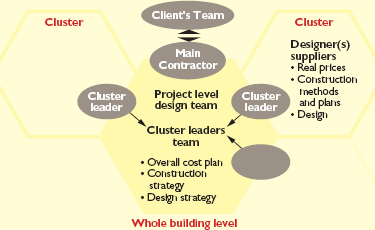
Researchers at the Tavistock Institute have recently led the development of an alternative approach in which construction projects are organised into ‘clusters’. A cluster is a place where a limited number of designers, suppliers of materials or components and builders engage in intensive collaboration to design and deliver a significant, recognisable element of the overall building, working to reduce costs, improve value and minimise waste.
Clusters operate as semi-independent parts of the project under the overall co-ordination of a contractor or project manager, replicating the logic of single-point responsibility down the supply chain.
The basic idea behind the cluster, summarised in the diagram below, is simple: multi-disciplinary teams spot and address design and ‘buildability’ inter-relationships early enough. Above them, a project co-ordination mechanism ensures that work at cluster level complies with the agreed overall strategy and that interface issues between clusters are identified and addressed. Suitable commercial arrangements are put in place to support delegation of activities to clusters so that, in effect, they become mini design-and-construct projects.
Putting clusters into practice
The arrangement was tested in two pilot projects as part of ‘Building Down Barriers’, a major collaborative action research project supported by the UK Department for the Environment, Transport and Regions (DETR), the UK Ministry of Defence and contractors AMEC and Laing. The two pilot projects each provided training and sports recreational facilities for the Army (£4 million and £9 million respectively) and used the clustering arrangement as well other process innovations (e.g. whole-life costing).
The two projects operated with slightly different cluster arrangements. One had five clusters: groundwork, frame and envelope, swimming pool (including water treatment), internal finishes and mechanical and electrical services. In the other the boundaries were drawn slightly differently: civils and groundwork, dry envelope, building and construction, water treatment, sports equipment, and mechanical and electrical services.
Each cluster had led a leader appointed early during scheme design by the main contractor in consultation with the principal designers. Cluster leaders were selected on the basis of three criteria
best-placed to carry the main risks in delivering the cluster's product
likely to have most intensive interactions with other cluster members during design and construction
has the experience, capability and credibility to manage the work of others.
Clusters were co-ordinated in two ways: the ‘cluster leader team’ that met periodically throughout the project and the ‘interface register’, a regularly updated electronic log in which interface issues, their potential cross-cluster impact and actions to be taken to prevent or reduce these issues were recorded and monitored.
Achieving up to 20% savings on programme
In-depth evaluation and comparison with site-productivity benchmarks confirmed the validity of the approach. Clustering design promoted multi-disciplinary work, permitted suppliers to contribute to the design and allowed transparent communication between parties. This resulted in improved value, enhanced efficiency and reduced waste.
Both facilities were received with ‘delight’ by the client and end users. Clustering led to improved buildability and efficiency on site by preventing traditional problems at the interface between trades. This produced programme savings (up to 20%), enhanced predictability of workforce utilisation, increased productivity (10% more that average sites according to the Building Research Establishment), reduced material waste, almost no rework or design by fax, and an exemplary safety record.
The experience gathered in the two pilot projects also highlighted some barriers and issues to be addressed in the future. Current commercial, contractual and professional indemnity practices are still based on a logic of fragmentation and strict division of labour and generally do not encourage radical forms of collaboration such as the one presented here.
Cluster-based projects also require a profound redefinition of the roles and functions of all the parties involved. Designers, who have their role potentially enhanced and enriched by such an approach, need to restyle their contribution from an expert authoritative mode to a more consultative one; suppliers need to learn how to be proactive and constructively critical; and contractors and project managers need to shift from a controlling attitude to a co-ordinating and coaching one.
Briefing: Natural cure found for dirty sludge
Sewage sludge is becoming a big problem. Not only is there much more of it, it now has to be cleaner. Piers Clark, head of research and technology at WS Atkins Water, introduces a new clean-up technology based on naturally occurring borate.
In the last few years, the amount of sludge handled by the privatised water companies has increased by 50%. This rise, combined with a plethora of external influences on sludge treatment and disposal, has served to make meeting sludge quality requirements extremely difficult.
The water companies face increased public and legislative pressure to attain ever-higher standards of sludge treatment. The job is further confounded by confused messages from Europe, which requires recycling to reduce incinerator use and, paradoxically, making the sludge so clean that most natural soils would fail to comply.
In an attempt to manage these conflicting demands, the water companies have adopted a comprehensive programme of improvements. These include cleaning out the anaerobic digesters, refurbishing them and also revamping the operational protocols to incorporate critical control points and audit procedures. However, on some sites, such comprehensive approaches may still not be enough to get exit sludge of sufficient quality.
Finding an environmentally safe solution
The water companies need the sludge problem solved quickly, and cost-effectively. Until now such a simple solution was just a dream to many sludge strategists in water companies—but that dream may be about to become a reality.
A group of novel, environmentally safe biocides have been developed by WS Atkins, Ectopharma Ltd and Micro Science Technologies Ltd on a project jointly funded by Yorkshire Water, Anglian Water, Southern Water and Severn Trent Water. These compounds, referred to as borate-carrier biocides (BCBs) have a considerable potential for pathogen reduction in sewage sludge.
The naturally occurring mineral borate has long been known to be toxic to a variety of microbial and insect pests. The BCBs consist of borate linked to an organic carrier molecule, which has the effect of greatly enhancing the intrinsic toxicity of borate itself. BCBs were originally developed as part of a research programme aimed at the replacement of organophosphates, currently used in sheep-dip and in medicated shampoo preparations, with environmentally friendly alternatives. This was their limited use, until now.
Benefits of borate carrier biocides
The properties of BCBs relevant to the sewage sludge application are high toxicity towards target organisms, low toxicity towards man, pets and livestock, and high biodegradability. The expected benefits of using these compounds are
rapid and highly effective sterilisation
safe to handle and stable in storage
completely biodegradable, therefore little environmental impact
inexpensive to produce and apply.
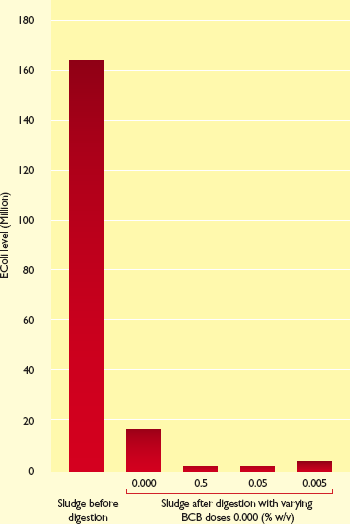
Initial results show that the BCB compounds have considerable potential for ensuring that sewage sludge complies with the proposed strict European-wide microbiological standards. Conventional sludge treatment processes remove about 99% of sludge pathogens. With BCB addition a further 90–99% of what is remaining can also be destroyed (see chart).
Implementation due to start this summer
Detailed testing of the BCB compounds is currently underway and established polyelectrolyte suppliers have been brought in to help develop a practical and effective dosing regime. Full results are expected by the end of this summer.
The microbial standards legislation came into force in January 2001 so the new innovation is needed immediately. The research and development continues but ultimately the funding organisations are striving to implement this technology as soon as possible.
For further information please contact Piers Clark by email at pbclark@wsatkins.co.uk
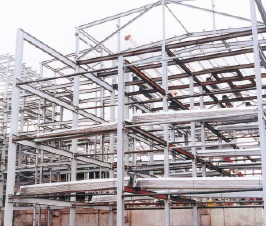
Briefing: UK steel design code updated
Eurocode 3 for structural steelwork design is just around the corner but, in the interests of safety, the existing British standard BS 5950: Part1 has been revised. David Nethercot, chairman of the drafting committee, explains.
Since being published in 1985 as the replacement for BS 449, BS 5950:Part 1 has been the main source of design guidance on structural steelwork for buildings in the UK. The document is also used widely for export work, as well as being the de facto code in several overseas countries such as Hong Kong, Malaysia and Singapore.
British Standards Institution (BSI) rules require that the sub-committees responsible for structural codes keep their documents under review so as to ensure they continue to provide a satisfactory basis for design. At one time this used to entail a full revision every ten years plus a mid-term assessment to see whether an amendment was necessary. As the focus of BSI work has shifted towards Eurocodes, the formality of this process has relaxed somewhat but the need to ensure that UK documents remain safe has not changed.
Changes needed to improve safety and clarity
The current version of BS 5950: Part 1 was issued in 1990; it represented only a modest update of the original 1985 version. Not surprisingly, many aspects of the subject matter have seen quite significant developments since then. However, the modifications contained in the recently issued 2000 edition result almost entirely from the need to ensure that the document correctly reflects a safe interpretation of the most informed view of each of the topics covered.
Although some items—such as cross-section classification, laterally unrestrained beams, prying action in bolted connections and portal frame stability—have been the subject of significant safety-related, technical updating, the great majority of the changes have been made so as to ensure a greater clarity of intent—that is to give a greater chance that the clauses will actually be implemented in the way the subcommittee originally intended.
Evidence collected by the advisory services of the British Constructional Steelwork Association, British Steel (now Corus), the BSI and the Steel Construction Institute had identified many aspects of the 1990 document where misunderstandings and differences in interpretation had indicated that more carefully expressed wording was necessary.
Implementing the revised code
The proposed changes were exposed in the publicly available draft for comment and great care was taken in re-drafting the document to give due attention to every comment received. The original decision that a new amendment was necessary resulted very largely from external pressures on the subcommittee, key factors being the problems with the existing version collected by the advisory services, revisions to supporting product standards, matters raised but not actually included in the 1990 amendment and points to emerge as a direct result of providing comments on behalf of the UK to the preparation of Eurocode 3.
Implementation of the 2000 document does not prevent designs already worked on to the 1990 version, or those still being completed using that document, to be still in accordance with the intentions of UK Building Regulations. This follows from the legal requirement for structural design of buildings (in all materials) in England and Wales, with a basically similar situation in Scotland and Northern Ireland, that the structure must be adequately designed.
Alternatives to the code
The Building Regulations do not specify the precise procedure to be used. In particular, they do not require any structure to be designed in accordance with any particular British Standard code of practice. Whereas the submission of designs fully in accordance with the most up-to-date BSI documents covering the topics concerned will, of course, be the most straightforward route to gaining an approval, although it is important to remember that it is not the only route.
Cases based on the best available evidence, appropriate use of foreign codes and so on are a valid alternative—providing the evidence has been presented in such a way that it satisfies the particular local authority or authorised person to which the design has been submitted for approval. Indeed, were this flexibility not available the situation would be intolerable. For example, it is simply not feasible to conceive of a situation in which every part of every design can be covered by rules given in a British Standard. The introduction of any new standard covering a part of a design submission should not (unless there is specific cause) be automatically regarded as invalidating—literally overnight—a perfectly acceptable structural design.
Documentation supporting the revised code
Publication of the revised code is being followed by a commentary (in both paper and electronic form), revised versions of the supporting handbooks and a new edition of the Connections Design Manual dealing with simple connections. Companies responsible for the production of steelwork design software are also releasing updated versions. This should ensure that designers become comfortable with using the new version relatively quickly.
Whereas it is understandable that those who have become used to working in a particular fashion would prefer not to have to adjust their practices, the care that has gone into the production of the amended document should ensure easier use, fewer misunderstandings, reduced opportunity for differences in interpretation and thus a general streamlining of the design and checking operations, leading to savings of both time and money.
Briefing: Consultancies that win more
New research has identified a ‘superbidder’ elite among engineering consultancies—firms that win more than half of their new-business bids. Peter Bartram of Policy Publications explains what makes them different.
When William Hannan and Associates, a Cheshire-based firm of mechanical and electrical consulting engineers, was hit by a downturn in business, it went on the attack. There was less work in office blocks—its traditional market—so it looked for new opportunities. And it found one unexpectedly in sports stadia.
Following tragedies at Hillsborough and Bradford City, football grounds were upgrading facilities. The firm researched the market carefully to discover who was doing what, why they were doing it and how they got into it. Since then, it has worked on projects for Manchester United, Blackburn Rovers and Chester and Ipswich Town football clubs. It was part of the team that built the Kippax stand at Manchester City and has also worked for rugby clubs.
Hannan has been identified as one of a new breed of ‘superbidder’ engineering consultancies in a recent research project1 carried out by the Centre for Competitiveness at Luton University. When these firms pitch for new business, they stand a better than evens chance of winning it.
Nearly 100 engineering consultancies studied
Led by Professor Coulson-Thomas, the research involved studying 95 UK engineering consultancies, from small local firms to large international players. Data was collected on how effective each firm was at around 120 different business development issues and activities.
Just over 20% of firms were found to win more than half their bids for new business— the so-called ‘superbidders’. Comparisons were then made between these firms and the rest. Whereas 89·5% of the superbidders win business from previous clients ‘frequently’ or ‘regularly’, only 76% of the other firms manage this. When it comes to gaining referrals from clients, the gap is even more striking — 52·6% for the superbidders, just 17·6% for the others.
When researchers looked at eight factors which are important for a consultancy to understand about a potential client when preparing proposals, the superbidders outstripped the others on the seven most important. For example, the superbidders were more likely than the others to be very satisfied with their performance at understanding the benefits clients expect to gain from the project (21·1% to 6·7%), the business context in which the project takes place (21·1% to 2·7%) and the criteria the client considers important when choosing a consultant (15·8% to 4%).
Relationships with clients seen as vital
There are even more dramatic differences when it comes to communicating with the client. The superbidders are more likely to be very satisfied with their performance at generating new ideas for the client (47·4% to 12%), developing person-to-person relationships with key individuals (36·3% to 13·3%), and communicating the distinctive nature of their expertise (36·3% to 9·5%). They also shine at addressing the specific concerns of the potential client (26·3% to 12%) and highlighting the shortfalls of rival bids (15·8% to 4·1%).
A key factor in gaining advantages during a bid for new business is leadership from senior partners or directors. Whereas 78·9% of super-bidders consider top leadership very important, only 64% of the others rate it so highly. Those consultancies which are most successful at winning new clients focus more tightly on the few issues that they find make a difference. They differentiate themselves from their competitors in ways which clients find attractive.
When superbidders are in a competitive pitch, they put the client rather than themselves at the centre of the universe. They seem to be better at looking at what they’re doing through the clients’ eyes and they make that extra effort to perform everything to best practice standards.
Marketing through personal contact
‘We try to be different in our design,’ says Hannan's managing director William Hannan. ‘We prefer to lead the market rather than follow where others have already taken the initiative and we try hard to be at the cutting edge of technology.
‘Our approach to marketing is to make personal contacts. We advertise in trade journals and that does bring our name before potential clients, but you don't get appointments just on a name.
‘We keep very closely in touch with the industry and discover what jobs are going to be on offer. Then we find out who the key people are whom we should approach for each job and invite them to have lunch with us. Often it may be necessary to first approach someone else who can introduce us to the key people in each case.’
Reference
Briefing: Web systems give consultants more time
The advent of web-based software systems means that civil engineering consultants can now spend less time managing time and more time making money. Syed Rizvi, European services industries director of Lawson Software, explains.
In today's increasingly competitive and complex marketplace, civil engineering consultants need to be faster, more efficient and more cost-effective than ever if they are to win and retain clients. They need to make optimum use of their time to deliver contracts on schedule—particularly as their organisations grow, their projects become larger, the numbers of suppliers increases and they are more frequently required to work in partnership with others.
With consultants constantly on the move, the need for better communication and flow of information has never been greater, both on management and day-to-day operations level. Civil engineering firms need to wake up to the complexity of the situation and recognise the need for business technology that can support this evolving, collaborative way of working as we enter the 21st century.
Automated time-recording can provide 10% more time
A large number of consultancies continue to ignore the need for change. A recent study1 of the UK's ten largest engineering consultants, management consultants and recruitment agencies revealed that around 30 % continue to process and manage administrative tasks manually, resulting in millions of pounds worth of lost productivity. By automating this work, the research found that an ‘average’ large engineering consultancy could save around £10 million a year.
In particular the research showed that individual consultants could save around 10 % of their time by automating administrative tasks such as time-recording and expenses, with senior consultants able to save a further 12% of their time by automating management tasks. These figures equate to around £33 million of lost fee-earning potential per year for a ‘typical’ large engineering consultancy.
Web-based systems allow all staff to benefit
However, consultants are frequently on the move and often working in remote locations without direct access to head-office software systems. Recent advances in technology mean that it is now possible to obtain systems that can be easily accessed via the internet on anything from a laptop to a palm pilot or WAP phone.
Enabling consultants to automate time recording wherever they are will free them up to focus on income-generating work or more strategic management activity such as project time analysis, income and profitability.
Improved decision-making also comes as a result of more accurate, up-to-date information being made available to more people within the firm.
The web-based system chosen should also be able to track expenditure and time, not only by consultant but also by project. This enables management to access up-to-the-minute information on profitability at any time in order to make informed decisions. This capability is also critical for correct billing of clients according to schedule, cutting through the problems of submission of timesheets on time by automating the process via mobile communications, with resulting advantages for business cashflow.
Armed with the evidence that even a relatively small increase in efficiency can lead to large returns, smart management teams should move quickly to take advantage of the benefits offered by web-based business applications. The only real barrier to greater profitability and efficiency is resistance to change.
For further information please contact Andrea Dunderi at Lawson software on +44(0)20 8560 0826 ext. 5377 or email andrea.dunderi@lawson.com
Reference
Briefing: What graduate civil engineers really want
Civil engineering employers will have their work cut out if they are to match the career expectations of this year's crop of civil engineering graduates. Maria Cansick of Universum Communications reports.
If you are planning to recruit a graduate civil engineer this year, a recent survey1 of nearly 6000 final-year undergraduates at 43 universities across the UK indicates that it might be a lot harder than you expected.
The survey set out to establish students’ views and opinions concerning future employers and what they expect to earn. The good news is that graduates voted a civil engineering consultancy as the biggest climber in their list of top 100 ideal employers. W S Atkins climbed 64 places to a lofty 20th position.
The Foreign & Commonwealth Office took the top spot, ending the BBC's two-year dominance. Civil engineering undergraduates rated the Foreign & Commonwealth office seventh after two engineering consultancies but also after two car manufacturers and two firms of accountants (see Table 1).
Salary expectations higher than ever
This year's survey also revealed that more than half of civil engineering graduates expected to earn over £18,000 year with nearly a quarter setting their sights on at least £24,000 at their first job after graduation (see Table 2).
When asked which career goals they hope to attain within their first three years of graduation, 60 % of engineering students chose ‘to balance personal life and career’. However, the principal goal for civil engineering undergraduates is ‘to work internationally’.
With regard to personal priorities, the top choice was ‘career development’ followed by ‘travel’ and ‘personal growth’.
The survey underlines the fact that graduates continue to be attracted to companies that offer graduate training programmes and international career opportunities.
Reference
Monitor
Proceedings: EDITOR'S CHOICE
Forthcoming papers
The following papers have been accepted for publication in future issues of ICE Proceedings journals.
Civil Engineering (CE)
Megalith mechanics 2001. J. H. Simpson
Trends in university admission to civil engineering. M. Byfield
Romania's most eminent engineer—Anghel Saligney (1854–1925). J. Manning
Historical contamination, modern law. M. O'Reilly
Concrete dams in the UK since 1945. C. Scott and D. Molyneux
Statutory construction adjudication: three years on. M. O'Reilly, G. D. Cottam and E. Ryan
Proposed suspension bridge at Rion-Antirion, Greece—esitmation of earth's micro movements due to seismic activity using GPS techniques—design implications. N. Hytiris and A. Kominos
Geotechnical Engineering (GE)
Geotechnical engineering and building research. The early days of soil mechanics at BRS. A. D. M. Penman
Development and testing of the load cell pressuremeter. D. R. Carder and D. I. Bush
Compressibility of foundation fills. J. A. Charles and H. D. Skinner
Improved site characterisation of contaminated land using pump and treat data. M. Dyer, M. van Zutphen and R. Hetterschijt
Earth pressure on cantilever walls at design retained heights. R. A. Day
Widening and deepening adjacent large shafts in rock. E. C. Antonio and N. L. Adams
The effects of hydrocarbon contamination on concrete strength. S. A. Wilson and P. J. Walden
Municipal Engineer (ME)
Sidelining politicians and community groups: the site selection process for a non-hazardous landfill facility in County Galway. M. Rogers and B. Gist
Providing an evidence base for community strategies. J. J. Field
Community involvement—a politician's perspective. A. Varden
Community involvement—the role of the community engineer. B. C. Planner
Access or hindrance—are all modern road crossing designs helpful for people with visual impairment. B. Duncan Jones
Completing the Avon Ring Road. J. Bickerstaffe and C. Kearns
A renaissance for Rugeley. R. Haisman
Decision-making and local government development planning in Ireland. M Rogers and B. Grist
Is local road maintenance meeting the community's needs? T. C. Martin
Involving the community in devising a waste strategy: the West Sussex experience. J. Seldon
Involving the community in local government. R. Huskinson
The role of the engineer in politics. O. Simon
Getting around: listening to children's views. A. Davis
Planning for real concept. C. Chick
Structures and Buildings (SB)
The construction of Westminster Station. P. R. Glass and C. S. Stones
Rational use of advanced composites in concrete. C. Burgoyne
Behaviour of reinforced tubular T-joints. T. K. Chan, T. C. Fung, C. Y. Tan and C. K. Soh
The plastic design of steel sway frames. A. G. Kamtekar, G. H. Little and A. Cunningham
Jacket design to resist ship impact. B. F. Rolands
Field trials on covercrete monitoring sensors. W. J. McCarter, A. Butler, T. M. Chrisp, M. Emerson, G. Starrs and J. Blewett
The forces in backprops during construction in flat slab structures. A. W. Beeby
Effect of relative humidity and air permeability on prediction of the rate of carbonation of concrete. P. A. Muhammed Basheer, D. P. Russell, G. I. B. Rankin and A. E. Long
Transport (T)
Completion of the Manchester Outer Ring Road. A. D. Withington
The development of the Irish Sea Ferry Services. Mike Garratt
Strategic environmental assessment in the Trans-Pennine Corridor. D. Coombe, A. Skinner, D Simmonds and B. Davidson
Metrolink—building on success. W. J. Tyson
Rail developments in the North West. E. Godward
Chester Deeside Transport System—towards implementation. D. Gennard, M. Smithard and C. Roberts-James
The role of Manchester Airport. J. Twigg
Water Maritime and Energy (now Water and Maritime Engineering – WM)
Comparative survey of river training measures on the Upper Rhine, Moselle, and Saar and their effects on flood behaviour. J. U. Belz, N. Busch, H. Engel, and G. Gasber
An unusual marine outfall off Central California, USA. R. A. Grace
Standard specifications for flow measurements structures. W. R. White
Numerical modelling of 3-D tidal currents and water. B. I. Lin and R. Falconer
Discharge prediction in straight mobile bed compound channels. J. Cassells, M. F. Lambert and W. R. C. Myers
Effect of tailwater depth and model scale on scour at Culvert Outlets. R. Day, S. L. Liriano and W. R. White
Discussions on Civil Engineering
The following discussion contributions on articles and papers published in Civil Engineering can now be read together with the authors’ replies on the ICE web site at www.ice.org.uk/jol.
Sustainable development in the use of energy for electricity generation, by Taylor, contribution by Thomas Douglas
Developing innovative problem solving skills in undergraduates, by Pender and Stewart, contribution by Thomas Douglas
Designers under CDM-a discussion with case studies, by Maitra, contribution by Alasdair Beal
Inspiring engineers to design aesthetically, by Morris, contribution by David Morris
Lines 2 and 3 of the Athens Metro, by Leto and Welburn, contribution by John Anderson
Privately financed infrastructure in the 21st century, by Merna and Smit, contribution by Charles Walker
Professor William John Macquorn Rankine, by Sutherland, contribution by Thomas Akroyd, William Cranston, Michael Gould and Peter Lowe
Smeaton to Egan-the extraordinary history of civil engineering management, by Barnes, contribution by Gerald Bratchell and Harrey Moores
Regeneration of the Forth & Clyde and Union Canals, Scotland, by Paxton, Stirling and Fleming, contribution by John Carmichael and Wilfred Lockett
New civil procedure rules, by Rogers, contribution by Roger Jones
Renewable energy sources: essential for sustainable development, by McNelis, contribution by Alwyn Jennings-Bramly
Foundations for the Future, by Chapman, Marsh and Foster, contribution by Martin Stockley and Eric Gray
Internet Global gateway for civil engineering
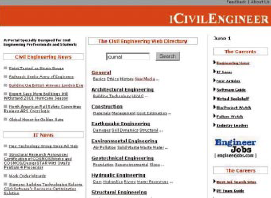
iCivilEngineer.com is a pure civil engineering web directory and search engine which indexes more than 3000 international websites, news articles and other documents related to the profession.
The independent, free-access site at www.icivilengineer.com was launched in June 2000 by Xiangwei Li, a Chinese civil engineer currently working in the US high-technology sector.
Information is presented under various headings on the regularly updated home page including news, careers, software, books, famous engineers, academic departments, major projects, top firms, discussion groups, specialist areas and so on.
Users can also sign up to a free newsletter service including civil engineering and IT news from around the world, the latest free full-text articles published on-line and recent updates to the site.
For further information please contact editor Lily Hann, on +1 42 5603 1747 or at editor@icivilengineer.com.
What the ICE is doing in Europe
A significant amount of information relating to the ICE's local association and country representative activity in Europe can be found at the website of its Swiss branch at www.icenet.ch.
The site includes details of the 6th annual meeting of ICE's European local associations network in Switzerland in May, which had over 100 participants from 17 countries and featured a forum of leading international tunnel experts.
Elsewhere news from the twice-yearly meetings of the European Council of Civil Engineers (ECCE), for which ICE provides the secretariat, can be found at www.eccenet.org.
ECCE seeks to promote high technical and professional standards for all civil engineers throughout Europe.
For further information please contact the ICE's European affairs manager Diana Maxwell on +44 20 7665 2155 or at diana.maxwell@ice.org.uk.
On-line index to over 150 construction journals
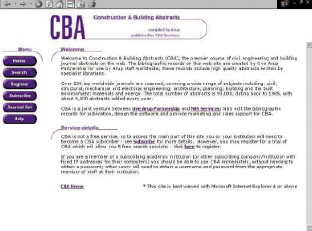
Construction Building Abstracts on the Web (CBA) is a joint venture between UK engineering consultancy Arup and NBS Services, a subsidiary of the Royal Institute of British Architects.
It's website at www.cbaweb.co.uk provides an on-line database of over 93,000 articles from over 150 UK and international construction journals and magazines – including all ICE titles – and Arup's librarians plan to add around 9000 new abstracts every year.
Users can either take out an unlimited annual subscription of £600 or buy a package of ten 20-minute search sessions for £50. A free trial of five searches is also available.
For further information please contact John Cann, NBS Services, on +44 (0)19 1232 9594, email cba@nbsservices.co.uk
IN BRIEF
columbus.arup.com – free download site for Arup's Columbus document management software that can view and print over 300 different file formats including MicroStation and AutoCAD.
www.getmapping.com/business – website where you can view and download high-resolution 0.5km × 0.5km aerial photographs covering most parts of the UK for £45 each.
www.concrete-info.com – British Cement Association's on-line database of 120,000 international references on cement and concrete, non-member single-user subscription costs £500.
www.construction.co.uk – website of Co-Construct, a UK government-funded partnership of five UK construction research bodies: CIRIA, BSRIA, SCI, TRADA and the Concrete Society.
EVENTS
The following meetings, seminars and social events have been organised by ICE headquarters staff on behalf of ICE Boards and Associated Societies. All are free to attend unless indicated by (£). Before travelling, please contact the organiser or visit the ICE web site at www.ice.org.uk to confirm details.