

The UK Government's target to build over two million new homes on brownfield land by 2016 looks ambitious given the amount of contamination. Alan Bromage, head of civil engineering at The Concrete Centre, says greater use of cement could be the answer to saving the green belt.
Recent UK Government reports have highlighted the need for 4·4 million new homes to be built in Britain by 2016. The target is for 60% to be built on brownfield land such as derelict industrial sites.
However, much of the brownfield land needs to be removed or treated in order to mimimise the risk to people and property from potential harm. Cement's ability to treat and recycle previously developed land in situ, thereby allowing greater areas of brownfield land to be used for residential development, would thus significantly relieve the pressure to build on green-belt land.
Locking in contamination
Cement-based stabilisation and solidification can be used to treat contaminated land by simply locking in the contamination. Another approach involves constructing vertical barriers to contain the contamination.
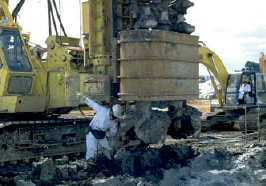
Cement-stabilisation of contaminated ground is a tried-and-tested technique and a wide range of plant is readily available
Cement-stabilisation of contaminated ground is a tried-and-tested technique and a wide range of plant is readily available
Both on-site approaches overcome the problems of excavating and then finding a disposal site. Such an unsophisticated ‘dig and dump’ approach is unsustainable. It has the potential of spreading the contaminants during excavation and, rather than dealing with the problem, simply shifts it elsewhere to fast-disappearing landfill sites.
Research undertaken by the British Cement Association shows how cement stabilisation and solidification can be used to chemically stabilise and physically immobilise contaminants within a solid matrix that prevents leaching.
A better base for building
The stabilisation process also improves the engineering properties of the ground to improve its redevelopment potential. It creates a monolithic structure within the ground that provides a suitable base for foundations.
The treated ground has a permeability as low as 1 × 10⁻⁹ m/s depending upon the soil conditions. This and the high pH of the matrix effectively restricts the flow and solubility of contaminants.
Cement stabilisation and solidification is particularly useful when dealing with contamination involving heavy metals. Cement can be used by itself or as the main ingredient in a number of proprietary systems that combine cement with lime, pulverised-fuel ash, ground granulated blast furnace slag, soluble silicates, clays and other materials.
Wide range of plant available
The benefits of in situ stabilisation and solidification are significant. It remediates and prepares the ground for redevelopment at the same time. This reduces development costs as only one contractor is required for groundwork operations.
There is a range of plant available that is well suited to introduce the cement, mix it thoroughly with the soil and then compact it so there is no need to invest in specialist equipment. Conventional augers are easily adapted to mix in and compact the cementing material.
Furthermore, cement stabilisation and solidification is a well-established technique based upon existing engineering procedures.
Slurry cut-off walls
Another approach is to use cement-based slurry ‘cut-off’ walls to contain and isolate contaminated land. This is by far the most common method used in the UK for the in-situ isolation of contaminated land. They were first used in the 1970s and are now installed at the rate of several km every month.
The technique basically involves building a barrier around the affected land to prevent further contamination. Cement is used together with other materials such as bentonite, ground granulated blast furnace slag and pulverised fuel ash. Adjusting the proportions of the slurry constituents allows restraint of a range of contaminants including acids, alkalis, heavy metals, solvents and other hydrocarbons.
Depending on the ground conditions, the cut-off walls are usually excavated with a hydraulic backhoe excavator to a depth of more than 13 m. This depth allows an aquicide, an underlying layer of low permeability, to be keyed in. The slurry hardens over two to three days to form a barrier with a low permeability that prevents future leaching of contaminants.
FOR FURTHER INFORMATION CONTACT, Alan Bromage, TEL 0700 4 822822, EMAIL enquiries@concretecentre.com

