

Discussion
BRIEFING: Dams still not being properly planned: by Ute Collier (February 2006)
Contribution by Andy Hughes
I was disappointed to read yet another article by Ute Collier and WWF which is critical of dams. Time after time articles are published which criticise dams but they never seem to tell of the benefits which dams give in terms of water supply, power generation, flood alleviation, navigation, and even environmental gain. We never seem to be given alternatives to dams that WWF would support that would provide the power, water and flood protection that millions of people around the world so desperately need.
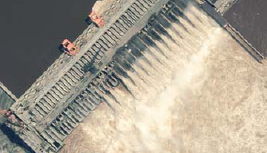
Small-scale solutions such as community hydro-power and rainwater harvesting impact less on the environment and society than large-scale dams (DigitalGlobe)
Small-scale solutions such as community hydro-power and rainwater harvesting impact less on the environment and society than large-scale dams (DigitalGlobe)
Author's reply
As mentioned in my article, the World Commission on Dams (WCD) recognised (as does WWF) the benefits dams provide. However, there is overwhelming evidence that there are many dam projects where these benefits are distributed unequally and where there are serious environmental and social impacts. WWF believes these negative impacts can and must be minimised, either through better dams (in terms of planning, siting and mitigation measures) or alternatives where appropriate.
Available alternatives vary depending on the purpose of individual dams and local circumstances. One of WWF's key demands is to give priority to addressing the huge inefficiencies inherent in energy and water supply systems. Dams that feed irrigation systems which waste two-thirds or more of the water supplied are an economic folly but not uncommon.
Furthermore, there should be a greater focus on addressing the needs of the poorest communities. These are often best met through small-scale solutions such as community hydropower schemes and rainwater harvesting projects. Comprehensive needs and options assessments, as recommended by the WCD, are the key to finding the most appropriate solutions, be they a dam or an alternative option.
BRIEFING: Climate change: man-made or natural?: by Robert Freer (February 2006)
Contribution by Angela Snook
This article seems to exclude the factor that research has been greatly influenced by the temperature changes monitored in the three days after the 11 September 2001 terrorist attacks in the USA. The subsequent grounding of aircraft gave an unprecedented opportunity to monitor temperatures over the USA while free of condensation trails.2
The daily temperature range jumped an unprecedented 1 °C, proving the ‘global dimming’ effect of jet trails and other particulate pollutants is much greater than expected—and that the warming effect of greenhouse gases is therefore even stronger than net global temperature rises suggest. A temperature drop was shown but on an overall much higher increased atmospheric temperature than had previously been supposed.
Ground studies during the past 10 years have also shown that the vapour cover from aircraft is blocking out part of the sun's spectrum responsible for evaporation and subsequent precipitation, thus altering rain patterns. The felling of timber has obviously increased landslide occurrences as well as also affecting overall temperature and weather patterns.
While it may be argued some of these events would occur naturally even in an un-industr-ialised environment, it cannot be argued that the effects are not greatly accelerated by industrial action which prohibits the subsequent acclimatisation of species to be able to adjust or migrate within the limits now imposed on them. Species of tree have been able to expand into new territories over time in the history of the planet, but now our landscape is so fractured that the isolation of some areas means that even if a species was allowed a satisfactory ‘migratory’ period of time, this would be impossible to achieve given the demography created by commercial actions over the last 40 years.
I feel the one-sided arguments given in this article could be used as a stumbling block to any serious political will to reduce the effects already created, and the argument that the reason is ‘this or that’ is wasting precious time when it is obvious that many actions need to be undertaken now. Whether the change is man-made or natural seems a detraction from the purpose that all industrial methods need a radical overhaul in combination with environmental impact and repair programmes.
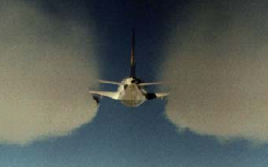
The contribution of aircraft emissions to global warming—as well as underestimates of industrial effects – was revealed in the three-day, post-9/11 flight-ban in the USA (Deutsches Zentrum für Luftund Raumfahrt e.V., from Petzold et al., 1997)
The contribution of aircraft emissions to global warming—as well as underestimates of industrial effects – was revealed in the three-day, post-9/11 flight-ban in the USA (Deutsches Zentrum für Luftund Raumfahrt e.V., from Petzold et al., 1997)
Author's reply
This is a very interesting practical observation. In recorded history one of the main disturbances to the atmosphere seems to have been volcanic eruptions. Anecdotal reports of the consequences of major eruptions include change of local temperature and rainfall and failure harvests probably linked to the ash and sulphur content of the emissions. There have been a dozen or so such events around the world Vesuvius erupted in 79 AD. More similar reports of recent local changes and effects would be useful for those planning to deal with the sequences of climate change.
Reference
2 Travers D. In Horizon: Global Dimming. Broadcast on BBC 1, 13/01/2005. See www.bbc.co.uk/sn/tvradio/programmes/horizon/dimming_trans.shtml (accessed 21/06/2006)
BRIEFING: Pavements: a new source of water and energy?: by Piotr Grabowiecki and Miklas Scholz (May 2006)
Contribution by Colin Mather
The article describes the heat pump as using ‘geothermal’ energy, which is incorrect. Residual heat recovered from the earth's surface by heat pumps is produced by solar energy. Geothermal energy recovery would require deep boreholes, except in unusual locations where geothermal warming is comparatively near the earth's surface.
The term ‘geothermal energy’ was erroneously used in the USA as it allowed grant funding to be accessed. Unfortunately, use of the term in the UK resulted in a detrimental effect as VAT was applied at 17·5% on heat pumps for two years due to the Government believing that the energy source was not solar, which attracts only 5% VAT. Thankfully this error has now been rectified and the 5% tax now applies.

P13788: Project management: turning engineers into team players: by Albert Hamilton (May 2006)
Contribution by Michael Keatinge
I suggest there are three key elements to project management which are, at best, only hinted at in the author's ten primary skills. ‘Verbal communication, including listening’ is not enough if it is done from a desk. Legwork is essential: the project managers must get out to meet the people and see for themselves. They must foresee where problems may arise and take steps to avoid them. Action when they do arise may already be too late.
Management within a project is a series of overlapping circles. There is often a gap in the middle which no one is covering. It may, for example, be a gap between disciplines, or a subcontractor may expect a service which the main contractor does not plan to provide. The project manager must identify and take ownership of such a gap.
Author's reply
My focus was more on what should constitute a good skills-transfer programme, and how to present it, rather than one dealing with project manager performance and behaviour. Research findings show that project outcome can be directly linked to the individual selected as the project manager. Some people should never be considered for such a position as they do not have the needed characteristics to deliver projects successfully. In other words, project manager appointments need to be made with great care. What is also known is that project managers who network—upwards, downwards, sideways and so on—are significantly more effective than those that do not.
P14199: Lessons learned from tsunami damage in Sri Lanka: by Priyan Dias, Ranjith Dissanayake and Ravihansa Chandratilake (May 2006)
Contribution by Robert Hodgson
I spent a month in eastern Sri Lanka with the aid agency Merlin immediately after the tsunami and was equally intrigued by some of the damage that I saw. As described in the paper, many of the failures of engineered buildings were scour-related.
The coastal soils in the Ampara and Batticaloa districts are predominantly sandy and hence vulnerable to scour. My photograph clearly shows the effect of scour on a concrete well located about 100–200 m from the shore. In the background, the corner of the local hospital has been undermined by scour. This failure mode occurred under the corners of most of the remaining buildings of this type, which were mostly supported on traditional footings with ground-bearing slabs.
Many people to whom I spoke reported that ground floor slabs had failed due to pressures beneath forcing them upwards. Although such reports are anecdotal, I noted that most cases of corner undermining like that shown in the photograph were accompanied by the ingress of significant quantities of sand into the buildings. This led me to wonder whether, given the porous nature of the soil and the high natural ground water levels, the hydrodynamic pressures generated by the tsunami wave were transmitted through the sand and caused premature subsurface failures that have been masked by more obvious structural impacts.
On the subject of wave heights, I examined many community health buildings along the coast. These, like the one in the photograph, were commonly modern and well-built and the ‘tide marks’ were clear. Many were within 100 m of the shore and none had been subjected to water levels above ground floor ceiling level (typically 2·5 m). One of my indicators was whether the water had reached the ceiling fans; if it had, the blades would be drooping in a ghostly manner!
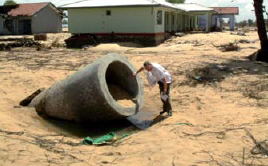
Effects of tsunami scour on a concrete well in Sri Lanka—but could the ground floor slabs of building have failed from groundwater surcharge first?
Effects of tsunami scour on a concrete well in Sri Lanka—but could the ground floor slabs of building have failed from groundwater surcharge first?
Authors’ reply
Mr Hodgson raises the question as to whether subsurface failures were caused by hydrodynamic pressures. Where there was scouring and undermining of building corners, the waves could have forced their way through the scoured area and forced the ground floor slabs upwards, also resulting in deposition of sand inside the building. It is less clear, and a matter of speculation, whether the waves affected ground water pressures so that a form of piping occurred. We agree with him that scouring was a very widespread problem and found that multi-storey structures were threatened mainly as a result of scouring.
Regarding wave heights, our surveys indicated that wave heights of 2–4 m from the plinth level were quite common.
Contribution by Ananda Moonasingha
The survival concept of open-construction ground floors without walls, and the vulnerability of water tanks supported on four columns in contrast to water tanks supported on a cellular structure, seems to be contradictory. However, the cellular tower is understandably robust. It may be that masonry columns supporting the tank do not meet the slenderness and other design criteria of load-bearing columns. Quantitative analysis of imposed and resisting forces might clarify the issue.
However, apart from robust, prudent design and construction adhering to good professional practice, I do not think tsunami risks can be eliminated by engineering solutions. Damage and risk limitation seems to be a more viable strategy.
Authors’ reply
Mr Moonasingha raises an interesting point for water-tank supporting structures—whether greater resistance would be shown by a cellular masonry structure, which will be more robust but attract more load too, or by a structure with masonry legs, which will attract less load because of its permeability. As he says, quantitative analysis would have shed greater light on this question, but in our survey we found that the cellular structures fared better.
He also makes the point about damage and risk limitation (as opposed to elimination). Professor Paul Grundy of Monash University has introduced the concept of a ‘disaster limit state’ to embody this notion—that is, accept physical damage but minimize death and injury.
Contribution by Ronald Livesey
Two rock lighthouses were built by ICE members in the nineteenth century on Great Basses reef off the south-east coast of Sri Lanka near Kirinda. Great Basses lighthouse was designed by J. N. Douglass and construction is described in paper 1394 The Great Basses Lighthouse, Ceylon, which William Douglas presented at ICE on March 3 1874. Little Basses lighthouse was subsequently constructed at the northern end of the reef. I was involved in modernisation of the two lighthouses on behalf of the Board of Trade in the late 1960s.
The Basses reef lay fully in the direct line of the tsunami of 26 December 2004. It would be interesting to ascertain how these two structures fared under attack by the tsunami.
Authors’ reply
Both the Basses lighthouses suffered virtually no structural damage. This is no doubt because of their circular plan form, which both reduced the loading on them and resulted in a high degree of robustness. The workers operating the lighthouses have however refused to go back to them and an unmanned, solar-powered flashing-light solution has been put in place.
Full versions of these discussions can be read along with all other discussions in the online version of the journal at www.civilengineering-ice.com
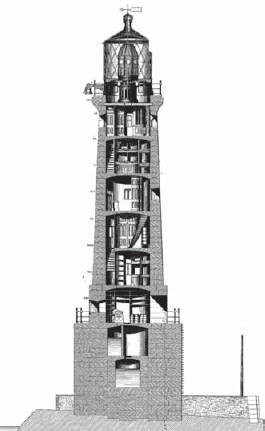
Great Basses Lighthouse built in 1874 survived the tsunami with minimal structural damage, though the keepers have refused to return
Great Basses Lighthouse built in 1874 survived the tsunami with minimal structural damage, though the keepers have refused to return
Proceedings: RECENTLY PUBLISHED PAPERS
In addition to Civil Engineering, the ICE Proceedings includes ten specialist journals. Papers and articles published in the most recent issues are listed here. Summaries of all these and other papers and articles published in the past three years can be read free at www.ice.org.uk/journals. ICE members can download any 15 papers published in 2006 for £25 from www.iceknowledge.com
Bridge Engineering
159, No. BE2, June 2006, 47–91
PAPERS
Engineering, architecture and the River Po footbridge, Turin
D. Mairs and M. Whitby
Reducing damage to concrete stitches in bridge decks
A. K. H. Kwan and P. L. Ng

Eight footbridges in the Rembrandt Park in Amsterdam
J. Smits
A Bayesian belief network model of bridge deterioration
N. O. Attoh-Okine and S. Bowers
St Paul's Footbridge, Ebbw Vale, Wales—landmark structure
D. E. Williams
Long-term maintenance strategies for highway bridges
P. R. Vassie and C. Arya
Construction Materials
159, No. CM1, February 2006, 1–45
BRIEFINGS
Gypsum: prospects for recycling
P. Claisse and E. Ganjian
Sustainable timber procurement
A. McGregor

Stress lamination: utilising low-grade timber in construction
G. Freedman and A. Kermani
PAPERS
Joining timber with glass fibre and epoxy
P. Claisse and B. Masse
A fracture-based model for the compressive strength of masonry
T. M. Roberts and T. G. Hughes
Development of bitumen-bound waste aggregate building blocks
J. P. Forth, S. E. Zoorob and I. N. A. Thanaya
Estimating concrete strength using a modified maturity model
Y. A. Abdel-Jawad
Engineering Sustainability
159, No. ES2, June 2006, 47–88
PAPERS
Engineering at the Centre for Alternative Technology
K. Brown

Sustainable water—lessons from the developing world
K.-F. S. Wong
Sustainable transport policies under scarcity of oil supply
S. P. Shepherd and P. Pfaffenbichler
Benefits of an Edinburgh–Newcastle high-speed rail link
J. Edwards
Transport, mobility and social capital in developing countries
A. S. C. Bradbury
Geotechnical Engineering
159, No. GE3, July 2006, 133–241
PAPERS
Distributed strain measurement for pile foundations
A. Klar, P. J. Bennett, K. Soga, R. J. Mair, P. Tester, R. Fernie, H. D. St John and G. Torp-Peterson
Set-up effect in long piles in weathered soils
L. M. P. Shek, L. M. Zhang and H. W. Pang
Use of stiffness inserts in pile groups and piled rafts
H. G. Poulos
Compression/tension load capacity of stone column anchors
K.-F. Liu, X.-Y. Xie, J.-F. Zhang and X.-R. Zhu
Design of braced excavations to limit ground movements
A. S. Osman and M. D. Bolton
Knowledge-based design and construction of driven piles
L. M. Zhang, L. M. P. Shek, H. W. Pang and C. F. Pang
Piled foundations for Eureka Tower, Melbourne, Australia
M. C. Ervin and J. E. Finlayson
Modelling the bearing capacity of displacement piles in sand
W. Broere and A. F. van Tol
Rock-socketed pile design and construction: a better way?
C. Haberfield and B. Collingwood
Building a deep isolating wall by an existing rail tunnel
C. Molins and A. Ledesma
Performance of bored piles with different construction methods
C. S. Chen and L. C. Hiew
Dynamic response of laterally loaded piles in clay
A. Boominathan and R. Ayothiraman
Maritime Engineering
159, No. MA2, June 2006, 45–89
PAPERS
Modelling wave attenuation by submerged resonators
T. V. Karambas and M. Gousidou
The marine energy resource, constraints and opportunities
I. G. Bryden
Modelling circulation and vertical mixing in estuaries
W.-C. Liu
Municipal Engineer
159, No. ME2, June 2006, 61–121
PAPERS
Stone paving for heavier traffic loads
M. J. McHale
Experimental research on waterjet street surface cleaning
D. Gao and J. Chen
Using planing agreements to fund transport infrastructure
R. Lane and J. Wells
Portsmouth's pioneering highways management contract, UK
A. Finch
Condition-based capital valuation of a road network
M. S. Snaith and D. M. Orr
Delivering well-maintained highways
M. Kendrick and A. Taggart
Ground-penetrating radar investigations for urban roads
R. Evans, M. Frost, M. Stonecliffe-Jones and N. Dixon
A GIS-based infrastructure management system for municipalities
A. J. L. Ferreira and A. dos Santos Duarte
Structures and Buildings
159, No. SB4, August 2006, 185–244
PAPERS
In-situ instrumentation and early-age monitoring of concrete structures
S. A. Austin, P. J. Robins and J. W. Bishop

Design of solid RC beams. Part 1: computational analysis
A. S. Alnuaimi and P. Bhatt
Simplified buckling analysis of skeletal structures
B. A. Izzudin
Cement content and concrete durability: effect of aggregates
R. K. Dhir, M. J. McCarthy, H. S. Abdelgader and P. A. J. Tittle
Transport
159, No. TR2, May 2006, 55–100
BRIEFING
I. K. Brunel: Engineer of the Great Western Railway
M. R. Bailey

PAPERS
Nottingham Express Transit Line I: geometrical aspects
K. Leighton and M. Gillespy
Rail ballast: conclusions from a historical perspective
P. Claisse and C. Calla
A high-speed railway through marshlands (CTRL)
S. W. Dyson and M. J. D. Kirk
Investigation of railway track subgrade. Part 2: case study
M. J. Brough, G. Ghataora, A. B. Stirling, K. B. Madelin, C. D. F. Rogers and D. N. Chapman
An analytical study of road pavement fatigue
H. T. Evdorides, M. S. Snaith and M. Anyala
Waste and Resource Management
159, No. WR1, February 2006, 1–52
BRIEFING
Improving the operation of PFI in the waste management sector
N. Mattravers
PAPERS
New household waste recycling centre in Blackpool, UK
L. S. Cunningham and A. Conroy
Transport impacts of household waste recycling centres
S. J. Maynard and T. Cherrett
Use of recycled aggregates for cementitious backfill
G. S. Ghataora, I. Alobaidi, E. Faragher and S. Grant
Using china clay waste in sprayed concrete
N. Henderson and T. Asbridge
Waste and resource management: challenges through to 2010
Water Management
159, No. WM2, June 2006, 87–145
PAPERS
Modelling sediment loads in the Lower Ganges, Bangladesh
G. M. Tarekul Islam and S. T. Jaman
Improving allocation of irrigation water in southwest India
I. K. Smout and S. D. Gorantiwar
On-site wastewater treatment and reuses in Japan
L. S. Gaulke
Modelling sewer failure by evolutionary computing
D. Savic, O. Giustolisi, L. Berardi, W. Shepherd, S. Djordjevic and A. Saul
Analysing river bank seepage with a synthetic design hydrograph
I. Butera and M. G. Tanda
Predicting runoff in ungauged UK catchments
H. Lee, N. R. McIntyre, H. S. Wheater and A. R. Young
Air entrainment and oxygen transfer in high-head gated conduits
F. Ozkan, A. Baylar and M. Ozturk
Personal on-line subscriptions to specialist Proceedings journals start from £11 a year for members. Print subscriptions start at £21 a year and include full on-line access to the current and past three years’ issues. Please call +44 (0)20 7665 2227, email subs@ice.org.uk or visit the ICE virtual library at www.iceknowledge.com. At the virtual library members can also download any 15 Proceedings papers published this year for £25 or any paper published over six years ago at £5 each.
Request for papers
All Proceedings journals rely entirely on papers sent in by civil engineers and related professionals, researchers, academics and students. Papers should be around 2000 to 5000 words long, in good English and with adequate illustrations and references. Project papers are particularly welcome. All papers sent in will be assessed on merit and not on the status of the author. Simply email your text and images together with your contact details to journals@ice.org.uk.
For full guidelines on writing a paper please visit www.thomastelford.com/ journals or contact the editor Simon Fullalove on 020 7665 2448 or editor@ ice.org.uk.
AWARD WINNING PAPERS IN 2005
On 1 November 2006, outgoing ICE president, Gordon Masterton, will present awards to the following papers published in the various ICE Proceedings journals in 2005. Journal editorial panels nominated their best papers and an awards committee, chaired by John Burland, allocated the awards. Members can download these award-winning papers free from their MyICE page on the ICE website at www.ice.org.uk.
| PAPER AND AUTHORS | ISSUE IN 2005 | AWARD |
|---|---|---|
| Bridge Engineering | ||
| Performance of a stress-laminated-timber arch bridge, by Abdy Kermani and Geoff Freedman | December | Bill Curtin Medal |
| A34 Chieveley/M4 Junction 13 improvement: design, by David Place, Imran Farooq and Sue Carter | March | Reed and Mallik Medal |
| Design and construction of the Sail Bridge, Swansea, by Paul Sanders and Ian Firth | December | John Henry Garrood King Medal |
| Filsa Bridge, Norway—a record-breaking timber bridge, by Per Ekeberg and Ketil Søyland | March | Overseas Prize (2) |
| Refurbishment of the old Medway Bridge, UK, by David Smith | September | Telford Premium |
| Civil Engineering | ||
| UK power: an ever-changing challenge for civil engineers, by Anthony Price | November | James Watt Medal |
| Improving traffic behaviour and safety through urban design, by Ben Hamilton-Baillie and Phil Jones | May | Rees Jeffreys Award |
| Why wind power works for Denmark/ Why UK wind power should not exceed 10GW, by Hugh Sharman | May/November | Telford Medal |
| Falsework verticality: leaning towards danger?, by Michael Burrow, Les Clark, Peter Pallett, Ray Ward and David Thomas | February | Telford Premium |
| Marine energy: getting power from tides and waves, by David Kerr | November | Trevithick Memorial |
| Modernising the UK's west coast main line railway, by Richard Spoors and James Martin | August | Webb Prize (1) |
| Engineering Sustainability | ||
| Urban biodiversity and sustainable development, by Rossa Donovan, Jonathan Sadler and John Bryson | June | Halcrow Prize (1) |
| Geotechnical Engineering | ||
| Construction monitoring of cut and cover tunnel, by Gary Holmes, Howard Roscoe and Adam Chodorowski | October | Halcrow Prize (2) |
| Comparing CPT and pile base resistance in sand, by David White and Malcolm Bolton | January | Telford Premium |
| Maritime Engineering | ||
| Wave overtopping at vertical and steep seawalls, by William Allsop, Tom Bruce, Jonathan Pearson and Phillip Besley | September | David Hislop Award |
| Municipal Engineer | ||
| Effective flood alleviation design and construction, by Warren Bradley | June | Frederick Palmer Prize |
| Community involvement in coast protection at Lyme Regis, UK, by Geoff Davis and Keith Cole | March | James Hill Fund |
| Managing a city's transportation network—a case study, by Paul Welsh | December | Manby Prize |
| Structures and Buildings | ||
| Deficiencies of the normal moment yield criterion for RC slabs, by Ian May and Sarosh Lodi | December | Howard Medal |
| Crowd circulation and stadium design: low flow rate systems, by David Brocklehurst, Dino Bouchlaghem, David Pitfield, Gary Palmer and Keith Still | October | Safety in Construction Prize |
| Transport | ||
| The safe management of civil airfield pavements, by John Barling and Paul Fleming | May | Parkman Medal |
| Railway risks, safety values and safety costs, by Andrew Evans | February | Baker Medal |
| The rise and fall of Edinburgh's congestion charging plans, by John Saunders | November | Webb Prize (2) |
| Water Management | ||
| 3-D computation of sediment transport at water intakes, by N. Ruether, J.M. Singh, N.R.B. Olsen and E. Atkinson | March | Cooper Hill War Memorial Prize |
| Pehur high-level canal, NWFP, Pakistan, by Adrian Laycock, Chris Swayne and José Marques | September | Overseas Prizes (1) |
| Real-time hydro-power forecasting on the Victoria Nile, by Robin Wardlaw, Mohd Sharif and Fred Kimaite | June | Robert Alfred Carr Prize |
| Impact of climate change on UK flooding and future predictions, by Murray Dale | December | Telford Premium |
Books
REVIEWS
Car park designers’ handbook by Jim Hill, published by Thomas Telford, 2005, reviewed: by Dennis Lam, University of Leeds

For those involved in the design of multi-storey car parks, this is an invaluable reference book. The author is to be commended for passing on his 35 years’ experience in multi-storey car park design and producing such a comprehensive text on the subject.
It is a practical guide for engineers and designers to understand the complexity of designing multi-storey car park structures. Although a book on this topic already exists, namely Design recommendations for multi-storey and underground car parks by the Institution of Structural Engineers, this book specifically looks at circulation design and layouts in detail.
It contains over 100 pages on circulation design and layouts, describing and illustrating some 60-plus variations, giving both the advantages and disadvantages of each scheme and commenting on their static efficiency. Design elements such as vehicle dimensions, aisle widths, ramp and headroom are discussed, and provisions such as lighting, security, signage, drainage and barrier control are also included.
Although some of the information is by no means detailed, it highlights the areas of consideration required for designing this type of building. It includes in an appendix a survey of new cars registered in the UK in 2004 with their dimensions, which is both useful and interesting.
Human factors methods—a practical guide for engineering and design by Neville Stanton, Paul Salmon, Guy Walker, Chris Baber and Daniel Jenkins, published: by Ashgate Publishing, 2005, reviewed by Mark Rudrum, Arup

Commenting on his country's failure to find weapons of mass destruction in 2003, US defence secretary Donald Rumsfeld said, ‘We also know there are known unknowns; that is to say we know there are some things we do not know. But there are also unknown unknowns—the ones we don't know we don't know.’ In Rumsfeld-speak, this book fell into the area of ‘unknown unknowns’ for me: I didn't know I didn't know about human factors methods.
The book presents a range of human factors methods that can be used in system design and evaluation. The subject has a broad remit, covering all manner of analysis from human interaction with devices, to the design of tools and machines, to team working and to various other general aspects of work and organisational design.
Particular focus is placed on the issue of human factors integration, which comes from the defence sector. Indeed, the authors are all members of the Human Factors Integration Defence Technology Centre, a consortium of defence companies and universities working in co-operation on a series of defence-related projects (www.hfidtc.com).
The book has a collection of contemporary human factors methods and offers a comprehensive database of existing methodologies with the aim of assisting the practitioner to select appropriate techniques. A total of 91 human factors design and evaluation methods are identified. Among these are several that I did recognise—for example critical path analysis, human error hazop, event and fault tree analysis, and functional analysis system technique.
In terms of application in civil engineering, the most relevant area seems to be safety systems analysis and, interestingly, the book devotes a chapter to a case study of human factors methods applied to the railway industry. Specifically, railway maintenance safety systems are considered using a method called ‘event analysis of systemic teamwork’. A similar analysis by the Railway Safety and Standards Board examining driver behaviour in relation to warning systems and alarms fitted in train cabs is also cited.
Overall the book is, as it says, very much a reference manual for human factors practitioners. From the viewpoint of civil engineers, its main attribute is that it highlights the diverse range of human factors methods and broadens the general understanding of how we could use human factors methods to support our projects and ventures.
Designers’ guide to EN 1993-1-1 Eurocode 3: Design of steel structures. General rules and rules for buildings by Leroy Gardner and David Nethercot, published by Thomas Telford, 2005, reviewed by Dennis Lam, University of Leeds
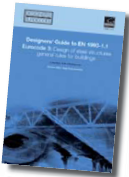
The book is one of the series of published by ICE subsidiary Thomas Telford to aid and support the transition from British Standards to Eurocodes. This new book provides engineers with straightforward explanations and useful design examples on using Eurocode 3 (EN 1993-1-1) to design steel structures.
It concentrates on the main provisions of Part 1-1 of EN 1993 but deals with some aspects of Part 1-3 on cold-formed sections, Part 1-5 on plated structures and Part 1-8 on connections. In addition, it makes comparisons with the equivalent provisions in BS 5950 and refers to Eurocodes EN 1990 and EN 1991 when dealing with loading.
Chapters 1–11 directly reflect the arrangement of the code, clause by clause, with section numbers and equation numbers matching those in EN 1993-1-1. Chapter 12 deals with the provisions for the design of joints, chapter 13 deals with the design of cold-formed sections and, finally, actions and combination of actions are dealt with in chapter 14.
This is currently the only book in the UK that provides a commentary to the EN 1993 and directly reflects the provisions of Eurocode 3. It is thus ideal for engineers and designers who want to familiarise themselves with Eurocode 3 for the design of steel structures.
Total quality in the construction supply chain by John Oakland and Marton Marosszeky, published by Butterworth Heinemann, 2006, reviewed by Joe Gunning, University of Ulster.
Any civil engineer familiar with the work of John Oakland will look forward eagerly to this book, the title of which suggests that it will present much new material on quality management in the construction process. Regrettably, such a reader will find here very little new or construction-specific material, other than the interesting case studies.

The text replicates every chapter heading and 90% of the sub-sections of Oakland's previous books—Oakland on quality (2004) and Total quality management: text and cases (2000). There are few references to construction issues within the index and the text is essentially repeated directly from the other two works, with the addition of around 20 pages of construction-related aspects based mainly on Australian experiences.
It is also surprising to find a book on quality management of construction without reference to the work of Egan, McCabe, Griffith and Watson. The book totally ignores the international research of the International Council for Research and Innovation in Building and Construction (CIB) working commission 88 on quality, as well as the Constructing Excellence initiative in the UK, with its widespread development of key performance indicators for benchmarking a wide range of construction-performance parameters. There is also a significant lack of references to the construction supply chain itself, despite the title.
Essentially this book represents a further presentation of Oakland's well-respected work on general quality management across a range of hard and soft performance measures. These provide the foundation for effective process management through leadership and teamwork. However, the authors appear to recognise few differences between construction organisations and other business enterprises.
The primary novelty of this book is in its 15 case studies, only two of which are from Oakland's previous works. These present a wide variety of construction-related illustrations of quality management practice from around the world. Academics and their students should find them of particular interest, and practitioners wishing to develop their own quality-management systems may gain some appropriate advice.
Despite the above reservations, any civil engineer new to Oakland's work will greatly benefit from reading this book. It represents a useful summary of much of the current thinking on total quality, a topic in which all construction professionals should have a keen interest. It is unfortunate that the text does not focus more on the issues particular to implementing total quality in the construction process, as the title suggests.
NEW BOOKS
The ICE's bookshop in London carries one of the most comprehensive ranges of civil engineering bookshops in the world. New books received in the past three months are as follows.
Strategic risk: a guide for directors
Actuarial profession and Institution of Civil Engineers £35.00
Concrete: Neville's insights and issues
Adam Neville £65.00
Brunel: in love with the impossible
Andrew Kelly and Melanie Kelly (editors) £29.95
Tables for the hydraulic design of pipes sewers and channels: 8th edition (volume 1)
HR Wallingford and D. Ian Barr £65.00
Tables for the hydraulic design of pipes, sewers and channels: 8th edition (volume 2)
HR Wallingford and D. Ian Barr £60.00
Tables for the hydraulic design of pipes, sewers and channels: 8th edition (2 volume set)
HR Wallingford and D. Ian Barr £110.00
Brunel, a rail tour of his achievements
Vic Mitchell £14.95
Commercial management of projects
David Lowe and Roine Leiringer £79.50
Contracts and international project management
David Carmichael £69.00
Creativity for engineers
Balbir Dhillon £28.00
The greater genius? Marc Isambard Brunel
Harold Bagust £24.99
Introduction to computational earthquake engineering
Muneo Hori £28.00
Introductory geotechnical engineering, an environmental perspective
Hai-Yang Fang, John Daniels £35.00
London's contemporary architecture
Ken Allinson £18.99
Planning, law and economics
Barrie Needham £25.00
The bookshop is in the ICE foyer, 1 Great George Street, London SW1P 3AA and is open from 9.30 am to 5.00 pm, Monday to Friday. Books can also be ordered by calling +44 (0)20 7665 2462, emailing orders@thomastelford.com or by visiting www.thomastelford.com or the bookshop section of www.ice.org.uk

Mathematical methods for physics and engineering, 3rd edition, by Ken Riley, Mike Hobson and Stephen Bence, published by Cambridge University Press, 2006, reviewed by Dennis Lam, University of Leeds

This is a very comprehensive textbook suitable for most students enrolling on undergraduate degree courses in engineering. It contains 31 stand-alone chapters of mathematical methods which enable the students to understand the principles of the basic mathematical techniques and the authors have produced a clear, thorough and straightforward explanation of each subject.
Since the contents of engineering mathematics courses vary greatly from university to university, finding a single textbook which covers the engineering student's need throughout their entire course is by no means an easy task. I believe the authors have achieved it in that respect.
I am particularly impressed by the fact that this book covered preliminary algebra and calculus in its first two chapters—especially important for students who are entering an engineering degree course without A-level mathematics.
In addition to the worked examples that follow at the end of each chapter, the book also contains over 800 exercises, with hints and answers to half of those, namely the odd-numbered ones. The student solutions manual accompanying this 3rd edition contains complete fully worked solutions to those exercises, which I think is a useful asset for both students and lecturers.
If there is one criticism about this book, it is going to be that it gives little reference to the engineering situations where these mathematical techniques are useful, but I guess this is difficult to achieve with the large variety of readers. Perhaps the authors could consider including some of the engineering-related questions in those 800 exercises at the back of each chapter.
All recent book reviews can be read in the online version of the journal at www.civilengineering-ice.com
ICE review
A review of recent and forthcoming developments at the Institution of Civil Engineers by ICE director of communications and marketing Anne Moir. For further information please contact the Communications Office on 020 7665 2150 or visit the ICE website at www.ice.org.uk
Supporting drought orders
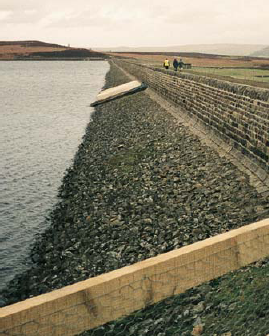
ICE has responded to Sutton and East Surrey Water being granted permission to use drought orders in 2006 help ease water shortages in south-east England. The Institution supports the use of such orders as a short-term measure, but insists that much more must be done to invest in new infrastructure. This will require water prices to rise.
According to John Lawson, chairman of ICE's water board, ‘It is unfortunate, but the measures in drought orders to limit water use are an appropriate and necessary response to the drought caused by two dry winters. Without such restrictions, we run the risk of much more severe measures later. However, this is a short-term measure which needs to be matched with long-term thinking. Since water privatisation in 1989, there has been little investment in new water supplies; this has to change. Water is currently valued too cheaply and the only way that new infrastructure can be afforded is to ask consumers to pay the true price for water.’
ICE is calling on UK water regulator Ofwat and the Government to allow companies to increase their investment in water resources. However, water companies will only be able to invest if they can charge consumers the real value of their water use. This can then be channelled into much-needed infrastructure including new reservoirs, desalination plants and water recycling facilities and replacement of old, leaky pipes. There should also be compulsory water metering to encourage household water efficiency.
Keeping energy in politics
ICE is teaming up with RIBA for a third year running to raise the profile of the two institutions at the three main political party conferences during September and October.
The focus this year will be on energy efficiency, following the recent publication of the Government's major Energy Review.
Marine energy conference
ICE has teamed up with the International Association of Hydraulic Engineers to run a conference on harnessing renewable energy from the sea. It will take place on 21 September 2006 at the London Stock Exchange.
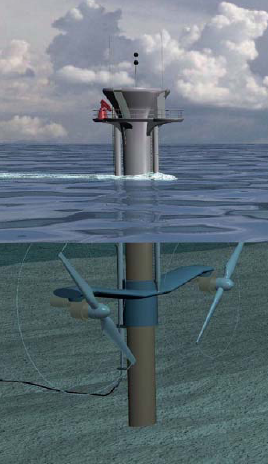
The Marine Renewable Energy conference will bring together experts in the field to review the latest developments and consider the challenges ahead. The event will be of interest to engineering and design firms, manufacturers and material suppliers for energy devices, private consultants and academics.
David Kerr, chairman of ICE's energy board, said, ‘The UK has the best wave and tidal resource in Europe, an asset which could potentially provide up to 20% of the country's electrical power. There is now a renewed drive to realise this potential and this conference comes at a time when significant progress is beginning to be made.’
Topics to be discussed at the conference include the UK's marine energy strategy; environmental and financial aspects of marine energy; tidal power developments and projects; and wave power developments and projects.
Confirmed speakers include Gary Shanahan from the UK Department of Trade and Industry, Peter Fraenkel of Marine Current Turbines, Richard Yemm of Ocean Power Delivery and Roger Abraham of Halcrow Water.
Those wishing to attend can book online at www.iceconferences.com or call ICE Conferences on +44 (0)20 7665 2318. (Image courtesy of Marine Current Turbines Ltd.)
State of the Nation 2006

ICE is launching its influential State of the Nation Report focusing on the UK's infrastructure on Tuesday 17 October 2006.
A Parliamentary reception will be held in the evening, which is anticipated to be attended by key stakeholders across the political spectrum.

