

Discussion
07-00049: Broads outdoor centre: a lesson in low-impact engineering: by Andrew Best (February 2008)
Contribution by Malcolm Millais
It is difficult to see how the project described in the paper gives value for money. There are dozens of proprietary sheds and cabins on the market, so why do they have to be purpose-built? I presume it is because there are none that look like ‘upturned timber boats’—which, of course, need curved, not-off-the-shelf, laminated timber beams. Even more extraordinary is the canopy, which requires a non-triangulated truss to cantilever 25 m from a soft alluvial soil. Furthermore, the continuously curving steelwork had to be ‘closely controlled’, not surprisingly. Why does it have to have a membrane roof, and why is the membrane flatter than normal? And, one could ask, why do people who have been canoeing, windsurfing or sailing actually need a vast canopy to protect them from the rain or sun? As the 1894 ICE president Alex Peterson noted, ‘It is quite easy to build an expensive structure, but it is the engineer's duty to build an effective structure for the least possible cost.’ Wise words frequently ignored these days.
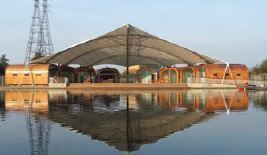
Whitlingham outdoor education centre in the Norfolk Broads—imaginative engineering or unnecessarily expensive?
Whitlingham outdoor education centre in the Norfolk Broads—imaginative engineering or unnecessarily expensive?
07-00031: Elred: new water for London from old assets: by Alexander Hamilton, Jamie Riches, Graham Realey and Howard Thomas (February 2008)
Contribution by Barry Tate
I recall a paper presented 20–30 years ago in Middlesbrough to ICE Northern Counties, which described the problems likely to arise following the cessation of pumping of groundwater from the Chalk under London. The authors suggested that, as the water table gradually returned to its pre-pumping level—presumably the ‘original water level’ shown in Fig. 3 of the current paper (right)—the London Clay would swell, giving rise to major foundation problems in London. The then authors considered and costed various options including do nothing, restarting pumping (to waste) and so on, each option amounting to many millions of pounds. The most expensive was to do nothing and to pay for repairs. Fig. 3 appears to indicate that the water table had only just returned to the London Clay by 2007, so presumably swelling of the Clay is not yet a problem. However, did the above factors enter in to the authors' considerations?
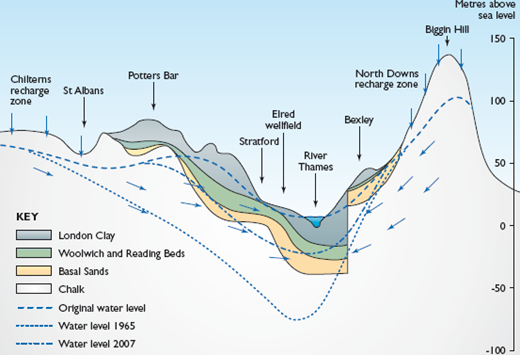
Groundwater levels have been stabilised under London over the past 10 years by increased abstraction, removing the risk of structural damage
Groundwater levels have been stabilised under London over the past 10 years by increased abstraction, removing the risk of structural damage
Authors' reply
One of the potential impacts of rising groundwater levels in the confined Chalk of London was identified in 1989 as a change to the geotechnical properties of the London Clay. Along with the potential for groundwater ingress, there appeared to be a real threat to subsurface structures, such as rail tunnels, and deep foundations associated with tall buildings in central London. In response to this threat, the Gardit strategy was developed jointly by Thames Water, London Underground and the Environment Agency. By implementing an increase in groundwater abstraction of over 50 Ml/d during the period 1994–2004, mainly for public water supply, delivery of the Gardit strategy has accelerated the control of rising groundwater levels in central London.
Although the Elred scheme was not included in the original Gardit strategy, the subsequent implementation of this abstraction in east London for public supply has played a role in ensuring the potential for managing groundwater levels in the Chalk aquifer. Present-day groundwater levels are broadly stable in the centre of the main area of original concern, are declining in south-west London, but are still continuing to rise in north-west London—though this is an area where there is little risk of impact.
07-00001: Gibraltar runoff: a steep challenge for decommissioning: by Martin Cooper, Paul Stubbs, Tony Carter and Stuart Dunn (February 2008)
Contribution by J. Fulton
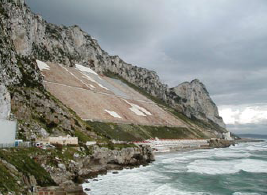
I was Property Services Agency director from 1984 to 1987, responsible for all the Ministry of Defence facilities in Gibraltar including water supply. Contrary to the opening comment ‘Much of the British government's water supply…was achieved by fixing corrugated sheeting’, in my time and for many years before, the catchments supplied no more than 10% of the requirement, the difference being made up from nine multi-stage flash distillers and subsequently a new reverse-osmosis desalination plant.
Maintenance of the catchments was not a major expenditure, but it required regular inspection and prompt replacement of damaged sheets to prevent water from undermining the structure. There were occasional rockfalls which damaged the sheeting, perhaps including one in 1981 as mentioned in the paper, but if so it had been repaired and the integrity of the surfacing was not permanently impaired during my time in Gibraltar. I have heard that later a decision was taken to cease using the catchments and to stop repairing them, which would have had the effect fairly quickly of allowing water through the sheeting, with the consequences described.
Authors' reply
The contribution of the catchments was recorded in documents and reports available to us as significant, and we would view the figure of 10% as confirmation of these reports.
The contributor is correct in his observation that difficulties in sustaining a viable maintenance regime for the disused catchments led to increased percolation through damaged sheets. It is likely that this contributed to the slope movements observed, which, together with the physical risk posed by deteriorating sheeting becoming detached, led to the decision fully to decommission the catchments to a condition suitable for transfer to the government of Gibraltar.
06-00002: Deep impact: why post-tsunami wells need a measured approach: by Lucy Lytton (February 2008)
Contribution by Sydney Xavier
It would be natural and instinctive to think of pumping out the tsunami seawater from wells but, as the author reports, this proved to be misguided. As such the author is probably correct with the comment that, ‘in some circumstances, the best course of action is to do nothing,’ but this is not very helpful. Are there any established chemical means that could have been used, or would simple and slow direct recharging of the wells with fresh water do the trick?
The author highlights the close proximity of water wells to latrines of around 10 m. However, published guides9,10 suggest a minimum of 10–15 m. Is it not time to strengthen planning regulations and procedures in Sri Lankan provinces and remote villages world-wide, especially as 2008 is designated as good sanitation year?
On a practical level, a simple inquiry to the Institution of Engineers Sri Lanka in Colombo or ICE in London would reveal sources of much design information and guidance on siting toilets in the vicinity of domestic water wells and the essential precautions to be taken in the management of such systems. These resources also carry useful reports on dewatering and tackling drinking water wells contaminated by seawater.
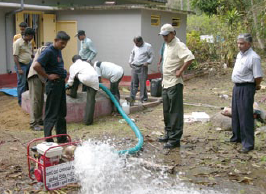
Locals as well as aid agencies made the mistake of pumping tsunami seawater out of wells
Locals as well as aid agencies made the mistake of pumping tsunami seawater out of wells
Author's reply
It was not my intention to imply that only local people were misguided in their well-cleaning activities. An alarming proportion of the international aid community were conducting ‘well rehabilitation’ in an equally inappropriate manner. Therefore, there is an urgent need to ensure that appropriate knowledge is held within both international and local communities. Advice to do nothing may be frustrating, but it is better than intervening in such a way as to exacerbate the problem.
There are no chemical means of improving the situation described and, in the case of the reported study, no recharging of wells would have been possible as the water table was already at ground surface. Furthermore, just as contaminated well water discharged to the ground surface percolates back into the wells, so also would recharge water, discharged into wells, lead to outflow at the adjacent ground surface and to resultant standing water.
The proximity of the latrines to the wells in this area is disastrous from a public-health point of view. None of the distances mentioned by the contributor are adequate for a highly permeable water supply aquifer where the water table is above the base of latrine pits. Yes, by all means strengthen planning regulations but remember that the communities affected on the east coast of Sri Lanka are amongst the poorest. Latrines that drain into the aquifer are ubiquitous and private wells are often the only available water supply. In order to be effective, improved planning regulations would have to be twinned with significant infrastructure investment.
Finally, it is hard to imagine what advice any of the institutional resources cited by the contributor might provide for the case described.
References
9. Franceys R., Pickford J. and Reed R. A Guide to the Development of On-site Sanitation. World Health Organisation, Geneva, Switzerland, 1992.
10. Davis I. and Lambert R. Engineering in Emergencies—A Practical Guide for Relief Workers (2nd edition). Intermediate Technology Development Group, Rugby, 2002.
07-00002: Central Park station—engineering a new leaf for Manchester: by Nigel Nicholls and Steve Jones (November 2007)
Contribution by Charles Brindley
How effective is the described canopy structure when the weather is really bad, blowing a gale and rain bucketing down? Looking at the section, all that seemed really necessary were simple non-opaque low roofs, rear walls to the platforms and roofs over the staircases—far less costly, less obtrusive and probably more effective.
Authors' reply
It was always recognised that there would be much cheaper methods of providing shelter to the users of the new Metrolink station; however, the client specifically wanted a ‘landmark structure’ at the entrance to the new Central Park business park to make a statement about the quality of the development. The structure does provide an effective canopy and does provide shelter in all but the most severe storm conditions. The wind tunnel testing for pedestrian environmental comfort is covered within the text of the paper.
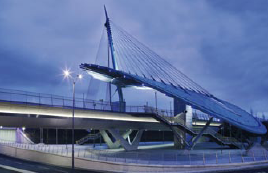
Central Park station canopy, Manchester—a landmark structure, but does it keep the rain out?
Central Park station canopy, Manchester—a landmark structure, but does it keep the rain out?
09-00019: How Roman engineers could have flooded the Colosseum: by Martin Crapper (November 2007)
Contribution by Alex Perry
It seems unnecessary to have removed the timber arena floor during flooding. The use of dense hardwood, perhaps covered in a sealing layer of clay and then, say, 150 mm of sand, would have only minimal buoyancy if the hypogeum was completely filled—or could have even supported the water directly. Furthermore, the spectacle could probably have been staged with less than 1·5 m of water—even 1 m seems generous for flat-bottomed theatrical boats. Being below the flooded arena would obviously be damp and potentially dangerous, but I doubt that would have deterred the Romans. Also, if most of the timber floor was permanent, it could have been thoroughly caulked, potentially making even a clay sealing layer superfluous.
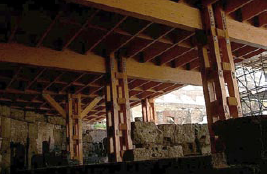
Trapdoors in the arena floor would have made it difficult to waterproof, meaning flooding had to be done from the base
Trapdoors in the arena floor would have made it difficult to waterproof, meaning flooding had to be done from the base
Author's reply
The arena floor is 6 m or so above the base of the hypogeum and the theory on which the paper is based is that it was the base of the hypogeum which was waterproofed and flooded, so 1·5 m depth of water would be 4·5 m below the arena floor. That it was the hypogeum and not the arena itself that was flooded would appear to be supported by evidence such as the traces of hydraulic mortar found.
To flood above the arena floor, it would have been necessary to block a substantial number of side passages into the main arena, which seems impractical. It would also have meant that the water depth had to be sufficient to fill the entire hypogeum and a metre or so above the floor—around 7 m in total—or the floor had to be a water-supporting structure, with a capacity of 1 t/m2 at least. As I understand it, the archaeological evidence supports the theory that the original floor was removable.
I have not studied the boats used; I am of the view that there is no clear evidence available for such study. Either way, if the base of the hypogeum were flooded only to 1 m depth, then the sight-lines would be worse for the audience
In later times, the area beneath the arena floor was used for bringing on scenery and animals for shows, and the floor was therefore pierced by a wide variety of trapdoors. If this were the case at the amphitheatre's opening, then it would make caulking very difficult.
Full versions of these discussions can be read with all other discussion in the online version of the journal at www.civilengineering-ice.com.
Proceedings
> RECENTLY PUBLISHD PAPERS
In addition to Civil Engineering, ICE Proceedings includes 15 specialist journals. Papers and articles published in some of the most recent issues are listed here. Summaries of all these and other papers and articles published in the past three years can be read free at www.ice.org.uk/journals. ICE members can download any 15 papers published in 2008 for £25 from www.iceknowledge.com
Bridge Engineering
161, No. BE1, March 2008, 1–53
Implications of the change to Eurocodes for bridge design
C. R. Hendy
London Underground bridge slide at White City viaduct, UK
A. Karbassi, P. Knight and D. Sharrocks
Analysis of compressive membrane action in concrete slabs
Y. Zheng, D. Robinson, S. Taylor, D. Cleland and A. Shaat
Strengthening of the Irwell Valley Bridge, UK
D. A. Smith and C. R. Hendy
Civil Engineering Special Issue
161, No. CESI1, May 2008, 1–64
Heathrow Terminal 5: gaining permission
R. Pellman

Heathrow Terminal 5: delivery strategy
A. Wolstenholme, I. Fugeman and F. Hammond
Heathrow Terminal 5: health and safety leadership
M. Evans
Heathrow Terminal 5: enhancing environmental sustainability
B. Lister
Heathrow Terminal 5: twin rivers diversion
D. Palmer
Heathrow Terminal 5: tunnelled underground infrastructure
I. Williams
Heathrow Terminal 5: building substructures and pavements
T. Dawson, K. Lingham, R. Yenn, J. Beveridge, R. Moore and M. Prentice
Heathrow Terminal 5: terminals T5A and T5B
S. McKechnie, D. Mitchell, W. Frankland and M. Drake
Heathrow Terminal 5: rail transportation systems
I. Fugeman
Heathrow Terminal 5: energy centre
G. Adams
Construction Materials
161, No. CM2, May 2008, 47–92
Sustainable concrete waste recycling
Y. Dosho
Using gypsiferous soil for embankments in hot desert areas
S. S. Razouki, D. K. Kuttah, O. A. Al-Damluji and I. H. Nashat
Effect of corrosion inhibitors on cement paste pore structure
L. Luo, G. Ye and G. De Schutter
Safe, high-tech and sustainable concrete construction
S. Desai
Energy
160, No. EN2, June 2008, 47–89
European Marine Energy Centre: facilities and resources
J. Norris and I. Bryden

Photovoltaics: added value of architectural integration
A. S. Bahaj, P. A. B. James and M. F. Jentsch
Retrofitting boosted over-fire air to coal-fired power stations
A. L. Bruder and C. D. Castleman
Visakhapatnam underground LPG storage cavern, India
N. Raghavan, S. R. K. V. Kosuri, K. V. Bhaskar, P. de Laguerie, P. Roux, P. Vaskou and A. Saint
Engineering Sustainability
161, No. ES1, March 2008, 1–101
Decision support methodology for complex contexts
L. Elghali, R. Clift, K. G. Begg and S. McLaren

Addressing practical problems in sustainability assessment frameworks
L. Hurley, R. Ashley and S. Mounce
Towards a deeper and broader ecological footprint
G. M. Peters, F. Sack, M. Lenzen, S. Lundie and B. Gallego
Transforming impact assessment for sustainable development and poverty eradication
T. J. Downs
A comparative analysis of two building rating systems. Part 1: Evaluation
R. A. Fenner and T. Ryce
A comparative analysis of two building rating systems. Part 2: Case study
R. A. Fenner and T. Ryce
Trialling Ceequal on a London railway embankment
E. Campbell-Lendrum and J. Feris
Application of sustainability indicators in decision-making processes for urban regeneration projects
D. V. Hunt, D. R. Lombardi, C. D. Rogers and I. Jefferson
Sustainability assessment and reporting in property development: a case study
P. D. Panagiotakopoulos
Geotechnical Engineering
161, No. GE2, April 2008, 63–116
Bridge distress caused by approach embankment settlement
C. A. Jones, D. I Stewart and C. J. Danilewicz
Sustainability of land remediation. Part 1: overall analysis
M. J. Harbottle, A. Al-Tabbaa and C. W. Evans
Maintenance and monitoring of ground anchorages: guidelines
S. Littlejohn and D. Mothersille
Maintenance and monitoring of ground anchorages: case studies
S. Littlejohn and D. Mothersille
Ground Improvement
161, No. GI2, May 2008, 55–108
Soil improvement by internally reinforced stone columns
T. Ayadat, A. M. Hanna and A. Hamitouche
Eccentricity effect on a footing supported by a stone column
M. Sadek and I. Shahrour
Modelling embankments reinforced with sand columns
M. Sathishbalamurugan and B. Muhunthan
Subgrade modulus of geocell-reinforced sand foundations
S. K. Dash, P. D. T. Reddy and S. T. G. Raghukanth
Ground improvement by small-diameter timber piles
S. Ghosh, S. Mukherjee, R. B. Sahu, A. Ghosh and N. Som
Management, Procurement and Law
160, No. MP4, November 2007, 137–180
Framework for effective collaborative working in construction
M. A. Shelbourn, D. Bouchlaghem, C. J. Anumba and P. Carrillo

European infrastructure procurement through PPP
O. Maslyukivska and M. Sohail
Construction, law and the environment: a historical review
B. Manie
Maritime Engineering
161, No. MA1, March 2008, 1–51
The programme of flood defence works, Humber estuary
A. Rowland, L. Trim and J. Ash

Breach design for realignment sites
I. H. Townend
Hypsometry of estuaries, creeks and breached sea wall sites
I. H. Townend
Erosion of sediments beneath an oscillating cylinder
R. Narayanan and A. Aminzadeh
Municipal Engineer
160, No. ME1, March 2008, 1–64
Advancing sustainable urban development in China
J. H. Wang, A. Koizumi and X. Liu
Water environment improvements in Zhenjiang City, China
H. Tang, S. Lu, Y. Zhou, X. Xu and Y. Xiao
Methane ingress during Yangtse River outfall construction
C. Preston, C. Beirne and G. Yang
Challenges in underground construction
Y. Yuan
Design for a large underground space
Y. Yuan, H.-L. Zhao and X.-F. Bao
Construction and demolition materials management in Hong Kong
A. T. Yeung
Expansion of Chinese economy and construction safety
D. P. Fang, J. X. Huang and J. M. Anderson
Structures and Buildings
161, No. SB1, February 2008, 1–54
Robustness of light steel frames and modular construction
R. M. Lawson, M. P. Byfield, S. O. Papa-Ola and P. J. Grubb
Achieving durable repaired concrete structures: a performance-based approach
S. Matthews and J. Morlidge
Neural networking modelling of RC deep beam shear strength
K.-H. Yang, A. F. Ashour, J.-K. Song and E.-T. Lee
Transport
161, No. TR2, May 2008, 55–98
Iberian rail: adding a new dimension to international travel
A. López Pita, P. F. Teixeira, A. Bachiller, C. Casas-Esplugas and R. Insa

Environmental effects on development of pavement joint cracks
J.-H. Jeong
A transport policy toolkit for the West Midlands
T. van Vuren
Highway safety analysis using geographic information systems
M. Castro, L. Iglesias, R. Rodríguez-Solano and J. A. Sánchez
Skid resistance loss of plastic-grooved concrete roadways
S. W. Lee and B. J. Cheon
Waste and Resource Management
160, No. WR4, November 2007, 131–174
Assessing MSW degradation by BMP and fibre analysis
B. Zheng, D. J. Richards, D. J. Smallman and R. P. Beaven
Solid waste management in Abadan and Khorramshahr, Iran
M. R. Alavi Moghaddam, N. Mokhtarani and B. Mokhtarani
Design of a reinforced embankment on compressible soil
G. M. Swift and D. R. V. Jones
Developing durable paste backfill from sulphidic tailings
A. Tariq and M. Nehdi
Encapsulation of fluoride sludge in stabilised mud blocks
S. M. Rao, P. Mamatha, R. P. Shantha and B. V. Venkatarama Reddy
Water Management
161, No. WM2, April 2008, 53–113
Stormwater sand filters in water-sensitive urban design
J. Kandasamy, S. Beecham and A. Dunphy
Water services regulation for the urban poor: Zambia
S. Kayaga and R. Franceys
Identifying risk factor of BOT for water supply projects
S. X. Zeng, T. W. Wan, C. M. Tam and D. Liu
Determining water surface elevation in tidal rivers by ANN
A. Adib
Critical flow over spillway profiles
O. Castro-Orgaz, J. V. Giráldez and J. L. Ayusa
Effect of the Froude number on assessment of the bridge afflux
G. Seckin, D. W. Knight, S. Atabay and N. Seckin
Experimental study of air demand in high head gated tunnels
K. Safavi, A. R. Zarrati and J. Attari
Request for papers
All Proceedings journals rely entirely on papers sent in by civil engineers and related professionals, researchers, academics and students. Papers should be around 2000 to 5000 words long, in good English and with adequate illustrations and references. Project papers are particularly welcome.
All papers sent in will be assessed on merit and not on the status of the author. Simply submit your text and images using the online submission system via www.ice.org.uk/journals.
Personal on-line subscriptions to specialist Proceedings journals start from £11 a year for members.
Print subscriptions start at £21 a year and include full on-line access to the current and past three years' issues. Please call +44 20 7665 2227, email subs@ice.org.uk
The following is a list of referees who have reviewed papers for Civil Engineering between 1 November 2006 and 1 November 2007. The Institution is very grateful for their assistance. If you would like to be considered as a referee, please contact the journal secretary Ben Ramster on +44 20 7665 2242 or e-mail ben.ramster@ice.org.uk
| J. Adams | R. Dawson | Y. Hurol | M. Murray | D. Smith |
| G. Amblin | M. dyer | R. Huxford | D. Nethercott | P. Smith |
| G. Amiri | M. Chrimes | P. Irawan | R. Nicholls | I. Smout |
| J. Anderson | R. Cragg | K. Johnson | T. Oakes | R. Spoors |
| C. Arya | P. Cross-Rudkin | P. Jowitt | D. Oehlers | M. Sterling |
| B. Attoh-Okine | A. Cunha | A. Kar | A. Osman | J. Surtees |
| S. Austin | R. Dawson | A. Kwan | B. Otter | J. Taylor |
| A. Bardill | T. Day | D. Lambert | R. Paxton | W. Tizani |
| M. Barnes | M. Dyer | D. Lamont | A. Pickles | N. Thom |
| B. Barton | A. Eadon | R. Lark | M. Phillips | K. Thomas |
| K. Baskaran | M. Emsley | A. Mann | R. Powell | A. Vignoli |
| R. Brown | M. Escarameia | J. Le Masurier | D. Richmond-Coggan | Y. Vimalanathan |
| R. Buckby | R. Fernie | G. Macdonald | J. Sanjayan | F. Wainwright |
| J. Burland | N. Fung | W. Manners | N. Sandilands | A. Warren |
| S. Caccavone | M. Garnham | D. Mara | I. Scott | G. Winch |
| T. Caccavone | M. Grant | I. May | M. Shahin | D. Wolfendale |
| S. Cartney | B. Hamer | C. Mcaleenan | C. Sherwood | G. Wolters |
| B. Clarke | I. Hamilton | M. Mcmarthy | B. Simpson | J. Wood |
| V. Chandra | M. Harrison | R. Mcwilliam | I. Scott | M. Zhang |
| J. Chapman | P. Harvey | R. Melchers | B. Sinclair | P. Zheng |
| M. Cullen | E. Hepper | J. Mills | A. Sloan | |
| J. Davies | I. Hunter | R. Morgan | A. Smith |
Publications
>>> REVIEWS
Green guide to the architect's job book (2nd edition)
by Sandy Halliday, published by RIBA Publications, 2007, £15, reviewed by Allan Haines, The Concrete Centre
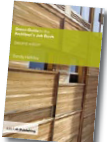
Guidance in this book takes the form of an extended aide-mémoire comprising lists that faithfully follow the Royal Institute of British Architects plan of work, from stage A to L. This format is usefully extended to include refurbishment and demolition sections that effectively complete the cradle-to-grave cycle.
The introduction reminds the reader that sustainable development is now mainline, and the guide goes on to ask the question, why green? It seems that the author prefers this designer-friendly term to ‘sustainable’, an already over-used term. Given that Greenpeace, The Green Party and The Green Council each adopt ‘green’ for different reasons, what does the public at large make of ‘green’? If green is good, is that organic, low carbon, or whole-life performance that includes the social dimension, or quite simply open to all possibilities?
Sandy Halliday demonstrates how designers can take pride in having shown considerable leadership and commitment to ecologically sound ideas and that these date back to low-energy design provoked by the 1970s energy crisis. Certainly achieving a greener future depends on how well designers and other early adopters can persuade others of the benefits derived from thinking globally and acting locally.
The guide is designer-centred as the title promises but, increasingly, aspiration to a greener future can only be maintained by resource and commitment from the client. Nevertheless, the role of the client or prime stakeholder, who arguably wields the greatest influence in a project, is accorded less than two pages. The ‘must do’ lists that can be handed to a client in initial discussions are not compiled in the most helpful fashion for the purpose.
Civil engineering, behind the scenes, volume three
by Fastline Films and Telerail, 2007, £25, reviewed by Tony Caccavone, The Nichols Group

Behind the scenes is a 60-minute documentary film on DVD that provides a fascinating insight into the work of the London and North Eastern Railway (LNER) and British Rail's civil engineering departments from the 1930s through to the 1960s. The film is the third volume in a series of four produced by Fastline Films, which grew out of the photographic unit of the chief civil engineer of the LNER and its successor British Rail.
The commentary is derived from thorough research of historic archives and is extremely informative, explaining in detail the methodologies and working practices undertaken on a variety of railway civil engineering projects. The commentary is delivered in a soft yet authoritative manner without over-dramatising the work, which is so often found in documentaries produced for mainstream television.
The high-quality black-and-white film covers a wide variety of railway projects, including several bridge reconstructions, ranging from cast-iron girder bridges to a pre-stressed concrete bridge, construction of the subway to platforms 10 and 11 at York station, permanent way re-modelling and bridge demolitions in preparation for electrification in the 1950s.
The commentary points the viewer to some fascinating details which would not be found on the railway today: engineers replacing a cast-iron girder bridge while maintaining passenger trains between engineers' trains on the adjacent line; workers pushing an engineers' train out of the way during a bridge reconstruction; bricklayers pointing the inside of a cavity wall during construction; and how supervisors wore trilby hats while workers wore flat caps—no hard hats or other personal protective equipment back in those days.
This documentary is remarkable for showing how working practices have changed over the last 70 years and will be of interest to anyone with an interest in civil engineering railway history.
Full versions of these and other reviews can be read at www.civilengineering-ice.com.
>>> NEW BOOKS
The ICE bookshop in London carries one of the most comprehensive ranges of civil engineering books in the world. New books received in the past three months are as follows.
A short course in geology for civil engineers
Marcus Matthews, Noel Simons and Bruce Menzies £65·00
Advanced unsaturated soil mechanics and engineering
Charles Ng and Bruce Menzies £95·00
Assessing risks posed by hazardous ground gases to buildings (revised) (C665)
Steve Wilson, Sarah Oliver, Hugh Mallett, Heidi Hutchings and Geoff Card £130·00
Biographical dictionary of civil engineers—volume 2 1830–1890
Peter Cross-Rudkin and Mike Chrimes (eds) £120·00
BTEC national construction: building services, engineering and civil engineering student book
Simon Topliss, Mike Hurst and Greg Skarratt £24·99
Building services handbook (4th edition)
Fred Hall and Roger Greeno £21·99
CDM 2007: a guide for clients and their advisors
Tony Baker £45·00
Cladding of buildings (4th edition)
Alan Brookes and Maarten Meijs £35·00
Construction dewatering and groundwater control: new methods and applications (3rd edition)
Patrick Powers, Arthur Corwin, Paul Schmall and Walter Kaeck £95·00
Construction superintendent operations manual
Sidney Levy £49·99
Design and access statements explained
Rob Cowan £35·00
Design of prestressed concrete bridges
Robert Benaim £90·00
Engineering geomorphology—theory and practice
Peter Fookes, Mark Lee and James Griffiths £40·00
Everyday engineering
Andrew Burroughs £17·99
Hydrogeology field manual (2nd edition)
Willis Weight £55·99
Innovation in small construction firms
Peter Barrett, Martin Sexton and Angela Lee £55·00
Materials, specification and detailing: foundations of building design
Norman Wienand £24·99
Motors as generators for micro-hydro power (2nd edition)
Nigel Smith £14·97
Pile design and construction practice
Michael Tomlinson and John Woodward £95·00
Practical hydraulics
Melvyn Kay £27·50
Practical road safety auditing
Martin Belcher, Steve Proctor and Phil Cook £49·00
Pressure transients in water engineering: a guide to analysis and interpretation of behaviour
John Ellis £95·00
Pump handbook
Igor Karassik, Joseph Messina, Paul Cooper and Charles Heald £85·99
Safety at work
John Ridley £79·99
Steelwork design guide to BS 5950 1:2000 volume 1: section properties and member capacities (7th edition)
The Steel Construction Institute £80·00
The bookshop is in the ICE foyer, 1 Great George Street, London SW1P 3AA and is open from 9.30 am to 5.00 pm, Monday to Friday. Books can also be ordered by calling +44 20 7665 2462, emailing orders@thomastelford.com and by visiting www.thomastelford.com or the bookshop section of www.ice.org.uk.
ICE review
A review or recent and forthcoming developments at the Institution of Civil Engineers by ICE director of communications and marketing Anne Moir. For further information please contact the Communications Office on +44 20 7665 2150.
Call for planning body
ICE president David Orr (pictured) sent a budget submission to UK chancellor Alistair Darling in February 2008 calling for a strategic infrastructure planning body to be set up in Britain.
In a covering letter, Orr said ICE welcomed the government's recognition that a more strategic approach had to be taken to managing, developing and financing the nation's infrastructure. He stated ICE stands ready to assist the government in setting up a strategic infrastructure planning body, headed up by a chief infrastructure advisor.

State of the nation's skills
ICE's State of the Nation report on UK construction capacity and skills, released in January 2008, highlighted how uncoordinated planning of infrastructure projects discourages industry investment in civil engineering capacity and skills.
According to the report, UK construction inflation has been running at a rate well above the consumer price index (CPI). If left unchecked, this gap will have reached nearly £8 billion by 2015. This will threaten vital investments as government, by far the biggest client for infrastructure, only allows for CPI inflation in its future spending plans.
More information can be found on the ICE website at www.ice.org.uk/stateofthenation.
The Little Book of Civilisation 2
ICE published Little Book of Civilisation 2 earlier this year as part of its ongoing campaign to boost public understanding of the huge contribution civil engineers make to society. Building on the success of the first edition published in 2005, the new edition is available both online and in hard copy and includes 16 new case studies, including the Beddington Zero Energy Development, York Eco Depot and Wembley Stadium.
Also available is a video exploring case studies from both the first and second editions, which is receiving over 1000 viewings a month on YouTube. The Little Book of Civilisation 2 and the accompanying video are both available from www.ice.org.uk/civilisation. To receive hard copies or to find out more about the book please email civilisation@ice.org.uk.

Adopt a book scheme
ICE's library in London has launched an ‘adopt a book’ scheme. Titles adopted so far include Lives of the Engineers by Samuel Smiles, Fairbairn's On the application of cast and wrought iron to building purposes by William Fairbairn and Account of Britannia Bridge by Edwin Clark, all published in the mid-nineteenth century.
Anybody interested in the adopting a book, drawing or painting should contact Claire Delgal at claire.delgal@ice.org.uk, +44 20 7665 2258, or Carol Morgan at carol.morgan@ice.org.uk, +44 020 7665 2043.
Breakwaters conference
ICE is currently inviting technical papers on breakwaters, coastlines, coastal structures and marine energy systems for its major conference on these topics on 16–18 September 2009 at the Edinburgh International Convention Centre, UK. Submission deadline is 1 August 2008.
For further information, including a full list of conference topics and details on how to submit an abstract please visit www.ice-breakwaters.com.
Ralph Peck, 1912–2008
Pioneering American geotechnical engineer Ralph B. Peck died in February 2008 aged 95. His career extended over nearly 70 years of consultancy work, almost unprecedented in civil engineering and without parallel in the geotechnical field. His last great project was the Rio Niteroi Bridge in Corinth, Greece.
Known as ‘the godfather of soil mechanics’, Peck is probably best known today as a pioneer of the observational method style of engineering, where tunnels and dams are designed as the project progresses rather than before the start of construction. Peck first used the technique when working on the Chicago subway project in 1939–42 with his mentor Karl Terzaghi. It was also the topic of 1969 Rankine lecture at ICE in London.

