


BIM for construction health and safety
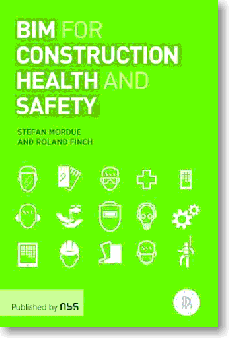
This new guide looks at how building information modelling (BIM) can be used to improve health and safety in the construction industry.
Written by an architect and a quantity surveyor, it discusses the opportunities for BIM and health and safety in the context of what BIM can offer in regard to compliance checking, model-driven prefabrication, hazard prediction, accident investigation, worker safety training and facility management. Case studies are provided with photographs and extracts from building information models.
With regard to health and safety information within the BIM process, the book covers collaborative working, information exchange and management, employer's information requirements, health and safety documentation, digital plans of work and data drops, and the health and safety aspects of procurement. It then goes on to describe how to interact with the building information model and covers risk assessment and design risk management in detail.
The book is just 120 pages but provides an excellent introduction to BIM in the context of construction health and safety by describing, in just the right level of detail, BIM, the Construction (Design and Management) regulations and construction health and safety.
Although written to introduce the concept of BIM from the construction health and safety advisor's viewpoint, it will be equally useful to other practitioners and students.
Forensic engineering: damage assessments for residential and commercial structures
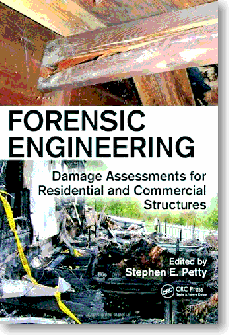
Forensic engineering deals primarily with hail and wind damage, water intrusion and structural failures of buildings using several well-illustrated case studies associated with insurance claims.
The authors have drawn upon their field experience and used clear colour photographs, schematic sketches, test samples and record photographs with measurement tapes. On hail and wind damage, the editor (also an author) demonstrates simulated damage assessment due to various objects.
The chapters on the insurance appraisal process and serving as an expert witness in the civil litigation process are a must-read for every civil engineer, as are the tips at the end of the book for preparing written reports and oral depositions.
By focusing on selected themes, the book is a ready reference for existing practitioners and new entrants alike.
Bridge engineering handbook (2nd edition)
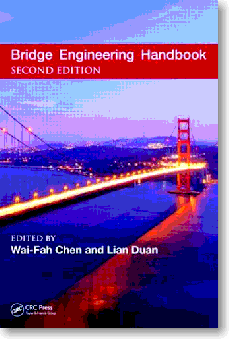
The 2nd edition of Bridge engineering handbook has contributions from over 140 experts from 14 countries.
It is divided into five volumes sub-titled Fundamentals, Superstructure Design, Substructure Design, Seismic Design, and Construction and Maintenance.
The new edition includes updates throughout and 26 new chapters, bringing the total to 89.
Diagrams and photographs are used to illustrate the text. Some chapters include design examples, while others provide design charts and typical design data. Importantly, each chapter has a list of references for further reading.
Many of the editors and chapter authors are from the USA, so the subjects are treated in terms of the American Association of State Highway and Transportation Officials and other American codes. While being of more direct use to design engineers working in America, the book should also provide a useful general reference for engineers elsewhere.
One of the reviewers used the 1st edition of the handbook in his bridge courses at the National University of Colombia and will now be adopting the five volumes of the 2nd edition for both his undergraduate and graduate courses.
Ground improvement (3rd edition)
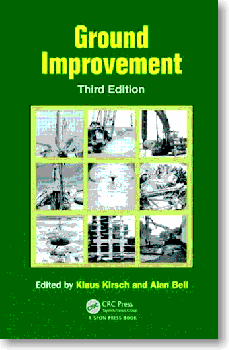
This 500-page 3rd edition of Ground improvement provides an updated basis for understanding the application of the most widely used processes for ground improvement. These include deep vibro techniques; dynamic compaction; prefabricated vertical drains; permeation, jet, soil fracture and compaction grouting; and soil mixing.
The edition also includes developments in equipment and methods as well as recent environmental legislation coupled with the need to recycle previously developed sites. Mention is made in the first chapter of health, safety and environmental impacts of ground improvement processes including hazardous materials and greenhouse gas emissions.
For anyone considering the use of ground improvement techniques this book provides a comprehensive overview of the processes currently available and will enable selection of the most appropriate processes suitable for a particular site together with monitoring, testing, quality control and quality assessment.
Concrete mix design, quality control and specification (4th edition)
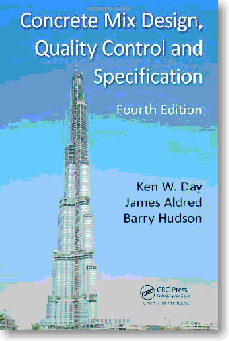
The 4th edition of Concrete mix design, quality control and specification gives an expert perspective on the practice of concrete technology.
The book stresses that quality control should be an ongoing process to determine quality changes early in the production cycle and not used as a remedial measure. Field experience is usefully supported by case studies from the UAE, Singapore, Australia, UK and USA.
This timely update fills an existing knowledge gap in practical concreting issues.
It will serve as a ready reference for quality control and contract personnel, and inspire graduate students to develop their interest in concrete technology further.
NEW BOOKS
The ICE library maintains one of the most comprehensive collections of civil engineering books in the world, including all titles from ICE Publishing (shown in bold below). New books received in the past 3 months include the following.
| A guide to the Reservoir Act 1975 (2nd edition) | Institution of Civil Engineers | £60·00 |
|---|---|---|
| Advances in the study of fractured reservoirs | G Spence | £125·00 |
| Bio- and chemo-mechanical processes in geotechnical engineering: Géotechnique symposium in print | L Laloui | £65·00 |
| Biographical dictionary of civil engineers: volume 3 − 1890 to 1920 | R McWilliam | £200·00 |
| Bridge launching (2nd edition) | M Rosignoli | £80·00 |
| Building information modelling: BIM in current and future practice | K Kensek | £57·50 |
| CESMM4: examples | Institution of Civil Engineers | £40·00 |
| Clays in natural and engineered barriers for radioactive waste confinement | S Norris | £140·00 |
| Coasts, marine structures and breakwaters 2013: from sea to shore − meeting the challenges of the sea | W Allsop | £350·00 |
| Construction health and safety manual (2nd edition) | Health and Safety Directors and Advisors | £156·00 |
| Crossrail project: infrastructure design and construction | M Black | £75·00 |
| Earth pressure and earth-retaining structures (3rd edition) | C Clayton | £35·00 |
| Emergent timber technologies: materials, structures, engineering, projects | S Jeska | £47·96 |
| Introduction to Autocad 2015 for civil engineering applications | N Yasmin | £37·49 |
| Prescribed form of record for a high-risk reservoir (2nd edition) | Institution of Civil Engineers | £45·00 |
| Rivers: a natural and not-so-natural history | N Holmes | £35·00 |
| Rock coast geomorphology: a global synthesis | D Kennedy | £125·00 |
| Sedimentary coastal zones from high to low latitudes: similarities and differences | I P Martini | £140·00 |
| Seismic design of piers and wharves | American Society of Civil Engineers | £82·95 |
| Smith's elements of soil mechanics (9th edition) | I Smith | £32·99 |
| Spon's architects' and builders' price book 2015 (140th edition) | Aecom | £155·00 |
| Spon's civil engineering and highway works price book 2015 (29th edition) | Aecom | £142·93 |
| Surveying: principles and applications (9th edition) | B Kavanagh | £96·83 |
| The eruption of Soufriere Hills volcano, Montserrat from 2000 to 2010 | G Wadge | £125·00 |
| The handbook of project-based management: leading strategic change in organizations (4th edition) | J Turner | £65·99 |
All books can be borrowed from the ICE library on the first floor of 1 Great George Street, London, SW1P 3AA from 8·30 am to 6·30 pm, Monday to Friday. ICE Publishing titles can also be purchased from the ICE library or ordered by calling +44 1892 832299, emailing orders@icepublishing.com or by visiting www.icevirtuallibrary.com/content/books.

