

Structural insulated panels (SIPs) are typically formed from a thick layer of polystyrene foam sandwiched between two layers of oriented strand board. They have improved insulation qualities due to reduced cold bridging effects and satisfy all other building regulations. They are also durable if a stringent manufacturing procedure is used. SIPs are a sustainable and cost-effective alternative to traditional timber-frame construction.
1. INTRODUCTION
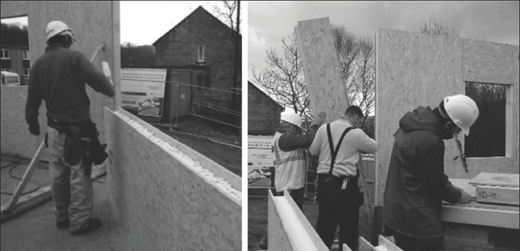
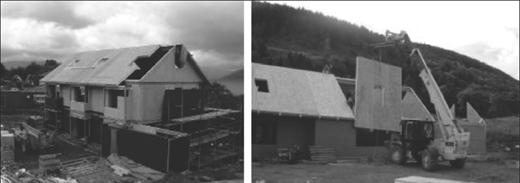
Structural insulated panels (SIPs) have been evolving quietly for 50 years. They offer structure, sheathing, insulation and airtightness in a single product. SIPs are structural composites with two outside skins normally of BS EN 3001 classification 3 oriented strand board (OSB/3) and a bonded rigid internal core of insulation. They are conventionally used for wall (Fig. 1) and roof construction (Fig. 2), although they can also be used in flooring systems.
Unlike stress skin panels that can be made by on-site skilled tradespersons, SIPs are manufactured off site and require quality-manufacturing standards to ensure that the product can perform as intended.2 There are two typical panel fabrication techniques.3
Adhesive is applied to a pre-cut foam core then the core is cold pressed between two facing boards.
Foam is poured into pre-spaced facings and the foam cures to bond the facings; this procedure is referred to as ‘autohesively bonded’.
They are also typically lightweight, although this is dependent on the outer skins, which facilitates on-site installation. As a result of the insulation being pre-installed, off-site SIPs tend not to suffer from
sagging insulation
wet insulation due to exposure on site which could reduce thermal performance
gaps and voids in insulation coverage left by poor site workmanship.
The most common insulating foam materials are
expanded polystyrene (EPS)
extruded polystyrene (XPS)
polyurethane.
The insulations are also very low density and as a result only small masses of the primary resource are needed to produce high levels of insulation. OSB is produced from fast-growing trees and forest thinning and recycled timber. In conjunction with this, if the OSB boards are autohesively bonded to the rigid urethane insulation core during the manufacturing process the requirement for potentially environmentally harmful adhesives is eliminated.
2. ENERGY EFFICIENCY
The environmental credentials of SIPs are not so much in the constituent materials, however, but rather in the potential energy efficiency of the building formed from them. The recent introduction of the revised Part L of the Building Regulations,4 in response to the EU Directive 2002/91/EC5 on energy performance of buildings, will lead to an improvement in the energy efficiency of buildings by around 20%. In terms of domestic dwelling construction, this will require the U-value (quantity of heat that will flow through unit area in unit time, per unit difference in temperature between the external and internal environment) of walls to be reduced to approximately 0·27 W/m2K.
Considering a typical external wall construction comprising SIPs with a core of autohesively bonded polyurethane finished with 12·5 mm plasterboard on timber battens and a brick outer leaf with a 50 mm vented cavity, an estimated U-value of between 0·19 and 0·22 W/m2K can be achieved, depending on the number and type of panels. This is above the required performance levels and is indeed perceived to be in excess of values required beyond 2010.
SIP panels also have a lower level of thermal bridging as a result of the reduced requirement for structural elements such as wall studs and lintels. For an SIP to function structurally it relies on the composite action between the skins and the core, a requirement of which is a robust bonding method. Extensive research at Napier University over the last few years has shown that when manufactured under appropriate conditions a suitably strong bond can be achieved.6
3. STRUCTURAL PERFORMANCE
The research has also evaluated the structural performance of SIPs in terms of vertical loading (direct compression), transverse wind loading (combined bending and compression), in-plane lateral forces (racking loads) and the effects of medium-term loading on the deformational characteristics (creep effects).6,7
The extensive experimental investigation at Napier University has demonstrated that SIPs perform as an effective composite material possessing considerable strength and stiffness and that the strength properties can be evaluated using the design rules of Eurocode58 by assuming a full composite action between the elements, albeit a conservative approach need be adopted in design analysis (Fig. 3). It was also demonstrated that with the addition of stiffening elements such as studs, the compression capacity can be further improved.6
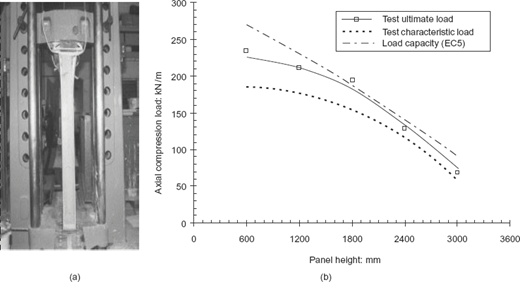
Chart for estimating direct compression capacity:6 (a) test set-up; (b) comparison of test and calculated results
Chart for estimating direct compression capacity:6 (a) test set-up; (b) comparison of test and calculated results
The combined bending and compression tests carried out showed that the SIPs tested had an improved performance when compared with design characteristic loads calculated in accordance with Eurocode 5.8 In terms of racking resistance SIPs again demonstrated that they were structurally more efficient when compared with stud walls of comparable make-up (Fig. 4).
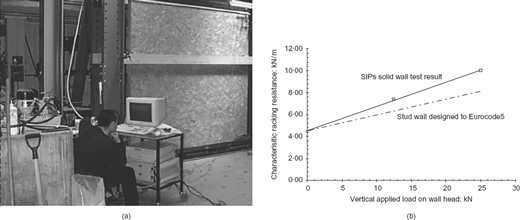
Characteristic racking strength of tested SIPs and of a stud wall of comparative framing material designed to EC5 Method B: (a) example of a test wall; (b) test results
Characteristic racking strength of tested SIPs and of a stud wall of comparative framing material designed to EC5 Method B: (a) example of a test wall; (b) test results
From a structural durability perspective the performance of SIPs subject to long-term loading was also evaluated. It was found that the creep effects under a series of normal to high loads (much higher than the normal intended loading) were negligible and that elastic recovery occurred after load removal. It was also noted from the long-term loading tests that no de-bonding (i.e. damage to glue-lines between polystyrene and OSB boards) or bulging of the boards took place.
In terms of longevity and continued structural performance there are SIP buildings in the USA which have been in service for 50 years. Therefore, the structural integrity of SIPs has been demonstrated both through testing and service as long as accredited manufacturing and erection methods are adhered to. There is, however, limited available information concerning buildings over three storeys which use SIPs as the structural load-bearing walls and as a result their application is limited somewhat to low-rise construction.
When considering SIP construction in residential dwellings for the UK, fire regulations will have to be adhered to. To achieve current fire regulations status the internal linings of the structure will require a class 0 (non-combustible) or class 1 (semi-combustible) lining depending on the size and occupancy of the building relative to the required fire protection. This can be achieved by providing one layer of 12·5 mm gypsum plasterboard to obtain class 1 and two layers to obtain a class 0 fire rating.
4. COST IMPLICATIONS
The added value of SIPs does tend to be at a cost, with SIPs generally costing 2–10% more than an insulated and sheathed wood frame. With wood framing, however, additional insulation requires deeper lumber dimensions or double framing; SIP insulation, by contrast, gets less expensive per unit volume as the panels get thicker, as the skins and manufacturing and installation process remain the same.9 It must also be noted that off-site application of insulation should result in reduced waste and an improved quality of product. Therefore, when high levels of insulation are required, SIPs are at an advantage in comparison with other forms of construction, although in terms of meeting current building regulation requirements they tend to be at a cost disadvantage.
5. SUMMARY
SIPs are a legitimate alternative to the traditional timber frame wall when considering low-rise construction and are also an ideal modern method of construction. SIPs have been proved to exhibit a level of structural robustness that meets and exceeds building regulation requirements. When considering the building envelope, they have improved environmental credentials in terms of insulation properties and can in fact deliver what are perceived to be thermal insulation ratings in excess of 2010 + requirements. SIPs are, however, more expensive than traditional forms of construction and are more geared towards future building regulation requirements, by which time modern technologies may result in more traditional forms of construction being able to compete in terms of thermal performance.

