

The ICEConstruction Materials journal will continue to publish six issues annually while broadening its scope to include both traditional and emerging construction materials, such as additive manufacturing (3D printing), bio-based building materials (3BM), fibre-reinforced polymer concrete (FRPC), ultra-high-performance concrete (UHPC), self-compacting concrete (SCC), geopolymer concrete, self-healing concrete, earthen materials, and the reuse of industrial by-products in concrete. The journal will continue to disseminate the latest research internationally to academia, industry, and other stakeholders.
This edition of Construction Materials in this issue presents a wide range of studies, including coral aggregate concrete, abrasion assessment using photogrammetry, biochar in concrete (Figure 1), UHPC with metakaolin and limestone or quartz powder, treated crumb rubber fly ash bricks, and natural fibre-reinforced concrete.
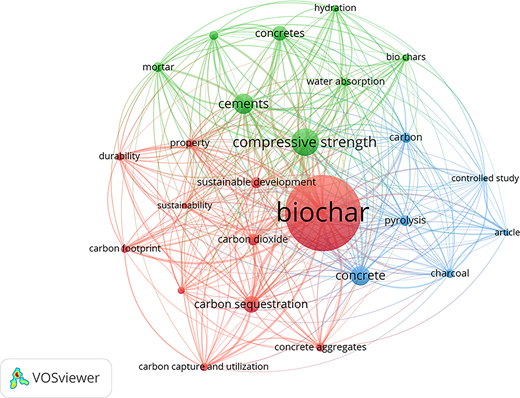
Network visualisation of some leading keyworks in biochar in concrete literature (Barbhuiya et al., 2026)
Network visualisation of some leading keyworks in biochar in concrete literature (Barbhuiya et al., 2026)
In the first paper reported by Lai et al. (2026), the study investigates seawater sea sand coral aggregate concrete (SSCAC) and highlights the role of wet packing density (WPD) in governing flowability and passing ability. The results show that incorporating limestone powder and crushed coral aggregate improves packing density, segregation resistance, and workability. A strong correlation between WPD and passing ability is established, providing a basis for optimised mix design. Overall, the study demonstrates that SSCAC can achieve satisfactory performance and sustainability for marine construction applications.
The second paper by Esmaeili et al. (2026) investigates the application of close-range photogrammetry for accurately measuring concrete abrasion. The study demonstrates that 3D modelling enables precise evaluation of cavity depth, profiles, and volume loss, achieving high accuracy compared to traditional methods. Results show improved reliability in abrasion assessment, with calculated wear volume remaining within standard limits, while also revealing additional insights such as depth variations and inter-cavity effects.
The third paper reported by Barbhuiya et al. (2026) reviews biochar as a sustainable concrete additive with potential to reduce carbon dioxide emissions while maintaining performance. The study concludes that biochar enhances strength and durability through internal curing, pore refinement, and improved hydration at optimal dosages. Its porous structure also reduces thermal conductivity and improves crack resistance. Furthermore, biochar enables long-term carbon sequestration, promoting sustainability, although standardisation and further long-term research are required for practical implementation.
The fourth paper by Zongyun Mo et al. (2026) investigated the influence of steel fibre (STF) content on the fresh, mechanical, durability, and microstructural properties of UHPC incorporating metakaolin with limestone or quartz powder. The study found that increasing fibre content reduces workability and air content but enhances compressive and flexural strength up to an optimal level (around 0.5% STF). In addition, fibre inclusion affects drying shrinkage, chloride permeability, and pore structure, with performance variations depending on whether limestone or quartz powder is used, highlighting the synergistic effects of supplementary materials in improving UHPC performance.
The fifth paper reported by Ankur Thakur et al. (2026) examines the feasibility of using crumb rubber as partial fine aggregate replacement in fly ash bricks, including NaOH-treated and untreated forms. The study evaluates mechanical, durability, and microstructural performance, showing strength reduction with higher rubber content but improved bonding with treatment. Optimum results occur around 12% replacement. Water absorption increases slightly, while efflorescence remains minimal. Overall, treated rubber enhances performance and sustainability with limited impact on cost and emissions.
The final paper in this issue by Kalyani et al. (2026) reports on experimental evaluation of pre-processing techniques to enhance natural fibre performance in concrete. Chemical treatments using sodium bicarbonate and sodium hydroxide improve fibre surface roughness, bonding, and durability. FTIR and SEM analyses confirm removal of hemicellulose and impurities, while reducing water absorption. Treated fibres exhibit improved interfacial adhesion and mechanical behaviour, offering a cost-effective and sustainable alternative to synthetic fibres in concrete applications.

