
Skip to article sections
Purpose

Previous studies on coworking spaces have mainly concentrated on location determinants and their effects on the immediate environment. Much of the research relies on data from developed countries, leaving a significant gap in user-centred perspectives in less-studied contexts, particularly before, during, and after COVID. This study aims to address this gap by examining the ranking for specific design attributes and exploring the underlying motivations for using coworking spaces in Windhoek, Namibia.

Design/methodology/approach

Self-administered questionnaires were sent to users of coworking spaces in Namibia, and the results were analysed using descriptive statistics and the Kruskal–Wallis and Mann–Whitney U tests.

Findings

The study found that affordable accommodation, a sense of community, a vibrant and creative atmosphere and the company’s professional appearance were the top motivations for using coworking spaces. Accessibility, digital accessibility and diversity in supply spaces are perceived as the most important attributes of coworking spaces in Namibia. Post hoc comparisons of the Kruskal–Wallis test revealed significant mean differences in ranked attributes for ordinary internet between the periods before and after the COVID-19 pandemic and between the periods during and after the pandemic.

Originality/value

Few studies have examined the influence of the period of use of coworking preferences (pre-, during and post-COVID) in a developing-country context.

Coworking spaces are subscription-based environments that facilitate collaborative work among individuals and teams from various organisations in a shared space. The business model is a variant of rental arbitrage in which coworking firms lease buildings from property owners under long-term, multi-year agreements. These firms enhance the spaces by incorporating common areas, cafes and other community-focused amenities, subsequently subleasing them to tenants at higher rates and with more flexible lease terms.

The tenants primarily comprised entrepreneurs, freelancers, remote workers and other independent or non-traditional workers unable to afford office space. Coworking not only provides workspace but also fosters a community of entrepreneurs who, while pursuing their ventures, collaborate in a shared environment (Bouncken and Reuschl, 2018; Orel and Bennis, 2021; Howell, 2022). Recent changes in work practices are attributed to the collaborative economy and emerging collaboration methods, which the shift towards hybrid working has further expedited, integrating in-office and remote work environments. There is growth in coworking spaces and their adoption by larger, more established companies.

Coworking spaces have been the subject of extensive research in the USA, various European countries (Rus and Orel, 2019), Asia (Bouncken and Reuschl, 2018; Bouncken et al., 2020a, 2020b; Chevtaeva, 2021; Chua et al., 2024) and Australia (Waters-Lynch and Potts, 2017; Halvitigali et al., 2019; Jackson et al., 2022). A limited number of studies offer insights into ranked attributes for physical workspace design. It remains uncertain whether these preferences vary between countries due to their single-country focus, except for Appel-Meulenbroek et al. (2021), which compares three European countries. Furthermore, there exists a paucity of studies that have collected data in developing countries. Zietsman (2019) in South Africa focused on sustainable building refurbishment and the application of lean construction principles. Lahti et al. (2022) examined coworking spaces in Namibia, contextualising cultural factors through a comparative case study with Finland. Adegoke and Comunian (2021) investigated factors influencing coworking in Nigeria, while Ayodele et al. (2022) analysed the characteristics of Nigerian coworking spaces from the perspective of space providers. Adewunmi-Abolarinwa (2024) examined the features and management of coworking spaces in Africa. No research has investigated the ranking of attributes of coworking spaces or the motivations for using them in Windhoek, Namibia.

A report by Allwork.Space (2022) indicated that 1,158 coworking spaces were operational in Africa in 2022, out of a global total of 27,000, suggesting significant growth potential in the sector. Offices in Windhoek, Namibia, are generally modern and align with international standards for physical amenities and technology, while also fostering diversity and inclusion, which is particularly important given the history of apartheid. Additionally, the workplace culture is more personal, with employees looking out for colleagues’ interests even outside the workplace, and places a distinctive emphasis on building strong relationships. The sector is influenced by a smaller economy and population and is set within a developing-country context (Master Southern Africa, 2024). Working in Namibia differs from that in other countries in that there is a strong preference for local labour, owing to population dynamics and the apartheid past, and a respect-based hierarchical corporate culture (Moima, 2017). Raunio and Andreas (2020) demonstrated that coworking spaces in Namibia can serve as hubs to promote the utilisation of technology, support youth entrepreneurial aspirations, eliminate geographical, political and income barriers, stimulate local start-ups and enhance cultural development.

This study aims to address the research question: What are the rankings of attributes and motivations of users of coworking spaces in Windhoek, Namibia? This study assumes that the motivations and rank attributes differ from those used by Appel-Meulenbroek et al. (2021). This study contributes to the literature in four ways. Firstly, it offers the first empirical analysis of coworking motivations and ranked design attributes in Namibia. Secondly, it confirms digital accessibility as a formal attribute, reflecting infrastructural realities in emerging markets. Third, it examines temporal differences across pre-, during- and post-COVID-19 periods (Cabral and van Winden, 2022; Orel et al., 2024), addressing how global disruptions reshape coworking preferences, understand shifts in coworking amenities, participation and design, inform strategic decisions about their future design and utilisation and ensure productivity (Orel et al., 2024). Finally, it applies neoclassical utility theory and Corporate Real Estate Management (CREM) principles to interpret user choices, bridging theoretical frameworks with practical design considerations. Neoclassical utility theory (NUT) and Corporate Real Estate Management (CREM) principles are highly relevant to coworking spaces because they provide a framework for analysing why users choose these spaces and how they fit within broader business strategies (Weijs-Perrée et al., 2019).

The study specifies that NUT explains how coworking users make trade-offs among attributes such as price, accessibility and internet quality under budgetary and infrastructural constraints. CREM explains how providers configure workplace resources (layout, atmosphere, services and lease structures) to create value. Together, these lenses link user utility optimisation with workplace value creation, supporting the study’s contribution to bridging theory and design.

Therefore, this study aims to address the following research questions (RQs):

RQ1.

What are the top motivations influencing the use of coworking spaces in Windhoek, Namibia?

RQ2.

What are the most important attributes influencing the choice of coworking spaces in Namibia?

RQ3.

How do preferences for coworking space attributes differ across the periods before, during, and after the COVID-19 pandemic?

RQ1 explores motivations for coworking spaces, while RQ2 examines the ranked importance of their attributes using descriptive statistics (Table 3). In contrast, RQ3 investigates differences in preferences for coworking space features across different COVID-19 periods and requires five hypotheses (H1–H5) for inferential statistical analysis. This structure effectively ties the descriptive nature of RQ1 and RQ2 to the confirmatory approach of RQ3, with insights from the literature review laying the groundwork for understanding changes in user preferences for coworking spaces in Windhoek, Namibia.

This study integrates NUT and CREM to explain coworking preferences. NUT highlights rational choices under constraints such as affordability, accessibility and digital connectivity (Hodgson, 2025; Munien and Telukdarie, 2024; Lahti et al., 2022). CREM emphasises design and service qualities – layout, atmosphere, hospitality and tenant diversity – as value-creation mechanisms (van der Voordt, 2017; Wijnja et al., 2021; Appel-Meulenbroek et al., 2021). Integrating these frameworks clarifies needs, motivations and preferences (Rådman et al., 2023), offering a comprehensive perspective for developing-country contexts.

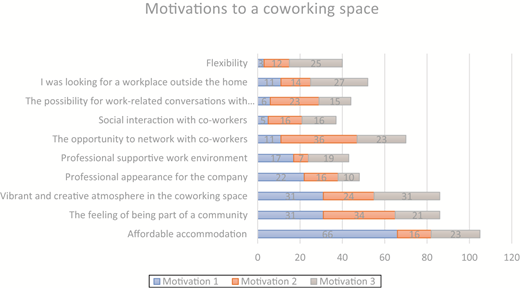
Affordability (a key resource constraint), alongside accessibility, lease flexibility and digital connectivity was derived from NUT as a set of utility-maximising factors influencing workspace choice (Appel-Meulenbroek et al., 2021). In contrast, atmosphere, hospitality, professional image, workplace quality, and tenant diversity were derived from CREM as key workplace design value-creation attributes that enhance user experience and organisational performance (Fuzi, 2015; Bouncken et al., 2020a, 2020b). These attributes are detailed in Table 3 and Figure 1, which show how design factors such as flexibility and atmosphere shape preferences (van der Voordt, 2017).

Integrating both frameworks reveals coworking choices as shaped by economic rationality and strategic resource management. Needs, motivations and preferences are clarified: affordability and connectivity are needs; networking and flexibility are motivations; ranked attributes such as atmosphere or lease terms are preferences (Rådman et al., 2023). This distinction deepens understanding of coworking behaviour. Reflecting on Namibia’s context, the study shows how rational cost considerations intersect with design-driven motivations, offering a comprehensive view of coworking selection.

The motivations examined are grounded in prior coworking research (Appel-Meulenbroek et al., 2021; Zhao et al., 2020; Christino et al., 2022) and interpreted through NUT and CREM. Affordability reflects utility maximisation, while networking and community reflect both social utility (NUT) and workplace value creation (CREM), linking economic constraints to social and spatial design factors.

The consistent and growing demand for coworking spaces reflects their resilience in both expanding and contracting economies. During economic downturns, rising unemployment often pushes previously stable workers toward self-employment or flexible work arrangements (Merkel, 2023). Governments may also promote entrepreneurship to stimulate growth and job creation, making coworking spaces attractive to both public and private sectors (Luo and Chan, 2020).

People are drawn to coworking spaces for various reasons, including flexible access to office and social environments, opportunities for direct interaction and support for social, learning, cultural and business-related activities (Ayodele et al., 2021). Many appreciate bundled service offerings, such as conference rooms, events and training, delivered through a space-as-a-service model (Appel-Meulenbroek et al., 2021). Table 1 presents studies on the motivations for coworking spaces across countries. Exploring the top motivations in Namibia will be particularly interesting.

Collaboration motivates coworking in Australia (Waters-Lynch and Potts, 2017; Zhao et al., 2020), the USA (Yang et al., 2019) and Brazil (Christino et al., 2022). Spatial arrangements matter in Europe (Appel-Meulenbroek et al., 2021) and Nigeria (Ayodele et al., 2022), while social aspects are emphasized in the USA (Yang et al., 2019), Australia (Zhao et al., 2020), the UK (Clifton et al., 2022) and Brazil (Christino et al., 2022). Creativity emerges in Europe (Appel-Meulenbroek et al., 2021) and the USA (Yang et al., 2019). Managerial approaches shape collaboration (Romeo et al., 2024). Whether Namibia aligns or diverges remains uncertain, warranting examination using Appel-Meulenbroek et al.’s (2021) approach.

Identifying the key characteristics of coworking spaces that align with user preferences is essential. Waters-Lynch and Potts (2017) noted that coworking spaces differ from other shared office models primarily in visual design, despite the prevalence of many hybrids between coworking spaces and other business centre models. While serviced offices are typically located in modern buildings (Weijs-Perrée et al., 2016), coworking spaces may occupy diverse structures, including industrial warehouses and refurbished factories (Deskmag, 2016; Gertner and Mack, 2017). This diversity results in more varied exterior and interior designs (Bouncken et al., 2020a), making atmosphere and interior aesthetics a relevant attribute to consider in this study

Most coworking spaces are situated in accessible locations (Chua et al., 2024), although remote and rural options also exist (Bouncken et al., 2020b; Vogl and Micek, 2023). Accessibility and layout considerations may differ in developing economies (Ayodele et al., 2022; Adewunmi-Abolarinwa, 2024). Therefore, accessibility (by car and public transport) constitutes is a critical attribute influencing the choice of coworking spaces in developing countries. The layout of space also influences user experience, with open-plan designs encouraging interaction (Bacevice and Spreitzer, 2023; Kinsman et al., 2024b). Many coworking spaces offer a mix of open areas, private offices, phone booths and meeting rooms (Bouncken et al., 2021). Newer designs incorporate informal zones and event spaces (Kojo and Nenonen, 2016; Bouncken et al., 2022).

In addition, they may offer extra leisure and well-being services, such as recreational facilities and guided sports activities (Cabral and van Winden, 2022). Coworking spaces support various mediation activities by organising events that use spatial mechanisms (Bouncken and Aslam, 2021) and digital tools (Rese et al., 2020). Events and teamwork are group activities that foster interaction and participation in particular endeavours (Waters-Lynch and Potts, 2017; Romeo et al., 2024).

Growth and market placement are significant tasks for those managing coworking spaces (Bouncken et al., 2018; Gauger et al., 2020; Gregg and Lodato, 2018; Orel et al., 2023). In addition, this exploitation demands the presence of a reception and other hospitality measures (Merkel et al., 2024). Additionally, coworking spaces provide their clients with reasonably priced digital access (Luo and Chan, 2020). Digital accessibility is an increasingly preferred attribute in coworking spaces (Ayodele et al., 2022). Other attributes include the diversity of tenants and the lease agreement. Fiorentino (2024) demonstrated that brief contracts are a prevalent feature of coworking spaces. Longer contracts are also possible, and some companies even operate without contracts (Durante and Turvani, 2018).

Preferences for these attributes (in italics) may vary across countries and timeframes. While some studies have explored personal characteristics such as age and gender (Haynes et al., 2017; Bae et al., 2020; Baranski et al., 2023), few have considered the ranking of attributes (RQ2) and timeframe differences (pre-, during- and post-COVID), in Namibia, addressed in RQ3.

Coworking spaces increasingly serve as talent hubs, facilitating access to skilled professionals and fostering community building (Orel et al., 2023). This dimension is particularly relevant in preferences for coworking spaces and appears relatively consistent globally. Contextual factors, such as Namibia’s socio-economic conditions, cultural emphasis on community and infrastructural constraints (e.g. digital access), may produce unique patterns. Addressing these gaps contributes to a more nuanced understanding of coworking in developing economies.

Based on the literature, this study hypothesises as follows:

H1.

There are no significant differences in users’ preferences for accessing coworking spaces by car and public transport across the pre-COVID, during COVID and post-COVID periods.

H2.

There are no significant differences in users’ preferences for digital accessibility features in coworking spaces across the pre-COVID, during COVID and post-COVID periods.

H3.

There are no significant differences in users’ preferences regarding coworking space layouts across pre-COVID, during COVID and post-COVID periods.

H4.

There are no significant differences in users’ preferences for coworking spaces with reception services and active hosts across the pre-COVID, during COVID and post-COVID periods.

H5.

There are no significant differences in users’ preferences for coworking spaces offering lease agreements versus no-contract options across pre-COVID, during COVID and post-COVID periods.

The study was conducted in Windhoek, Namibia’s administrative capital, which has the highest concentration of offices in the country. It aimed to analyse coworking space preferences across user categories using a positivist epistemological stance to ensure methodological rigour and objectivity. A cross-sectional survey was conducted using a structured questionnaire that included a ranked-choice question adapted from a stated-choice experiment by Appel-Meulenbroek et al. (2021). Given the absence of an official register of coworking spaces at the time of data collection, coworking sites were identified through a structured reconnaissance process. A total of 16 spaces representing most of the Windhoek market were identified through a field survey conducted between July and September 2022. The identification process proceeded in three stages. Firstly, an initial inventory of coworking spaces was compiled using local business directories, online mapping and search platforms (e.g. Google Maps), as well as entrepreneurship networks and referrals. Secondly, each candidate site was physically visited to verify that it met the study’s inclusion criteria: provision of shared workspace accessible to independent users, availability of flexible access or membership arrangements and multi-tenant usage, as distinct from single-organisation offices. Thirdly, site managers were approached to obtain permission to administer on-site questionnaires and to determine appropriate periods for data collection. Six typologies of coworking spaces were identified and included in the study: public spaces, third places/cafés, collaboration hubs, coworking hotels, incubators and shared studios (Weijs-Perrée et al., 2019).

The authors conducted a survey of coworking space users by distributing a hard-copy questionnaire to participants. The participants completed the survey on site while using these spaces. The questionnaire was pretested with 10 tenants of coworking spaces, the pretest affirmed the suitability of the questions without changes. Of 244 questionnaires sent, 212 were returned, yielding an 88% response rate. Informed written consent was obtained from all participants, and respondents’ demographic details are presented in Table 2.

Participants were recruited on-site using convenience intercept sampling technique. Users present in the coworking spaces during data-collection visits were invited to participate, after which informed written consent was obtained (Atiku and Ganiyu, 2022). The survey was completed and returned on-site, which explains the high response rate. Four questionnaires contained limited missing values; these were handled using group-specific median imputation before non-parametric analysis, while fully blank questionnaires were excluded from further analysis.

The questionnaire focused on assessing the attributes of coworking spaces in Windhoek, Namibia, using nine attributes adapted from Appel-Meulenbroek et al. (2021). These attributes included accessibility, digital accessibility, atmosphere and interior aesthetics, layout of space, diversity in supply spaces, reception and hospitality, events, diversity of tenants and lease contract. Each attribute was measured at three distinct levels (see Table 3). Each attribute was evaluated at three distinct quality levels, and respondents ranked the attributes from 1 to 9 in terms of importance, with 1 indicating the highest importance. Additionally, respondents identified their top three motivations (1–3) for choosing coworking spaces (Figure 1), using options adapted from Appel-Meulenbroek et al. (2021).

Data analysis included descriptive and inferential statistics such as the Kruskal–Wallis H test and Mann–Whitney U test. The non-parametric nature of this test is well-suited to analysing ordinal data that do not meet the basic assumptions of parametric tests such as ANOVA (Okoye and Hosseini, 2024). Post hoc analysis was conducted using the Mann–Whitney U test (Nguyen et al., 2025), which is essential for determining specific pairwise differences in user preferences following significant overall findings from the Kruskal–Wallis test. The results of descriptive analyses include simple percentages, means and standard deviations. The reliability of the 27-item instrument was assessed using Cronbach’s alpha, which yielded 0.698, indicating acceptable internal consistency. Findings were interpreted through the analytical lenses of NUT and CREM, reflecting dominant decision logics. NUT-related attributes are identified when behaviour reflects rational optimisation, whereas CREM-related attributes arise when decisions are shaped by institutional constraints, path dependencies and adaptive workplace practices.

As indicated in Table 2, 55.7% of the sample were female. Judging from the mean, the average age of users was 30 years. By race, 67.5% were Black. Most respondents held higher education qualifications, with 54.7% holding bachelor’s degrees. Regarding employment status, 29.7% were self-employed and 29.2% worked in small companies (2–10 employees). Income levels varied, with 53.3% earning less than N$400,000.00 annually. Regarding the usage period, 53.7% began using coworking spaces before the COVID-19 pandemic. Regarding transportation, 53.7% used cars to access coworking spaces.

The analysis of motivations for coworking spaces indicates that the primary motivations were affordable accommodation, opportunities to network and a vibrant, creative atmosphere. A preference for affordable accommodation may be due to the respondents’ economic backgrounds. Workers in Namibia exhibit a culture that emphasises community orientation (Lahti et al., 2022). Many users of these spaces come from diverse backgrounds, including consulting, which requires creativity. The least frequently cited factors included a professional supportive environment, social interaction with co-workers, work-related conversations and flexibility.

Table 3 presents the ranking of coworking space attributes based on user preferences. The top three attributes were accessibility (mean of 2.41), digital accessibility (mean of 3.54), and atmosphere and interior aesthetics (mean of 3.89). The least important attributes were events, diversity of tenants, lease contracts and diversity in supply spaces.

Further analysis of attribute-level preferences (Table 4) reveals that accessibility by car (x̄ = 1.43, SD = 0.696) was most preferred, followed by accessibility by car and public transport (x̄ = 2.05, SD = 0.619), highlighting the importance of private transport (Nwagbara and Iyama, 2019). Fast internet speed (x̄ = 1.37, SD = 0.717) and average internet speed (x̄ = 2.06, SD = 0.536) were also highly valued, highlighting the significance of digital access in Namibia (Keskinen et al., 2022; Lahti et al., 2022).

An analysis of ranked attributes of coworking spaces across different periods used the Kruskal–Wallis H test, revealing several significant differences (Table 5).

H1a. **Accessibility by Car**: A significant difference was found (χ2 (2) = 6.324, p = 0.042) with mean rank scores of 183.03 (before COVID-19), 198.27 (during COVID-19), and 209.72 (after COVID-19). Post hoc analysis revealed a significant difference between the pre- and post-COVID-19 periods (mean rank increase of 26.69; p = 0.013). This suggests that the choice of coworking space is influenced by car travel during and after the pandemic. This shift suggests that choice based on access by car has changed after the pandemic (Bruwer and Anderson, 2022). Car travel behaviour in Windhoek is comparable to other African cities and is driven by social status and security within fragmented and unreliable transport systems (Nuuyandja et al., 2025).

H1b. **Accessibility by Public Transport**: Significant differences were noted (χ2 (2) = 7.101, p = 0.029) with mean ranks of 201.69 (before), 201.13 (during) and 172.82 (after). The Mann–Whitney U test revealed a significant mean difference between the pre-COVID-19 and post-COVID-19 periods (mean rank decrease of 28.87, p = 0.011). The results suggest that coworking preference is significantly based on public transport accessibility before the COVID-19 pandemic, compared to after the pandemic and even reduced during the pandemic.

H2. **Ordinary Internet**: A significant difference was observed (χ2 (2) = 13.095, p = 0.001) with mean ranks of 202.39 (before), 209.49 (during) and 165.62 (after). Post hoc comparisons revealed significant mean differences between before and after (mean rank decrease of 36.77; p = 0.001) and between, during and after the pandemic (mean rank decrease of 43.87; p = 0.003). These findings suggest that choice based on ordinary internet was reduced after the pandemic, compared to their preferences before and during the pandemic, with the highest preference during the pandemic. There was a greater preference for digital solutions during the pandemic (Innstrand et al., 2022). People in developing countries experience more severe constraints on digital access than their counterparts in developed countries, which, in turn, drives a stronger preference for coworking spaces that provide superior connectivity (Ayodele et al., 2022).

H3. **Closed Layouts**: A significant difference was found (χ2 (2) = 9.752, p = 0.008) with mean ranks of 204.43 (before), 199.34 (during) and 168.94 (after). The Mann–Whitney U test revealed a significant difference in mean rank between the pre-COVID-19 and post-COVID-19 periods (mean rank decrease of 35.49; p = 0.002). The results suggest that users exhibited a significantly greater preference for closed layouts before COVID-19 than during and after the pandemic. This shift confirms the global trend of having a more mobile workforce and reduced office usage (Barath and Schmidt, 2022).

H4. **Reception and Active Hosting**: Significant differences were observed (χ2(2) = 12.480, p = 0.002), with mean ranks of 84.81 (before), 225.82 (during) and 187.00 (after). Post hoc analysis showed significant mean differences between before and during (mean rank increase of 141.01, p = 0.001) and during and after (mean rank decrease of 38.82, p = 0.005). These findings suggest that users significantly preferred receptions with active hosts during the pandemic, compared with both the pre- and post-pandemic periods, indicating a need for interaction.

H5. **Lease Contracts**: Significant differences were observed for no contract (H5a) (χ2 (2) = 17.634, p = 0.001), short-term contract (H5b) (χ2 (2) = 14.203, n = 387, p = 0.001), and long-term contract (H5c) (χ2 (2) = 11.878, p = 0.003). For no contract, mean ranks were 211.92 (before), 186.38 (during) and 164.06 (after), with significant differences between before and during (mean rank decrease of 25.54, p = 0.038) and before and after (mean rank decrease of 47.86, p = 0.001). The results suggest that users significantly prefer no-contract arrangements before COVID-19 than during and after the pandemic, and thus prefer longer, more formal stays at coworking spaces, indicating growing confidence in such spaces.

H5c. **Long-term Contracts**: Long-term contracts showed mean ranks of 176.84 (before), 205.38 (during) and 216.31 (after), with significant differences between before and during (mean rank increase of 28.54, p = 0.027) and before and after (mean rank increase of 39.47, p = 0.001). These findings suggest that users exhibit significantly higher preferences for long-term contracts during and after the pandemic. The reason for this shift could be to seek more stable lease terms and requires further investigation.

These findings indicate a shift in user preferences for coworking spaces before, during and after the pandemic, highlighting increased emphasis on car access and a greater focus on long-term contracts post-pandemic. In contrast, preferences for public transport and ordinary internet decreased.

The findings of this study provide important insights into coworking motivations in a developing-country context and demonstrate the explanatory strength of integrating NUT and CREM. Affordability reflects NUT-driven utility maximisation under financial constraints, as users prioritise cost efficiency in workspace selection. Community and networking reflect both social utility (NUT) and workplace value creation (CREM), while a creative atmosphere and professional image reflect CREM design values and enhance opportunities and income potential consistent with NUT principles.

The prominence of affordability strongly aligns with NUT, which posits that individuals make rational choices under resource constraints (Hodgson, 2025; Munien and Telukdarie, 2024). Users prefer coworking spaces as cost-effective alternatives to traditional offices, reflecting the need to minimise operational costs while maintaining productivity. This finding aligns with evidence from Europe (Netherlands, Germany and the Czech Republic) (Appel-Meulenbroek et al., 2021) and Nigeria (Ayodele et al., 2022), where affordability is a key driver of coworking adoption. However, in Namibia, where economic and infrastructural constraints are more pronounced, this behaviour reflects stronger utility-maximisation tendencies, thereby extending NUT to developing contexts.

Networking and a sense of community further highlight the combined relevance of NUT and CREM. From a NUT perspective, social interaction enhances indirect utility by improving access to knowledge, opportunities and professional support, thereby supporting productivity and income generation. From a CREM perspective, community represents a central mechanism of workplace value creation, enhancing satisfaction, collaboration and belonging (Garrett et al., 2017; Bouncken et al., 2020a, 2020b). This double interpretation aligns with findings across Australia (Waters-Lynch and Potts, 2017), the USA (Zhao et al., 2020) and Brazil (Christino et al., 2022), where collaboration is a key motivation. The stronger emphasis on community in Namibia suggests that socio-cultural dynamics reinforce CREM-driven workplace values more strongly than in some developed contexts.

The importance of a vibrant and creative atmosphere is primarily explained through CREM, which emphasises the role of spatial and experiential design in enhancing workplace value and performance (van der Voordt and Jensen, 2023; Wijnja et al., 2021). Coworking environments that provide stimulating and aesthetically engaging spaces contribute to creativity, identity and job satisfaction. This finding aligns with studies from European countries (The Netherlands, Germany and the Czech Republic) (Appel-Meulenbroek et al., 2021) and broader international contexts (Echeverri et al., 2021), where inspiring environments are key drivers of adoption. In this study, creative atmosphere demonstrates how spatial design translates into perceived workplace value. Similarly, professional image reflects core CREM principles associated with organisational performance and external stakeholder perception. Coworking spaces enable users to project a professional identity through high-quality environments, enhancing credibility and legitimacy (Gauger et al., 2020; van der Voordt, 2017). Concurrently, this motivation aligns with NUT, as improved professional environments are associated with increased income potential and business opportunities.

The relatively low flexibility and social interaction suggests important contextual variation. While these factors are often prominent in European studies (Appel-Meulenbroek et al., 2021), their reduced importance in Namibia indicates that more fundamental constraints. Particularly, affordability and infrastructural constraints play a dominant role in shaping decision-making. From a NUT perspective, this pattern reflects prioritisation of core utility-maximising attributes. In contrast, from a CREM perspective, workplace value is predominantly derived from stability and core functional attributes rather than from flexibility alone.

This study integrates these theoretical lenses to demonstrate that coworking motivations are shaped by both economic rationality (NUT) and workplace value creation (CREM). The findings not only confirm key NUT predictions but also extend the framework by revealing the heightened significance of cost and infrastructural constraints in developing countries. Similarly, while confirming core CREM principles, the results advance the framework by highlighting the significant role of socio-cultural dynamics. This integrated perspective strengthens and deepens the study’s theoretical contribution.

This study makes an original contribution to coworking research by presenting one of the first empirical analyses of user motivations and ranked design attributes in Namibia. It explores temporal differences across the pre-, during- and post-COVID periods. By applying NUT and CREM principles, the study bridges theoretical frameworks with practical design considerations. These contributions advance understanding of coworking dynamics in resource-constrained environments and offer actionable insights for operators, policymakers and scholars seeking to adapt coworking models to developing-country contexts.

The study’s findings can inform strategies to enhance stakeholder value in coworking spaces, thereby promoting customer loyalty. From a CREM perspective, the identified preferences can inform sourcing decisions, aid location selection and provide insights into employee comfort across various workplace settings (Appel-Meulenbroek et al., 2021). Developers and investors will find pertinent information regarding the design and delivery of spaces that address the needs of a wider demographic, informed by the specific temporal context. User preferences for spaces fluctuate over time, subsequently impacting business continuity.

Practical recommendations for coworking operators emphasise aligning spaces with user preferences and maintaining affordable pricing. Community-oriented layouts with central hubs and flexible furniture should be adopted. Flexible lease options address post-COVID demand for longer agreements. Operators should host networking events, promote diversity, support underprivileged groups and implement anti-discrimination codes aligned with Namibia’s cultural values. Adequate parking, reliable high-speed internet, modern designs and diverse suppliers are essential to enhance inclusivity, functionality and the sustainability of coworking spaces.

The study also highlights differences in global trends: while some developed countries prefer short-term leases and hostless receptions, Namibian users prefer longer-term contracts and hosted receptions. In the post-pandemic period, the preference for stability has intensified, necessitating managerial adaptation to ensure long-term sustainability.

Methodologically, the study used a ranking approach rather than stated-choice experiments, as used in some prior models, thereby eliminating trade-offs between attributes and levels, which tends to select the highest quality levels. This approach may lead respondents to select the highest-quality levels, potentially influencing costs. Future studies could incorporate additional sustainability-related attributes and broader geographic coverage to improve generalisability. Limitations include the single-city focus and reliance on convenience sampling, which restrict external validity. Future research should employ more robust sampling techniques to account for potential random or environmental factors. Also, longitudinal studies examining coworking space lease trends in Namibia can be conducted.

The authors would like to acknowledge the input of Prof Rianne Appel-Meulenbroek in developing the paper.
Adegoke
,
D.
and
Comunian
,
R.
(
2021
), “
Creative Coworking in Nigeria: emerging trends, opportunities and future scenarios
”,
Developing Creative Economies in Africa
, pp.
57
-
73
.
Adewunmi-Abolarinwa
,
Y.
(
2024
),
Work Productivity in Strategic and Sustainable Management of Workplace Facilities
,
Taylor & Francis
.
Allwork.Space
(
2022
), “
The growing coworking industry is revitalizing communities in Africa
”,
Allwork.Space
[online],
available at:
Link to The growing coworking industry is revitalizing communities in AfricaLink to the cited article (
accessed
6 August 2024).
Appel-Meulenbroek
,
R.
,
Weijs-Perrée
,
M.
,
Orel
,
M.
,
Gauger
,
F.
and
Pfnür
,
A.
(
2021
), “
User preferences for coworking spaces; a comparison between The Netherlands, Germany and the Czech Republic
”,
Review of Managerial Science
, Vol.
15
No.
7
, pp.
2025
-
2048
.
Atiku
,
S.O.
and
Ganiyu
,
I.O.
(
2022
), “
Flexible work options in higher educational institutions in times of crisis
”,
SA Journal of Human Resource Management
, Vol.
20
, pp.
1
-
10
, doi: .
Ayodele
,
T.O.
,
Ogunbayo
,
O.T.
,
Kajimo-Shakantu
,
K.
and
Babatunde
,
T.
(
2022
), “
Coworking space practices: assessing space users’ preferences and challenges in Ibadan, Nigeria
”,
Journal of Corporate Real Estate
, Vol.
24
No.
4
, pp.
256
-
272
.
Bacevice
,
P.A.
and
Spreitzer
,
G.M.
(
2023
), “
‘It’s like, instant respect’: coworking spaces as identity anchoring environments in the new economy
”,
New Technology, Work and Employment
, Vol.
38
No.
1
, pp.
59
-
81
.
Bae
,
S.
,
Asojo
,
A.O.
and
Martin
,
C.S.
(
2020
), “
Impact of occupants’ demographics on indoor environmental quality satisfaction in the workplace
”,
Building Research and Information
, Vol.
48
No.
3
, pp.
301
-
315
.
Baranski
,
E.
,
Lindberg
,
C.
,
Gilligan
,
B.
,
Fisher
,
J.M.
,
Canada
,
K.
,
Heerwagen
,
J.
, …
Mehl
,
M.R.
(
2023
), “
Personality, workstation type, task focus, and happiness in the workplace
”,
Journal of Research in Personality
, Vol.
103
, p.
104337
.
Barath
,
M.
and
Schmidt
,
D.A.
(
2022
), “
Offices after the COVID-19 pandemic and changes in perception of flexible office space
”,
Sustainability
, Vol.
14
No.
18
, p.
11158
.
Bouncken
,
R.
,
Ratzmann
,
M.
,
Barwinski
,
R.
and
Kraus
,
S.
(
2020
a), “
Coworking spaces: empowerment for entrepreneurship and innovation in the digital and sharing economy
”,
Journal of Business Research
, Vol.
114
, pp.
102
-
110
.
Bouncken
,
R.B.
and
Reuschl
,
A.J.
(
2018
), “
Coworking-spaces: how a phenomenon of the sharing economy builds a novel trend for the workplace and for entrepreneurship
”,
Review of Managerial Science
, Vol.
12
No.
1
, pp.
317
-
334
.
Bouncken
,
R.B.
,
Aslam
,
M.M.
and
Qiu
,
Y.
(
2021
), “
Coworking spaces: understanding, using, and managing sociomateriality
”,
Business Horizons
, Vol.
64
No.
1
, pp.
119
-
130
.
Bouncken
,
R.B.
,
Kraus
,
S.
and
Martínez-Pérez
,
J.F.
(
2020
b), “
Entrepreneurship of an institutional field: the emergence of coworking spaces for digital business models
”,
International Entrepreneurship and Management Journal
, Vol.
16
No.
4
, pp.
1465
-
1481
.
Bouncken
,
R.B.
,
Lapidus
,
A.
and
Qui
,
Y.
(
2022
), “
Organizational sustainability identity:‘new work’of home offices and coworking spaces as facilitators
”,
Sustainable Technology and Entrepreneurship
, Vol.
1
No.
2
, p.
100011
.
Bruwer
,
M.M.
,
Andersen
,
S.J.
(
2022
), “
The impact of the COVID-19 pandemic on urban movement: using floating car data to analyse road-based traffic patterns
”, In:
Proceedings of the 41st Southern African Transport Conference (SATC 2022)
,
Pretoria, South Africa
,
4–7 July 2022
,
University of Pretoria
,
Pretoria
, available at: Link to The impact of the COVID-19 pandemic on urban movement: using floating car data to analyse road-based traffic patternsLink to the cited article
Cabral
,
V.
and
van Winden
,
W.
(
2022
), “
The reaction of coworking spaces to the COVID-19 pandemic. A dynamic capabilities perspective
”,
Service Business
, Vol.
16
No.
2
, pp.
257
-
281
.
Chevtaeva
,
E.
(
2021
), “
Coworking and coliving: the attraction for digital nomad tourists
”, In
Information and Communication Technologies in Tourism 2021: Proceedings of the ENTER 2021 eTourism Conference, January 19–22, 2021
.
Springer International Publishing
, pp.
202
-
209
.
Christino
,
J.M.M.
,
Cardozo
,
É.A.A.
,
Petrin
,
R.
,
Carrieri
,
A.D.P.
and
Silva
,
J.O.
(
2022
), “
Understanding the adoption of coworking spaces
”,
International Journal of Services and Operations Management
, Vol.
42
No.
3
, pp.
315
-
338
.
Chua
,
S.J.L.
,
Myeda
,
N.E.
,
Azmi
,
N.F.
and
Wong
,
C.W.
(
2024
), “
Ascendancy of coworking space: user perceptions toward workspace features
”,
Journal of Corporate Real Estate
, Vol.
27
No.
3
, pp.
452
-
466
.
Clifton
,
N.
,
Füzi
,
A.
and
Loudon
,
G.
(
2022
), “
Coworking in the digital economy: context, motivations, and outcomes
”,
Futures
, Vol.
135
, p.
102439
.
Deskmag
(
2016
), “
2016 coworking forecast: global coworking survey results
”,
Deskmag
[online],
available at:
Link to 2016 coworking forecast: global coworking survey resultsLink to the cited article (
accessed
6 August 2024).
Durante
,
G.
and
Turvani
,
M.
(
2018
), “
Coworking, the sharing economy, and the city: which role for the ‘coworking entrepreneur’?
”,
Urban Science
, Vol.
2
No.
3
, p.
83
.
Echeverri
,
N.
,
Jylhä
,
T.
and
Koppels
,
P.
(
2021
), “
Searching for flexibility in corporate real estate portfolio: Six coworking strategies for user corporations
”,
Buildings
, Vol.
11
No.
3
, p.
115
.
Fiorentino
,
S.
(
2024
), “
Are shared workspaces a new form of social infrastructure?
”,
Planning Practice and Research
, Vol.
39
No.
5
, pp.
1
-
14
.
Fuzi
,
A.
(
2015
), “
Coworking spaces for promoting entrepreneurship in sparse regions: the case of South Wales
”,
Regional Studies, Regional Science
, Vol.
2
No.
1
, pp.
462
-
469
.
Garrett
,
L.E.
,
Spreitzer
,
G.M.
and
Bacevice
,
P.A.
(
2017
), “
Co-constructing a sense of community at work: the emergence of community in coworking spaces
”,
Organization Studies
, Vol.
38
No.
6
, pp.
821
-
842
.
Gauger
,
F.
,
Voll
,
K.
and
Pfnür
,
A.
(
2020
), “
Corporate coworking spaces–determinants of work satisfaction in flexible workspaces
”,
Future Workspaces
, Vol.
162
.
Gertner
,
D.
and
Mack
,
E.A.
(
2017
), “
The entrepreneurial orientation (EO) of incubators, accelerators, and co-working spaces
”,
International Journal of Regional Development
, Vol.
4
No.
2
, pp.
1
-
14
.
Girija
,
S.
,
Sharma
,
D.R.
,
Yeediballi
,
T.
and
Sriramneni
,
C.
(
2024
), “
Factors influencing the intention to use coworking spaces in emerging markets: an analytic hierarchy process approach
”,
Property Management
, Vol.
42
No.
2
, pp.
235
-
255
.
Gregg
,
M.
and
Lodato
,
T.
(
2018
), “Managing community: coworking, hospitality and the future of work”, In
Affect in Relation
,
Routledge
, pp.
175
-
196
.
Halvitigali
,
D.
,
Antoniades
,
H.
and
Eves
,
C.
(
2019
),
Coworking: The New Design of Workplaces
,
AUBEA
.
Haynes
,
B.
,
Suckley
,
L.
and
Nunnington
,
N.
(
2017
), “
Workplace productivity and office type: an evaluation of office occupier differences based on age and gender
”,
Journal of Corporate Real Estate
, Vol.
19
No.
2
, pp.
111
-
138
.
Hodgson
,
G.M.
(
2025
), “
On the meaning of “neoclassical economics
”,
Journal of Economic Issues
, Vol.
59
No.
4
, pp.
1070
-
1083
.
Howell
,
T.
(
2022
), “
Coworking spaces: an overview and research agenda
”,
Research Policy
, Vol.
51
No.
2
, p.
104447
.
Innstrand
,
S.T.
,
Christensen
,
M.
,
Grødal
,
K.
and
Banks
,
C.
(
2022
), “
Within-and between-person changes in work practice and experiences due to COVID-19: lessons learned from employees working from home, hybrid working, and working at the office
”,
Frontiers in Psychology
, Vol.
13
, p.
948516
.
Jackson
,
D.
,
Shan
,
H.
and
Meek
,
S.
(
2022
), “
Enhancing graduates’ enterprise capabilities through work-integrated learning in coworking spaces
”,
Higher Education
, Vol.
84
No.
1
, pp.
101
-
120
.
Keskinen
,
P.
,
Winschiers‐Theophilus
,
H.
,
Chivuno‐Kuria
,
S.
,
Müller
,
A.
and
Nieminen
,
M.
(
2022
), “
Digital microwork as a livelihood strategy in a Namibian informal settlement
”,
The Electronic Journal of Information Systems in Developing Countries
, Vol.
88
No.
1
, p.
e12197
.
Kinsman
,
L.
,
Bilevicius
,
E.
,
Shamblaw
,
A.L.
,
Alcolado
,
G.
and
Furer
,
P.
(
2024
a), “
Group cognitive-behavioral therapy for perinatal anxiety: predictors of completion and response
”,
Current Psychology
, Vol.
43
No.
6
, pp.
5419
-
5427
.
Kinsman
,
N.
,
Marris
,
N.
and
Oakman
,
J.
(
2024
b), “
The impact of coworking spaces on workers’ performance, mental and physical health: a scoping review
”,
Work
, Vol.
77
No.
1
, pp.
61
-
75
.
Kojo
,
I.
and
Nenonen
,
S.
(
2016
), “
Typologies for co-working spaces in Finland – What and how?
”,
Facilities
, Vol.
34
Nos
5/6
, pp.
302
-
313
.
Lahti
,
M.
,
Nenonen
,
S.P.
and
Sutinen
,
E.
(
2022
), “
Coworking, co-learning and culture–co-creation of future tech lab in Namibia
”,
Journal of Corporate Real Estate
, Vol.
24
No.
1
, pp.
40
-
58
.
Luo
,
Y.
and
Chan
,
R.C.
(
2020
), “
Production of coworking spaces: evidence from Shenzhen, China
”,
Geoforum
, Vol.
110
, pp.
97
-
105
.
Merkel
,
J.
(
2023
), “Coworking spaces as social infrastructures of care”, In
Coworking Spaces: Alternative Topologies and Transformative Potentials
,
Springer International Publishing
,
Cham
, pp.
83
-
95
.
Merkel
,
J.
,
Belvončíková
,
E.
and
Zhurbas-Litvin
,
V.
(
2024
), “Caring practices in and beyond coworking spaces”, In
Evolution of New Working Spaces: Changing Nature and Geographies
,
Springer Nature Switzerland
,
Cham
, pp.
59
-
70
.
Moima
,
S.N.
(
2017
), “
Agency work in Namibia and South Africa: Legal comparison and appraisal of compliance with international norms
”(Master’s thesis,
University of Pretoria (South Africa
)).
Munien
,
I.
and
Telukdarie
,
A.
(
2024
), “
Updating neoclassical economics with contemporary conceptions of homo economicus: a bibliometric analysis
”,
Quality and Quantity
, doi: .
Nguyen
,
T.K.
,
Ahmad
,
Z.
,
Nguyen
,
D.T.
and
Kim
,
J.M.
(
2025
), “
A remaining useful lifetime prediction model for concrete structures using Mann-Whitney U test state indicator and deep learning
”,
Mechanical Systems and Signal Processing
, Vol.
222
, p.
111795
.
Nuuyandja
,
H.
,
Pisa
,
N.
,
Masoumi
,
H.
and
Chakamera
,
C.
(
2025
), “
Association of urban form, neighbourhood characteristics, and socioeconomic factors with travel behaviour in Windhoek, Namibia
”,
Sustainability
, Vol.
17
No.
17
, p.
7800
.
Nwagbara
,
V.
and
Iyama
,
W.
(
2019
), “
Assessment of the environmental impact of road infrastructure in countries: a study of the Namibia scenario
”.
Okoye
,
K.
and
Hosseini
,
S.
(
2024
), “Choosing between parametric and non-parametric tests in statistical data analysis”, In
R Programming: Statistical Data Analysis in Research
,
Springer Nature Singapore
,
Singapore
, pp.
87
-
98
.
Orel
,
M.
and
Bennis
,
W.M.
(
2021
), “
Classifying changes. A taxonomy of contemporary coworking spaces
”,
Journal of Corporate Real Estate
, Vol.
23
No.
4
, pp.
278
-
296
.
Orel
,
M.
,
Demir
,
F.
,
Tagliaro
,
C.
and
Rus
,
A.
(
2024
), “
Pandemic-Driven evolution: the reshaping of coworking spaces in the (post) COVID-19 era
”,
Journal of Real Estate Literature
, Vol.
32
No.
1
, pp.
31
-
50
.
Orel
,
M.
,
Mayerhoffer
,
M.
and
Chytkova
,
Z.
(
2023
), “
We were working together, apart”: shifting fundamentals of pandemic disrupted coworking environments
”,
European Management Journal
.
Rådman
,
E.
,
Johansson
,
E.
,
Bosch-Sijtsema
,
P.
and
Raharjo
,
H.
(
2023
), “
In search of member needs in coworking spaces
”,
Review of Managerial Science
, Vol.
17
No.
3
, pp.
881
-
907
.
Raunio
,
M.
and
Andreas
,
D.
(
2020
), “Transnationalising business and innovation ecosystems shaping EU-Africa relations: a case study of Finland and Namibia”, In
Expanding Boundaries
,
Routledge
, pp.
168
-
184
.
Rese
,
A.
,
Kopplin
,
C.S.
and
Nielebock
,
C.
(
2020
), “
Factors influencing members’ knowledge sharing and creative performance in coworking spaces
”,
Journal of Knowledge Management
, Vol.
24
No.
9
, pp.
2327
-
2354
.
Romeo
,
C.
,
Capdevila
,
I.
,
Da Roit
,
B.
and
Busacca
,
M.
(
2024
), “Nuances of working together: the influence of managerial approaches on collaboration within coworking spaces”, In
The Coworking (R) evolution
,
Edward Elgar Publishing
, pp.
142
-
158
.
Rus
,
A.
and
Orel
,
M.
(
2015
), “
Coworking: a community of work
”,
Teorija in praksa
, Vol.
52
No.
6
, pp.
1017
-
1038
.
Spinuzzi
,
C.
(
2012
), “
Working alone together: coworking as emergent collaborative activity
”,
Journal of Business and Technical Communication
, Vol.
26
No.
4
, pp.
399
-
441
.
van der Voordt
,
T.
(
2017
), “
Facilities management and corporate real estate management: FM/CREM or FREM?
”,
Journal of Facilities Management
, Vol.
15
No.
3
, pp.
244
-
261
.
van der Voordt
,
T.
and
Jensen
,
P.A.
(
2023
), “
The impact of healthy workplaces on employee satisfaction, productivity and costs
”,
Journal of Corporate Real Estate
, Vol.
25
No.
1
, pp.
29
-
49
, doi: .
Vogl
,
T.
and
Micek
,
G.
(
2023
), “
Work-leisure concepts and tourism: studying the relationship between hybrid coworking spaces and the accommodation industry in peripheral areas of Germany
”,
World Leisure Journal
, Vol.
65
No.
2
, pp.
276
-
298
.
Waters-Lynch
,
J.
and
Potts
,
J.
(
2017
), “
The social economy of coworking spaces: a focal point model of coordination
”,
Review of Social Economy
, Vol.
75
No.
4
, pp.
417
-
433
.
Weijs-Perrée
,
M.
,
Appel-Meulenbroek
,
R.
,
De Vries
,
B.
and
Romme
,
G.
(
2016
), “
Differences between business center concepts in The Netherlands
”,
Property Management
, Vol.
34
No.
2
, pp.
100
-
119
.
Weijs-Perrée
,
M.
,
van de Koevering
,
J.
,
Appel-Meulenbroek
,
R.
and
Arentze
,
T.
(
2019
), “
Analysing user preferences for coworking space characteristics
”,
Building Research and Information
, Vol.
47
No.
5
, pp.
534
-
548
.
Wijnja
,
J.
,
van der Voordt
,
T.J.M.
and
Hoendervanger
,
J.G.
(
2021
), “Corporate real estate management maturity model: Joroff et al. one step ahead”, In
A Handbook of Management Theories and Models for Office Environments and Services
,
Routledge
, doi: .
Yang
,
E.
,
Bisson
,
C.
and
Sanborn
,
B.E.
(
2019
), “
Coworking space as a third-fourth place: changing models of a hybrid space in corporate real estate
”,
Journal of Corporate Real Estate
, Vol.
21
No.
4
, pp.
324
-
345
.
Zhao
,
F.
,
Prentice
,
C.
,
Wallis
,
J.
,
Patel
,
A.
and
Waxin
,
M.F.
(
2020
), “
An integrative study of the implications of the rise of coworking spaces in smart cities
”,
Entrepreneurship and Sustainability Issues
, Vol.
8
No.
2
, pp.
467
-
486
.
Zietsman
,
J.H.
(
2019
), “
Framework for developing coworking spaces through sustainable refurbishment in South Africa
”, (Doctoral dissertation,
Stellenbosch
:
Stellenbosch University
).
Balakrishnan
,
B.K.
,
Muthaly
,
S.
and
Leenders
,
M.
(
2016
), “
Insights from coworking spaces as unique service organizations: the role of physical and social elements
”, In
Rediscovering the Essentiality of Marketing: Proceedings of the 2015 Academy of Marketing Science (AMS) World Marketing Congress
.
Springer International Publishing
, pp.
837
-
848
.
Bednář
,
P.
,
Danko
,
L.
and
Smékalová
,
L.
(
2023
), “
Coworking spaces and creative communities: making resilient coworking spaces through knowledge sharing and collective learning
”,
European Planning Studies
, Vol.
31
No.
3
, pp.
490
-
507
.
Ciccarelli
,
F.C.
and
Mariotti
,
I.
(
2024
), “Remote work, coworking spaces, and wellbeing during the COVID-19 pandemic and beyond: exploring peripheral and rural areas”, In
Pandemic Recovery?
,
Edward Elgar Publishing
, pp.
209
-
220
.
Kraus
,
S.
,
Bouncken
,
R.B.
,
Görmar
,
L.
,
González-Serrano
,
M.H.
and
Calabuig
,
F.
(
2022
), “
Coworking spaces and makerspaces: Mapping the state of research
”,
Journal of Innovation and Knowledge
, Vol.
7
No.
1
, p.
100161
.
Kumar
,
V.
,
Lahiri
,
A.
and
Dogan
,
O.B.
(
2018
), “
A strategic framework for a profitable business model in the sharing economy
”,
Industrial Marketing Management
, Vol.
69
, pp.
147
-
160
.
Omrani
,
H.
(
2015
), “
Predicting travel mode of individuals by machine learning
”,
Transportation Research Procedia
, Vol.
10
, pp.
840
-
849
.
Pichayakul
,
P.
and
Tangtong
,
A.
(
2023
), “
Customer preferences for coworking spaces in Chiang Mai
”,
Rajabhat Chiang Mai Research Journal
, Vol.
24
No.
1
, pp.
185
-
197
.
Rodríguez-Ruiz
,
Ó.
,
Labrado-Antolín
,
M.
,
Fernández-Menéndez
,
J.
and
Delgado-Pina
,
I.
(
2024
), “
Enablers of satisfaction with coworking spaces: assessing the influence of users’ personality and experience
”,
European Journal of Management and Business Economics
.
Tønnessen
,
Ø.
(
2022
), “
Employee creativity in coworking spaces: towards a conceptual framework
”,
European Journal of Workplace Innovation
, Vol.
7
No.
1
, pp.
53
-
83
.
Uda
,
T.
(
2013
), “
What is coworking? A theoretical study on the concept of coworking
”,
A Theoretical Study on the Concept of Coworking (December 27, 2013).
Vogl
,
T.
and
Arkesteijn
,
M.H.
(
2026
), “
Coworking space users: a literature review on characteristics, motivations and workplace preferences in urban and non-urban areas
”,
Journal of Corporate Real Estate
, Vol.
28
No.
1
, pp.
24
-
49
, doi: .
Published by Emerald Publishing Limited. This article is published under the Creative Commons Attribution (CC BY 4.0) licence. Anyone may reproduce, distribute, translate and create derivative works of this article (for both commercial and non-commercial purposes), subject to full attribution to the original publication and authors. The full terms of this licence maybe seen at Link to the terms of the CC BY 4.0 licenceLink to the terms of the CC BY 4.0 licence.

Data & Figures

Figure 1.
A stacked horizontal bar chart compares three motivation values across 10 reasons for using a coworking space, with affordable accommodation having the largest total.The stacked horizontal bar chart is titled Motivations to a coworking space. The horizontal axis ranges from 0 to 120 at intervals of 20. The legend lists Motivation 1, Motivation 2, and Motivation 3. Flexibility has values of three, 12, and 25. I was looking for a workplace outside the home has values of 11, 14, and 27. The possibility for work-related conversations with, with the label truncated, has values of six, 23, and 15. Social interaction with co-workers has values of five, 16, and 16. The opportunity to network with co-workers has values of 11, 36, and 23. Professional supportive work environment has values of 17, seven, and 19. Professional appearance for the company has values of 22, 16, and 10. Vibrant and creative atmosphere in the coworking space has values of 31, 24, and 31. The feeling of being part of a community has values of 31, 34, and 21. Affordable accommodation has values of 66, 16, and 23.

Coworking space motivations

Source: Authors’ own work

Figure 1.
A stacked horizontal bar chart compares three motivation values across 10 reasons for using a coworking space, with affordable accommodation having the largest total.The stacked horizontal bar chart is titled Motivations to a coworking space. The horizontal axis ranges from 0 to 120 at intervals of 20. The legend lists Motivation 1, Motivation 2, and Motivation 3. Flexibility has values of three, 12, and 25. I was looking for a workplace outside the home has values of 11, 14, and 27. The possibility for work-related conversations with, with the label truncated, has values of six, 23, and 15. Social interaction with co-workers has values of five, 16, and 16. The opportunity to network with co-workers has values of 11, 36, and 23. Professional supportive work environment has values of 17, seven, and 19. Professional appearance for the company has values of 22, 16, and 10. Vibrant and creative atmosphere in the coworking space has values of 31, 24, and 31. The feeling of being part of a community has values of 31, 34, and 21. Affordable accommodation has values of 66, 16, and 23.

Coworking space motivations

Source: Authors’ own work

Close Figure 1.
Table 1.

Studies on coworking spaces’ motivations

AuthorsCountrySocial interactionLearningProductivityLocationServicesCreativityInnovationCommunitiesCultureUrban mobilitySustainabilityEntrepreneurshipSpaceAmbienceLeasesKnowledge sharingAffordabilityFlexibilityMobile workersEaseTechnologyChanging workforce
Spinuzzi (2012) USAXX                    
Waters-Lynch and Potts (2017) AustraliaX                     
Weijs-Perrée et al. (2019) The Netherlands          X           
Yang et al. (2019) USAX     X               
Zhao et al. (2020) UK, UAE, Fiji, AustraliaX      XXXX           
Tan and Lau (2020)Malaysia                      
Appel-Meulenbroek et al. (2021) Netherlands, Germany, Czech Republic   XX       X XXX     
Echeverri et al. (2021) The Netherlands     X     XX  XXX    
Lahti et al. (2022) Finland                 X XX 
Clifton et al. (2022) UKX      X       X      
Christino et al. (2022) BrazilX X                   
Ayodele et al. (2022) Nigeria and South Africa            X   X   XX
Girija et al. (2024) IndiaX   X     X    XX     
Kinsman et al. (2024a) CanadaX XXX       XX   X  X 
Source(s): Authors’ own work
Table 2.

Sample characteristics (n = 212)

Sample characteristicsN%
Gender  
Female11855.7
Male9444.3
Age  
≤ 24 years5224.5
25–34 years11252.8
35–44 years4018.9
≥ 45 years83.8
Race  
Black Namibian14367.5
Black International125.7
White Namibian2210.4
White International136.1
Asian52.4
Coloured136.1
Others20.9
Educational level  
No education/elementary school31.4
Preparatory secondary vocational education52.4
Senior general secondary education157.1
Pre-university education115.2
Intermediate vocational education31.4
Higher vocational education188.5
University (bachelor)11654.7
University (master)2913.7
University (PhD)104.7
Work description  
Self-employed worker6329.7
Employee of a company (2–10 employees)6229.2
Employee of a company (11–50 employees)4420.8
Employee of a company (more than 50 employees)146.6
Student2712.7
Position in organisation  
Supporting staff (desk attendant, receptionist, etc.)2511.8
Regular employee8841.5
Manager3315.6
Board/owner2913.7
Does not apply3516.5
Sector  
Consultancy3114.6
Design62.8
Commerce136.1
ICT115.2
Art62.8
Management157.1
Research73.3
Education199.0
Project management3114.6
PR, marketing, sales, advertising, communication199.0
Writing41.9
Others4521.2
Annual net income  
I don’t know/I’d rather not say4320.3
Less than $N400, 000 a year11353.3
$N 400,001 – $N 500, 000 a year2913.7
$N500, 001 – $N 600, 000 a year157.1
$N 600,001 – $N 700, 000 a year62.8
More than $N 700, 000 a year41.9
Period  
Before COVID-19 pandemic9453.7
During COVID-19 pandemic3520.0
After COVID-19 pandemic4626.3
Mode of transport to coworking space  
Car9453.7
Bike42.3
By foot95.1
Public transport6637.7
Source(s): Authors’ own work
Table 3.

Importance by rank

AttributesTheoretical basisMeanSD
AccessibilityNUT2.411.973
Digital accessibilityNUT/CREM3.542.091
Atmosphere & interior aestheticsCREM3.892.168
Reception & hospitalityCREM4.432.270
Layout of spaceCREM4.582.382
Diversity in supply spacesCREM5.382.447
Lease contractCREM5.442.448
Diversity of tenantsNUT/CREM5.872.509
EventsCREM6.832.885
Source(s): Authors’ own work
Table 4.

Descriptive analysis

AttributesChoiceMeanSD
By carBest choice1.430.696
By car and public transportNext best choice2.050.619
By public transportWorst option2.430.816
Fast internet speedBest choice1.370.717
Average internet speedNext best choice2.060.536
Ordinary internetWorst option2.450.788
ModernBest choice1.510.673
Home likeNext best choice2.10.813
TraditionalWorst option2.270.768
Open layoutBest choice1.740.817
Half open layoutNext best choice1.760.626
Closed layoutWorst option2.410.81
Premium coworking spaceBest choice1.780.842
Standard coworking spaceNext best choice1.710.616
Basic coworking spaceWorst option2.370.804
Reception and active hostBest choice1.480.789
Reception but no hostNext best choice2.070.611
No reception or hostWorst option2.370.765
OftenBest choice1.80.822
SometimesNext best choice1.720.604
NoneWorst option2.350.87
Strong diversity of tenantsBest choice1.520.721
Moderate diversity of tenantsNext best choice1.80.576
No diversity of tenantsWorst option2.610.731
Long-term contractBest choice1.750.852
Short-term contractNext best choice1.730.606
No contractWorst option2.390.824
Source(s): Authors’ own work
Table 5.

Differences in users’ preferences by period

    Kruskal–Wallis H testMann–Whitney U (post-hoc) test
AttributesTime groupNMean rankX2(2)p  Sig diff (post-hoc)p  
Accessibility
By carBefore COVID202183.036.3240.042Before and after Covid0.013
 During COVID76198.27    
 After COVID108209.72    
By public transportBefore COVID202201.697.1010.029Before and after Covid0.011
 During COVID76201.13    
 After COVID108172.82    
Digital accessibility
Ordinary` internetBefore COVID202202.3913.0950.001Before and after Covid0.001
 During COVID76209.49  During and after Covid0.003
 After COVID108165.62    
Layout of space
Closed layoutBefore COVID202204.439.7520.008Before and after Covid0.002
 During COVID76199.34    
 After COVID108168.94    
Reception & hospitality
Reception and active hostBefore COVID20284.8112.4800.002Before and during Covid0.001
 During COVID76225.82  During and after Covid0.005
 After COVID108187    
Lease contract
No contractBefore COVID202211.9217.6340.001Before and during Covid0.38
 During COVID76186.38  Before and after Covid0.001
 After COVID108164.06    
Short-term contractBefore COVID202209.8814.2030.001Before and after Covid0.001
 During COVID76189.02    
 After COVID108166.02    
Long-term contractBefore COVID202176.8411.8780.003Before and during Covid0.027
 During COVID76205.38  Before and after Covid0.001
 After COVID108216.31    
Source(s): Authors’ own work

Supplements

References

Adegoke
,
D.
and
Comunian
,
R.
(
2021
), “
Creative Coworking in Nigeria: emerging trends, opportunities and future scenarios
”,
Developing Creative Economies in Africa
, pp.
57
-
73
.
Adewunmi-Abolarinwa
,
Y.
(
2024
),
Work Productivity in Strategic and Sustainable Management of Workplace Facilities
,
Taylor & Francis
.
Allwork.Space
(
2022
), “
The growing coworking industry is revitalizing communities in Africa
”,
Allwork.Space
[online],
available at:
Link to The growing coworking industry is revitalizing communities in AfricaLink to the cited article (
accessed
6 August 2024).
Appel-Meulenbroek
,
R.
,
Weijs-Perrée
,
M.
,
Orel
,
M.
,
Gauger
,
F.
and
Pfnür
,
A.
(
2021
), “
User preferences for coworking spaces; a comparison between The Netherlands, Germany and the Czech Republic
”,
Review of Managerial Science
, Vol.
15
No.
7
, pp.
2025
-
2048
.
Atiku
,
S.O.
and
Ganiyu
,
I.O.
(
2022
), “
Flexible work options in higher educational institutions in times of crisis
”,
SA Journal of Human Resource Management
, Vol.
20
, pp.
1
-
10
, doi: .
Ayodele
,
T.O.
,
Ogunbayo
,
O.T.
,
Kajimo-Shakantu
,
K.
and
Babatunde
,
T.
(
2022
), “
Coworking space practices: assessing space users’ preferences and challenges in Ibadan, Nigeria
”,
Journal of Corporate Real Estate
, Vol.
24
No.
4
, pp.
256
-
272
.
Bacevice
,
P.A.
and
Spreitzer
,
G.M.
(
2023
), “
‘It’s like, instant respect’: coworking spaces as identity anchoring environments in the new economy
”,
New Technology, Work and Employment
, Vol.
38
No.
1
, pp.
59
-
81
.
Bae
,
S.
,
Asojo
,
A.O.
and
Martin
,
C.S.
(
2020
), “
Impact of occupants’ demographics on indoor environmental quality satisfaction in the workplace
”,
Building Research and Information
, Vol.
48
No.
3
, pp.
301
-
315
.
Baranski
,
E.
,
Lindberg
,
C.
,
Gilligan
,
B.
,
Fisher
,
J.M.
,
Canada
,
K.
,
Heerwagen
,
J.
, …
Mehl
,
M.R.
(
2023
), “
Personality, workstation type, task focus, and happiness in the workplace
”,
Journal of Research in Personality
, Vol.
103
, p.
104337
.
Barath
,
M.
and
Schmidt
,
D.A.
(
2022
), “
Offices after the COVID-19 pandemic and changes in perception of flexible office space
”,
Sustainability
, Vol.
14
No.
18
, p.
11158
.
Bouncken
,
R.
,
Ratzmann
,
M.
,
Barwinski
,
R.
and
Kraus
,
S.
(
2020
a), “
Coworking spaces: empowerment for entrepreneurship and innovation in the digital and sharing economy
”,
Journal of Business Research
, Vol.
114
, pp.
102
-
110
.
Bouncken
,
R.B.
and
Reuschl
,
A.J.
(
2018
), “
Coworking-spaces: how a phenomenon of the sharing economy builds a novel trend for the workplace and for entrepreneurship
”,
Review of Managerial Science
, Vol.
12
No.
1
, pp.
317
-
334
.
Bouncken
,
R.B.
,
Aslam
,
M.M.
and
Qiu
,
Y.
(
2021
), “
Coworking spaces: understanding, using, and managing sociomateriality
”,
Business Horizons
, Vol.
64
No.
1
, pp.
119
-
130
.
Bouncken
,
R.B.
,
Kraus
,
S.
and
Martínez-Pérez
,
J.F.
(
2020
b), “
Entrepreneurship of an institutional field: the emergence of coworking spaces for digital business models
”,
International Entrepreneurship and Management Journal
, Vol.
16
No.
4
, pp.
1465
-
1481
.
Bouncken
,
R.B.
,
Lapidus
,
A.
and
Qui
,
Y.
(
2022
), “
Organizational sustainability identity:‘new work’of home offices and coworking spaces as facilitators
”,
Sustainable Technology and Entrepreneurship
, Vol.
1
No.
2
, p.
100011
.
Bruwer
,
M.M.
,
Andersen
,
S.J.
(
2022
), “
The impact of the COVID-19 pandemic on urban movement: using floating car data to analyse road-based traffic patterns
”, In:
Proceedings of the 41st Southern African Transport Conference (SATC 2022)
,
Pretoria, South Africa
,
4–7 July 2022
,
University of Pretoria
,
Pretoria
, available at: Link to The impact of the COVID-19 pandemic on urban movement: using floating car data to analyse road-based traffic patternsLink to the cited article
Cabral
,
V.
and
van Winden
,
W.
(
2022
), “
The reaction of coworking spaces to the COVID-19 pandemic. A dynamic capabilities perspective
”,
Service Business
, Vol.
16
No.
2
, pp.
257
-
281
.
Chevtaeva
,
E.
(
2021
), “
Coworking and coliving: the attraction for digital nomad tourists
”, In
Information and Communication Technologies in Tourism 2021: Proceedings of the ENTER 2021 eTourism Conference, January 19–22, 2021
.
Springer International Publishing
, pp.
202
-
209
.
Christino
,
J.M.M.
,
Cardozo
,
É.A.A.
,
Petrin
,
R.
,
Carrieri
,
A.D.P.
and
Silva
,
J.O.
(
2022
), “
Understanding the adoption of coworking spaces
”,
International Journal of Services and Operations Management
, Vol.
42
No.
3
, pp.
315
-
338
.
Chua
,
S.J.L.
,
Myeda
,
N.E.
,
Azmi
,
N.F.
and
Wong
,
C.W.
(
2024
), “
Ascendancy of coworking space: user perceptions toward workspace features
”,
Journal of Corporate Real Estate
, Vol.
27
No.
3
, pp.
452
-
466
.
Clifton
,
N.
,
Füzi
,
A.
and
Loudon
,
G.
(
2022
), “
Coworking in the digital economy: context, motivations, and outcomes
”,
Futures
, Vol.
135
, p.
102439
.
Deskmag
(
2016
), “
2016 coworking forecast: global coworking survey results
”,
Deskmag
[online],
available at:
Link to 2016 coworking forecast: global coworking survey resultsLink to the cited article (
accessed
6 August 2024).
Durante
,
G.
and
Turvani
,
M.
(
2018
), “
Coworking, the sharing economy, and the city: which role for the ‘coworking entrepreneur’?
”,
Urban Science
, Vol.
2
No.
3
, p.
83
.
Echeverri
,
N.
,
Jylhä
,
T.
and
Koppels
,
P.
(
2021
), “
Searching for flexibility in corporate real estate portfolio: Six coworking strategies for user corporations
”,
Buildings
, Vol.
11
No.
3
, p.
115
.
Fiorentino
,
S.
(
2024
), “
Are shared workspaces a new form of social infrastructure?
”,
Planning Practice and Research
, Vol.
39
No.
5
, pp.
1
-
14
.
Fuzi
,
A.
(
2015
), “
Coworking spaces for promoting entrepreneurship in sparse regions: the case of South Wales
”,
Regional Studies, Regional Science
, Vol.
2
No.
1
, pp.
462
-
469
.
Garrett
,
L.E.
,
Spreitzer
,
G.M.
and
Bacevice
,
P.A.
(
2017
), “
Co-constructing a sense of community at work: the emergence of community in coworking spaces
”,
Organization Studies
, Vol.
38
No.
6
, pp.
821
-
842
.
Gauger
,
F.
,
Voll
,
K.
and
Pfnür
,
A.
(
2020
), “
Corporate coworking spaces–determinants of work satisfaction in flexible workspaces
”,
Future Workspaces
, Vol.
162
.
Gertner
,
D.
and
Mack
,
E.A.
(
2017
), “
The entrepreneurial orientation (EO) of incubators, accelerators, and co-working spaces
”,
International Journal of Regional Development
, Vol.
4
No.
2
, pp.
1
-
14
.
Girija
,
S.
,
Sharma
,
D.R.
,
Yeediballi
,
T.
and
Sriramneni
,
C.
(
2024
), “
Factors influencing the intention to use coworking spaces in emerging markets: an analytic hierarchy process approach
”,
Property Management
, Vol.
42
No.
2
, pp.
235
-
255
.
Gregg
,
M.
and
Lodato
,
T.
(
2018
), “Managing community: coworking, hospitality and the future of work”, In
Affect in Relation
,
Routledge
, pp.
175
-
196
.
Halvitigali
,
D.
,
Antoniades
,
H.
and
Eves
,
C.
(
2019
),
Coworking: The New Design of Workplaces
,
AUBEA
.
Haynes
,
B.
,
Suckley
,
L.
and
Nunnington
,
N.
(
2017
), “
Workplace productivity and office type: an evaluation of office occupier differences based on age and gender
”,
Journal of Corporate Real Estate
, Vol.
19
No.
2
, pp.
111
-
138
.
Hodgson
,
G.M.
(
2025
), “
On the meaning of “neoclassical economics
”,
Journal of Economic Issues
, Vol.
59
No.
4
, pp.
1070
-
1083
.
Howell
,
T.
(
2022
), “
Coworking spaces: an overview and research agenda
”,
Research Policy
, Vol.
51
No.
2
, p.
104447
.
Innstrand
,
S.T.
,
Christensen
,
M.
,
Grødal
,
K.
and
Banks
,
C.
(
2022
), “
Within-and between-person changes in work practice and experiences due to COVID-19: lessons learned from employees working from home, hybrid working, and working at the office
”,
Frontiers in Psychology
, Vol.
13
, p.
948516
.
Jackson
,
D.
,
Shan
,
H.
and
Meek
,
S.
(
2022
), “
Enhancing graduates’ enterprise capabilities through work-integrated learning in coworking spaces
”,
Higher Education
, Vol.
84
No.
1
, pp.
101
-
120
.
Keskinen
,
P.
,
Winschiers‐Theophilus
,
H.
,
Chivuno‐Kuria
,
S.
,
Müller
,
A.
and
Nieminen
,
M.
(
2022
), “
Digital microwork as a livelihood strategy in a Namibian informal settlement
”,
The Electronic Journal of Information Systems in Developing Countries
, Vol.
88
No.
1
, p.
e12197
.
Kinsman
,
L.
,
Bilevicius
,
E.
,
Shamblaw
,
A.L.
,
Alcolado
,
G.
and
Furer
,
P.
(
2024
a), “
Group cognitive-behavioral therapy for perinatal anxiety: predictors of completion and response
”,
Current Psychology
, Vol.
43
No.
6
, pp.
5419
-
5427
.
Kinsman
,
N.
,
Marris
,
N.
and
Oakman
,
J.
(
2024
b), “
The impact of coworking spaces on workers’ performance, mental and physical health: a scoping review
”,
Work
, Vol.
77
No.
1
, pp.
61
-
75
.
Kojo
,
I.
and
Nenonen
,
S.
(
2016
), “
Typologies for co-working spaces in Finland – What and how?
”,
Facilities
, Vol.
34
Nos
5/6
, pp.
302
-
313
.
Lahti
,
M.
,
Nenonen
,
S.P.
and
Sutinen
,
E.
(
2022
), “
Coworking, co-learning and culture–co-creation of future tech lab in Namibia
”,
Journal of Corporate Real Estate
, Vol.
24
No.
1
, pp.
40
-
58
.
Luo
,
Y.
and
Chan
,
R.C.
(
2020
), “
Production of coworking spaces: evidence from Shenzhen, China
”,
Geoforum
, Vol.
110
, pp.
97
-
105
.
Merkel
,
J.
(
2023
), “Coworking spaces as social infrastructures of care”, In
Coworking Spaces: Alternative Topologies and Transformative Potentials
,
Springer International Publishing
,
Cham
, pp.
83
-
95
.
Merkel
,
J.
,
Belvončíková
,
E.
and
Zhurbas-Litvin
,
V.
(
2024
), “Caring practices in and beyond coworking spaces”, In
Evolution of New Working Spaces: Changing Nature and Geographies
,
Springer Nature Switzerland
,
Cham
, pp.
59
-
70
.
Moima
,
S.N.
(
2017
), “
Agency work in Namibia and South Africa: Legal comparison and appraisal of compliance with international norms
”(Master’s thesis,
University of Pretoria (South Africa
)).
Munien
,
I.
and
Telukdarie
,
A.
(
2024
), “
Updating neoclassical economics with contemporary conceptions of homo economicus: a bibliometric analysis
”,
Quality and Quantity
, doi: .
Nguyen
,
T.K.
,
Ahmad
,
Z.
,
Nguyen
,
D.T.
and
Kim
,
J.M.
(
2025
), “
A remaining useful lifetime prediction model for concrete structures using Mann-Whitney U test state indicator and deep learning
”,
Mechanical Systems and Signal Processing
, Vol.
222
, p.
111795
.
Nuuyandja
,
H.
,
Pisa
,
N.
,
Masoumi
,
H.
and
Chakamera
,
C.
(
2025
), “
Association of urban form, neighbourhood characteristics, and socioeconomic factors with travel behaviour in Windhoek, Namibia
”,
Sustainability
, Vol.
17
No.
17
, p.
7800
.
Nwagbara
,
V.
and
Iyama
,
W.
(
2019
), “
Assessment of the environmental impact of road infrastructure in countries: a study of the Namibia scenario
”.
Okoye
,
K.
and
Hosseini
,
S.
(
2024
), “Choosing between parametric and non-parametric tests in statistical data analysis”, In
R Programming: Statistical Data Analysis in Research
,
Springer Nature Singapore
,
Singapore
, pp.
87
-
98
.
Orel
,
M.
and
Bennis
,
W.M.
(
2021
), “
Classifying changes. A taxonomy of contemporary coworking spaces
”,
Journal of Corporate Real Estate
, Vol.
23
No.
4
, pp.
278
-
296
.
Orel
,
M.
,
Demir
,
F.
,
Tagliaro
,
C.
and
Rus
,
A.
(
2024
), “
Pandemic-Driven evolution: the reshaping of coworking spaces in the (post) COVID-19 era
”,
Journal of Real Estate Literature
, Vol.
32
No.
1
, pp.
31
-
50
.
Orel
,
M.
,
Mayerhoffer
,
M.
and
Chytkova
,
Z.
(
2023
), “
We were working together, apart”: shifting fundamentals of pandemic disrupted coworking environments
”,
European Management Journal
.
Rådman
,
E.
,
Johansson
,
E.
,
Bosch-Sijtsema
,
P.
and
Raharjo
,
H.
(
2023
), “
In search of member needs in coworking spaces
”,
Review of Managerial Science
, Vol.
17
No.
3
, pp.
881
-
907
.
Raunio
,
M.
and
Andreas
,
D.
(
2020
), “Transnationalising business and innovation ecosystems shaping EU-Africa relations: a case study of Finland and Namibia”, In
Expanding Boundaries
,
Routledge
, pp.
168
-
184
.
Rese
,
A.
,
Kopplin
,
C.S.
and
Nielebock
,
C.
(
2020
), “
Factors influencing members’ knowledge sharing and creative performance in coworking spaces
”,
Journal of Knowledge Management
, Vol.
24
No.
9
, pp.
2327
-
2354
.
Romeo
,
C.
,
Capdevila
,
I.
,
Da Roit
,
B.
and
Busacca
,
M.
(
2024
), “Nuances of working together: the influence of managerial approaches on collaboration within coworking spaces”, In
The Coworking (R) evolution
,
Edward Elgar Publishing
, pp.
142
-
158
.
Rus
,
A.
and
Orel
,
M.
(
2015
), “
Coworking: a community of work
”,
Teorija in praksa
, Vol.
52
No.
6
, pp.
1017
-
1038
.
Spinuzzi
,
C.
(
2012
), “
Working alone together: coworking as emergent collaborative activity
”,
Journal of Business and Technical Communication
, Vol.
26
No.
4
, pp.
399
-
441
.
van der Voordt
,
T.
(
2017
), “
Facilities management and corporate real estate management: FM/CREM or FREM?
”,
Journal of Facilities Management
, Vol.
15
No.
3
, pp.
244
-
261
.
van der Voordt
,
T.
and
Jensen
,
P.A.
(
2023
), “
The impact of healthy workplaces on employee satisfaction, productivity and costs
”,
Journal of Corporate Real Estate
, Vol.
25
No.
1
, pp.
29
-
49
, doi: .
Vogl
,
T.
and
Micek
,
G.
(
2023
), “
Work-leisure concepts and tourism: studying the relationship between hybrid coworking spaces and the accommodation industry in peripheral areas of Germany
”,
World Leisure Journal
, Vol.
65
No.
2
, pp.
276
-
298
.
Waters-Lynch
,
J.
and
Potts
,
J.
(
2017
), “
The social economy of coworking spaces: a focal point model of coordination
”,
Review of Social Economy
, Vol.
75
No.
4
, pp.
417
-
433
.
Weijs-Perrée
,
M.
,
Appel-Meulenbroek
,
R.
,
De Vries
,
B.
and
Romme
,
G.
(
2016
), “
Differences between business center concepts in The Netherlands
”,
Property Management
, Vol.
34
No.
2
, pp.
100
-
119
.
Weijs-Perrée
,
M.
,
van de Koevering
,
J.
,
Appel-Meulenbroek
,
R.
and
Arentze
,
T.
(
2019
), “
Analysing user preferences for coworking space characteristics
”,
Building Research and Information
, Vol.
47
No.
5
, pp.
534
-
548
.
Wijnja
,
J.
,
van der Voordt
,
T.J.M.
and
Hoendervanger
,
J.G.
(
2021
), “Corporate real estate management maturity model: Joroff et al. one step ahead”, In
A Handbook of Management Theories and Models for Office Environments and Services
,
Routledge
, doi: .
Yang
,
E.
,
Bisson
,
C.
and
Sanborn
,
B.E.
(
2019
), “
Coworking space as a third-fourth place: changing models of a hybrid space in corporate real estate
”,
Journal of Corporate Real Estate
, Vol.
21
No.
4
, pp.
324
-
345
.
Zhao
,
F.
,
Prentice
,
C.
,
Wallis
,
J.
,
Patel
,
A.
and
Waxin
,
M.F.
(
2020
), “
An integrative study of the implications of the rise of coworking spaces in smart cities
”,
Entrepreneurship and Sustainability Issues
, Vol.
8
No.
2
, pp.
467
-
486
.
Zietsman
,
J.H.
(
2019
), “
Framework for developing coworking spaces through sustainable refurbishment in South Africa
”, (Doctoral dissertation,
Stellenbosch
:
Stellenbosch University
).
Balakrishnan
,
B.K.
,
Muthaly
,
S.
and
Leenders
,
M.
(
2016
), “
Insights from coworking spaces as unique service organizations: the role of physical and social elements
”, In
Rediscovering the Essentiality of Marketing: Proceedings of the 2015 Academy of Marketing Science (AMS) World Marketing Congress
.
Springer International Publishing
, pp.
837
-
848
.
Bednář
,
P.
,
Danko
,
L.
and
Smékalová
,
L.
(
2023
), “
Coworking spaces and creative communities: making resilient coworking spaces through knowledge sharing and collective learning
”,
European Planning Studies
, Vol.
31
No.
3
, pp.
490
-
507
.
Ciccarelli
,
F.C.
and
Mariotti
,
I.
(
2024
), “Remote work, coworking spaces, and wellbeing during the COVID-19 pandemic and beyond: exploring peripheral and rural areas”, In
Pandemic Recovery?
,
Edward Elgar Publishing
, pp.
209
-
220
.
Kraus
,
S.
,
Bouncken
,
R.B.
,
Görmar
,
L.
,
González-Serrano
,
M.H.
and
Calabuig
,
F.
(
2022
), “
Coworking spaces and makerspaces: Mapping the state of research
”,
Journal of Innovation and Knowledge
, Vol.
7
No.
1
, p.
100161
.
Kumar
,
V.
,
Lahiri
,
A.
and
Dogan
,
O.B.
(
2018
), “
A strategic framework for a profitable business model in the sharing economy
”,
Industrial Marketing Management
, Vol.
69
, pp.
147
-
160
.
Omrani
,
H.
(
2015
), “
Predicting travel mode of individuals by machine learning
”,
Transportation Research Procedia
, Vol.
10
, pp.
840
-
849
.
Pichayakul
,
P.
and
Tangtong
,
A.
(
2023
), “
Customer preferences for coworking spaces in Chiang Mai
”,
Rajabhat Chiang Mai Research Journal
, Vol.
24
No.
1
, pp.
185
-
197
.
Rodríguez-Ruiz
,
Ó.
,
Labrado-Antolín
,
M.
,
Fernández-Menéndez
,
J.
and
Delgado-Pina
,
I.
(
2024
), “
Enablers of satisfaction with coworking spaces: assessing the influence of users’ personality and experience
”,
European Journal of Management and Business Economics
.
Tønnessen
,
Ø.
(
2022
), “
Employee creativity in coworking spaces: towards a conceptual framework
”,
European Journal of Workplace Innovation
, Vol.
7
No.
1
, pp.
53
-
83
.
Uda
,
T.
(
2013
), “
What is coworking? A theoretical study on the concept of coworking
”,
A Theoretical Study on the Concept of Coworking (December 27, 2013).
Vogl
,
T.
and
Arkesteijn
,
M.H.
(
2026
), “
Coworking space users: a literature review on characteristics, motivations and workplace preferences in urban and non-urban areas
”,
Journal of Corporate Real Estate
, Vol.
28
No.
1
, pp.
24
-
49
, doi: .

Languages

or Create an Account

Close subscription notice
Close access options
