This article summarises the 4-day technical tour of southern Switzerland undertaken by an international group of ICOLD 2011 attendees. The tour, which began in Lucerne and ended in Zurich, took in the Gotthard base tunnel along with five alpine dams: the Nalps, Santa Maria, Luzzone, Contra and Isola dams.
1. Introduction
Thirty four people from various parts of the world left Lucerne on a dull Saturday morning for a tour of southern Switzerland over a 4-day period. The group was truly ‘international’ with members from the Russian Federation (nine), USA (three), Austria (one), Australia (five), Ethiopia (two), Brazil (four), Colombia (two), South Africa (one), Switzerland (two), Japan (three) and the UK (two).
2. Oberalop Pass
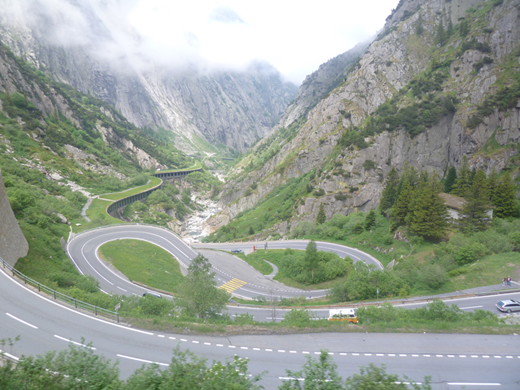
On the first day the group left Lucerne and travelled to Ardermatt alongside Lake Lucerne and, by way of elevated roads and long tunnels, up through the Oberalop Pass to visit the new Gotthard base tunnel – twin bores 57 km long (see Figures 1 and 2). This is a project taking more than 20 years to create a ‘level’ run through the Alps and allow the capacity for passenger and freight traffic to be nearly doubled. This hopefully will take the heavy long traffic off the roads in the area and reduce the travel time from Zurich to Milan by more than 1·5 h. Some 152 km of tunnel has been constructed with four ‘emergency’ stations where trains can be emptied of passengers who are transferred to the other track and with cross-passages every 325 m. The project is likely to cost 4·9 billion Swiss francs (£3·58 billion).
The geology has been challenging and the excavation has lowered water pressures causing settlement and some movement at the many dams situated above the tunnel.
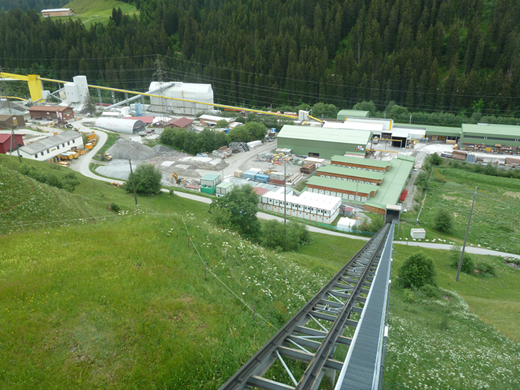
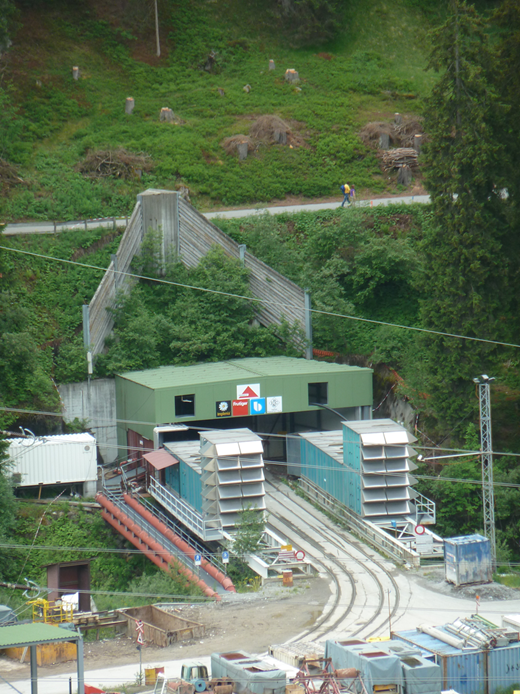
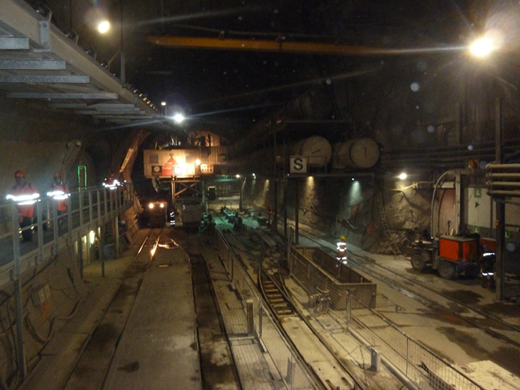
The group entered the tunnels at the mid-point by way of an 800 m deep shaft set some 1000 m inside the hillside at Sedrum (see Figures 3–5).
Some 13 Mm3 of fill has been removed to form the tunnel, which is now complete. The work now continues with the installation of the liner, drainage and track works. A fascinating major project!
3. Nalps dam
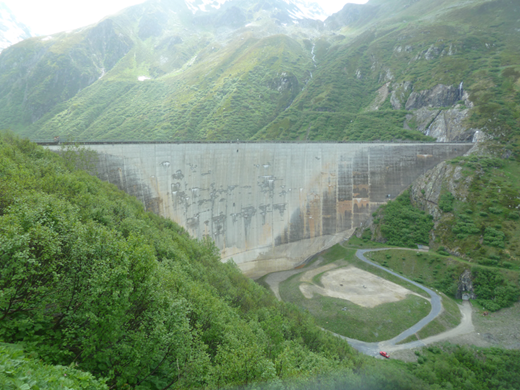
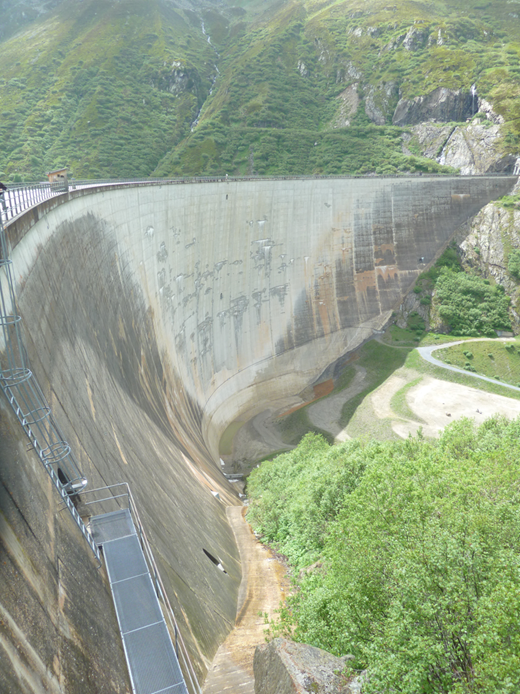
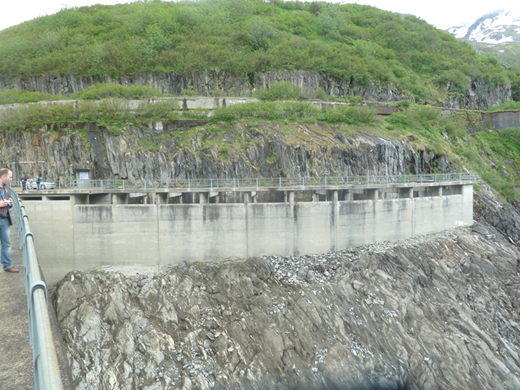
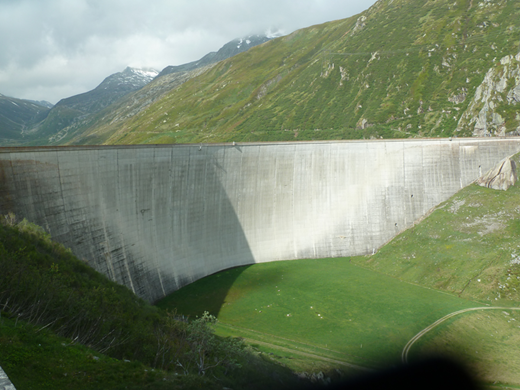
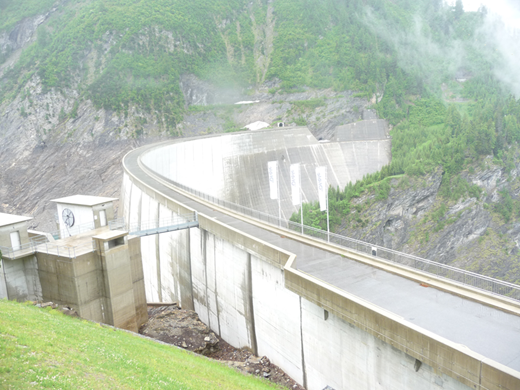
The Nalps dam is a double-curvature arch dam some 127 m high and 480 m long retaining a reservoir with a capacity of 593 000 m3 (see Figures 6–10). The dam was built between 1958 and 1962. It is owned by one of the electricity generators and acts as the head pond to the system with the two reservoirs in adjacent valleys being discharged into it before it is used to generate power.
It is instrumented with pendulums (inverted and normal), crack gauges, surface points and there is some foundation pressure measurement.
The Alps are in general still rising and when the reservoir is emptied, which is done every 10 years to inspect the face, the joints between the blocks open and then close when it is refilled. This puts an interesting slant on the concept of grouting joints. With the construction of the Gotthard tunnel 1600 m below and 400 m to one side the drainage is causing movement and settlement, which is causing the valley sides to move together – and to date there has been 15 mm of movement. The dam does not appear to have been adversely effected. Modelling has shown that cracking will occur at the toe if movement exceeds 60 mm. The company that operates the dam (NOK Nordostschweizerische Kraftwerke AG) has removed excess fill from the toe to enable any cracking to be observed.
The company prefers to send an operator/reservoir keeper to site once a week rather than to rely on instrumentation as they feel the presence of the human eyeball is better than any instrumentation – very refreshing!
4. Santa Maria arch dam
On the second day the group visited the Lukmanier Pass to visit the Santa Maria arch dam. This dam has a height of 127 m and a length of 560 m – so a very wide arch dam. Annual movement of the valley sides is of the order of ± 4 mm and the effect of the tunnelling has caused a further 4 mm of movement. Just after construction, problems of movement were experienced in the valley bottom, which sheared the grout curtain. This was due to an inclined seam under the dam, which opened when the permeability of the rock below the downstream toe was reduced. Thus the dam experiences full uplift pressures in the centre and there is no or very little drainage. The owner has decided not to relieve the pressure or to introduce foundation drainage as he fears that the situation would worsen.
5. Luzzone arch dam
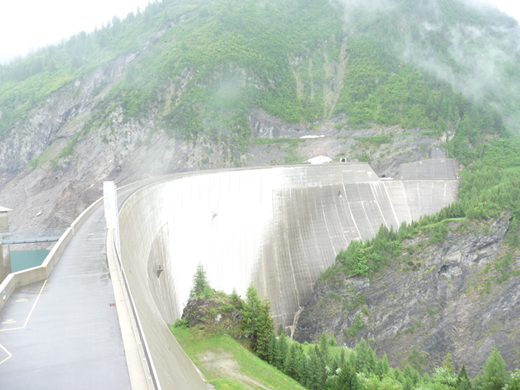
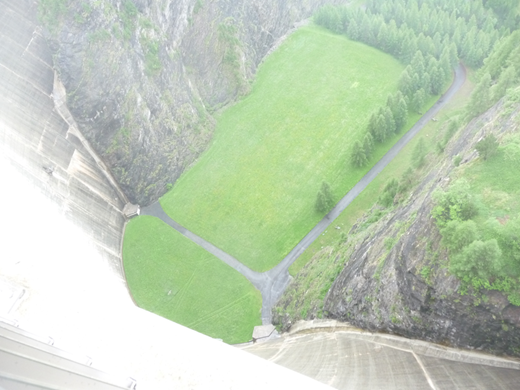
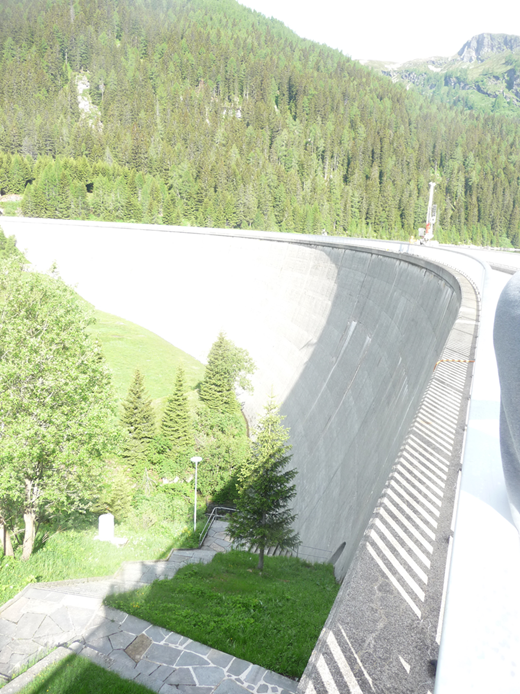
Travelling on to the south side of the Alps the Luzzone arch dam (Figures 11–13) was visited. This dam was raised between 1997 and 1999 by adding a 15 m high gravity section. The dam is now 225 m high and is the third highest dam in Switzerland.
The dam has a length of 510 m and retains 107 million m3 of water. It has climbing wall footholds in the downstream face – the record for climbing the face is about 50 minutes!
6. Contra arch dam
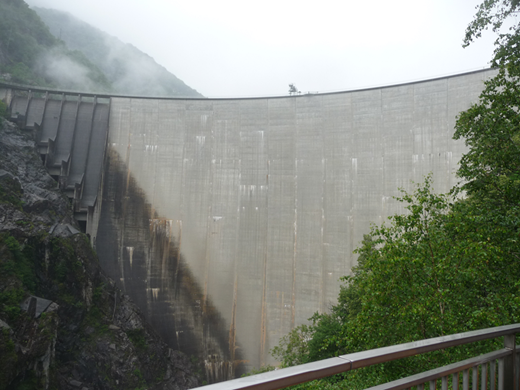
Day 3 brought a visit to the Contra arch dam (Figure 14) in the Verzasca Valley (see Figure 15) – another concrete arch dam some 220 m high and 380 m long retaining a reservoir of 94 million m3. The dam was built between 1963 and 1965.
This was the site of the bungee jump from the James Bond film GoldenEye, and there is a permanent facility to allow members of the public to get an adrenalin boost. No ICOLD members chose to brave the jump (luckily it was closed). The dam is ‘drop’ tight and was built 50 years ago by Lombardi. Mr Lombardi was on site to guide the group around the underground power station and switch yard and then on to the dam. Mr Lombardi was the engineer who developed the grout intensity number (GIN) process of grouting control. The dam is completely symmetrical with spillways on each side and it sits beautifully in a narrow gorge with houses perched on the hillside above the reservoir. A most impressive and beautifully proportioned dam – well worth a visit.
The dam was visited in heavy rain and cloud – one minute the dam was there and the next minute it was gone!
Unlike the UK, all dams allow total public access to the crest and surrounding areas even with vehicles. The army insists that the crests are wide – usually 8 m or more – to counter against wartime attacks from the air!
7. Isola dam
After an overnight stop in the beautiful lakeside town of Lugano, day 4 took the group into the Misox Valley to visit the Isola dam (see Figure 16) where remedial works are to be undertaken. The arch gravity dam has a height of 45 m and a crest length of 290 m and retains a reservoir of 6·5 million m3. It was built between 1957 and 1963 and has an output of 80 MW.
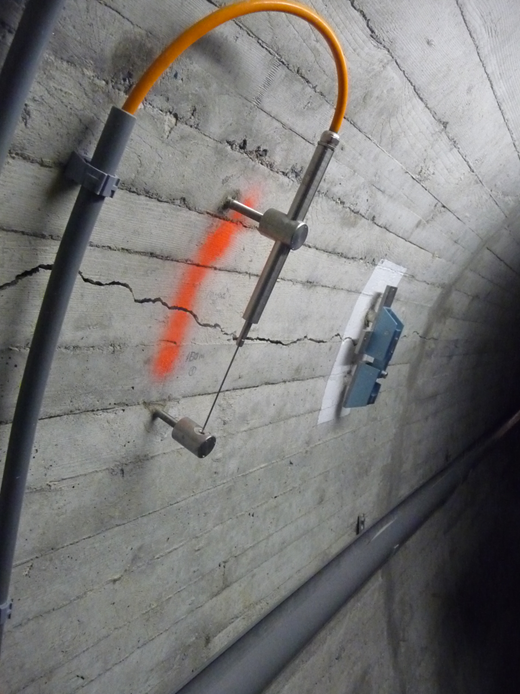
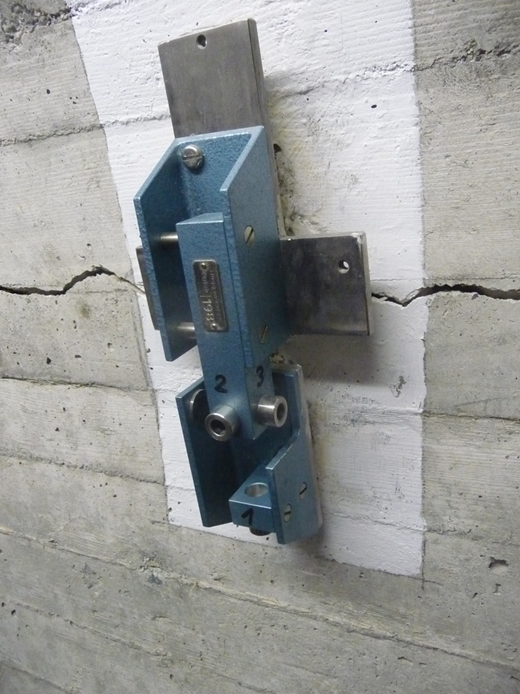
This dam has suffered an expansive silicate reaction within the concrete, which has created cracks in the upper gallery both upstream and downstream (see Figures 17 and 18). These cracks appeared about 20 years after the completion as the stresses caused became too high. This has caused the dam to expand and cracked and tilted towards the upstream. Expansion horizontally has been up to 80 mm. Currently the owner has decided to put in five additional pendulums but during the winter (November 2012–March 2013), seven cuts will be made through the dam with a diamond cutting wire to create gaps of at least 80 mm. The joints formed (in the centre of the existing) will be grouted up. The company accept that they may have to redo the works in 20–25 years' time.
After a visit to the Romanesque church of Zillis (twelfth century), with its unique painted wooden ceiling, the group reached Zurich for an overnight stop before departing for the four corners of the world.