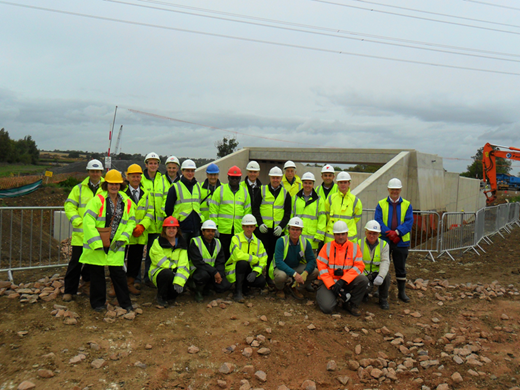
The British Dam Society was invited to undertake a site visit to the Banbury flood alleviation scheme, organised by committee member and project site supervisor, John Hopkins of Black & Veatch, the scheme’s designers. The visit to the site, located just upstream of the town of Banbury on the River Cherwell, took place on 7 September 2011 with 17 visiting members hosted by the project site team.
The visit commenced with a presentation on the scheme by John Hopkins in the site office. The scheme consists of 2·9 km of earth embankment, two identical passive reinforced concrete flood control structures and an auxiliary spillway. In addition to the main embankment, the scheme also involves 860 m of ‘A’ class road raising and two areas of localised low flood defences downstream in Banbury protecting Wildmere and Tramway industrial estates.
Following the presentation, the group (Figure 1) was given a guided tour of works on the main site. Site works commenced in March of this year and are due for completion in spring 2012. First stop on the tour was the largely complete Huscote flood control structure. The structure works by regulating flows through use of a double baffle orifice which is formed by a baffle and weir arrangement. The arrangement is set up so as to regulate flows to 19 m3/s, on each of the structures, over a range of increasing head up to the 1-in-200-year return period flood event level. At this level, the stored volume will start to overtop two weirs just downstream of the orifice.
Next stop was the auxiliary spillway which is designed to operate during a 1-in-1000-year return period flood event. The embankment along the spillway was largely complete and offered the visitors a chance to see a cross-section through the construction. The embankment in this area is zone construction with a clay core, sand filter drainage chimney and drainage blanket on the downstream side with clay shoulders. This type of construction has been used for approximately 1·4 km of the embankment with the remainder being homogeneous clay construction.
The group continued down the site, with the chance to see the embankment at varying stages of completion as well as a stop at the borrow pit where all the clay material and some aggregate for the embankment is being sourced. Also seen on the day, was the excavation for the second of the two identical flow control structures at Hardwick.
Following the site tour, the visitors reconvened in the site office for a more detailed description of the flow control structure’s operation by John Ackers, of Black & Veatch, who has been heavily involved in the design of the project since 2001 and is the construction engineer for the reservoir.
The visit was concluded by words of thanks by BDS chairman Martin Airey. The visit could not have happened but for the permission of the Environment Agency, the client on the scheme and the help of staff from EC Harris, CA Blackwell and particularly Morrison Construction Limited, the principal contractor on the scheme who provided the facilities and refreshments; so a big ‘thank you’ to all involved for making the visit a great success.