A brief report highlighting key points of interest arising from the Annual National Resilience Forum held in Derby in November 2013, which focused on emergency planning for reservoirs.
Exercise Triton
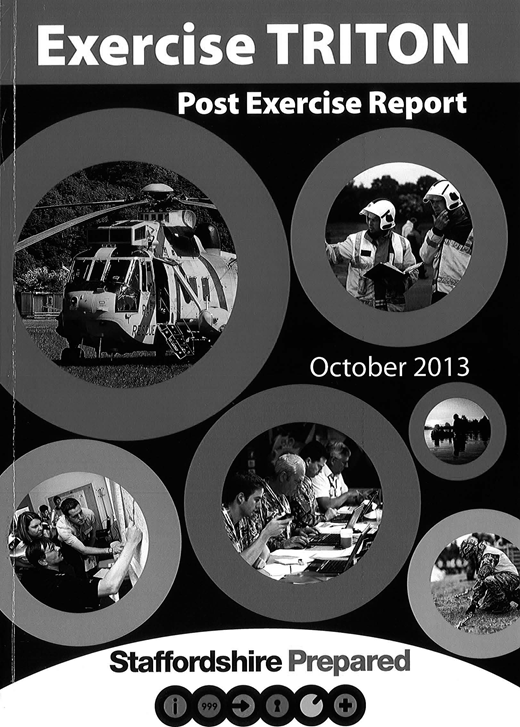
Summer 2013 witnessed one of the UK's largest civil response exercises based on a dam breach. Exercise Triton (Figure 1) was organised by the Staffordshire Resilience Forum and was held between 3–7 June 2013.
It has been estimated that the cost of the exercise exceeded £100 000. The exercise took 2 years to plan and during the week of the exercise over 1000 participants from 39 organisations took part.
The openness of the approach of Staffordshire LRF (local resilience forum) by inviting visitors to witness the exercise and providing access to post-exercise reporting is to be commended. Having read this brief write-up, readers are strongly recommend to access Staffordshire Resilience Forum's website (http://www.staffordshireprepared.gov.uk/) to view the explanatory video and comprehensive lessons learnt from the report dated October 2013 (SCCU, 2013). There are learning points for every organisation, especially undertakers with only one or perhaps a few reservoirs, who rarely interface with the ‘Blue light’ services.
The exercise was conducted around a fictitious scenario involving the degrading condition and eventual failure of South Staffordshire Water's Blithfield reservoir. From the water company's perspective over 60 of their 350 employees participated (or ‘played’ to use the emergency planners' term) in the exercise.
The exercise tested the three component parts to the emergency plan for the reservoir
on-site plan
inundation or ‘flood maps’
off-site plan.
At the meeting, Kate Wilkes, the emergency planning manager for South Staffordshire Water, reported on a few key learning points for their staff.
Staff need to understand the roles of gold, silver and bronze control
Marshalling the many resources that descended on the site requires a multi-agency plan and key marshalling points
Significant support was sought of others such as pump suppliers
Paper logging of the incident was preferred due to the fact that electronic logging can later be amended
Hot debriefs on the day were essential
A loudhailer was essential to give people clear direction to keep clear of the dam.
As a water company they were also involved with supporting the off-site response and recovery. Key learning points arose over access to geographic information systems (GIS) data and access to the inundation maps.
Derbyshire LRF
Dee Collins, the chair of Derbyshire LRF, reported that they had
ten site-specific plans
80 generic plans.
She recounted that there had been two recent problems with smaller third-party reservoirs, one of which threatened a major section of the A6 near Ambergate. Also, she announced that the LRF propose to include a reservoir theme to their next major exercise, planned for September 2014.
Academic view
The majority of the attendees were emergency planners. However, as a contrast, Dr Lucy Easthorpe of Bath University delivered a thought-provoking presentation. Throughout the day, she had observed that the planners had revelled in using their own dictionary, for example talking of meeting at a ‘bird table’. She stressed the need for all communications to be simplistic and to avoid reverting to such terms as ‘gold control’ in public statements.
Dr Easthorpe has travelled extensively across the world to record and study the experience of victims following catastrophic events involving mass fatalities. She observed that following disasters where victims take control of their own destiny there was less blame directed at the emergency services. She stressed that the sooner victims became involved in determining their own destiny and therefore owning solutions, the quicker the recovery process was achieved.
She took the opportunity to reinforce points made earlier by Sir Michael Pitt in his report of the 2007 flooding disaster that confronted this country (Pitt, 2008).
Commentary
Emergency planning
The three key components that comprise an emergency plan – on-site preparedness, extent of potential impact of the hazard and off-site response – are the normal components of emergency planning. In other potentially hazardous industries they are a legal requirement, for example for a chemical works under Comah (Control of Major Accident Hazards) regulations (HMG, 1999).
The Water Act 2003 (2003) amended the Reservoirs Act 1975 (1975) and introduced the requirement for undertakers to draw up and exercise emergency plans. However, on-site plans are not a legal requirement. Several years ago, the Department for Environment, Food and Rural Affairs (Defra) sought consultation on their preparation, but this was never followed through. While this requirement does not yet have the force of law, it is strongly recommended that on-site plans are produced for all reservoirs. Increasingly inspecting engineers are specifying their requirement as a measure in the interest of safety.
Some undertakers already have flood plans in place for all their reservoirs. For example, at Severn Trent Water, all 58 reservoirs currently subject to the Act have on-site plans in place and are annually reviewed by the supervising engineer. In addition, an annual desktop exercise is carried out to test resilience at one of our reservoirs.
Civil Contingencies Act 2004
The Civil Contingencies Act 2004 (2004) requires LRFs to assess the risks in their area, rank them and plan accordingly. Plans can range from site specific off-site plans for the highest risks, through to generic plans for perceived lower risks, ‘H44’ in the case of reservoir emergency. There are 47 LRFs across England and Wales, based on political – that is, police – rather than catchment boundaries. Flooding from a reservoir will inevitably follow river catchment boundaries and cross more than one LRF boundary, hence the need for coordination. As an illustration, the boundary of Severn Trent Water, which is catchment based, encompasses/overlaps 18 LRFs.
Emergency response
Generally, the police will lead and control the emergency response. For a major disaster, three levels of control are established
gold – strategic
silver – tactical
bronze – operational.
Panel engineers are likely to play a key role(s) in an incident. During the Ulley incident for example, Jim Claydon was whisked to site by the police to help lead on the operational response.
Supervising engineers should expect to fulfil a role at bronze/operational control as they will generally receive the first call in the event of an incident. As potential incidents may run for a prolonged period and therefore through the night, attendees should consider the need for back-up to cover key roles.