

On 12 August 2013 members of the British Dam Society were invited to visit construction works underway at Black Esk dam, with a party of 33 attending the site near Lockerbie, Dumfries and Galloway. The reservoir owner, Scottish Water, instigated the works to raise the overflow level by 2·5 m in order to increase the storage volume of the reservoir by 40%. The adoption of a new piano-key weir around the rim of the bellmouth spillway has reduced the flood rise and therefore the extent of dam-raising that is required. The visit was hosted by Black & Veatch, who are both designer and principal contractor for the project. Representatives from Scottish Water were present and accompanied the group throughout the visit.
Black Esk dam was completed around 1962 with the reservoir having a storage capacity at that time of 2200 Ml. It is an embankment dam with a rolled clay core formed of glacial till, shoulders of a similar material, a chimney drain on the downstream side of the core and approximately horizontal drainage layers. It was originally designed with an oversized upstream rockfill toe berm, such that it could be more easily raised by up to 9·1 m at some point in the future. This would have involved building up both the upstream and downstream shoulders together with raising of the valve tower and bellmouth spillway.
This project to raise the level by 2·5 m represents part of a significant investment for Scottish Water in the water supply infrastructure of the region, following major investment in the Black Esk water treatment works in 2010 and another project currently underway to upgrade water mains throughout the area. Together with the enlargement of Black Esk reservoir, these projects are intended to improve the security of supply and water quality for a population of 48 000.
The visit started with a presentation at the site offices by John Ackers, the construction engineer for the works under Section 6 of the Reservoirs Act (Reservoirs Act 1975 (1975)), David Gethin, projects manager, and members of the project team Tom Scott and Simon Pryce (see Figure 1).
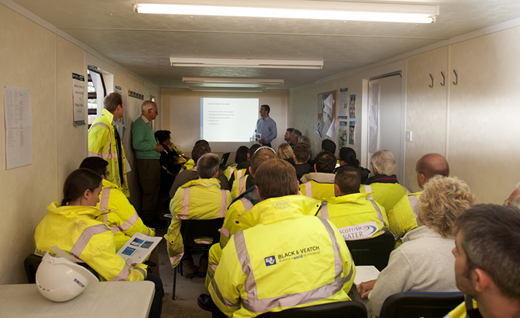
The presentation opened with an overview of the history of the dam, including a description of the hydraulic performance of the original bellmouth spillway. The existing hydraulic behaviour was confirmed by the project team at the design stage as being controlled by the ogee weir around the bellmouth rim until a water level over the weir of about 1·7 m, at which point the hydraulic control would move directly to tunnel full flow.
The concept of piano-key weirs was then described, with an overview of the different arrangements considered for Black Esk. Details were presented of the selected geometry which, although not the option with the most efficient hydraulic arrangement, was considered to provide the best balance of buildability and performance. The hydraulic rating curve for the bellmouth spillway with piano-key weir was shown in order to demonstrate the expected hydraulic behaviour of the new arrangement, indicating a reduction in flood surcharge which reduces the amount of dam raising by 0·64 m compared to a standard ogee weir profile. This is understood by the project team to be the first use of a piano-key weir in a circular alignment.
The presentation described some of the construction milestones and noteworthy points since construction had started in early 2013. This included photographs of the installation of the precast piano-key weir segments which had been installed over the previous 2 to 3 weeks. Some detail was then presented on the raising of the dam and the valve tower.
Following the presentation, two groups were formed for a guided tour of the dam and bellmouth spillway, with each group being led by two of the speakers. A general view of the dam during the tour is shown in Figure 2.
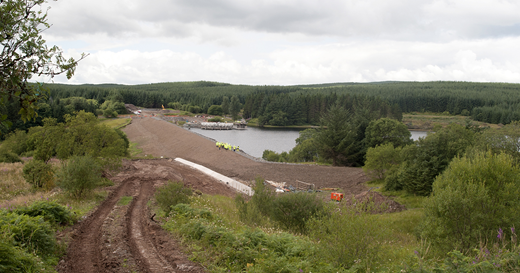
General view of site during tour, with one tour group on the dam crest and the other on the bellmouth and valve tower at the far side
General view of site during tour, with one tour group on the dam crest and the other on the bellmouth and valve tower at the far side
The author's group was led down the right mitre and across the downstream face. The group were interested to hear that the material used to raise the clay core was won from the downstream shoulder of the dam. Hydroseeding of the downstream face should encourage rapid vegetation growth to provide protection of the exposed shoulder, whereas the crest will be seeded.
At the left-hand abutment a wet spot had been found during excavation down to the existing concrete cut-off. Although this flow was tracked to an upwelling from a crack along the top of the concrete cut-off, the reservoir level at the time was significantly lower than the outflow, indicating that the source of the flow was not the reservoir and likely to be artesian flow from the underlying rock. Some concrete pipework and areas of gravel were found in the clay backfill in this area. A decision was made not to attempt to seal this crack, but rather to capture and monitor the flow by way of a new measurement chamber feeding into the left mitre drain.
The author's group proceeded back along the crest of the dam, from where they could see the clearance of vegetation around the perimeter of the reservoir in preparation for the elevated water level.
At the bellmouth spillway and valve tower the excellent floating pontoon access platform was used to get around the raised valve tower and then into the top of the bellmouth itself (Figures 3 and 4). Scaffolding made safe access to this area straightforward and provided a fine position from which to see the precast piano-key elements up close.
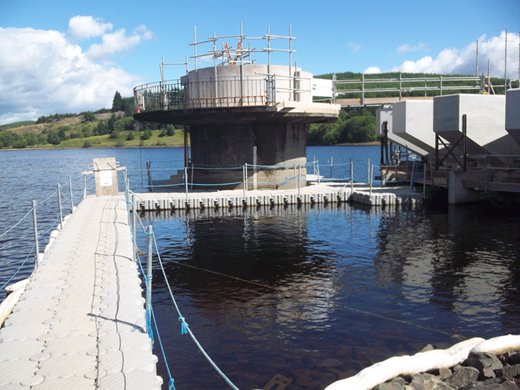
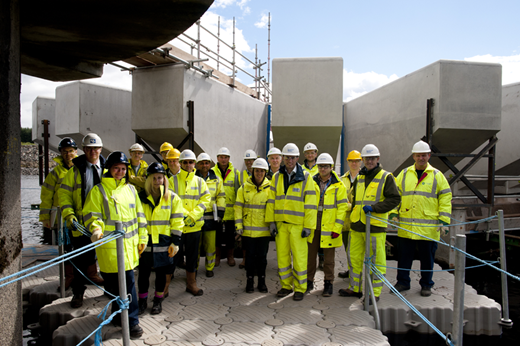
The speed and reported accuracy of the installation of the precast element was impressive, and was facilitated by the construction of a crane hard-standing adjacent to the bellmouth, which will remain in place submerged within the reservoir.
The weather had been kind throughout the tour, but the heavens opened as the visitors retired to the site offices for a buffet lunch courtesy of their hosts. The floating pontoon access has apparently proved invaluable in maintaining access to the bellmouth spillway and valve tower, despite the rapidly fluctuating water level in the reservoir (which has remained operational throughout).
A question-and-answer discussion followed, after which thanks were expressed to the team from Black & Veatch, who made this very interesting and well-attended visit possible.

