

The 14th German dam symposium was held at Freising, near Munich, over two days, together with a third day visiting Sylvenstein reservoir, Walchensee hydropower station and Munich Technical University's hydraulic engineering laboratory at Obernach. It was attended by almost 500 delegates, about a third of whom were from a total of 28 other countries, including 16 delegates from the UK. The conference was held jointly with the 7th International Commission of Large Dams (ICOLD) European Club.
During the British Dam Society (BDS) conference at Durham, UK, in September 2006, a stunning venue had been promised and delegates were not disappointed. Many were accommodated at the Kardinal Dopfner Haus, a former monastery adjacent to Freising's St Mary's cathedral, where the current Pope Benedict XVI was Archbishop from 1977 to 1982. Freising is the oldest town in northern Bavaria. As well as being a very pleasant place, it is of significant cultural interest having been the seat of bishops since 739 AD. It boasts the world's largest museum of Christian art and, at nearby Weihenstephan within the university campus, there is what is claimed to be the world's oldest brewery, founded by Benedictine monks in 1040.
Commencing on Monday morning and concluding on Tuesday evening, the conference sessions were entitled ‘New public awareness on dams in Europe’, ‘The benefits and risks of hydraulic structures’, ‘Leakage detection in embankment dams’, ‘Internal erosion’ and ‘Hydraulic structures and hydropower’. Some 44 papers were delivered, 26 by German authors and 18 by other European authors. There were four papers by UK authors which were well received by the delegates. This was out of a total of 83 papers published in the proceedings.1
A European working group on internal erosion, established by ICOLD European Club, had produced a summarising report of their work over the years 2003–2007 entitled Assessment of the Risk of Internal Erosion of Water Retaining Structures: Dams, Dykes and Levees.2 The 270-page report document was issued to all delegates and contains 22 papers of which eight (two by UK authors) were delivered in a parallel session.
The simultaneous live translation of all of the presentations into English was very well executed via headsets and could not have been more effective. This was very helpful in view of the cracking pace at which the papers were delivered. The downside was that little or no time was left for discussion.
New public awareness on dams in Europe
For much of the first day the theme was ‘New public awareness on dams in Europe’ indicating the raised awareness of the benefits that dams can provide, for example, for generating green electricity, supplying drinking water and, by pre-lowering reservoir levels or raising crest levels of existing dams, to regulate river flows during exceptional rainfall to provide better flood protection to communities downstream. The general message was that climate change is a fact of life and there is a need for urgent action. Since global warming is very much in the public eye every opportunity must be taken to make people aware that dams are essential to combat the effects of global warming. Papers were delivered providing examples of schemes involving crest raising and optimisation of water management techniques. It is the aim to raise public awareness of the importance of dams and increase support from the public which would influence policy makers and to tilt the scales against the disproportionate weighting of environmental matters by campaigners on dam-related projects.
It seems that such harnessing of public support cannot come soon enough. Dr.-Ing. Gianni Biasiutti from Switzerland related the as-yet unresolved three-year dialogue with environmental groups over the loss of a miniscule 0·8 km2 of land in the proposed scheme to raise the level of Grimsel Lake by 23 m. Green campaigners had seized on the scheme as a symbol of their opposition to all such projects and, thanks to the environmentalists, the matter was currently in the hands of the courts. He recommended others to establish public trust but was pessimistic about the outcome of his project.
Andy Hughes spoke, with humour, about conflicting cultural, environmental and regulatory interests on a successful dam improvement project at Woodchester, UK. This must have rung some local bells and Andy's paper was warmly applauded.
A German politician, Mayor Robert Strumberger, gave a talk about the successful mobilisation of public and government support for the recommissioning of a dam near to a town in the southern Black Forest. It was first listed as a public monument and the public awareness thus generated was key to the success of the project. Apparently the town's citizens are now really proud of their dam!
It was refreshing to listen to Helena Nynas, from Norway, who has completed a 7-year project to list all of Norway's historically important dams. In Norway, a dam is recognised to be a cultural asset which has helped to provide society's basic needs—water, food, clothes, shelter, warmth, heating, mills, industry, and so on. 2750 have been registered so far and there are many more to go. It looks like Norwegians know how to capture the cultural aspects of dams to enable greater public awareness and acceptance!
Finally, Rod Bridle talked about how to engineer sustainable dams, putting forward the ‘engineered sustainable infrastructure cycle’ as a means to demonstrate numerately that the most sustainable option has been selected to confirm that infrastructure meets the needs of society. This paper was also very well received by the delegates.
The benefits and risks of hydraulic structures
Following the Monday afternoon coffee break, two hours or so were devoted to six papers concerning ‘The benefits and risks of hydraulic structures’.
First, delegates heard from Jiri Cemus and Dana Halbe about the role dam engineers played in conflict resolution at Eder dam, Germany, balancing inflow against outflow to satisfy the conflicting requirements of downstream flood risk, flow compensation, shipping, water supply to a canal company, hydro power, tourism and ecology.
Another paper, by Prof. Andreus Schumann, then informed delegates about flood forecasting using models constructed from an ensemble selected from 17 different weather prediction models for different dams and rivers in Germany. It was concluded that devastating floods which occurred in Germany during 2002 could have been predicted 2·5 days earlier if the model had been available.
Those involved with pooled stepped spillways may be interested in the results of a dissertation by Jens Thorwarth of Aachen University. He looked at the formation of self-induced unsteady flows in such structures and has derived a formula enabling the conditions necessary for the creation of unstable flow to be identified.
During the session, papers were also delivered concerning the design of a new spillway at Esch-sur-Sure dam, Luxembourg, probabilistic risk assessment of the structural safety of gravity dams and on uncertainty analysis for breach formation in the risk assessment of dams.
Leakage detection in embankment dams
Before the coffee break on Tuesday morning, six papers on leakage detection were delivered by speakers from Austria, Germany, Switzerland and France. The papers covered the merits and shortfalls of geophysical, resistivity, fibre optic temperature sensing, passive temperature sensing and flow velocity measurement methods of leakage detection and monitoring. Temperature sensing has the longest and most successful track record and plenty of examples of its use were provided. Delegates were informed that the use of fibre optic, passive temperature monitoring is standard practice in Sweden on upgraded and new dams. Temperature measurements are, however, qualitative, whereas the relatively newly developed flow velocity measurement methods are quantitative, and so it is possible that this method may be used more widely in the future.
Internal erosion
The conference then split into parallel sessions on ‘Internal erosion’ and ‘Hydraulic structures and hydropower – ongoing projects at home and abroad’.
The European working group on internal erosion had published 22 papers, eight of which were delivered during the session on a subject which remains a major concern universally. Two of the papers came from UK authors: Rod Bridle, who compared six different approaches, and Alan Brown, who described a method for the management of risk from internal erosion. Other papers described the effects of frost and thaw on dams, tools for identifying the best method of detecting internal erosion in particular situations, hydraulic criteria for internal erosion, research on piping in sand using a finite element model and, subsequently, a neural network. The final paper of the session described a means of improving resistance to seepage by adding a downstream berm.
The working group has produced a document2 which indicates a structured approach to issues and that research has been targeted to specific areas to provide a tool for identifying the most appropriate method for detection of internal erosion for a particular situation.
There will be improved benefit to dam engineers if this future research has more emphasis on how the research could be applied by end users.
Hydraulic structures and hydropower – ongoing projects at home and abroad
For those who have concentrated their efforts on UK dams and reservoirs this session provided a fascinating insight into the challenges faced by dam engineers in other parts of the world. The session continued through to the afternoon, during which 14 papers were delivered on an interesting range of projects and studies on a variety of types of dam in Turkey, Austria, Jordan, south east Asia, Germany, Algeria, Libya, China, Russia and CIS countries, Afghanistan and Tajikistan.
While some of the papers strayed a little from the theme of ‘Dams in Europe’, this was quite acceptable as the speakers provided descriptions of their experiences, sometimes in dangerous circumstances such as in Afghanistan. The papers delivered were: ‘The 249 m high Deriner arch dam in Turkey’, ‘Design of a 120 m high rockfill dam and hydropower development in the Tyrol’; ‘Dams in the Karst mountains of Jordan’; ‘Advantages of roller-compacted gravity dams – two examples in south east Asia’; ‘Refurbishment of Klingenberg dam – Phase 1’; ‘Structural safety assessment of four Algerian dams’; ‘Innovative solutions for hydraulic concrete structures damaged by alkali aggregate reaction’; ‘The asphalt lining of a large reservoir near Benghazi’; ‘Rehabilitation of the bituminous lining system of the Eggberg reservoir 2005’; ‘Construction of the first cut-off wall by a low headroom trench cutter inside a dam tunnel in China’; ‘Sealing of hydropower plants and dams by injection in Russia and countries of the CIS’; ‘New projects of E.ON hydropower – changed environment and its consequences’; ‘The Lower Kokcha irrigation and hydropower project feasibility study, Afghanistan’; ‘Results of a feasibility study for construction completion of Rogun hydropower scheme in Tajikistan’.
Technical visits
On Wednesday, delegates were taken on an excursion to the foothills of the Bavarian Alps to visit Walchansee hydropower station, followed by a tour of the Laboratory of Hydraulic and Water Resources Engineering of the Technical University of Munich at Obernach and, finally, to Sylvenstein reservoir.
Walchansee hydropower station is one of Germany's largest hydropower plants with a maximum rating of 124 MW and an average annual output of 320 million kWh (see Fig. 1). At full capacity, the four Francis turbines and four open jet Pelton turbines require a water flow of some 84 m3/s.
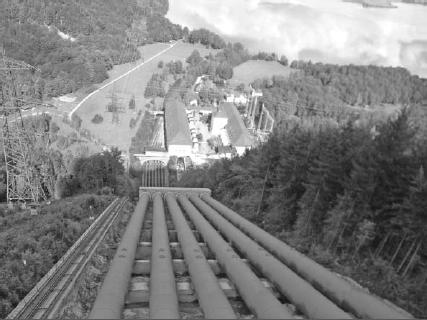
Walchansee Lake water passes via an intake structure at Urfield through a 1·2 km long tunnel to a 10 000 m3 capacity balancing tank situated within higher ground about 200 m above the turbine hall. Water is fed to the turbines through six 2 m diameter, 450 m long pipes. A funicular railway is used to transport staff and visitors alongside the steeply sloping feed pipes to the balancing tank building. There is a large visitor and exhibition centre at the plant which is visited by nearly 100 000 visitors annually.
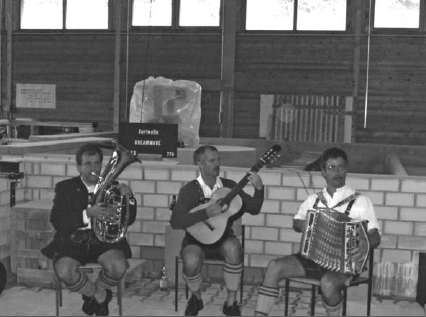
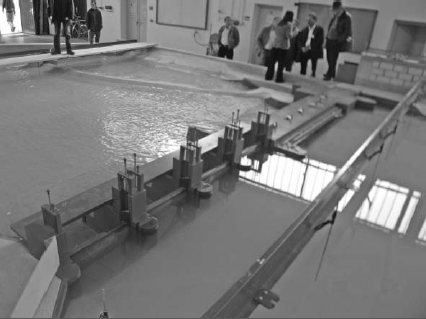
At the nearby Laboratory of Hydraulic and Water Resources Engineering, delegates were served a hot lunch and locally produced beverages to the accompaniment of a splendid band (Fig. 2). During the subsequent tour of the laboratory several large physical models of barrages along sections of German rivers were shown (Fig. 3).
Sylvenstein is a rockfill dam situated on the River Isar in southern Bavaria (Fig. 4). It has a height of 44 m, crest length of 180 m and a storage volume of 108 × 106 m3. It was constructed between 1954 and 1959 and is used for hydropower and to facilitate river regulation. This method of using headwater storage on a large scale to mitigate flooding could be considered in the range of options for UK flood schemes. Its crest was raised between 1994 and 2001 following much local opposition led by environmentalists; however, the increased storage prevented flooding of the downstream town of Bad Tolz during the 2002 flood event (Fig. 5). There was something of a change of heart by the local press, at least, and we were shown newspaper headlines declaring ‘Dam saves town from flooding’. Perhaps this should be publicised more widely.
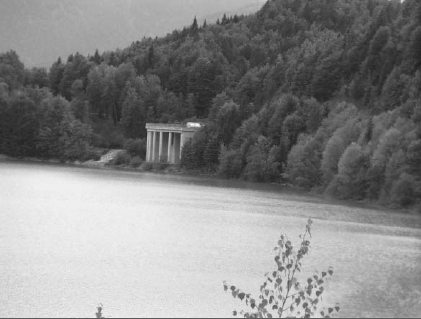
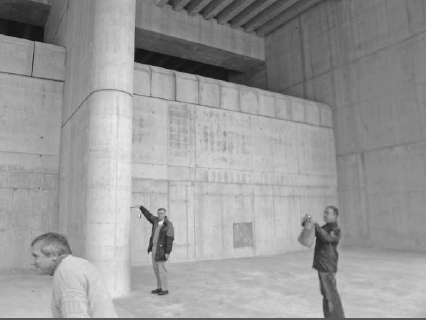
Sylvenstein overflow indicating the maximum reservoir level during the 2002 flood
Sylvenstein overflow indicating the maximum reservoir level during the 2002 flood
It would be remiss not to include mention of the warm and friendly way delegates were treated by the Bavarian hosts. The Monday night event at a local ‘Bavarian Octoberfest’ venue was superb with good food, ample supplies of local weisse beer, excellent music and lots of merriment. As many new friends as possible were invited to attend the BDS conference at Warwick in September, where their hospitality will hopefully be returned.

