

A party of 11 people from BDS visited northern Germany from 11 to 14 May 2011 at the invitation of the Ruhr Dams Association, the Saxony Dams Administration and the German National Committee on Large Dams.
The visit started on 11 May at the 69 m high Sorpe dam. This dam, which is an earthfill dam of particularly robust construction with a concrete core, successfully withstood the Dambusters raid of 16/17 May 1943 and also subsequent raids by the RAF. However, the core was damaged and in January 1951 there was a sudden and steady rise in seepage water to 180 l/s. This necessitated the drilling of 53 000 lin. m of boreholes and the injection of 4350 t of cement as well as the use of 1700 t of clay (Hinks et al., 2010).
Trees are being allowed to grow at the top of the downstream face as can be seen in Figure 1.
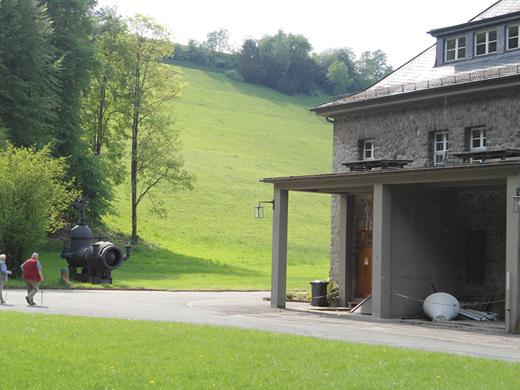
The party were shown around the gallery and were interested to see the use being made of an industrial scale dehumidifier. It can be imagined that this will significantly reduce the maintenance requirements and repainting of pipework.
The BDS group visited the 40 m high Möhne dam (Figure 2) on the morning of 12 May after a night spent at a hotel on the banks of the reservoir. The dam is constructed of cyclopean masonry and was breached by the RAF on the night of 16/17 May 1943.
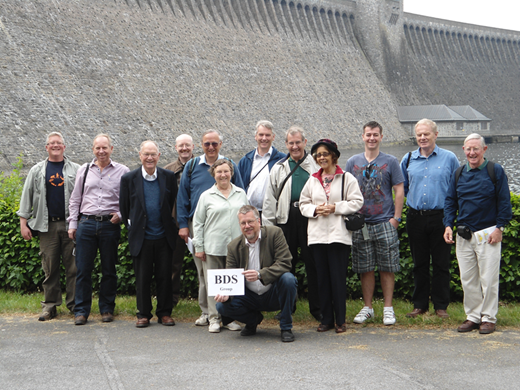
The BDS Group at the Möhne dam. Chris Heitefuss, formerly of the Ruhrverband, was entitled to hold the sign as he is a fully paid up member of BDS
The BDS Group at the Möhne dam. Chris Heitefuss, formerly of the Ruhrverband, was entitled to hold the sign as he is a fully paid up member of BDS
A bottom gallery was excavated in the dam in the early 1970s by drill and blast. Up to 20 m3/s flow from the bottom outlet is shot vertically into the air downstream of the dam (see Figure 3). Why don’t we do this at UK dams?
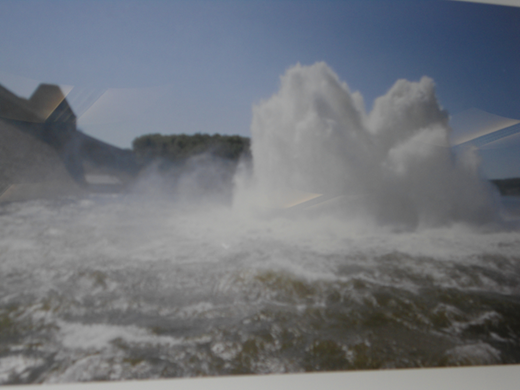
Flow from the bottom outlet is shot vertically into the air downstream of the dam
Flow from the bottom outlet is shot vertically into the air downstream of the dam
A rather nice touch was the padlocks on the fence at the crest. Courting couples have their names engraved on the padlocks which they then fix to the fence before throwing the key into the reservoir (Figure 4). Presumably if they later decide to break up they have to retrieve the key, which would be inconvenient. Apparently the practice started in Hungary and is now sweeping across the continent towards Britain. Dam owners in the UK should prepare to erect suitable fences.
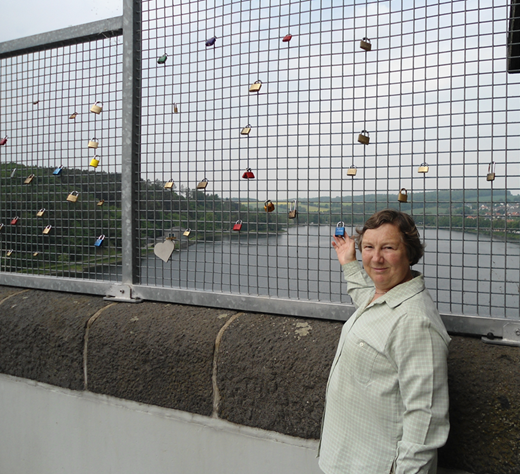
Fräulein with engraved padlocks on the crest of the Möhne dam
Fräulein with engraved padlocks on the crest of the Möhne dam
The Eder dam (Figure 5) is a 48 m high masonry dam which was also breached by the RAF on the night of 16/17 May 1943. It is intended to augment flows in the Fulda and Weser Rivers and to supply water for the Mittelland Canal which carries traffic to Berlin. The dam also has a flood control function.
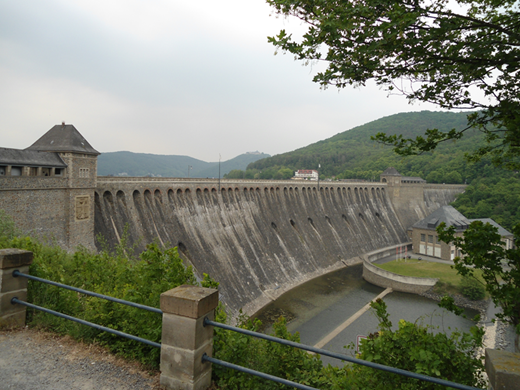
In 1991 to 1994 the dam was stressed down to the foundation rock with 104 anchors which terminate in the Upper Gallery (see Figure 6). The anchors, which are at 2 m spacings are 65 to 75 m long and have an ultimate capacity of 7·5 MN. The operational load is 4·6 MN per anchor. It would have been useful to have compared notes with the designer of the post-tensioning as similar works were being designed for Mullardoch Dam in the UK at about the same time.
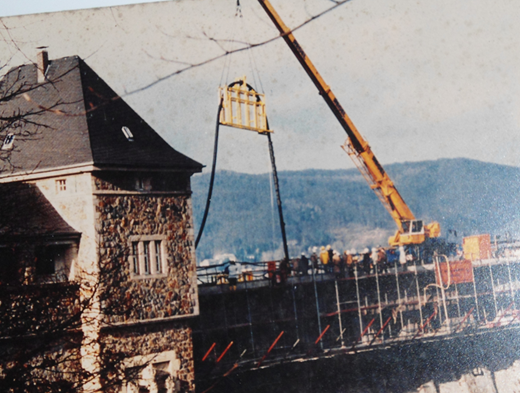
Old photograph showing installation of anchors in 1991–1994
Old photograph showing installation of anchors in 1991–1994
The Eder is another dam where a gallery in the dam has been excavated by drill and blast.
After visiting the Eder dam the party moved eastwards towards Saxony where the first stop was the Eibenstock dam (see Figure 7). This is a concrete dam 65·5 m high completed in 1987 for drinking water supply, flood control, flow augmentation in the River Zwickauer Mulde and power generation (Figure 8).
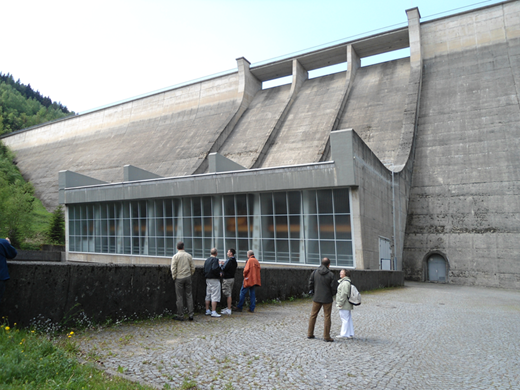
Eibenstock dam with spillway and valve house
Eibenstock dam with spillway and valve house
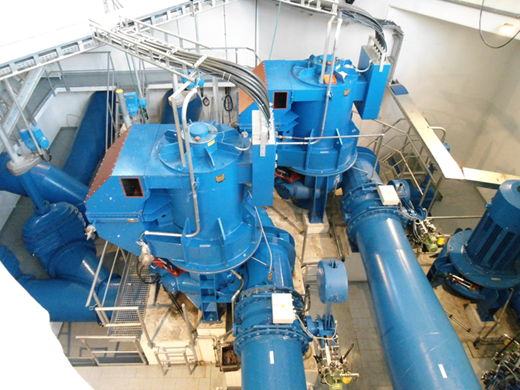
Compact power station with Francis turbines
Compact power station with Francis turbines
The catchment area is 199·8 km2 and the gross capacity of the reservoir is 81·7 Mm3.
There are normal and inverted pendulums in the dam; the cyclical movement of the dam is about 18 mm. The dam is provided with 208 piezometers of which 28 are measured with a manometer. Total leakage is very low.
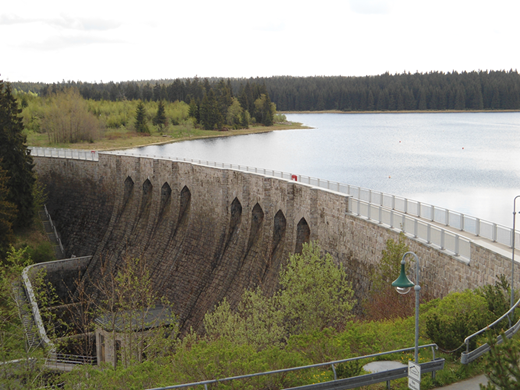
The Carlsfeld dam (Figure 9) is at an elevation of about 900 m ASL close to the border with the Czech Republic. It is a medium-sized masonry dam 31·8 m high. The main dam was repaired in 1997 when a concrete gallery (Figure 10) was added on the upstream side of the dam with Züblin as the contractor. At the same time the upstream face of the dam was sealed against the ingress of water.
Carlsfeld is one of only three dams in Europe to have a variable level water intake looking rather like a mangonel. This was not seen as it was under water.
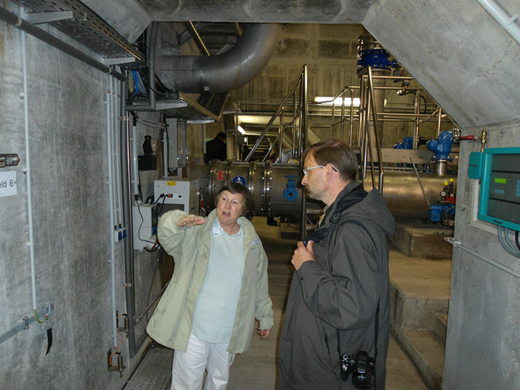
One of the party questioning Ingo Lux about the instrumentation in the gallery
One of the party questioning Ingo Lux about the instrumentation in the gallery
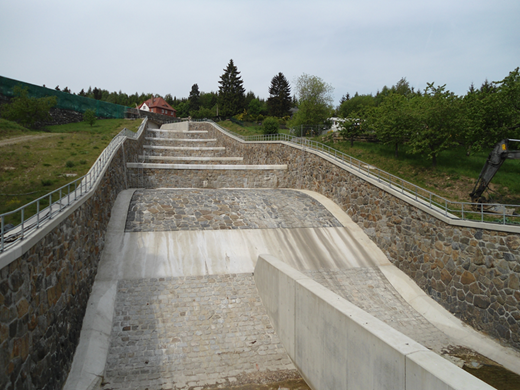
The 40 m high Klingenberg Masonry dam near Dresden was visited on 14 May. The spillway had been badly damaged by a flood event with a magnitude 175% of the design flood in 2002; which had recently been elegantly restored in masonry and concrete (see Figure 11 and Figure 12).
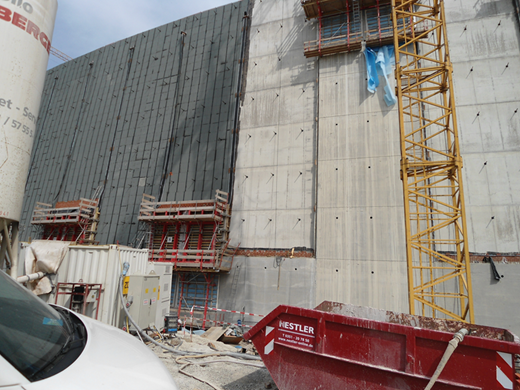
Application of impermeable facing to Klingenberg dam
Application of impermeable facing to Klingenberg dam
The reservoir supplies 60% of Dresden’s water supply. The new spillway was a part of 80 M Euros worth of work presently in hand at the dam.
The catchment area is 89·4 km2 of which 12·3 km2 is in the Czech Republic. The PMF outflow (which must not be allowed to overtop the dam) is 320 m3/s. The party were relieved to hear that two bombs found in the reservoir were dropped by the Russians.
A new gallery was driven by drill and blast through the masonry of the dam. The tunnel was advanced 1 m at a time with 40 holes each charged with 190 g of Smoothex explosive. The finished job looked extremely good.
At the time of the visit work was in full swing on a new upstream facing for the dam which was costing 7 M Euros for 7000 m2. Grouting was also in progress at the heel of the dam – at an angle to intersect the vertical rock joints.
Conclusion
The tour of Germany enabled the party to see six dams, most of which had been the subject of extensive improvement or remedial works. The work was all of a very high standard and well engineered. The German attitude to health and safety was sensible without being oppressive – hard hats were provided at Klingenberg, which was an active construction site, but not for entering the galleries at the other dams.
We in the UK can certainly benefit from closer contacts with our German counterparts and it is to be hoped that BDS will continue to foster such contacts in the future.
The BDS party are most grateful to all those who helped with the organisation of the trip including Messrs. Heitefuss, Thüsing, Harder, Fröbisch, Jüngel, Lautenschläger and Schönfelder as well as Mr Heiland and Mr Müller of the German National Committee on Large Dams.

