

The British Dam Society (BDS) attended a site visit to Shon Sheffrey reservoir to see the latest progress on the spillway improvement works, where a new labyrinth weir and reinforced concrete spillway are to be constructed to the approximate alignment of the existing structure. The visit was organised by the client Dŵr Cymru Welsh Water, where BAM Nuttall Ltd are the principal contractor carrying out the works designed by Black and Veatch. Twenty-five members of the BDS attended the visit on Wednesday 25 June 2014.
1. Introduction
Shon Sheffrey reservoir is a category A earthfill embankment dam of approximately 260 m length with puddle clay core built across the River Sirhowy. The dam was originally completed in 1896 to supply potable water to the Tredegar area and was subsequently raised in 1945–1948 to its current height of 15 m above original ground level. The reservoir has a reported capacity of 350 Ml, which supplies raw water to Nantybwch Water Treatment Works (WTW). In recent years this has been supplemented by pumped flow from adjacent reservoirs (Rhymney Bridge and Carno) to increase the yield at the WTW. The primary overflow consists of a 33·5 m wide concrete weir located on the right abutment discharging into a masonry faced chute for the remaining length, while an auxiliary spillway is located on the side of the valley at the right-hand side of the primary spillway.
The section 10 inspection of 2010 by all reservoirs panel engineer John Ackers of Black and Veatch (BV) made recommendations ‘in the interest of safety’, including an investigation into the existing overflow works and spillway to ensure that the design flood can safely be passed. To this end, a flood study was carried out and a physical model built to optimise improvements, which will enable the spillway to pass the probable maximum flood (PMF) flow of 140 m3/s, with in excess of 600 mm freeboard to the reservoir crest.
2. Scope of work
For the spillway to pass the PMF flow wholly within the primary spillway the existing weir is to be replaced by the construction of a new labyrinth weir consisting of eight cycles increasing the overall weir length to 180 m. To facilitate the new labyrinth the invert of the upper portion of the spillway immediately downstream is to be lowered and widened to avoid excessive cross waves. For the central portion of the spillway a new reinforced concrete channel is to be constructed within the existing chute with the invert slab placed on top of the existing masonry face, while the side walls are to be raised to contain the increased design flow. At the lower section of the spillway a twin box culvert arrangement is to be constructed to ensure that design flows are contained within the channel, protecting the toe of the dam and adjacent WTW. In addition to the reinforced concrete spillway and weir, new land drainage pipe work is to be installed at the rear of the left-hand wall with cross drainage located adjacent movement joints within the structure.
3. Site visit
After meeting at the Mountain Air pub near the site for a light lunch a minibus carrying the group left for the main site office, which is located within the Nantybwch WTW site compound for a short presentation before a tour of the spillway construction site.
Richard Terrell of Dŵr Cymru Welsh Water (DCWW), supervising engineer for Shon Sheffrey dam, and David Prisk, lead design engineer for the project from BV provided an introduction and background to the design and drivers of the project. Slides presented included photographs from the physical model, which showed the extent of out of channel flow at PMF and how it influenced decision-making during the design for various aspects of the spillway. This included the practical and economic reasoning for the twin box culvert to contain the large plume, which occurred at the left-hand wall adjacent to the dam toe as opposed to a raised wall, which would have had to be disproportionately high.
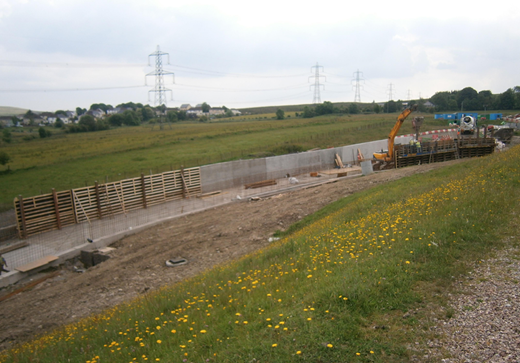
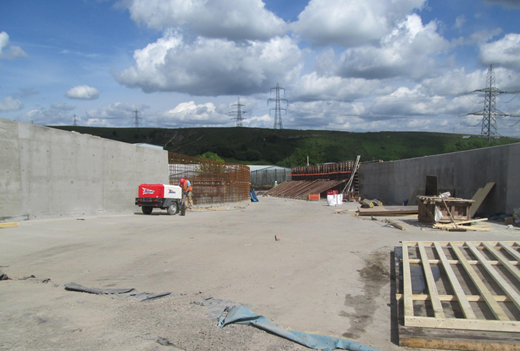
Following the presentation, Paul Tyler the Site Agent from BAM Nuttall Ltd (BNL), gave a guided tour of the site with the assistance of Gareth Humphreys, works supervisor from DCWW. The group was led across the crest of the dam allowing for a good view of the whole spillway section downstream of the existing weir (Figure 1). Paul Tyler explained the BNL method of sequencing the spillway construction working downstream from the transition point where the invert slab is built on top of the existing spillway, and how one of the main challenges to the work has been controlling the water levels within the reservoir for the construction period. Owing to the strategic need for water supply from the adjacent WTW, drawdown is limited while the rate at which levels rise in the reservoir following rainfall also inhibits ‘online work’. In order to avoid delays to the programme, BNL have implemented temporary works, which have allowed spillway flows to be diverted by a bund around the working area allowing the invert slabs to be constructed in halves. Progress to date included approximately 60 m (total chainage around 200 m) of spillway slab constructed along with around 40 m of new side wall on the right-hand side and 20 m on the left-hand side (Figure 2).
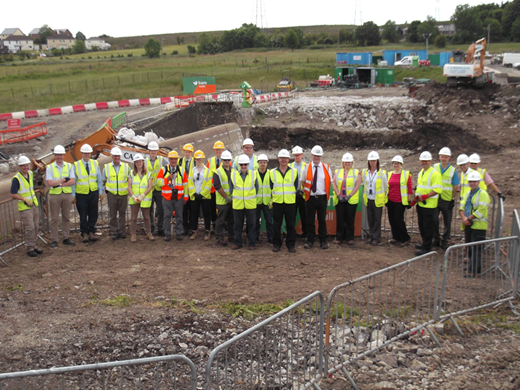
The group was then led to an area overlooking the excavation for the proposed labyrinth weir on the right abutment of the dam (Figure 3). Initially the labyrinth was programmed to be constructed earlier in the project; however, due to persistent wet weather, the water levels in the reservoir had not receded enough to allow this work to commence earlier. During the visit the excavation was in progress to reach formation level for the labyrinth base slab, while the extents of the weir had been marked out for illustration of the magnitude of the structure in comparison to the existing weir, which had been partially broken out in an effort to reduce downtime in works upstream by temporarily lowering the top water level.
The site visit was then concluded with questions from the group.
4. Summary
The site visit demonstrated the challenges of constructing a new spillway online and how the balance between construction flood risk and maintaining water supply has to be managed carefully. These are significant factors which have to be considered for ‘online working’ when the intended use of the dam is for water supply.
The author would like to thank Dŵr Cymru Welsh Water, Black and Veatch and BAM Nuttall for their hospitality and providing an informative site visit.

