Principal agency remains underexplored in non-Western, high-accountability contexts, with implications for leadership learning and practice. This study investigates how Hong Kong principals perceive and enact agency, examining the influence of professional histories, relational dynamics and systemic conditions. It reimagines the principalship as a dynamic, contextually embedded and agency-driven role within complex reform environments.
Using a qualitative life history and narrative methodology, the study draws on semi-structured interviews with 15 principals from Hong Kong. Iterative thematic analysis, supported by memoing and member checking, was employed to explore how principals' experiences and contexts influence their leadership agency and responses to reform.
The study identifies three interrelated dimensions of agency: temporal, experiential and relational dynamics, that shape principals' leadership practices. Principals enact agency through reflection on past experiences, strategic adaptation to present challenges and relational engagement with school communities, while maintaining a values-driven approach that often challenges compliance–oriented expectations.
This study contributes a contextually grounded framework for understanding principal agency, challenging dominant Western leadership models and offering insights into leadership development in high-accountability, socio-politically complex systems. It highlights the need for leadership learning that supports agency, reflexivity and relational practice.
Introduction
School leadership today is characterised by intensifying complexity, driven by global challenges such as equity, accountability, technological advancement, civic unrest, constitutional uncertainty, and health and climate crises (Striepe et al., 2023; Brown and Flood, 2019). These pressures have reshaped the principalship, demanding strategic, adaptive and values-driven leadership (Walls and Louis, 2023). While leadership has long been recognised as a cornerstone of educational improvement (Harris and Jones, 2023; Grissom et al., 2018), the role now extends far beyond instructional oversight. Principals must navigate shifting expectations, lead through uncertainty and sustain school communities amid systemic change (Shaked and Schechter, 2017; De Voto and Superfine, 2023).
Effective school leadership is widely recognised as a key driver of student achievement, teacher retention and school climate (Grissom et al., 2018; Harris and Jones, 2023; Bush, 2022). Principals shape these outcomes through strategic vision, relational engagement and instructional support (Shaked and Schechter, 2017; Gurr, 2024). In high-accountability systems, however, role intensification and leadership turnover often disrupt continuity and impact (DeMatthews et al., 2022). Reflecting these concerns, OECD (2024) and UNESCO (2025) emphasise the pivotal role of principals in driving school and system reform. Understanding how principals enact agency within these constraints is essential for reimagining leadership in complex education systems.
Despite growing global interest in educational leadership, there remains a limited understanding of how principal agency is conceptualised and enacted in non-Western, high-accountability contexts. This study addresses that gap by examining how principals in Hong Kong navigate reform through values-driven, relational and contextually embedded leadership. Understanding how agency is exercised in such settings is critical for informing leadership development, policy design and education reform efforts in increasingly complex and diverse systems. As one principal reflected, “I’m working on the margins in order to shake the core” (Principal 1); a metaphor that encapsulates the strategic and reflective agency this study seeks to illuminate. Drawing on life history and narrative methods, this research explores how principals' professional histories, relational dynamics and systemic conditions shape their leadership practices and exercise of agency. The study aims to reimagine the principalship not as a static role, but as a dynamic practice of agency within complex education systems. It is guided by the following research question:
How do principals' professional histories and experiences, alongside relational, structural and policy contexts, shape their understanding and enactment of agency in leading school improvement and navigating education reform?
Leadership and the principalship
Educational leadership is widely recognised as a key driver of school and system improvement, with the principalship occupying a central role (Campbell, 2025; Harris and Jones, 2023). While traditionally viewed through functional and behavioural lenses, leadership is increasingly understood as a relational practice, enacted through dynamic interactions among individuals, structures and communities (Bush, 2022; Gunter, 2001). This relational framing is especially relevant to principals, who must navigate evolving demands across policy, pedagogy and community engagement (Shaked and Schechter, 2017; Tintoré et al., 2020).
The principalship has undergone significant transformation, shaped by global trends such as new public management, heightened accountability and bureaucratic intensification (Gurr, 2024; Savage, 2021). In contexts like Hong Kong, these pressures are further complicated by socio-cultural dynamics, including hierarchical norms and high power–distance relationships (Kwan and Li, 2015; Lee and Ip, 2021). Leadership is therefore more than a role; it is a practice shaped by experience, context and tradition. Principals' approaches are influenced by career trajectories, professional learning and the socio-political environments in which they operate (Ng and Szeto, 2016; Campbell, 2025). These factors inform how they conceptualise their work, make decisions and enact change (Park and Datnow, 2025).
In this context, agency becomes a critical lens through which to understand leadership, and the leadership exercised by principals. Principals are not merely implementers of policy but active agents who negotiate, resist and reshape the structures around them (Guy, 2019; Giddens, 1999). Their capacity to lead is contingent on their ability to exercise agency within systems that both enable and constrain their actions. This interplay between agency and structure is particularly evident in Hong Kong, where principals must navigate the tensions between policy compliance and community responsiveness (Campbell, 2025; Hilal and Akar, 2023). Understanding leadership through this lens invites a reimagining of the principalship, not as a static position, but as a dynamic and contextually embedded practice, with the principalship not only being a position of leadership, but a role characterised by agency, where individuals shape and are shaped by the systems they inhabit (Thomson, 2010; Hilal and Akar, 2023).
Conceptual framework
This study is grounded in Emirbayer and Mische's (1998) chordal triad of agency, which conceptualises agency as a temporally embedded, socially situated process shaped by past experiences (iterational), present judgments (practical-evaluative) and future aspirations (projective). It also involves intentionality and reflexivity, as principals make purposeful choices aligned with their values and identities (Thomson, 2010; Brewer et al., 2020). This framework provides a dynamic lens for understanding how principals navigate complex systems and policy landscapes, make decisions and enact leadership. By applying this triadic model to the principalship, the study explores how agency may be enacted through context-sensitive leadership practices that are relational, adaptive and reflective in nature (Eteläpelto et al., 2013; Guy, 2019; Samman and Santos, 2009).
While leadership and agency are closely connected, they must be distinguished conceptually. Leadership refers to the practices, roles, and responsibilities enacted within schools and systems, often framed as the practices and activities associated with specific named positions (Evans, 2021; Lumby, 2013). Agency, however, denotes the intentional capacity to act within, with and against structural constraints, enabling leaders and in the context of this study, principals, to interpret, resist and reshape mandates in ways that align with values and contextual needs (Emirbayer and Mische, 1998; Eteläpelto et al., 2013; Guy, 2019). This distinction is also important for moving beyond functionalist and compliance-oriented models of leadership toward relational, reflexive and contextually grounded understandings (Bush and Glover, 2014; Blackmore, 2004).
In contexts like Hong Kong, agency is shaped by socio-political dynamics, hierarchical traditions and accountability pressures, which both enable and constrain principals' actions (Kwan and Li, 2015; Lee and Ip, 2021). While school-based management reforms aimed to empower leaders, they often redistribute responsibility without increasing decision-making power (Campbell, 2023). Thus, agency becomes a space of negotiation, where principals not only operate within structures but also reproduce and reshape them through their leadership (Giddens, 1979, 1999). The Hong Kong case illustrates this well: principals enact leadership within hierarchical traditions and accountability pressures, yet exercise agency to sustain trust, adapt practices and preserve professional identity (Ng and Szeto, 2016; Szeto, 2020).
Methods
Considering this, this study adopts a qualitative, life history and narrative approach to explore how principals in Hong Kong describe their professional trajectories and enact agency in the context of education reform (Clandinin and Connelly, 1998). Life history methods were selected for their capacity to illuminate the temporal, relational and contextual dimensions of leadership, and to capture how principals make sense of their work, identities and decision-making over time (McAdams, 2008; Berger, 2008).
Interviews were guided by a life history protocol adapted from McAdams (2008), designed to elicit narratives around professional trajectories, leadership identity and experiences with reform (see Appendix). The protocol included prompts on high and low points, turning points, reform memories and future aspirations, as well as questions about values and identity. These were intentionally aligned with Emirbayer and Mische's (1998) chordal triad of agency, exploring iterational (past), practical-evaluative (present) and projective (future) dimensions, and with the study's guiding research question: How do principals' professional histories and experiences, alongside relational, structural and policy contexts, shape their understanding and enactment of agency in leading school improvement and navigating education reform? This alignment enabled participants to reflect on how their leadership practices are shaped by experience, context and intention, and how they negotiate reform within complex systems. Table 1 provides an overview of the principals' career trajectories and school sectors, offering contextual insight into the diversity of leadership experience represented in the study.
The analytical approach was guided by Emirbayer and Mische's (1998) chordal triad of agency, which conceptualises agency as iterational (past), practical-evaluative (present) and projective (future). The interview protocol was intentionally designed to elicit narratives across these dimensions: prompts on career trajectories, turning points and reform memories illuminated the iterational dimension; questions on current reform experiences and leadership challenges engaged the practical-evaluative dimension; and reflections on future aspirations and professional life themes addressed the projective dimension. This alignment ensured that the data collection process was not only exploratory but also theoretically grounded, enabling the thematic analysis to connect participants' life histories with the triadic model of agency. In this way, the protocol functioned as both a narrative device and an analytical scaffold, linking principals' accounts directly to the study's conceptual framework.
Fifteen semi-structured interviews were conducted with principals from government-funded primary and secondary schools across Hong Kong between 2024 and 2025. Participants were recruited using purposive, convenience, and snowball sampling strategies to ensure variation in leadership experience, school level and reform engagement. Inclusion criteria required participants to be currently serving as principals in the public sector and having direct involvement in education reform. Principals from international, private or special schools were excluded to maintain consistency in policy context and governance structures. Each interview lasted between 60 and 90 min and focused on professional histories, leadership approaches, turning points in careers and experiences of reform. Interviews were conducted in person or via Zoom, depending on participant preference. The sample included both male and female principals across primary and secondary levels, with varied career trajectories and school contexts, contributing to a rich diversity of perspectives. This sampling strategy supported the study's aim to explore how principal agency is enacted within Hong Kong's public education sector, where reform pressures, hierarchical norms and policy expectations are most acutely felt.
Data were analysed using an iterative thematic approach, supported by reflective memoing and coding. A preset coding framework was initially developed based on Emirbayer and Mische's (1998) chordal triad of agency, iterational, practical-evaluative and projective dimensions, and informed by the structure of the life history interview protocol. The protocol's focus on turning points, reform experiences, identity and future aspirations provided a scaffold for initial thematic categories. The framework was piloted with early transcripts and refined through constant comparison, allowing emergent themes to be integrated while maintaining theoretical coherence. Coding was conducted manually and reviewed across transcripts to ensure consistency and depth. Member checking and reflexivity were employed throughout, including sharing draft findings with participants for feedback and validation (Lincoln and Guba, 1985). This process enabled a nuanced interpretation of how principals' agency was enacted and narrated across varied contexts and experiences (Brewer et al., 2020).
Findings
The thematic analysis of principals' narratives was organised around Emirbayer and Mische's (1998) triad of agency, temporal, experiential and relational, which provided a coherent lens for interpreting how agency is enacted in practice. Yet, the data also revealed context-specific subthemes that reflect the distinctive Hong Kong environment, where hierarchical traditions, accountability pressures and reform histories shape leadership practice. These are highlighted and elaborated on in the following subsections.
Temporal dynamics
In Hong Kong, principals' agency is shaped by a range of temporal dynamics, including their personal career histories, collective reform cycles, hierarchical traditions and socio-political uncertainties, which frame how past experiences and institutional memories inform present leadership and future aspirations. Three subthemes emerged within this dimension: reform histories and policy cycles, navigating hierarchical traditions over time and future aspirations amid socio-political uncertainty. These narratives reflect the iterational dimension of agency (Emirbayer and Mische, 1998), where past roles and accumulated knowledge inform present decision-making. Responses in this section were prompted by questions about career trajectories, turning points and identity, and are situated within Hong Kong's reform histories, where principals must navigate legacies of school-based management and shifting accountability demands (Ng and Szeto, 2016; Szeto, 2020). In response to a prompt about current reform experiences and leadership challenges, one principal noted that:
When I first became the principal here, there were lots of judgments about whether I was following what we’ve been doing for the past 20 years. I felt like I was from Mars, like I didn’t belong, because the school had such a strong identity and history that I had to learn to navigate.
(Principal 6)
Others reflected on the unpredictability of recent years, where shifting societal conditions reshaped their sense of leadership:
That’s a turning point because there’s so much unpredictability in recent years. I understand it’s changing, yet I can’t define it exactly as it is now. It feels like the ground is shifting under us, and I’m constantly trying to make sense of what leadership means in this moment.
(Principal 4)
The changing political atmosphere also shaped principals' roles, forcing them into public positions of representation:
The political atmosphere has made this even more significant. My school is a patriotic school, and during politically sensitive times, that identity brings unique challenges … The PR strategy was that I needed to stand in front, to represent the school. People would send their children to the school because they trusted me. That role forced me to become a kind of public figure.
(Principal 5)
Principals also spoke about aspirations for future transformation, seeing their work as planting seeds that take time to flourish:
My next chapter … I want to see how the seeds flourish. I’ve already seen results for some things I’ve done, but the actual transformation is yet to come.
(Principal 8)
Future orientation was also tied to broader system challenges and preparation for change:
Yeah, because I think if we’re trying to prepare students and the school for the future, we need to think about what that future looks like … I think school leaders themselves have to think about and prepare for these changes. If not, when they come, you’ll just try to keep everything the same and not adapt … we have to prepare them so that they know they’re teaching for the future, preparing the school for the future, and that they are the teachers of the future … The other thing I think I have to do is refine the systems in the school and encourage the teachers or the teaching staff to think more systematically … When they change jobs or schools, they learn new things, and they contribute new perspectives.
(Principal 12)
Together, these accounts highlight how Hong Kong principals draw on past legacies, grapple with present unpredictability, and orient themselves toward future aspirations. Importantly, a range of experiences and expertise developed also influenced their decisions and actions related to this.
Experiential dynamics
In Hong Kong, mandated certification programs for leadership roles, particularly the principalship, often emphasise compliance, yet principals described mentorship and on-the-job learning as more impactful (Walker and Dimmock, 2006; Wong and Liu, 2018). This section explores how experiential dynamics of agency in Hong Kong emerge through mentorship, on-the-job learning and identity work within bureaucratic constraint, highlighting the limits of mandated certification programs and the need for adaptive strategies in high-accountability systems. Within experiential dynamics, subthemes highlighted mentorship and informal preparation, strategic adaptation within bureaucratic constraint and the emotional weight of identity work in high-accountability systems. Data were drawn from prompts about reform experiences, leadership challenges and values alignment. Prompted by a question about high and low points in leadership, and what prepared them for this, principals emphasised the importance of mentorship and experiential learning over formal preparation:
I didn’t learn how to be a principal from the course. I learned it from my mentors, from watching, from failing, and from trying again. Those experiences taught me far more than any certification program could.
(Principal 6)
Others described how their leadership identity shifted from operational management to strategic influence:
I do not micromanage in this role. I love to conceptualize what we are doing and inspire my colleagues … I’m not just a principal. I’m a strategist. I think about how to move people, how to move ideas, and how to shape the culture of the school.
(Principal 1)
The realities of the role, however, were often more constrained than principals had anticipated:
Being a principal in Hong Kong, I’m sorry to say, isn’t what I imagined it would be … there are so many things you can’t change. Even if you complete what’s asked of you or what others expect, that’s already a lot, and beyond that there is little space to do more.
(Principal 2)
These realities, and the learning resulting from varied professional experiences, were also shaped by critical incidents and socio-political pressures. One principal recalled how:
Everyone remembers 2019, but in fact, something smaller happened in 2014 … nearly 100 past students, all dressed in black, gathered in front of the school … wanting to speak with students about their views. As a new principal, we had to manage everything, ensure these people were under control, and make sure they were satisfied … That experience in 2014 shaped my leadership style … it helped build their confidence in me.
(Principal 2)
Learning from such experiences was also tied to identity work and the ways principals understood their positioning within the system. One principal described how being marginalised shaped their practice and sense of agency:
I think I'm working on the margins, in order to shake the core. Myself, always being marginalized. My practice always—your school is special, your kids are blah, blah, blah. Many people think I'm academically very weak because I end up teaching kids with language and learning difficulties. But I believe we need the best people to help the most disadvantaged groups. So, I would say I'm working on the margin all the time, but ultimately, I want to shake the core, change the core by standing on the margins.
(Principal 1)
Others highlighted how reforms and resources influenced their practice:
During the earlier education reforms, teachers struggled significantly … heavy workload—covering everything from lesson delivery to assessments and even administrative tasks … Later reforms improved conditions … schools gained the ability to recruit support staff … Now, with extra resources and staffing, the workload has eased … However, current government deficits may impact this support in the future.
(Principal 3)
Principals also described how they navigated systemic pressures around testing and accountability by reframing expectations:
We’re lucky. We don’t care much about standardized tests. For us, tests are just data that helps us assess our teaching … We don’t feel pressure from standardised testing or school performance measures. We always guide our parents to look at their child’s life over a lifetime, not just for the next six years … We don’t need to be controlled by the traditional rules of the game. We know the rules, but we actively choose how to play the game … we play it trickly, I’m just like a gambler, but we find creative ways to play within them.
(Principal 8)
Formal preparation programs were also discussed, with principals reflecting on both their value and limitations:
The principals’ program gave me an overview and the theory … One valuable part was connecting with other senior teachers … Some people finish the program and realize the principal’s role isn’t what they expected … especially after having to submit a 30-page portfolio … The program is useful for the basics and for hearing stories from serving principals … that real-life sharing is valuable.
(Principal 12)
Together, these accounts highlight how Hong Kong principals construct their leadership identities through lived experiences, mentorship, reform legacies and professional preparation. They reveal the unique pressures of leading in a system marked by socio-political incidents, bureaucratic constraint and evolving policy environments, while underscoring the importance of human connection, adaptability and learning from varied experiences over time, beyond the expectations of formal or compulsory programmes. Intrinsic to many aspects of the experiential dynamics has been the role of interaction, relationships and collaboration with others.
Relational dynamics
This section highlights how relational dynamics in Hong Kong are negotiated within high power-distance traditions and accountability pressures, where principals cultivate trust, mobilise staff and community relationships and use interpersonal engagement to soften or reinterpret systemic demands. Three subthemes were evident: negotiating hierarchical relationships, engaging communities under policy pressure and exercising relational agency as a form of resistance through trust and collaboration. These reflections engage both the relational and projective dimensions of agency, revealing how values, interpersonal engagement and future aspirations shape leadership. Insights were drawn from questions about leadership approach, reform memories and professional life themes.
One principal reflected on the importance of prioritising people in leadership practice, when prompted by a question about their leadership approach:
Handling things. Although many people find it challenging, it’s actually easier to handle things when you handle people first.
(Principal 8)
Another principal, in response to a prompt about values and reform experiences, emphasised the humanistic dimension of leadership, resisting the reduction of education to metrics and frameworks:
I don’t care about your curriculum framework. I don’t care about your statistics. I don’t care about your expected output outcome. I care about, you know, are we considering our students as human?
(Principal 1)
The relational nature of the principalship was also described in terms of emotional labour and support. One principal shared:
I’m more of a social worker and a life coach than a school principal … I need to listen a lot to them.
(Principal 2)
Another underscored the intensity of this emotional burden:
Sometimes I feel like I carry the emotional weight of the whole school. It’s not just about decisions, it’s about people’s lives.
(Principal 5)
Collaboration and shared purpose were also central to these reflections. One principal described a particularly meaningful high point in their leadership career:
The spirit of being together and working toward something as a team, that part was really a high point in my life as a principal.
(Principal 3)
Another articulated their role as one of unification and hope:
My job as principal is to bring people together and to give hope … In every conversation, we walk together. Growing together is a bonus, but the key is walking together.
(Principal 4)
Within this, the importance of team dynamics was again emphasised:
If the team is good enough, no matter what you are doing, the effect is multiplied … if you can’t manage your team, you’ll fail easily.
(Principal 13)
However, relational dimensions of leadership were also shaped by broader systemic and cultural influences. One principal expressed concern about how new principals may be more focused on compliance than on relational or community-based leadership:
I feel that those who truly care about education, they don’t want to be principals. For those who want the position, the pay, the status, they want to be principals … new principals often get into trouble because they don’t know enough about the rules and regulations. They’re unaware of the details they need to handle.
(Principal 2)
This reflection points to the tension between relational dimensions of leadership and systemic constraints, where principals must navigate hierarchical norms and accountability pressures that can limit their capacity to lead relationally, and exercise agency. Several principals emphasised that reform is relational, not procedural. As one noted:
You can’t lead reform if you don’t understand your people. Reform is not a document, it’s a relationship.
(Principal 7)
Finally, principals spoke about the enduring nature of unresolved relational challenges:
One thing I’ve learned is … if there are problems you’re struggling to resolve, you can’t leave them behind … it will stay with you for the rest of your life.
(Principal 7)
Together, these reflections illustrate how Hong Kong principals enact agency through relational strategies, building trust, fostering collaboration and navigating cultural and systemic norms. Relational dynamics of leadership practice and the exercise of agency were found to be central to how principals influence their schools, support their communities and sustain their own sense of purpose within complex education systems and environments (Bush and Glover, 2014; Shaked and Schechter, 2017; Guy, 2019).
Discussion
This study addressed the research question: How do principals' professional histories and experiences, alongside relational, structural and policy contexts, shape their understanding and enactment of agency in leading school improvement and navigating education reform? The findings indicate that principals enact agency through temporal reflection on reform histories, experiential adaptation within bureaucratic constraints and relational negotiation of socio-cultural norms and traditions. In doing so, they illustrate how agency is exercised as both constrained and enabled by Hong Kong's socio-political context. These insights extend Emirbayer and Mische's (1998) chordal triad of agency by situating it within a high-accountability, Confucian-heritage system and align with recent scholarship emphasising the relational and contextual nature of leadership (Bush, 2022; Harris and Jones, 2023; Ng and Szeto, 2016). Importantly, the findings also highlight implications for leadership preparation: principals consistently described how mentorship, identity work and learning from experience were more influential than formal certification programs in cultivating agency (Walker and Dimmock, 2006; Wong and Liu, 2018; Eteläpelto et al., 2013).
The findings were organised around three interrelated dimensions of principal agency, temporal, experiential and relational. These dimensions were developed through thematic analysis of the life history interviews, which prompted principals to reflect on formative experiences, leadership challenges and values-driven aspirations. The structure of the interview protocol, which included prompts about turning points, reform encounters and professional identity, shaped the analytic process and ensured alignment with the study's objective to examine how principals in Hong Kong narrate and enact their leadership agency within a high-accountability education system shaped by reform pressures, hierarchical norms and shifting policy expectations. This approach enabled a coherent interpretation of how principals navigate reform, enact leadership and construct meaning within their professional trajectories. Together, these three dimensions shape principals' leadership practices, and they enact agency through reflection on past experiences (iterational), strategic adaptation to present challenges (practical-evaluative) and relational engagement with school communities (projective). Principals negotiate and reshape structural constraints by exercising agency that is both contextually embedded and future-oriented; reframing limitations through strategic and relational action (Eteläpelto et al., 2013; Hitlin and Elder, 2007).
The Hong Kong context, marked by Confucian traditions, hierarchical norms and School-Based Management (SBM) reforms, presents unique challenges for leadership. Principals must balance compliance with creativity, navigating accountability pressures while responding to community needs. Principals also, for example, reframed accountability cultures by resisting the narrowing effects of testing regimes. As Principal 8 explained, assessments were not treated with the same dominance as perhaps intended systemically, with parents guided to consider their child's education over a lifetime rather than short-term performance. This illustrates how experiential dynamics of agency in Hong Kong can involve redefining what counts as success, creatively “playing the game” within systemic rules while sustaining values-driven practice (Walker and Dimmock, 2006; Wong and Liu, 2018). Principal 2's concern that new principals are more focused on compliance than relational leadership highlights the tension between bureaucratic expectations and values-driven practice. These dynamics are compounded by broader socio-political forces, including nationalisation and re-politicisation, which influence identity and governance in schools (Fung and Pun, 2021; Lin and Jackson, 2020; Tang et al., 2022).
The accounts of the principals in this study also show how they construct agency from possible positions of marginalisation. As Principal 1 reflected, working “on the margins” became a deliberate strategy to challenge dominant expectations and reimagine the core purposes of schooling. This highlights how agency in Hong Kong is not only adaptive but can also be oppositional, enacted through values-driven practice that seeks to disrupt compliance cultures and re-centre disadvantaged communities (Blackmore, 2004; Eteläpelto et al., 2013; Thomson, 2010). The findings suggest that conceptions of leadership in relation to agency, leadership preparation and professional learning, should support the development of agency across all three dimensions; temporal, experiential and relational. Programs should include mentoring, identity work and context-sensitive learning that develops reflective practice, emotional resilience and strategic thinking (Chen-Levi et al., 2024; Lee and Ip, 2021).
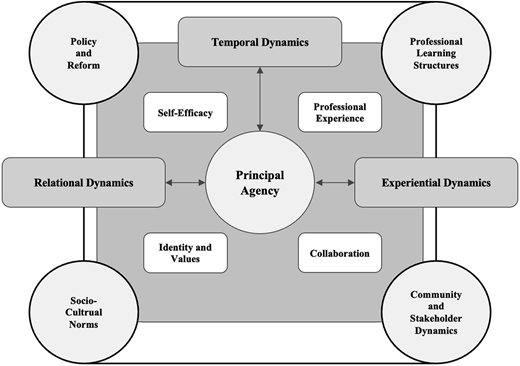
Hong Kong's context illustrates how principals' agency is enacted within hierarchical traditions, accountability pressures and postcolonial policy environments. These dynamics offer lessons for other systems facing similar constraints. To synthesise the findings and their implications for how principal agency is conceptualised, enacted and supported, Figure 1 presents a framework that integrates the temporal, experiential, and relational dimensions identified in this study. Building on Emirbayer and Mische's (1998) chordal triad of agency, this framework illustrates how principals' leadership practices are shaped by their past experiences (iterational), their capacity to respond to present challenges (practical-evaluative) and their aspirations for the future (projective).
In addition, the framework highlights four contextual domains that shape how agency is enacted in practice. Professional learning structures provide both opportunities and constraints, with mandated certification and mentoring shaping how principals develop adaptive capacity (Walker and Dimmock, 2006; Wong and Liu, 2018). Community and stakeholder dynamics emphasise the relational dimension of agency, as principals negotiate trust and expectations across parents, teachers and wider networks (Lee and Ip, 2021). Socio-cultural norms, rooted in Confucian heritage and hierarchical traditions, frame how authority, leadership and collaboration are understood, often constraining innovation while reinforcing collective responsibility (Kwan and Li, 2015; Szeto, 2020). Finally, policy and reform initiatives, such as school-based management, redistribute accountability without necessarily increasing autonomy, requiring principals to act within and against systemic structures (Ng and Szeto, 2016; Campbell, 2023). This framework is grounded in Hong Kong's realities, illustrating how agency is negotiated within hierarchical traditions, accountability pressures and policy reforms. At the same time, it can be mobilised across diverse contexts to inform conceptions of leadership and agency, leadership learning and policy design internationally, advancing more contextually sensitive understandings of the principalship and how principals exercise agency (Dimmock and Yong Tan, 2013).
Leadership and agency, while closely connected, are not synonymous. Leadership refers to the practices, roles and responsibilities through which principals guide schools and communities, whereas agency denotes the capacity to act intentionally within and against structural constraints (Humphreys and Rigg, 2020). Distinguishing between the two is critical as leadership can be exercised in compliance with external mandates, but agency reflects the ability to interpret, resist and reshape those mandates in ways that align with values and contextual needs (Emirbayer and Mische, 1998; Eteläpelto et al., 2013).
The Hong Kong context illustrates this distinction. School-based management reforms redistributed accountability without increasing autonomy, requiring principals to enact leadership within rigid policy frameworks while simultaneously exercising agency to sustain relational trust, adapt practices and preserve professional identity (Ng and Szeto, 2016; Szeto, 2020). These insights highlight how agency is not an abstract construct but a lived practice of negotiation in high-accountability, hierarchical systems (Humphreys and Rigg, 2020; Lee and Ip, 2021). Internationally, this offers lessons for other contexts facing similar tensions between compliance and innovation: agency enables leaders to move beyond technical enactment of policy toward reflexive, values-driven leadership that sustains communities under pressure (Thomson, 2010; Guy, 2019).
Considering this, agency should be conceptualised as something that is not a heroic or singular act, but a situated, negotiated and embedded process of sensemaking, decision-making and action, reflective of a principal's systemic socio-political and cultural context (Acton, 2021l Chen-Levi et al., 2024; Eteläpelto et al., 2013). Leadership preparation must go beyond technical skill-building to cultivate emotional resilience, reflective practice and agency-driven decision-making amid uncertainty (Tintoré et al., 2020; Chen-Levi et al., 2024). At the same time, principals emphasised that relational dynamics of agency are inherently collective. As Principal 13 noted, team cohesion multiplies leadership impact, while Principal 4 described leadership as “walking together” with staff and communities. These accounts highlight that agency in Hong Kong is not enacted individually but through a sense of collectivity, where the strength of teams and shared purpose sustain leadership capacity (Bush and Glover, 2014; Shaked and Schechter, 2017).
Principals' accounts highlighted also how agency in Hong Kong is exercised in schools, but also in public arenas. As Principal 5 described, politically sensitive contexts require principals to act as public figures, embodying school identity and managing community trust. This highlights how temporal dynamics of agency are shaped by socio-political pressures unique to Hong Kong, where principals negotiate both institutional legacies and public representation (Kwan and Li, 2015; Szeto, 2020). Professional learning should be grounded in context, recognising how cultural norms, policy frameworks and institutional expectations shape leadership enactment (Kwan and Li, 2015; Lee and Ip, 2021).
Taken together, these findings suggest that policy and leadership development in Hong Kong and internationally should respond to agency as a central capacity of school leaders. Supporting leaders to exercise agency, through mentoring, relational networks and opportunities for reflexive practice, can enable them to navigate uncertainty, sustain communities and reimagine the principalship in ways that are both contextually grounded and internationally relevant (Blackmore, 2004; Guy, 2019; Ng and Szeto, 2016; Szeto, 2020). Leadership learning should equip principals to make sense of context, politics and systemic drivers, enabling them to actively interpret, decide and reshape their role in pursuit of community responsiveness and needs. Such an approach aligns with calls for reflexive and context-sensitive leadership development that recognises agency as central to navigating complexity (Eteläpelto et al., 2013; Blackmore, 2004; Dimmock and Yong Tan, 2013).
Conclusions
The quote “I'm working on the margins in order to shake the core” (Principal 1) encapsulates a central tension in this study: principals operate within tightly governed systems, yet enact agency through strategic, relational and values-driven leadership. Rather than overt resistance, they influence reform by leveraging the margins as spaces of creativity, reflection and quiet disruption to reshape practices, priorities and perceptions.
This study highlights how principals in Hong Kong navigate reform through experiential, temporal and relational dynamics of agency (Emirbayer and Mische, 1998; Hitlin and Elder, 2007). Their leadership is shaped by professional histories, cultivated values and relational engagement, enacted within a context marked by centralised governance, accountability pressures and socio-cultural complexity (Lee and Ip, 2021; Kwan and Li, 2015; Szeto, 2020). Unlike dominant Western models that emphasise autonomy or distributed leadership, Hong Kong's principalship reflects strategic negotiation within constraint. Life history narratives reveal how principals lead with purpose, adapting to shifting demands while maintaining a values-driven approach (Guy, 2019; Thomson, 2010;Chen-Levi et al., 2024).
The study contributes a contextually grounded framework for understanding principal agency, challenging universalist assumptions and broadening the epistemic foundations of educational leadership. It underscores the need for leadership development and policy design that support reflexivity, relational practice and strategic adaptability (Ng and Szeto, 2016; Armstrong et al., 2020; Aas and Paulsen, 2019). Ultimately, the principalship is reimagined not as a static role but as a dynamic, agentic practice shaped by context and enacted through intentional engagement with community and change. The Hong Kong case further illustrates how principal agency is enacted at the level of the individual, but influenced by relational dynamics that are inherently collective. This is also shaped by the need to navigate systemic pressures, political sensitivities and accountability demands while maintaining a values-driven orientation. Agency here is expressed through personal judgment and intentional practice, highlighting the importance of leadership learning that cultivates the capacity to interpret, adapt, and act within complex environments (Guy, 2019; Kwan and Li, 2015; Szeto, 2020). Further research is needed to explore how agency is exercised across diverse systems and traditions, and how leadership can be supported in ways that are responsive, equitable and sustainable.
Acknowledgement and gratitude go to Professor Amanda Datnow and Dr Vicki Park for their support and collaboration in conceptualising this study and for their initial design of interview protocol, which was developed based on the work of Dan P. McAdams, The Foley Center for the Study of Lives Northwestern University, Revised, 2007.
See: (McAdams, 2008; Park and Datnow, 2025)
Appendix
Interview protocol
Principal Life History Interview Protocol
Background
Number of years teaching
Schools taught in (including principalship)
Number of years as principal
Number of schools as a principal
Professional trajectory
Walk me through your professional life from beginning to now.
How would you describe your leadership approach?
Key life-history scenes
High point: Describe a time in your life as a principal that stands out as an especially positive experience.
Low point: Describe a time that stands out as a low point in your life as a principal.
Turning point: Describe an episode you now see as a turning point in your professional life.
Positive reform memory: Describe an especially positive experience with educational reform.
Negative reform memory: Describe an especially negative experience with educational reform.
Current reform experience: Describe your current experiences with educational reform in your school and district.
Identities: What identities are most salient or important in your professional and personal life?
Future orientation
What do you see as the next chapter in your principalship?
(If applicable) When did you know it was time to retire?
Challenges and reflections
What is the greatest challenge you have faced as a principal?
What is the greatest failure or regret you have experienced in your career?
Looking across your life story, do you discern a central theme or message?
Additional reflections
What else should I know to understand your professional life story?
What lessons from your experience would be helpful to new principals or to those who support principals?
Is there something you have read or learned that has shaped your thinking?
Related leadership questions
Describe something you have done that has been successful in improving teaching, learning, or your school/community.
What was the problem, issue, or goal? Why was it important?
What did you do?
How did the effort evolve?
What did you learn, or what advice would you give to someone doing similar work?
What are you working on now?