Complex adaptive systems (CAS) theory offers a useful lens for understanding entrepreneurial ecosystems (EEs), yet little is known about how CAS mechanisms manifest in resource-constrained metropolitan ecosystems in developing economies. Responding to calls for place-sensitive ecosystem research that studies EEs as a CAS, this study aims to examine how CAS mechanisms enable or constrain EE development in Nelson Mandela Bay, South Africa.
A mixed-methods design was used. Survey data from 300 economically active participants were analysed using multiple linear regression to identify salient ecosystem components, followed by 15 semi-structured interviews with key stakeholders analysed through thematic analysis and integrated using joint displays. CAS concepts – emergence, self-organisation, nonlinearity and feedback loops – were used as interpretive lenses across both phases.
Culture and city planning emerged as significant predictors of ecosystem perceptions, while business environment constraints inhibited development. Qualitative analysis revealed maladaptive self-organisation, weak institutional coordination and infrastructure failures, reinforcing negative feedback loops. The findings highlight constraint-dependent emergence, whereby constrained ecosystems generate partial adaptive responses that compensate for, rather than transform, systemic dysfunction.
The study provides an empirical example of CAS mechanisms operating in a resource-constrained metropolitan EE – a context underexplored in CAS–EE scholarship, focused primarily on well-resourced or institutionally stable ecosystems. The primary contribution is the theorisation of constraint-dependent emergence – a novel CAS concept identifying the specific boundary conditions under which constrained ecosystems generate partial adaptive responses. This extends path dependency theory, institutional voids scholarship and evolutionary EE frameworks. Methodologically, the study advances mixed-methods integration through theory-driven thematic analysis and causal loop diagramming of feedback mechanisms.
1. Introduction
Entrepreneurial ecosystems (EEs) have gained prominence as a regional development strategy, yet theoretical refinement has lagged, and limited sub-national data and fragmented conceptualisation continue to constrain understanding, particularly in developing economies where place-based capabilities remain underused (Bailey et al., 2018; Buratti et al., 2023; Candeias and Sarkar, 2024; Cantner et al., 2020; Hess et al., 2025; O’Connor and Audretsch, 2023; Spigel et al., 2020). Existing approaches often fail to account for the complex, non-linear relationships among actors and institutions, resulting in policy prescriptions that overlook systemic interdependencies (Buratti et al., 2023; Candeias and Sarkar, 2024).
Against this background, complex adaptive systems (CAS) theory provides a useful corrective by emphasising how system-level outcomes emerge from decentralised agent interactions, nonlinearity and adaptive responses (Anderson, 1999; Roundy et al., 2018). While prior studies have observed CAS mechanisms in successful ecosystems, such as Zhongguancun (Han et al., 2021) or the US space ecosystem (Carter and Pezeshkan, 2023), the concept remains underexplored in resource-constrained contexts. Resource-limited ecosystems often exhibit institutional fragmentation, infrastructural strain and weak system boundaries that intensify nonlinear dynamics (Boucher et al., 2025; Duodu et al., 2024; Hess et al., 2025; Wurth et al., 2023).
Under these conditions, small disturbances can cascade across the system, negative feedback loops become self-reinforcing and adaptation is inhibited by structural rigidities. Such dynamics help explain why linear policy interventions have yielded limited entrepreneurial development in resource-constrained metropolitan EEs. CAS, therefore, offers an analytically appropriate lens for diagnosing how systemic frictions suppress emergence, coordination and growth. This study advances CAS–EE scholarship by introducing the concept of constraint-dependent emergence, which describes how resource scarcity and institutional fragmentation alter self-organising dynamics, producing maladaptive rather than productive ecosystem outcomes.
Nelson Mandela Bay (NMB), in South Africa, is experiencing these challenges. The country continues to experience declining GDP per capita, high inequality and persistent unemployment (Galan, 2025; World Bank Group, 2025), as well as ecosystem dysfunctions that constrain productive entrepreneurship. Therefore, the application of CAS theory to examine EE dynamics in NMB allows us to make three contributions: extending CAS application to a resource constrained metropolitan ecosystem; theorising constraint-dependent emergence as a novel CAS mechanism and demonstrating how emergence, self-organisation and nonlinear feedback loops manifest under resource constraints through a mixed-methods design; and providing evidence-based, actor specific insights for policy and ecosystem coordination.
2. Literature review
2.1 Entrepreneurial ecosystems – an overview
EEs represent geographically concentrated networks of interconnected actors that collaborate to foster new venture creation (Malecki, 2018; Wurth et al., 2022). These actors (i.e. governments, universities, large firms, mentors and service providers) form multi-stakeholder systems that advance socio-economic transformation (Thai et al., 2023; Wurth et al., 2022, 2023). However, EEs are inherently place-specific, shaped by local resource endowments and institutional contexts (Mason and Brown, 2014; Paprotny, 2021).
This study adopts the Elements and Outputs of the Entrepreneurial Ecosystem model (Stam and van de Ven, 2021), which distinguishes between foundational resources and institutional arrangements as inputs and productive entrepreneurship as the output. These layers enable venture creation and innovation through mechanisms such as signalling, reducing entry barriers and facilitating knowledge diffusion (Vedula and Kim, 2019). The study operationalised eight factors aligned to this framework (Leendertse et al., 2022; Stam, 2015):
Entrepreneurial culture refers to the shared norms, values and trust that shape motivation, innovation and social legitimacy within a community. It influences how entrepreneurship is perceived and whether it is viewed as achievable.
The regulatory framework includes laws and government policies that enable or constrain market participation and institutional efficiency. Strict and complex regulations and barriers to entry impede economic growth and competitiveness.
Business environment captures broader institutional quality, including perceived corruption, bureaucratic efficiency and service delivery reliability (Small Business Institute, 2021a). While not a core construct in Stam and Van de Ven’s model, it represents the implementation layer of formal institutions, which significantly shapes entrepreneurial behaviour in emerging economies.
Finance pertains to financial resources for investing in entrepreneurial activities within an ecosystem. Access to funding (credit, venture capital, grants) affects entry and scaling potential.
Human capital reflects access to skilled labour and the role of education in shaping entrepreneurial capabilities.
City planning refers to the spatial arrangement of economic activity, including infrastructure and zoning. Poor spatial design limits embeddedness, agglomeration benefits and knowledge spillovers (Audretsch et al., 2015).
Business support services provide mentorship, information access and operational support.
Entrepreneurial intention captures individuals’ opportunity perception, risk tolerance and confidence, which are key precursors to entrepreneurial behaviour (Tehseen and Anderson, 2020; Boucher et al., 2023).
To strengthen conceptual precision and avoid construct overlap, particularly between institutional and resource dimensions, several distinctions warrant clarification. First, Entrepreneurial Culture, Regulatory Framework and Business Environment represent analytically distinct institutional pillars. Culture denotes shared norms and legitimacy beliefs shaping risk-taking and entrepreneurial desirability (Boucher et al., 2023; Spigel, 2015). In contrast, the Regulatory Framework comprises formal rule-based structures governing firm entry and compliance (Stam, 2015).
The Business Environment, firstly, reflects the implementation quality of institutions, bureaucratic efficiency, corruption and municipal performance, which may diverge significantly from both cultural norms and formal regulations, especially in emerging economies (Small Business Institute, 2021a). Secondly, Human Capital and Entrepreneurial Intention operate at different analytical levels. Human Capital refers to ecosystem-level skill availability and absorptive capacity (Vedula and Kim, 2019), whereas Entrepreneurial Intention captures individual-level cognitive and motivational orientations towards entrepreneurship. Distinguishing these constructs aligns with models separating resource endowments from agent-level entrepreneurial agency.
To refine the paper’s conceptual precision, the eight factors we explained are positioned within the micro–meso–macro structure of EEs (Roundy et al., 2018; Van Rijnsoever, 2020; Fuentes et al., 2024). Micro-level elements capture individual cognitive attributes (Entrepreneurial Intention). Meso-level elements concern organisational and network structures that facilitate coordination, including Business Support Services and Human Capital. Macro-level elements refer to system-wide institutional and structural conditions – Entrepreneurial Culture, the Regulatory Framework, the Business Environment, Finance and City Planning. This classification underscores the layered nature of ecosystems and clarifies why these constructs represent distinct, non-overlapping dimensions.
In spite of their sophistication, most EE models still assume linear and stable relationships, overlooking feedback loops, emergence and adaptation (Hess et al., 2025; Stam and van de Ven, 2021; Wurth et al., 2023). Three foundational assumptions underpin mainstream EE models, namely, linearity (inputs produce proportional outputs), stability (ecosystems tend towards equilibrium) and additive causality (factors combine in predictable, measurable ways). These assumptions hold tolerably well in well-resourced, institutionally stable economies where ecosystem elements are relatively coherent, and actors interact predictably. However, Cao and Shi (2021) confirm that each of these assumptions breaks down systematically in emerging economies, where resource scarcity, structural gaps and institutional voids disrupt the element interactions the models assume. Firstly, linearity fails: small shocks – such as a single municipal leadership collapse or a policy reversal – can produce cascading, system-wide deterioration disproportionate to their apparent scale, as NMB’s chronic underspending cycle illustrates. Secondly, stability fails: rather than self-correcting towards equilibrium, resource-constrained ecosystems may lock into maladaptive trajectories where institutional volatility and infrastructure decay become self-reinforcing (Cloutier and Messeghem, 2022). Thirdly, additive causality fails: qualitative evidence consistently shows that interventions that succeed in one domain are simultaneously undermined by constraints in another – a CAS property of co-evolution that regression coefficients cannot capture (Carter and Pezeshkan, 2023).
2.2 Complex adaptive systems theory and entrepreneurial ecosystems
CAS theory addresses these assumption failures by explaining how system-level outcomes emerge from decentralised interactions among heterogeneous agents rather than from predetermined structures or sequential growth stages. This study follows Carter and Pezeshkan’s (2023) call for analysing EEs as a CAS but extends this lens to a resource-constrained context. Adaptive-cycle, co-evolutionary and institutional approaches recognise interdependence but generally conceptualise ecosystem development as progressive or cyclical, limiting their ability to explain stagnation and nonlinear collapse. These models cannot fully explain why ecosystems in developing regions frequently become locked into stagnation, how negative feedback loops emerge or why small shocks generate disproportionate systemic effects (Brown and Mason, 2017; Pindado et al., 2023). This limits their ability to account for the volatility, institutional fragmentation and structural constraints typical of under-resourced contexts.
CAS theory provides a complementary lens by focusing on how system-level outcomes emerge from decentralised interactions among heterogeneous agents, rather than from predetermined structures or sequential growth stages (Anderson, 1999; Phillips and Ritala, 2019). CAS helps explain three features of ecosystem behaviour that linear and sequential frameworks struggle to capture (Carter and Pezeshkan, 2023):
Emergence – ecosystem-level capabilities arise from the interaction of agents rather than from formal structures.
Nonlinearity – small changes can trigger amplified or cascading effects.
Adaptive dynamics – ecosystems evolve in response to both internal interactions and external shocks.
Recent advances in CAS–EE scholarship offer explicit frameworks for analysing these mechanisms. Roundy et al. (2018) conceptualise EEs as emergent systems governed by self-organisation; van Rijnsoever (2020, 2022) emphasises their multilayered structure across micro, meso and macro levels; Han et al. (2021) highlight dynamic feedback loops underpinning ecosystem evolution; and Fuentes et al. (2024) show how multilevel interactions shape ecosystem complexity. Daniel et al. (2022) provide a parsimonious CAS-based 4P framework, people, place, purpose and process, demonstrating that EEs are self-organising systems where macro-level patterns emerge from micro-level interactions; however, their framework is applied to a well-institutionalised rural agribusiness EE in Western Australia.
Against this background, the authors find that a CAS perspective is particularly suited to resource-constrained ecosystems such as those in South Africa, where institutional volatility, fragmented governance, high informality and spatial misalignment generate conditions in which nonlinearity and maladaptive feedback loops dominate (Boucher et al., 2023; Duodu et al., 2024). Under these conditions, emergent processes can be suppressed rather than amplified; self-organisation may produce regressive rather than productive coordination; and adaptation may be constrained by infrastructural or institutional rigidities rather than enabled by them. High informality in resource-constrained contexts generates distinct entrepreneurial dynamics, which include necessity-driven activity, partial substitution for absent formal institutions and layered informal networks that mainstream EE frameworks are ill-equipped to capture (Welter et al., 2015, 2017). CAS therefore offers a theoretically appropriate framework for understanding why ecosystems in South Africa and comparable contexts often struggle to transition from survivalist activity to productive, innovative entrepreneurship.
CAS framing resonates with emerging evidence from resource-constrained developing-economy EEs. In Latin America, Muñoz et al. (2022) demonstrate through configurational analysis of Chilean local EEs that ecosystem outcomes arise from non-additive, place-specific configurations of attributes rather than the universal linear combinations assumed by mainstream frameworks, revealing a “passive self-absorbed” ecosystem type in which cultural resilience persists in spite of absent financial support and constrained market dynamism. Similarly, Boucher et al. (2023) and Duodu et al. (2024) show how governance failures and structural exclusion in South African metropolitan ecosystems generate self-reinforcing negative feedback loops that suppress productive entrepreneurship, consistent with the maladaptive lock-in dynamics theorised here.
To guide the empirical analysis, the study links CAS mechanisms to the ecosystem elements operationalised. Entrepreneurial Culture reflects shared norms that enable or inhibit self-organisation; the Regulatory Framework and Business Environment represent institutional boundary conditions and feedback mechanisms that either stabilise or distort system coherence. Finance, Human Capital and Business Support Services affect adaptive capacity and resource flow, while City Planning shapes system boundaries and spatial connectivity that influence emergence. Finally, Entrepreneurial Intention captures micro-level cognitive mechanisms that activate adaptation. Therefore, these elements operationalise CAS mechanisms: emergence, self-organisation, nonlinearity, feedback loops and adaptation – providing a coherent bridge between CAS theory and the empirical measures used in this study.
Building on this comparative foundation, the study develops constraint-dependent emergence as its primary theoretical contribution: the condition in which ecosystem-level capabilities arise not in spite of structural adversity but through it, as agents adapt, recombine and self-organise in response to chronic resource scarcity and institutional dysfunction. The concept differs from three adjacent constructs. Unlike the standard CAS notion of emergence, it does not presuppose neutral or enabling conditions. Unlike resilience (Roundy et al., 2018; Iacobucci and Perugini, 2021), which concerns system recovery after periodic disturbance, it treats chronic adversity as the generative condition itself. Unlike bricolage (Baker and Nelson, 2005), a firm-level strategy of resource recombination, it theorises how interactions among multiple agents under shared structural constraints produce system-level capabilities irreducible to individual resourcefulness. The concept applies where formal institutional channels are blocked or unreliable; agents hold heterogeneous adaptive strategies enabling local substitution for missing system functions; and ecosystem outputs, however suboptimal, continue to emerge through informal, bottom-up mechanisms. NMB partially meets these conditions, making it a theoretically informative site for observing constraint-dependent emergence in action.
In sum, the literature reveals a clear theoretical gap. Mainstream EE frameworks rest on assumptions of linearity, stability and additive causality that break down under chronic constraint, while existing CAS–EE scholarship has been developed almost exclusively in well-resourced or institutionally stable ecosystems. What remains untheorised is how emergence, self-organisation, nonlinearity and feedback loops operate where constraint is the permanent condition rather than a temporary disturbance – and whether emergence under such conditions takes a qualitatively different form. This study addresses that gap through a mixed-methods examination of NMB and the theorisation of constraint-dependent emergence.
3. Methods
3.1 Case study: Nelson Mandela Bay, South Africa
NMB comprises a dense network of interdependent actors whose interactions produce both enabling and constraining dynamics. Key ecosystem actors include municipal government departments, the Coega Special Economic Zone, anchor firms within the automotive manufacturing cluster, Nelson Mandela University, business support organisations (e.g. The Business Place and the NMB Business Chamber), township-based micro-entrepreneurs and informal traders (Nelson Mandela Bay Municipality, 2025). These actors are linked through supply chains, procurement networks, training partnerships and labour market flows, creating interdependencies characteristic of EEs. However, these relationships operate within a context of extreme structural constraints: an estimated 87.4% of micro-enterprises operate informally (Boucher et al., 2023).
Expanded unemployment in the metro exceeds 35% (Democratic Alliance Eastern Cape, 2025), with youth unemployment nearing 50%, and historic spatial fragmentation continues to limit access to markets and industrial zones. These conditions generate feedback loops that are consistent with CAS mechanisms – for example, infrastructural failures reduce firm productivity, which undermines municipal revenue and further weakens service delivery; similarly, high informality weakens the tax base, which constrains public investment and reinforces infrastructural decay. These features demonstrate that NMB operates as a dynamic but fragile EE shaped by interacting agents and recursive constraints, making it an analytically rich context for empirical testing.
3.2 Sampling and data collection procedure for Phase I and Phase II
3.2.1 Sampling.
Given the complex, multi-agent nature of EEs (Stam and van de Ven, 2021; Thai et al., 2023) as directed by CAS, this study made use of purposive sampling to capture diverse ecosystem actors and their interactions while using a mixed-method research design, as it provides an empirical inquiry on a contemporary phenomenon within a real-world context (Yin, 2014; Han et al., 2021). CAS requires an understanding of both individual agent behaviours and system-level properties that emerge from their interactions (Roundy et al., 2018). In particular, EEs are characterised as human-constructed responses by sets of actors who co-create through intentional actions and shared goals to promote entrepreneurial activity (Stam and Spigel, 2018).
The target population was divided into economically active actors and economic development agents. CAS emphasises that systems are composed of heterogeneous agents who produce emergent system-level properties (Anderson, 1999; Roundy et al., 2018). Applied to EEs, these agents operate across micro, meso and macro levels (Fuentes et al., 2024; Roundy et al., 2018), with economically active actors, entrepreneurs and SME operators constituting the micro-level agents whose adaptive behaviours drive bottom-up self-organisation. Economic development agents (ecosystem feeders such as incubators, development finance institutions and municipal bodies) represent meso-level actors whose intermediary functions shape the feedback loops, resource flows and institutional boundaries that condition micro-level activity. Capturing both agent types is, therefore, essential to observing the multi-level interactions – specifically, the recursive feedback between micro-level adaptation and meso-level institutional response – that are central to the CAS analytical framework applied in this study. A single-agent-type sample would collapse this heterogeneity and prevent the identification of cross-level CAS mechanisms. All individuals who formed part of the target population provided skills and insights regarding processes and market opportunities created by employment (Spigel, 2017).
The sample for the quantitative component (Phase I) included economically active actors who work for or operate a business in NMB. These individuals fall into the following categories: start-up, micro-enterprises (i.e. mostly informal), small and medium enterprises, big business, corporate or multinational enterprises. The selection of the start-ups, micro-enterprises and SMEs is centred around the role of the entrepreneur as creators of new ventures who have successful or failed businesses (Bosma et al., 2019). Individuals from big businesses, corporates or MNEs were selected, as they form part of the skilled workers who are important for their expertise.
The sample for the qualitative data (Phase II) comprised economic development agents who act as ecosystem “feeders” – legitimising new ventures and facilitating market access (Boucher et al., 2021; Hechavarría and Ingram, 2019). These actors include representatives from government, universities, business support organisations, mentors, service providers and large companies. Selection criteria included a minimum of two years in an economic development role, direct involvement in entrepreneurship facilitation and decision-making capacity in their respective organisations.
3.2.2 Data collection.
The data were collected using two primary techniques. Phase I included the dissemination of questionnaires, which were distributed to individuals in the category of economically active actors. The questionnaire consisted of a biographical section and a set of statements associated with factors (EE, Culture, Business Environment, Regulatory Framework, Finance, City Planning, Business Support Services, Entrepreneurial Intention and Human Capital), which were used against a five-point Likert Scale (ranging from 1 = Totally disagree to 5 = Totally agree). Validated survey items were used to ensure consistency and measurement reliability.
A Web-based survey was administered using QuestionPro, complemented by a delivery-and-collection method to capture a wide range of responses. The authors distributed the survey through business support institutions such as The Business Place and the NMB Business Chamber, which also circulated the survey via email to their databases. Additional outreach occurred through attendance at Propella incubator boot camps and promotion on social media platforms. For the quantitative component, sample size was determined using comparative figures from the Small Business Institute’s national study (Small Business Institute, 2021b). At a 95% confidence level, an adequate sample size is n = 382, though samples of 200–400 provide a sound estimation basis while maintaining reasonable goodness-of-fit measures (Hair et al., 2014). This study received 300 responses. Notably, start-ups comprised 35% of responses, potentially overrepresenting opportunity-driven ventures because of recruitment through business support organisations.
While the sample in the quantitative component may not be statistically representative of NMB’s business population, it captures the diversity of ecosystem actors necessary for CAS analysis (Daniel et al., 2022). The purposive approach prioritised information-rich cases over statistical generalisability, aligning with the theoretical framework used for this study.
Phase II included semi-structured interviews with economic development agents. Fifteen semi-structured interviews were conducted. Theoretical saturation was achieved progressively during the interview process. Initial themes emerged by Interview 8, with thematic stability by Interview 12. Interviews 13–15 confirmed saturation through informational redundancy (Vasileiou et al., 2018; Ahmed, 2024). These interviews, which lasted between 30 and 90 min, were scheduled in advance with participants who provided informed consent.
The Nelson Mandela University Ethics Committee (Human) approved the study and provided the ethics approval number for the study: H-18-BES-BS-039.
3.3 Analytical procedures
All quantitative analyses were conducted using SPSS (p < 0.05) with factor analysis, reliability testing, correlations, t-tests and multiple regression to identify CAS patterns (Hair et al., 2014). Multiple regression examined component interactions to identify salient ecosystem components and potential interaction patterns.
The regression analysis is not positioned as a test of CAS mechanisms. It identifies which ecosystem elements are most salient in actors’ perceptions, surface interdependence patterns – including the multicollinearity and suppression effects consistent with co-evolution (cf. Stam and Van de Ven, 2021) – and provide the quantitative baseline for cross-validation with qualitative themes through joint displays. CAS mechanisms are identified primarily in the qualitative phase, with quantitative results providing contextual anchoring rather than causal inference, consistent with convergent mixed-methods designs (Creswell and Plano Clark, 2018; Molina-Azorín et al., 2012).
Thematic analysis followed Braun and Clarke’s (2006) six phases in a hybrid deductive–inductive design: the three core CAS mechanisms established a priori – emergence, nonlinearity and adaptive dynamics – structured initial coding, while sub-themes (e.g. dependency culture and infrastructure decay) emerged inductively within these categories (Maguire and Delahunt, 2017). Two coders independently coded three transcripts, and discrepancies were resolved through a structured consensus process before the remaining transcripts were coded (Campbell et al., 2013). Final themes were validated through member checking with three participants, meeting Lincoln and Guba’s (1985) credibility and confirmability criteria.
Joint displays were used to examine convergence, complementarity or divergence between data sets for themes with clear CAS relevance and strong empirical evidence (Fetters and Tajima, 2022). Moreover, joint displays were constructed for themes that met three criteria: clear theoretical relevance to CAS mechanisms; empirical evidence across multiple participants; and meaningful relationships with quantitative ecosystem components.
3.4 Alignment of methods with complex adaptive systems principles
The methodological choices are aligned with – rather than assumed to measure – CAS mechanisms. The quantitative phase is descriptive and diagnostic: regression results reflect respondents’ perceptions of system-level interactions, indicating where interdependencies may exist rather than testing CAS mechanisms causally.
Secondly, the qualitative phase provides the primary analytical basis for identifying CAS mechanisms, as thematic analysis enables the examination of emergent patterns, self-organising behaviours and recursive constraints across ecosystem actors. CAS analysis in this study follows an abductive logic, in which qualitative insights are used to interpret how micro-level behaviours and institutional conditions contribute to broader system dynamics. The qualitative data, therefore, form the core mechanism for understanding adaptation, maladaptation, negative feedback loops and constraint-driven emergence within the ecosystem.
Finally, the mixed-methods integration through joint displays is not used to infer causality between quantitative predictors and CAS mechanisms. Instead, joint displays enable the comparison of quantitative salience (e.g. predictors of ecosystem perceptions) with qualitative evidence of CAS mechanisms (e.g. maladaptive self-organisation, infrastructural path dependency). This approach reflects CAS-consistent methodological pluralism, where different data sources better explain different layers of the system (Byrne and Callaghan, 2023; Phillips and Ritala, 2019). The integrated analysis thus combines actor perceptions, systemic constraints and emergent behavioural patterns to construct a holistic account of how CAS mechanisms manifest in a resource-constrained EE.
4. Results
4.1 Quantitative results
4.1.1 Descriptive information Phase I.
The quantitative sample (n = 300) included 35% start-ups, 32% SMEs, 16% micro-enterprises and 17% larger firms, with most respondents aged 26–45 (57%) and diverse educational backgrounds (see Table 1).
4.1.2 Reliability.
Table 2 provides the Cronbach’s alpha coefficients with eight factors demonstrating acceptable reliability (Cronbach’s α ≥ 0.70), indicating internal consistency. The Human Capital factor showed lower reliability (α = 0.68) but was retained because of the exploratory nature of the study.
4.1.3 Pearson’s correlation.
Table 3 presents the correlation scores. Strong inter-correlations among factors (i.e. predictor variables) ranging from r = 0.309 to r = 0.642 indicate systemic interdependencies characteristic of CAS, with culture showing the strongest positive correlation with EE (r = 0.663) and Regulatory framework obstacles showing the strongest negative correlation (r = −0.552).
4.1.4 Descriptive statistics and independent samples t-test scores between firms showing growth versus no growth.
Table 4 provides the group statistics, and Table 5 provides the scores from the independent samples t-tests. The growth comparison was restricted to the entrepreneurial categories (start-ups, micro-enterprises and SMEs), excluding the 52 big-business, corporate and MNE respondents for whom business growth is not a comparable indicator; the analysis therefore draws on 248 of the 300 respondents. Significant differences from the sample, between growth and no-growth firms, were revealed across most ecosystem factors. These differences demonstrate adaptive responses to environmental conditions. Growing firms consistently perceived higher ecosystem support across Culture (M = 3.43 vs M = 3.19, p = 0.008), Finance (M = 2.71 vs M = 2.43, p = 0.001) and City Planning (M = 3.08 vs M = 2.48, p < 0.001). Similarly, growth firms scored significantly higher on Business Environment (M = 2.35 vs M = 1.91, p < 0.001), indicating a more favourable perceived environment.
City Planning showed the largest effect (t = −5.357, p < 0.001), indicating that structural adaptation through infrastructure development most strongly differentiates successful firms. Growing firms also perceived significantly fewer Regulatory Framework obstacles (t = 3.387, p = 0.001), suggesting that successful firms either navigate regulatory environments more effectively or operate in less constrained regulatory niches. The lack of significant differences in Entrepreneurial Intention (p = 0.996) and Human Capital (p = 0.768) supports CAS theory that individual-level factors matter less than system-level properties and interactions (Anderson, 1999; Roundy et al., 2018; Carter and Pezeshkan, 2023).
4.1.5 Multiple regression.
Multiple regression analysis, as shown in Table 6, revealed a model [F(8,291) = 56.206, p < 0.001] explaining 60.7% of the variance in EE perceptions. Additionally, the results show that culture (β = 0.364, p < 0.001) is the strongest single predictor, which aligns with emergent social norms and shared values that self-organise to create ecosystem success. According to CAS, successful entrepreneurs become role models within the region, which reinforces cultural support (Roundy et al., 2018; Spigel, 2015; Daniel et al., 2022). This aligns with the feedback loops. City planning (β = 0.211, p < 0.001), which is the second largest predictor in this model, shows that structural adaptation is imperative for entrepreneurial support. Within this study, the focus was on infrastructure, zoning and the spatial design of NMB.
Business Support Services (β = 0.111, t = 2.579, p = 0.010) reveal a moderate but significant network effect as they evolve to fill ecosystem gaps. Thus, their adaptive capacity is through the adaptation of their offerings based on entrepreneurs’ needs. Another factor, with a high negative relationship, was the Business Environment Obstacles (β = −0.185, t = −3.892, p < 0.001). According to CAS, environmental constraints impair the functioning of the ecosystem because actors must try to overcome such obstacles, which means less time is spent on value creation (Han et al., 2021). In line with this study, the construct for Business Environment focused on items: crime, corruption and disorder. The regression results also reveal a negative but non-significant effect from the regulatory environment (β = −0.094, t = −1.888, p = 0.060), because institutional friction creates inefficiencies in the ecosystem through transaction costs and adaptation barriers through rigid regulations. Its limited independent contribution likely reflects overlap with the broader Business Environment construct (β = −0.185, p < 0.001), which absorbs the shared variance – suggesting systemic barriers rather than a distinct regulatory effect.
In spite of strong bivariate correlations, Finance, Entrepreneurial Intention and Human Capital showed non-significant effects in the multivariate model, indicating these factors operate through complex interactions with other ecosystem components rather than directly influencing ecosystem perceptions.
4.2 Qualitative results
4.2.1 Descriptive information Phase II.
Economic development agents were selected, as they form part of the population who facilitate entrepreneurship in NMB. Table 7 provides the descriptive information.
Following thematic analysis, eight themes emerged from qualitative data. However, to maintain theoretical coherence and analytical depth, this analysis focuses on the four themes that directly relate to CAS mechanisms and demonstrate clear convergence or divergence with quantitative ecosystem factors.
4.2.2 Theme 1: regressive city leadership.
Respondents highlighted that there was a decline in service delivery, which reduced the social contract with local citizens. Furthermore, participants explained that the persistence of corruption and political expediency has regressed NMB’s economic growth. The data revealed how regressive leadership creates negative feedback loops that constrain the ecosystem’s adaptive capacity and limit emergent entrepreneurial activities. From a CAS perspective, effective leadership acts as a coordinating mechanism that enables ecosystem self-organisation and adaptive responses (Roundy et al., 2018; Daniel et al., 2022). Four subthemes emerged.
4.2.2.1 Poor competencies and skills in the public sector.
Participants consistently identified incompetent appointments as fundamental constraints on ecosystem development. As P10 explained, those responsible often “lack the necessary expertise or appetite” (P10). P4 similarly stressed that appointments should rest on the capacity to execute rather than on political allegiance (P4). These gaps impair the system’s ability to respond adaptively to entrepreneurial needs.
4.2.2.2 Low accountability and implementation.
Systematic failures in infrastructure and service delivery were seen as constraints on functioning. P2 noted: “8% should be spent on repairs […] NMB is spending 2%” (P2). Such neglect creates environmental constraints, with P7 describing businesses operating among “potholes and holes” (P7).
4.2.2.3 Political instability.
Political dysfunction emerged as a major barrier to coordination. P12 described how “no council resolutions… negatively affect morale” (P12), while P7 attributed the systemic corruption and unethical work culture to the example set at the top (P7). These create negative feedback loops that inhibit emergence.
4.2.2.4 Unclear goals and vision.
The absence of a coordinated leadership vision was flagged as a barrier to system-level functioning. P10 called the approach “fragmented […] depends on leadership priorities” (P10), highlighting weak alignment necessary for ecosystem coherence.
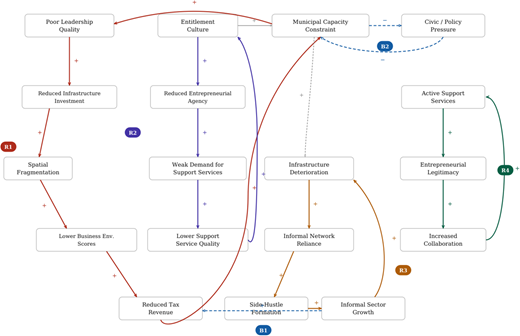
These subthemes evidence two CAS mechanisms: maladaptive self-organisation, in which institutional agents coordinate around political expediency rather than ecosystem coordination, and the reinforcing governance-decay loop (R1, Figure 1), in which leadership failure suppresses infrastructure investment, erodes the business environment and further weakens municipal capacity.
4.2.3 Theme 2: culture and societal norms.
While culture plays a critical role in shaping entrepreneurial attitudes (Stam and Spigel, 2018; Stam and van de Ven, 2021), interview responses revealed divergent viewpoints. The theme Culture and societal norms emerged with three sub-themes.
4.2.3.1 A culture of dependency and entitlement.
Participants identified a problematic dependency culture constraining genuine entrepreneurial development. P3 explained that policies such as Black Economic Empowerment (BEE) quotas create expectations: “If I meet the criteria, I should be getting work […] you create dependency and entitlement” (P3). P4 observed that this fosters opportunism rather than the linking of risk and reward that defines entrepreneurial behaviour (P4).
4.2.3.2 Negative views on legitimacy and culture.
Cultural barriers were seen to limit entrepreneurial legitimacy. P9 described entrepreneurship as driven by need, not innovation: “It’s not entrepreneurial culture, it’s pressure from unemployment” (P9). Failure intolerance was another barrier; as P15 explained, “If you fail, people treat you differently […] there’s a bad connotation” (P15), which hinders adaptive learning.
4.2.3.3 Positive signs of legitimacy and culture.
Some participants highlighted cultural resilience and adaptation. P7 noted a rise in informal ventures: “Many staff have side hustles […] formal jobs are like needles in haystacks” (P7). P10 and P11 described strong local support: “There’s pride in our city and loyalty to local business” (P10).
These cultural contradictions evidence co-evolution as the operative CAS mechanism: cultural norms and structural constraints reinforce one another (Loop R2, Figure 1), with dependency mindsets suppressing entrepreneurial emergence even as community support sustains partial adaptation.
4.2.4 Theme 3: regressive city planning.
An efficient spatial design, land use and infrastructure allow firms to benefit from external economies of scale. Investment into these components reduces business transaction costs; provides better access to labour, suppliers and customers; and allows for knowledge spillovers to occur. However, when asked about the city planning in NMB, most respondents were negative, developing the following two subthemes.
4.2.4.1 Poor spatial planning and segregated development.
Participants revealed that NMB’s spatial design maintains apartheid-era segregation, limiting ecosystem connectivity. As P5 remarked, “Show me a picture from 1986 […] from today […] spot the difference—there’ll be none” (P5). Bureaucratic inefficiencies hinder responsiveness; P4 criticised rezoning turnaround times of up to 18 months (P4). Such rigidity undermines the spatial adaptability essential for ecosystem emergence.
4.2.4.2 Infrastructure decay and maintenance failures.
Infrastructure deterioration reflects system-wide maladaptation. P2 again cited chronic maintenance underspending relative to the mandated 8% threshold (P2). P15 described visible decline: “The infrastructure is going backwards […] potholes as big as a house” (P15), discouraging business relocation and expansion. These failures reveal how poor spatial governance and path-dependent planning decisions constrain the evolution of a dynamic, responsive EE.
Poor infrastructure creates rigid system boundaries that fragment rather than connect ecosystem agents, while bureaucratic delays constrain the responsive adaptation essential for entrepreneurial emergence, illustrating sensitivity to initial conditions where historical planning choices continue to constrain ecosystem development.
4.2.5 Theme 4: perception of business support.
Business Support Services are recognised as a precondition within ecosystems, supporting the legitimisation of new ventures and facilitating market access (Brown and Mason, 2017; Malecki, 2018). However, they can struggle with information asymmetry in the demand and supply of their services, which creates disproportionate effects on nascent entrepreneurs. After the interviews, the theme Perception of Business Support Services emerged with three sub-themes.
4.2.5.1 Support services as active role players.
Participants acknowledged visible support activity across NMB, with efforts targeting underserved communities. P3 described capacity-building initiatives: “We train SMMEs on meetings, tenders […] how to be compliant” (P3). P5 added that the municipality invests substantially in SMME development by funding these support institutions (P5).
4.2.5.2 Support services as catalysts for collaboration.
Nine participants confirmed that support institutions promote collaboration. P1 cited cluster initiatives such as “NMB Maritime Cluster” and the “Tourism Action Group” (P1). P10 noted that large firms support smaller ones through supply chain inclusion and flexible procurement practices.
4.2.5.3 Lack of impact measurement.
In spite of visible activity, eight participants noted gaps in monitoring and evaluation. P1 admitted: “It’s currently not measured […] difficult to compare cities” (P1). P10 described the ecosystem as “fragmented and disorganised […] indicative of disintegration” (P10).
The findings revealed that business support services demonstrated active self-organisation through networks and training programmes. However, they lacked feedback mechanisms for adaptive improvement, and these support services lacked robust measurements for emergent learning. Therefore, these gaps underline the disproportionate effects of information asymmetry, which constrains adaptive capacity for development.
4.3 Integration of the data sets
Joint displays are used for the cross-validation and interpretation of the data sets (Fetters and Tajima, 2022). Confirmation and expansion provide supportive data evidence; however, discordance in the results required the researchers to re-evaluate both data sets to ensure the inferences made were correct (Erzberger and Kelle, 2003). Discordance reveals a different dimension of the phenomenon being studied and warrants expansion (Moseholm and Fetters, 2017). CAS will support abductive reasoning to understand any deviations between data sets (Erzberger and Kelle, 2003; Schoonenboom and Johnson, 2017).
4.3.1 Business environment and regressive city leadership.
Table 8 presents the first joint display, comparing quantitative Business Environment scores with the qualitative theme Regressive City Leadership, which was identified through thematic analysis. Both data sets converge to show that institutional corruption and political dysfunction prevent self-organisation by disrupting the conditions necessary for spontaneous agent coordination within the ecosystem.
The CAS insight is a negative emergence operating nonlinearly: system-level trust collapse arises from decentralised acts of rent-seeking, with cumulative effects disproportionate to any single failure.
4.3.2 Culture and societal norms.
Table 9 presents the joint display for Culture with Culture and Societal Norms. Culture emerged as the strongest predictor of ecosystem perceptions (β = 0.364, p < 0.001), underscoring the role of social norms in ecosystem functioning. Qualitative findings revealed cultural contradictions that both enable and constrain entrepreneurial emergence. From a CAS perspective, culture reflects emergent social properties that self-organise through repeated interactions, forming feedback loops that shape ecosystem behaviour (Roundy et al., 2018; Han et al., 2021; Fuentes et al., 2024). The CAS insight is co-evolution: cultural norms and structural constraints have evolved in tandem – procurement dependency shapes survivalist expectations, which in turn reduce pressure for structural reform – a dynamic visible only through joint integration.
4.3.3 City planning and regressive city planning.
Table 10 presents the joint display for City Planning and Regressive City Planning. The meta-inference reveals divergence between methods: City Planning was the second strongest predictor (β = 0.211, p < 0.001), highlighting its influence on ecosystem perceptions. Qualitative data exposed systemic infrastructure failures and fragmented spatial design. Poor city planning limits entrepreneurial opportunities by constraining supply chain diversification and access to tradable spaces. The CAS insight is path dependence and spatial lock-in: aggregate scores obscure a bifurcated spatial reality in which inherited locational advantage determines whether agents experience the ecosystem as enabling or constraining.
4.3.4 Business support services and the perception of business support.
Table 11 presents the joint display for Business Support Services and Perception of Business Support. The meta-inference shows divergence across methods: while support services had moderate significance in the model (β = 0.111, p = 0.010), qualitative data revealed active institutional efforts hindered by weak impact measurement. In spite of visible coordination, the lack of evaluation systems limits adaptive improvement. The CAS insight is incomplete self-organisation: support agents coordinate at the activity level, but the adaptive feedback loop between outputs and outcomes is broken.
4.3.5 Causal loop diagram: visualising complex adaptive systems feedback.
Figure 1 presents a causal loop diagram synthesising the CAS feedback mechanisms identified across the quantitative and qualitative phases. The diagram depicts four reinforcing loops (R) and two balancing loops (B) operating across the NMB ecosystem. The diagram visualises the co-evolutionary interdependencies among ecosystem elements and demonstrates why sequential, siloed policy interventions fail: interventions in one loop are undermined by reinforcing dynamics in adjacent loops, consistent with CAS co-evolution logic.
The dominant maladaptive pathway is captured in Reinforcing Loop R1 (Governance Decay), which traces a self-reinforcing deterioration cycle: poor leadership quality suppresses infrastructure investment, producing spatial fragmentation that depresses business environment scores, erodes tax revenue and further constrains the municipal resource base available for effective leadership. This is a canonical CAS positive feedback loop – small governance failures cascade into system-wide deterioration disproportionate to their apparent scale, consistent with the nonlinear sensitivity to initial conditions characteristic of resource-constrained ecosystems. Reinforcing Loop R2 (Cultural Dependency) operates in parallel, amplifying stagnation through a distinct pathway: an entitlement culture reduces entrepreneurial agency, weakening ecosystem demand for support services, which in turn degrades support service quality and reinforces dependency. In this line, we find that R1 and R2 constitute the dual structural and cultural lock-in that defines NMB’s maladaptive equilibrium.
Against this background of systemic constraint, Reinforcing Loop R3 (Informal Adaptation) represents the ecosystem’s primary emergent response – and the empirical basis for the concept of constraint-dependent emergence. As infrastructure deteriorates, actors increasingly rely on informal networks, generating “side-hustle” formation and informal sector growth that partially substitutes for absent formal ecosystem functions. This loop is theoretically significant: it demonstrates that emergence does occur under constraint, but in a form that partially compensates for rather than transforms the underlying dysfunction, producing the partial adaptive responses that distinguish constraint-dependent emergence from both productive emergence and complete system collapse.
Reinforcing Loop R4 (Support Self-Organisation) represents the ecosystem’s most productive dynamic – active support services generate cluster formation, increased collaboration and greater entrepreneurial legitimacy, which in turn expands demand for support. However, this loop remains weakly coupled to R1 and R2, meaning its positive effects are continuously undermined by the reinforcing deterioration in those loops – a co-evolutionary property that regression analysis cannot capture but the causal loop diagram makes visible.
The two balancing loops operate as weak self-correcting mechanisms. Balancing Loop B1 traces a fiscal constraint pathway in which rising informality reduces tax revenue, constrains municipal capacity and generates pressure towards regulatory reform – a self-limiting dynamic that theoretically contains the deterioration but remains insufficient to break it given the strength of R1. Balancing Loop B2 describes a governance accountability pathway in which institutional failures generate civic pressure and accountability demands that produce reform signals. Both balancing loops are currently weak relative to the reinforcing loops, which explains the ecosystem’s persistence in a maladaptive trajectory in spite of the presence of self-correcting pressures.
5. Discussion
5.1 Theoretical contribution
This study provides an empirical example of how CAS mechanisms manifest within a resource-constrained EE, rather than claiming to extend CAS theory itself. By examining the ecosystem dynamics of NMB, the study demonstrates how core CAS mechanisms – emergence, self-organisation, maladaptive feedback loops and constraint-driven adaptation – become visible under structural and institutional fragility. This aligns with prior research showing that EEs in developing economies operate under volatile institutional arrangements, infrastructural deficiencies and persistent market failures (Brown and Mason, 2017; Krammer, 2025; Wurth et al., 2022, 2023). The contribution is therefore empirical and contextual, showing how CAS mechanisms unfold in a South African metropolitan region where resource scarcity and institutional fragmentation significantly influence entrepreneurial behaviour (Musara and Nieuwenhuizen, 2021; Boucher et al., 2023).
The findings align with and refine insights from foundational CAS–EE scholarship. Roundy et al. (2018) emphasise emergence as a defining property of EEs; however, this study shows how emergence can be inhibited in resource-constrained contexts by negative feedback loops arising from institutional failures and structural rigidities. Van Rijnsoever (2020, 2022) highlights the multilayered nature of ecosystems, characterised by interactions between micro-level actors, meso-level organisations and macro-level institutions. The evidence presented here confirms this nested structure but also illustrates how misalignment across layers – such as weak municipal performance combined with informal survivalist entrepreneurship – produces systemic maladaptation rather than productive co-evolution (Bailey et al., 2018; Wurth et al., 2023).
Against this background, the study theorises constraint-dependent emergence as the mechanism through which constrained ecosystems generate partial adaptive responses – emergence that compensates for, rather than transforms, underlying dysfunction. In contrast to the productive emergence typical of well-resourced ecosystems, institutional fragility, resource scarcity and structural path dependency channel self-organisation into system maintenance rather than system transformation.
The concept of constraint-dependent emergence is positioned within – and extends – three established strands of EE and complexity literature. Firstly, it extends path dependency theory in EEs (Cloutier and Messeghem, 2022) by showing that in resource-constrained contexts, path lock-in is not merely institutional inertia but an active CAS property: maladaptive feedback loops actively reinforce path dependency by channelling adaptive energy into system maintenance (informal network substitution, “side-hustle” formation) rather than system transformation.
Secondly, it advances the institutional voids literature by demonstrating how voids do not simply create gaps – they generate bottom-up self-organising responses that partially compensate for absent formal institutions, producing outputs that existing void-focused frameworks do not predict (Boucher et al., 2023; Duodu et al., 2024; Khanna and Palepu, 1997). NMB exhibits institutional voids in precisely this sense: governance fragmentation, BEE procurement distortions, unreliable infrastructure and weak intermediaries create gaps in the support architecture that entrepreneurs must navigate or work around.
Thirdly, it complements evolutionary EE theory (Cantner et al., 2020; Cho et al., 2022) by introducing a specific evolutionary state – constraint-locked emergence – the lifecycle expression of constraint-dependent emergence – that existing models do not account for: a pre-growth configuration in which resource constraint and institutional fragility prevent the transition from birth to growth-stage development, rather than merely delaying it. In this line, the boundary conditions under which constraint-dependent emergence operates appear to be sufficient agent heterogeneity for differentiated adaptive responses; partial institutional functionality (some support services and some formal channels) that prevents complete system collapse; and cultural norms that retain some entrepreneurial legitimacy in spite of structural barriers. Future research should test these boundary conditions comparatively across resource-constrained EEs in sub-Saharan Africa, South and Southeast Asia and Latin America to establish the generalisability and limits of the concept.
5.2 Policy and practical implications
CAS perspectives emphasise that interventions act as system events – they trigger ripple effects across interconnected actors and institutions rather than influencing only the targeted domain (Cantner et al., 2020; Phillips and Ritala, 2019). As Carter and Pezeshkan (2023, p. 3) note, even a narrowly targeted policy change can generate disproportionate ecosystem effects. The findings of this study underscore this principle: institutional dysfunction, spatial fragmentation, cultural dependency and information asymmetries produce cascading negative feedback loops with system-wide economic costs. The recommendations below are therefore organised into government policy levers (Section 5.2.1), practical levers for ecosystem actors (Section 5.2.2) and cross-cutting design principles (Section 5.2.3).
5.2.1 Policy implications.
Policy interventions are essential to address the socio-economic and institutional challenges characterising resource-constrained EEs (Candeias and Sarkar, 2024; Hess et al., 2025). We therefore offer the following interventions, beginning with those of highest systemic leverage. First, enforcing the mandated 8% infrastructure-maintenance allocation, together with binding turnaround times for land rezoning, attacks the governance-decay loop (R1, Figure 1) at its strongest link. Second, competency-based appointments and transparent performance metrics interrupt the rent-seeking self-organisation that suppresses trust and investment. Third, a tiered formalisation pathway for the 87.4% informal majority weakens the informality–revenue–capacity loop (B1). Actor-specific instruments, time horizons and the CAS mechanisms targeted are detailed in Table S1 (Online Supplementary File).
5.2.1.1 Regulatory streamlining as a mechanism to weaken maladaptive feedback loops.
The extremely high informality rate (87.4%) creates a negative loop that undermines tax revenue, limits firm formalisation and weakens municipal capacity. Streamlining regulatory processes can disrupt this loop by lowering barriers to formalisation. From a CAS perspective, this intervention targets the regulative pillar as a leverage point: reducing friction in one node weakens the self-reinforcing cycle between informality and institutional fragility (Cho et al., 2022; Buratti et al., 2023).
5.2.1.2 Infrastructure investment as a stabilising intervention for system coherence.
Municipal underinvestment in infrastructure (2% actual vs 8% allocated) has weakened the ecosystem’s structural backbone and reinforced maladaptive loops in which declining service delivery reduces firm productivity and further constrains municipal revenue. Prioritising infrastructure maintenance and enforcement of Treasury regulations stabilises the ecosystem by improving system coherence. In CAS terms, this strengthens the structural conditions enabling positive emergence (Boucher, 2021; Stam and van de Ven, 2021; Wurth et al., 2023).
5.2.1.3 Governance reforms to strengthen adaptive capacity and rebuild trust.
Weak governance, corruption and leadership failures create institutional uncertainty that suppresses self-organisation and inhibits investment. Introducing transparent performance metrics and anti-corruption oversight improves institutional reliability. In CAS terms, this enhances adaptive capacity – the ability of agents and institutions to adjust, coordinate and co-evolve – restoring the conditions under which self-organisation and emergence can occur (Bailey et al., 2018; Carter and Pezeshkan, 2023).
5.2.1.4 Spatial integration to reduce structural constraints and unlock emergence.
Spatial exclusion limits agglomeration benefits and produces geographic isolation that inhibits knowledge spillovers. Integrated urban planning – improved transport links, land-use rezoning and better connections between peripheral communities and economic centres – reduces structural fragmentation. In CAS terms, spatial integration increases connectivity, facilitating the interactions necessary for self-organisation, resource recombination and emergent innovation (Boucher et al., 2025; Carter and Pezeshkan, 2023; Roundy et al., 2018).
5.2.2 Practical implications for ecosystem actors.
Beyond government, practical responsibility falls to support institutions, intermediaries, higher education providers and the private sector (Table S1). Two levers are central.
5.2.2.1 Reducing information asymmetry to strengthen network connectivity and self-organisation.
Information asymmetries between entrepreneurs, investors and institutions prevent the formation of cohesive networks (Boucher, 2021; Boucher et al., 2025). Establishing formal platforms for interaction, transparent monitoring systems for support organisations and accessible information repositories can reduce fragmentation. CAS characterises ecosystems as networks of interacting agents; improving information flows increases connectivity, enabling emergent coordination and reducing dependency on centralised institutions (Stam and van de Ven, 2021; Duodu et al., 2024).
5.2.2.2 Addressing cultural dependency and risk aversion to enable micro-level adaptation.
The study shows that cultural dependency mindsets reduce the willingness to experiment, collaborate and engage in opportunity-driven entrepreneurship. Targeted entrepreneurship education in previously excluded communities can reduce fear of failure and foster adaptive behaviours (Boucher et al., 2023). CAS theory highlights that small behavioural changes at the micro level can generate disproportionate effects when aligned with enabling meso- and macro-structures, making targeted education and skills programmes behavioural catalysts for emergent ecosystem capabilities (Pindado et al., 2023; Roundy et al., 2018).
5.2.3 Principles for intervention design.
5.2.3.1 Systemic interventions must be simultaneous, not sequential.
Sequential reforms often fail because improvements in one domain are undermined by constraints in another. CAS emphasises that system-wide change requires simultaneous interventions targeting multiple nodes – regulation, spatial design, governance and information flows – because the system adapts as a whole rather than in isolated components (Carter and Pezeshkan, 2023). Coordinated cross-domain actions with clear accountability structures are therefore essential for shifting NMB out of its current maladaptive equilibrium.
5.2.3. 2 Place-based specificity in intervention design.
Finally, the findings confirm that policy designs imported from well-resourced contexts may misallocate resources or fail to address local dynamics (Duodu et al., 2024; Hess et al., 2025). Effective intervention requires acknowledging the context-specific constraints – including institutional dysfunction, cultural dependency and spatial fragmentation – that shape system evolution in NMB. Intervention designs must therefore be tailored to local conditions rather than relying on generic models derived from high-income ecosystems (Spigel et al., 2020).
5.3 Limitations and future research
This single-case, cross-sectional study presents several limitations. The focus on NMB constrains generalisability, requiring replication across multiple metropolitan regions to assess the broader applicability of CAS insights in resource-constrained ecosystems. The findings may not transfer directly to rural or peri-urban EEs where agent density, infrastructure access and institutional presence are structurally different, and future research should explicitly test whether the boundary conditions identified here hold in structurally different contexts. Additionally, the cross-sectional design also limits causal inference, meaning that while the regression analysis identifies statistically significant associations, it does not establish causal pathways or capture the temporal evolution of ecosystem dynamics. Furthermore, the use of multiple linear regression does not allow for the examination of nonlinear feedback loops or emergent system behaviour – mechanisms that are central to CAS. Future research should therefore use CAS-consistent analytical approaches, such as qualitative comparative analysis, to examine how interdependencies evolve over time. These methods would provide a more robust account of nonlinear interactions, co-evolutionary processes and path-dependent trajectories within resource-constrained EEs.
References
Supplementary material
The supplementary material for this article can be found online.