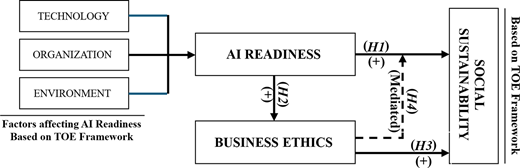
This study aims to assess the AI preparedness of Indian small and medium enterprises (SMEs) and its impact on social sustainability. This study used a technology–organization–environment-based proposed framework; it explores how technical, organizational and environmental readiness influences ethical practices and social goals. This research investigates whether ethical AI mediates AI readiness and SS in Indian SMEs.
The data, using a structure survey, collected from 739 respondents serving SMEs in eight Indian states was used. A five-point Likert scale was used to collect data on all the constructs. Structural equation modeling (SEM) was used to test the theoretical model. Descriptive statistics, reliability and discriminant validity were performed to ensure an effective measurement model. This provided a basis for analysis of direct effects and mediating effects of AI-driven ethical and sustainable business practices.
The research revealed positive relationships between AI readiness and social sustainability (β = 0.43) and AI readiness and business ethics (β = 0.51). In addition, business ethics had a strong positive direct effect on social sustainability (β = 0.47). Importantly, business ethics is also an important mediator between AI readiness and social sustainability (indirect effect β = 0.24). Furthermore, it is reflected that ethical integration is important for AI to achieve socially sustainable outcomes. The SMEs are much better prepared to use AI responsibly and inclusively to benefit the stakeholders if they are more digitally and culturally prepared.
This study is a cross-sectional design that limits the causal inference. Though the responses were taken from the executives of SMEs in eight Indian states, they may have sectoral and regional imbalances. Also, the responses could have personal biases, as respondents may have been influenced by social desirability. Despite these constraints, the research adds to the literature on AI readiness, social sustainability, and the mediating role of ethics. It also highlights avenues for future research, including a longitudinal study on the SMEs and their AI readiness, regional comparisons of SMEs and integration of governing regulations with ethical AI policies in SMEs.
This research suggests that the SME management must invest in digital tools and promote ethical culture for successful AI use. Ethical auditing may be done by SMEs alongside people analytics to use ethical AI for enterprise social causes. Policymakers can complement initiatives such as IndiaAI and the Business Responsibility and Sustainability Report requirements by including ethical AI training in the SMEs. The responsible adoption of AI can enhance both trust and employee engagement and can potentially improve CSR outcomes.
The research articulates an “AI-readiness-ethics-sustainability framework” to study AI preparedness and social sustainability in Indian SMEs. Majorly, the literature review reflects the work of researchers on the technical or economic impacts of AI. This study not only explores the technological, organizational and environmental preparedness but also records the mediating effect of ethics on AI readiness of SMEs on social sustainability and advocates that ethically engaged AI can foster efficiency and influence inclusive and sustainable development.
1. Introduction
Sustainable development integrates economic growth, environmental protection and social equality and contributes to nation development (Kolk, 2016). One important aspect is social sustainability (SS), which leads to inclusive societies that value human rights, equity and strength of social relationships (Herrmann and Pfeiffer, 2023). In the pursuit of sustainable development, especially in developing countries, increasing attention is paid to social issues to accompany economic and environmental ones (Heeks et al., 2014; Derse, 2024).
Enormous literature suggests the use of artificial intelligence (AI) for achieving the United Nations Sustainable Development Goals (SDGs) by offering innovative solutions to global challenges. Historical literature indicates the contribution of AI in economic growth and innovation (SDG 8 and SDG 9) by helping businesses in optimizing resources, improving productivity and generating new avenues. AI can strongly support industries in clean energy management (SDG 7), climate action (SDG 13) and sustainable cities (SDG 11) by facilitating use of energy, predicting environmental risks and backing green technologies. Essentially, AI can support organizations (SDG 16) in data-driven governance, maintaining transparency and affixing accountability. While challenges remain, AI offers a powerful pathway to accelerate progress toward achieving the SDGs and ensuring a more equitable and sustainable future.
Also, the small and medium enterprises (SMEs) can play a prime role in SS (NITI Aayog, 2018) as they can support industrial output, workforce empowerment and ethical business behavior (Aljarboa, 2024; Chatterjee et al., 2023). Entrepreneurs are increasingly relying on AI to assist in creating and scaling new ventures (Roundy, 2022). SMEs account for almost 96% of industrial units and provide approximately 40% of the country’s total industrial production (Srivastava, 2018). These enterprises contribute to employment, particularly for the most marginalized and lowest income (Birungi et al., 2024; Senadjki et al., 2023), and thus the SMEs are primary facilitators of social development and inclusion (Badghish and Soomro, 2024). Viewing the impact of AI and SMEs on social development, the author proposes that the AI readiness of Indian SMEs has a significant effect on achieving SS targets (Aljarboa, 2024; Brunetti et al., 2020). In addition, it is also proposed that ethics acts as a mediator between the adoption of AI and SS outcomes (Singhapakdi et al., 1999; Reddy et al., 2024).
Indian SMEs are adopting better people management by improving working conditions, employee relations and employee engagement practices (Yawar and Seuring, 2017; Tongkachok et al., 2022). This supports partnerships with MNCs that conform with their compliance and sustainability models (Brunetti et al., 2020; Wang et al., 2023). Under various regulation acts, the SMEs are becoming more accountable for their operations (Dwivedi et al., 2021; Derse, 2024). The Companies Act 2013 and the Business Responsibility and Sustainability Report (BRSR) from SEBI validate the efforts of Indian organizations toward building an integrated ethical and sustainability platform, including the CSR practices (Kolk, 2016; NITI Aayog, 2018). Literature advocates a shift from traditional ethical practices to a more ample regulatory framework that supports sustainable development.
The primary question that arises is how Indian SMEs can adapt to the regulatory framework. Will the technology readiness help the Indian SMEs to do so? For SMEs in India, SS is not just about profit. It is also about improving community well-being, creating equal opportunities and developing employees (Karuppiah et al., 2023; Bilderback and Kilpatrick, 2024). By implementing SS frameworks, SMEs can increase their social capital and resilience by taking socially responsible actions [e.g. fairly paid wages, inclusion and involvement of the community (Lv et al., 2019)]. Being socially sustainable and ethical may also increase SMEs’ access to global markets and secure stakeholder trust (Al-Adeem, 2024), which stabilizes local economies and reduces socio-economic risks (Kulkarni et al., 2024; Fernando and Lawrence, 2014).
In the context of Industry 4.0, the researchers have recognized that AI has transformative potential to achieve sustainability objectives in SMEs (Badghish and Soomro, 2024; Mohamed Riyath and Inun Jariya, 2024). Industry 4.0 integrates advanced digital technologies such as AI, IoT, big data and automation to create smart, interconnected and efficient organizations. These technologies could be a great enabler for implementation of SS (Brunetti et al., 2020). Also, sustainability and ethics are core features for the growth of SMEs; nevertheless, the direct relation is not visible in the literature (Tiwari and Khan, 2020). Though specialists recommend that AI adoption by SMEs is vital for their growth, the adoption is still very slow in India (Oxford Insights, 2023). Thus, addressing this gap is needed as SS is an important factor for industrial growth through sustainability. Hence, the author intends to explore the AI readiness of Indian SMEs to enhance their sustainable goals.
To explore the relation between SS and AI readiness in an organization, the literature reflects the use of technology–organization–environment (TOE) framework (Carneiro and Veloso, 2022; Chatterjee et al., 2023). The framework focuses on three variables, of which the first is Technology, which denotes the technical maturity of the company; second is Organization, which represents culture within the organization; and the third is Environment, which represents regulations and competition. Also, the TOE framework is not flexible enough to assess the effect of ethics on sustainability. Because the author intends to find out whether business ethics plays a mediating role in the relationship between AI readiness and SS, a modified framework with a base of TOE is proposed for the research.
The progression of this paper starts with Section 1, which emphasizes the role of AI on SS in SMEs in India and outlines the objectives of the research and the research questions. The existing literature on AI and SS is reviewed in Section 2 to outline the hypotheses and formulate the new framework. Section 3 denotes gaps and the scope of the paper. Section 4 details the research methodology and sampling methods. Data analysis, results and discussion and conclusions on the data are framed in Sections 5, 6 and 7, respectively. Thereafter, the paper details the theoretical and practical contributions of the research, policy and managerial implications, limitations of the research and future research scope.
The research questions (RQs) that this study aims to explore are:
Whether Indian SMEs can adopt AI applications based on TOE elements?
How does the adoption of AI impact social sustainability in Indian SMEs?
Is there a relationship between AI readiness, business ethics and social sustainability in the context of Indian SMEs?
2. Literature review
2.1 Artificial intelligence and readiness
AI readiness refers to the status at which individuals or organizations or systems are prepared to leverage, deploy and benefit from AI technologies (Hossain et al., 2024). The concept of AI readiness includes multiple dimensions, including technical and IT architecture, workforce skills and expertise, managerial commitment, ethical compliance and regulatory context and readiness (Chatterjee et al., 2023; Magliocca et al., 2024).
Researchers have identified three primary factors that together determine the AI readiness of an organization. The first factor is technological readiness, which includes aspects such as digital architecture, software and hardware engines, and data provenance and management. The second is organizational readiness, which includes leadership, organizational ability to manage change, skilled employees and organizational culture that supports the adoption of technology. Finally, there is an environmental readiness of an organization that is influenced by the external factors such as government mandates, regulations, industry competition, vendor offerings and so on, which are important variables that determine the likelihood of adoption (Narwane et al., 2019; Dwivedi et al., 2021; Chatterjee et al., 2021). These variables are often organized into the TOE framework, which is a common theoretical model for evaluating technology adoption. The TOE framework allows a comprehensive analysis of the contextual factors influencing the environment for AI adoption (Carneiro and Veloso, 2022).
Additionally, the Oxford Insights’ Government AI Readiness Index 2023 provides a global rating of countries on governance, infrastructure, skills and public sector innovation. The findings show that while high-income countries have greater readiness levels for AI, emerging economies are rapidly catching up through targeted policies, developing skills and building digital ecosystems (Oxford Insights, 2023). Also, ethical readiness is increasingly viewed as part of overall AI readiness. Chatterjee et al. (2023) provide a recent review indicating that for organizations to reduce the risks of bias, discrimination and privacy breaches in their AI application, they will need to establish context-specific ethical frameworks. By embedding ethical principles early in the AI adoption lifecycle, organizations build trust among stakeholders and ensure sustainability for the long run (Reddy et al., 2024; Parris et al., 2016).
2.2 Artificial intelligence readiness in Indian small and medium enterprises
As new technologies evolve rapidly, AI is becoming a powerful disruptor for SMEs in India (Senadjki et al., 2023; Aljarboa, 2024). AI can help SMEs streamline operations, enhance innovation and assure a competitive advantage (Badghish and Soomro, 2024). The commitment of the Indian Government toward a digital agenda, as well as improved access to AI tools by SMEs, will encourage the adoption of AI to automate the business processes of SMEs (NITI Aayog, 2018; Wu et al., 2024).
Within the Indian context, the strategic imperative of enhancing AI readiness is compounded by its very large and diverse SME sector, which is the backbone of both employment creation and industrial output (Srivastava, 2018). Understanding this, India, through NITI Aayog, has set out its National Strategy for AI and asserted the case for deploying AI across different sectors to drive inclusive and sustainable growth. It identified five priority areas together with SMEs as a cross-cutting enabler, namely, health care, agriculture, education, smart cities and smart mobility (NITI Aayog, 2018; Chatterjee et al., 2021).
Despite rising interest, there is evidence and studies that conclude that AI readiness in Indian SMEs is inconsistent. According to a recent report by Cisco’s AI Readiness Index 2023, only 26% of Indian companies claim to be AI-ready, although this is higher than the global average of 14%. The major barriers identified include gaps in foundational digital infrastructure, limited access to AI talent, issues in data governance and ambiguity in ROI expectations (The Economic Times, 2025; Oxford Insights, 2023).
SMEs in India, in particular, have resource constraints that limit their AI readiness across all three critical dimensions. From a technological perspective, many SMEs still use legacy systems and operate at low levels of digitization (Kulkarni et al., 2024). Organization-wise, SMEs face a lack of adequately skilled personnel and resistance to technological change. From an environmental angle, the presence of SME-focused AI vendors is limited, and awareness of government AI initiatives remains low (Aljarboa, 2024; Goel et al., 2022).
To address these deficits, plans have been made and actions have been taken. India’s mission on AI, for example, is a flagship program from the Ministry of Electronics and IT that promotes AI skill development, AI research and the adoption of AI in inclusive ecosystems across sectors, including SMEs (Wu et al., 2024; Saheb and Saheb, 2024). Along with the mission launched by the Government of India, institutes such as the Wadhwani Institute for AI are developing AI solutions aimed at Indian businesses, especially for underserved and underexplored business domains such as agriculture and health care. Other initiatives and plans have been offered by industry organizations such as NASSCOM and are focused on initial AI mentorship and capacity-building workshops for Indian SMEs to adopt and scale (NASSCOM, 2025; SME Futures, 2024).
2.3 Artificial intelligence and social sustainability
AI is a prime driver of sustainable development, particularly in enhancing SS through inclusive innovation and healthy working conditions. India is witnessing rapid digital adoption in SMEs, offering them AI tools for socially sustainable outcomes. Rapid increase in AI adoption by Indian SMEs is enhancing productivity and efficiency. Currently, 23% of SMEs in India use AI, and 73% expect to use it by 2025, exceeding the global adoption of 52% (The Economic Times, 2025). The Government is supporting the AI ecosystem and created platforms such as the National AI Portal (INDIAai) to provide SMEs with education, tools and inclusive engagement with AI (Shrivastava and Mahajan, 2016).
For transparent sustainable practices, SEBI launched BRSR in 2023, which enables firms to report environmental and social indicators. Initially, there had been limited SS reporting, but AI use in productivity monitoring and workplace analytics resolved this. The social practices such as gender equality and poverty alleviation are part of mainstream sustainability frameworks such as GRI (Derse, 2024; Herrmann and Pfeiffer, 2023). The other frameworks, such as socially responsible AI (SRAI), addressed ethical and societal complexities through AI-based people analytics frameworks, which help organizations in measuring diversity in their workforce and equity in promotions. AI can help support SS through fairness, transparency and inclusiveness while making data-driven decisions that do not breach human well-being.
From a business perspective, using AI to create better social conditions at work has very realistic benefits, including improved employee engagement, reduced attrition rates and better employer branding, which are in line with CSR objectives. Researches such as “bottom of the pyramid,” (Prahalad, 2008) underscored that innovations are mandatory for underserved populations. In addition to this, Heeks et al. (2014) proposed AI as a tool for indigent populations toward empowerment, equity and resilience.
Several recent policy recommendations aim to foster AI-enabled SS. These include providing skill development for the employees (Magliocca et al., 2024), supporting paid training in technology sectors (Heeks et al., 2014) and promoting employment for marginalized groups, including people with disabilities (Prahalad, 2008). Ethical AI-driven hiring practices are encouraged to reduce bias and improve diversity (Herrmann and Pfeiffer, 2023), while entrepreneurship among women and minority-owned SMEs is promoted to ensure equitable AI benefits (Derse, 2024).
To enable effective integration of AI technologies and to facilitate human-AI teamwork across the operational, tactical and strategic levels, organizations need to establish effective strategies (Magliocca et al., 2024). AI technologies help to improve SS by improving the availability of decision-making data, identifying the risk of inequalities and supporting ethical decision processes, but this only occurs if AI systems prioritize fairness, privacy and security (Nugent et al., 2020). AI technologies that are poorly governed or biased, combined with poor governance and decision-making, can reduce diversity and inclusion objectives (Nugent et al., 2020). To develop SS with AI, organizations typically focus on the risks that will require careful balancing between innovation and human-centered values and will help SMEs in managing both economic and social impact (Magliocca et al., 2024):
Artificial intelligence readiness is positively related to the social sustainability performance in Indian SMEs.
2.4 Artificial intelligence and business ethics
The convergence of AI and business practices raises numerous ethical challenges regarding bias, transparency, privacy and accountability, which need to be effectively managed so that trust is established with the stakeholders (Reddy et al., 2024). Given that AI applications are being adopted for decision-making in businesses, to tackle these ethical challenges, organizations need to build ethical guidelines that provide transparency on risks and bias (Parthasarathy and Padmapriya, 2023). The transparent frameworks and all implementations of AI need to adhere to those guidelines (Parris et al., 2016). Organizations have also been advised to have AI ethics committees and governance structures to help alleviate AI ethics hurdles and ensure that AI is used ethically and responsibly (Camilleri, 2024).
As AI development continues to accelerate, companies are urged to think beyond the basic principles of ethics and build ethics into their values for responsible integration of the technology across business functions (Tigard et al., 2023). However, the drive to innovate can challenge ethical safeguards that can be detrimental to the success of AI (Hagendorff, 2022). Ethics-based auditing has emerged as a tangible way to move from principles to practice by creating a culture of accountability and trust and ensuring effective governance of AI (Laine et al., 2024).
In Indian SMEs, the ethical use of AI seems to face considerable challenges, including limited resources, a generally low level of awareness and poor regulatory frameworks (Soudi and Bauters, 2024). Many SMEs do not have access to the guidelines around ethical impacts, dilemmas and issues with the use of AI (Chatterjee et al., 2023). To tackle this scenario, government solutions, such as the National AI Portal (INDIAai), provide knowledge resources while promoting responsible and inclusive use of AI in the SME sector (Wu et al., 2024).
The Indian Government should enforce corporate principles with ethical values, promoting SMEs to effectively use AI for social benefits (Saheb and Saheb, 2024). IT should induce regulations on transparency and biased algorithm and transparency. To create a robust AI ecosystem for SMEs, they need to support developing skills, establish partnerships with universities and allocate funds for smaller enterprises (George and George, 2023):
Artificial intelligence readiness positively influences business ethics adoption in Indian SMEs.
2.5 Business ethics and social sustainability
Ethically founded businesses foster a culture of trust that reinforces relationships with stakeholders, which manifests into social capital, transforming how employees work and engage with others (Youndt and Snell, 2004). Customers of these businesses feel valued and taken care of and receive good products and services, improving their satisfaction and loyalty and their impression of the company (Strong and Sutherland, 2007).
Ethical organizations place more emphasis on collaboration, sharing and exploring ideas for employees rather than competition in a negative sense (Ruppel and Harrington, 2000). Some research shows that SS practices can also reflect the values represented within a culture dependent on where the business operates (Penaflor-Guerra et al., 2020). Other research works link SS and business ethics through the interactions of both individuals and organizations (Ronaghi and Mosakhani, 2022). Moreover, important studies focus on how ethics and social responsibility have influence on both business practices and individuals that work for them (Fukukawa et al., 2007):
Adoption of business ethics augments social sustainability outcomes in Indian SMEs.
Business ethics mediates artificial intelligence readiness and social sustainability in Indian SMEs.
3. Gaps and scope
In the previous section, the recent literature on AI readiness and its relationship with business ethics and SS was reviewed. It was found that while interest in these areas is growing, research on the actual state of AI adoption in SMEs in India is limited. Majorly, the research in this domain explores the relation between AI readiness and SS using TOE variables; they rarely investigated the impact of ethics on sustainability.
To address the identified gaps, the study proposes an AI readiness-ethics-sustainability framework (Figure 1) that aims to answer the research questions and test the proposed hypothesis.
4. Research methodology
4.1 Data collection methods
The research intends to investigate the relationship between AI readiness, business ethics and SS in SMEs in India. Based on the SMEs’ industrial clusters, data were collected from individuals located across several states in India, including Maharashtra, Tamil Nadu, Gujarat, Karnataka, the Delhi-NCR, Uttar Pradesh, West Bengal and Telangana, who are characterized by high concentrations of SME-related activities.
The sample target was 1,000 professionals who belong to 200 SMEs, and the author ultimately received 739 valid responses, amounting to a 73.9% response rate, which is acceptable for cross-sectional survey research (Baruch and Holtom, 2008). The data was collected over a period of three months using online and offline structured questionnaires and telephonic/in-person interviews, depending on the geographical and infrastructural limitations of each SME.
4.2 Sampling method
The study used a stratified purposive sampling technique that ensured representation from SMEs within different states and industry sectors. This sampling technique gave the author the ability to include firms that differed in size, location and degree of digital maturity, enabling variability of responses in examining AI readiness and ethical behavior among SMEs in India. The sampling technique was also helpful in representing sufficient regional and sector diversity, while ensuring that respondents had enough managerial or technological knowledge to be able to competently respond to questions about both AI readiness and ethical practices.
4.3 Respondent profile
The respondents consulted were mainly owners/directors, general managers, HR managers, IT heads, quality heads and operations managers – people who occupied strategic positions related to AI decision-making and sustainability in their organizations.
The author assured respondents that the data collected would only be used for academic research and would be confidential. Table 1 shows the profile of the respondents.
4.4 Development of research instrument
The data collection for the present research used a structured questionnaire containing four main constructs that have multi-item measures. Each of the four constructs is based on adapted measures from various research studies:
Construct 1: Artificial intelligence (AI) readiness – AI readiness consists of three sub-constructs, namely, technology readiness, organizational readiness and environmental readiness. Technology readiness as a measure relates to the availability of technical infrastructure and capacity for technology support for AI adoption; organizational readiness as a measure relates to internal capabilities, level of management support and human resources that are available for AI adoption; and environmental readiness includes the environmental variables such as policies and market conditions that may impact AI adoption (adapted from Aljarboa, 2024; Narwane et al., 2019; Dwivedi et al., 2021). Each of these three constructs typically has four items each.
Construct 2: Business ethics – It has eight items (adapted from Singhapakdi et al., 1999; Reddy et al., 2024; Chatterjee et al., 2023).
Construct 3: Social sustainability – To capture the broader employee well-being perspective, the construct includes four elements: occupational safety (four items), physical and organizational environment (five items), employment conditions (five items) and opportunities for skill enhancement (three items) (adapted from Yawar and Seuring, 2017; Herrmann and Pfeiffer, 2023; Chatterjee et al., 2023).
Construct 4: Demographic information: It is the last section of the questionnaire; the information collected is included in Table 1.
All items under the core constructs were measured using a five-point Likert scale (1 = Strongly disagree, 5 = Strongly agree), adapted from validated sources to fit the SME context in India. The questionnaire was pretested with a small sample (n = 20) comprising ten officials from SMEs and ten subject experts and faculty members. The scales were further refined to accurately convey meanings to respondents in the right way (Churchill, 1979) and exemplify the area of study (Smyth et al., 2006).
5. Data analysis
The data collected (n = 739) was analyzed in SPSS 26 and AMOS 24 to examine the reliability, validity and internal consistency of the measurement model before structural model analysis. This study investigates three main constructs – artificial intelligence, business ethics and SS – which include 39 observed items measured on a five-point Likert scale.
5.1 Descriptive statistics and reliability analysis
To assess the reliability of each construct, the research used Cronbach’s alpha (α), composite reliability (CR) and average variance extracted (AVE). The strong internal consistency is reflected by alpha > 0.070 (Hair et al., 2019). The measure of central tendency of data and degree of its spread were judged using mean and standard deviation.
The results in Table 2 show strong internal consistency and convergent validity among the constructs and subconstructs, with an alpha value >0.70 (Hair et al., 2019). This indicates a reliable measurement as all alpha values are in the range of 0.82–0.88. Also, all CRs are above 0.85 construct stability. AVE for each sub-construct is above the minimum acceptable value of 0.50, indicating sufficient convergence of the indicators with their latent variables. Constructs such as organizational readiness (AVE = 0.65) and skill enhancement (AVE = 0.66) show particularly strong convergent validity.
5.2 Discriminant validity
The Fornell–Larcker criterion was used to assess the discriminant validity of the data. This test compares the correlation between the constructs with the square root of AVEs. In Table 3, the diagonal values are the square roots of AVEs.
Referring to Table 3, in each case, the square root of the AVE (the diagonally located values) was higher than the inter-construct correlations, thus establishing that each sub-construct is more correlated with its respective items than it is with all other constructs. For example, the square root of AVE for organizational readiness (0.81) was larger than the highest correlation with business ethics (0.59). Likewise, the construct “skill enhancement opportunities” (0.81) was clearly distinct from related constructs such as employment conditions (0.60) and organizational readiness (0.53). This confirmed that the constructs in this study are conceptually and statistically distinct, demonstrating that the measurement model is valid, and the next step of structural model testing can be reliably conducted. This leads to the acceptance of discriminant validity.
5.3 Structural equation modeling and hypothesis testing
Upon validating the instrument’s reliability, convergent validity and discriminant validity of all constructs in the measurement model, structural equation modeling (SEM) was used to test the hypothesized relationships of AI readiness (further divided into technology readiness, organizational readiness and environmental readiness), business ethics and SS (with four sub-dimensions, i.e. occupational safety; physical and organizational environment; employment conditions; and skill enhancement opportunities). The SEM analysis was performed using AMOS 24. The model fit indices were reviewed before testing the hypotheses.
5.4 Model fit summary
Overall, the model produced a suitable fit with the observed data, as demonstrated by the following indicators:
Chi-square/df (CMIN/Test df) = 1.98;
comparative fit index (CFI) = 0.957;
Tucker–Lewis Index (TLI) = 0.948;
root mean square error of approximation (RMSEA) = 0.046; and
standardized root mean square residual (SRMR) = 0.041.
All statistics were well within the threshold of acceptable levels, confirming that the structural model can be deemed healthy (Hair et al., 2019).
5.5 Hypothesis testing results
Presented in Table 4 are the path coefficients, standard errors, t-values and significance levels for each of the hypotheses.
The results support all four hypotheses. AI readiness affects business ethics and SS significantly. Business ethics affects SS directly. Also, the transitive effect of AI readiness on SS was significant, though through partial mediation of business ethics.
The results indicate that SMEs with better AI readiness are more likely to effectively adopt ethical behaviors, which reinforce their SS commitment. The fact that business ethics mediates the relationship indicates that ethical alignment serves as a connecting link between technology readiness and social impact. This is especially salient to the Indian context of micro- and small-sized enterprises where digital transformation and technology adoption are still emerging.
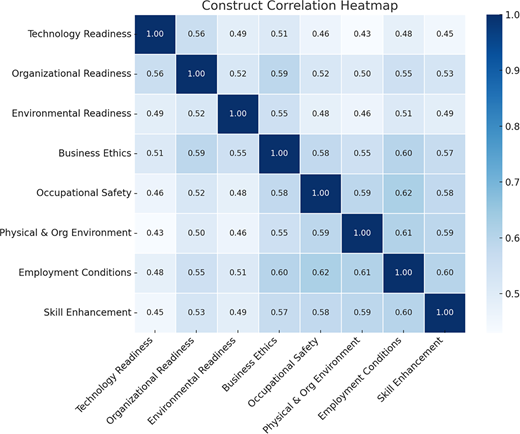
The visual heatmap correlation matrix below provides a representation of the correlations on all sub-constructs in the structural model.
The heatmap (Figure 2) shows that there is a strong correlation between organizational readiness and business ethics (r ≈ 0.59), employment conditions and occupational safety (r ≈ 0.62) and skill development and employment conditions (r ≈ 0.60). Moderate correlations have also been recorded between AI readiness dimensions (TR, OR and ER) and the SS sub-constructs, and business ethics and all four SS sub-constructs. This clearly supports the assumptions and relationships in the model, especially with respect to mediation by business ethics and the interconnectedness of the social dimensions.
5.6 Internal construct testing
For internal construct testing, R square and Q square were calculated; the values are as given:
Business ethics R2 = 0.639 Q2 = 0.373
Social sustainability R2 = 0.302 Q2 = 0.211
The results above show that AI readiness, which comprised technology readiness, organization readiness and environment readiness, was able to explain 63.9% variance in business ethics and 37.3% variance in SS. For business ethics, the predictive relevance (Q2) value indicates a large size effect, while for SS, it indicates a medium size effect.
5.7 Second-order sub-construct testing
Referring to Table 5, all the second-order constructs of AI readiness are significant. It is found that technology readiness (β = 0.52, p < 0.05), organization readiness (β = 0.68, p < 0.05) and environment (β = 0.59, p < 0.05) are significant dimensions for AI readiness for SMEs. These factors make it easier for MSMEs to successfully adopt and use AI technologies.
6. Results and discussion
This study used SEM to evaluate the relationship between AI readiness of SMEs and other factors such as business ethics and SS. Referring to Table 4, all research hypotheses were accepted. The observation from Section 5.6 shows that AI readiness was able to explain 63.9% of variance in business ethics and 37.3% of variance in SS. For business ethics, the predictive relevance value indicates a large size effect, while for SS, it indicates a medium size effect. The outcomes are as follows.
6.1 Impact of artificial intelligence readiness on social sustainability
The results reveal a statistically significant, positive association between AI readiness and SS (β = 0.43, p < 0.001), thereby confirming H1. The result corroborates previous literature by establishing that SMEs that have technological, organizational and environmental digital readiness are better positioned to leverage AI, thereby contributing to improved social outcomes, such as better working conditions, safety and inclusion. The results support the findings of Narwane et al. (2019) and Dwivedi et al. (2021), affirming that digital maturity facilitates sustainable/ethical operations in small businesses.
6.2 Impact of artificial intelligence readiness on business ethics
The path coefficient for the relationship between AI readiness and business ethics was also found to be significant (β = 0.51, p < 0.001), thus supporting H2. This finding implies that SMEs with strong technological infrastructure, leadership commitment and responsiveness to the external environment are more likely to embed ethical practices into their AI deployment strategies. This aligns with the views of Aljarboa (2024), who asserts that organizational culture and digital competency significantly influence ethical AI adoption.
6.3 Impact of business ethics on social sustainability
Furthermore, the relationship between AI readiness and business ethics was significant (β = 0.51, p < 0.001), thereby supporting H3. This indicates that the SMEs in India with good technology infrastructure, leadership engagement and alertness to the external environment are more likely to incorporate ethical practices in their AI deployment strategy. This aligns with the views of Aljarboa (2024), who indicated that organizational culture and digital competency play a vital role in ethical AI implementation.
6.4 Business ethics intermediating role
Business ethics play a mediating role between AI readiness and SS in Indian SMEs (β = 0.24, p < 0.001). This observation supports H4 and indicates that AI can tremendously contribute toward social values if applied ethically. AI readiness alone is not sufficient to impact the social cause. This finding complements the SRAI framework, which states that ethical behavior is key in having fair AI applications (Magliocca et al., 2024).
The results underscore the critical importance of ethical alignment to facilitate socially sustainable AI adoption in Indian SMEs. While digital and organizational preparedness will provide a foundation, ethical governance enhances the benefits of AI by confirming that the implementation of AI incorporates socially sustainable values. These values are of prime importance in India, where regulations are in nascent stages, SMEs are often under resourced and professionals may not be aware of ethical governance (Chatterjee et al., 2023).
The study also supports the literature that advocates the relationship among the prominent constructs and displays how readiness amalgamates with ethics and social outcomes. Through the literature review, the study reveals that the governing policies such as the IndiaAI Mission and SEBI’s BRSR are contributing toward the ecosystem development for SMEs to adopt AI and leverage ethics and sustainability.
7. Conclusion
This study was aimed at investigating the effect of AI readiness on SS in Indian SMEs and assessing whether business ethics mediates the relationship. AI readiness was conceptualized using a proposed framework. The data was received from 739 respondents serving 200 SMEs in eight Indian states. The results of the study show a significant contribution of AI readiness to business ethics (β = 0.51) as well as SS (β = 0.43). Also, the study showed that business ethics positively mediates in converting the AI readiness into a socially sustainable outcome.
The results have also supported the viewpoint of previous researchers that ethical alignment should serve as the basis for the responsible deployment of AI (Herrmann and Pfeiffer, 2023; Parris et al., 2016). Moreover, the findings support relevant literature that AI applications can positively influence SS, specifically in terms of employee health and wellness, equitable hiring and occupational safety as part of an ethical governance culture (Derse, 2024; Magliocca et al., 2024). As India plans to be an AI leader in the world, the study confirms that SMEs should embrace AI for a better future and demonstrate that AI is effective, equitable and socially responsible.
8. Theoretical and practical contributions
This work has several important theoretical contributions. First, it extends the TOE framework, adding business ethics as a mediating variable to form a more comprehensive model for AI readiness in SMEs. Second, it extends the nascent literature on SRAI by providing empirical evidence of the role of ethics in sustainability in relation to AI. Third, the current research has emphasized the recurrently neglected SS attribute in AI adoption studies, especially in developing economies such as India where SMEs are very prevalent. The results provide insights on how SMEs may progress beyond mere technical adoption to more socially responsible innovation.
From a practical perspective, this research provides SME leaders with a valuable framework for adopting ethical AI. Also, the research highlights SMEs’ readiness not just in technology but also, importantly, in leadership, culture and the environment. Moreover, the research underlines the alignment of AI technology in SMEs with their CSR and ESG commitments. It generated the insights on how AI readiness of SMEs can result in stakeholder trust, employee well-being and community involvement as key elements of SS.
9. Policy and managerial implications
For policymakers and SME managers, this work offers important insights on AI advancements. As a policymaker, the Indian Government needs to scale up the prevailing initiatives, such as the IndiaAI Portal and SEBI’s BRSR, and include sector-specific ethical AI guidelines for SMEs. The Indian Government should consider scaling current funding models, such as purchase financing (Yao et al., 2024), to drive investment in ethical and inclusive AI systems for SMEs. Also, an initiative to convoy more regional training hubs could be used to reskill workers in ethical AI and sensitize workers on the topic of digital rights and privacy.
Conversely, SME leaders must recognize that adopting ethical AI gives a competitive advantage, and it is not just an obligation. Ethical governance of AI can enhance talent retention, brand image and stakeholder trust, as well as mitigate risks related to transparency and accountability. So far, most SMEs have not instituted ethics committees, AI readiness audits or training programs to promote a culture of responsible innovation. The SME leaderships need to concentrate on inclusively designed AI, which will support rural outreach, gender equity and equal access and data protection as part of their business plan. This will leave a positive impact on the stakeholders, better SS practices and an improved organizational culture.
10. Limitations
While this study’s outcome shows the impact of AI readiness on other constructs, the research is not without limitations.
The data was collected during the span of current research at a single point in time; it may not reflect the impact of AI readiness on SS in the longer run and prove causality or correlation. A longitudinal study that follows businesses for a more extended period would provide a deeper understanding of how AI readiness and social outcomes evolve.
Although the sample includes businesses from eight Indian states, noting the variance in the sample, the possibility is that it may not represent the sectoral differences or differences between rural and urban SMEs in India.
In addition, the author relied on what people said about themselves, and they may not always explain themselves accurately. Some respondents may have biases that influence them to exaggerate their responses on ethical behavior or ethical use of AI to look “better” or the “right thing to do.”
Additionally, the author did not measure the impact of sudden external events, such as government policy or economic challenges, that could change SMEs’ use of AI.
11. Future research scope
Future research can expand on this study in many useful ways.
Studies could be conducted that track the changes over time. It can help in showing how AI readiness and SS grow together, especially in the modern times of AI where the technology and regulations change very fast.
A comparative study with SMEs in other developing countries can show how SMEs in different geographies handle AI ethics and social responsibility, giving a global perspective.
Researchers can study other factors that may impact AI readiness. These may include the culture of the organization, their learning methods, how tech-savvy the management is, the leadership styles and so on to make the study model stronger.
In-depth studies, with more rigorous and detailed interviews and real-life case studies with SME leaders, can help in more precise understanding of the everyday challenges and decisions they face when using AI ethically.
As AI keeps getting more advanced and is disruptive to itself, it is important to study how clear, fair and accountable the AI-based tools and applications are to have a better understanding of their long-term effects on businesses and society.
Ethics statement
This study used data from human participants serving various SMEs in India. Ethical standards pertaining to research integrity and data confidentiality were strictly followed throughout the study. All participants were informed about the academic purpose, anonymity and voluntary nature of participation.
Data access statement
Previously published and publicly available research contributed to the secondary data, which were accessed online or through the physical library of the author’s affiliated institution. No proprietary or restricted data sets were used in this research. The primary data was collected from the respondents abiding by the ethical standards maintaining anonymity.