This article systematically reviews research at the intersection of gamification and the metaverse to understand how gamified immersive environments contribute to business value. It consolidates current knowledge, proposes an integrative framework to guide research and practice, and identifies gaps that can guide scholarly inquiry in this emergent domain.
A systematic literature review (SLR) was conducted. A total of 38 relevant articles were identified through initial screening and forward–backward search. These were analyzed via concept-centric coding and synthesized into thematic clusters. The insights were used to develop a business-oriented, comprehensive framework integrating design, engagement, value and ethical considerations for responsible metaverse gamification.
Four thematic clusters were identified: (1) Design and Mechanics, highlighting game elements (e.g. avatars, narratives, feedback systems) that promote immersion and flow; (2) Business and Consumer Engagement, showing how gamification influences affective and cognitive engagement, loyalty and purchase intentions; (3) Business Value, demonstrating how gamified experiences generate economic, relational and strategic benefits and (4) Ethics, Policy and Societal Impact, underscoring risks including data misuse, manipulation and inequitable access. Drawing on these themes, the article introduces the “GAMIFY” framework, synthesizing these dimensions for gamification in the metaverse.
The review is limited to peer-reviewed, English-language publications and excludes gray literature, yielding a focused corpus of 38 studies that reflects the emerging state of metaverse-specific gamification research. Given the predominance of consumer-facing contexts in the reviewed literature, GAMIFY's applicability across all sectors should be interpreted with these boundaries in mind. The framework offers a structured research roadmap and opens avenues for longitudinal, ethically informed and cross-industry studies that would refine and validate it across diverse metaverse ecosystems.
GAMIFY gives managers an actionable diagnostic for turning gamified metaverse engagement into sustainable business value, reframing immersive design from a set of engagement tactics into a coherent strategic architecture. By aligning goals, mechanics and metrics while pairing Fair Governance with Yield-focused evaluation, it shifts attention from surface metrics to high-impact outcomes such as customer lifetime value and skill mastery, providing a structured basis for ethical, scalable and measurable gamification in the metaverse.
This is the first systematic review to integrate insights on gamification design and business value in the context of the metaverse. The article contributes a novel framework for responsible, value-driven metaverse gamification (GAMIFY) and a future research agenda.
1. Introduction
Gamification integrates game design elements into nongaming contexts (Deterding et al., 2011) and has proven effective in enhancing engagement across domains such as education, marketing and healthcare (Koivisto and Hamari, 2019; Sharma et al., 2024). It capitalizes on fundamental human desires for competition, achievement and social interaction by embedding mechanics such as rewards, points and challenges into virtual environments (Sailer et al., 2017). In brief, gamification leverages the intrinsic and extrinsic motivators of human behavior to drive participation and sustained interaction (Seaborn and Fels, 2015).
The metaverse is enabling new forms of socialization that transform the way people interact with both digital and physical environments, offering opportunities for enhancing engagement (Wasiq et al., 2024). It is increasingly recognized as a multidimensional convergence of virtual reality (VR), augmented reality (AR) and mixed reality (MR) technologies, creating immersive and persistent digital environments (Vidal-Tomás, 2023). The metaverse should be understood as a dynamic and shifting environment (Dolata and Schwabe, 2023). It amplifies gamification's potential as its immersive nature allows virtual experiences to be naturalized. This immersiveness (the “perception of being physically present in a nonphysical world”) is a critical differentiator from previous virtual environments as it helps overcome the traditional “trade-off between richness and reach” (Krüger et al., 2025). In doing so, the metaverse can offer experiences that are comparable to, or even surpass, physical encounters in both utility and enjoyment (Xi et al., 2024).
Gamification in the metaverse is transformative due to its capacity for immersive interaction (Rincon Soto and Sanchez Leon, 2022). It supports the creation of personalized digital experiences that blur boundaries between physical and virtual spaces (Cha et al., 2024). For instance, virtual showrooms enhance customer engagement through gamified interactions (Chernbumroong et al., 2024). Furthermore, evidence from fashion highlights how gamification can enhance engagement and purchase intentions (Lau and Ki, 2021). Its psychological foundations draw from Flow theory (Csikszentmihalyi, 1990) and Self-Determination Theory (Deci and Ryan, 1985), which inform designs that promote deep concentration and relatedness (Chen et al., 2023). Achievement and self-expression (Cha et al., 2024) combined with enjoyment and personalization (Singh et al., 2025; Yang et al., 2023) can drive adoption and sustained participation.
The global metaverse market, valued at approximately USD 105.4 billion in 2024 and projected to reach around USD 936.6 billion by 2030 at a compound annual growth rate of 46.4% (Grand View Research, 2025), represents a rapidly expanding economic domain. This underscores the need for frameworks that can guide the integration of gamification in metaverse environments for generating business value. This is not straightforward as the relationship between digital technologies and the generation of business value has been elusive in extant research (Schryen, 2013). Unlocking the business potential of gamification in the metaverse requires a granular understanding of specific design aspects, and behavioral pulls contributing to value creation (Kostelić and Etinger, 2025).
The generation of business value in the metaverse is not straightforward, as it depends heavily on how users cognitively appraise and emotionally experience the environment (Suh, 2024). As emphasized by Schryen (2013), it is important to ensure clarity around business value and take into account that it emerges through complex, multilayered processes. In the case of gamification in the metaverse, value creation is further complexified by ethical challenges, including risks of addiction, manipulation and data misuse that make responsible technology enactment a key managerial concern (Akbarighatar et al., 2025), and a growing stream of work explicitly calls for responsible-metaverse principles to guide decision-making in immersive business environments (Behera et al., 2024). Therefore, leveraging the metaverse for business value requires responsible strategizing (Marabelli and Newell, 2023).
Building on these insights, this literature review synthesizes the emerging but fragmented body of research on gamification in metaverse environments and its implications for business value creation. To ensure methodological rigor, the review follows established systematic literature review (SLR) guidelines (Kitchenham et al., 2009; Okoli, 2015). The review is guided by the following research question: what are the key findings in extant research related to gamification in the metaverse and its impact on business value creation?
The article's contribution is threefold. First, recurring themes in the literature are identified and mapped in a concise concept matrix. Second, a novel, research-grounded framework is proposed as a roadmap for responsible, value-driven metaverse gamification. The framework encompasses Goal-driven mechanics, Avatar mediation, Multi-sensory immersion, Incentivization, Fair governance and Yield measurement, and is named with the acronym “GAMIFY”. Finally, as a third contribution, the article identifies research gaps and develops a future research agenda to guide scholarly inquiry in this emerging domain.
The remainder of the article is organized as follows. First, the method used for selecting and analyzing the articles for this review is presented. Then, a synthesis of the findings and a concise concept matrix are presented. Next, the comprehensive “GAMIFY” framework is suggested along with guidance for its implementation. Finally, the article is concluded by discussing implications for further research.
2. Methodology
This study employs an SLR methodology to rigorously analyze existing scholarly work examining gamification within metaverse environments and its impact on customer engagement and business value creation. The SLR methodology was selected for its demonstrated capacity to minimize selection and interpretation biases while providing thorough coverage of complex interdisciplinary domains (Boell and Cecez-Kecmanovic, 2015; Rowe, 2014; Tranfield et al., 2003). Unlike traditional narrative reviews, the SLR allows for an explicit, transparent and replicable process (Kraus et al., 2023; Williams et al., 2021). The review process included mapping the state of the art on gamification in the metaverse for business value and synthesizing the insights from this corpus of relevant publications by developing a concept matrix (Webster and Watson, 2002) and identifying thematic patterns.
2.1 Methodological framework
This review was performed by following a structured and rigorous approach informed by two established SLR guiding frameworks: Kitchenham's (2004) three-stage protocol and Okoli's (2015) eight-step procedure. They both emphasize transparency, replicability and rigor and they are complementary as they are at different levels of granularity. The guidance by Kitchenham (2004) focuses on high-level review stages (planning, conducting, reporting) (Kitchenham et al., 2009), while Okoli (2015) provides operational detail and procedural specificity. Okoli guides the articulation of the review purpose and the protocol development, the search, screening, extraction, appraisal, synthesis and write-up (Okoli, 2015). The two frameworks are complementary in scope. So, in this work, Kitchenham provides the structural backbone of the review and Okoli provides the fine-grained procedural guidance.
2.2 Literature corpus identification
A comprehensive search was performed in Scopus, Web of Science and the Association for Information Systems (AIS) eLibrary using structured Boolean queries. Scopus and Web of Science were selected because they are among the most comprehensive multidisciplinary databases of scientific literature and offer advanced search capabilities that support transparent and reproducible systematic reviews (Gusenbauer and Haddaway, 2020). This database choice is consistent with the rigor expected of evidence-informed management reviews (Tranfield et al., 2003) and with broader IS-oriented SLR practice (Boell and Cecez-Kecmanovic, 2015; Williams et al., 2021), which emphasize the use of comprehensive, well-indexed sources to ensure transparency and replicability. The AIS eLibrary was included because Information Systems scholarship frequently develops relevant research that may not be indexed in broader databases. This inclusion mitigates the risk of overlooking relevant metaverse studies. To enhance coverage, backward and forward searches were performed (Hu et al., 2011). This multi-pronged search aimed to produce a corpus as complete as possible.
The literature search was conducted on 3 February 2025 using a carefully structured Boolean query. A combination of three keyword components was used aligning with this study's objective to explore gamification for business value in the metaverse. Specifically, the first component includes “gamification” and its lexical variants (gam*), the second component includes the term “metaverse” or alternatively “virtual world” thereby encompassing both emerging metaverse terminology and its established conceptual predecessor. Finally, the third component captures the business value domain broadly by including the terms “business” or “value” allowing for the identification of relevant studies even when the exact phrase “business value” does not appear. Searches were conducted within title, abstract and keyword fields to ensure topical relevance. The temporal scope was restricted to publications after 2015, reflecting the period during which the metaverse crystallized as a distinct technological and scholarly construct; earlier works were also excluded because technologies have changed significantly during the years. The search covered journal articles and conference proceedings. Only English-language publications were included to maintain interpretive consistency.
In generic form, the Boolean search string is: (“gamification” OR gam*) AND (“metaverse” OR “virtual world*”) AND (“business” OR “value”). The query was adapted to the specific syntax requirements of each database.
The inclusion and exclusion criteria used are presented in Table 1.
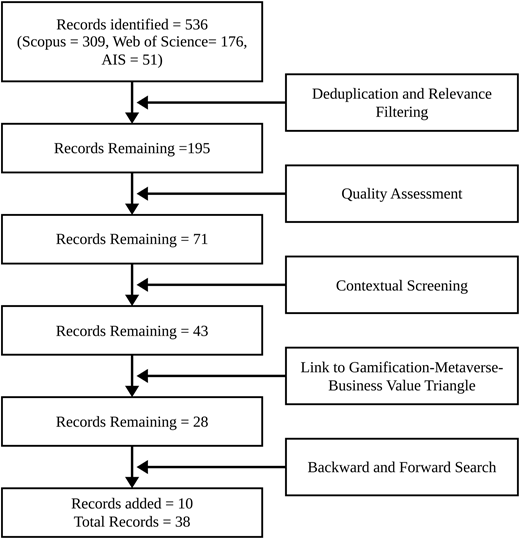
The initial search yielded a dataset of 536 records: 309 retrieved from Scopus, 176 from Web of Science, and 51 from the AIS eLibrary. After removing duplicate records, the abstracts of all unique publications were screened for relevance, resulting in 195 studies that met the conceptual boundaries of this review. These remaining studies underwent a rigorous quality and contextual appraisal, assessing outlet quality and methodological robustness. Furthermore, the studies were assessed for contextual relevance, leading to the exclusion of articles that did not relate to business contexts (e.g. papers focused on educational or medical applications of gamification in the metaverse were excluded). A final round included the assessment of the full text in terms of relevance to the gamification – metaverse – business value triangle. The resulting corpus was a focused, high-quality dataset of 28 articles. Backward and forward searches were performed starting from this well-curated set and yielded an additional set of ten publications that were added. Figure 1 provides an overview of the process followed.
The outlet quality for the articles included in the final literature corpus is strong according to established journal quality rankings, specifically the SCImago Journal Rank (SJR). Overall, 25 of the 38 studies were published in SJR Q1 outlets (top-tier outlets), with an additional four appearing in Q2 outlets and three in Q3/Q4 outlets. The remaining six publications are conference papers (Table 2).
Given the limited body of empirical research at the intersection of gamification, the metaverse and business value, particular care was taken to ensure rigor and transparency throughout the review. A pre-defined review protocol, informed by Kitchenham (2004) and Okoli (2015), governed each stage of the process and specified the search strings, inclusion and exclusion criteria, screening procedures, quality appraisal indicators and synthesis approach prior to data extraction. Consistency checks were embedded across the workflow: each candidate study was independently screened against the pre-defined criteria, and ambiguous cases (e.g. studies straddling business and educational domains, or studies addressing virtual worlds without explicit metaverse framing) were flagged and revisited. Decisions on inclusion, exclusion and contextual relevance were systematically documented in an audit trail comprising spreadsheets recording reasons for exclusion at each screening stage, and the outcomes of the backward and forward citation search. Conducting these procedures in an emerging field with a relatively small evidence base required iterative refinement; the protocol was therefore re-validated after the initial screening to ensure that the criteria remained discriminating and well-aligned with the review question. This process helped ensure the consistency, methodological rigor and trustworthiness of the review, while also providing transparency around the judgements made in synthesizing a still-nascent literature.
2.3 Literature corpus analysis
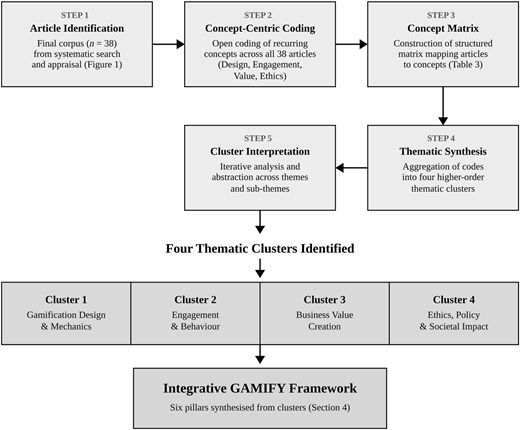
For the analysis of the articles identified, the approach proposed by Webster and Watson was followed (Webster and Watson, 2002). Specifically, a concept-centric matrix was constructed to categorize key themes, providing a structured overview of existing research. The process followed is presented in Figure 2. The concept matrix is presented in Table 3 and it includes themes that were generated by synthesizing codes into higher-order thematic clusters. Insights from these clusters informed the development of an integrative framework.
3. Literature analysis results
The SLR revealed four thematic clusters that structure the scholarly discourse. These clusters are presented in the subsections that follow and provide a structure for understanding gamification as a multi-level construct with far-reaching implications for design, business value and social responsibility. They also reveal that gamification in the metaverse is not only a technological and commercial innovation but also has cognitive and ethical implications. Specifically, through iterative analysis and abstraction, the themes identified are: (1) Gamification Design and Mechanics, (2) Engagement and Behavior, (3) Business Value Creation and (4) Ethics, Policy and Societal Impact. These are presented in what follows.
3.1 Gamification design and mechanics in the metaverse
This theme captures how gamification elements – including badges, levels, leaderboards, avatars and storytelling – are integrated into immersive environments to foster engagement. Studies emphasize the importance of adaptive systems, emotional resonance and narrative immersion to facilitate flow and sustained participation. Research identifies experiential design dimensions (playfulness, sensory immersion, usability and environmental aesthetics) as key levers for gamification design (Zhou et al., 2025). Furthermore, prior work shows that successful gamified environments emerge from configurations of mutually reinforcing features rather than isolated mechanics (Jacobides et al., 2024). Gamification mechanics such as exploratory quests and collectible-based challenges can operate as spatial scaffolding tools that reduce navigational friction and facilitate cognitive orientation in three-dimensional virtual spaces, guiding users toward spatial congruence (Kango et al., 2025).
The synergy between gamification and immersion fosters a heightened state of presence and flow, catalyzed through avatar-based personalization. Customizable identities deepen engagement (Bousba and Arya, 2022) while personalization influences sensory and relational experiences (Ezzatian et al., 2025). Metaverse platforms can enhance experiential realism through advanced avatar embodiment features, such as layered digital clothing and personalized visual identity, which strengthen users' sense of self-presence and psychological immersion (Dai and Bal, 2009). Avatar design can support anthropomorphism, interactivity and multi-sensory feedback (Pandey and Mukherjee, 2024). This argument reinforces the broader emphasis on multi-sensory immersion as a core experiential lever (Sharma et al., 2024; Zhou et al., 2025) and complements evidence on avatar-driven brand engagement in metaverse settings (Arya et al., 2024). Extant research illustrates how avatar-based interactions and customizable virtual identities significantly impact user satisfaction and perceived autonomy (Arya et al., 2024; Bousba and Arya, 2022). Personalization is not merely aesthetic but functions as a psychological anchor, enhancing self-presence and behavioral consistency in digital environments. Avatars, embodiment and identity expression significantly shape engagement and interaction in virtual spaces (Lau and Ki, 2021).
Traditional game elements (such as real-time feedback and dynamic difficulty adjustment) are adapted to immersive contexts (Sharma et al., 2024), with their effectiveness amplified by technologies like VR, AR and XR, which enhance spatial presence, embodiment and interactivity. Furthermore, a growing subset of the literature highlights the importance of real-time adaptation of gamified elements based on user input and behavior (e.g. Sharma et al., 2024). It is important not to generate cognitive overload and prior research underscores the need for tailored configurations (or “value recipes”) that optimize engagement and well-being (Vakeel et al., 2025). Prior research cautions against the risk of “over-gamification,” noting that excess can undermine realism (Dincelli and Jafarian, 2025). This observation is consistent with broader evidence on cognitive overload and diminishing experiential returns when gamified intensity is poorly calibrated (Flavián et al., 2024; Vakeel et al., 2025). Game mechanics ensure that challenges are optimally engaging (neither too hard nor too easy) and linked to achievement, identity, competition and self-expression (Cha et al., 2024). Adaptive mechanics respond to user behavior in real time (Sharma et al., 2024), enabling challenge calibration at scale.
A key aim for gamification design is Gameful Experience (GAMEX). This is a holistic experiential state capturing enjoyment, absorption, activation, dominance and creative thinking (Bazi and Hajawi, 2025; Thomas et al., 2023). GAMEX aligns with core psychological needs for autonomy, competence and relatedness and elucidates how immersive environments generate flow. In metaverse contexts, additional design levers (such as avatar personalization) further configure interactive and relational experiences (Ezzatian et al., 2025). GAMEX integrates the affective, cognitive and motivational layers of immersion (Bazi and Hajawi, 2025). The evolution of gamification in the metaverse moves beyond simple point-based incentives, incorporating a mixture of processes, random events, role-play and adaptable reward structures to achieve a complex emulation of reality (Dai and Bal, 2009). Concurrently, social mechanics are being transformed through gamified social coupons (network-shared rewards that require users to complete collaborative challenges) to earn points. Such interactions can foster shared achievement and social connection, effectively turning functional transactions into memorable, socially engaging experiences (Nayal, 2026). This finding complements established evidence that gamification fosters affective engagement and consumer–brand bonds in the metaverse (Arya et al., 2024; Bousba and Arya, 2022) by extending the focus to network-level mechanics in which collaboration itself becomes the engagement lever. These insights align with (Zhou et al., 2025), who emphasize immersion, usability and aesthetics as experiential levers that designers can modulate. Operational strategies commonly include structured progression and community building via social mechanics.
The studies in this cluster demonstrate that design in gamified metaverse applications requires balancing traditional game elements and immersive features. Effective design must account for flow, personalization and adaptivity, creating integrated and emotionally resonant experiences.
3.2 Gamification engagement and behavior in the metaverse
Empirical studies (Arya et al., 2024; Bousba and Arya, 2022; Lau and Ki, 2021) reveal that gamification in the metaverse significantly enhances affective and cognitive engagement. By leveraging game-like elements within virtual brand spaces, companies are able to increase dwell time, brand recall and emotional attachment. These effects are amplified when combined with immersive storytelling and avatar-driven personalization. Customer engagement, a critical business metric, improves as gamification creates a sense of accomplishment and emotional connection (Sharma et al., 2024; Yang et al., 2023). Interactive campaigns, reward systems and VR-based product simulations foster satisfaction, and memorable brand experiences (Ezzatian et al., 2025) and can also enhance enjoyment, social affiliation, status signaling and expressive behaviors (Hao et al., 2025). Studies like Arya et al. (2024) and Bousba and Arya (2022) show how gamified metaverse campaigns increase affective brand engagement through interactive avatars and environments, as further evidenced in luxury fashion case studies, where gamified avatar-mediated environments support identity expression and reinforce brand engagement (Heo, 2025).
Recent work positions gamified metaverse activities as psychological stimuli that enhance engagement, affective satisfaction and hedonic value (Arya et al., 2024; Cha et al., 2024). Across the literature, engagement is conceptualized as a voluntary investment of cognitive, affective and behavioral resources, while immersion represents the deeper mechanism that enables sustained involvement. To sustain meaningful engagement, it is important to move beyond initial interactions and nurture multifaceted relationships where individuals and organizations participate, interact, communicate, transact and exchange information in real time (Behera et al., 2024). This relational view aligns with the conceptualization of engagement as a voluntary investment of cognitive, affective and behavioral resources (Sharma et al., 2024).
Immersion, which is characterized by focused attention, experiential involvement and affective absorption, functions as a primary pathway through which gamified elements generate continuous use and platform attachment (Choi, 2022; Wang and Guo, 2025). The antecedents of this immersive state are often explained through the Motivation–Opportunity–Ability framework. Enjoyment (motivation), facilitating conditions (opportunity) and self-efficacy (ability) all positively influence immersion (Choi, 2022). When these conditions align, high engagement produces favorable behavioral outcomes, including stronger continuous-use intentions, increased brand loyalty, heightened brand happiness and intensified advocacy (Afkar et al., 2022; Jang and Kim, 2025; Moon and Han, 2023). Engagement in the metaverse is found to be driven by distinct experience categories: community, utilitarian digital commerce, socializing, hedonic gaming and information-seeking (Pagani and Xie, 2025). This typology dovetails with the experiential archetypes (nudge, flow, alternate reality and hedonic) identified in prior conceptual work (Thomas et al., 2023) and reinforces the broader view that engagement in immersive environments is multidimensional rather than unitary (Cha et al., 2024). While presence and interactivity generally boost engagement, their effectiveness can be weakened by perceived embarrassment related to avatar behavior. This highlights the need for designers to ensure that social interactions feel natural and “un-weird” to maintain high engagement levels (Nayal, 2026).
Individual differences moderate gamification dynamics, as users with higher affect intensity experience stronger emotional amplification and deeper immersion (Choi, 2022). The effectiveness of gamification lies in its ability to influence behavior through psychological triggers. Gamified engagement strategies includes blends of intrinsic–extrinsic and active–reactive levers (Zhou et al., 2025). Behavioral nudges (such as rewards, social validation and adaptive challenges) play a central role in shaping engagement and driving intention formation (Thomas et al., 2023). Social presence is also fundamental: avatar-mediated interaction, embodied communication and shared experiences enhance enjoyment, and satisfaction underscoring that engagement in the metaverse is both psychological and socially co-constructed (Jang and Kim, 2025).
Gamification consistently correlates with favorable behavioral outcomes, including increased purchase intention, repeat engagement and brand advocacy (Bazi and Hajawi, 2025). These behavioral impacts arise because immersion and engagement act as precursors to user responses. Immersion influences purchase intention and continuous-use intention (Choi, 2022), while high engagement (often triggered by interactive, gamified features) enhances anticipated satisfaction (Al-Adwan et al., 2025; Bousba and Arya, 2022). Experiential dimensions such as immersive sensory appeal and avatar-mediated presence further elevate relational outcomes (Hao et al., 2025; Jang and Kim, 2025), and event-based evidence shows that branded metaverse experiences translate engagement into brand equity outcomes such as awareness, perceived quality and loyalty (Pagani and Xie, 2025). Consequently, gamification has the potential to become a central component of business development in the metaverse, particularly through campaigns designed to foster emotional connection and sustained participation.
However, sustaining engagement presents challenges. A significant challenge to sustained engagement arises from the fact that digital goods are intangible and infinitely reproducible, which can diminish users' sense of possession and perceived value. By fulfilling users' needs for control and self-identification through sensory-rich interactions, it is possible to foster a stronger psychological bond between users and their digital assets (Pandey and Mukherjee, 2024). This argument extends prior evidence that immersive sensory appeal and avatar-mediated presence elevate relational outcomes (Hao et al., 2025; Jang and Kim, 2025), reframing multi-sensory affordance as a partial remedy to the intangibility problem of digital goods. Furthermore, evidence shows diminishing returns as gamification enhances satisfaction only up to a threshold, after which excessive intensity leads to cognitive overload and reduced user experience (Flavián et al., 2024; Vakeel et al., 2025). Immersive environments can introduce cognitive biases (such as inattention and attentional imbalance) that complicate information processing (Chen et al., 2023). Gamification can mitigate these biases by structuring attention through quests, challenges and reward loops, helping users navigate high-load environments (Flavián et al., 2024). Sharma et al. (2024) demonstrate that gamified spaces generate stronger customer-brand relationships, particularly among digitally native users who view interactivity as normal rather than novel. However, although metaverse gamification strategies show immediate benefits, their long-term effects on customer engagement remain underexplored.
3.3 Business value creation in the metaverse
The third theme examines how gamification within metaverse environments functions as a driver of business value. Across the literature, the metaverse is framed not merely as a new channel but as an enabler offering firms novel pathways to value creation and distinct innovation trajectories for digital business models (Ezzatian et al., 2025; Mancuso et al., 2023; Sharma et al., 2024). Prior research delineates metaverse-enabled opportunities, distinguishing between internally oriented, product/channel-focused opportunities and customer-oriented opportunities, such as virtual identity affirmation, co-creation and community building, which catalyze virtual transformation of market-facing processes (Mancuso et al., 2023; SanMiguel et al., 2024).
Metaverse activities can generate measurable business value by directly influencing awareness, associations, perceived quality and brand loyalty (Pagani and Xie, 2025), reinforcing the broader argument that gamified metaverse environments contribute not only to engagement but also to measurable brand-equity outcomes (Arya et al., 2024). Gamification can be instrumental in attracting and converting consumers and is consistently linked to strengthened consumer–firm relationships. Metaverse-based gamified marketing increases purchase intention, customer loyalty and positive word-of-mouth, while customer inspiration derived from immersive experiences elevates users' willingness to pay premium prices (Al-Adwan et al., 2025). Complementary empirical evidence demonstrates that gamification marketing activities in the metaverse significantly enhance consumer-based brand equity and consumption retention (Arya et al., 2024). Industry-specific research, such as in tourism, illustrates that the adoption of the metaverse and its gamification mechanics can create competitive advantage by enhancing destination appeal, underscoring gamification's instrumental role in pre-experience branding (Bazi and Hajawi, 2025; Ezzatian et al., 2025). Furthermore, enabling transactions in virtual goods and tokenized digital assets can strengthen brand stickiness and expand firms' reach within metaverse ecosystems (Bazi and Hajawi, 2025). In digital entrepreneurship, practitioners identify gamification as one of the foundational metaverse-enabled concepts (alongside digital twins and co-design) that foster new entrepreneurial ventures and business model diversification (Calandra et al., 2024). This further reinforces the metaverse's role as a technological lever that not only enhances existing offerings but also creates entirely new value creation logics.
Business value can be generated when organizations leverage gamification to support specific strategic objectives, for instance to stimulate brand engagement and enhance awareness (Jacobides et al., 2024). For commercial firms, the metaverse can expand economies of scope and scale at a fraction of the cost of physical expansion. It allows reaching digitally native Gen Z and Alpha consumers who prioritize virtual identity and symbolic participation over traditional physical goods (Heo, 2025). Dwivedi et al. (2023) introduce a comprehensive framework for business value creation in the metaverse, emphasizing the strategic interdependence of three elements: (1) a digital strategy calibrated to immersive environments, (2) responsible platform governance to mitigate emerging ethical and privacy risks and (3) stakeholder engagement that connects users, firms and ecosystem partners. Despite its strategic promise, metaverse gamification introduces also new management challenges. Prior research with industry experts emphasizes that traditional marketing metrics are insufficient for capturing metaverse activation effectiveness (Jacquemin et al., 2025). Firms need to adopt expanded measurement paradigms, including nontraditional attention, immersion and co-creation metrics applied across the full funnel from awareness to conversion and loyalty.
3.4 Ethics, policy and societal impact
This theme highlights the implications of implementing gamification in metaverse environments. As gamified systems become more immersive, data-rich and behaviorally influential, concerns over long-term user well-being, digital rights and regulatory accountability have become increasingly salient in scholarly discourse. Gamification in the metaverse raises ethical challenges, including risks of addiction, manipulation and data misuse. The features that enhance engagement (immersion, identity fluidity, embodied interaction and XR-enabled presence) also heighten vulnerabilities related to privacy, cognitive overload and deviant behavior. Researchers emphasize the need for ethical frameworks (Dwivedi et al., 2022; Nosikov, 2025) to mitigate risks, including privacy violations, cybersecurity threats and intellectual property disputes (Behera et al., 2024).
Ethical challenges, including data privacy, addiction and manipulation via gamified interfaces, are raised in the reviewed literature. Sharma and colleagues emphasize that gamification can exploit psychological vulnerabilities when misapplied, prompting calls for regulatory frameworks and ethical design principles (Sharma et al., 2024). There is also concern about the long-term cognitive and social impact of sustained gamified interactions in immersive environments. Studies show that immersive gamified environments can distort time perception, induce escapism and foster emotional dependency, particularly among younger or vulnerable users. The literature highlights the psychological risks of persistent virtual engagement, including techno-stress, compulsive use cycles, emotional exhaustion and dissociation from physical reality (Flavián et al., 2024). Emerging research flags concerns over the cognitive and emotional toll of sustained engagement with gamified metaverse environments. Studies warn that exploitative mechanics (such as variable reward schedules, compulsive progression systems and emotionally persuasive avatars) can erode user autonomy and induce maladaptive behaviors (Bousba and Arya, 2022; Sharma et al., 2024). Recent work on gamified social coupons further suggests that even ostensibly playful, network-shared rewards can generate feelings of social embarrassment and pressure that, if poorly designed, may undermine user autonomy and well-being while still driving engagement (Nayal, 2026), reinforcing calls for responsible-metaverse principles (Behera et al., 2024).
A significant concern is the collection and commodification of user data, particularly biometric and behavioral data gathered in VR/AR environments. Activities in the metaverse capture unprecedented levels of sensitive information (including spatial patterns, affective cues, micro-gestures and transaction histories), creating a surveillance-intensive ecosystem that exceeds the protective capacity of traditional cybersecurity frameworks. Without robust governance mechanisms, such data can be exploited for profiling, targeting and algorithmic discrimination, undermining privacy and autonomy. Scholars call for transparent data governance and sector-specific ethical guidelines to preserve user trust and mitigate privacy vulnerabilities (Ezzatian et al., 2025).
Interestingly, while the commercial adoption of gamified metaverse experiences is accelerating, the literature points to a lag in regulatory oversight. The borderless nature of virtual worlds, combined with decentralized ownership models and fluid user identities, generates legal and governance ambiguities around accountability, identity verification and the regulation of virtual conduct (Dwivedi et al., 2022). These ambiguities extend to gamified practices related to monetization, such as microtransactions and reward-driven consumption loops, which raise concerns regarding financial harm (Sánchez-Adame et al., 2023). There is a lack of clear legal definitions and protections for users in virtual gamified spaces, particularly concerning consent and accountability. Scholars advocate for international policy collaboration and design ethics codes tailored to the immersive and gamified nature of the metaverse. Such contributions mark a proactive shift toward balancing innovation with moral responsibility.
4. GAMIFY: a proposed metaverse gamification framework for value creation
The findings in this review articulate a compelling case for critical, ethically informed engagement with gamification in the metaverse. While gamification holds transformative potential, it also introduces risks related to exploitation, inequity and psychological harm (Sánchez-Adame et al., 2023). To ensure equitable and sustainable deployment, the literature calls for a combination of sound design, impact monitoring and governance to prevent harms. However, existing research, although expanding rapidly, remains fragmented and predominantly descriptive, offering limited integration or guidance. Ultimately, in this section, we move from what gamification can do, to how we can bring it to the service of human dignity and social good.
GAMIFY is an acronym; each letter represents a core pillar, ensuring a holistic approach that balances engagement, business value and ethical responsibility. Overall, the framework bridges design, business and ethics research. As the framework aims to support gamification deployment in metaverse environments, a significant number of its components relate to design aspects being directly linked to the gamification design and mechanics theme identified in the literature. Each component of the framework – Goal-Driven Mechanics, Avatar-Mediated Identity, Multi-Sensory Immersion, Incentivization and Nudges, Fair Governance and Yield Measurement – is derived from research findings that can inform the design, deployment and evaluation of gamification in the metaverse.
The pillars consolidate insights drawn from across the four thematic clusters identified in Section 3. Goal-Driven Mechanics and Multi-Sensory Immersion build on the design and mechanics evidence (e.g. Zhou et al., 2025; Sharma et al., 2024; Vakeel et al., 2025); Avatar-Mediated Identity and Incentivization and Nudges integrate findings from the engagement and behavior cluster (e.g. Arya et al., 2024; Bousba and Arya, 2022; Jang and Kim, 2025); the Yield pillar synthesizes business value insights (e.g. Pagani and Xie, 2025; Jacquemin et al., 2025; Heo, 2025) and Fair Governance is anchored in the ethics, policy and societal-impact stream (e.g. Dwivedi et al., 2022; Behera et al., 2024; Sánchez-Adame et al., 2023). Together, these pillars constitute an integrated conceptual foundation for understanding how gamification in the metaverse can be designed and governed for business value.
While existing studies illuminate specific aspects of metaverse gamification, they rarely integrate these dimensions into a coherent sociotechnical model. To bridge this gap, the present study develops the GAMIFY framework, which consolidates the four thematic clusters into six interrelated pillars for responsible, value-driven metaverse gamification. The framework is presented in Table 4.
GAMIFY provides a structured approach for practitioners to design, implement and evaluate gamified experiences in the metaverse while ensuring long-term engagement, strategic value and ethical integrity. In the subsections that follow, each pillar is presented in detail.
4.1 G – goal-driven and adaptive mechanics
Effective gamification requires alignment between game elements (e.g. points, badges, leaderboards) along with adaptive mechanics (e.g. dynamic difficulty, real-time feedback) and measurable, well-defined behavioral and business objectives (Dwivedi et al., 2022; Thomas et al., 2023). The metaverse amplifies this need due to its immersive and persistent nature (Zhou et al., 2025). Studies demonstrate that adaptive systems – those that dynamically adjust challenges and rewards based on user behavior – significantly enhance engagement and reduce cognitive overload (Lau and Ki, 2021; Vakeel et al., 2025). Success requires goal–mechanic–metric coherence, where every element, from a leaderboard to an AI-driven mentor, is explicitly linked to an outcome (Dai and Bal, 2009). To implement this pillar, it is important to explicitly link game elements (e.g. leaderboards, quests) to target outcomes (e.g. increased brand interaction, learning retention) and utilize real-time analytics to modify difficulty, feedback and rewards, ensuring sustained user motivation (Flavián et al., 2024). Adaptive systems should calibrate challenge, skill balance, support autonomy and cultivate a sense of competence (Bazi and Hajawi, 2025). A core design implication is goal–mechanic–metric coherence: each mechanic must carry a clear rationale and demonstrable effect on outcomes (Jacquemin et al., 2025). This coherence principle echoes Dai and Bal's (2009) early demonstration that virtual-world simulations are most effective when role-play, randomness and reward structures are tied to clearly defined behavioral and learning objectives, an insight that remains relevant for contemporary metaverse design.
4.2 A – avatar-mediated identity and embodiment
Avatars function as critical digital extensions and psychological interface of user identity within metaverse environments (Choi, 2022), serving as powerful mediators of behavior, emotional engagement and social interaction. Luxury brands effectively leverage this by offering digital goods and accessories in virtual environments like Roblox, allowing users to express their identities while expanding brand awareness among younger audiences (Heo, 2025). Empirical research demonstrates that avatar customization capabilities significantly enhance self-presence and foster stronger brand attachments (Jang and Kim, 2025), particularly when users perceive their avatars as authentic representations of their identity (Bousba and Arya, 2022). This is amplified in VR environments where embodied interactions create more profound psychological and emotional connections. Avatars are central in the metaverse, shaping how users experience identity, presence and sociality (Arya et al., 2024). The visual and symbolic qualities of avatars influence users' attitudes, confidence and behaviors (Bazi and Hajawi, 2025). To implement this pillar, it is important to provide comprehensive avatar personalization options (e.g. physical appearance, abilities and accessories) to facilitate user self-expression and emotional investment. Furthermore, it is important to design avatar-driven interactive systems that leverage the social dimension of avatar-mediated interactions without overwhelming complexity (Ezzatian et al., 2025). To ensure effectiveness, designers must prioritize avatar realism to foster psychological and emotional connections, as the visual and symbolic qualities of avatars directly influence user attitudes and self-congruence (Heo, 2025).
4.3 M – multi-sensory immersion and narrative integration
The metaverse's unique features, including spatial presence and haptic feedback, facilitate significantly deeper emotional engagement compared to conventional digital platforms (Arya et al., 2024; Jang and Kim, 2025; Nosikov, 2025). Narrative-driven gamification, when combined with immersive technologies can be very powerful. To implement this pillar, it is important to include multi-sensory layering (integration of haptic, auditory and visual stimuli) to create cohesive immersive experiences (Ezzatian et al., 2025), a recommendation that directly addresses the intangibility problem identified by Pandey and Mukherjee (2024), whose work shows that multi-sensory affordances help mitigate the shortcomings of metaverse offerings by strengthening users' sense of control over and connection to digital assets. It is also important to embed gamified mechanics within compelling story arcs (Al-Adwan et al., 2025) and design narrative elements that leverage the metaverse's spatial and interactive capabilities (e.g. environmental storytelling through virtual world design). Ensuring narrative congruence (the alignment of mechanics, environment and story) prevents cognitive fragmentation (Flavián et al., 2024) and supports a sustained sense of presence (Bazi and Hajawi, 2025). This positions gamification as a holistic experiential process (Wang and Guo, 2025) by emphasizing the orchestration of multisensory, narrative-consistent sociotechnical systems (Nosikov, 2025). Designing for multi-sensory layering (integration of haptic, auditory and visual stimuli) is essential to create narrative congruence and prevent cognitive fragmentation (Pandey and Mukherjee, 2024).
4.4 I – incentivization and digital nudges
The design of reward systems in metaverse gamification requires careful balance between extrinsic motivators (e.g. tokens, badges) (Sharma et al., 2024) and intrinsic drivers (e.g. mastery, social belonging) (Jang and Kim, 2025; Lau and Ki, 2021), to sustain long-term engagement (Yang et al., 2023). While tokenized rewards have demonstrated effectiveness in boosting platform loyalty and short-term participation, excessive dependence on extrinsic incentives may lead to motivational crowding-out effects and potentially addictive behaviors (Sánchez-Adame et al., 2023). This tension is heightened in immersive environments (Chen et al., 2023; Flavián et al., 2024), where context-sensitive and continuous nudges can become highly persuasive, necessitating ethical frameworks that prevent exploitative designs while maintaining engagement efficacy. Effective systems combine tangible rewards (e.g. non-fungible tokens (NFTs), virtual goods) (Mancuso et al., 2023) with psychological rewards (e.g. social recognition, skill mastery) (Lau and Ki, 2021; Wang and Guo, 2025) and employ progressive reward schedules. Implementing ethical nudge design principles (voluntariness, transparency, avoidance of dark patterns) is essential to mitigate manipulation risks and respect user autonomy (Sánchez-Adame et al., 2023). This situates incentivization not merely as a motivational tactic but as a responsible sociotechnical design process integral to sustainable digital engagement in the metaverse (Dwivedi et al., 2023). Effective incentivization should avoid “dark patterns,” situating rewarding as responsible sociotechnical design (Nayal, 2026). This recommendation reinforces the broader call for ethically designed reward and microtransaction systems (Sánchez-Adame et al., 2023; Sharma et al., 2024) and aligns with governance-oriented framings of responsible metaverse design (Behera et al., 2024; Dwivedi et al., 2023).
4.5 F – fair governance
The Fair Governance pillar emphasizes the establishment of transparent, accountable and inclusive oversight mechanisms to ensure that gamification in the metaverse operates within clear ethical and legal boundaries (Dwivedi et al., 2023; Thomas et al., 2023). Despite the rapid commercialization of immersive platforms, the literature consistently highlights a notable governance gap: there is a lack of standardized regulations and policy frameworks addressing consent, data monetization and platform accountability in virtual environments (Dwivedi et al., 2022). Without robust regulatory oversight, gamified metaverse experiences risk infringing on user autonomy (Lau and Ki, 2021; Sánchez-Adame et al., 2023) through exploitative reward loops, opaque algorithms and hyper-personalization (Jacobides et al., 2024), potentially leading to compulsive behaviors and disproportionate data harvesting. Dwivedi et al. (2022) call for international policy collaboration to define clear legal definitions for virtual goods, biometric data usage and user rights, arguing that only a coordinated regulatory response can mitigate risks of profiling, manipulation and digital exclusion in metaverse ecosystems. Governance is a structural condition for trust, legitimacy and fairness in data-intensive, algorithmically mediated environments (Dwivedi et al., 2022). This pillar therefore foregrounds ethics-by-design practices, data transparency and inclusive stakeholder participation as essential safeguards (Tayal et al., 2022). Governance protocols must also address inclusiveness, ensuring that diverse user groups are not excluded by high-stimuli virtual environments (Dincelli and Jafarian, 2025). By embedding Fair Governance in the GAMIFY framework, practitioners are guided to co-design gamified experiences with stakeholder representation, transparent data practices and enforceable accountability standards, balancing innovation with long-term user well-being and social responsibility.
4.6 Y – yield: measuring long-term value, ROI and societal impact
Effective metaverse gamification extends beyond conventional short-term engagement metrics (e.g. daily active users, click-through rates) toward assessing sustained business value and broader societal implications (Jacobides et al., 2024; Yang et al., 2023). Current research highlights a critical disconnect between immediate behavioral metrics and long-term outcomes (Bazi and Hajawi, 2025; Vakeel et al., 2025), necessitating multidimensional assessment frameworks that capture both organizational ROI and user well-being (Singh et al., 2025). Measurement can include multidimensional KPIs that assess how immersive metaverse events translate into brand equity, including brand awareness, perceived quality and long-term brand loyalty (Pagani and Xie, 2025). A major limitation is the reliance on short-term interaction data, which obscures insights into retention, value creation and potential societal consequences. To implement this pillar, it is important to include longitudinal performance tracking across business and societal metrics. Business-oriented evaluations should incorporate retention rates (Jacobides et al., 2024; Singh et al., 2025), customer lifetime value, mastery progression (Jang and Kim, 2025), ecosystem participation (Mancuso et al., 2023) and conversion efficiency (Arya et al., 2024) across extended user journeys. Societal and ethical evaluation requires integrating digital well-being indicators, inclusiveness and accessibility measures, periodic well-being assessments embedded into user experience flows and metrics derived from privacy, security, and fairness audits and continuous feedback loops (Wang and Guo, 2025). These are essential for distinguishing novelty effects (Vakeel et al., 2025) from sustained impact, ensuring that gamification drives enduring value rather than transient engagement (Bazi and Hajawi, 2025).
5. The role of GAMIFY for sustained impact and implementation pathways
This study advances research on gamification in the metaverse by introducing GAMIFY, a sociotechnical framework that integrates design, identity, immersion, incentivization, governance and impact evaluation into a unified architecture for value creation. It is developed specifically for the metaverse context unlike prior non-metaverse specific gamification frameworks such as Chou's Octalysis framework which emphasizes motivational drivers (Chou, 2019), Kumar's framework for gamification in the enterprise which includes elements of behavior, feedback and progression (Kumar, 2013) and the gamification framework by Liu, Santhanam and Webster for guiding design and research (Liu et al., 2017).
The proposed framework also moves beyond the recent metaverse-specific gamification frameworks proposed by Thomas et al. (2023) and Xie et al. (2026). Specifically, in contrast to the experiential typology developed by Thomas et al. (2023), which is focused on experiences through four overarching categories of nudge, flow, alternate reality and hedonic experience, GAMIFY offers an operationalizable deployment structure. GAMIFY does not cover only the gamification designer's perspective but extends to cover governance and measurable outcomes. GAMIFY translates experiential insights into structured design pillars linked to strategic objectives and evaluative metrics. Furthermore, compared to the affordance-driven gamification framework for the metaverse proposed by Xie et al. (2026), GAMIFY shifts the focus from short-term engagement to continued impact at the individual, organizational and also societal level. While that framework provides an important affordance-based lens, its primary focus remains interactional.
Table 5 makes these distinctions explicit by positioning GAMIFY against prior gamification frameworks along the analytical dimensions in which their contributions most meaningfully differ. The frameworks are ordered chronologically. The first three frameworks predate or are not specific to the metaverse context, but they are foundational gamification frameworks, while the last three are explicitly developed for metaverse settings. GAMIFY is presented in the final row.
Overall, existing metaverse gamification frameworks prioritize engagement mechanics without embedding governance or long-term societal evaluation. GAMIFY advances this literature by integrating six interdependent pillars into a unified sociotechnical framework. This integration constitutes the primary contribution of the framework. It synthesizes previously disjoint streams, bringing together design, ethics and business value. GAMIFY conceptualizes metaverse gamification not merely as a set of engagement tactics but as a sociotechnical arrangement which brings together technology features, governance and performance metrics. By explicitly embedding Fair Governance and Yield-focused evaluation, the framework positions ethics and impact assessment as constitutive elements of design rather than ex post considerations. Examples of how the framework can be operationalized for different aims are provided in the following paragraphs.
For customer-facing businesses that want to improve market impact, GAMIFY can be leveraged to shift from transactional interactions toward experiential engagement. Goal-driven mechanics may be configured as personalized exploration tasks or progression pathways linked to conversion, cross-category discovery or retention. Avatar-mediated identity can enable product trial and self-representation in virtual environments, reducing post–purchase uncertainty. Multi-sensory immersive spaces can communicate brand narratives and differentiate experiential value. Incentive systems can balance loyalty rewards with intrinsic motivators such as status or community recognition, while Fair Governance can guide the establishment of responsible activity tracking and data management. Yield measurement can extend beyond click-based metrics to include customer lifetime value, return reduction and brand attachment.
For enterprise learning and employee motivation, GAMIFY can be used to support competency-based progression and experiential skill development. Adaptive mechanics allow learning difficulty and feedback to adjust dynamically based on performance. Avatar-based role-play can enable experiential training for leadership, negotiation, safety or customer interaction scenarios. Immersive structures can be employed to increase completion and persistence. Incentivization can be directed toward mastery and skill progression rather than purely extrinsic rewards to avoid superficial participation. Governance considerations can include privacy and protection of learner autonomy. Yield can be assessed through knowledge retention, skill transfer, performance improvement and workforce capability development.
Across contexts, there is a common implementation principle: organizations should ensure goal–mechanic–metric coherence, where each gamification element is explicitly linked to behavioral objectives, governance safeguards and multidimensional performance outcomes.
6. Future research agenda
The synthesis of state-of-the-art research on gamification design and business outcomes in the context of the metaverse shows that the fusion of gamification and the metaverse can reshape digital engagement and enhance value creation. The thematic analysis identified four interconnected domains: design and mechanics, engagement and behavior, business value creation, ethics, policy and societal impact. These domains illustrate how design choices feed into immersive engagement processes, which in turn fuel business outcomes. At the same time, the mechanisms that generate value also heighten risks related to privacy intrusion, persuasive manipulation, inequitable participation and governance ambiguity, underscoring the need for balanced guardrails as these environments evolve.
Despite the growing body of literature on gamification in the metaverse, several significant gaps remain that limit the field's conceptual depth and practical applicability. One of the most critical limitations is the lack of investigation into the long-term impact of gamification. While many studies focus on interactions and behavioral triggers, few examine how gamification affects long-term retention, commitment or emotional investment within immersive environments. Longitudinal studies are critically needed to assess gamification effects over time. By investigating user behavior, engagement metrics and loyalty indicators over extended periods, scholars can determine whether gamification merely triggers initial interest or can contribute to sustained user commitment and business value. Furthermore, research is needed on long-term implications for user well-being and the particular impact on sensitive user groups (for instance, minors). Field studies, panel data analyses and multi-period behavioral datasets are essential for such research.
Another gap pertains to ethical considerations, which are often overlooked or superficially addressed. The immersive and persuasive nature of gamified systems in the metaverse raises complex issues concerning user autonomy, privacy and transparency, and inclusiveness. The literature provides insufficient critical discourse on how gamification may reinforce behavioral manipulation, exclude marginalized groups or infringe on digital rights. The immersive and persistent nature of metaverse environments amplifies the influence of algorithmic personalization and behavioral nudging. While adaptive guidance can enhance user experience and goal attainment, it also raises concerns regarding, over-persuasion and erosion of autonomy. Future research should investigate boundary conditions between supportive and coercive forms of influence, user perceptions of fairness and transparency, and the effectiveness of design mechanisms that preserve informed choice. Experimental, mixed-method and design science approaches can help research these issues.
Furthermore, there is a notable absence of assessment frameworks for gamification within metaverse platforms. Most studies employ ad hoc models or platform-specific strategies, hindering replicability and comparative analysis across ecosystems. Evaluation criteria are often embedded within proprietary platform infrastructures or designed around idiosyncratic campaign objectives. Furthermore, comparative analysis across ecosystems is impeded, since different metaverse environments employ distinct interaction logics and governance structures. Without common evaluative dimensions, it becomes difficult to determine whether observed outcomes stem from gamification design or general platform characteristics. This can be researched through comparative multi-platform studies.
Theoretical integration is another vital frontier. There is a compelling need for comprehensive models that synthesize behavioral psychology, game theory and ethics-related theorizing. Current research often draws selectively from one of these domains emphasizing motivational drivers, strategic interaction or normative concerns without systematically connecting them. Such integrative theorizing can offer a more holistic understanding of how gamified mechanisms influence decision-making, emotional responses and social interactions in the metaverse. It would also enable scholars to move toward a multidimensional conception of value creation that incorporates behavioral effectiveness, systemic performance and ethical accountability as interdependent dimensions.
Finally, research is needed on role of value creation through gamification in the metaverse within the overall context of value creation through digital transformation. While metaverse gamification initiatives are often implemented as discrete projects, they increasingly intersect with digitalization strategies involving omnichannel ecosystems and virtual service delivery. Understanding how immersive gamification contributes to (or detracts from) strategic digital objectives therefore represents a critical research frontier. Future work should examine how organizations integrate immersive gamification into broader digital initiatives and how value is distributed across ecosystem actors. Research can analyze issues of value appropriation, redistribution, power asymmetries and long-term ecosystem sustainability. Research should also explore when gamification can function as a peripheral engagement layer and when it can be leveraged as a core orchestrating mechanism within digital business models. This can be studied through longitudinal multi-case studies of organizations undergoing digital transformation, examining how gamification initiatives integrate with broader digital infrastructures, governance mechanisms and business model innovation.
To support scholars in navigating this future research agenda, it is helpful to prioritize the directions outlined above. Two areas should be considered the most urgent. The first is ethical governance: the immersive, persuasive and data-intensive nature of gamified metaverse environments creates immediate risks around user autonomy, biometric and behavioral data use, manipulation and inclusion. Without timely scholarly engagement, governance frameworks will continue to lag commercial deployment, with consequences that are difficult to reverse. The second is cross-platform knowledge integration. Because metaverse ecosystems currently differ substantially in their architectures, data models and design logics, findings generated within one platform rarely travel to another. Establishing common measurement frameworks and baseline design standards is a prerequisite for comparative research and, ultimately, for building cumulative knowledge across the field.
A second tier of priorities operates on a medium-term horizon and encompasses longitudinal empirical work on user engagement, retention and well-being, as well as deeper theoretical integration across behavioral, psychological and strategic perspectives. Over the longer term, research might productively situate metaverse gamification within broader digital transformation strategies, with particular attention to value appropriation and ecosystem-level dynamics, while also examining how immersive gamification intersects with adjacent developments in AI agents, generative content and decentralized identity systems. Treating these directions as an ordered rather than undifferentiated set allows scholars to concentrate effort where conceptual and societal stakes are highest.
Taken together, these research avenues reconnect directly to the core findings of the literature review. The four domains identified are deeply interdependent, yet current scholarship tends to examine them in isolation. Advancing the field therefore requires moving beyond fragmented analyses toward integrative, longitudinal inquiries that can transform metaverse gamification from a collection of engagement techniques into a new sociotechnical paradigm of value creation.
7. Limitations
Several limitations of this review should be acknowledged. First, although the search drew on three extensive databases (Scopus, Web of Science and the AIS eLibrary) and was extended through systematic backward and forward citation searches, the final corpus comprises 38 articles. While this is consistent with the still-emerging nature of research at the intersection of gamification, the metaverse and business value, the relatively small number of articles constrains the generalizability of the findings. Conclusions about the universal applicability of the GAMIFY framework should therefore be made cautiously, as the evidence base is unevenly distributed across industries: retail, marketing and tourism are comparatively well represented, whereas sectors such as financial services, healthcare-related business contexts, public services and heavy industries remain underexplored. As a result, framework dimensions that have been most extensively examined in consumer-facing settings (e.g. avatar-mediated identity and incentivization) may need contextual recalibration when applied in business-to-business, regulated or workplace environments. Second, the review is limited to peer-reviewed English-language publications and excludes gray literature, which may result in greater representation of academic perspectives while offering more limited coverage of rapidly evolving industry practices and practitioner reports. Third, the field itself is moving quickly, and metaverse technologies, platforms and governance arrangements are likely to evolve substantively beyond the snapshot provided here. Accordingly, the findings and the proposed GAMIFY framework should be interpreted as a research-grounded yet evolving foundation, intended to guide future empirical refinement as metaverse ecosystems, organizational practices and governance structures continue to mature.
8. Conclusion
This study set out to synthesize extant research on gamification in the metaverse for business value. Through an SLR of 38 high-quality publications, the findings demonstrate that while gamification in the metaverse can enhance engagement, strengthen relationships and enable innovative digital business models, it simultaneously introduces governance, ethical and societal challenges that cannot be treated as peripheral concerns. In response to the fragmented yet rapidly expanding body of knowledge, the article introduces the GAMIFY framework integrating Goal-driven mechanics, Avatar-mediated identity, Multi-sensory immersion, Incentivization, Fair governance and Yield-focused evaluation. By embedding governance and impact assessment alongside design and engagement mechanics, GAMIFY advances the discourse from short-term interaction metrics toward sustained, responsible value creation. Overall, this review contributes conceptual advancement and practical direction. It reframes metaverse gamification not merely as a set of engagement tactics but as a strategic value creation instrument. As immersive technologies continue to evolve, the future of metaverse gamification will depend on organizations' ability to align design innovation with governance safeguards and multidimensional performance evaluation, ensuring that immersive engagement translates into value.
The author is grateful to colleagues at the University of Agder and Singular Logic for their support, and to the reviewers and editorial team at JEIM for their constructive feedback. Finally, the author is deeply grateful to his wife, Fatimah, and son, Yahya, for their patience and support throughout this research, and to his family for their constant encouragement.