This study aims to theorize the tensions of hot-desking. Moving beyond its surface-level effects, we explain its complex impact on employee well-being and organizational conflict.
Using a multi-platform netnographic approach, we analyzed unsolicited discussions from online communities to capture diverse, authentic experiences across Eastern and Western contexts.
Grounded in technology affordance and constraints theory (TACT), our central finding is that hot-desking's affordances and constraints are dynamically co-produced. The organizational affordance of space efficiency is directly experienced by employees as a constraint of spatial insecurity and resource deprivation. This core tension fuels emergent social conflicts, such as senior staff “claiming” desks, as individuals seek stability.
Our primary contribution is a process model explaining how hot-desking's dual outcomes emerge in practice. We advance theory by demonstrating that potential negative consequences, from potential workplace bullying to reduced well-being and working capacities, are structural outcomes of the core tension between organizational affordances and individual constraints, despite the affordance of space efficiency and exposure to different co-workers. This reframes the problem from one of individual misbehavior to one of socio-material design. Practically, we argue that effective governance requires managers to address this tension, not merely enforce surface-level policies, thus paving the way for more effective workplace strategies in digital settings.
Introduction
Enabled by advancements in communication and collaboration technologies, digital workplaces have transformed the traditional office landscape (Aroles et al., 2021). Different digital workplace arrangements, such as work-from-home (WFH) and hot-desking, have emerged in response to the call for flexibility and adaptability in working environments (Golden, 2009), accelerated by global events such as the COVID-19 pandemic (Rigotti et al., 2020). Hot-desking practices promote different benefits, such as interaction across departments and greater freedom of movement (Aleem et al., 2023; Duan et al., 2020). Yet, hot-desking was criticized for its potential negative impacts on employee well-being, job satisfaction and productivity. The lack of personal space and the need to adapt daily to new seating arrangements can create instability and diminish the comfort and privacy that a permanent workspace provides (Taskin et al., 2019).
After the COVID-19 pandemic, some companies, such as Amazon, have encouraged or mandated returning to the office to strengthen face-to-face connections (Jassy, 2024). Work arrangement negotiations vary across companies, but the advantages and disadvantages of these digital workplace arrangements will become more pronounced as more employees return. When many workers take hybrid mode, which means different arrangements may co-exist, advancing our understanding of the basic arrangements' (e.g. pure hot-desking) impact is necessary. Addressing this knowledge gap may facilitate digital entrepreneurs in effectively adopting a mix of different digital workplace arrangements, thus saving costs (Duan et al., 2020) and enabling their successes.
Grounded in technology affordance and constraints theory (TACT), this qualitative study, based on multiple online communities, aims to examine the bright and dark sides of hot-desking and to provide an integrated view to guide companies in balancing employee well-being, job motivation and performance. Moving beyond viewing hot-desking as a simple policy or technology, we conceptualize it as a digitally mediated socio-spatial work arrangement. This framing allows us to analyze how its consequences emerge from the dynamic interplay between its core components: (1) the digital technologies that enable it (e.g. booking systems), (2) the organizational rules and policies that govern it (e.g. clear-desk policies), (3) the physical office layout (e.g. open-plan spaces) and (4) the social enactment by employees (e.g. norm violations). In turn, we can advance our theoretical understanding of hot-desking and provide practical implications for different stakeholders, especially those considering implementing hot-desking in their organization or team. Accordingly, our research question
What are the affordances and constraints of hot-desking workplace arrangements?
Literature review
Digital workplace arrangements and hot-desking
Workplaces are where workers carry out their job responsibilities and work-related tasks (Ashforth et al., 2024), which impact employees' work experiences in various dimensions (see Table 1). In recent years, employees' daily routines, habits (Duan et al., 2023; Richter, 2020) and professional competencies (Colbert et al., 2016) have become integrated with new technologies (Lamovšek et al., 2025), which led to the emergence of alternative digital workplace arrangements, possibly including spaces beyond traditional office locations (Aroles et al., 2021; de Lucas Ancillo et al., 2023).
A list of factors related to workplace design and their impact on employees
| Factors | Description |
|---|---|
| Physical dimensions | |
| Spatial configuration and barriers | Spatial configurations determine employees' privacy and control over distraction levels in the workplace (Elsbach and Pratt, 2007). Yet, barriers within these configurations may impede collaboration (Mark, 2002) and reinforce undesirable status differences (Elsbach and Pratt, 2007) |
| Personalization | Workplace personalization helps maintain emotional energy when facing stressors and distractions (Laurence et al., 2013) and affirms distinct identities (Elsbach, 2003) |
| Technological dimensions | |
| Digital tools | Digital tools can enhance flexibility, autonomy (Golden, 2009) and job performance (Duan et al., 2024) and enable flexible work arrangements (Aroles et al., 2021) |
| Digital overload | Digital overload may lead to stress, anxiety and interruptions and create a state of “technological ill-being” (Leclercq-Vandelannoitte, 2019) |
| Socio-cultural dimensions | |
| Digital-enabled workplace arrangements | Digital-enabled workplace arrangements can reduce travel time and enhance focus at work (Waizenegger et al., 2020) |
| Identity and belonging | Workplace design can facilitate a situated identity and create a sense of self (Ashforth et al., 2024), a sense of community and belonging of employee (Hirst, 2011) |
| Interactions and relations | Workplace design can impact relationship building and employee strain by influencing factors such as proximity, workspace assignment, privacy and crowding (Khazanchi et al., 2018). The design may also structure a social landscape that shapes the interactions and working relationships between employees (Ashforth et al., 2024) |
As synthesized in Table 1, the literature establishes that workplace design is a multi-dimensional construct where physical, technological and socio-cultural factors collectively shape the employee experience. However, the existing research reveals a persistent tension within each dimension: spatial configurations that promise collaboration can also erode privacy; digital tools that grant flexibility can simultaneously create overload; and workplace arrangements designed for efficiency can strain the very sense of identity and belonging crucial for employee well-being. Yet, these factors are often studied in isolation. What remains underexplored – and is central to our investigation – is how these dimensions collide and interact in a non-territorial environment, where traditional anchors of stability are deliberately removed.
In recent years, open-plan offices have been replacing traditional enclosed workspaces and cubicles with large, shared areas with few physical barriers, while incorporating dedicated sections to accommodate different job tasks (Maher and Von Hippel, 2005; Oldham and Brass, 1979). Built on the concept of open-plan offices, hot-desking (also known as flexi-desking, desk-sharing or non-territorial working) is a workplace in which employees have no permanent workspaces and are required to share work areas with their colleagues (Hirst, 2011; Millward et al., 2007). Examples of early pioneers of hot-desking include IBM Tokyo and Deloitte UK (Laing, 1990). Table 2 lists the characteristics, enablers and impact of the hot-desking arrangement.
A list of arguments related to characteristics, enablers and outcomes of hot-desking
| Dimensions | Description |
|---|---|
| Characteristics | |
| Exchangeable space | Employees have no more right of exclusive ownership to an office desk than to a seat on a bus or at a restaurant table (Hirst, 2011). Conversely, spaces are claimed or booked on a daily/temporary basis (Hedge, 1982) |
| Emphasis on flexibility and autonomy | Hot-desking is designed to support a flexible work style. Employees have the autonomy to choose a workspace that best fits their needs for a particular day or task (Coenen and Kok, 2014; Millward et al., 2007) |
| Space usage variety | Hot-desking is not only about reclaiming unused space but also creating space for a variety of new uses and activities (Laing, 1990) |
| Spatial distribution | Hot-desking is intended to foster spontaneous interactions and collaboration; however, it results in employees being scattered across disparate zones of the office (Chua et al., 2023; Masoudinejad and Veitch, 2023) |
| Non-territorial settings | Hot-desking is typically paired with a “Clear Desk Policy,” which requires employees to remove all personal belongings upon departure (Elsbach, 2003; Hirst, 2011). To facilitate this, workstations are highly standardized, ensuring that any staff member can seamlessly transition and begin working at any available location (Kim et al., 2016) |
| Enablers | |
| Technologies | Desk sharing and remote work rely on advanced technology to ensure efficiency matches that of traditional desk setups (Laing, 1990). As Internet access, smartphones and portable computers become more widespread, work is no longer confined to fixed office locations (Joroff, 2002) |
| Changing business process | With modern business practices and increased employee flexibility in when and where they work, many now spend parts of the day away from the employer's office (Hugh Fawcett, 2009). In turn, more offices and desks remain unoccupied during business hours (James et al., 2021) |
| Lack of resources | Given the cost associated with office accommodation (e.g. rent, heating or cooling, lighting, interior fitting, furniture, service, etc.) and property management can be substantial, some businesses may opt for hot-desking practices so that they can rent a smaller office, thus saving rent expense (Hedge, 1982; Kim et al., 2016) |
| Outcomes | |
| Cost-saving | Cost savings arise from more intensive use of office space – often measured by the number of desks per ten staff – since total space need not grow in proportion to headcount (Duffy, 2000) |
| Agility | Flexi-desking can indirectly benefit organizations by making workplaces more adaptable to rapid changes, such as expansion, downsizing or team restructuring (Gibson, 2003). With depersonalized workstations in desk-sharing setups, relocating staff becomes easier compared to traditional workplaces (Breu et al., 2002; Kim et al., 2016) |
| Increased interactions between colleagues | Hot-desking typically offers more opportunities for interaction, knowledge sharing and collaboration, as employees are no longer tied to specific desks (Elsbach, 2003; Kissmer et al., 2018). However, it also brings increased noise, distractions and privacy concerns (James et al., 2021; Kim et al., 2016). Some researchers suggest it may distance co-worker relationships (Taskin et al., 2019), while the loss of daily workspace ownership can create practical and social tensions (Hirst, 2011) |
| Time wastage | More time is required to locate team members, find a desk to work at upon arrival and set up and pack up the workstation (Kim et al., 2016). In the worst case, workers may encounter a long period of displacement (unable to find a desk) before they can be settled and start their work (Hugh Fawcett, 2009) |
| Health and well-being | While hot-desking helps reduce employees' sedentary behavior (Masoudinejad and Veitch, 2023), it results in ergonomic discomfort (Kim et al., 2016) arising from the use of standardized furniture and a heavy reliance on portable laptops. Also, although hot-desking can reduce loneliness through increased interaction, it undermines employee well-being by decreasing job satisfaction (Chmiel, 2025) and causing emotional exhaustion with increased exposure to unwanted environmental stimuli (Danielsson and Theorell, 2024) |
Table 2 critically illuminates the central debate surrounding hot-desking. While the practice is predominantly framed through its intended organizational and economic benefits – such as cost-savings, agility and enhanced interaction – a critical examination of documented outcomes reveals a divergent employee experience, characterized by time wastage, health and well-being concerns and a struggle for stability. This creates a disconnect between the managerial rationale for hot-desking and the employee's lived reality. In addition, existing scholarship has largely focused on organizational-level considerations, including team collaboration and resource optimization (de Lucas Ancillo et al., 2023; John et al., 2025). Although some individual-centric approaches have emerged, they often present limitations. For instance, Elsbach (2003) explored the “dark sides” of non-territorial office spaces, yet her analysis primarily centered on employees' workplace identities rather than their needs and did not extensively account for the nuanced influence of specific task characteristics. Consequently, much of the hot-desking literature, despite offering valuable empirical insights (e.g. Coenen and Kok, 2014; Elsbach, 2003), remains largely phenomenon-driven and descriptive. This descriptive focus has consistently highlighted the tension where hot-desking simultaneously generates organizational affordances and imposes individual constraints. While prior scholarship has documented this duality and called for investigations into moderating factors, implementation practices and long-term impacts, these inquiries largely address the symptoms rather than probing the underlying theoretical mechanisms. Such approaches tend to focus on “what works” or “what happens next,” often sidestepping the more fundamental question of “why does this tension manifest?” We contend that before effectively moderating, measuring or mitigating these outcomes, a comprehensive theoretical model is required to explain their generative mechanisms. Literature critically lacks a framework for understanding how the very features designed to enable organizational goals can simultaneously engender constraints at the individual level. This deficiency hinders the development of more informed theoretical insights and a clear roadmap for future research. The increasing prevalence of hybrid working arrangements, where hot-desking often plays a significant role (Waizenegger et al., 2020), further amplifies the influence of these workplace configurations on workers' experiences and well-being (Chmiel, 2025; Marsh et al., 2022). Therefore, advancing a robust theoretical understanding of hot-desking has become a pressing concern for business success. It is important to clarify, however, that while WFH, hybrid work and hot-desking are related concepts, they do not refer to the same phenomenon. Specifically, WFH denotes paid workdays performed from a residence (Barrero et al., 2023), whereas hybrid work describes the co-existence of traditional and non-traditional modes concerning how, where and when work activities are performed (Lauring and Jonasson, 2025).
Therefore, our study moves beyond cataloging these opposing outcomes to investigate the social and psychological processes through which employees respond to the inherent tension between organizational goals and their personal needs for place and identity. Crucially, we conceptualize hot-desking not as a monolithic technology, but as a socio-technical arrangement that is enabled by an assemblage of digital tools (e.g. booking systems, communication platforms), governed by organizational rules and enacted within a specific physical design. It is precisely the interaction with these technological components that generates the phenomenon we seek to understand. More specifically, we assume these workplace arrangements are a type of job resource (Demerouti et al., 2001; Tummers and Bakker, 2021). However, while frameworks such as the Job Demands-Resources (JD-R) model are useful for categorizing workplace factors, they are less equipped to explain the generative mechanism through which a single work arrangement can simultaneously produce positive affordances for one group (the organization) and negative constraints for another (the employee). Similarly, while a broad lens like Structuration Theory could frame the interplay between rules and employee actions, it lacks the specific vocabulary needed to analyze the nuanced human–technology interactions at the heart of this phenomenon. We therefore turn to the technology affordance and constraints theory (TACT). As we will elaborate, TACT is uniquely suited for this study because it is designed precisely to explain how the intended and unintended consequences of a technology emerge not from its features alone but from its use in practice, making it the ideal framework for unpacking the double-edged nature of hot-desking.
Technology affordance and constraints theory (TACT)
A technology can both enable and limit actors in achieving their goals (Du et al., 2019). Affordances refer to how an individual or organization with a particular purpose can utilize a technology, while constraints denote ways in which an individual or organization can be hindered from achieving a specific goal when using a technology or system (Majchrzak and Markus, 2012). Typically, affordances and constraints are studied together to explain complex phenomena (Majchrzak and Markus, 2012). TACT reflects potential human–technology interactions, rather than inherent properties. For example, affordances and constraints vary based on the capabilities of various individuals or organizations using the same technology (Moldovan et al., 2012; Volkoff and Strong, 2017). Thus, examining only specific technology's features is inadequate for exploring its affordances and constraints. Instead, studies should focus on the interactions between people and technology, as this interplay is crucial to understanding affordances and constraints (Benbunan-Fich, 2019). Additionally, a technology artifact both enables and limits actors' ability to achieve specific objectives, reinforcing the necessity of studying affordances and constraints together (Majchrzak and Markus, 2012). The concept of affordances is frequently used to analyze computer-mediated communication contexts (Federici et al., 2015), enterprise information systems (Stoeckli et al., 2020) and other IT-enabled collective actions (Sæbø et al., 2020). Research typically starts by examining the technological factors of the IT artefacts, followed by the social context, cultural background, community or organizational capabilities, desires and goals. This approach investigates the interactions between IT artefacts and their users, leading to both intended and unintended positive and negative consequences (Sæbø et al., 2020).
TACT has been employed to examine workplace digitalization. Nelson et al. (2017) highlight how digital workplaces enhance the mobility of knowledge transmission, benefiting both individual workers through increased flexibility and organizations through more efficient and widespread knowledge sharing. Digitalization positively influences coordination, communication, knowledge sharing, decision-making, innovation and individual performance (Duan et al., 2024). Table 3 presents a list of studies that adopted TACT, along with the affordances and constraints they discussed.
A list of TACT-based studies
| References | Context | Affordance for users | Constraints on users |
|---|---|---|---|
| Au (2025) | Cyberbullying against business | Dissemination, Collective actions, Anonymity, Flexibility | Mental health status, Rationale business decisions |
| Benbunan-Fich (2019) | Wearable device | Wearing and interacting, Self-effecter | Wearing discomfort, Interaction failures, Data accuracy conflicts |
| Cohen and Dishon (2025) | Computer-assisted learning | Connections, Engagement with others | Reliance on stereotypes |
| Hacker et al. (2020) | Web-conferencing systems | Communications with social groups, Social activities engagement with family and friends, Event attendance, Hobbies, Con-recreational services consumption | Lack of features and competencies, Fear of being on camera, “always-on” requirement, Private living space exposure, Lack of security |
| Maragno et al. (2023) | AI applications in the public sector | Faster data analysis, Task automation, Enhanced collaboration | Technological difficulties and complexity, Lack of trust, resources and awareness |
| Mettler and Wulf (2019) | Wearables at the workplace | Security, Work environment adaptiveness, Awareness and cognition, Adherence to norms | Privacy, Personal freedom, Technology independence, Individuality |
| Park (2024) | Generative AI | Content generation, Data analysis, and Information dissemination | Over-reliance on tools |
| Safadi (2024) | Enterprise social media for knowledge work | Meta-knowledge learning, Social interaction | Digital interruptions, Privacy and accountability concerns |
| Yang et al. (2024) | AI applications in financial auditing | Data-led decision-making, Resource allocation to higher level tasks | Information bombardment, Black-box decision making, Task displacement |
| Zhong et al. (2025) | ChatGPT applications in education | Personalized learning, Classroom instruction, Provision of educational resources, Curriculum changes, Assessment | Academic dishonesty, Polarized policies on ChatGPT |
As detailed in Table 3, the literature applying the TACT perspective consistently reveals a fundamental duality: for every powerful affordance a technology offers, a corresponding constraint or challenge emerges. From the efficiency of AI applications being shadowed by their black-box nature and the risk of task displacement (Yang et al., 2024), to the collaborative potential of social tools being undermined by privacy concerns and digital interruptions (Safadi, 2024), this tension is a recurring theme. However, while these studies are invaluable for cataloguing the specific affordances and constraints within discrete technological contexts, they often present a static ledger of outcomes. They effectively identify this duality but offer less insight into the dynamic, often improvisational ways users navigate the inherent tensions between these enabling and constraining properties. Extant digital workplace research tends to emphasize positive affordances, leaving the constraints underexplored. In hot-desking contexts, affordances sought for firm-level goals (such as cost reduction, see Hirst, 2011) do not offset the significant constraints imposed on individual workers (such as the loss of workplace identity or increased cognitive load, see Danielsson and Theorell, 2024; Kim et al., 2016). Failing to account for how these factors occur together across different organizational levels limits our insight into how hot-desking is enacted and experienced, leaving a gap in our understanding of how such digital workplace initiatives are sustained or hindered. Our study, therefore, shifts the focus from the what – the list of affordances and constraints – to the how: the active, ongoing process by which users reconcile these opposing forces in their daily practices.
Research method
We adopted netnography as our main research method, which involves examining communities and cultures formed through online or Internet-based communications (Kozinets, 2010). This allows for unobtrusive insights into consumers' opinions, motives, and concerns (Langer and Beckman, 2005) and uses established techniques to collect and analyze qualitative data (Kozinets, 2010). As the emergence of the hot-desking workplace arrangement has triggered extensive online discussions and news reports, netnography has become a suitable method for studying its various facets. Moreover, when most previous studies related to hot-desking adopted survey as the sole method (e.g. Kim et al., 2016), adopting netnography in this study can avoid social desirability bias. While these studies paved excellent foundations for our study, we believe that analyzing the online comments made by these workers can more accurately reflect the thoughts of workers.
In response to our RQ, it was desirable to select online communities that extensively discussed different sides of the hot-desking arrangement, ideally with diverse participants from around the globe, to establish a balanced view. Therefore, we selected Quora and Reddit for our study. Both have gained millions of visitors and frequent appearances in Google search results (Schleifer, 2019), suggesting they are suitable as starting points. However, selecting two online communities dominated by Western culture could introduce cultural bias, as users are more likely to be influenced by individualistic norms. To counteract this, we also included Zhihu (from Mainland China) and LIHKG (from Hong Kong) in our data collection, establishing an East-meets-West perspective to ensure our findings are less subject to the boundary conditions of individual vs collectivist cultural differences. In turn, the dataset is well-suited to capturing contested experiences, resistance narratives and emergent tensions, rather than representative prevalence.
Our research team's composition was critical to this strategy. The team includes native speakers of English, Mandarin and Cantonese, all of whom possess a deep bicultural understanding from living in both Eastern and Western countries. This unique combination of linguistic skills and lived experience allowed us to effectively handle the data's cultural and linguistic nuances. Specifically, our analytical process involved (1) conducting initial coding in the original language to preserve idioms and context, (2) having bilingual team members translate the core concepts and representative quotes and (3) engaging in iterative peer debriefing sessions to debate interpretations and confirm the conceptual equivalence of themes across the different cultural datasets. This rigorous, multi-layered approach ensures our holistic understanding of hot-desking is analytically sound.
Our preliminary exploration revealed that online discourse surrounding hot-desking is not concentrated within a single dedicated community. Instead, it is highly fragmented, appearing across a diverse array of platforms. This dispersed nature renders a traditional single-site netnography or case study inadequate, as such methods would artificially narrow the scope and fail to capture the breadth of authentic, unsolicited experiences from individuals across various industries and roles. Our data collection strategy was therefore a methodological necessity to construct a holistic understanding of the phenomenon as is naturally discussed. Table 4 shows a brief description of the selected online communities.
Description of selected online communities
| Data source | Description |
|---|---|
| Quora | Quora is an American social question-and-answer website and online knowledge-sharing platform. Users can post questions, answer questions and comment on other users' answers. As of 2020, the website was visited by approximately 300 million users per month. In our study, we have included 58 posts in our data source |
| Reddit is an American social news aggregation, web content rating and discussion forum platform. Registered users, commonly referred to as “redditors,” submit content to the site such as links, text posts, images and videos, which are then upvoted or downvoted by other members. As of February 2025, Reddit is the sixth-most-visited website globally | |
| Zhihu | Zhihu is a Quora-like question-and-answer platform and news aggregator. Originally based in Chengdu, China, the website was launched on January 26, 2011. By the end of 2013, the number of registered users on Zhihu had exceeded 10 million, and reached 17 million as of May 2015, with 250 million monthly page views |
| LIHKG | LIHKG is a multi-category online discussion forum based in Hong Kong. The website has gained significant popularity since its launch in 2016 and is often referred to as the “Hong Kong version of Reddit.” LIHKG is particularly well known as one of the primary platforms for discussing strategies and coordinating the leaderless anti-extradition bill protests in Hong Kong in 2019 |
Data collection and analysis
Primarily between February and May 2025, we collected data and searched Google for related posts using keywords from the identified online communities. To ensure a comprehensive and rigorous data collection process, we followed a multi-stage approach. The process began with a set of initial seed keywords related to our phenomenon, including “hot-desking,” “hot desking,” “flexible seating” and “agile working.” During an initial exploration phase, we engaged in a keyword expansion process, adding terms that users themselves employed to describe their experiences, such as “shared desks,” “no assigned seats” and “office hoteling.” This expanded set of keywords was used to search the selected platforms. The resulting posts were then subjected to a systematic two-stage filtering process to create the final dataset. First, we screened all titles and opening sentences for relevance. Second, we read the full text of the relevant posts and applied a formal set of inclusion and exclusion criteria. More details of the process are listed in Table 5.
Data collection and filtering audit trail
| Platform | Primary search keywords | Inclusion criteria | Exclusion criteria | Number of posts included |
|---|---|---|---|---|
| Quora |
|
|
| 54 |
|
|
| 25 | |
| Zhihu |
|
|
| 7 |
| LIHKG |
|
|
| 12 |
It should be noted that on LIHKG, the number of posts was relatively less, given that it was not posited as an online community largely for discussing workplace topics. For Zhihu, the number of posts was relatively less given that the community members were mostly in Mainland China, where hot-desking is relatively less common than in Western context.
We analyzed our data concurrently with data collection to take advantage of the flexibility of qualitative methods (Eisenhardt, 1989). Informed by our literature review, Table 6 lists our initial set of theoretical dimensions and themes (Gioia et al., 2013) as the initial framework guiding data collection (Klein and Myers, 1999).
The initial set of theoretical dimensions and second-order themes
| Theoretical dimensions | Second-order themes |
|---|---|
| Hot-desking (Table 2) | |
| Characteristics | Exchangeable space, Emphasis on flexibility and autonomy, Space usage variety |
| Enablers | Technologies, Changing business processes, Lack of resources |
| Outcomes | Cost-saving, Agility, Interactions between colleagues, Time wastage, Dissatisfaction |
| Technology affordance and constraints theory (TACT, See Table 3) | |
| Affordance | Information dissemination, collective actions, flexibility, security, accelerated task performance |
| Constraints | Personal freedom, technological complexity, lack of trust |
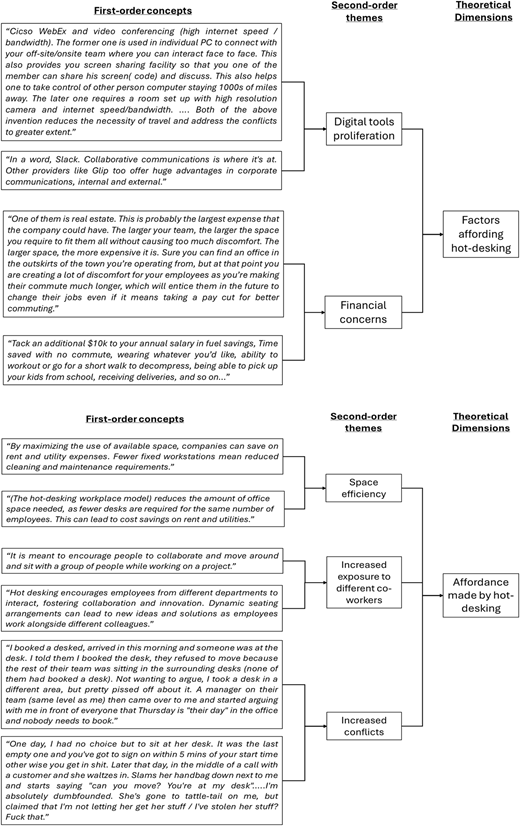
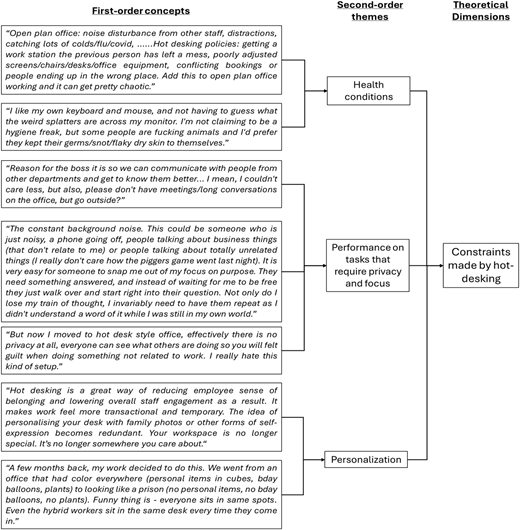
Following Strauss and Corbin (1998) and Gioia et al. (2013), we employed open, axial and selective coding methods (Langley, 1999), along with cross-referencing various sources, especially from different perspectives, to ensure data consistency and the establishment of findings (Klein and Myers, 1999). More specifically, open coding was utilized to identify new theoretical dimensions and to validate existing ones in the original language, ensuring that idioms, slang and culturally specific expressions were accurately captured. For example, while data in the English language can be coded more directly with respect to our set of dimensions and themes, terms like the Cantonese profanity “DKLM” (which stand for “fuck his/her mother”) found on LIHKG were first interpreted within their local socio-linguistic context before a conceptual equivalent (e.g. dissatisfaction) was established for the integrated analysis. Axial coding was employed to discern and corroborate new and existing second-order themes within these dimensions (e.g. the affordances of technologies, such as information dissemination). Selective coding was subsequently applied to distil our case evidence into a number of first-order categories, which were then assigned to the relevant dimensions and themes (Pan and Tan, 2011). We present the data structure (see Gioia et al., 2013) constructed to support our coding process, along with the evidence from our data that corroborates our first-order concepts. These concepts were then conceptually abstracted into second-order themes and aggregate dimensions, as illustrated in Appendix. Our data analysis was complemented by visual maps, narratives and timelines to provide a holistic understanding. Specifically, visual maps documented the emergent theory in diagrams, while the narrative strategy involved creating a textual account of events. Additionally, we cross-referenced various sources from different perspectives to ensure data consistency of findings (Klein and Myers, 1999). Iterations between data, analysis and theory development continued until theoretical saturation was reached (Eisenhardt, 1989).
Saturation was assessed through an iterative process that involved continuously comparing data from new posts against our evolving coding structure. We considered saturation achieved when the analysis of the final approximately 20 posts and supplementary webpages ceased to generate novel first-order concepts or necessitate modifications to our emergent second-order themes, thereby indicating the stability and robust development of our conceptual categories. This process, culminating in a final dataset of 98 detailed posts and 20 supplementary webpages (provided by users within the discussion forum), revealed significant conceptual repetition and a marked decline in the identification of new first-order codes. Consequently, despite its relatively small size, our multi-source sample proved sufficient in both breadth and depth to comprehensively map the conceptual domain pertaining to the bright and dark sides of hot-desking.
Last but not least, although the data were drawn from publicly accessible online forums, we recognized our ethical obligation to protect the individuals who generated the content. Our primary concern was to mitigate the risk of deductive disclosure, whereby users could be traced back from the data presented in this manuscript. To ensure anonymity, we implemented a multi-step de-identification process. First, all usernames, user-specific identifiers and exact timestamps were removed from the data excerpts. Second, to address the traceability of direct quotes, we employed two strategies: (1) we lightly paraphrased quotes to alter unique phrasing while preserving the core meaning (for English-language sources) and (2) for any verbatim quotes used, we performed checks to ensure they were not easily traceable to the original source via a standard search engine. Crucially, no direct hyperlinks to the original posts or websites are provided in this paper. The raw data collected was stored in an encrypted, password-protected file accessible only to the research team. This approach allowed us to present authentic data that illuminates the phenomenon while upholding our duty to protect the privacy of the online community members.
Findings
We identified that external factors (the proliferation of digital tools) and internal factors (FOMO – fear of missing out, financial concerns) foster the hot-desking workplace arrangement. Since the implementation of hot-desking and WFH is largely facilitated by digital tools along with organizational rules and policies, physical office layouts and social enactment, we treat it as a digitally mediated socio-spatial work arrangement, while both lead to a range of outcomes. Figure 1 outlines the relationship between affordances and constraints, as well as their outcomes.
 A diagram of the triggers, affordances, and constraints of the hot-desking workplace arrangement. The diagram begins with external and internal factors that drive the further proliferation of hot-desking arrangements, such as digital tool adoption, organizational fear of missing out, and financial considerations. These contextual factors enable both hot-desking and work-from-home, the former of which is further fueled by the implementation of the latter. Hot-desking manifests a dual nature; while it affords space efficiency and exposure to different co-workers, it simultaneously imposes constraints on physical and mental health conditions, tasks requiring privacy and focus, and personalization.
Affordance, constraints and outcomes of the hot-desking arrangement
A diagram of the triggers, affordances, and constraints of the hot-desking workplace arrangement. The diagram begins with external and internal factors that drive the further proliferation of hot-desking arrangements, such as digital tool adoption, organizational fear of missing out, and financial considerations. These contextual factors enable both hot-desking and work-from-home, the former of which is further fueled by the implementation of the latter. Hot-desking manifests a dual nature; while it affords space efficiency and exposure to different co-workers, it simultaneously imposes constraints on physical and mental health conditions, tasks requiring privacy and focus, and personalization.Affordance, constraints and outcomes of the hot-desking arrangement
Affordance
Digital tools proliferation has facilitated communication and collaboration (Aroles et al., 2021). In a discussion on how technology has transformed the workplace, some users suggested different technological applications (such as video conferencing and team communication platforms) which facilitated business communications, even if different parties are physically distanced.
Cicso WebEx and video conferencing (high internet speed / bandwidth). The former one is used in individual PC to connect with your off-site/onsite team where you can interact face to face. This also provides you screen sharing facility so that you one of the member can share his screen(code) and discuss. This also helps one to take control of other person computer staying 1000s of miles away. The later one requires a room set up with high resolution camera and internet speed/bandwidth. …. Both of the above invention reduces the necessity of travel and address the conflicts to greater extent.
In a word, Slack. Collaborative communications is where it's at. Other providers like Glip too offer huge advantages in corporate communications, internal and external.
The drivers of alternative workplace arrangements also include internal factors, such as the financial concerns of the organizations (Hedge, 1982). This was highlighted in a discussion of both WFH and hot-desking arrangements, with rising office rental costs often a key consideration that may not be easily addressed by relocating the office to more remote areas, as this may, on the other hand, create commuting issues and discomfort for employees.
One of them is real estate. This is probably the largest expense that the company could have. The larger your team, the larger the space you require to fit them all without causing too much discomfort. The larger space, the more expensive it is. Sure you can find an office in the outskirts of the town you’re operating from, but at that point you are creating a lot of discomfort for your employees as you’re making their commute much longer, which will entice them in the future to change their jobs even if it means taking a pay cut for better commuting.
An organization may also implement alternative working arrangements due to the fear of missing out (FOMO) on the latest trends, which appear to enhance productivity, instead of informed considerations on the actual benefits. A Quora user who preferred the traditional cubicle highlighted the trend's role.
It’s more a trend than based on actual benefits. The Escape from Cubicle Nation thing.
One of the commonly seen digitally mediated socio-spatial work arrangements, the WFH arrangement affords a range of benefits, such as flexibility in time arrangement (Golden, 2009) and physical locations (Duan et al., 2023; Giménez-Nadal et al., 2020). WFH also affords greater flexibility, enabling both talents and employers to access a broader range of opportunities, thus fostering the best matches between them. Moreover, with the need to travel to work locations partially or entirely eliminated, expenses in areas such as travel, meals and clothing may be reduced.
Tack an additional $10k to your annual salary in fuel savings, Time saved with no commute, wearing whatever you’d like, ability to workout or go for a short walk to decompress, being able to pick up your kids from school, receiving deliveries, and so on …
With increasing vacancies in office desks and space, some businesses began reviewing the need for a fixed allocation of office space, which led to the emergence of hot-desking. On both Quora, the relationship between WFH and hot-desking was often discussed (Adikesavan and Ramasubramanian, 2023).
If you combine hot desking with flexible working (i.e. workers not needing to be in the office to do their jobs) then you get a significant benefit in terms of space needed.
In theory hot desking creates the requirement for business to allow more people having a hybrid WFH / in office model.
In summary, hot-desking is not afforded solely by external digital tools proliferation but also internal factors such as FOMO and financial concerns. These factors, concurrently afforded WFH, also catalyze the proliferation of hot-desking.
Actualization and outcomes
With the removal of fixed office space allocations (Hirst, 2011), hot-desking is largely afforded by hot-desking software (e.g. Archie and Officely) and the removal of walls and barriers in existing cell offices (Maher and Von Hippel, 2005; Oldham and Brass, 1979). In turn, hot-desking affords a range of advantages, with increased space efficiency (including associated reductions in cleaning and maintenance requirements and financial expenses) being the most commonly highlighted.
By maximizing the use of available space, companies can save on rent and utility expenses. Fewer fixed workstations mean reduced cleaning and maintenance requirements.
(The hot-desking workplace arrangement) reduces the amount of office space needed, as fewer desks are required for the same number of employees. This can lead to cost savings on rent and utilities.
Increased exposure to different co-workers is another affordance of hot-desking practices. In turn, collaboration between different departments may be fostered (Mark, 2002), potentially leading to new ideas and solutions to existing problems, as indicated in some discussions.
It is meant to encourage people to collaborate and move around and sit with a group of people while working on a project.
Hot desking encourages employees from different departments to interact, fostering collaboration and innovation. Dynamic seating arrangements can lead to new ideas and solutions as employees work alongside different colleagues.
Yet, some opponents of hot-desking policies state that constraints on health conditions (Elsbach and Pratt, 2007) are the drawbacks of hot-desking. Some Quora users highlighted the potential mess left by previous users, such as hygiene issues and poorly adjusted equipment that may lead to work and health safety (WHS) issues.
Hot desking policies: getting a work station the previous person has left a mess, poorly adjusted screens/chairs/desks/office equipment, conflicting bookings or people ending up in the wrong place. Add this to open plan office working and it can get pretty chaotic.
I like my own keyboard and mouse, and not having to guess what the weird splatters are across my monitor. I'm not claiming to be a hygiene freak, but some people are fucking animals and I'd prefer they kept their germs/snot/flaky dry skin to themselves.
The constraints on health conditions may also be related to mental health. More specifically, first, hot-desking may lead to increased conflicts between colleagues, which may function as a potent social stressor, worsening mental health (Sonnentag et al., 2013). On Reddit, a user reported that he was forced by a group to move to another desk, despite having booked a desk in advance. In turn, he had to take extra time settling before starting to work (Hugh Fawcett, 2009). In more extreme cases, some overbearing colleagues, along with their team members, would ask others to give up their positions despite their critical tasks (such as during a conversation with customers) or established bookings.
I booked a desked, arrived in this morning and someone was at the desk. I told them I booked the desk, they refused to move because the rest of their team was sitting in the surrounding desks (none of them had booked a desk). Not wanting to argue, I took a desk in a different area, but pretty pissed off about it. A manager on their team (same level as me) then came over to me and started arguing with me in front of everyone that Thursday is “their day” in the office and nobody needs to book.
One day, I had no choice but to sit at her desk. It was the last empty one and you've got to sign on within 5 mins of your start time other wise you get in shit. Later that day, in the middle of a call with a customer and she waltzes in. Slams her handbag down next to me and starts saying “can you move? You're at my desk” …..I'm absolutely dumbfounded. She's gone to tattle-tail on me, but claimed that I'm not letting her get her stuff / I've stolen her stuff? Fuck that.
On LIHKG, some Internet users noted that hot-desking will not actually work, since some senior workers would still dominate their preferred desks. The meeting rooms, proposed for more privacy-intensive and focus-intensive work, will also be occupied by the senior managers, who would never clear up the space that they occupied. In turn, only the junior workers had to be under hot-desking arrangements.
(the middle and senior management) say they will clean up the desk, but they always leave their personal belongings (cups, keyboards, etc.) on the desks and treat them as private seats. Some of the most arrogant isolation seats are not open to people. I have seen fresh graduates sitting there and being asked to move away. Hot desks are basically just for low-level employees like you guys.
Then some old people will book the meeting room as their own room for a long time, DKLM, a living person occupying place for the dead
In fact, such cases may point toward workplace bullying, which refers to situations in which someone is subjected to long-lasting, recurrent and severe harmful or hostile acts and behavior that are annoying and oppressive in workplaces (Vartia, 2001). This may include (but is not limited to) resource deprivation (De Clercq, 2022; Trépanier et al., 2013), akin to the above case, which involved the loss of a pre-booked desk.
In addition, the hot-desking environment may often create noise that disrupts tasks requiring privacy and focus. Some Internet users stated that they hated hot-desking owing to noise from others' discussion, their disinterest in learning others' conversations, difficulties of focusing on their work and anxiety of being interrupted.
Reason for the boss it is so we can communicate with people from other departments and get to know them better … I mean, I couldn't care less, but also, please don't have meetings/long conversations on the office, but go outside?
(background noise) could be someone who is just noisy, a phone going off, people talking about business things (that don't relate to me) or people talking about totally unrelated things (I really don't care how the piggers game went last night). It is very easy for someone to snap me out of my focus on purpose. They need something answered, and instead of waiting for me to be free they just walk over and start right into their question. Not only do I lose my train of thought, I invariably need to have them repeat as I didn't understand a word of it while I was still in my own world.
But now I moved to hot desk style office, effectively there is no privacy at all, everyone can see what others are doing so you will felt guilt when doing something not related to work. I really hate this kind of setup.
In LIHKG, when Internet users discussed the implementation of the WFH arrangement in HSBC, the issue of privacy (e.g. insider information leakage) and comfort in the office were highlighted as a concern, which may, in turn, heighten legal risk for employees and the company.
Listen to the boss's detailed talk and then use the inside information to trade stocks LOL
It’s so hard to feel comfortable with the entire office watching you do it.
Release the information to the family member (yeah).
The difficulties of focusing on privacy and focus-intensive tasks created by hot-desking may also be reflected in a Quora post about a forced, unpleasant table-rotation experience due to the implementation of hot-desking that caused significant inconvenience.
I had a two week period where I was changing jobs to another team, and my old boss (who I still reported to) had given my desk away before I officially had a desk with the new team I would be reporting to. I spent those two weeks storing boxes of binders in my new boss’s office while I sat in different available cubicles on different floors. I changed seats at least once per day, multiple times a day if my [old] manager kept looking for me to harangue me about something inconsequential.
Some Internet users have also highlighted that hot-desking constrains workspace personalization, potentially leading to feelings of dehumanization (Taskin et al., 2019). Some Internet users describe the hot-desking arrangement as “prison”.
Hot desking is a great way of reducing employee sense of belonging and lowering overall staff engagement as a result …. The idea of personalising your desk with family photos or other forms of self-expression becomes redundant. Your workspace is no longer special. It’s no longer somewhere you care about.
A few months back, my work decided to do this. We went from an office that had color everywhere (personal items in cubes, bday balloons, plants) to looking like a prison (no personal items, no bday balloons, no plants). Funny thing is – everyone sits in same spots.
In other words, employees not only dislike hot-desking but also try to retain their space ownership despite upper-level policies.
Theoretical implications of hot-desking
Our primary theoretical implication is the explanation of how hot-desking operates in post-COVID organizational contexts and dynamically co-produced through everyday socio-material enactment, thus moving beyond predominantly phenomenon-driven accounts of hot-desking and providing a theoretically anchored understanding of both its adoption and consequences. More specifically, we strengthen the conceptual foundation of hot-desking research by systematically applying TACT to explain (1) the internal and external factors that afford its adoption and (2) the ways in which the arrangement subsequently affords and constrains employees' work practices. Hot-desking adoption is shaped by the combined influence of external forces (e.g. the proliferation of digital tools, such as Cisco WebEx and other video conferencing technologies, as suggested by our findings) and internal factors (e.g. FOMO and financial concerns, such as real estate costs). Comparing WFH with hot-desking, we argue that WFH is an enabling condition for hot-desking, given that the proliferation of WFH reduces the need for a permanent office desk (Adikesavan and Ramasubramanian, 2023). Our identification of the role of technology in hot-desking adoption aligned with the arguments of Aroles et al. (2021), while the role of financial concerns in adopting hot-desking was also mentioned by Hedge (1982). Furthermore, we show that hot-desking generates a complex configuration of affordances and constraints that shapes both operational outcomes (e.g. space efficiency) and social dynamics (e.g. potential workplace bullying, as indicated by our findings). In this way, our study responds to calls for a more holistic theorization of digital workplace arrangements by bridging organizational-level initiatives with individual-level experiences (Aroles et al., 2021). Beyond the affordance that leads to adoption, we advance affordance-based theorizing by explicitly foregrounding the constraints of hot-desking rather than relegating them to post-hoc discussion. Much of the existing digital workplace literature privileges affordances as the primary analytical focus (e.g. Duan et al., 2023, 2024), resulting in a partial understanding of how workplace arrangements unfold in reality. Our findings demonstrate that the realization of hot-desking is not inherently positive: Despite affording space efficiency and networking opportunities (Elsbach, 2003; Kissmer et al., 2018), it simultaneously constrains employees' health (Kim et al., 2016), their ability to perform tasks requiring privacy and concentration and opportunities for personalization. Indeed, the intended benefits for organizations afforded by hot-desking (e.g. space efficiency and flexibility) can directly precipitate significant constraints and unintended negative consequences for employees, such as time wastage (for finding space or colleagues), health concerns (both mental and physiological), conflicts with other colleagues and a diminished sense of belonging. In our study context, compared with urban mobility contexts (see, e.g. Turoń, 2025b), hot-desking may be regarded as a micro-mobility issue within an organization. The additional time wasted on desk-seeking in the hot-desking environment is comparable to time wasted on commuting in urban mobility contexts, while the diminished sense of belonging in the hot-desking environment is comparable to the lack of a sense of place in mobility studies, both of which cost the user emotionally. In addition, by comparing our study context with digital service ecosystem contexts (see, e.g. Turoń, 2025a), the identified conflicts with colleagues in the workplace mirror governance challenges in other service ecosystems, such as shared mobility, where the absence of robust enforcement leads to resource hoarding and ecosystem friction. We also challenge the often techno-optimistic assumption that affordances reached for one group (the organization) can be analyzed separately from the constraints imposed on another (the employees). For example, our findings suggested that shared resources become sites of contestation when senior members appropriate desirable desks or meeting rooms, transforming a collective design into individualized advantages. This highlights that the effects of a digitally mediated socio-spatial work arrangement are not determined by design intentions alone but emerge through everyday enactment, where one group's affordance may become another's constraint.
Beyond our primary implications, our data also presented an exploratory insight into potential cultural variations in the hot-desking experience. It is crucial to state up front that our study was not designed for a formal cross-cultural analysis; therefore, the following observations should be treated as tentative and primarily as a guide for future research. We observed that discussions originating from a more Eastern context (LIHKG) seemed to place more emphasis on power distance and job rank as drivers of space contestation. In contrast, such factors were less prominent in the discussions from Western-centric forums (Reddit and Quora). A speculative interpretation, which would require dedicated study, could link this observation to the prevailing cultural dimensions of power distance and individualism in these respective societies (Croucher et al., 2024). Similarly, while privacy concerns appeared in both contexts, their nature seemed to differ. Discussions from the Eastern context appeared to show greater concern for intentional information leakage (e.g. insider trading), whereas Western-based discussions focused more on being monitored at work. This tentative pattern might reflect different cultural conceptions of privacy, which in many Western societies is rooted in individual rights (Fleming et al., 2021), Despite these potential points of divergence, our analysis also noted commonalities, such as financial pressures and technology proliferation, that act as universal enablers of hot-desking, aligning with prior work on technology adoption (Au et al., 2024). Ultimately, while these patterns are intriguing, they primarily highlight the need for dedicated research into how culture may shape the implementation and outcomes of socio-spatial work arrangements.
Last but not least, this study acts as a bridge between the digital workplace literature (Aroles et al., 2021) and the organizational behavior literature on workplace bullying (Vartia, 2001). Previous studies on non-territorial offices have focused on identity (Elsbach, 2003) or general well-being (Danielsson and Theorell, 2024). Our findings, however, point toward a specific, structural pathway that may foster hostile workplace behavior. The conflict over scarce desk resources, which we observed in our data, can be interpreted as a form of resource deprivation – a recognized dimension of workplace bullying (De Clercq, 2022; Trépanier et al., 2013). By theorizing how hot-desking, as a digitally mediated socio-spatial work arrangement, can create conditions conducive to such conflict, we introduce a novel, design-centric perspective to the study of negative interpersonal dynamics at work. This contribution is valuable for understanding the “dark side” of digital workplace transformation (Marsh et al., 2022) as both a source of individuals' stress and a structural source of friction that can erode collaborative norms and undermine team cohesion. Nevertheless, not all conflicts over workspaces necessarily constitute workplace bullying in the stronger organizational behavior sense, which usually implies persistence, power asymmetry and repeated hostile conduct over time. We frame hot-desking as a structural antecedent that may enable or intensify bullying-like dynamics – resource deprivation and territorial exclusion – rather than asserting that the study directly observes or proves workplace bullying.
To summarize, we identified a few theoretical implications for hot-desking, with Table 7 providing a brief comparison between the existing understanding and our implications.
A comparison between existing understanding of hot desking and our implications
| Dimension | Existing understanding | Our implications |
|---|---|---|
| Primary focus | Predominantly phenomenon-driven, focusing on “what happens” (e.g. cost-saving vs dissatisfaction) with no particular adoption of theoretical foundations | Theoretically anchored in technology affordance and constraints theory (TACT) to explain “why” these outcomes manifest |
| Conceptualization | Viewed as a simple office policy, real estate strategy or physical layout | Conceptualized as a digitally mediated socio-spatial work arrangement |
| Drivers of adoption | Often attributed to simple organizational goals like resource optimization or cost reduction | Driven by a combination of external factors (digital tool proliferation) and internal factors (financial concerns and FOMO) |
| Individual experience | Focuses on surface-level symptoms like “dark sides” or general well-being/identity issues | Identifies that organizational affordances (space efficiency) are directly experienced by individuals as structural constraints (spatial insecurity and resource deprivation) |
| Workplace behavior | Viewed as individual misbehavior or lack of professional etiquette | Reframed as a socio-material design problem where hot-desking acts as a potential structural antecedent to workplace bullying and resource-based conflict |
| Cultural context | Often limited to Western, individualistic contexts | Provides exploratory insights on an “East-meets-West” perspective, showing how cultural differences moderate the dynamics of privacy and territoriality |
| Practical solution | Focuses on better policy enforcement or improved booking technology | Argues for active governance and need-based/risk-informed allocation to manage the tension between flexibility and psychological safety |
Theoretical implications of the theories of technology affordance and constraints
Beyond contributing to the hot-desking literature, we extend the applicability of the TACT to the fluid, non-territorial context of hot-desking, thereby broadening its theoretical scope beyond conventional IT-use settings. Prior research has predominantly employed TACT to examine the consequences of IT artefact use at the individual and organizational levels (e.g. Du et al., 2019; Leidner et al., 2011; Leonardi, 2011). Hot-desking, however, represents a qualitatively different configuration in which digital technologies, organizational initiatives, physical space and mobile work practices are continuously intertwined. By applying TACT to this complex socio-spatial environment, we demonstrate the theory's explanatory potential for understanding digitally enabled socio-spatial work arrangements and their associated social dynamics, while laying a conceptual foundation for future IS research on how technological change reshapes organizational space, power relations and everyday work practices. More importantly, our findings refine TACT by showing that many of the most consequential constraints in such settings are not inherent properties of technologies but socially constructed outcomes of everyday enactment. While the literature often treats constraints as static limitations embedded in systems, artefacts or other digitally-enabled arrangements (Majchrzak and Markus, 2012), we reveal how intended affordances – such as flexibility enabled through booking systems and clear-desk policies – are frequently subverted by social behaviors and thus creating constraints (e.g. senior staff disregarding formal rules to appropriate desirable desks). These practices transform collective designs into individualized advantages, converting flexibility into desk scarcity and uncertainty for others. This insight advances TACT by demonstrating that constraints can emerge dynamically from violations of social norms governing technology use, rather than from the technology itself, thereby repositioning affordances and constraints as outcomes of ongoing socio-material negotiation rather than as fixed design features.
Second, we seek to extend the application of TACT by introducing the concept of affordance-constraint inversion, which provides a more dynamic view of affordances and constraints. More specifically, existing affordance research has masterfully shown that different actors may perceive different affordances from the same technology (e.g. an affordance for a manager may not be one for an employee). However, the literature has paid less attention to the generative dynamic where an affordance designed for and actualized by one actor (the organization) systematically and directly creates a constraint for another actor (the individual). In our study context, conversely, while the intended flexibility and potential for co-workers’ collaboration may have been afforded by the elimination of fixed desk arrangements, the same elimination may also have constrained the autonomy of personalization (i.e. the affordance-constraint inversion). This is not merely a case of different perceptions, but a causal mechanism where the realization of a positive outcome at the organizational level is the very source of a negative friction at the individual level. Beyond the context of hot-desking arrangements, similar inversion outcomes may also be seen in, for example, urban mobility systems in city design. According to Turoń (2025b), “sustainable mobility” policies intended to provide flexibility can become perceived as “material constraints” that clash with a person's sense of autonomy and spatial identity. In these cases, affordances and constraints were dialectically opposed yet mutually constitutive. Such paradoxical outcomes in both contexts are likely due to top-down implementation approaches that neglect the actual experiences and emotional needs of ordinary users (residents in city design contexts; employees in hot-desking workplace contexts). By theorizing this inversion, we move beyond a simple ledger of co-existing affordances and constraints to explain how one begets the other across levels of analysis. Our study uses the hot-desking context to empirically illustrate and build the theoretical foundations for this novel mechanism.
To summarize, we made a few theoretical implications in TACT, with Table 8 showing a brief comparison between the existing understanding and our implications.
A comparison between existing understanding of TACT and our implications
| Dimension | Existing understanding | Our implications |
|---|---|---|
| Application context | Predominantly employed to examine conventional IT-use settings and specific IT artifacts like enterprise systems or wearables | Extends TACT to the fluid, non-territorial context of hot-desking, broadening the theory's scope to include socio-spatial work arrangements |
| Nature of constraints | Often treated as static limitations embedded within the physical or digital features of systems and artifacts | Reveals that constraints are socially constructed outcomes of everyday enactment, emerging dynamically when social norms are violated |
| Interplay of outcomes | Recognizes the coexistence of affordances and constraints but often studies them as distinct consequences of use | Argues that affordances and constraints are dynamically co-produced and intertwined, where one group's perceived affordance can become another's debilitating constraint (i.e. inversion) |
| Role of social behavior | View social context as a background factor influencing the interaction between users and IT artifacts | Position social enactment (e.g. senior staff “claiming” desks) as a primary driver that subverts intended digital affordances and converts them into social constraints |
Practical implications
Our findings also suggested a range of practical implications for different stakeholders. For organizations and senior management, our findings indicate that hot-desking should not be implemented through a one-size-fits-all logic, as employees within the same unit often have heterogeneous work norms, privacy requirements and ergonomic or psychological needs. Organizations are therefore advised to adopt a need-based and risk-informed workspace allocation strategy that involves formal assessments of employees' data sensitivity, task concentration demands and accommodation requirements. A tiered arrangement – ranging from dedicated offices for high-risk users to semi-private shared pods for moderate-risk users – can fulfil employers' duty of care and provide defensible evidence of “reasonable adjustments” in legal contexts. When combined with genuine employee autonomy over workspace choice, such arrangements can enhance engagement while preserving organizational flexibility. However, our findings also caution that poorly governed hot-desking may unintentionally facilitate workplace bullying, territorial behavior and psychosocial risks, potentially leading to legal costs. To mitigate these outcomes, organizations must treat hot-desking not merely as a cost-saving real estate strategy but as a strategic organizational change requiring continuous risk management, particularly regarding WHS compliance, data privacy and psychosocial safety.
For frontline managers, human resources managers and facilities managers who are directly responsible for implementation, this study underscores that the success of hot-desking hinges on robust governance rather than technology alone. Booking systems and open layouts are insufficient unless accompanied by clearly articulated and strictly enforced desk-usage policies, cleanliness protocols and transparent dispute-resolution procedures. Managers must remain vigilant in preventing territorial bullying, social exclusion and resource-based conflicts that may be exacerbated by non-territorial seating. Technological governance systems – such as regulating access to quiet pods and monitoring space usage – can reduce perceptions of inequity, prevent resource wastage and minimize interpersonal tensions. Crucially, managers should acknowledge the trade-off between forced flexibility and psychological safety: while policy enforcement may appear bureaucratic, it represents a necessary investment to prevent declines in morale, productivity and collegiality that often accompany poorly managed hot-desking environments. Proactive feedback mechanisms, including regular employee surveys and dispute tracking, are essential to sustaining a fair-use culture over time.
For employees and professionals in hot-desking environments, our findings emphasize the importance of being informed, proactive and assertive. They should actively manage their work habits and well-being, clearly communicate their spatial and task-related needs, and provide feedback to management, particularly where hot-desking has been adopted out of managerial idealism or fear of missing out rather than operational necessity. Such feedback functions as a diagnostic mechanism for assessing whether hot-desking is genuinely viable, enabling organizations to adjust workspace design or even revert to traditional arrangements before productivity losses accumulate. Employees should also make strategic use of formal reporting channels when facing persistent desk “squatting,” conflicts, or behaviors that create hostile work environments, as documenting these incidents provides the evidentiary basis required for managerial intervention and organizational accountability.
For practitioners in office design and facilities management, our findings recommend shifting from purely flexible, non-territorial layouts toward highly reconfigurable solutions. These enable seamless transitions between open and private space-settings, especially as some organizations may revert to traditional arrangements due to negative hot-desking outcomes. Furthermore, policymakers must modernize occupational health and safety frameworks to address these trends. Updates should include minimum space-per-person ratios and ergonomic standards for shared desks to protect worker well-being. Additionally, role-specific suitability is critical; for positions handling sensitive information, non-territorial arrangements may increase risks of unauthorized data disclosure and must be carefully managed.
Limitations and future research directions
As a qualitative study based on netnography, our findings capture the rich, unsolicited experiences of individuals but are not intended for statistical generalization. The anonymity of online forums also limits our ability to verify user roles or specific contexts. Furthermore, the chosen online forums are not simply “global” spaces but algorithmically filtered, demographically uneven public arenas that may amplify negative experiences. However, we argue this characteristic makes our dataset uniquely suited to our theoretical objective. By focusing on these contested experiences, our study excludes cases in which hot-desking is successfully implemented in highly coordinated, well-resourced or task-appropriate environments. This focused scope, in turn, paves the way for future research. Building on our work, researchers can use alternative methods to explore the contingencies of hot-desking success. For instance, we have theorized hot-desking experiences that were shared online, but it will be desirable to cover data beyond online communities. For example, quantitative surveys could test the relationships we identified, while longitudinal case studies could offer deeper insight into how policies and social norms evolve to manage these challenges over time. Specifically, future studies should investigate when hot-desking works better, for whom (e.g. considering personality traits or job roles), under what governance arrangements, and with what combinations of digital systems and spatial design.
In addition, our study offers a compelling, albeit exploratory, direction for future cross-cultural research. We observed a tentative pattern where discussions from an Eastern context (LIHKG) appeared to frame conflicts around power and hierarchy, while those from Western-centric forums (Reddit, Quora) focused more on issues of individual surveillance and autonomy. We must emphasize that this was an emergent, post-hoc observation. In the meantime, there are more posts related to hot-desking implementation in online communities dominated by Western culture (Reddit and Quora) than in communities more influenced by Eastern culture (LIHKG and Zhihu), possibly due to both the nature of the communities and the less-wide implementation of hot-desking in Eastern societies. While the tentative pattern provides a compelling basis for future work, more robust methodological design (e.g. matched samples, pre-defined cultural frameworks) for cross-cultural analysis is required. A dedicated study could formally investigate whether and how national or regional culture (e.g. power distance, individualism vs collectivism) moderates employee reactions to non-territorial work arrangements, a crucial question for global organizations.
Moreover, while our study proposes a link between the implementation of hot-desking and the emergence of workplace bullying, the exact nature of this relationship should be validated in future studies across different contexts, possibly using different research methods. Finally, future work could adopt a service ecosystems framework to explore governance for digital workplaces, moving beyond office rules.
Conclusions
This paper presented a qualitative study exploring the affordances and constraints of the hot-desking digital workplace arrangements. Theoretically, our study extends the TACT by revealing the inherent tensions between organizational-level affordances, such as cost efficiency, and individual-level constraints, such as the loss of privacy and personalization. We uniquely identify how the pursuit of flexibility can paradoxically create a context for workplace conflict and bullying, thereby bridging the digital workplace and organizational behavior literature. Our findings offer actionable insights for business managers on the critical importance of policy enforcement and employees in navigating these new work environments.
Our findings reveal a critical paradox in the hot-desking arrangement. While organizations adopt this digitally mediated socio-spatial work arrangement to actualize the affordances of space efficiency and flexibility, our research demonstrates how these intentions can be systematically undermined by the simultaneous actualization of powerful constraints. Specifically, the intended affordance of a “flexible,” non-territorial space can, in practice, become a constraint of “un-owned,” contested space. This fosters an environment in which negative social dynamics, such as territorial bullying and resource deprivation observed in our data, can emerge. This highlights that the impact of a digitally mediated socio-spatial work arrangement is not fixed by its design but is dynamically shaped by social practice, in which one group's perceived affordance (e.g. “claiming” a desirable area) becomes a debilitating constraint for another. While proponents might argue that alternatives such as quiet pods or WFH resolve these issues, our findings suggest that such solutions are often illusory. Access to specialized office spaces is not guaranteed, and as our data shows, can become another flashpoint for conflict. Furthermore, the viability of WFH is highly context-dependent. The constraints of resource scarcity and spatial insecurity we identified are significantly amplified in high-cost urban environments (e.g. cities like Hong Kong, London, or Sydney) where a dedicated home office is an unattainable luxury for many. In these contexts, the failure to secure a workspace through hot-desking can lead to acute displacement, leaving an employee with no viable place to work at all. Consequently, this study cautions against a purely techno-optimistic or cost-driven perspective on workplace design. The success of hot-desking is contingent not on policy alone, but on an organization's capacity to manage the emergent social frictions and mitigate their negative consequences. A failure to do so risks not only negating the arrangement's intended benefits but also fostering a hostile and inefficient work environment.
We hope this study stimulates further scholarly conversation on the socio-technical complexities of modern workplaces, ultimately leading to designs that are not only efficient but also humane and equitable for all employees.
Appendix Examples of Gioia structure