This study aims to explore the role of digital platforms in fostering digital service innovation (DSI) in business-to-business (B2B) settings. More specifically, it delineates how firms orchestrate and govern multi-platform ecosystems to pursue DSI, outlining key complementors and their interdependencies.
Using 37 in-depth interviews with DSI decision-makers from leading transportation and healthcare firms, the study investigates how different types of digital platforms enable data-driven services.
The study extends B2B platform classification beyond traditional open vs closed architecture and transaction vs innovation platforms, revealing five distinct types of B2B digital platforms. These are manufacturer-led, provider-mediated, customer innovation, customer-moderated and data brokerage platforms. The study explores different actors-resources-activities constellations in these platforms for executing DSIs. It further elucidates how platform actors play different roles in DSI depending on their ecosystem positions. Finally, it underscores the importance of platform governance in facilitating interoperability and introduces the concept of customized technology adapters as tools for integrating external complementors and supporting DSI.
Prior studies on digital platforms have predominantly concentrated on examining platform architecture and objectives to categorize platform types. Our investigation, which centers on platform-based DSI activities, identifies distinct platform types that revolve around idiosyncratic service business models implemented by B2B firms. Additionally, we distinguish emerging boundary resources employed by these firms to integrate complementors, which may play a crucial role in ensuring platform interoperability in subsequent developments.
1. Introduction
Platforms are instrumental in digital service innovation (DSI) by providing common standards, interfaces and infrastructure that enable the exchange of data and functionality among diverse actors (Coreynen et al., 2024; Kowalkowski et al., 2024). In doing so, they facilitate the transition from product-centric to service-centric business models, enable scalability and promote open innovation (Randhawa et al., 2018; Soto Setzke et al., 2023). While existing literature has primarily focused on consumer markets (Wirtz and Kowalkowski, 2023), where a multitude of social media, sharing, transaction, payment and search platforms have emerged (Rangaswamy et al., 2020), digital platforms are also becoming increasingly critical to the competitiveness of industrial firms in business-to-business (B2B) settings (Jovanovic et al., 2022; Kowalkowski et al., 2024).
In this context, research has investigated platform evolution and its effects on organizational boundaries and the overarching ecosystem, as a growing number of industrial firms develop platforms that support a collection of complementary assets for extended value creation and capture across multiple actors (Gawer and Cusumano, 2014; Jovanovic et al., 2022; Sandberg et al., 2020). While the platform and ecosystem literature has highlighted the role of complementarities in platform ecosystems (Thomas et al., 2024), it generally takes a focal firm perspective on DSI (e.g. Gawer, 2021; Jovanovic et al., 2022; Perks et al., 2017; Sandberg et al., 2020). That is, literature—explicitly or implicitly—assumes that the service provider and the platform owner are generally the same actors.
Nonetheless, the general shift to more open interfaces and marketplaces and a push for interoperability (Boudreau, 2010; Menon et al., 2020) is changing the competitive landscape in B2B markets. The blurring of industry boundaries means that data-driven and software-based firms may now compete with legacy manufacturers in the digital service domain. It also means that industrial firms need to maneuver in multi-platform ecosystems where value creation and capture are increasingly based on DSI (Kowalkowski et al., 2024).
Against this backdrop, our research sheds light on an overlooked issue: how can B2B firms pursue DSI in multi-platform ecosystems? Relatedly, which actors in industrial ecosystems drive and govern such initiatives? To address these issues, we draw on platform literature and the actors–resources–activities (ARA) framework in industrial marketing (Håkansson and Snehota, 1995), outlining key actors in B2B platform ecosystems and their interdependencies. We build our cases using data from the transportation and healthcare industries, deliberately selecting these two distinct sectors to capture the heterogeneity of services and data types. The transportation industry involves services tied to physical products and large-scale operations, whereas the healthcare industry is driven by software-based services and data centered on individuals. This contrast calls for different platform types for DSI and governance approaches. We present five distinct types of B2B platforms, each affording different opportunities for DSI. While much of the literature assumes a B2C-centric winner-takes-all approach and focuses on single platforms, many of today’s B2B industries comprise multiple types of platforms. Clarifying and conceptualizing different types of B2B platforms helps explain what drives platform value for its members and, ultimately, how opportunities for service innovation can play out.
Our paper contributes to the understanding of how digital platforms execute DSI by orchestrating diverse ecosystem actors and enabling interoperability for innovation. First, we extend the platform classification framework beyond the traditional distinctions of open vs closed architecture and transaction vs innovation platforms. We illustrate how B2B platforms often exhibit unique, business model-driven characteristics rather than depending solely on technological architecture. In this context, we identify five distinct types of B2B digital platforms, along with their associated actors, resources and activities constellations. Second, we emphasize that the roles of platform actors are dynamic, shifting from controllers to enablers of DSI activities based on their position within the ecosystem. Furthermore, we highlight the crucial role of platform governance in either facilitating or impeding interoperability, introducing customized technology adapters as a novel tool for integrating complementors and enhancing platform-based DSI activities.
2. Conceptual foundations
2.1 Digital platforms
Digital platforms are information technology artifacts with specific development affordances (Bonina et al., 2021). They serve as amalgamations of digital resources that facilitate interaction and exchange among participants (Constantinides et al., 2018), enable the provision of interconnected products and services (Cennamo, 2021) and optimize operational resource usage through effective monitoring and controlling (Vaillant and Lafuente, 2024). Today, three of Forbes’s top ten firms are platform-based enterprises (Murphy and Schifrin, 2024) and traditional pipeline businesses like Caterpillar, GE and Siemens are investing strategically in digital platforms. While a “winner takes all or most” approach prevails in consumer markets (Gawer, 2014), industrial settings often witness a narrower platform scope, encouraging platform coopetition rather than competition (Jovanovic et al., 2022).
Digital platforms play an increasingly central role in the servitization of industrial firms (Ulaga and Kowalkowski, 2022), often requiring organizational and structural transformation processes (Paiola and Gebauer, 2020). In the era of digitalization, platforms assume a crucial role as catalysts for enhanced value creation through service innovation, facilitating interaction between customers and providers, orchestrating broader service ecosystems and potentially reshaping traditional industry boundaries (Kowalkowski et al., 2024). Thus, digital platforms transcend their conventional operational support function to become enablers of DSI within B2B markets.
2.1.1 Platform architectures and openness
The technological architecture of a platform encompasses its technological capabilities, component interconnection and platform complementarities (Tiwana et al., 2010). Enhanced technical performance and functionalities of the platform offer benefits such as productivity gains, usability improvements and enhanced service quality for users (Gawer, 2014). Additionally, the design of the platform’s technological architecture influences the content quality and complementary innovation by affecting the costs and complexity of the innovation process for external providers, and, the degree of integration and fit with the system (Cennamo, 2021). Thus, platform architecture directly contributes to platform value by delivering performance benefits and enabling higher-quality content and complementary innovations, shaping the overall customer experience (Xu et al., 2010).
Platform architectures are typically categorized as closed or open models based on their technological structure (Boudreau, 2010). Closed architectures involve full ownership, proprietary control and vertical integration by a single entity, restricting technology access. In contrast, open platform architectures adopt two primary approaches: granting access to the platform while retaining control over complementary components or relinquishing control over the platform itself, enabling widespread entry and competition (Katz and Shapiro, 1994). For digital platforms, openness extends beyond organizational entrance and exit rules to the openness of the boundary resources within the broader ecosystem (Cennamo, 2021; Jovanovic et al., 2022). Different levels of openness are observed in mobile platforms like Apple iOS and Google Android, digital marketplaces and payment platforms (Ghazawneh and Henfridsson, 2015).
The platform literature further distinguishes between transaction and innovation platforms (Bonina et al., 2021). Transaction platforms, or multi-sided markets, facilitate transactions between different organizations and individuals, focusing on economics-related aspects such as pricing and contractual factors (de Reuver et al., 2018). Conversely, innovation platforms serve as foundations for building complementary services, products and technologies, offering accessible innovative capabilities for developers to create platform complements (Gawer, 2009, 2014). Leveraging digital technology’s properties, innovation platforms allow developers to access underlying functionality through boundary resources and arrange it using algorithms into applications, benefiting from the generative potential of digital technologies (Bonina et al., 2021). The self-referential nature of digital technology (Yoo et al., 2010) is such that technologies like software development kits (SDKs) are required to innovate further digital technologies (e.g. applications). Value creation occurs by opening the platform to third-party developers and providing them with the necessary resources. Monetization strategies typically involve charging developers for access to platform resources or users for services (Bonina et al., 2021).
2.1.2 Platform governance and boundary resources
Effective platform governance positions the platform owner at the center of a broader platform ecosystem (Iansiti and Levien, 2004), where it holds property rights over the core functionality (Hart and Moore, 1990). Areas requiring management or governance by a platform authority include (1) gatekeeping, which entails determining the membership and conduct within the ecosystem; (2) platform evolution, involving decisions on how platform functionality progresses and who influences these decisions; and (3) decision rights, specifying the allocation of authority and responsibilities between the platform owner and other ecosystem participants, such as app developers (Tiwana, 2013). This control mechanism is important as granting unsupervised freedom to diverse complementors may lead to negative externalities and diminish platform attractiveness (Chen et al., 2022). First, low-quality complementors may engage in opportunistic behaviors, including providing false information and manipulating feedback (Lin and Heng, 2015). Second, they may engage in cut-throat competition and activities to undermine competitors’ reputations (Luca and Zervas, 2016). Third, strongly tied complementors may seek to bypass the platform interface to avoid transaction fees (Gu and Zhu, 2021).
The platform governance relationship between centralized platform authority and distributed ecosystem members can be analyzed through the concept of boundary resources, which act as interfaces between the platform and its complements (and complementors) (Thomas et al., 2024). Boundary resources (Bonina et al., 2021), such as application programming interfaces (APIs) (Ghazawneh and Henfridsson, 2015) and SDKs (Hein et al., 2019), are software tools and regulations governing the interaction between the platform owner and its members. They are crucial for facilitating platform growth, serving both resourceful and securing functions, hence playing a dual role in platform dynamics (Cennamo, 2021; Yoo et al., 2010; Jovanovic et al., 2022). Conversely, boundary resources also serve to safeguard the platform by managing risks associated with detrimental applications, such as through the implementation of rules against malicious content (Ghazawneh and Henfridsson, 2015; Bonina et al., 2021). Architectural decisions regarding boundary resources allow platform owners to balance encouraging growth and mitigating threats for further platform development (Cennamo and Santaló, 2019; Tilson et al., 2010).
2.2 Actors, resources and activities in platform ecosystems
The notion of a platform ecosystem has gained prominence in recent years as a conceptual framework for comprehending the benefits derived by participants through resource or activity linkages beyond conventional pipeline businesses or other interdependencies associated with industry, cluster or network concepts (Adner, 2017; Gawer, 2014; Alaimo et al., 2020). It denotes a system characterized by multilateral connections among firms and their activities, fostering synergies and complementarities that would not emerge otherwise. In exploring the dynamics of platform ecosystems, we turn to the ARA framework, originally proposed by Håkansson and Johanson (1992) as a framework for comprehending business networks as interconnected systems of relationships. Adner (2017) subsequently identified analogous components crucial for fostering innovation. Given the networked, multi-actor nature of B2B digital platforms, the ARA framework provides a structured yet flexible approach to understanding how actors collaborate, how resources are exchanged and how activities drive DSI. It extends beyond firm-centric views and offers a systematic way to analyze platform governance, interoperability challenges and ecosystem evolution.
First, the actor layer encompasses organizational entities that perform activities and control resources (Håkansson and Johanson, 1992). Actors initiate, cultivate and terminate business relationships, with their activities influenced by their control over resources. Each actor possesses unique knowledge and experiences, and their capabilities are significantly shaped by network support or opposition (Håkansson and Snehota, 1995). The significance of an actor correlates with the importance of their resources and relationships, with positions delineating their placements within the ecosystem (Adner, 2017). Second, resources encompass both tangible and intangible assets, including financial, technological, temporal and human resources, controlled either individually or jointly within the network (Håkansson and Johanson, 1992). Platform-based assets, whether physical or digital, serve as intermediaries for direct exchange or as architectures for complementary innovations (Wirtz and Kowalkowski, 2023). Finally, various activities undertaken by actors over time involve creating, developing, combining or exchanging resources with other network actors. These activities are interdependent and involve mutual resource utilization and cooperative learning among firms. The interconnected layers of actors, resources and activities mutually influence each other, driving the development of relationships within the network (Håkansson and Snehota, 1995).
2.3 Complementarities in the platform ecosystem
The formation of ecosystems hinges on creating value by achieving specific complementarities across multiple participants (Adner, 2017; Jacobides et al., 2018). Complementarity, as a fundamental attribute of the ecosystems, denotes the activities undertaken by independent actors who contribute synergistically by deploying their resources, resulting in a collective value that surpasses the sum of the individual values of the separate parts (Baldwin, 2018). In this section, we discuss complementarity types pertaining to DSI.
2.3.1 Data as a complementarity
Complementarities are often realized through the systematic exploitation of various types of data. Platform actors can leverage these resources to assemble digital services such as popularity indexes, booking packages and data analytics subscriptions (Alaimo et al., 2020). Data-based complementarities, arising from data generation and utilization (Alaimo et al., 2020), enable ecosystems reliant on data to surpass industry boundaries and enhance innovation more effectively than traditional products and services (Teece, 2018; Yoo et al., 2010). Unlike physical resources, data complementarities are reconfigurable and updatable, facilitating the crossing of industry boundaries in unforeseen ways (Yoo et al., 2010).
2.3.2 Vertical and horizontal complementarities
Complementarities can be categorized as either vertical or horizontal. Vertical complementarity refers to the interdependent relationship existing between a platform and its complementary goods or services and, consequently, the entities providing these complements, known as complementors (Thomas et al., 2024). It facilitates value creation through the seamless interoperability between the platform and its complementary elements, illustrated by the fluid interaction between platforms such as Apple iOS and Google Android and their third-party applications. Moreover, in data-centric platforms like map databases, business information can serve as complementary assets.
In contrast, horizontal complementarities refer to mutual enhancement or synergy between goods, services or components offered by entities operating within the same level of the supply chain or market segment (Thomas et al., 2024). Thus, these complementarities often lead to increased demand or adoption of both complementary products or services due to their combined utility (Economides and Katsamakas, 2006). These complementarities exist between individual complements and manifest when multiple complements are used jointly, enhancing the overall user experience. For example, on mobile phone platforms, office productivity apps like email and calendar apps typically offer complementary value when used together. Similarly, related Wikipedia entries demonstrate complementarity, providing supplementary value for individual users and use cases (Thomas et al., 2024).
Vertical and horizontal complementarities are interdependent in platform ecosystems, with the platform owner’s control over vertical complementarities influencing complement availability. Vertical complementarities also shape the functionality of horizontal complementarities, as observed in platforms facilitating data sharing and analysis, where the database structure affects how complements operate individually and together (Tiwana et al., 2010).
This study examines the unique orchestration processes of actors, resources and activities within various digital platform ecosystems to facilitate DSIs. To analyze these processes, we apply the ARA framework (Håkansson and Johanson, 1992), which provides a comprehensive approach to understanding the interdependencies and interactions among key elements. Through this framework, we systematically investigate and illustrate the orchestration mechanisms across multiple digital platforms, highlighting how firms coordinate and align actors, resources and activities to enable DSIs.
3. Research method
While platform studies are extensive, research on multiple digital platforms for B2B service innovation is still nascent (Budde et al., 2024). To provide a deep understanding of focal actors and their interactions and contribute to theory development, the study followed an exploratory qualitative approach (Woodside and Wilson, 2003). Given that the platform concept is still evolving in theory (Mancuso et al., 2024), and in order to delineate the boundaries and scope of our system, we sought to examine diverse empirical settings. Hence, we chose one industry oriented around physical products and another that focuses on people.
We wanted to focus on industries in which firms engage with multiple platforms, both those they own and those in which they participate. Transportation and healthcare were selected as representative industries exhibiting these characteristics, given their evolving ecosystems with a diverse set of platforms and stakeholders. For data collection, we deliberately selected focal firms from these industries that (1) demonstrated investment in digital platforms aimed at fostering digital service innovation, (2) offered access to a substantial informant base comprising key respondents from various organizational functions and hierarchical levels who are directly responsible for the firms’ platform-based DSI activities and (3) displayed heterogeneity in terms of platform approaches and types.
Our research primarily focused on a commercial vehicle manufacturing firm within the transportation industry, where we conducted semi-structured interviews with key informants. Our findings revealed a firm shifting from traditional product-centric and hardware-based service innovations to DSI initiatives, increasingly adopting platform-based services. This transition reflects the firm’s growing role as a DSI orchestrator, integrating external complementors and leveraging complementarities. Simultaneously, the firm engages in DSI initiatives led by external actors, positioning itself as a DSI enabler. To provide contrasting perspectives, we included firms specializing in software development and data selling for trucks and trailers, enabling a comparative analysis of DSI in incumbent pipeline businesses versus born-digital, platform-based firms in the same industry.
Likewise, our study extended to the healthcare sector, where digitalization and service agnosticism are more prominent. We examined a firm with a long history of providing platform-based services to the public healthcare sector, where customers traditionally orchestrate DSI by identifying service needs and deciding on complementors selection. The firm facilitates these activities and makes recommendations, but customers have the final say. Recently, the firm launched a new platform empowering customers to develop their own services, recommend complementors and propose service additions. In this context, the firm retains its role as the platform orchestrator, overseeing the selection and execution of DSIs. Consequently, the firm assumes dual and contrasting roles of enabler and orchestrator of DSI initiatives, depending on the specific platform and context.
Initially, we adopted a focal firm perspective and conducted interviews with two firms. To deepen our understanding of DSI across platform ecosystems in these industries, we expanded our investigation to include their customers and complementary partners. This broader approach allowed us to capture platform-based DSI from multiple ecosystem stakeholder perspectives, following a similar methodology to Perks et al. (2017).
Despite the differences in industry focus, regulatory environments and market dynamics between transportation and healthcare, we observed a consistent openness among firms to function both as orchestrators and enablers within the DSI process. Additionally, the diverse investigative approach across these two fundamentally different industries—one oriented toward capital goods and the other toward citizen well-being—provided a comprehensive understanding of how digital platforms can drive service innovation.
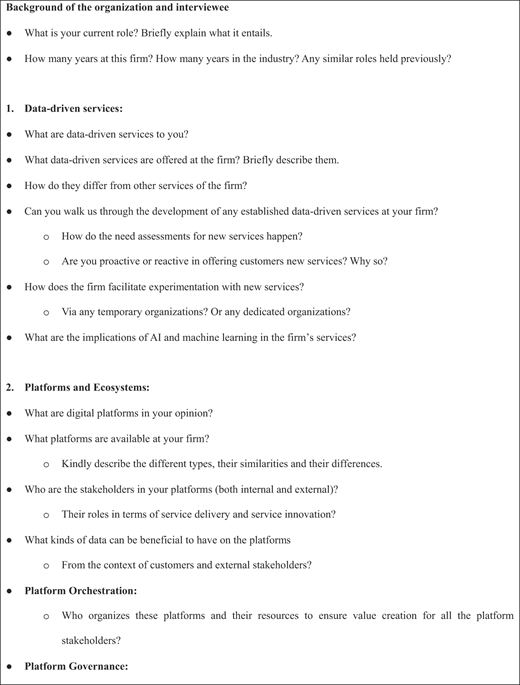
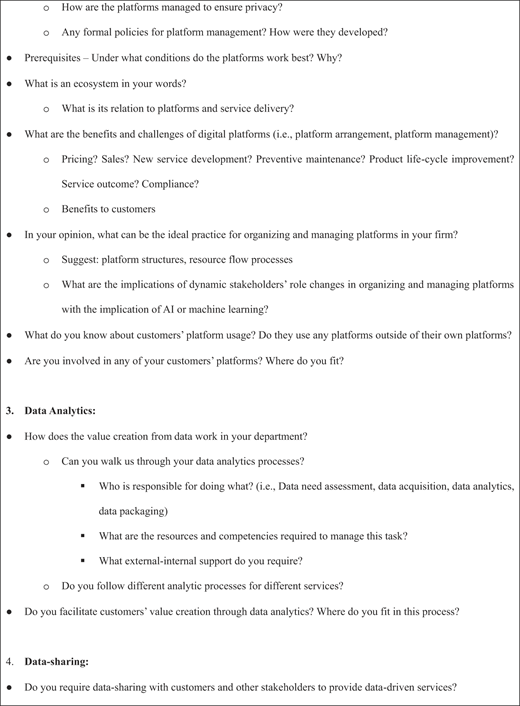
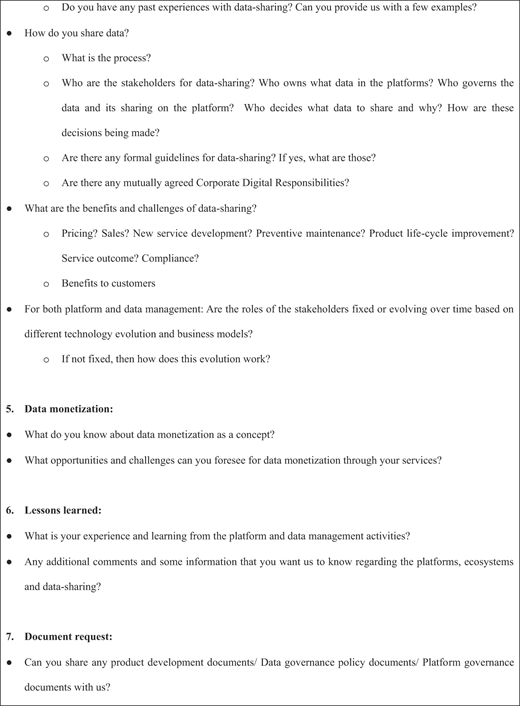
In total, we conducted 37 semi-structured interviews with respondents from six firms. Data collection took place between October 2022 and April 2024, permitting iteration between empirical data and theory in what Dubois and Gadde (2002) call the “abductive” approach to case research. We used a pre-designed interview guide (see Appendix). This guide included open-ended questions focused on key topics such as data-driven service development, the data analytics process, data sharing, digital platforms, platform development, both internal and external platform ecosystems and platform and data governance. Throughout the interviews, we asked follow-up questions to clarify concepts and ensure a thorough understanding of the phenomenon under study. We encouraged participants to move beyond their specific job responsibilities and explain how their responses connected to the broader concept of platform-based servitization.
To ensure that data was collected from actors with different perspectives with respect to the investigated phenomena (Piekkari et al., 2010), we interviewed respondents from a wide range of business functions, including top-level executives, product managers, data analysts, customer relationship managers, platform developers and customers of the digital services. To account for the diversity of our informant base, we made iterative revisions to the interview guide, carefully considering the distinct roles and expertise of each participant. This dynamic learning process, informed by each interview, guided the ongoing refinement of the guide.
The timelines of these interviews ranged from 30 to 122 min, for a total of 2,237 min of interview recordings (see Table 1). The transcripts were later presented to the original respondents for review in order to minimize misunderstandings and errors of interpretation (Gibbert et al., 2008).
Informants and roles
| Industry | Firm | Role | Interview time (minutes) |
|---|---|---|---|
| Transportation | T1 | Analytics team member | 81 |
| Analytics team member | 45 | ||
| Dealership team member | 40 | ||
| Dealership team member | 41 | ||
| Director of mobility services | 50 | ||
| Head of analytics | 29 | ||
| Head of strategy | 65 | ||
| Legislative officer | 54 | ||
| Commercial product manager | 122 | ||
| Commercial product manager | 65 | ||
| Commercial product manager | 75 | ||
| Commercial product manager | 66 | ||
| Commercial product owner (Digital platform development team member) | 100* | ||
| Strategy manager | 59 | ||
| Venture builder | 56 | ||
| Venture builder | 59 | ||
| Workshop product owner | 50 | ||
| Workshop product manager | 54 | ||
| T2 | Head of emerging technologies | 63 | |
| Head of AI research | 55 | ||
| Chief legal and IP officer | 51 | ||
| Manager, Legal and IP | 57 | ||
| Customer A | Fleet manager | 38 | |
| Customer B | Fleet manager | 44 | |
| Data broker | Chief executive officer | 79 | |
| Director of sales Product manager | 61* | ||
| Chief customer officer | 64 | ||
| Customer care specialist | 30 | ||
| Chief technology officer | 51 | ||
| Technical developer | 46 | ||
| Healthcare | H1 | Chief information officer | 79 |
| Founder | 75 | ||
| Chief commercial officer | 56 | ||
| Senior product manager | 74 | ||
| Strategic partnerships manager | 53 | ||
| Product owner, Platform R&D | 76 | ||
| Product owner, Platform R&D | 74 |
Note(s): *These interviews were conducted with two informants simultaneously
Source(s): Authors’ own work
For this study, digital platforms serve as the unit of analysis, focusing on the firm-level orchestration processes of actors, resources and activities required to execute DSIs. To analyze the data, we employed the ARA framework (Håkansson and Johanson, 1992) as our primary lens to identify the distinct constellations of actors, resources and activities involved in the firms’ platform-based DSIs.
Additionally, insights from the existing literature on platform ecosystems and network dynamics (Adner, 2017; Gawer, 2014; Alaimo et al., 2020), as well as concepts of vertical and horizontal complementarities (Thomas et al., 2024) and boundary resources (Bonina et al., 2021), were instrumental in deepening our investigation. The framework and additional sources enabled us to systematically map out the interactions and contributions of various actors and resources, as well as how the activities are coordinated within the broader ecosystem for platform-based DSIs. To substantiate our analysis, we included direct quotations from informants where relevant, ensuring that our interpretations are grounded in the empirical data.
Additionally, we triangulated our findings with secondary sources, including firms’ annual reports, websites and online news portals, to corroborate details about their platform-based offerings and DSI activities. This element of the research design was also intended to minimize respondents’ biased interpretations. Data were systematically grouped according to different platforms and ecosystems. The ARA framework guided the analysis process, and we applied pattern matching as our analytic techniques to ensure a systematic approach. Ultimately, this led to the identification of five distinct types of platforms for digital service innovation.
4. B2B platforms for digital service innovation
In B2B markets, firms employ digital platforms to manage intricate networks of actors and resources. Based on our empirical insights, we outline five distinct platform types, each representing diverse actors and resource configurations for driving DSI. We refer to them as manufacturer-led, provider-mediated, customer innovation, customer-moderated and data brokerage platforms (see Table 2).
Actors, activities and resources configurations for different B2B platform types
| Manufacturer-led platform | Provider-mediated platform | Customer innovation platform | Customer-moderated platform | Data brokerage platform | ||
|---|---|---|---|---|---|---|
| Actors | Focal firm’s role | Equipment manufacturer, data curator, DSI moderator | Platform provider, DSI facilitator | Platform owner, DSI enabler | Platform owner, DSI moderator | Data sharing intermediary |
| Platform and database installation base | Manufacturer’s premise | Customer’s premise | Platform provider’s premise | Customer’s premise | Data broker’s premise | |
| Platform ownership | Manufacturer | Platform provider | Platform provider | Customer | Data broker | |
| Ecosystem members and their roles | Manufacturer, complementors, customer, competitors | Platform provider, customer, complementors | Platform provider, customer, complementors | Customer, manufacturers, platform provider | Data broker, data customers, data complementors | |
| Data ownership | Blurry ownership: Customer (Operational data), manufacturer (Data-driven insights) | Customer | Customer | Customer | Data broker | |
| Platform interoperability responsible | Manufacturer | Platform provider | Platform provider | Not applicable | Data broker | |
| Platform governance responsible | Manufacturer | Customer | Platform provider | Customer | Data broker | |
| Ecosystem orchestration and management responsible | Manufacturer | Customer | Platform provider | Customer | Data broker | |
| Resources | Platform resources | Operational data, complementary datasets, closed architecture platform | Operational data, closed architecture platform | Operational data, low-code and no-code development platform | Operational data, closed architecture platform | Complementary datasets, closed architecture platform |
| Boundary resources | APIs | APIs, SDKs | APIs, SDKs | APIs | APIs, customized technology adapters | |
| Activities | Platform governance type | Centralized | Centralized | Federated | Centralized | Centralized |
| Ecosystem orchestration type | Centralized | Centralized | Centralized | Centralized | Centralized | |
| Data curation | Manufacturer | Platform provider | Platform provider | Manufacturers, platform provider | Data broker | |
| Data analytics | Manufacturer | Platform provider | Platform provider | Manufacturers, platform provider | Not applicable | |
| DSI need-identification | Manufacturer | Customer, platform provider | Customer, platform provider | Customer, platform provider | Data customers | |
| Service development | Manufacturer, complementors | Platform provider, complementors | Platform provider, complementors | Platform provider | Data customers | |
| DSI | DSI activity summary | Manufacturer integrates and orchestrates the actors, resources and the DSI activities. It is a natural part of the firm’s digital servitization | Platform provider integrates and orchestrates the actors and resources based on the customer and provider’s identified DSI opportunities. The DSI activities are carried out by the provider based on mutual agreement | Platform provider integrates and orchestrates the actors and resources based on the customer and provider’s identified DSI opportunities. The DSI activities are carried out by the provider and customer based on mutual agreement | Customer identifies DSI opportunities. The DSI activities are carried out by the provider based on customer’s directions | Data broker collects and shares data requested by the data customers based on their DSI requirements |
Source(s): Authors’ own work
The customer-moderated platform is characterized by stringent control and limited innovation opportunities, with minimal interoperability and integration provisions for external complementors. Conversely, the manufacturer-led platform is a typical proprietary B2B platform orchestrated by the equipment manufacturer. Both the manufacturer-led and provider-mediated platforms facilitate interoperability for external complementors through the provision of APIs (Bonina et al., 2021) and technology adapters. We define customized technology adapters as specialized software tools designed to facilitate seamless integration, interoperability and enhanced functionality across distinct systems. Developed or modified on a case-by-case basis, these adapters accommodate specific data formats and delivery requirements, demonstrating their flexibility in integrating heterogeneous systems and meeting unique customer needs.
The customer innovation platform offers customers the opportunity to contribute through service innovations. Facilitated by the platform provider providing a platform that enables low-code and no-code developments along with necessary SDKs (Bonina et al., 2021) and training. Low-code and no-code refer to technologies that allow the creation of software applications with minimal or no coding expertise (Ajimati et al., 2024). Finally, the data brokerage platform operates on a distinct business model aimed at data monetization. While no DSI activities occur on the data broker’s platform, it enables service innovation activities by sharing necessary data complementarities on a subscription basis.
In the following sections, we examine each type of platform supporting DSIs drawing on our empirical evidence–followed by analytical discussions informed by the conceptual foundations established in Chapter 2.
4.1 Manufacturer-led platform
Our first empirical example from a commercial transport manufacturing firm illustrates how a manufacturer-led platform supports DSI. In this scenario, the manufacturing firm establishes contractual agreements with customers buying its products–trucks–enabling the collection of operational data on its digital platform from the trucks using embedded sensors. In return, customers receive insights for improving fleet efficiency through the manufacturer’s proprietary data analytics. To perform these analytics, the firm’s research and development (R&D) team relies on additional telematics data and algorithmic support from external complementors. These complementors or only their data and algorithm sources are then integrated into the platform. The R&D team combines the data and algorithms to conduct analytics and generate data-driven insights. These insights are then shared with the service development teams, who identify DSI opportunities to improve trucks’ operational efficiency. These DSIs contribute to proactive maintenance or efficient fuel management either in the form of data-driven intelligence reports or the development of preventive services.
The manufacturer pursues vertical complementarities from strategically aligned external actors. These complementarities are incorporated into the platform as subscription services for customers. As exemplified by a venture builder from T1:
We fully understand the need to collaborate and orchestrate services from different partners and then offer these data-driven services to our customers in various ways—whether we directly interact with the customer or our partners take the lead. In cases where we take the forefront, we would like to procure white-label software from these partners and sell it under our brand through our platform.
The platform payments comprise a base monthly subscription and additional fees for manufacturer-developed complementarities. Payments for externally developed complementarities may follow upfront or pay-per-use models. Additionally, recognizing that customers often own trucks from different brands, the manufacturer integrates fleet management services from competitors onto the platform upon customers’ request. This integration enables customers to manage trucks from multiple brands through a single platform interface. Figure 1 illustrates this platform type.

Manufacturer-led platforms are prevalent in industries where product manufacturing firms seek to augment their core product offerings by integrating data-driven services through digital platforms. As illustrated in Figure 1, the manufacturer assumes the roles of provider, owner and orchestrator of its proprietary, closed architecture platform (c.f. Gawer and Cusumano, 2014). Positioned at the center of this platform’s ecosystem, the manufacturer orchestrates service innovation initiatives on the platform, leveraging its own resources along with complementary resources sourced from other members of the ecosystem. These ecosystem members encompass customers, complementors and, under certain circumstances, competing manufacturers.
In this platform type, embedded sensors within the equipment sold to the customers capture operational data and send them to the platform at pre-set intervals (e.g. hourly, per minute or per second). The manufacturer leverages these data, the key resources of this platform, for analytics to derive data-driven insights, identifying opportunities for DSI. However, these analytical activities often necessitate complementary datasets held by external actors (Homburg et al., 2020). These insights may reveal DSI needs beyond the manufacturer’s core capabilities, prompting the sourcing of such innovative offerings from external firms, which then become complementors contributing vertical complementarities to the platform (Thomas et al., 2024). In this integration process, the manufacturer develops APIs as boundary resources, controlling platform access (gatekeeping) and authorizing the use and sharing of necessary data and resources to and from these integrated complementors for the planned DSI activities (e.g. decision rights; Tiwana, 2013).
The process of DSI activities on this platform is twofold: identifying the DSI needs and then executing DSIs. The manufacturer initially focuses on identifying customer needs by monitoring their interactions with the manufacturer’s equipment. This involves collecting raw operational data from the equipment. These data undergo curation and analytics by the manufacturer’s data analysts to generate insights. If the data analysts identify any additional data requirements for the analytics from external actors, the manufacturer integrates them as data complementors via APIs. The manufacturer only allows one-way data flow from external actors to the platform in these cases, controlled by the API as a boundary resource. Payment to the data provider is made by the manufacturer based on mutual agreements. Once all required data are aggregated on the platform, the data analysts conduct analytics to generate data-driven insights. These insights are then shared with customers to help them enhance their operational efficiencies and the manufacturer’s service development teams to develop new services. Both data-driven insights and data-driven services developed for customers can be considered platform-based DSI initiatives.
Alternatively, if the identified innovation opportunities require capabilities beyond the manufacturer’s capacity, external actors capable of executing the DSI are sought and integrated as vertical service complementors on the platform via APIs. Operational data required to support the DSIs are shared with these actors through the platform and resulting offerings are hosted on the platform. The manufacturer pays for these offerings, which act as vertical complementarities atop the manufacturer’s core (product and service) offerings (see Figure 1). Moreover, the manufacturer allows competitors’ integrations on the platform at customer request, using APIs to grant limited accessibility rights. These integrations enable customers to access various manufacturers’ equipment management portals from a single platform interface, involving data flow for DSI activities.
4.2 Provider-mediated platform
To illustrate how a provider-mediated platform executes DSI, we draw on an example from the healthcare industry. We studied this software firm developing an operational process management platform for hospitals and healthcare facilities under public authorities’ jurisdiction. The public authorities own the operational data, and the provider utilizes these data with the authorities’ consent to optimize medical caregivers’ daily workflows and introduce new services. Complexity arises from the public authorities being the platform’s customers, while caregivers are its users. To identify value-addition opportunities, the provider focuses on caregivers’ DSI needs.
Caregivers communicate their needs to the provider, who assesses feasibilities and discusses them with the public authorities. Upon approval, the provider executes the required service innovations, which consist of horizontal complementarities. If in-house innovation is not feasible, external complementors are chosen based on customer-provider agreement. APIs integrate these complementors into the platform, using caregiver workflow data to support planned DSIs. New services developed through these DSIs are offered to customers via the platform. In case the services are sourced from external complementors, the public authorities negotiate monthly subscription prices with the complementors and pay them directly. The integration of horizontal complementarities is explained by a product owner from H1:
We have a range of smaller or satellite services and software, which we have developed either internally or through acquisitions. This includes a vaccine scheduling app for mobile phones, various workflow tools, clinical decision support systems and tools for integrating APIs with our platform. The biggest commonality between all our different software is that each was developed with a specific purpose and as a full-stack solution. For instance, our vaccine app operates with its own proprietary database and SQL table structure tailored to its needs. Similarly, our core platform features a complex backend that has evolved over time, incorporating new features supported by a proprietary database and distinct data models.
Provider-mediated platforms (see Figure 2) are increasingly prevalent, as, via these platforms, firms transition from offering software products through perpetual licensing to adopting Software-as-a-Service (SaaS) models (e.g. Link and Back, 2015). These platforms align with Tiwana’s (2013) definition of software platforms, comprising software and hardware components that support the development and integration of complementary services. This type of platform is owned and provided by the software product provider (see Figure 2). Customers pay periodically recurring fees to the provider for their platform usage rights, without any platform modification authorization. The platform, proprietary to the platform provider, bears a generic brand name and can be delivered to numerous customers in highly standardized or customized forms. The distinctive feature of this platform lies in the orchestration roles of the ecosystem resources and actors (Adner, 2017).

The customer, positioned at the center of the platform’s ecosystem, orchestrates the platform-based innovation processes alongside the required resources and complementarities. The platform facilitates the integration of complementors, selected based on their capacity to provide horizontal complementarities. The platform mandates mutual approval for any external actor integration, whether initiated by the customer or the provider, with the provider assuming responsibility for the actual integration of actors on the platform. These horizontal complementors constitute the additional actors within the provider-mediated platform ecosystem.
The provider-mediated platform type is a closed architecture platform (Gawer and Cusumano, 2014), subscribed to by the customer. This platform is dedicated to enhancing the efficiency of the customer’s operational processes. Data collected from the customer’s operations are critical resources for DSI and are owned by the customer. The provider is granted data access by the customer to assess and pursue service innovation opportunities. If the customer or provider identifies external actors who can contribute to existing platform offerings, these actors can be integrated as horizontal complementors with the customer’s approval. Moreover, the customer’s operational data may be shared with these actors to support the intended DSI, contingent upon the customer’s consent (see Figure 2). The provider develops APIs as boundary resources for these external actor integrations, maintaining control over their activities on the platform.
This platform follows the twofold DSI process similar to the manufacturer-led platform. Both the customer and the provider identify DSI needs in this platform type. However, the customer approves the DSI activities, while the provider executes them. The process commences with the provider monitoring customer journeys to identify potential DSI opportunities. Alternatively, the customer may identify opportunities internally or externally from the horizontal complementors directly connected to the customer (see Figure 2). In both scenarios, ideas come from insights generated by analyzing customer’s operational data.
Subsequently, the provider evaluates the identified DSI opportunities and proceeds with execution if deemed viable, focusing on developing horizontal complementary services (Thomas et al., 2024). If the identified services are not feasible for the provider or the existing horizontal complementors to develop, both the customer and provider look for new suitable complementors. Once identified, complementors are finalized for platform integration following a mutual agreement between provider and customer. The provider conducts a technical certification check of the complementors before integration. For complementors lacking technical adaptation capabilities, the provider aids integration by offering necessary APIs (Bonina et al., 2021). Once integrated, the provider supports complementors’ DSI activities by sharing operational data with the customer’s consent or the customer shares data directly. This leads to the development of novel complementary horizontal services aimed at enhancing customer operational efficiency (c.f. Thomas et al., 2024).
Payments for these services are negotiated among the customer, provider and complementors. They can take two forms: direct payment from the customer to the complementors or payment facilitated by the provider. In the latter case, the payment may be included in the customer’s monthly subscription fee (refer to Figure 2). Finally, similar to the manufacturer-led platform, APIs enable the provider to manage complementors’ platform access rights (Tiwana, 2013).
4.3 Customer innovation platform
The customer innovation platform can also be exemplified by a case from the healthcare industry. In this scenario, the software product firm extended its provider-mediated process management platform offering by introducing a separate innovation platform for the customers. This platform supports both low-code and no-code development, enabling medical caregivers (i.e. the platform users) to develop and host non-commercial services for their own usage. These developments are facilitated by SDKs developed by the platform provider. Both the customer and the platform provider identify new service innovation ideas, jointly assessing their feasibilities. For DSIs in these platforms, the provider focuses on the caregivers’ (users) journeys as described by a product owner of H1:
We are deeply focused on understanding the entire user journey, which is a key aspect of our work. As a product owner for our core services, I am also dedicated to exploring the customer user journeys at the platform level. This is crucial because we are dealing with a disruptive shift that is transforming the field. Understanding this change is essential as our customers are encountering many new challenges and will continue to do so. In five years, familiarity with informatics and open data standards will be more widespread, but right now, many aspects are new for our customers. Therefore, we need to identify where they need support and what kind of assistance they require—whether it is documentation, consultancy, training, or other services. Our goal is to map out these needs and determine how best to address them, which might involve collaborating with various stakeholders. Ultimately, our mission is to create real customer value. We can develop excellent features and data-driven services from our data models, but value is only realized when customers can effectively use them. Understanding and meeting their needs is key to delivering that value.
If in-house execution is not feasible, the firm identifies external actors who can contribute. The firm then carries out the necessary certification and integration process for these actors, granting them access to the platform through relevant APIs. The provider shares necessary customer-consented operational data with the integrated complementors for the execution of the intended DSI. The innovation platform’s architecture is more flexible compared to the previously described platform types, with the provider focusing on increasing the platform’s acceptability and usability to incrementally enhance its value.
The customer innovation platform, illustrated in Figure 3, is owned, provided and orchestrated by the software product firm. This platform type is designed to enhance comprehensive services by involving the provider, customers and potential complementors who can support customer-driven innovation efforts. This platform, resembling innovation ecosystem platforms like Amazon AWS, Apple iOS and Steam (Gawer, 2021), is offered as a Platform-as-a-Service (PaaS) to customers.

Unlike the provider-mediated platform type that manages one-directional service provisioning, the customer innovation platform provides opportunities for customers to develop horizontal complementarities through their own DSI initiatives. These complementarities aim to enhance customers’ process efficiencies and can be hosted on the platform by the customers themselves. The platform is proprietary, with the provider solely orchestrating the ecosystem (see Figure 3). The provider actively seeks vertical complementary services integrations to broaden its offerings with vertical complementarities (Thomas et al., 2024). Thus, this platform’s ecosystem consists of the platform provider, the customer and vertical complementors (see Figure 3).
The customer innovation platform type features a semi-open architecture platform, accommodating both low-code and no-code development capabilities. Unique SDKs are developed by the provider to facilitate customers’ service innovation activities. Consequently, this platform allows customers without service development expertise to participate in platform-based service innovation using these SDKs through provider-led training. For external complementors, the provider develops APIs to integrate them and their offerings into the platform (Bonina et al., 2021). Thus, SDKs and APIs serve as boundary resources for gatekeeping and decision rights management of the platform (Tiwana, 2013). Additionally, operational data from customers’ daily workflows, similar to the provider-mediated platform, are considered resources in this platform type that helps the provider identify potential customer-driven DSI opportunities.
The DSI activities for this platform type follow a twofold pattern similar to the preceding platform types discussed above: DSI needs identification and DSI execution. The uniqueness of this platform is that the customer is engaged not only in identifying DSI needs but also in executing them if feasible. Both customers and the provider identify DSI opportunities, with the provider leveraging customer journey monitoring and operational data analytics, while customers rely on their own emerging demands.
Three processes drive DSI from identification to execution. The first two processes are for horizontal complementarities, whereas the third one is for vertical complementarities. To begin with, if the provider finds DSI feasible, it executes the DSI in-house, integrating complementary services into existing customer offerings. The second process that distinguishes this platform is the joint identification of DSI opportunities that can be executed by the customer. The provider develops SDKs (Hein et al., 2019) and necessary service development training for the customer, supporting their DSI activities (Chen et al., 2022). Lastly, if DSI execution is not feasible by the provider or the customer, the provider seeks complementors that can develop the necessary vertical complementarities. Upon the necessary selection and approval process of the complementors, they are integrated into the platform by providing necessary training. In case of any technical incapability, the provider develops the necessary API for the platform integrations. The developed complementarities are then hosted on the platform. The customer pays the provider for the platform, the associated complementarities and the SDKs, while the platform provider compensates the complementors for their services (see Figure 3).
4.4 Customer-moderated platform
To illustrate the customer-moderated platform type, we draw on examples from the transportation industry. More specifically, the truck manufacturer’s customers—logistics service providers operating fleets with vehicles from multiple manufacturers. These firms can subscribe to fleet management portals provided by each vehicle manufacturer. However, they often opt for customized, branded fleet management platforms developed by third-party software firms, in exchange for monthly subscription fees and annual maintenance fees. Additionally, they purchase on-demand data from manufacturers based on specific data types and volumes. These platforms collect operational data using third-party sensors installed by manufacturers at the customers’ request before delivery. These sensors enable the consolidation of vehicle data from different brands into a single platform, as described by the fleet manager of Customer A:
We use trucks from multiple manufacturers, so we need to purchase services from each of these manufacturers to collect data from the trucks. Additionally, we subscribe to a third-party service, which is solely developed for us by a software developer. This is our own platform. This platform consolidates data from all our trucks into a single database. The system is designed to work with tachographs, as mandated by EU regulations. Essentially, the data is first transferred to the manufacturers’ databases and then forwarded to the database in our platform, which we access to view the consolidated information.
The platforms, controlled end-to-end by the logistics providers, generate customized vehicle performance reports. While they do not support data exchange or integration, data can be downloaded and shared externally. If additional reports or features are needed, the software developers are granted access to specific development or innovation activities. If manufacturer support is required, such as for an additional vehicle performance dataset, the logistics providers request it. The manufacturers provide the necessary datasets to the customers through APIs without getting integrated into the customers’ platforms.
The customer-moderated platform (Figure 4) is distinct in that it is provided by a third-party software firm, while owned and orchestrated by the customer, offering a more limited scope for service innovation. Unlike the provider-mediated platform, it is tailored to a specific customer’s needs. While the backend can be generic or non-generic, the frontend is fully customized and branded for the customer, resembling a customer-proprietary platform. Unlike other platforms, this type is closed to external actor integration (Boudreau, 2010). It connects directly to the customer’s operational equipment, enabling the collection and sharing of on-demand raw operational data while also serving as the customer’s equipment management portal.

In this platform’s ecosystem, the customer is at the center and the sole user of the platform that orchestrates this ecosystem. Other actors include the platform provider and the customer’s equipment provider (see Figure 4). The platform provider can only access the platform and its embedded resources (e.g. data and algorithms) based on the customer’s requirements and granted access.
This platform type features a closed architecture platform (Gawer and Cusumano, 2014), which is used by customers to monitor equipment operations and generate performance reports using operational data collected from customers’ equipment. The platform provider implements specific data structuring and report-generating algorithms based on customer requests. The operational data and algorithms enable the platform to generate equipment performance reports for customers, thus serving as the platform resources for DSI. Although this platform lacks boundary resources and is closed to external actor integration, manufacturers offer APIs for the customer, allowing one-way dataflow toward the customer’s platform without integrating the manufacturers (see Figure 4).
The scope of this platform’s DSI process is limited. Initially, the platform collects data on equipment performance using provider-implemented algorithms. These data consist of energy usage, equipment handling, location tagging and preventive maintenance alarms; and are used to generate equipment performance reports. In certain instances, the customer communicates with other ecosystem actors for necessary service needs. For example, if anomalies appear in performance reports, the customer requests a deeper data analysis from the platform developer. The customer grants specific platform access for this activity through user authentication, similar to what Sun et al. (2020) mentioned about agents getting access to data on certain web services. Using the equipment data and existing algorithms, the platform provider attempts to resolve the issue through data analytics.
Three outcomes can result from the analytics. First, the platform provider may solve the issue using existing data and algorithms. Second, if the existing algorithms are insufficient, the platform provider develops new algorithms, service extensions or service offerings by executing necessary DSI activities. Finally, if the existing data is insufficient, the customer may request additional data from the manufacturer. The issue can either be resolved with the additional data or the manufacturer may need to collaborate with the platform provider, jointly executing DSI to resolve the customer’s issue. It is noteworthy that the manufacturer’s intervention does not involve platform integration, but occurs through dialogue between the firm, platform provider and customer. If specific data are required, the manufacturer provides the necessary APIs. The customer uses these APIs to acquire and aggregate the data unidirectionally to the customer’s platform without integrating the manufacturer into it.
4.5 Data brokerage platform
The data brokerage platform is the most distinct of the digital platforms identified in the study. We illustrate this platform using a data broker’s example from the transportation industry. Within the increasingly data-centric commercial logistics domain in the transportation industry, manufacturers are pioneering fleet management platforms to gather operational data for analytics and DSI. This domain encompasses various equipment providers, including those for trailers and refrigeration systems, catering to their customers. Customers who possess trucks from diverse brands need data from all these entities to conduct effective data analytics, thereby uncovering data-driven insights and fostering opportunities for service innovation. Complicating matters, third-party software developers within the customers’ sphere offer centralized, vendor-agnostic fleet management solutions. This consolidation permits customers to oversee their entire fleet via a singular platform, streamlining operations across different brand-specific fleet management platforms. Nevertheless, challenges surrounding data sharing among different truck brands and equipment providers impede customers’ access to equipment-centric operational data.
To resolve this issue, a data broker serves as an intermediary, devising a data monetization framework that furnishes data-as-a-service through a subscription-based model. The broker integrates data customers and facilitates access to its proprietary platforms through APIs and customized adapters for individual actors. It identifies and integrates manufacturers, trailer providers or complementary telematics dataset suppliers essential for its clients’ DSI initiatives. Subsequently, the required data are shared with customers after curation and structuring, thus enabling the execution of the customers’ innovation initiatives. Moreover, the data broker implements internal governance mechanisms on the platform, amalgamating the governance requisites of all partners to safeguard data privacy across the platform ecosystem. The unique multiplicity of data sharing orchestrated by a data brokerage platform is described by the chief executive officer of the platform owner:
The most effective setup for our platform involves allowing each entity we onboard to share data not just once with a single customer, but also to have the opportunity to exchange data with multiple other firms. Currently, we operate with ad-hoc consignment-wise data agreements. However, our future goal is to move beyond these temporary agreements to negotiate commercial and framework agreements for subscription services, enabling real-time seamless and continuous data sourcing from vehicles for our customers. This also involves, rather than having data owners dictate specific actions randomly, maintaining customers as independent participants on our platforms, giving them control over their subscribed data assets.
Owned, provided and orchestrated by a data intermediary or data broker (Liozu and Ulaga, 2018), the data brokerage platform (Figure 5) addresses the data needs of the actors for executing DSI in the B2B context, where firms fear data privacy loss and misappropriation (Sun et al., 2020). Addressing this challenge, the data broker emerges by cultivating trust among ecosystem members to mitigate the risks associated with data sharing. The data broker introduces a proprietary platform, that implements a business model specifically aimed at data monetization (Ritala et al., 2024). Through its trusted networked connectivity using the platform ecosystem, the data broker creates a massive data supply chain within the industry. The data broker is positioned at the center of its proprietary platform ecosystem (see Figure 5). While this platform does not support innovation itself, its major role is to enable DSI through data extraction and sharing. Additionally, it acts as a data monetizing intermediary for the data broker and associated data complementors (Liozu and Ulaga, 2018). Thus, the platform’s innovation lies in its business model: customers pay for data subscriptions and the data broker pays parts of these subscriptions to data complementors for their data while earning the rest for providing this proprietary data monetization service.

The platform’s ecosystem consists of data complementors, such as original equipment manufacturers (OEMs), vendor-agnostic service providers (e.g. rental and logistics providers) and equipment-related data providers (e.g. environmental and geographical data regarding equipment operation) and data customers, who are the users of the equipment and associated services. For this platform, data complementors generate crucial equipment operational data for customers’ DSI processes.
This platform type features a closed-architecture proprietary platform designed by the data broker to integrate selected industry actors as ecosystem partners through developing APIs and customized technology adapters on a case-by-case basis. The APIs and the technology adapters, serving as the platform’s boundary resources, ensure uninterrupted connectivity for seamless data flow among partners. For the data brokerage platform, data collected from the complementors are the most vital resources (Jacobides et al., 2018; Alaimo et al., 2020).
As previously indicated, the data brokerage platform does not directly initiate DSI activities. Instead, it facilitates DSI for its customers by procuring the necessary data. Initially, the broker identifies industry customers seeking complementary datasets for DSI initiatives. Subsequently, it identifies suitable data complementors capable of meeting these needs, akin to matchmaking functions observed in dating apps. Once suitable matches are found, the broker enters into separate data-sharing agreements with the involved parties. These agreements outline various aspects, including monthly data volume requirements, pricing based on volume or frequency, data governance protocols and usage rights on the platform, mutually agreed upon by all parties. Subsequently, the broker evaluates the technological requirements for integrating both data complementors and customers onto the platform, developing necessary APIs and customized technology adapters, tailored for each actor to facilitate their platform integrations and seamless data-sharing. Upon integration, the broker acquires the required data from the complementor, curates it according to customer specifications and shares it with the customer.
This data exchange adheres strictly to contractual terms, with the broker implementing necessary governance measures on the platform, enabled through APIs and technology adapters as boundary resources (Ghazawneh and Henfridsson, 2015; Jovanovic et al., 2022). These resources safeguard data privacy-related challenges for the platform ecosystem members. Upon receiving the requisite data, the customer proceeds with planned DSI initiatives. Data complementors, although not directly involved in DSI activities, earn revenue through the data brokerage platform, offering them a unique opportunity to generate income. Consequently, the broker effectively facilitates data-driven innovation for its platform members across both upstream and downstream segments of the data value chain. Despite being potential competitors in the data market, both the data broker and data complementors engage in a collaborative yet competitive relationship, known as coopetition (Bengtsson and Kock, 2000), within the data brokerage platform ecosystem. This cooperative approach, rather than outright competition, is a distinctive characteristic of this platform. Notably, the data brokerage platform aims to implement a high level of partner-neutral interoperability by developing novel technology adapters. These adapters enable instant onboarding of external partners without requiring them to adhere to any specific platform architecture or data standards.
5. Discussions and implications
In this paper, we identify and conceptualize five distinct platform types in B2B settings, highlighting the diverse actor and resource constellations involved. While other platform configurations may exist in these or related industries, each identified platform follows a unique process for executing DSI, creating both horizontal and vertical complementarities for customers. Next, we discuss the theoretical and managerial implications of our findings.
5.1 Theoretical implications
This study makes several contributions to the burgeoning literature on DSI (Opazo-Basáez et al., 2022). First, existing literature categorizes digital platforms into open and closed architecture platforms (Jacobides et al., 2018) and transaction versus innovation platforms (Bonina et al., 2021). Expanding upon these classifications, we have identified and conceptualized five distinct types of digital platforms for B2B service innovation. These include B2B manufacturer platforms for connected equipment and innovation platforms enabling customers to develop complementary data-driven services. While these may serve as archetypal representations, we argue that many B2B platforms exhibit idiosyncratic traits, being more agnostic to business models than solely reliant on technological architecture. Depending on the business model and intended DSI, various ecosystem actors and resource configurations shape platform ecosystems. For instance, the customer-moderated platform offers limited innovation potential and control, with no or minimal interoperability for external complementors. In contrast, the manufacturer-led platform is a standard proprietary B2B platform, that, similar to the provider-mediated platform, facilitates interoperability through APIs (Bonina et al., 2021). The customer innovation platform empowers customers with both low-code and no-code development options (Ajimati et al., 2024), along with the requisite SDKs (Hein et al., 2019) and training. Lastly, the data brokerage platform implements a higher degree of interoperability by developing novel and customized technology adapters, aiming at data monetization through aggregating data from multiple sources and simultaneously offering it to customers to augment their DSI activities.
Second, we argue that actors’ roles transcend different platforms contingent upon the orchestration of DSI activities (Adner, 2017). We posit that both platform providers and platform customers can assume the roles of platform owners and orchestrators across various platforms. Depending on their positioning within the ecosystem and their networking capabilities, actors’ roles shift from DSI process controller to DSI enabler for the customers and complementors. Moreover, in most instances, platform developers enhance the DSI process and activities by furnishing data and generating necessary boundary resources for the integration of external complementors onto the platform by enabling interoperability. Consequently, platform developers emerge as the most pivotal actors in facilitating platform interoperability and platform-based DSI activities.
Finally, platform governance mechanisms can function as both facilitators and impediments to the establishment of an interoperable ecosystem. Literature on B2B platforms and ecosystems highlights the crucial role of platform governance in facilitating platform-based service innovation. We contend that. While it suggests that open platform architectures are more conducive to innovation due to their interoperability (Gawer and Cusumano, 2014; Jovanovic et al., 2022; Sandberg et al., 2020), we see that many B2B firms are reluctant to sudden changes to their architectures to seamlessly integrate complementors without encountering barriers. Instead, they may utilize boundary resources and adapters to regulate the extent of interoperability, gradually opening up their platforms to complementors who prove instrumental for platform-based DSIs. While the literature primarily discusses the role of SDKs and APIs in facilitating external actor integration on the platform, we identify a third tool typically not discussed in the literature: customized technology adapters. These adapters facilitate the integration of external complementors into the provider’s platform, particularly those with differing platform technologies or data standards compared to the focal platform. Bypassing the need for external actors to undergo extensive standard adaptation processes, these adapters mitigate interoperability challenges and enhance the acceptability and usability of the provider’s platform. Consequently, they facilitate the flow of data and resources across multi-platform settings, fostering DSIs and enhancing the overall value of the platform.
5.2 Managerial implications
Our study underscores the importance of selecting platform approaches that align with firms’ and their customers’ business models and strategic goals. For B2B firms driving service innovation, this requires identifying the most relevant platforms, defining their role within the ecosystem and understanding the capabilities needed to deliver novel services in an increasingly multi-platform environment. As summarized in Table 3, each of the five platform types presented in this study facilitates specific services while also imposing distinct requirements on the platform orchestrator and participants. Understanding these requirements is crucial for firms aiming to leverage platforms effectively for service innovation.
Managerial implications for different platform types
| Platform type | DSI intervention | DSI mechanism | DSI outcomes |
|---|---|---|---|
| Manufacturer-led platform |
|
|
|
| Provider-mediated platform |
|
|
|
| Customer innovation platform |
|
|
|
| Customer-moderated platform |
|
|
|
| Data brokerage platform |
|
|
|
Source(s): Authors’ own work
Firms need to assess the platform’s governance structure, data-sharing mechanisms and interoperability features to determine how well it supports their service offerings and strategic objectives. Manufacturer-led platforms rely on strong vertical integration and advanced analytics to enhance efficiency and expand product-orientated service offerings. Provider-mediated and customer innovation platforms require collaboration with horizontal complementors and active customer participation in service development. Customer-moderated platforms depend on flexible data-sharing frameworks, while data brokerage platforms prioritize secure data transactions and monetization strategies. Additionally, customer-moderated platforms feature a distinct ownership-orchestration structure, where the platform is externally developed by third-party software firms, but ownership and orchestration lie with the customers. This implies that the customers are to deal with platform governance. By aligning with these requirements, firms can drive DSIs and unlock new revenue streams.
From our cases, we identify platform providers who often navigate multiple platforms to meet diverse internal and customer needs. In one healthcare industry example, the provider takes on dual roles, acting as both an orchestrator and enabler of DSI. Specifically, the provider drives innovation in the customer innovation platform while facilitating it in the provider-mediated platform. This flexibility allows the provider to govern and foster service innovation more effectively.
From the transportation industry example, we identified providers often engaging with multiple external platforms to support customers’ DSI efforts, sometimes even collaborating with competitors. In manufacturer-led platforms, the product firm owns and orchestrates the platform for service development through data sharing and analytics. However, in customer-moderated and data brokerage platforms, the product firm acts solely as a data provider. While technically competing with data brokers and other data sellers, the product firm balances competition with collaboration, ensuring financial benefits while supporting customers’ innovation activities. A key strategic factor is data ownership constraints, which prevent the product firm from directly selling data to customers. To navigate this, the firm leverages a data brokerage platform while taking a passive enabling role in services—circumventing restrictions and monetizing data through intermediaries.
The literature on platform strategy highlights that when a platform provider offers complementary products, it can be seen as an indication of their intention to capture a significant portion of the potential ecosystem value. However, this approach may sometimes discourage external complementors from participating (Cusumano, 2010). We argue that, given the diversity of customer demands, the development of numerous complementors may exceed the provider’s core capability and scope. Enabling external complementors to contribute with their innovative offerings by opening up the platform (Cenamor and Frishammar, 2021) signals the platform provider’s positive intention to include complementors in platform-based DSIs. Interoperability is an effective strategy for enabling the DSIs that are beyond the platform provider’s core capabilities. Effective value creation in the platform ecosystem through DSI relies on consolidating complementors and complementarities, which can be bolstered by enhancing interoperability. Firms can develop appropriate boundary resources for external complementors to facilitate these consolidations while ensuring governance. Platform providers can regulate openness based on the contributory capacities of customers and complementors to contribute effectively. APIs suffice for the innovations orchestrated solely by the platform providers. However, SDKs become necessary if customers and partners contribute to complementarity development for the platform. If complementors lack the technical capacity to meet platform standards, platform providers can offer training for necessary certifications. They may also invest in boundary resources to enhance complementarity and drive service innovation.
For decision-makers in customer firms, navigating a multi-platform environment requires selecting platforms that align with their strategic needs while balancing data-sharing, governance and service benefits. Manufacturer-led and provider-mediated platforms enhance efficiency and integrate external services. While customer innovation platforms allow customers to develop tailored services, these require members of customer firms to get trained in low-code and no-code development to use this platform feature effectively. Customer-moderated platforms offer greater control over data and insights, supporting independent decision-making and data brokerage platforms provide access to valuable datasets for in-house service innovation by the customers. Managers from customer firms need to carefully select and engage with platforms that have the potential to enhance their firms’ operational effectiveness and strengthen innovation capabilities.
5.3 Limitations and further research
Due to our design choices, this study has certain limitations. The conceptualization of the five distinct platform types is based on a limited sample drawn from two specific industries: transportation and healthcare. While these industries are distinct, they represent broader industry categories. While the installed bases in transportation consist of vehicle fleets, other product industries—such as elevators, industrial machinery and energy systems—also operate large installed bases where platform-based service innovation plays an increasingly important role. Similarly, the healthcare industry, with its strong emphasis on digitalization, regulatory complexity and data-driven services, aligns with other knowledge-intensive and service-oriented industries. Despite these broader alignments, caution is needed when applying our findings to other sectors. Platform-based service innovation may vary in industries with different technological dependencies, regulatory environments or competitive structures. Future research could examine platforms for DSI in additional industry settings to further validate its applicability and identify potential variations across different business ecosystems.
The platforms examined in this study leverage customer usage data to enable DSIs, making them well-suited for firms with long-term customer relationships. In contrast, transaction platforms in retail and e-commerce industries primarily facilitate short-term interactions and one-time purchases, often operating under different business logic. From a governance perspective, the platforms analyzed in this study must adhere to stringent data-sharing regulations, whereas transaction platforms, such as those in retail, typically function with lower governance requirements and sometimes less regulatory clarity regarding customer data acquisition. Consequently, while our platform typology is relevant to industries with complex service ecosystems and long-term customer engagement, its direct applicability to industries with high transaction volumes and lower data governance requirements may be more limited. Future research should explore how these platform types manifest across additional industry settings to refine their generalizability.
Additionally, we suggest subsequent research could delve more profoundly into each platform classification, elucidating the motivations and mechanisms behind firms’ choices of specific platforms. Further investigation may discern the individual, organizational and technological determinants, as well as industry-specific attributes, that either facilitate or impede the adoption of diverse platform ecosystem configurations. Moreover, exploring whether firms’ DSI initiatives can reap advantages from transitioning their platform ecosystems from one type to another warrants attention. Complementary inquiries in alternative industries would contribute valuable insights to this burgeoning field of study. Additionally, platform governance mechanisms play a dual role in platform ecosystems, serving as both enablers and barriers to DSI. Our research has shed light on technology adapters as a novel boundary resource, offering potential insights into enabling interoperability while sustaining governance in a multi-actor platform ecosystem. Future studies should delve deeper into the implications of these adapters for platform-based DSI and seek to identify additional boundary resources with similar capabilities that can enhance platform interoperability for service innovation.
6. Conclusion
As the transition from traditional pipeline businesses to platform ecosystems in B2B markets unfolds, understanding the dynamics of innovation and competition in this platform-driven economy becomes crucial. Historically, B2B firms have operated closed-architecture platforms, restricting external complementarities and limiting interoperability. However, the platform economy has driven a shift toward more open and interoperable platforms. By examining multiple B2B firms, we identify five distinct digital platforms for service innovation, each characterized by different actor and resource configurations. These ecosystems vary in their levels of interoperability, ranging from fully controlled internal platforms to more open models that incorporate external contributions from customers and complementors through boundary resources.
Funding: This research work has been funded by the Excellence Center at Linköping-Lund in Information Technology (ELLIIT).
References
Appendix Overarching interview guide