

Orthopedic implants, such as those made of stainless steel, cobalt (Co)-based alloys and titanium (Ti) alloys, are commonly used to stabilize, protect, improve, replace or regenerate damaged musculoskeletal tissues both anatomically and functionally in millions of bone injury patients. The biggest drawback of these metallic biomaterials is their non-degradability in the body environment. Magnesium (Mg) and magnesium-based alloys are a new generation of degradable implant materials that have attracted great attention in the past 10 years. There are several advantages of magnesium-based alloys for orthopedic application over other metallic biomaterials. First, magnesium is an essential element for many biological activities, including enzymatic reactions, the formation of apatite and bone cell adsorption. Second, their mechanical properties, including density, elastic modulus and compressive yield strength, are much closer to those of natural bone, and, therefore, they can avoid the stress-shielding effect. Third, magnesium alloys can eliminate the necessity of a second surgery to remove permanent bone implants. Recent results show that alloying of magnesium with aluminum (Al), zinc (Zn), calcium (Ca), zirconium (Zr), yttrium (Y) and rare-earth elements can significantly improve its corrosion resistance and mechanical strength. This paper reviews and compares the mechanical properties, corrosion resistance and biocompatibility of currently researched magnesium-based alloys for use in medical implant applications.
1 Introduction
Historically speaking, the concept of implanting foreign objects into the human body has arisen remarkably. Biomaterial science involves the study of the properties and composition of materials and the physiological and biological interactions in which they participate.1 Since the late eighteenth century, biomaterials have been used in joint replacements, bone plates, bone cement, artificial ligaments, artificial tendons, dental implants, blood vessel prostheses, heart valves, cardiovascular stents and artificial skin.2 The development of biomaterials has three stages: inert biomaterials, biodegradable biomaterials and regenerative biomaterials.3 Inert biomaterials function mainly to maintain local system integrity and have limited tissue response. Degradable biomaterials can be degraded and absorbed by local tissues over a certain amount of time. Regenerative biomaterials should not only have the basic characteristics of a biomaterial, but also be able to induce and promote the self-healing of tissue.2 Based on material composition, the most common classes of biomaterials include ceramic materials, polymer materials, metallic materials and composite materials.3
Metallic materials continue to play an essential role as biomaterials in assisting with the repair or replacement of bone tissue that has become diseased or damaged. Metals are more suitable for load-bearing applications compared with ceramics or polymers because of their high mechanical strength as well as high fracture toughness.4 In the past few decades, non-degradable metals – namely, titanium (Ti), titanium alloys, stainless steel, nitinol (nickel (Ni)–titanium alloy) and cobalt (Co)-based alloys – have been the most widely used biomaterials for medical implant applications.5–9 However, the major limitations of these currently applied metals lie in their undesirable mechanical properties, leading to the serious stress-shielding problem,10 and the non-degradability of these permanent materials, thus requiring a second surgery for implant removal, as well as the release of toxic ions through corrosion or the wear process, such as titanium and cobalt particles, which could even cause inflammatory osteolysis.11–13 Therefore, an urgent necessity for the development of next-generation implant biomaterials has arisen. Recently, biodegradable metallic materials, such as iron (Fe), zinc (Zn), zinc alloys, magnesium (Mg) and magnesium alloys, have attracted a growing interest and are intensively investigated.14–17
Magnesium is a very attractive biodegradable material with good mechanical properties, suitable biocompatibility and low thrombogenicity.16,17 The densities of the biomedical titanium alloy Ti6Al4V and stainless steel 316L are 4·47 and 7·79 g/cm3, respectively, while the densities of pure magnesium (1·738 g/cm3) and magnesium-based alloys (1·75–1·85 /cm3) are very similar to that of human cortical bone (1·75 g/cm3).18 The history of application of magnesium as a degradable biomaterial dates back to the late nineteenth century. Huse19 in 1878 reported the first use of pure magnesium wires as ligatures. In 1981, a 3-month-old child with proliferating hemangioma on its face, throat and shoulders was cured after 20 months of treatment by insertion of the magnesium arrows (Figure 1).20 The major limitation of pure magnesium is its low corrosion resistance. Low corrosion resistance results in the rapid release of degradation products. A high rate of degradation under physiological conditions can cause a reduction in the mechanical integrity of the implant before the bone or tissue is sufficiently healed. Therefore, due to the high corrosion rate, very fast degradation rate and lower mechanical strength of pure magnesium in vivo, the trial failed only 8 d after the surgery.21

(a) A 3-month-old child with proliferating hemangioma of the face, throat and shoulders. (b) The same patient as in (a); the incisions for the insertion of the magnesium arrows are marked with ink on the skin. (c) After 3 weeks, the treatment was repeated, and, 9 months after the beginning of the treatment, a significant reduction of the hemangioma could be observed. (d) After an additional insertion of magnesium arrows at 3 months, the face of the 2-year-old child became almost normal at 20 months after starting the magnesium treatment20
(a) A 3-month-old child with proliferating hemangioma of the face, throat and shoulders. (b) The same patient as in (a); the incisions for the insertion of the magnesium arrows are marked with ink on the skin. (c) After 3 weeks, the treatment was repeated, and, 9 months after the beginning of the treatment, a significant reduction of the hemangioma could be observed. (d) After an additional insertion of magnesium arrows at 3 months, the face of the 2-year-old child became almost normal at 20 months after starting the magnesium treatment20
Aluminum (Al), zinc, calcium (Ca), manganese (Mn), zirconium (Zr), yttrium (Y) and rare-earth (RE) elements are the most common elements used in magnesium alloys.22 In 1944, Troitskii and Tsitrin23 reported a study where, for the first time, magnesium alloyed with cadmium (Cd) was fabricated into plates and screws and used to secure bone fractures: 25 of 34 cases were successfully implanted and no inflammatory reaction or high serum magnesium level was observed. Alloying elements and their weight percentage in the composition of magnesium-based alloys should be selected carefully to maintain corrosion resistance and biocompatibility. The mechanical properties and corrosion resistance could be improved by aluminum significantly.22 However, excessive aluminum ions have a high toxic effect on the nervous system.24 Also, zirconium, which is added as a grain refiner in magnesium-based alloys, has been linked to breast and lung cancer.25 Zinc and calcium are two common necessary elements in the human body, and it is believed that zinc is one effective element for improving the mechanical strength of magnesium-based alloys.26,27 In addition, zinc and manganese can also enhance the corrosion resistance by avoiding the galvanic corrosion caused by nickel and iron impurities.28 One of the most attractive approaches today in fabricating a new magnesium-based alloy is to add RE elements (scandium (Sc), yttrium and all lanthanides) to the alloy system. On the other hand, their toxicity and biocompatibility is still controversial and remains as the main concern. Neodymium (Nd), gadolinium (Gd), yttrium and erbium (Er) are the most commonly used REs.29,30 The corrosion resistance, biocompatibility and mechanical behavior of recently reported magnesium-based alloys for use in medical implant applications are summarized in the current paper, with the mechanical properties of bone tissue and the toxicology, and pathophysiology of the alloying elements also discussed.
2 Alloying elements
There are several considerations for element selection in developing bio-magnesium alloys, as shown schematically in Figure 2. The process of alloying magnesium with other elements leads to an improvement in the corrosion resistance, biocompatibility and mechanical behavior of magnesium.17 Therefore, potential alloying elements need to be considered carefully. Magnesium alloys may contain a variety of elemental additions, as shown in Table 1. ASTM created a system for selecting and naming different elements alloyed with magnesium. The system uses two letters followed by two numbers.31 The first letter tells the element with the highest portion in the alloying addition. For example, the composition of AZ91 magnesium is approximately 9 wt.% aluminum and 1 wt.% zinc. Another example is WE43, which has 4 wt.% yttrium and 3 wt.% REs. Before discussing corrosion and biocompatibility in detail, it should be noted that different elements could also contribute to the modification of the mechanical properties of magnesium.
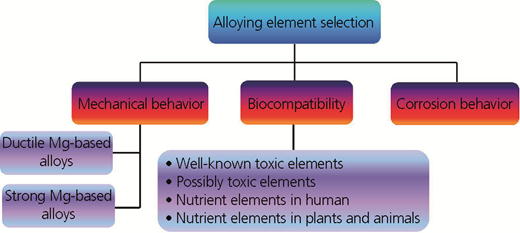
Considerations of element selection for developing biodegradable magnesium-based alloys
Considerations of element selection for developing biodegradable magnesium-based alloys
ASTM codes for magnesium alloying elements31
| Code | Alloying element | Code | Alloying element |
|---|---|---|---|
| A | Aluminum | N | Nickel |
| B | Bismuth (Bi) | P | Lead (Pb) |
| C | Copper (Cu) | Q | Silver (Ag) |
| D | Cadmium (Cd) | R | Chromium (Cr) |
| E | REs | S | Silicon (Si) |
| F | Iron | T | Tin (Sn) |
| H | Thorium (Th) | W | Yttrium |
| K | Zirconium | Y | Antimony (Sb) |
| L | Lithium | Z | Zinc |
| M | Manganese |
3 Implantation-related mechanical properties
Recent investigations into the application of coronary stents for commercial magnesium alloys, as shown in Figure 3(a), have opened up new opportunities for biodegradable magnesium alloys.32–34 Moreover, as shown in Figures 3(b)–3(e), another potential use for biodegradable magnesium alloys is in the manufacture of orthopedic devices, the implants for either scaffolding on which new bone can grow or fixtures holding bones together long enough to allow natural healing to take place.13 The mechanical requirements of magnesium as an implant material depend on the medical indication. During the surgical procedure of implantation, the material might be submitted to peak loads or deformations that can exceed the subsequent values during its function as an implant. For example, a cardiovascular stent is significantly deformed during the expansion of the balloon catheter.33 The struts of the stent are stretched, exceeding the limit of elasticity, and will remain permanently deformed. However, this plastic deformation should not negatively affect subsequent degradation behavior. Another example of plastic deformation during implantation is that of osteosynthesis plates that are used to fix bone fractures. The surgeon usually needs to adapt the shape of the plate to the contour of the bone. Pliers have been used to prebend bone plates, but these might leave impressions on the surface of the implant. Besides the geometrical factors of the plate, the material needs to be ductile enough to allow contouring without cracking. For bridging the fracture, the osteosynthesis plate needs to be fixed to the bone pieces. This is commonly done using screws. During the insertion of the screw, the friction between the bone and the screw threads needs to be overcome. The material needs to withstand multiaxial loads (e.g. torsion, shear and compression) that are transmitted by the screwdriver. These examples show how different the mechanical requirements for a material can be during implantation.35
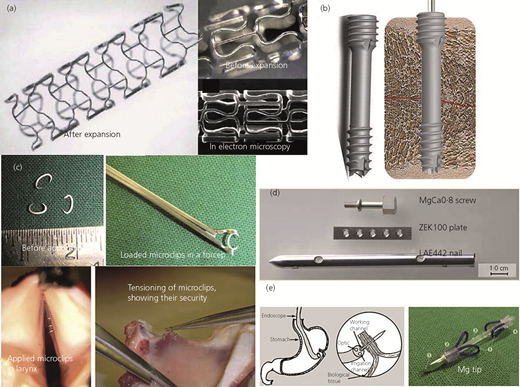
Real applications of biodegradable magnesium implants: (a) cardiovascular stents; (b) screws for orthopedic fixation; (c) biodegradable microclips; (d) biodegradable orthopedic implants; (e) wound-closing devices32
Real applications of biodegradable magnesium implants: (a) cardiovascular stents; (b) screws for orthopedic fixation; (c) biodegradable microclips; (d) biodegradable orthopedic implants; (e) wound-closing devices32
The use of bioabsorbable materials should allow tissues to regain their natural state and ability to transform and, in the case of children, to continue to grow. The integrity of an implant is particularly important when mechanical loads are involved. During degradation, the implant should not lose its integrity prior to the fulfillment of its mechanical function. If a failure occurs, it should be in a controlled and reproducible manner without causing unwanted side effects. The risk for the patient should always remain acceptable.36 Some typical mechanical properties of tissues and biomaterials are summarized in Table 2. Some of the alloy compositions have attracted more attention compared with others and have been tailored for specific applications. Magnesium in its elemental state has been used, as well as other elements, including aluminum, zinc, calcium, manganese, lithium (Li), zirconium and yttrium and some of the RE metals.36 In the following sections is a general explanation of some of the most common alloying elements and their benefits.
Aluminum. Metals alloyed with aluminum have a good combination of mechanical properties and good die-castability. Aluminum improves strength and hardness, and, when present in amounts in excess of 6 wt.%, the alloy becomes heat-treatable.22,42
Zinc. Similar to aluminum, zinc can improve some mechanical properties of magnesium alloys – for example, strengthening of magnesium through a solid-solution-hardening mechanism. Magnesium is frequently alloyed with zinc, which increases its yield strength. Magnesium alloys, as well as other implant materials, should have a Young’s modulus of 20 GPa, which is similar to the Young’s modulus of bone.26,36,37
Calcium. Studies demonstrated that calcium addition improves mechanical properties, influences grain growth, serves as a grain refinement agent and improves the rollability of magnesium sheets.36,37
Manganese. It is the most common alloying addition and is used to neutralize the effect of iron and to help modify the morphology and type of intermetallic phases. Modifications in the morphology improve tensile strength, elongation and ductility. Manganese alloying addition also increases high-temperature strength and creep resistance.36,43
Lithium. The addition of lithium decreases strength but increases ductility. Magnesium–lithium alloys are also amenable to age hardening.44
Other RE metals. These have a powerful grain-refining effect on magnesium-based alloys. Addition of the REs increases strength and die-castability.29,30,36
| Tissue/material | Density: g/cm3 | Compressive strength: MPa | Tensile strength: MPa | Yield strength: MPa | Elastic modulus: GPa | Fracture toughness: MPa m1/2 | Elongation: % |
|---|---|---|---|---|---|---|---|
| Arterial wall | N/A | N/A | 0·50–1·72 | N/A | 0·001 | N/A | N/A |
| Collagen | N/A | N/A | 60 | N/A | 1·0 | N/A | N/A |
| Cancellous bone | 1·0–1·4 | 1·5–9·3 | 1·5–38 | N/A | 0·01–1·57 | N/A | N/A |
| Cortical bone | 1·8–2·0 | 160 trans. 240 long. | 35 trans. 283 long. | N/A | 5–23 | 3–6 | N/A |
| Hydroxyapatite | 3·05–3·15 | 100–900 | 40–200 | N/A | 70–120 | 0·7 | N/A |
| Cobalt–chrome alloys | 7·8 | N/A | 450–960 | 310 | 195–230 | N/A | N/A |
| Stainless steel | 7·9 | 170–130 | 480–620 | N/A | 193–200 | 50–200 | N/A |
| Titanium alloys | 4·4 | N/A | 550–985 | 420–780 | 100–125 | 55–115 | 12–16 |
| Pure magnesium (cast) | 1·74 | 20–115 | 90–190 | 20·9 ± 2·3 | 41 | 15–40 | 13·0 ± 1·4 |
| AZ31 (extruded) | 1·78 | 83–97 | 241–260 | 125–135 | 45 | N/A | 7 |
| AZ91D (die-cast) | 1·81 | 160 | 230 | 150 | 45 | N/A | 3 |
| WE43 (extruded – T5) | 1·84 | N/A | 280 | 195 | 44 | N/A | 10 |
| AM60B (die-cast) | 1·78 | 130 | 220 | N/A | 45 | N/A | 6–8 |
| Mg–6Zn | N/A | 433·76 ± 1·40 | 279·5 ± 2·3 | 169·5 ± 3·6 | 42·36 ± 0·1 | N/A | 18·86 ± 0·80 |
| Mg–1Ca (cast) | N/A | N/A | 71·38 ± 3·01 | N/A | N/A | N/A | 1·876 ± 0·140 |
| Mg–1Ca (rolled) | N/A | N/A | 166·7 ± 3·01 | N/A | N/A | N/A | 3·00 ± 0·78 |
| Mg–1Ca (extruded) | N/A | N/A | 239·63 ± 7·21 | N/A | 135·6 ± 5·4 | N/A | 10·63 ± 0·64 |
| Mg–0·6Ca | N/A | 273·2 ± 6·1 | N/A | 114·4 ± 15·1 | 46·5 ± 0·6 | N/A | N/A |
| Mg–1·2Ca | N/A | 254·1 ± 7·9 | N/A | 96·5 ± 6·6 | 49·6 ± 0·9 | N/A | N/A |
| Mg–1·6Ca | N/A | 252·5 ± 3·3 | N/A | 93·7 ± 7·8 | 54·7 ± 2·4 | N/A | N/A |
| Mg–2·0Ca | N/A | 232·9 ± 3·7 | N/A | 73·1 ± 3·4 | 58·8 ± 1·2 | N/A | N/A |
| Mg–2Sr (rolled) | N/A | N/A | 213·3 ± 17·2 | 147·3 ± 13·1 | N/A | N/A | 3·15 ± 0·30 |
| Mg–0·5Ca–0·5Sr | N/A | 274·3 ± 7·2 | N/A | N/A | N/A | N/A | N/A |
| Mg–1·0Ca–0·5Sr | N/A | 274·2 ± 4·0 | N/A | N/A | N/A | N/A | N/A |
| Mg–0·1Ca–1·0Sr | N/A | 214·5 ± 3·5 | N/A | N/A | N/A | N/A | N/A |
| Mg–1Zn–1Mn (cast) | N/A | N/A | 174 | 44 | N/A | N/A | 12 |
long., longitudinal; N/A, not available; trans., transverse
Magnesium implants could offer additional benefits compared with existing implant materials. They might replace permanent metallic implants for indications in which degradation is a significant advantage. Thus, considering the matching of mechanical properties, magnesium-based materials are the best choice for biodegradable orthopedic implants. Yield strength, tensile strength and elongation are the three most common factors for determining if the material could fulfill its function from a mechanical perspective.36
The grain sizes of the alloys, second-phase distribution, mechanical properties and the absence of structural defects are strongly related to the processing routes.35 Pure magnesium and other alloying elements are typically melted and cast under an inert environment. As-casted alloys often have an inhomogeneous grain structure, which results in lower mechanical strength and fast corrosion at the grain boundary.35,36 Optical micrographs of magnesium–calcium and magnesium–calcium–manganese–zinc alloys are shown in Figures 4(a)–4(d). Zinc has a relatively high solubility in magnesium (6·2 wt.%) and can play dual roles in both solid solutions and can refine the grain size. As shown in Figures 4(a)–4(d), zinc can significantly refine the microstructure of magnesium–calcium–manganese–zinc alloy. However, the mechanical properties of the binary magnesium–calcium alloys decreased significantly with the addition of 4 wt.% calcium. However, after the addition of zinc and manganese into the binary Mg–2Ca alloys, the ultimate tensile strength and elongation were enhanced by about 31·5 and 64·9%, respectively (Figure 4(e)).45 Zhang et al.46 estimated the effects of extrusion and heat treatment on magnesium-based alloy systems. It was shown that extrusion can significantly improve the mechanical properties of an alloy by grain refinement and precipitation strengthening.46 Wang et al.47 showed that grain refinement may be a proper route for controlling the degradation rate of the magnesium alloy AZ31 in Hanks’ solution. The samples were processed by squeeze-casting (SC), hot-rolling (HR) and equal-channel angular pressing (ECAP). The degradation rates of the HR- and ECAP-processed samples with fine grains (∼10 µm) were only about 50% of the coarse-grained (∼400 µm) SC sample. However, fine grains alone would not increase the degradation rate.47
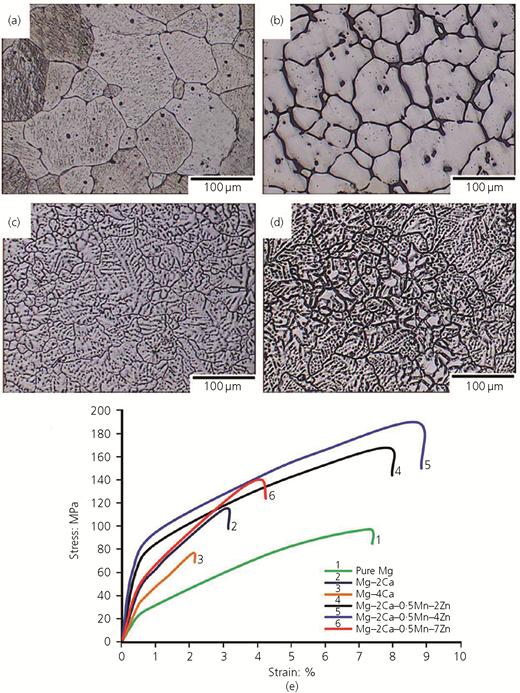
Optical microscopic images of specimens: (a) Mg–2Ca; (b) Mg–4Ca; Mg–0·5Ca–0·5Mn–Zn alloys with different zinc contents: (c) 2 and (d) 4 wt.%. (e) Typical stress–strain curve of as-cast pure magnesium, magnesium–calcium and magnesium–calcium–manganese–zinc alloys45
Optical microscopic images of specimens: (a) Mg–2Ca; (b) Mg–4Ca; Mg–0·5Ca–0·5Mn–Zn alloys with different zinc contents: (c) 2 and (d) 4 wt.%. (e) Typical stress–strain curve of as-cast pure magnesium, magnesium–calcium and magnesium–calcium–manganese–zinc alloys45
4 Corrosion and bio-corrosion of magnesium-based alloys
According to Figure 2, the alloying elements have a direct influence on the corrosion resistance of biodegradable magnesium-based alloys. Corrosion of magnesium and its alloys has been studied by researchers due to their strong thermodynamic tendency to act as active materials, with high oxidation.36 Among metals, magnesium demonstrates a very low standard potential as seen in Table 3.48 The dissimilitude of standard potential against corrosion potential is related to the formation of a magnesium hydroxide (Mg(OH)2) film on the surface of the metal. It has been reported, an insulating layer of Mg(OH)2 forms on the surface in aqueous environments and this protects the metal from further rapid corrosion.28,35 Inorganic/organic components, such as amino acids, proteins and chloride (Cl−) ions, can influence the corrosion rate and degradation of magnesium alloys. Due to the corrosion activity of magnesium alloys, mechanical integrity can be affected before the specific tissue has the appropriate time to heal without any negative effects. Hard-tissue implantation repairs may require at least 12 weeks. Magnesium and its alloys corrode in aqueous solutions, and the different oxidation–reduction reactions are affected by the different alloying elements. Alloying elements that have a close electrochemical potential to, or that form intermetallic phases with a similar potential to, magnesium (−2·37 V) can improve corrosion resistance by reducing the internal galvanic corrosion. Such elements include yttrium, −2·37 V; neodymium, −2·43 V; and cerium (Ce), −2·48 V.49
Standard reduction potentials48
| Electrode | Reaction | Potential: V |
|---|---|---|
| Lithium, lithium ion (Li+) | Li+ + e− → Li | −3·02 |
| Potassium (K), potassium ion (K+) | K+ + e− → K | −2·92 |
| Sodium (Na), sodium ion (Na+) | Na+ + e− → Na | −2·71 |
| Magnesium, magnesium ion (Mg2+) | Mg2+ + 2e− → Mg | −2·37 |
| Aluminum, aluminum ion (Al3+) | Al3+ + 3e− → Al | −1·71 |
| Zinc, zinc ion (Zn2+) | Zn2+ + 2e− → Zn | −0·76 |
| Iron, iron (II) ion (Fe2+) | Fe2+ + 2e− → Fe | −0·44 |
| Cadmium, cadmium ion (Cd2+) | Cd2+ + 2e− → Cd | −0·40 |
| Nickel, nickel (II) ion (Ni2+) | Ni2+ + 2e− → Ni | −0·24 |
| Tin, tin (II) ion (Sn2+) | Sn2+ + 2e− → Sn | −0·14 |
| Copper, copper (II) ion (Cu2+) | Cu2+ + 2e− → Cu | 0·34 |
Typically, the corrosion of magnesium produces hydrogen gas (H2) and magnesium hydroxide. The hydroxide ions produced through the cathodic reaction cause an increase in the pH of the solution. The common anodic and cathodic reactions are expressed as follows.25
Figure 5(a) depicts the potential–pH diagram (Pourbaix) for magnesium; the diagram helps visualize the effects on potentials of pH and how these affect the thermodynamic regions of corrosion, immunity and passivity.50 Furthermore, at low pH values, the corrosion potential resembles the region where hydrogen is stable. This leads to the production of hydrogen, which leads to the dissolution of magnesium. Similarly, it can be seen that there is a strong hydrogen evolution against dissolved oxygen (O2); however, it is not significant.31 A major drawback of magnesium is the production of hydrogen gas when placed in contact with physiological environments. Hydrogen evolution may lead to gas pocket formation, causing necrosis within tissues and delayed healing at the surgery region area. On the other hand, if hydrogen gas is evolved at a slow rate, it can be tolerated and released by the body system. According to Noviana et al.,51 a hydrogen evolution rate of 0·01 (ml/cm2)/d can be tolerated by the human body. However, recent research has shown that hydrogen gas can be exchanged rapidly through the skin and/or accumulate in fatty tissue. Therefore, hydrogen gas adjacent to an implant (Figures 5(b) and 5(c)) may not be of major concern; it is better to eliminate it by improving the material itself.51 One successful strategy to overcoming this problem is to fabricate metal glasses with high zinc content, particularly above the zinc-alloying threshold.52
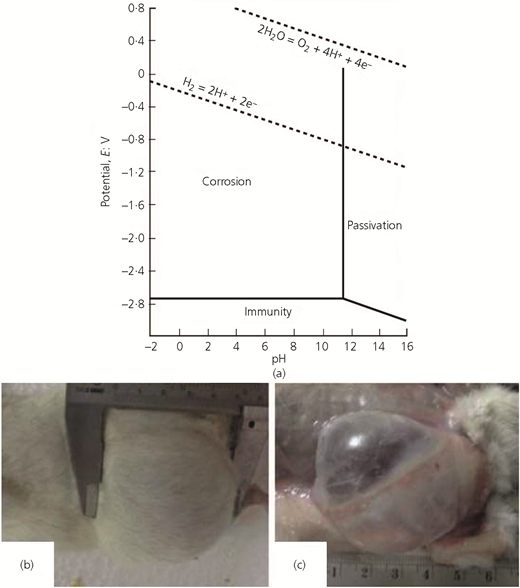
(a) Potential–pH (Pourbaix) diagram for the system of magnesium and water at 25°C;50 (b) gas bubble at the medial area; (c) subcutaneous opening of the medial area at day 7 postimplantation of pure magnesium51
(a) Potential–pH (Pourbaix) diagram for the system of magnesium and water at 25°C;50 (b) gas bubble at the medial area; (c) subcutaneous opening of the medial area at day 7 postimplantation of pure magnesium51
As previously mentioned, magnesium alloys exhibit different corrosion rates depending on the alloying element that they contain. Magnesium–aluminum–zinc (AZ alloys) are the most common category of magnesium alloys. There are different opinions about the role of aluminum on the corrosion resistance of magnesium alloys. Lunder et al.53 observed that, when the aluminum content reaches 8% (mass fraction), the corrosion resistance of magnesium alloys improves at a noticeable level. Warner et al.54 reported that even 5% addition of aluminum in magnesium alloys is beneficial in improving their corrosion resistance, whereas Hermann et al.55 indicated that 9% and above aluminum is helpful in improving the corrosion resistance of magnesium alloys.
Li et al.39 studied the influence of calcium amount and chloride concentration in corroding media on the corrosion behavior of magnesium–calcium alloys. A negative shift of about −0·1 V in the open-circuit potential was observed with increasing chloride concentration in the electrolyte for all the investigated alloys. Polarization curves showed that, with increasing amount of calcium in the alloy, the mixed corrosion potential (Ecorr) became more noble or positive. The magnitude of the corrosion current density (Icorr) also changed with calcium content, and, the higher the calcium content was, the larger the current density became. Sodium chloride (NaCl) concentration showed a similar effect, and an increased amount of chloride led to higher corrosion current densities and corrosion rates. Kannan and Raman56 examined the degradation behavior and mechanical integrity of calcium-containing magnesium alloys using electrochemical techniques and slow-strain-rate tests, respectively, in modified simulated body fluid (m-SBF). AZ91Ca (1·0 wt.% calcium), AZ61Ca (0·4 wt.% calcium) and AZ91 (without calcium) were used. Potentiodynamic polarization tests were performed at 36·5 ± 0·5°C in m-SBF buffered at 7·4. The general and pitting corrosion resistance of calcium-containing magnesium alloys in m-SBF was significantly improved compared with that of the base alloy. The corrosion current was significantly lower in AZ91Ca alloy than that in AZ91 alloy. Furthermore, AZ91Ca alloy exhibited a fivefold increase in surface film resistance relative to AZ91 alloy.56 Manganese can improve corrosion resistance by removing iron and other heavy-metal elements into relatively harmless intermetallic compounds. The best anticorrosion property is obtained with 1 wt.% zinc, while a further increase in zinc content deteriorates the corrosion property. An in vivo study showed that, after 18 weeks, about 54% as-cast magnesium–manganese–zinc (Mg–1·2Mn–1·0Zn, in wt.%) implant had degraded, but the degradation of magnesium did not cause any increase in serum magnesium content or any disorders of the kidney after 15 weeks postimplantation.36 The addition of silver (Ag) to magnesium alloys often results in an increase in the corrosion rate of magnesium alloys. As shown in potentiodynamic polarization curves in Figure 6, the self-corrosion potential of Mg–Zn–Y–Nd–xAg shows a decreasing trend with the increase in silver content. Silver has a much higher self-corrosion potential than magnesium.27 The addition of silver results in more microgalvanic cells between the α-magnesium matrix and the magnesium/silver second phase in the alloys, which would accelerate the corrosion rate of the alloys. In addition, it is evident that the corrosion resistance is clearly decreased due to the smaller dimensions of the capacitive loops in the Nyquist plot.57 Gu et al.58 also found higher corrosion rates for both as-cast and as-rolled Mg–1Ag compared with pure magnesium, calculated from electrochemical measurements and immersion tests. Nevertheless, the generated hydrogen was lesser and the pH value of the Mg–1Ag sample was lower than those of pure magnesium.58
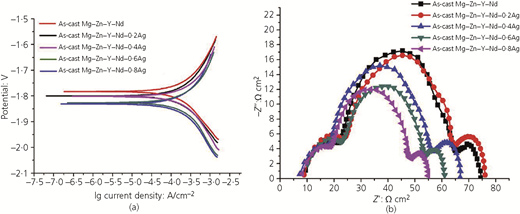
(a) Potentiodynamic polarization curves and (b) electrochemical impedance spectroscopy of as-cast magnesium–zinc–yttrium–neodymium and its alloys with different silver contents55
(a) Potentiodynamic polarization curves and (b) electrochemical impedance spectroscopy of as-cast magnesium–zinc–yttrium–neodymium and its alloys with different silver contents55
The corrosion resistance of magnesium–RE alloys (RE = yttrium, gadolinium, terbium (Tb), dysprosium (Dy), holmium (Ho), erbium, thulium (Tm)) was investigated by Hort et al.59 They conducted immersion tests in aerated 1% sodium chloride solution. They reported that, with increasing gadolinium up to 10 wt.% for the as-cast condition, the corrosion rate decreased. The Mg–15Gd values, which had a higher gadolinium amount, led to a drastic increase in the corrosion rate. Hort et al.59 explained that, compared with other binary alloys, the fraction of the grain boundaries was larger for the 15 wt.% gadolinium alloy. They also noted that the nickel content in Mg–15Gd was the highest observed.59 Immersion in SBF and Hanks’ balanced salt solution (HBSS), electrochemical corrosion tests and in vitro cell cultures are often used to determine corrosion properties and biocompatibility. Table 4 summarizes the electrochemical corrosion tests of different bio-magnesium-based alloys. Sample size and corrosion solution in different experiments varied, which could have direct effects on the degradation rate.
| Alloy | Shape | Area: cm2 | Solution | Icorr: mA/cm2 | Ecorr: V | Degradation rate: mm/year |
|---|---|---|---|---|---|---|
| Pure magnesium | Square | 1 | HBSS | 0·0598 | −1·554 | N/A |
| AZ31 | Round | 0·785 | SBF | 0·182 | −1·54 | N/A |
| WE43 | Round | 1 | SBF | 0·509 | −1·85 | N/A |
| Magnesium–lithium–aluminum | Round | 0·785 | HBSS | 0·418–1·412 | −1·482 to −1·587 | 0·1–3·4 |
| Magnesium–zinc–calcium | Square | 1 | SBF | 0·11 | −1·645 | N/A |
| Mg–0·5 strontium (Sr) | N/A | 0·72 | HBSS | 0·005 | −1·58 | 0·2–0·4 |
| Magnesium–zinc–yttrium–neodymium | Round | 1 | SBF | 1·08 | −1·7 | N/A |
| Magnesium–neodymium–zinc–zirconium | Round | 1 | HBSS | 0·00141 | −1·69 | N/A |
| Magnesium–zinc–yttrium | N/A | 1 | SBF | 0·44 | −1·792 | N/A |
| Magnesium–lithium | Round | 0·785 | HBSS | 0·428–0·461 | −1·52 to −1·565 | 0·1–0·16 |
N/A, not available
Finally, the alloying elements have a direct influence on the corrosion resistance of magnesium-based alloys. Aluminum, zinc, manganese, zirconium and most the REs, including neodymium and gadolinium, have been proven to improve corrosion resistance. It should be noted that most elements have a critical limit with regard to their improvement of corrosion resistance that falls within their solubility in magnesium: beyond the critical limit, further addition leads to the deterioration of the corrosion resistance.36Figure 7 shows the corrosion rate and mass loss of several kinds of magnesium alloys in physiological solution.49
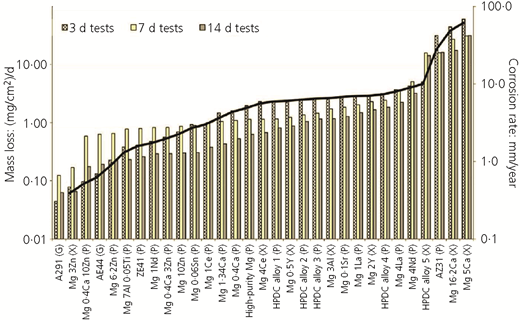
Experimentally determined corrosion rates for different magnesium alloys. The notation ‘G’ refers to alloys that suffered a general corrosion mode; ‘P’ refers to the pitting corrosion mode; and ‘X’ refers to extremely localized corrosion. HPDC, high-pressure die-cast49
Experimentally determined corrosion rates for different magnesium alloys. The notation ‘G’ refers to alloys that suffered a general corrosion mode; ‘P’ refers to the pitting corrosion mode; and ‘X’ refers to extremely localized corrosion. HPDC, high-pressure die-cast49
Sometimes it is difficult to improve corrosion resistance without sacrificing the mechanical performance of an alloy.62,63 In this case, surface modification or treatment is a favorable option, because surface modification or treatment occurs only on the surface layer of a magnesium alloy and the bulk alloy is left unchanged. Several techniques have been developed and used for this purpose. For example, plasma electrolytic oxidation coatings are one of the simplest approaches that can effectively passivate the surface without reducing the bulk performance of a material.64–69 An overview of the different techniques used for developing coatings on magnesium and magnesium alloy substrates is shown in Figure 8.
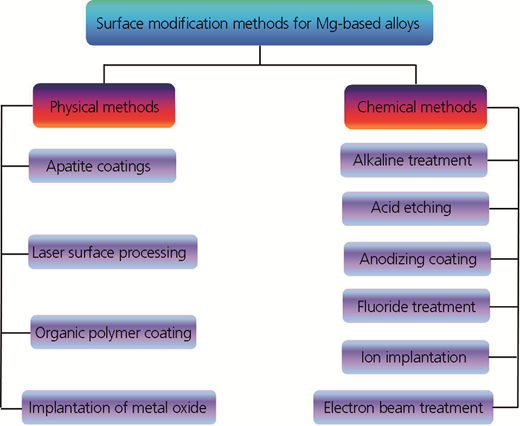
Main strategies of surface modification techniques for magnesium and its alloys as orthopedic implants
Main strategies of surface modification techniques for magnesium and its alloys as orthopedic implants
5 Biocompatibility of magnesium alloys and cytotoxicity of alloying elements
In order to employ implants successfully inside the body, good interaction between metals and living organisms is necessary; in other words, a high degree of biocompatibility is required. The term ‘biocompatibility’ indicates the ability of a material to perform with an appropriate host response. No adverse effects are acceptable, or the material should not affect local and systemic host environments, such as soft tissues, bone, the ionic composition of plasma and even intra- and extra-cellular fluids.70 In other words, materials intended for medical use should be non-carcinogenic, non-pyrogenic, non-toxic, non-allergic, non-inflammatory and hemocompatible.70 Magnesium is an essential divalent intracellular cation that plays a pivotal role in daily physiological functions within the body. In fact, magnesium is necessary for the synthesis of nucleic acids and proteins and is critical in the production and function of various enzymes and transporters. Also, magnesium is vital to metabolic processes, being a cofactor in many enzymes stabilizing the structures of deoxyribonucleic acid (DNA) and ribonucleic acid (RNA) and a key component of ribosomal machinery that translates the genetic information encoded by messenger RNA into polypeptide structures.71 There are approximately 22–26 g of magnesium within the adult human body, and it is the fourth most abundant cation.72 On the other hand, excess magnesium can lead to muscular paralysis, hypotension, respiratory distress and cardiac arrest, all found to be unlikely because of efficient filtration by the kidneys. In vitro and in vivo studies have shown that magnesium alloys possess good biocompatibility.73
Alloying elements not only enhance the corrosion and mechanical behavior of magnesium alloys, but also impart significant effects on its biocompatibility.36 In vitro tests are often performed for evaluation of potential effects of the material on the host organism before implantation. These experiments are simulated in a physiological environment in the laboratory and in test tubes. In order to start evaluating and testing a material, cytotoxicity tests should be performed.72,74 There are various in vitro approaches that are employed to examine biomaterials and cell behavior. The material is tested by performing direct-contact and indirect-contact experiments. The most common methods for biomaterial screening are cytotoxicity assays and cell proliferation. To illustrate, Figure 9 shows the viability of murine fibroblast cells L-929 expressed as a percentage of the viability of cells cultured in negative control after cultured in as-cast pure magnesium and Mg–1X alloys extraction medium solutions for 2 and 4 d. It can be seen that, for L-929 fibroblasts, the extracts of pure magnesium and Mg–1Ag, Mg–1In, Mg–1Mn, Mg–1Si, Mg–1Y and Mg–1Zr alloys lead to significantly reduced cell viability (p < 0·05) in comparison with negative controls for the 4 d culture.75
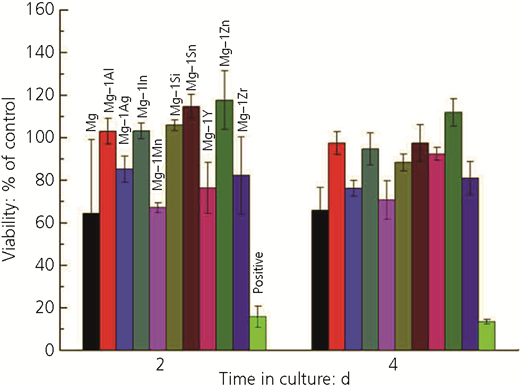
Cell viability expressed as a percentage of the viability of cells in the control after 2, 4 and 7 d of culture in as-cast pure magnesium and Mg–1X alloy (X = aluminum, silver, indium (In), manganese, silicon, tin, yttrium, zinc and zirconium) extraction media75
Cell viability expressed as a percentage of the viability of cells in the control after 2, 4 and 7 d of culture in as-cast pure magnesium and Mg–1X alloy (X = aluminum, silver, indium (In), manganese, silicon, tin, yttrium, zinc and zirconium) extraction media75
Furthermore, tests in vivo play an important role in providing understanding of the sample behavior under in-service conditions. All research works until now have reported enhanced new bone formation around the implants of magnesium alloys and enhanced local periosteal and endosteal bone formation in the vicinity. Degradation product layer on experimental magnesium alloy implants revealed a high deposition of calcium phosphate (PO43−)-based mineral. The design of the implants also influences the corrosion of the implants. The most common orthopedic implant designs used in animal models are either screw type (threaded) or cylindrical (rod-shaped).76 Screw-type implants provide good initial stability, and analysis of rod-shaper or cylindrical implants may be less complicated, and the exact fit into the bone gives accurate results regarding their effect on bone integration.77 Lee et al.78 investigated the bone formation mechanism of a biodegradable magnesium–5 wt.% calcium–1 wt.% zinc alloy implant. Biodegradable magnesium–5 wt.% calcium–1 wt.% zinc alloy screws were implanted in vivo and were gradually degraded within 26 weeks, and new formation of bone was observed. Figure 10 shows radiographic images of a selected 1-year follow-up of the 29-year-old female patient. The 1-year follow-up, including clinical, laboratory and radiographic assessments, revealed that the degradable magnesium-based screws showed good to excellent clinical and radiographic results with a high satisfaction rate. No foreign body reaction, osteolysis, systemic inflammatory reaction, palpable gas cavity and significant elevations in blood magnesium levels are observed.78 According to Figure 2, the degradation products of the designed alloys should be non-toxic and absorbable by the surrounding tissues or dissolvable for excretion through the kidneys Elements can be classified into the following groups: (a) well-known toxic elements: beryllium (Be), barium (Ba), lead (Pb), cadmium and thorium (Th); (b) elements that are likely to cause severe hepatotoxicity or other allergic problems in humans: aluminum, vanadium (V), chromium (Cr), cobalt, nickel, copper (Cu), lanthanum (La), cerium amd praseodymium (Pr); (c) nutrient elements found in the human body: calcium, manganese, zinc, tin (Sn) and silicon (Si); and (d) nutrient elements found in plants and animals: aluminum, bismuth (Bi), lithium, silver, strontium (Sr) and zirconium.36,75,79–81 For example, animal studies have found excessive exposure to aluminum toxicity to result in a variety of problems, including those affecting reproduction, inducing dementia and potentially leading to Alzheimer’s disease (although data are not conclusive for humans).82Table 5 summarizes the pathophysiology and toxicology of the three categories magnesium and the commonly used alloying elements: potential essential metals, an essential nutrient and the other common alloying elements.83
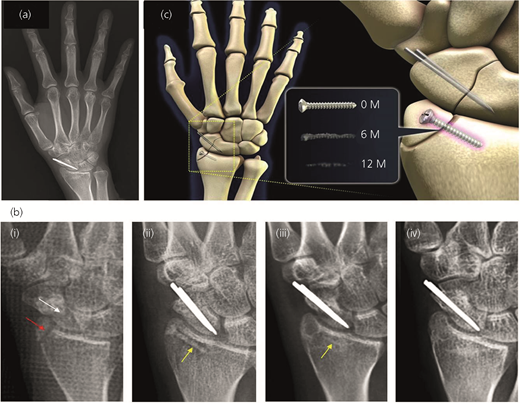
Clinical observation of the radiographic images of selected 1-year follow-up of a 29-year-old female patient. (a) A 1-year follow-up X-ray of the patient that received a magnesium alloy implant (D 2.3 mm × L 14 mm) for distal radius fracture and a stainless-steel conventional implant (CI) for scaphoid non-union. (b) X-ray images of (i) the distal radius fracture and the scaphoid non-union before the surgical intervention; (ii) the implantation site immediately taken after the surgical procedures to fix the distal radius fracture with the magnesium alloy implant and the scaphoid non-union with CI; (iii) the 6-month follow-up; and (iv) complete degradation and bone healing after 1 year postoperation. The red arrow shows the distal radius fracture, and the white arrow points to the scaphoid non-union. The yellow arrows show the magnesium alloy implant. (c) Schematic diagram showing the implantation site and the change in the magnesium alloy over time: immediately (0 M), after 6 months (6 M) and after 12 months (12 M) after implantation78
Clinical observation of the radiographic images of selected 1-year follow-up of a 29-year-old female patient. (a) A 1-year follow-up X-ray of the patient that received a magnesium alloy implant (D 2.3 mm × L 14 mm) for distal radius fracture and a stainless-steel conventional implant (CI) for scaphoid non-union. (b) X-ray images of (i) the distal radius fracture and the scaphoid non-union before the surgical intervention; (ii) the implantation site immediately taken after the surgical procedures to fix the distal radius fracture with the magnesium alloy implant and the scaphoid non-union with CI; (iii) the 6-month follow-up; and (iv) complete degradation and bone healing after 1 year postoperation. The red arrow shows the distal radius fracture, and the white arrow points to the scaphoid non-union. The yellow arrows show the magnesium alloy implant. (c) Schematic diagram showing the implantation site and the change in the magnesium alloy over time: immediately (0 M), after 6 months (6 M) and after 12 months (12 M) after implantation78
Summary of the pathophysiology and toxicology of magnesium and commonly used alloying elements83
| Element | Amount in the human body | Blood serum level | Pathophysiology | Toxicology | Daily allowance |
|---|---|---|---|---|---|
| Magnesium | 25 g | 0·9 mmol/l | Activator of many enzymes; coregulator of protein synthesis and muscle contraction; stabilizer of DNA and RNA | Almost no evidence indicates toxicity of magnesium | 0·7 g |
| Aluminum | <300 mg | 2·1–4·8 μg | — | Neurotoxic and accumulates in bone | — |
| Zinc | 2 g | 46 μmol/l | Essential trace element; appears in all enzyme classes | Neurotoxic and hinders bone development at higher concentration | 15 mg |
| Calcium | 1100 g | 1·3 mmol/l | Most abundant mineral and mainly stored in bone and teeth; participates in blood clotting; activator or stabilizer of enzymes | Calcium metabolism disorder; kidney stones | 0·8 g |
| Manganese | 12 mg | 1 μmol/l | Essential trace element; activator of enzymes; manganese deficiency is related to osteoporosis, diabetes mellitus and atherosclerosis | Excessive manganese results in neurotoxicity | 4 mg |
| Zirconium | <250 mg | Total < 250 mg | — | High concentration in liver and gall bladder | 3·5 mg |
| Lithium | — | 2–4 ng/g | Used in the treatment of manic-depressive psychoses | Reduced kidney function and central nervous system disorders | 0·2–0·6 mg |
| Yttrium and REs | — | <47 μg | Compound of drugs for treatment of cancer | Accumulation in bone and liver | — |
| Silicon | — | — | Cross-linking agent of connective tissue base membrane structures; necessary for growth and bone calcification | Excessive silicon dioxide (SiO2) causes lung diseases | — |
6 Conclusion
The main purpose of this study is to review and compare the mechanical properties, corrosion properties and biocompatibilities of currently researched magnesium alloys for biomedical applications. Magnesium alloys, as a new kind of degradable biomaterials, have attracted great attention recently. The major advantages of magnesium alloys as temporary biomaterials are their good mechanical properties and biocompatibility. (a) Magnesium and magnesium alloys are exceptionally lightweight metals with densities ranging from 1·74 to 1·85 g/cm3, which is much lower than that of biomedical titanium alloys (4·4–4·5 g/cm3) and close to that of the bone (1·8– 2·1 g/cm3). (b) The fracture toughness of magnesium is greater than that of ceramic biomaterials, while the elastic modulus (41–45 GPa) is close to that of the bone, avoiding the stress-shielding effect. (c) Magnesium is essential to human metabolism and is the fourth most abundant cation in the human body, with an estimated 25 g magnesium stored in the human body and approximately half of the total content stored in bone tissue. Magnesium is a cofactor for many enzymes and stabilizes the structures of DNA and RNA. (d) Magnesium has a standard electrode potential of −2·37 V, and bare magnesium metal exhibits even poorer corrosion resistance in the chloride-ion-containing physiological environment. Therefore, magnesium alloys could be developed as new biodegradable metals, taking advantage of their fast corrosion rate in the physiological environment. Alloying elements can be added to increase the strength and corrosion resistance of pure magnesium, but alloying elements should be selected carefully to maintain magnesium’s biocompatibility. Most commercial magnesium alloys contain aluminum and RE; however, aluminum is a neurotoxicant and severe hepatotoxicity has been detected after the administration of RE. Therefore, another research highlight is the exploration of new magnesium alloy systems containing non-toxic or low-toxicity elements. However, there is a lack of uniform criteria for evaluating the biomedical properties of magnesium alloys.



Acknowledgements
This study was supported by the Materials and Energy Research Center. The authors would like to thank many colleagues, students and collaborators who have made a vast contribution to this area of research.

