

The UN Climate Change Conference (COP26) is taking place in Glasgow, Scotland in November with the goals to: (1) secure global net zero by 2050 and keep 1.5 degrees within reach, (2) adapt to protect communities and natural habits, (3) mobilise finance and (4) work together to deliver (UK COP26, 2021). The construction industry will play a fundamental role in delivering the first two goals to reduce embodied/capital carbon in construction and increase resilience of infrastructure, respectively. It also has an important part to play for goal 4.
The carbon emissions of the infrastructure sector, as a proportion of the UK total, is in the order of 6% according to the Infrastructure Carbon Review (ICR) (HM Treasury, 2013). The displacement of fossil fuel power generation by renewables and the transition from natural gas to hydrogen from cutting carbon will bring down capital as well as operational carbon emissions. At the time of publication of the ICR in 2013, the UK had committed to reducing carbon by 80% relative to 1990 emissions which has now been increased to net zero by 2050. However, production of steel, cement and other construction materials/products is heavily reliant on the high-intensity thermal energy provided by fossil fuels. This is reflected in the percentage ratio of embodied/capital carbon to operational carbon which was projected to shift from 4:96 in 2010 to 7:93 by 2025 and 18:82 by 2050. Therefore, the relative significance of embodied/capital carbon will increase as the grid is decarbonised and operational emissions reduce. Building smart, increased efficiencies in construction methodologies and use of more sustainable materials will be beneficial, but the overall embodied/capital carbon will unfortunately not reduce due to the substantial planned increase in infrastructure investment. The largest carbon reduction potentials are in ‘build nothing’ or ‘build less’, as shown in Figure 1.
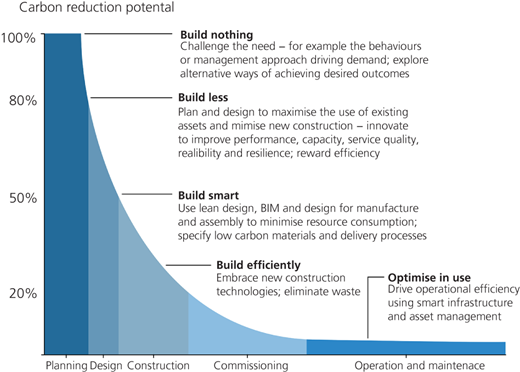
The sector will need to consider the effects of climate change, and how the resilience of existing infrastructure can be increased to balance the cost of action versus the cost of long-term inaction. New infrastructure will need to be designed and constructed to be resistant against climate change on one side. It also needs to be the most sustainable and lowest embodied carbon option on the other side.
As an example, the increase in resilience of infrastructure is often combined with the improvements of flood defences and overall resistance of structures against flood events. This requires significant amounts of embodied carbon in addition to the carbon required several decades ago, and that proportion will increase each year. The longer the industry waits to make the required cuts and implement new technology, the faster the wheel will spin, which can generally be translated with significant higher costs in all areas.
Climate change and embodied carbon is not specifically the topic of the three very interesting papers contained in this issue, but given the undeniable relevance of COP26, and the need to embed environmental and climate change questions into our work, I have decided to highlight some indirect links to this.
The first paper by Plasencia-Lozano, ‘The Membrío Bridge, Spain: Roman origins with many rebuilds,’ analyses the construction history of the bridge over the Salor River in western Spain, which is described as a structure of notable importance. The author suggests that the bridge probably dates back to Roman times based on the potential original design and characteristic features observed at the bridge. Historic information was identified to exist from the late 17th and early 18th century when the bridge was believed to require remodelling due to several flood events and later as a result of war. Further modifications were undertaken in the 19th and 20th centuries until the structure was converted into a pedestrian bridge only following the opening of a new road bridge nearby. The changes to the structure in form and materials are well described.
The second paper by Bartzsch et al., ‘The railway bridge in Meissen, Germany: a structure with a long history,’ presents the history of the railway bridge over the River Elbe and how it was assessed and rehabilitated to comply with current structural requirements. The origins of the bridge date to 1868, but remodelling was undertaken by the well-known architect Heinrich Tessenow in the 1920s. After the war, the bridge was left for single-track use for decades until extensive rehabilitation including the reinstatement of the original double-track use was carried out in the 2010s. The challenges of complying with modern codes are discussed, and solutions were provided to enable the reuse of the existing structure without significant modifications to structural elements or the load-bearing system.
These two papers reinforce that the structures can be rehabilitated/modified throughout the times to accommodate changing requirements without the need to build new structures. The Membrío Bridge in Spain was modified to increase its resilience against flooding in the 17th century and then widened to accommodate the increased traffic demands in the 20th century. Despite the piers of the Meissen railway bridge being the original piers, and the superstructure being around 100 years old, the bridge could be rehabilitated to 21st century requirements without significant structural changes or element replacements.
Remodelling, rehabilitations and repairs build on existing forms and elements, and can significantly extend the service life of structures and its resilience at lower levels of embodied carbon compared with new structures. New developments in low carbon construction methods, repair techniques and materials could potentially further extend the life of the Meissen bridge beyond its current intended life, but would it be possible to reach the age of the Membrío bridge?
The third paper by Cochrane and Blackett-Ord, ‘Pre-deflecting a steel platform to support a new organ at Manchester Cathedral, UK’, discusses the design of the support structure for the new organ at Manchester Cathedral. The challenges by the designers were to conceal the platform within the gallery floor above the pulpitum, minimise the visual effect on the existing structure, and minimise the disruption to the day-to-day operation of the cathedral during its construction. The structure was also required to be reversible. An excellent solution was identified that utilises existing cast iron elements to minimise the impact to the stone columns. The approach and methodology are well explained, including the importance of the collaboration between the architect, structural engineer and contractor.
The papers were a very interesting read, discussed a structure’s history, described an approach on how to extend the service life of a bridge without needing to make significant changes, and highlighted the importance of collaboration to achieve a successful project. For this journal, it is important to receive such a variety of papers from the civil engineering profession and its associated disciplines.
Information about how to submit your paper online is available at www.icevirtuallibrary.com/page/authors, where you will also find detailed author guidelines. For more information on how to submit a paper to this journal, or to put yourself forward to serve on its Editorial Panel, please contact journals editor Rebecca Rivers by emailing rebecca.rivers@icepublishing.com

