Agriculture is closely linked to many concerns, including biodiversity loss, global warming and water availability. The recent International Assessment of Agricultural Science and Technology for Development (IAASTD) report, published on 15 April 2008, considers ways to reduce hunger and poverty, improve rural livelihoods and foster equitable and sustainable development. Sponsored by the United Nations, the World Bank and the Global Environment Facility, it represents a 3-year effort by approximately 400 experts worldwide working under the auspices of 30 governments and 30 representatives of civil society. This briefing provides a summary of the report's findings.
1. TODAY'S CHALLENGES
For decades, agricultural science has successfully focused on boosting production through the development of new technologies. This has come, though, at a high environmental cost and has not solved the social and economic problems of the poor in developing countries who generally have benefited the least from this boost in production.
According to the International Assessment of Agricultural Science and Technology for Development (IAASTD)1 it is time to fundamentally rethink the role of agricultural knowledge, science and technology in achieving equitable development and sustainability. The focus must now turn to the needs of small farms in diverse ecosystems and to creating realistic opportunities for areas with the greatest need. The engineering community has a role to play, for instance when it comes to better implementing existing knowledge and technology and developing new technologies and infrastructure to respond to these needs.
2. PROS AND CONS OF BIOENERGY
Bioenergy is heat, electricity, or transport fuel produced from plant or animal materials.
Millions of people still depend on traditional bioenergy like wood or charcoal for cooking and heating, which can be unsustainable and pose health risks. Traditional biomass is usually associated with time consuming and unsustainable harvesting, hazardous pollution and low end-use efficiency, and, in the case of manure and agricultural residues, depletion of soil by removal of organic matter and nutrients. Collecting fuel is time-consuming, reducing the time that can be devoted to productive uses, including farming and education. Moreover, air pollution from biomass combustion can lead to asthma and other respiratory problems.
New forms of bioenergy, such as liquid biofuels made from crops or agricultural and forestry residues, are getting more and more attention. Energy is needed to grow, transport and process bioenergy crops, however, and this is causing debate about their net benefit in terms of greenhouse gas reduction. The debate is caused by differences in life-cycle emissions measurement methodologies and the strong effect of specific local circumstances, such as type of feedstock, original use of agricultural land, mechanisation of production, and fertiliser use. Generally, assuming feedstocks are produced on agricultural land and do not induce deforestation, crops produced with few external inputs (fertilisers, pesticides, etc.), such as rain-fed sugarcane in Brazil, perform significantly better than high-input crops such as maize in north America. Consequently, whether biofuels are a viable option for climate change mitigation depends on the emissions reductions that can realistically be achieved as well as relative costs compared to other mitigation alternatives. Moreover, using crop land to produce fuel could raise food prices, drive small-scale farmers off their land and prolong hunger in the world.
3. BIOTECHNOLOGY
Some conventional biotechnologies that use living organisms to make or modify a product are well-accepted, such as fermentation for bread production, or plant and animal breeding to create new varieties.
Modern biotechnologies change the genetic code of living organisms by transferring genes between organisms that are not naturally able to crossbreed. These technologies have been widely adopted, for instance to produce enzymes. The creation of genetically modified - or ‘transgenic’ - crops, however, remain contentious. It is still unclear if and under what conditions they actually improve yields. The rapid development of new techniques means that assessments of environmental and health risks and benefits tend to lag behind discoveries. Furthermore, although the possibility of patenting transgenic varieties can attract investment, this tends to concentrate ownership of resources, drive up costs, inhibit independent research and undermine local farming practices.
4. CLIMATE CHANGE AND AGRICULTURE
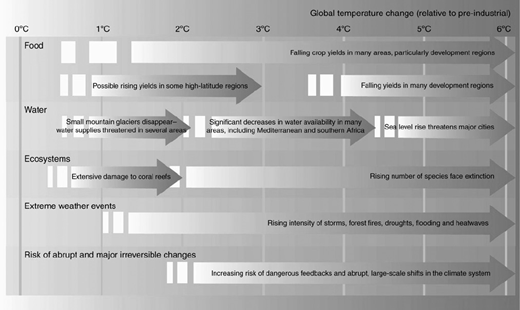
Agriculture has contributed to climate change, for instance through the conversion of forests to farmland and the release of greenhouse gases. Conversely, climate change now threatens to irreversibly damage natural resources on which agriculture depends (Fig. 1).
In some areas, moderate warming may improve yields, but negative impacts will be overwhelmingly dominant overall. More frequent and severe floods and droughts will seriously affect farm productivity and the livelihoods of rural communities, and increase the risk of serious conflicts over land and water.
New approaches to land-use management, such as planting trees and improving soil and fertility management can help mitigate global warming. Since some changes in the climate are now inevitable, however, adaptation measures are also imperative.
The engineering community will have a role to play both in implementing existing knowledge and technology in response to the changes experienced and in developing new technologies and infrastructure to enable effective adaptation actions.
5. FOOD PRODUCTION AND HEALTH
Despite increasing food production, many people remain undernourished. Meanwhile, others are affected by obesity and chronic diseases, which are increasing across the world.
Global trade and growing consumer awareness have increased the need for proactive food safety systems. Concerns include the presence of pesticide residues, antibiotics, and additives in the food system, as well as risks related to large-scale livestock farming.
Worldwide, agriculture accounts for at least 170 000 work-related deaths each year. Besides accidents with equipment like harvesters and tractors, agricultural workers can be affected by noise, transmissible animal diseases and exposure to toxic substances.
Because agriculture can contribute to the emergence and spread of infectious diseases, surveillance and response programmes are critical across the food chain.
6. MAKING BETTER USE OF NATURAL RESOURCES
Historically, agricultural development was geared towards increasing productivity and exploiting natural resources, but ignored complex interactions between agricultural activities, local ecosystems and society.
These interactions must be considered to enable sustainable use of resources like water, soil, biodiversity and fossil fuels. Much of the agricultural knowledge, science and technology needed to resolve today's challenges are available and well understood, but putting them into practice requires creative efforts from all stakeholders. Among the many challenges there is, for example, the need to tackle loss of soil fertility (through synthetic inputs and natural processes), erosion, soil salinisation and decreased water quality and availability.
7. SMALL FARMS AND GLOBAL TRADE
Small farmers and rural communities in developing countries have often not benefited from opportunities that agricultural trade can offer. Opening farm markets prematurely to international competition can further weaken the agricultural sector of a developing country, causing more poverty, hunger and harm to the environment in the long-term.
The environmental footprint of agriculture could be reduced by adapting market and trade policies, for instance by removing detrimental subsidies, changing taxation policies and improving property laws.
8. TRADITIONAL KNOWLEDGE
Many effective innovations are generated locally, based on the knowledge and expertise of indigenous and local communities rather than on formal scientific research. Traditional farmers embody ways of life relevant for the conservation of biodiversity and for sustainable rural development.
Local and traditional knowledge has been built successfully into several areas of agriculture, but more efforts should be made to archive and evaluate the knowledge of local people and to protect it under fairer international intellectual property legislation.
9. WOMEN'S ROLE
The proportion of women involved in agricultural activities ranges from 20% to 70%, a number that is climbing in many developing countries, especially where agriculture is geared towards export.
Although some progress has been made, women continue to struggle with low incomes, limited access to education, credit and land, job insecurity, and deteriorating work conditions.
10. OPTIONS FOR ACTION
The assessment raises key issues for the sustainable development of agriculture, and suggests paths for action.
In the fight against poverty, small-scale farmers would benefit from greater access to knowledge, technology and credit, and, critically, from more political power and better infrastructure.
Ensuring food security is not merely a matter of producing enough to eat: food must also be available to those who need it. Stronger local markets and preparation for sudden price changes and extreme weather events are needed.
Agricultural sustainability means maintaining productivity while protecting the natural resource base, for instance by improving low impact practices such as organic agriculture.
Human health can be improved through efforts to diversify diets and enhance their nutritional value, but also through enhanced food safety infrastructures and through coordinated prevention of the spread of infectious disease.
Achieving greater equity in agriculture requires investment to bring technology and education to rural areas. Fair access to land and water and fair prices for agricultural products are crucial, as is the involvement of stakeholders in decision making and resource management.