

It is with great pleasure that I, on behalf of the Chair and the Editorial Panel, introduce the third issue of Proceedings of the Institution of Civil Engineers – Engineering Sustainability for 2020, which includes four papers (Mandić Ivanković et al., 2020; Wang and Arya, 2020; Watrin et al., 2020; Udrea et al., 2020).
The first paper, by Mandić Ivanković et al. (2020), gives a comprehensive review of the considerable variety of performance indicators for bridge management across Europe. Mandić Ivanković et al. (2020) conclude in part that a European performance database is needed to achieve the fundamental goals of bridge management and that three main stakeholders should be involved, namely: (i) ‘technological providers’, (ii) ‘engineers and experts’ and (iii) ‘bridge owners and operators’. This work aligns with the aspirations of the UN Sustainable Development Goals and notes the advantages of structural health monitoring technology for bridge management (Mandić Ivanković et al., 2020).
The second paper, by Watrin et al. (2020), presents the environmental study of green roof technology (experimental schematic shown as Figure 1) showing the potential for such technology to reduce rainfall run-off and improve thermal insulation. The experimental results indicated that the green roof peak discharge was about 50–90% less than the control, with measured peak temperature reduction of about 10·5°C, which was about 6·6°C less than the control (Watrin et al., 2020).
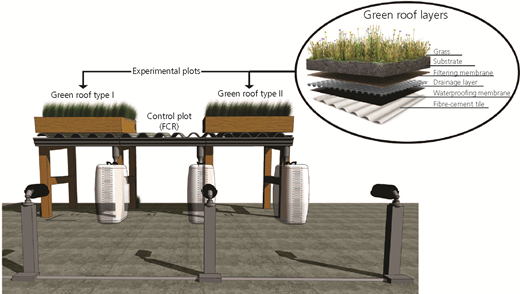
Schematic drawing of the green roof experiment (reproduced from Watrin et al. (2020))
Wang and Arya (2020) report a study of the energy demand of office spaces in London using a series of simulations performed by the tool Tas; concluding in part that the cooling demand annually is higher than the demand for heating (i.e., the summer energy demand is higher). For example, these heating and cooling energy demands could be lowered by decreasing the internal gains and/or by the specification of low-solar-energy-transmittance facades; however, these measures may increase construction costs (Wang and Arya, 2020).
The final paper, by Udrea et al. (2020), presents a study of adaptive thermal comfort (ATC) for buildings in Romania with a specific ATC equation proposed for Romania. I hope that all the readers of the journal enjoy this issue of Engineering Sustainability.

