Family business in the Czech Republic has a very short history, which creates inequalities in the conditions of family business compared to other countries. The aim is to find out whether, despite the disadvantages resulting from historical development, the approach of Czech family business owners to digitization differs from that of business owners existing in an environment with a long history of family business.
The respondents of the online questionnaire survey conducted in spring 2024 are family business owners from the Czech Republic. About 500 valid responses were obtained, mainly from small manufacturing businesses. The hypotheses were statistically verified. To analyse the relationships between variables, coefficients were used (Pearson’s, Spearman’s, Gamma, Kendall’s or Kruskal–Wallis test). Factor analysis was used to identify hidden variables that may explain the relationships between the observed variables.
Key findings related to the approaches of generations owned and managed to the implementation of digitization, the influence of non-family managers and owners, the main barriers to implementation or the expected benefits. The finding that, despite the large historical distance, the attitudes of historically young family businesses do not differ much from those of owners in countries with a long history of family businesses can be considered novelties. It demonstrates that family businesses are mainly influenced by their specific characteristics brought about by the intermingling of family and business, regardless of the history of the development of the business environment.
This research highlights a key insight into family business dynamics: the cultural and historical context appears to have a less significant impact on owners’ attitudes than the inherent characteristics shared across family businesses. In essence, the unique blend of family and business interests creates commonalities that transcend geographical or historical differences. Comparing family business owners from the former “Eastern Bloc” and those from countries that have not been hampered by this social scrutiny provides a new perspective in the discipline of family business. Groups of barriers to the introduction of digitization were identified, namely resources, changes, data security and employees.
1. Introduction
With the advent of new technologies family businesses are increasingly facing new challenges that complement the off-discussed challenges of succession planning and family business corporate governance. They have been forced to abandon traditional strategies based on family incentives and ties and adapt their actions to the digital environment (Saura et al., 2023).
Many family businesses (FB) are struggling to keep up. Research by KPMG as early as 2017 shows family businesses surveyed often limit digitization to the introduction of information systems and production processes or e-commerce. Also, later research by Xie et al. (2023) shows that many family firms still have not started digitizing their business or are not preparing for it. The finding is alarming because digitization is often seen as a way to solve many corporate problems.
Rossato and Castellani (2020) interpret the practical findings of companies where digitization has been implemented. These include increased process efficiency, understanding of customer needs, knowledge sharing, increased impact of company culture values, and development of skills associated with digital platforms. Additionally, Nieto et al. (2023) argue that the positive effect of digitization is more pronounced among family firms.
The digital transformation has raised new practical and research questions, including the growing skills gap, as shown by the research of Rossato and Castellani (2020), but especially on soft skills (Vrabec, 2019).
Digitization and the approaches of family business owners to the digitization of their business are the subject of the research presented here.
In October 2024, a search for “family business” in the Web of Science database identified 19,000 documents, of which only 413 were related to Central Eastern Europe (CEE) countries. 168 documents were found when the keywords family business + digitalisation or digital transformation were combined. A keyword check revealed that only 45 documents met the search conditions. Of these, one document was related to a CEE country. The authors acknowledge that the issue under investigation may also be under other keywords. Even so, it is clear that research on family business and digitization, and especially this research in CEE countries, still has a lot of room.
The Czech Republic, as one of the former Eastern Bloc countries, has a very short modern history of family business. After the end of the Second World War there was a period of building socialism. There was no possibility of private and therefore family business. It was not until the 1990s that it was restored. This fifty-year interruption had a negative impact on the continuation of business traditions. The entrepreneurs lost their entrepreneurial spirit, there was no natural transmission of experience from parents to offspring, the offspring often took a different career path or lost interest in family traditions.
Here the authors identified a research gap: How does the historically “young” family business in the Czech Republic compare to the lead of family businesses in countries with a longer history of family involvement in business? Do their current problems and ways of solving them differ? Does the lack of transferable knowledge and experience in the family component affect the vision or performance of the business?
Of the many areas that merit comparative research, the authors focus on the current topic of digitization. The research question was formulated: Does the approach of Czech family business owners to digitization differ from that of business owners existing in an environment with a long history of family business?
Hypotheses are established to investigate the relationship between the digitization process and selected features of family businesses. The results obtained from the online survey are statistically processed and compared with existing outputs from countries where FB has a long history.
2. Theoretical background
Family businesses must now embrace digital transformation to keep pace with accelerating market expectations. Family businesses that have been happily operating offline for years may until now have been reluctant to digitize. However, the pandemic has accelerated the oncoming of the digital age (McKinsey, 2023). The pandemic has acted as a catalyst for this shift, emphasizing the importance of embracing digital tools and strategies to remain competitive and responsive to evolving consumer demands. There are researchers presenting evidence about the resilience of family businesses during the COVID-19 supported by the disruptive role of emerging digital technologies (Ahmad et al., 2024; Soluk et al., 2021; Del Vecchio et al., 2024). However, it should be added that some research, e.g. Bürgel et al. (2023), on the contrary, report higher resilience in non-family businesses, especially those highly affected by globalization.
Although family businesses are trying to get a head start on digitizing, they do not have any guidance on how to ensure a successful digital transformation (Zapata-Cantu et al., 2023). This may be partly due to the way they are organized: Family firms tend to have longer serving CEOs. Many family firms have had their CEOs for more than 15 years, sometimes as long as 25 years (Soluk et al., 2021). In contrast, the average tenure of CEOs at non-family firms is six years (KPMG, 2017). Such extended tenures can negatively contribute to how family businesses deal with changes in technology, business models, and even consumer behaviour (Soluk et al., 2021).
2.1 Benefits of digitization
Level of digitizing depends on the importance attributed to digitizing, whereas the importance of digitizing depends on the expected long-term benefits of digitizing for the firm. Erjavec and Redek (2023) find that these benefits have a positive, yet non-significant impact. However, they note that despite business agility having an impact on the importance of digitizing for businesses that is less than the expected benefits, it is still highly significant.
Digitization has an impact on business performance, both financial and non-financial (Erjavec and Redek, 2023). Issah and Calabro (2024) emphasize that this result is weaker in family firms that prioritize family goals.
The positive relationship between digitizing and firm performance is fully mediated by strategic flexibility (Li et al., 2023). This positive relationship is supported by the constant rapid changes in the market. On the other hand, the result of Wang et al. (2023) suggest that digital technologies have more pronounced positive impact on the financial performance of non-family firms compared to family-owned firms: it has a greater positive effect on shareholders' funds, and key indicators like return on capital employed (ROCE), solvency ratio, and operating revenue. The above findings show that family-owned businesses may face barriers like limited capital, slower adoption rates, or a more conservative approach to technological investments. These factors may inhibit the potential of digital technologies to drive significant financial improvements in these firms.
Digitization can indeed drive disruptive innovations (Yu et al., 2023), foster new business models (Soluk, 2022); significantly impacted on international networking capability (Chatterjee et al., 2023); improve decision-making and customer engagement (Kumar and Ratten, 2024); positively influence resiliency and agility; enable novel ways of collaboration; competitiveness, effectiveness of decision-making, visibility and communication and new opportunities for value creation (Del Vecchio et al., 2024); involve key family members in the decision-making process, and preserve legacy (Tuncalp, 2024), all of which can accelerate the transition to more resource-efficient and circular production systems (Dauda et al., 2024).
The potential for positive outcomes following the implementation of a digital strategy lies in a change in management style towards long-term sustainability, emotional connection to the firm, personal involvement of family members, employee care and the idea of family legacy (Ano and Bent, 2021). Whatever our understanding of the digitization process, we cannot forget that there is a link, positive or negative, between corporate digitization and sustainability or environmental management in family businesses (Niehoff, 2022; Veiga, 2024; Issah et al., 2024).
It follows from the above that digitization significantly enhances collaboration with a broader range of technology partners, thereby enriching the innovation process. Overall, research on family firm digitizing is yet to fully understand how it differentiates from family firm innovation (De Massis et al., 2022) and under appreciates how important family firm heterogeneity is when discussing digitizing activity.
2.2 What role do family ownership and management play in the process of digitizing their business?
Research results about the role of family owners and managers in the process of digitization are mixed. Soluk et al. (2021) find that the positive relationship between family influence and their firm’s dynamic capabilities is weakened rather than strengthened by environmental dynamics. These findings offer valuable insights into the role of family firms' dynamic capabilities and environmental dynamics in the digital economy.
The results of Xie et al. (2023) show that family involvement in ownership mitigates the direct effect on digital business model formation as well as the indirect effect of organizational readiness for digital innovation on the digital business model through the learning mechanism of the family owning the business. A similar argument regarding greater family involvement in management is argued by Ceipek et al. (2021). These, like Arzubiaga et al. (2021), argue that family ownership has a negative impact on the Internet of Things, which furthermore increases with the number of family managers. In contrast, ownership identity positively associates with e-commerce marketing that may utilize the perception as a human brand (Rashid and Ratten, 2020; Muñoz-Bullón et al., 2020). The results of Heider et al. (2022) show that product digitization is statistically independent from family influence. Amato et al. (2024) search the relationship between mentioned family firm status and management control and argue that digitization negatively moderates this relationship.
The status of non-family owners and non-family managers was the focus of the research by Du et al. (2023). They found that non-family shareholders play a positive role only when they are block-holders. As for non-family managers, they play a significant role in digital transformation only in industries where there is high competition.
The awareness of digitalization’s impact varies significantly among different generations and roles within family businesses. As noted by Ferraro and Cristiano (2021), future leaders of family businesses, typically the younger generation preparing for succession, are more attuned to the potential of digital transformation, viewing it as a key factor for long-term growth, competitiveness, and innovation. They tend to be digitally savvy, having grown up in a technologically advanced era, which gives them both the understanding and the urgency to integrate digital solutions more proactively. They often view digitalization as a way to innovate and position the family business competitively for future growth. They tend to prioritize digital strategies in areas such as marketing, data analytics, and automation, seeing these as critical for scaling and efficiency (Saura et al., 2023). They are also more likely to perceive digitiyation as essential for engaging younger customers (Petru et al., 2020).
The results of Pöschl and Freiling (2020) indicate that potential successors focus on efficiency-related digitization activities already during the succession process, too. Business model changes and other long-term issues are underrated and postponed. The greater activity and interest of the incoming generation in business digitization is also confirmed by the research of Arzubiaga et al. (2021) and Chung et al. (2021), which furthermore underlines the greater involvement of women in the digitization process of the family business or family farms.
The impact of multi-generational involvement on digital transformation in family businesses has been notably significant. According to survey findings, family businesses with multiple generations engaged in the business are 45% more likely to implement a transformation strategy compared to those with only one generation involved. This trend highlights the crucial role that diverse generational perspectives play in driving digital change (Saura et al., 2023). It can be stated that the multi-generational impact on digital transformation underscores the value of diverse perspectives in driving digital change.
Multiple generations bring a blend of traditional knowledge and modern technological understanding. This diversity fosters innovative ideas and approaches to digital transformation (Saura et al., 2023). Older generations provide experience and stability, while younger generations bring tech-savviness and openness to new technologies, leading to a more balanced and comprehensive digital strategy. The same view is shared by Folvarcna et al. (2020) who concluded in their research that the greatest effects in implementing innovation and digitization are achieved by generations working together.
However, Bürgel and Hiebl (2024) suggest that, in case of multiple active ownership generations, senior family generations feel less responsible for digitization and pass it on to the younger generation. At the same time these authors point out that digital transformation may lead to substantial conflicts. Ferraro and Cristiano (2021) also state complications in the process of digitization in the case of coexistence of different generations. In many cases, the younger generations, have to engage in educating other family members about the value of digital technology as the deeply embedded values, traditions, and long-term focus in family-owned enterprises can make digital transformation a more complex process compared to non-family businesses.
The digital transformation of family businesses is not only influenced by the generation owning and managing the family business (Cioca et al., 2020), the socio-economic wealth of the family business owners also has a significant impact (Basly and Hammouda, 2020). The importance of binding social ties and their positive impact on digitizing is also revealed by Arzubiaga et al. (2021) and Heider et al. (2022).
2.3 Why family managers/owners reject digitizing
Alongside positive opportunities, digitizing also involves risks and can lead to negative reactions such as anxiety related to individual or organizational changes. This problem was addressed in the research of Pfaffinger et al. (2020). They make recommendations for organizations, teams and individuals on how to cope with the concerns arising from the introduction of digitizing in order to improve people’s feelings and experiences related to digitizing.
A number of factors have been identified as negatively affecting the adoption of digitizing in family businesses. Many companies perceive the cost as prohibitively high. Particularly for smaller FBs, financial constraints can significantly impede their ability to invest in the digital technologies and infrastructure. This is linked to the lack of employees with the required skills (Bettoni et al., 2021); lack of monetary resources, inadequate internet connectivity, unclear economic benefit of digital investment (Gupta et al., 2022); high cost of digital technologies, political instability (Rakgoale et al., 2024); trusting the system, understanding benefits, perspective of economics, learning to manage scope (Thun et al., 2022); strategic corporate management, technology and regulation (Ulrich-Diener et al., 2023); lack of management support, lack of IT system (Özbek et al., 2023); cultural/organizational constraints, regional disparities, data security/privacy concerns, and awareness/capacity-building constraints (Dauda et al., 2024); resource constraints, inadequate infrastructure, low customization and AI knowledge gaps (Kumar and Ratten, 2024); digital literacy gaps and concerns over maintaining family legacy (Tuncalp, 2024); or finding personalized digital solutions that address their specific needs at an affordable price (Oro et al., 2024).
Some of the other barriers are repeatedly mentioned in various forms (e.g. Polat, 2021; Neligan et al., 2023; Fang and Li, 2024; Ding, 2023; Gil-Lamata et al., 2024; Raj et al., 2020; Bettoni et al., 2021; Appleton and Holt, 2024): FBs often value stability and continuity, and the perceived risks associated with digital transformation, such as cybersecurity threats, and system complexity, can lead to hesitancy. Also, the fear of disrupting known well-established processes and practices and potentially causing operational upheaval can lead to resistance to digitization. There can be a strong attachment to traditional methods that are familiar and have served the business well. This comfort with the status quo can make the prospect of change seem unnecessary or risky. Some FBs may not fully understand or be aware of the potential benefits that digitization can offer. They’re more worried about the unknown and uncertainty about the outcomes of digitization.
A number of researchers are concerned with the importance of changes in business in relation to family business. This is where a potential conflict arises between the character of a family business and digital transformation. There is a common belief that family businesses develop gradually and more slowly. On the contrary, digitization means swift action. On the other hand, some authors argue that the pandemic has shown that FBs solve complex problems faster than non-family businesses. They have demonstrated flexibility in transformation and adaptation due to their proximity to company processes and management, and their social network inside and outside their organizations that allows them to respond to market needs based on rapid decision-making (Zapata-Cantu et al., 2023). This insight suggests that the requirement for digital transformation could also be quickly accepted in family businesses.
The study by Menth (2022) highlights several crucial factors that can either promote or hinder the digital transformation of family firms. Among these, three primary obstacles stand out: value, leadership, and culture. Value relates to how a family business perceives the importance and necessity of digital transformation. In some family firms, there may be resistance due to a preference for traditional ways of doing business or a lack of understanding of the long-term benefits digital technologies can bring. Effective leadership is central to guiding a company through digital transformation. In family businesses, leadership can sometimes be a challenge if the leadership is not well-equipped to navigate the complexities of digital change or if there is internal conflict about the direction of the company. The cultural values within a family business can be a significant driver for digital transformation. Family firms often have strong, established cultures that are passed down through generations, and these cultures can either support or hinder the adoption of digital practices. When family businesses embrace digitization as part of their identity, they can foster a more agile, forward-thinking mindset.
3. Methodology and methods used
The following figure briefly summarizes the methodological approach of the research (Table 1).
3.1 Methodology
By studying sources, especially research articles from the Web of Science and Scopus databases, a theoretical basis for research was created. The content analysis of the created database defined topics related to the researched area, i.e. digitization in family business.
The research question was formulated: Does the approach of Czech family business owners to digitization differ from that of business owners existing in an environment with a long history of family business?
Within the research question, hypotheses were formulated.
The empirical data are obtained by a questionnaire survey. Ten closed questions are formulated with the possibility of adding one’s own opinion. A four-level scale is used for the evaluation. After the pilot test, the survey was conducted in spring 2024. The CAWI method questionnaire solution is used in the research, which allows to effectively collect data from respondents through an online questionnaire. This method is ideal for getting a large number of responses in a relatively short time and at low cost.
Respondents are family business owners from all over the Czech Republic. A voluntary register of family businesses, which contains about three thousand businesses at the time, was used to select respondents. About 478 valid responses were received.
After the description and analysis of the obtained data, their statistical evaluation is carried out. After accepting or rejecting hypotheses, it was possible to answer the research question. Individual outputs from the analysis of Czech family businesses were compared with the research results from countries with a long history of family business. The comparison is supplemented by the authors' considerations and an outline of other research directions in this area.
3.2 Hypothesis formulation
A number of surveys reveal that FBs tend to be more risk-averse, often clinging to exhibiting a reluctance to move away from established processes (Ceipek et al., 2021; Arzubiaga et al., 2021). The familial ties to the business often lead to a preference for maintaining traditional approaches, slowing down the pace of innovation and digital transformation (Xiu et al., 2023). This resistance to change is typically driven by a fear of disrupting proven business practices, which have contributed to the stability and longevity of the enterprise (Rydvalova and Antlova, 2020).
Businesses that are 100% family owned are significantly less likely to implement digitizing in their business than businesses that also have non-family shareholders.
Businesses that are 100% family managed are significantly less likely to implement digitizing in their business than businesses that also have non-family managers.
Younger generations tend to be more knowledgeable about new technologies and are often more adept at recognizing their benefits (Arzubiaga et al., 2021). Unlike their older counterparts, they are generally more willing to experiment with new approaches and are open to accepting the risks associated with failure (Antlova et al., 2020). Pöschl and Freiling (2020) or Chung et al. (2021) note that potential successors often begin to focus on efficiency-driven digitization activities, actively seeking ways to modernize the business to ensure its long-term competitiveness and relevance.
FBs that are managed by 2nd generation have the highest interest in digital.
The resistance to digitization in family businesses, particularly among older generations, often stems from a combination of factors, including fear of disruption and attachment to established methods. Long-standing processes and practices that have been successful over time can create a sense of security and familiarity (Neligan et al., 2023). Concerns about disrupting daily operations, losing efficiency, or facing potential financial losses can further amplify scepticism toward digital transformation (Neligan et al., 2023; Fang and Li, 2024; Ding, 2023; Gil-Lamata et al., 2024; Raj et al., 2020).
FBs that are 1st generation owned have currently the least interest in going digital.
According to Polat (2021), the biggest obstacle to digitizing their business is the total cost of implementing digital transformation in their business, among other things. For smaller family businesses, which typically operate on limited budgets, financial constraints are often a major obstacle when it comes to adopting digital technologies (Mikusova and Horvathova, 2023). These financial challenges can exacerbate the generational resistance to change, as older family members may perceive digital investments as too costly or risky, especially if the business is already under economic pressure (Rydvalova and Antlova, 2020).
The overall cost of digital transformation implementation is the most cited barrier for businesses with an annual turnover of up to €1m
Managers most often approach digitizing because they recognize its benefits and potential to improve business performance (Rossato and Castellani, 2020). Another important motivator is that digitizing promotes innovation and opens up new business opportunities, for example through e-commerce, digital marketing or data analytics (Petru et al., 2020). Ultimately, managers are looking to take advantage of the benefits of digitization not only to achieve better financial results, but also to strengthen company culture and increase employee satisfaction, which also brings non-financial benefits to the company (Erjavec and Redek, 2023).
Managers approach the introduction of digitization because they are aware of its benefits.
The findings of Rossato and Castellani (2020) emphasize that one of the primary advantages of digitization is increased process efficiency. In sum, the authors present digital transformation as a critical driver of modernization, offering measurable improvements in efficiency and effectiveness for companies willing to embrace it. Digitization has a significant impact on both financial and non-financial business performance, as highlighted by Erjavec and Redek (2023). Li et al. (2023) further explores this relationship, identifying the positive link between digitization and firm performance.
The increse in business performance is the most expected benefit for second generation managed businesses.
There are researches whose authors argue that family businesses expend more care on human resources compared to non-family business (e.g. Hedberg and Luchak, 2018; Lambrechts and Gnan, 2022). In contrast, research by Horvathova et al. (2020a, b) found no significant differences between family and non-family businesses in their approach to human resources. Family businesses create a mutually beneficial psychological contract with their employees (Guest, 2017). Satisfied employees can become closer to family (Hayward et al., 2022), and contribute to performance (Ferrer et al., 2020). All this is closely linked to job benefits (Querbach et al., 2022).
The increse in employee satisfaction is the most expected benefit for first generation managed businesses.
Implementing digital technologies often requires high initial investments in infrastructure, software, staff training and integration of new systems into existing processes. It takes time for business processes to adapt and for employees to take full advantage of new technologies. Managers may worry that the costs of digitizing will outweigh the benefits, especially if the results are not immediately visible or if it is not clear how the changes will deliver direct financial benefits (e.g. Neligan et al., 2023; Fang and Li, 2024; Ding, 2023; Gil-Lamata et al., 2024).
There is no dependence between generation in management and the absence of the benefits of digitization outweighing its costs as a reason not to digitize.
3.3 Methods used
Descriptive statistics are used to process and analyse the data to summarize the basic characteristics of the data set. This analysis will provide an overall picture of the underlying trends and patterns in the respondents' answers.
In addition to descriptive statistics, hypothesis testing using chi-square test is an important part of the research. This test is used to test whether there is a statistically significant relationship between two categorical variables. Furthermore, correlation tests, are used to further analyse the relationships between variables.
Mutual dependences between the selected relations are analysed using Pearson correlation coefficient which represents initial correlation coefficient for the measurement of linear dependence between two numeric characters. The correlation coefficient value ranges from −1 to +1. Values close to null express independence of the two characters; positive values indicate direct (increasing) dependence and negative values show indirect (decreasing) dependence.
The correlations were evaluated also using Spearman rank correlation coefficient rs. This coefficient is used primarily for the measurement of dependence of ordinal characters or characters showing significant deviation from normal distribution. It is the nonparametric version of the Pearson correlation coefficient. The values of the Spearman coefficients and the following Kendal coefficients take the values from −1 to +1 and the explanation is the same as for the Pearson coefficient.
To analyse the relationships between ordinal variables, Kendall’s tau-b and Kendall’s tau-c are applied to provide a measure of association between these variables. These coefficients are particularly useful when there is a need to account for possible matches in the data. In addition, the Gamma coefficient is used to determine the strength and direction of the relationship between the two ordinal variables, which will contribute to a better understanding of the relationships and their interpretation. The Kruskal-Wallis test is used to analyse the ordinal and nominal parameters, which is a non-parametric statistical method used to compare the medians of more than two independent groups.
Factor analysis was used to identify hidden variables that may explain the relationships between the observed variables. It is useful in examining the structure of a data set to determine whether a large number of variables can be explained by a smaller number of factors (dimensions). The suitability of the data for factor analysis, i.e. the existence of sufficient correlations, is tested by the KMO test (Kaiser-Meyer-Olkin test). The KMO test gives a value between 0 and 1. In general, the higher the value, the better the data is suitable for factor analysis. The principal components method is most commonly used for factor extraction in factor analysis. After factor extraction, rotation is applied to make the results of factor analysis easier to interpret. Here the orthogonal Varimax rotation was used.
4. Results and discussion
After identifying the key characteristics of respondents, it is investigated what they consider to be the key task of their company. By doing so, the authors want to find out in general the situation in which respondents find themselves in terms of digital transformation. After that, the questionnaire focuses on digitization in business.
Respondents are asked whether they feel the need to implement elements of digitization in their business and if so, for what reason. The next part of the questions is intended only for those respondents who are interested in digitization. They state in which area of the company’s activities they want to implement digitization, or are already taking this step (production, supply, customer relationship, etc.) and in what way (intranet, automation, IoT, etc.). Other required information relates to the expected benefits of digitization (cost reduction, performance improvement, etc.). In the final part the respondents identify their concerns about the adoption of digitizing and the barriers that hinder digitizing.
First, the basic characteristics of the respondents are presented (Table 2).
The majority of the businesses surveyed are 100% family owned with the owners being predominantly the founders. Meanwhile, the founders mostly manage the business but, unlike ownership, are more likely to hand over management to the second generation. Only 14% of respondents have appointed controlling bodies. This fact may be due to the fact that almost 60% of the enterprises are still owned by the founders. Thus, they control the enterprise and do not need to act through supervisory bodies.
Most of the companies were founded in the 1990s. That is, in the years when private entrepreneurship was again given the opportunity after the years of socialism. These are small production companies mostly with annual turnover ≤ €1m and up to fifty employees.
4.1 Key findings
4.1.1 Is digitization one of the current important tasks for your business?
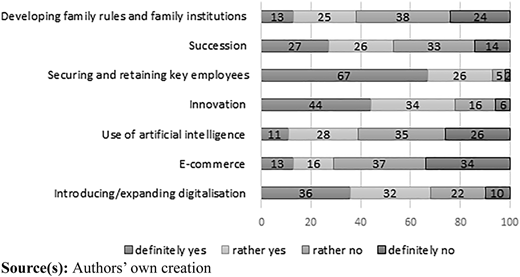
The summary of owners' attitudes towards the key tasks of their business are shown in a graph (Figure 1).
The strongest support is for securing and retaining key employees, which is seen as a key factor in the success of the business (93%). Innovation (78%) and digitizing (68%) are also viewed overwhelmingly positively. E-commerce, use of artificial intelligence, succession planning and family institutions have mixed or mostly negative responses, indicating some scepticism or concern about these areas.
4.1.2 Do you feel the need to digitalize your business?
The next part is focused on the issue of digitization (Table 3).
Half of the respondents say they have not yet started digitizing but plan to implement it. This indicates that digitization is perceived as an important step, but for various reasons has not yet been implemented. A fifth of respondents have already started the digitization process. This group of companies seems to have already recognized the benefits of digitization and have started to put it into practice.
On the other hand, there is a significant proportion of companies that do not use these technologies and have no plans to implement them mostly because they do not see the benefits of digitizing to offset the costs, which may reflect concerns about the return on investment in digital technologies.
In terms of the different sectors, it can be mentioned that for manufacturing enterprises, the highest percentage of respondents are already working on digitization of their business or are considering it.
4.1.3 Reasons for digitization
Those who have started or intend to start digitizing (70% of the surveyed subjects, i.e. 334) gave reasons for doing so (Table 4).
23% of responses agree that digitization brings benefits, indicating a positive attitude of most respondents towards these benefits. A very small proportion of managers/owners do not see the benefits of digitizing. The situation is similar for managers' findings that digitizing is becoming an inevitable part of business. This shows a recognition of the importance of digital transformation.
17% of respondents feel pressure fromp internal key groups to connect databases and speed up information retrieval etc. In comparison, a relatively large percentage (7.5%) do not perceive this pressure. The situation is similar for demands for faster communication and information sharing etc. from external key groups.
Overall, most managers and owners have come to the necessity of digitization and understanding its benefits on their own. A smaller part of them has been pushed to implement digitization either by internal or external key groups.
4.1.4 Area of priority for digitization
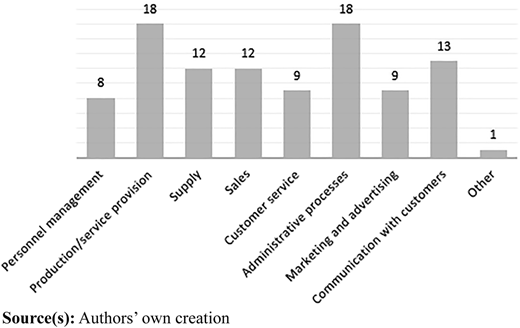
Researchers are interested in the priority area for digitization (Figure 2).
Most cases of digitization relate to the area of production/service provision and administrative processes within the entire company, where 18% of cases were recorded in both categories. The greatest room for the introduction of digitization elements is in the area of personnel management (8%). This finding is surprising in the context of previous assessments of the importance of attracting and retaining key employees.
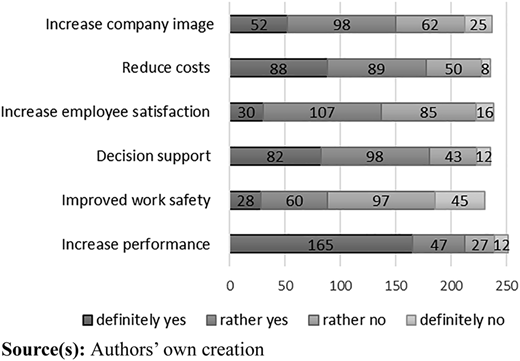
4.1.5 The expectations from the introduction of digitization (Figure 3)
The increase in business performance after the introduction of digitization absolutely prevails in the expectations of respondents. Cost reductions and increased decision-making support follow. On the other hand, the improvement of occupational safety is viewed with scepticism. Respondents take a cautious attitude towards employees. There is a lot of room for communication with employees, their education, and securing key employees.
4.1.6 Challenges of digitization
What problems do you expect when introducing digitalization? (Table 5)
Deployment and maintenance costs are the most frequently cited barrier to digitizing. The lack of employees already professionally proficient in the new conditions and at the same time the fear that it will not be possible to ensure enough of them in the future are other key barriers.
Many companies are afraid of major problems with integrating new technologies into existing systems, but they are not entirely sure (“rather yes” and “rather no” prevail). Similarly, the ambiguous approach is related to concerns involving a lack of technical/technological resources and data security. This suggests that businesses often encounter challenges in sourcing and protecting sensitive information.
Respondents feel support from top management, they believe in achieving the expected result, they are not afraid of the changes that will come with digitization. They believe that suppliers and customers will accept the changes positively, but they are not sure about direct consumers (“rather no”).
Respondents are unsure of employees' potential resistance to change and employees' approach to preparing for work with new technologies (“rather yes” and “rather no”). However, they do not see digitization as a reason for employee dissatisfaction or fear of job loss.
Overall, there is a wide range of concerns that can affect the success and willingness of companies to adopt new technologies and systems.
4.2 Hypotheses
H1 Businesses that are 100% family owned are significantly less likely to implement digitizing in their business than businesses that also have non-family shareholders
The table below shows the relationship between the level of ownership and the introducing/expanding of digitization. Most firms responded that the introducing/expanding of digital is “definitely yes” one of the current tasks for firms that have families in 100% ownership (Table 6). Statistics are then calculated to accept or reject the hypothesis (Table 7, Table 8).
There is a relationship between the level of ownership and the effort to adopt digitization (significance level <0.001). The coefficients take values from −0.088 (Kendall’s tau-c) to −0.68 (Gamma). The values of the ordinal correlation coefficients (Kendall’s and Spearman) are close to each other. It means that the dependence is very weak and inverse (the correlation is negative). It means, with lower levels of family involvement in ownership, there is a greater tendency to adopt digitization. In a business that is wholly owned by the family, there may be a fear of risk that may threaten the existence of their business as a source of livelihood.
The hypothesis H1 is accepted.
H2 Businesses that are 100% family managed are significantly less likely to implement digitizing in their business than businesses that also have non-family managers
The absolute values show that, at 100%, family management is less inclined to adopt digitization. The statistical results of the analysis of the relationship between the two variables (i.e. the percentage of family representation in management and the willingness to adopt digitization), through correlation measures, show that in all cases there is a negative relationship, which means that an increase in one value is related to a decrease in the other. However, this effect is so weak that it cannot be said with certainty that these variables are correlated (Tables see in Appendix 1).
The overall conclusion, therefore, is that there are no significant statistical associations between the variables examined because the significance levels are greater than 0.05 and if any relationships exist, their strength and significance are very limited. Thus, management does not matter whether it is represented only by family members or whether it includes non-family members.
The hypothesis H2 is rejected.
H3 FBs that are managed by 2nd generation have the highest interest in digital
The majority of companies, from both the first and second generation of management support digitalization. The difference between the generations is in the indecision (“rather yes” and “rather no”). There are a smaller number of businesses that are sceptical of digitalization, both first and second generation driven. Contingency table and tables with measures of interdependence are presented in Appendix 1.
Measures of interdependence between management and digitization show a dependence between the generational management of the company and digitization (value of coefficients are −0.1, p-value 0.002). Companies managed by both first and second generation have a generally positive attitude towards digitization, but the interest of the second generation is statistically significantly higher. Management successors see digitization as an opportunity to move the business forward.
The hypothesis H3 is accepted.
H4 FBs that are 1st generation owned have currently the least interest in going digital
Overall, the data suggests that support for digitization is strong across generations of owners. Tables see in Appendix 1.
It can be concluded that there is a relationship between the generation of ownership and the effort to adopt digitalization (p-value <0.001). The coefficients take values ranging from −0.122 (Kendall’s tau-c) to −0.232 (gamma). The values of the ordinal correlation coefficients (Kendall’s and Spearman) are close to each other. It means that the dependence is very weak and inverse (the correlation is negative). Thus, it can be said that firms that are owned by the first generation are statistically significantly least interested in digitalization. The founders, who are still the owners of the business, do not want to abandon traditional processes.
The hypothesis H4 is accepted.
H5 The overall cost of digital transformation implementation is the most cited barrier for businesses with an annual turnover of up to €1m
Costs in general are a big obstacle to larger investment projects, especially for small businesses, which tend to be undercapitalized. Tables see in Appendix 1.
Based on the results shown in the table, the dependence between the two variables cannot be statistically proven. The values of the correlation coefficients are very low (from 0.03 to 0.04) showing almost no dependence and the p-value is greater than 0.05 (p-value = 0.32). It can be said that there is no dependence between firm size as defined by annual turnover and the cost of digitalization. Every company, regardless of its annual turnover, sees cost as the biggest issue when implementing digitalization.
The hypothesis H5 is rejected.
H6 Managers approach the introduction of digitization because they are aware of its benefits
The motivation to start digitizing a company should be your own awareness that digitization has benefits for business. The majority of managers, from both the first and second generation, fully or rather agree with recognition of the benefits of digitization. Tables see in Appendix 1.
In all cases, the values of the correlation coefficients are low and negative (from −0.03 to −0.06), indicating a very weak negative dependence between the variables. The negative value of correlations indicates that when the value of one variable increases, the other decreases slightly. However, this relationship is very weak. Importantly, the results are not statistically significant as evidenced by the high p-values (0.402). This means that we cannot say with certainty that there is a true relationship between the variables - the observed values may be random. In summary, there is no strong or significant relationship between the variables analysed.
Thus, there is no dependence between management generation and the expected benefits of digitalization. Regardless of which generation manages a given company, they see the values that digitization will bring. That’s why they started digitizing their business. It is their own decision they are not pushed to digitization by internal or external stakeholders.
The hypothesis H6 is accepted.
H7 The increse in business performance is the most expected benefit for second generation managed businesses
Different generations of managing a business may have different expectations for the introduction of digitalization. Increasing the performance of the company can be one of them. However, the majority of managers, from both the first and second generation, either fully agree or at least rather agree with their increase in business performance expectation. Tables see in Appendix 1.
The table shows weak negative relationships between the variables (coefficient values around −0.1 to −0.2), which means that as one variable increases, the other decreases slightly. The p-values for all coefficients are less than 0.05 (maximum 0.019), which means that all the relationships found are statistically significant. Although the strength of the relationship is weak, we can say that these relationships are not due to chance.
In general, companies that are run by the successors of the founders expect to see an increase in business performance from the introduction of digitization. Successors to the founders usually bring a new perspective on business management, including an interest in implementing digital technologies in day-to-day processes.
The hypothesis H7 is accepted.
H8 The increse in employee satisfaction is the most expected benefit for first generation managed businesses
Referring to the previous hypothesis, the focus is now on the first generation. Table see in Appendix 1.
The results show that a very weak negative dependence was found between the variables (from Kendall´s tau-c −0.056 to Gamma −0.129), which means that when the value of one variable increases, the other variable tends to decrease slightly. However, none of these dependencies is statistically significant at the 0.05 level (p-value = 0.173). That is, based on this test, it cannot be said with certainty that there is a real dependence between the variables. It is possible that the observed dependence is the result of chance. Statistically speaking, none of the correlation coefficients tested showed strong enough evidence that the variables are associated. Overall, based on these results, there is insufficient evidence for a significant association between the variables studied. From a practical point of view, it can be said that regardless of which generation runs the company, it strives to increase employee satisfaction.
H8 is rejected.
H9: There is no dependence between generation in management and the absence of the benefits of digitization outweighing its costs as a reason not to digitize
The majority of managers, from both the first and second generation, either fully agree or at least rather agree with the statement “the benefits do not outweigh the costs”. Tables seen in Appendix 1.
The results show that all coefficients have very low, almost zero values, which means that there is practically no dependence between the variables. The values are positive, but since they are very close to zero, this relationship is negligible. Moreover, all results are statistically insignificant, which is confirmed by p-values higher than 0.05. That said, there isn’t enough evidence to say that the relationship between variables is real and not random. Overall, the analysis does not reveal any strong or significant relationship between the variables studied.
Again, there was no evidence of a significant correlation between the management generation and that the benefits outweigh the costs. This suggests that regardless of whether a business is run by a younger or older generation of managers, the perception of a balance of benefits and costs does not depend on the age or experience of management. This result may mean that different generations of management have similar views of how they evaluate benefits and cost of digitalization.
The hypothesis H9 is accepted.
4.3 Factor analysis
Factor analysis was carried out on the question of what problems respondents expect to encounter in the implementation and operation of digitization. Factor analysis was used to develop scaled questions where respondents rated 18 statements on a scale of 1–4, corresponding to their level of agreement with the statement. The KMO value is 0.879 and sig. = 0.000. It means factor analysis is appropriateness. After factor extraction four factors emerged, describing 67.9% of the variability of the whole population. The Varimax method was used to create a rotated component matrix that helped to reveal all significant variables falling within the newly created four batteries of factors (Table 9).
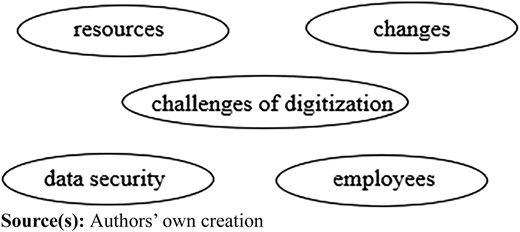
The table includes four groups of interlinked items (with significant positive correlations). The batteries are named according to common features of individual factors. The largest groups of items are battery expressing respondents' challenges due to a lack of resources to implement digital transformation, and battery expressing concerns related to the changes that digitization will bring, including changes in relationships. Another battery of items is related to employees, which proves that employers are aware of the importance of quality staffing. Data security is the focus of the fourth battery (Figure 4).
5. Discussion
In the presented research, the authors focused on identifying possible differences between the approach of historically young family businesses from Central Europe and countries with historical roots of family business.
5.1 Comparison of research results
Respondents see securing and retaining key employees as a key factor for business success (in line with Lambrechts and Gnan, 2022). Innovation and digitization are also perceived as overwhelmingly positive.
Furthermore, it appears that the importance of succession planning and family rule-making is still under-appreciated, which may be due to a lack of maturity of entrepreneurs or a lack of awareness of the importance of these elements for the long-term existence of the family business.
The survey results also show that many businesses have not yet started digitization (confirming the findings of Xie et al., 2023) but plan to start it in the near future. However, around a fifth of respondents have already work on digitization. It is therefore evident that there is a group of companies that have recognized the benefits of digitization and have started to apply it in their businesses.
Most managers and owners are positive about digitization, perceive the benefits it brings and consider it an essential part of modern business (also argued by Saura et al., 2023). A minority admits pressure from external or internal stakeholders to adopt digitization.
Research has shown that most instances of digitization are in the areas of production/service delivery and administrative processes within the enterprise. Human resources management is the area with the largest gap for the introduction of digitization elements, which is surprising in the context of the proclaimed importance of attracting and retaining key employees (see Oesterreich et al., 2019; Haziazi et al., 2021).
Respondents' expectations from the introduction of digitization are completely dominated by the increase in firm performance (see Rossato and Castellani, 2020; Erjavec and Redek, 2023; Li et al., 2023). This is followed by cost reduction and increased decision support (see Zapata-Cantu et al., 2023). On the other hand, improvements in work safety are viewed with scepticism. Respondents have a cautious attitude towards employees. A great deal of attention is given to communication with employees, employee training and the provision of key personnel (as recommended by Ano and Bent, 2021).
The most frequently cited barrier to the adoption of digitization is the cost of implementation and maintenance. Other barriers are related to the lack of skilled staff (in line with Polat, 2021). There are also concerns about the lack of technical resources, compatibility and data security. Regarding suppliers, customers and top management, respondents rather expect their positive attitude (importance is confirmed by Yang et al., 2021; Ageron et al., 2020; Busco et al., 2023; uncertainty in attitudes is also found by Attaran, 2020). For employees' resistance to change (confirmed by Pfaffinger et al., 2020), willingness to prepare for new conditions, concerns about job loss and the impact of digitization on their job satisfaction, respondents are not sure which side to lean towards. It is clear that there is a wide range of concerns that can affect firms' willingness and ability to adopt new technologies and systems.
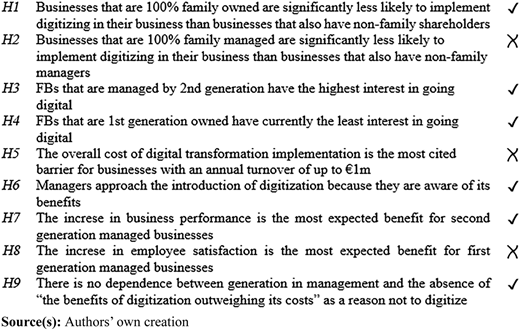
The results of the hypotheses are summarized in the Figure 5.
It is evident from the overview that the key results are in line with the results of research from countries with a long tradition of family business (these are elaborated in Theoretical background): It is confirmed that even in “young” FBs the senior generation of owners and managers is more concerned about the introduction of digitization elements; that the younger generation is more open to technological changes; the trend of stability prevails in 100% family owned businesses, and the most expected benefit is the increase in business performance.
Where consistency has not been found is on the issue of cost. In contrast to other research that associates this barrier primarily with small businesses (see Theoretical background), here it is most reported regardless of the annual turnover of the business. It is interesting to note that both generations have the same doubts about whether the benefits of digitization will actually outweigh the costs. The age or experience of management does not seem to influence how they assess the value of digital transformation. The primary reason managers often hesitate to adopt digital transformation is their concern about an insufficient return on the investment. Managers may fear that these costs will exceed the benefits, especially if the impact is not immediately clear or if the changes do not directly lead to measurable financial gains. Another concern is the long payback period. Digital transformation can taky time for businesses to fully adapt to the next processes and for employees to utilize the technologies effectively. As a result, managers may worry that the benefits will materialize too slowly, leading to short-term financial strain (Neligan et al., 2023; Fang and Li, 2024). This delayed return on investment further complicates decision-making, particularly for businesses already operating on tight budgets.
Another new element was the finding that the composition of management does not affect the adoption of digitization. According to Schuman et al. (2016) a number of family business managers believe they have to choose between family and business. This raises the questions: do non-family managers adopt family values and make decisions in line with family managers regardless of the benefit to the business? Or do they set their remuneration to achieve short-term goals, which would be disadvantageous for them in the case of digitization? While it may seem satisfying for family members that non-family managers share their view, they need to be aware of the reason for engaging them.
The answer on the research question:
The research offers an interesting perspective on family business dynamics, emphasizing the importance of the intrinsic qualities that shape family enterprises regardless of location or historical background. The idea that family businesses share core characteristics that outweigh cultural or historical context speaks to the powerful influence of family ties and shared ownership on decision-making, governance, and values within these organizations. This suggests that factors like the intertwining of personal and business goals, and long-term vision create a unique operating environment that is largely consistent among family businesses around the world.
The “novelty” here emphasizes that family-owned businesses are shaped more by their intrinsic structure than by the surrounding economic environment, suggesting that family dynamics may universally influence business approaches in similar ways across cultures and history.
In addition to the views on digitization in business, where, e.g. dimensions (Yu et al., 2023) or phase (Soluk, 2022) are identified, the factor analysis added another view on digitization in terms of four groups of barriers to the introduction of digitization in the enterprise, namely resources, changes, data security, and employees.
5.2 Research implication
The comparison of family business owners’ approaches across distinct historical contexts offers valuable insights, particularly when looking at businesses that emerged post-1990s in former “Eastern Bloc” countries versus those with longer intergenerational histories in regions unaffected by such socio-political upheavals in the field of digital transformation. These differences in historical trajectories shape not only family-business dynamics but also how these entities approach contemporary challenges, such as digitization.
Eastern Bloc family businesses are often newer and may experience resistance to change, particularly from the founding generation who might have built the business under challenging, rapidly evolving post-socialist conditions. In contrast, family businesses from Non-Eastern Bloc Countries typically have multi-generational histories, providing them with established family governance structures, accumulated knowledge on succession, and institutionalized roles for family members. This long-term perspective allows for smoother management of family dynamics and business growth, making them more resilient in adapting to changes like digitization.
This comparative framework highlights the critical role of historical context in shaping the strategies, capabilities, and challenges faced by family businesses as they confront digitization, offering a nuanced perspective that enriches the discipline of family business research and practice.
The defined groups of barriers (resources, changes, data security, and employees) contribute to the typology of constraints on access to digitalisation.
5.3 Practical implication
The research contributes to the understanding of how historical and cultural factors influence family business in an Eastern European country that is currently facing the challenge of only the first generational change. Exploring this area enables an understanding of what values and approaches to sustainability are important in these countries and how they are transmitted. The results of the research can provide important information for the design of support programmes and measures. In particular, the areas of regulation, tax support and training programmes can play a key role in the long-term prosperity of family businesses. Family businesses in smaller towns and rural areas often provide a significant part of the local economy and employment, which is crucial for regional development. Research therefore helps to understand their specific needs and how they can be supported by beneficial policies and measures. Effective policies can help ensure the steady growth of family businesses, create jobs, increase resilience during economic downturns and ensure a balance between business and family life.
The finding that cost is the biggest barrier to digitalisation adoption, regardless of the annual turnover of the business, could trigger family businesses to access targeted grants and subsidies, including the possibility to apply for support to finance the costs of hardware, software, consultants, experts, studies, seminars, conferences or marketing and promotion, to retrain employees or to increase their knowledge and skills. Educational activities can overcome the disapproving or cautious attitude of the older generation. The results can also be an incentive to develop study programmes in secondary and higher education specifically focused on family business. Such study programmes or centres for the promotion of family entrepreneurship are widespread in other countries, especially in Anglo-Saxon countries, but this is not yet the case in the Czech Republic. Only one university has a centre for family business. Only three associations are involved in supporting family business on a larger scale.
This targeted approach can foster digitizing and with this growth and sustainability within the family business sector.
5.4 Limitation
Although 478 valid responses, which is a robust sample size for drawing specific conclusions, it is important to note that these results cannot be generalized to the entire population. Then, the authors admit that due to the close interconnection of the concepts of digitization and innovation, respondents may have confused the terms (as stated De Massis et al., 2022). Other limitation can be the fact, that respondents are family businesses registered in a voluntary register, which has been created from 2021. This introduces potential bias, limiting the generalizability of the findings. However, there is no other list of family businesses.
Despite these limitations, the authors are confident that their research offers significant theoretical and practical implications. The insights gained can inform policy formulation, academic research, and strategic business decisions, thereby supporting the growth and development of family businesses in changed economic environments.
5.5 Next research
The distinction between family businesses with different historical timelines suggests that future studies should consider not only economic factors but also historical contexts that shape family business behaviour. Understanding how socio-political history influences family business resilience, adaptability, and digital readiness can add depth to family business theory. The authors intend to conduct similar research in the coming years to identify a potential shift in the approaches of family business owners to the digitization transformation of their business. Further research will be aimed at determining the level of digitization of family businesses in comparable conditions, e.g. in V4 countries. The authors also plan to conduct comparative qualitative research on family values and SEW.
6. Conclusion
Research insights indicate that strategies and best practices designed for family businesses may be broadly applicable across different regions, offering a universal framework for addressing the unique challenges of family-owned firms.
Absolutely, family businesses are well-positioned to leverage their long-term orientation to prepare effectively for digital transformation. Their tendency to prioritize sustainability and legacy over short-term gains can be an advantage when planning for extensive and complex shifts like digitalization, which require time, commitment, and often a cultural shift within the organization.
For family businesses, digital transformation isn’t just about implementing new technology-it’s also about fostering a mindset of adaptability and continuous learning among both business leaders and family members. By focusing on building digital literacy and adaptability within the family, these businesses can create a culture that is prepared not only to embrace current digital tools but also to stay resilient as new technologies emerge.
Historically young family businesses, i.e. those that have been established relatively recently and do not have a long history or intergenerational tradition, are characterised by their specific position and challenges. Although they do not have the firmly rooted traditions of long-established family businesses, they have certain advantages: they were often established at a time when digitalisation, globalisation and rapid innovation were already part of the business environment; they do not have established multi-generational traditions that can sometimes be binding; they often have leaders who are aware of the importance of digitalisation and modern management; and they have the opportunity to shape the corporate culture from the ground up with respect to contemporary values such as sustainability, innovation and openness to change. If they can use these characteristics effectively, they can be successful even in highly competitive markets while building a solid foundation for the long-term future.
Funding: The project SP2024/028 Digital Transformation in the Management of Companies.
References
Further reading
The supplementary material for this article can be found online.